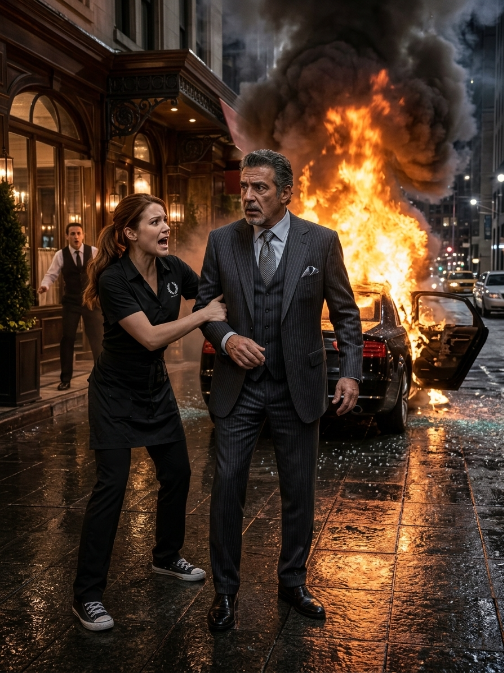
She Was Hired to Cook His Wedding Feast — Then the Groom Walked Away From the Bride for Her

“Eventually,” she said. “Not immediately. It took about a year to understand that staying in the grief wasn’t the same as honoring him.” Walking him out that evening, standing by the horses under a sky gone properly dark, he asked her to tell him something else he didn’t know. “When I was learning to make bread,” she said, “really learning it, not just doing it, I ruined something like forty batches before I made one I was satisfied with. Forty batches is a lot of flour when you’re counting your flour.” “What kept you going?” “The thirty-ninth was better than the thirty-eighth. Not good, not right. But better. And I thought, if thirty-eight to thirty-nine moved that much, maybe thirty-nine to forty would too. It did. Forty was the first one I wasn’t embarrassed by.” He was quiet a moment. “I think I’ve been waiting to be at forty,” he said, “without doing enough thirty-nines.”
Two weeks later she suggested he come to May Briggs’s harvest supper and peel potatoes instead of whatever ranchers did on Saturday afternoons — not a formal occasion, nothing either of them would need to perform. “May’s idea?” he asked. “My idea,” Clara said. “May’s a wise woman, she’ll just be the one handing you the knife.” He got through thirty pounds of potatoes without complaint, listening to Pia’s instructions on the correct angle with more seriousness than the task probably required, which was somehow exactly right. When he finished, he found May directly — not Pia, not Rosalie — and asked what needed doing next. May, who regarded everyone who entered her kitchen with the same measuring look, handed him a pot to scrub and pointed at the yard pump. He took it and went.
Rosalie appeared at Clara’s shoulder, chopping with the efficient rhythm of a person who’d done a great deal of chopping. “He asked me what your favorite thing to eat was,” she said. “Three weeks ago. I thought you should know.” “What did you tell him?” “I told him I wasn’t his intelligence source and he’d have to find out himself. Then I told him apple butter on fresh bread, because it seemed unkind not to.”
By noon the kitchen had reached full productive chaos. Clara tasted something May put in front of her and said, “More salt, and the pepper needs a minute longer in the fat before you add the broth,” and the correction was over in thirty seconds — but Garrett had been standing nearby waiting for a task and had heard it.
“You did that without thinking,” he said.
“It’s just practice.”
“It’s not just practice. I’ve had practice at things and I don’t do them like that — like the information’s already in your hands before your brain’s finished deciding.”
“When you’ve made enough of something,” she said, “you stop cooking with recipes and start cooking with memory. The recipe is the map. The memory is knowing the road.”
“What happens when you hit a road you haven’t traveled?”
“Then you go carefully, and you’re willing to be wrong before you’re right. The wedding cake was a road I’d read about a hundred times and never driven.”
May, watching him from across the crowded kitchen, said to Clara quietly: “He peeled thirty pounds of potatoes without being asked twice. That’s character.” Then, before Clara could deflect it: “He looks at you like you’re a person. Most people look at each other like they’re a role — widow, rancher, cook, rich man, poor woman. They see the category and stop there. He looks past the category. That’s harder to find than it sounds.”
He came every Saturday after that with a jar of apple butter, and she had the bread ready in its first, best hour, and they talked the way people talk when they’ve stopped performing conversation — contradicting themselves, sitting in silences that didn’t need filling. He straightened salt dishes when something was on his mind. He held opinions firmly and changed them slowly, and said so plainly when he did. She was not easy either, and knew it — impatient, prone to disappearing into her own head, ending conversations by simply having nothing more to say. They were not easy together. They were honest together, which was harder, and better.
In December, a hotel in the nearest large town offered her a standing contract worth more than she’d made in any month of the past three years — contingent on production capacity her kitchen couldn’t yet handle. Garrett offered to fund the cold-room expansion. “That’s not what I’m asking,” she said. “I know you’re not asking,” he said. “I’m offering. Those are different things” — her own words, from months before, handed back to her. She insisted on a loan, written terms, a twelve-month repayment schedule he suggested himself because he trusted the contract’s numbers more than she was letting herself.
“You’re the most determined person I’ve ever met about not accepting help,” he said.