She Was Hired to Cook His Wedding Feast — Then the Groom Walked Away From the Bride for Her

He exhaled, long and real, and she found that more moving than anything else about the moment — the fact that he’d been afraid, and said the thing anyway.
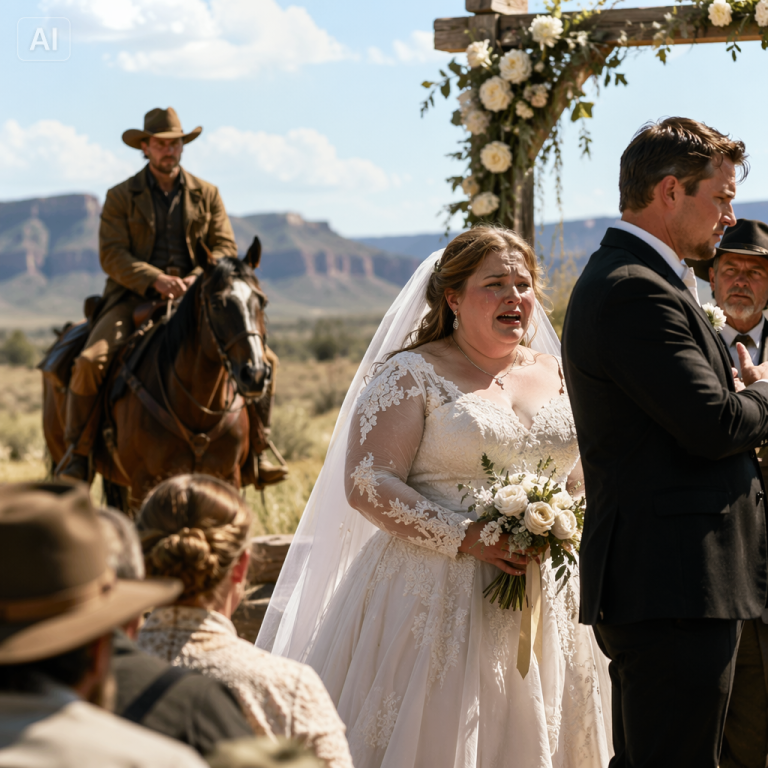
They married in the second week of May, small and unstaged, the prairie doing the rare thing of being genuinely beautiful — grass coming in green, sky a hard clear blue, air smelling of things growing. May Briggs came, and cried in the second row, because she was seventy-one and had earned the right to cry at weddings. Rosalie came and did not cry and did not pretend she might. Pia came and tried not to cry and failed. Connell came from the larder and said nothing for the duration and clapped with the rest. Helen Pratt sat in the third row with the satisfied expression of a woman who considered an outcome correctly reached.
Clara wore a dress she’d made herself, river-water blue-green, not a traditional bridal color, and was not concerned about that. Under it, tied at her waist where no one could see, her mother’s apron — the small embroidered flowers against her skin, not for anyone else’s benefit, just because it was there. Rosalie saw her tie it on in the back room and said, after a moment, “She’d have liked him.” “She’d have made him peel something,” Clara said, “to see what he was made of.” “And he’d have peeled it,” Rosalie said, “and asked how to do it better.” It came out as something close to a laugh, in Rosalie’s register.
When Clara walked in, Garrett was standing at the front of the room looking at the door, and when she came through it, something in his face went very simple and very clear — not theatrical, just a man watching a woman walk toward him and something in him quietly settling into place. They married plainly and honestly. Afterward there was food, because of course there was food — good, honest food that didn’t announce itself but made people feel cared for in the eating of it. May brought cornbread. Of course May brought cornbread.
Standing at the edge of the room in the middle of the afternoon, Clara let herself feel the whole distance she’d traveled — from the graveside in the rain and the thirty-one dollars and the back door she’d used for seven invisible days, to her name spoken out loud in front of two hundred people who hadn’t known to say it before. She was not the woman she’d been at twenty-six, or even the woman sitting on the Mercer kitchen floor with cold coffee and flour in her hair the previous October. She was something still becoming — which, she’d decided, was exactly the right state to be in.
Garrett found her at the edge of the room, standing close enough to be present, far enough not to crowd — the way he’d learned to stand beside her. “You all right?” he asked. “Yes,” she said, and meant it completely, with none of the qualifications she usually applied to statements that size. “Good,” he said, and handed her a plate. “Connell brought something from the larder. Says it’s a wedding gift, but I think he just didn’t know what else to bring.” “That’s exactly what it is,” she said. “He’s a practical man.” “Like someone else I know.” “Don’t,” she said, but she was smiling, and he knew the difference.
On a Saturday morning the following June, Clara came downstairs to find Garrett already in the kitchen, bread laid out from the night before, fire built the way she’d shown him, straightening the salt dish without noticing he was doing it.
“You’re going to move that thing back to center and then a millimeter past, and then back again,” she said, “for about four more minutes, I’d guess, maybe five.”
“How did you know?”
“You always do it when something’s on your mind.”
“I was thinking,” he said, “that I’m glad I came on the thirtieth day. I thought about coming on the twenty-eighth.”
“Why didn’t you?”
“Because you said a month, and you meant it, and taking that seriously was the minimum I could offer.” A pause. “Also I was afraid that if I came two days early, you’d send me home.”
“I would have,” she said.
“I know. Thirty days.”
“Thirty days,” she agreed. “Worth every single one of them. Now eat your breakfast before it gets cold, Garrett Mercer.”
She turned back to the stove, poured the coffee, cut the bread, pushed the apple butter across the table — the same table, the same kitchen she’d built out of thirty-one dollars and hard work and the plain, hard-won knowledge that the things worth having were the things you built one careful layer at a time, slowly enough that they lasted. Outside, Red Creek Crossing was waking up the way it always did, ordinary and real and, this particular June morning, more than enough.
THE END