Mafia Boss Finally Speaks: “I Can’t Pretend Anymore” After Her Silent Love

# THE ELEVATOR STOPPED BETWEEN FLOORS — AND SO DID MY CAREFULLY PLANNED ESCAPE
—
PART 1
I almost made it.
The east wing corridor stretched ahead of me, heels clicking against marble, the sound of the engagement party floating up from the floors below like music from a world I had finally decided to leave. My car was packed. My lease was signed. Boston was twenty-two hours away and getting closer with every step I took toward the private elevator at the far end of the hall.
Behind me, Callum’s voice ricocheted off the walls.
“Valentina. Just listen to me.”
I did not slow down.
I had been listening to Callum Voss for eleven months — listening to his promises, his ambitions, his carefully rehearsed declarations about how perfect we were together. What I had not heard, in all that time, was a single true thing about who he was or why he wanted me. My father’s approval. A ladder into the De Luca inner circle. A beautiful daughter who asked the right questions at the right tables and smiled on cue.
That was what Callum saw when he looked at me.
I knew, because it was the same thing most men in this world saw.
“You can’t just end things and walk away,” he called after me, his composure cracking into something uglier. “Your father will—”
“My father,” I said without turning around, “doesn’t get to choose.”
The words came out colder than intended. Good.
Downstairs, my brother Nico’s engagement to the Sartori girl was being toasted in the grand ballroom. Crystal chandeliers and champagne and the elaborate theater of our world performing its rituals. Another alliance. Another piece placed on a board that had been arranged before any of us were born.
I had smiled for three hours.
I had run out of performance.
The elevator was ahead. I jabbed the call button, once, twice, three times, watching the indicator climb. Fourth floor. Fifth. Sixth.
Callum’s footsteps quickened behind me.
“Valentina, I know you still—”
“No,” I said. “You don’t know anything about me.”
I turned long enough to see his face flush, his jaw tighten with something that had always made me uneasy. The kind of expression men wore when they had confused being wanted with being owed.
“You think you can find someone better in Boston?” he said. “You think you can just leave all of this and start over like you’re anyone? Like your name isn’t—”
The elevator arrived.
The doors opened.
I turned away from Callum and stepped forward.
And stopped.
Emilio De Luca stood in the center of the elevator car with his shoulder braced against the mirrored wall, his dark eyes finding mine before I had fully crossed the threshold, as if he had been waiting for exactly this moment with the unhurried patience of a man who had never needed to chase anything in his life.
He was thirty-one. He had been thirty-one the entire time I had known him, which was not true but felt that way — the same black suit, the same controlled stillness, the same quality of absolute authority that existed below volume, in the way space arranged itself around him.
Emilio was everything this world had made him. The heir. The architect of strategy and violence. The man who would, within the year, take his father’s place at the head of a family whose reach extended through three states and two continents.
He had also spent the last five years making me feel as though I barely existed.
Cold dinners. Interrupted arguments. Every time I brought an idea to the table, a glance at his watch or a quiet word to someone else that redirected the entire conversation before I could finish my sentence. Every time I walked into a room, something in his posture suggested I was a complication he had already calculated for and chosen to ignore.
I had spent five years deciding it did not bother me.
I had failed.
“Going somewhere, Valentina?”
His voice was low, the slight Italian cadence his grandfather had given him wrapping around my name like something deliberate.
Behind me, I heard Callum’s footsteps slow.
In the elevator, Emilio’s gaze moved past me just briefly — not long enough to be an acknowledgment, but long enough to be a warning — then returned to my face.
“I was just leaving,” I said.
“I can see that.”
He straightened from the wall with a fluid economy of movement that somehow made the spacious car feel smaller, and pressed no buttons.
“Your father asked for you specifically. Nico’s announcement.”
“I already congratulated them.”
“Thirty-seven minutes ago. Before the formal announcement.”
“You timed me.”
“I notice things.”
The doors had been waiting. They began to close. I stepped inside, not because he told me to — I had spent years not doing things because he told me to — but because Callum was behind me and the alternative was worse.
The doors sealed.
Callum disappeared.
We began to descend.
Or we should have.
Instead, Emilio let the elevator sit, floor-light steady, going nowhere.
“You’re leaving,” he said. It was not a question.
“Tomorrow morning. Flight out of O’Hare.” I kept my voice level. “I have a position in Boston. A signed lease. My bags are in my car.”
“I know.”
“Of course you do.”
I pressed my back against the far wall, hating that the elevator was not larger, hating that after five years of practiced indifference he still managed to make the air feel thinner when he was in it.
“You’re very well-informed about someone you’ve spent half a decade pretending doesn’t exist.”
Something shifted in his expression.
Not much. But I had spent five years studying the geography of Emilio De Luca’s face, cataloguing the minor tectonic movements that passed for emotion in a man trained to show none.
That was something.
“That’s not what I’ve been doing.”
“Then what would you call it?” I kept my voice even, but five years of pent-up frustration gave it an edge I didn’t try to smooth. “Every family meeting where I try to argue a position and you either interrupt me or redirect the conversation before I finish. Every time I walk into a room and you find somewhere else to be. Five years of being treated like an obligation you’ve already accounted for and filed away.”
“Valentina—”
“I’m not angry,” I said, which was a lie I had been practicing for years. “I’m done. There’s a difference.”
The elevator hummed around us.
Emilio was very still.
“I have something to tell you,” he said finally. “And I need you not to move toward the door panel while I do it.”
“Why would I move toward the—”
“Because once I say it, your instinct will be to leave. And I need you to hear all of it.”
I stared at him.
For the first time in five years, Emilio De Luca looked like something beneath the architecture of control he had spent a decade building. Something careful and specific and aimed entirely at me.
My pulse, treacherously, responded.
“Then say it,” I said.
He did.
—
## PART 2
“Every time you walk into a room,” Emilio said, “I walk out because if I stay, I stop being able to think about anything else.”
The elevator held its breath.
I held mine.
“The interruptions at meetings,” he continued, his voice stripped of its usual measured quality — not by volume, but by honesty, which was somehow more startling, “are because when you lean forward to make a point, when you find the precise weakness in someone’s argument and press it without mercy, I forget what the meeting is about. I forget everything except that you are extraordinary and that I have spent five years telling myself the twelve-year gap between us is a reason to stay away from you rather than a number.”
I could not speak.
I was not, by nature, a woman who lost her words. I had argued in rooms full of men who thought a twenty-three-year-old with a law degree was a novelty rather than a threat. I had held positions under pressure that would have made others capitulate. I had spent five years building an internal architecture specifically designed to withstand Emilio De Luca.
It appeared to have structural flaws.
“Say something,” he said. Quiet. Not commanding.
“How long?” I managed.
“Since the night you dismantled every argument my father’s corporate attorney made about the Russo acquisition. You were twenty-one. You had been in one business meeting in your life prior to that one. You took apart every position he had with case law he had never encountered and didn’t know how to counter.” A pause. “I decided in that moment that you were the most dangerous person I had ever met. That the safest thing I could do was maintain distance.”
“Distance,” I repeated. “Is that what you call five years of treating me like I’m invisible?”
“Yes. And I am aware it was cowardly.” The word cost him. I could see that. “I am also aware of every other reason it was wrong. You deserve more than someone who chose silence because the alternative scared him.”
“It scared you,” I said carefully. “Being in love with me scared Emilio De Luca.”
Something that was not quite a smile, but was adjacent to one, crossed his face.
“Terrified,” he said.
The elevator suddenly shuddered.
We both looked at the panel.
Then it began to move again — down, toward the lobby, toward the party, toward everything I had been running from.
Emilio’s hand reached the control panel.
He pressed a button.
The elevator stopped.
His eyes found mine across the small space between us, and I understood that this was the moment. That whatever happened in the next sixty seconds was going to determine something neither of us could take back.
“Valentina,” he said. “Don’t go to Boston.”
And before I could answer — before I could decide whether the five years of distance were an injury I had healed past or one I was still carrying — my phone buzzed in my clutch.
A message from my brother Nico.
*Get to father’s office. Now. Something’s happened with Callum.*
—
## PART 3
### What Callum Had Done
My father’s office on the third floor had the particular quality of rooms where serious things happen: heavy furniture, paintings worth more than buildings, the kind of silence that accumulated rather than existed passively. Roberto De Luca sat behind his desk with the expression he wore when something had moved from complicated to dangerous.
Emilio was already beside me as I entered, though I had not invited him and he had not asked.
My brother Nico stood near the fireplace, still in his tuxedo from the engagement announcement, looking like a man who had just understood something he wished he hadn’t.
“Sit down, Valentina,” my father said.
“Tell me first.”
He looked at me for a moment, then nodded slowly.
“Callum Voss has been selling information to the Ferrara family for approximately seven months. Financial records. Operational schedules. The names of two informants we had embedded in their organization, both of whom are now dead.”
The room seemed to contract.
I heard Emilio exhale very carefully to my left.
“He’s been skimming protection collections as well,” Nico added, his voice tight with something that was not quite anger. More like the specific fury of someone who had trusted wrong. “We’re looking at two hundred thousand at minimum, probably more.”
“How long have you known?” I asked.
“Six weeks,” Emilio said.
I turned to him.
“I’ve been building verification. I wanted to be certain before bringing it to your father.”
“And you didn’t tell me.” The betrayal was layered — not just the information, but the assumption that I didn’t need to know that the man I had spent eleven months with was a traitor. “I was sleeping next to him, Emilio. If he suspected I knew anything, if he thought I had access to—”
“You broke up with him three months ago,” my father said.
“That’s not the point.”
“No,” Emilio agreed quietly. “She’s right. It should not have been kept from her.”
This admission, coming from him, in front of my father and brother, landed differently than I expected. I looked at him. He looked back without deflection.
“The more immediate problem,” Roberto said, “is that Callum knows Valentina is leaving tomorrow. And he’s desperate. He met with the Ferrara organization’s second this afternoon, which tells us he’s looking for protection or leverage. The most obvious form of leverage is—”
“Me,” I said.
“Yes.”
I sat down.
Not because I needed to, but because standing felt performative in a room where everything was already stripped down.
“What are the options?”
“We find him before he can act,” Nico said. “We’re locating him now.”
“And Boston?” I asked.
My father’s expression became careful. “We think it would be wise if you remained close. Until this is resolved.”
I looked at the four walls of the office, at the Renaissance painting over the fireplace that had watched every difficult conversation in this family for thirty years. Remaining close meant remaining here. Under protection. Inside the structure that had been the defining feature of my life since birth.
“There’s another option,” I said.
Nico frowned. “What option?”
“I find Callum first. I arrange a meeting. He still thinks I might come back to him — he made that abundantly clear tonight. I could wear a wire, get him talking, give you everything you need on record.”
The silence that followed had texture.
My father’s expression moved through several things rapidly.
Emilio said, “No.”
I turned to him.
“It’s too dangerous,” he said. “Callum is not careful anymore. Desperate men aren’t careful. One wrong word—”
“I’m a lawyer. I know how to conduct a conversation without showing my hand. I know what questions to ask. I know how to make him trust me long enough to incriminate himself.”
“You’re not trained for—”
“Neither was I when I sat in my first business meeting at twenty-one,” I said evenly. “You told me tonight I was the most dangerous person you’d ever met. Which is it?”
The room was very quiet.
Emilio looked at me with the expression I had waited five years to see openly — not the cold management of distance, but the real war underneath it.
“If she’s doing this,” he said finally, to my father, “I oversee every detail personally. The meeting location is one of ours. The team surrounding it is the best we have. And the moment anything deviates from the plan—”
“Then we pull her out,” Nico said. “Immediately.”
Roberto De Luca looked at his daughter for a long moment.
“You have your mother’s nerve,” he said quietly. “She would have volunteered for exactly the same thing.”
He nodded once. “We’ll meet tomorrow morning to finalize.”
—
### The Wire
The restaurant was on the seventh floor of a building Emilio had partial ownership of through three layers of holding companies — a fact Callum would never know and could not have researched in the twelve hours available to him. The room had been quietly cleared of civilian diners by nine that morning. The staff was entirely ours. Nico sat at a table near the window behind a newspaper, visible but unremarkable. Emilio himself was in the manager’s office with headphones on and an expression I had been told, by the tech fitting my wire, was the specific face he made when he was controlling something very carefully.
“Breathe normally,” the tech said, adjusting the adhesive.
“I am breathing normally.”
“You’re breathing like someone performing calm.”
“Those are the same thing.”
Emilio appeared in the doorway.
“Give us a minute,” he said to the tech.
When we were alone, he crossed the room and stopped in front of me. Not close enough to crowd. Just present, in the particular way that had always meant something different from what I wanted to name.
“You know the safe word.”
“Lighthouse,” I said. “Yes.”
“You use it the moment anything feels wrong. Not when it goes wrong. Before.”
“I know.”
“Valentina.”
My name, again, with that weight.
“I know that you’re angry with me,” he said. “About the five years. About Callum. About the things I kept from you when I should have trusted your judgment. All of it is justified. But I need you to know—” He paused, as if finding the precise form of the words. “I need you to know that if something happens to you in that room, I will not recover from it.”
I looked at him.
“Then make sure nothing happens to me,” I said.
The corner of his mouth moved. Not quite a smile.
“That’s all you’re going to say?”
“I’ll say the rest when this is finished.”
Callum arrived eight minutes late, which was tactical — designed to suggest he had the luxury of time when every instinct in that tailored jacket was screaming otherwise. He looked good. He had always looked good. That had been part of the problem. He had the kind of face that worked in rooms like this one, all charm and confidence and absolutely nothing underneath.
He kissed my cheek when he reached the table.
I did not recoil.
“I’m glad you agreed to meet,” he said.
“I almost didn’t,” I replied. “After tonight.”
“I know. I’m sorry. I was—”
“Upset,” I offered. “Jealous.”
He seized the word. “Yes. Exactly. Seeing you with Emilio, I just—”
“We were talking,” I said. “He’s my brother’s closest friend.”
Callum’s expression said he did not believe this, but he filed it.
We ordered wine neither of us would drink. I let him talk for six minutes about how much I meant to him, about what we had built together, about Boston being a mistake driven by pride. I listened with the expression I had practiced in the mirror that morning — open, uncertain, almost persuadable.
“I’ve been thinking,” I said finally. “About us. About whether I left too quickly.”
The hope that moved through his face was almost difficult to watch.
“Then stay,” he said. “Come back. We can work through whatever—”
“I need to know I can trust you.”
“Of course you can.”
“Then why does my father seem worried? Why has security doubled?” I let vulnerability soften my voice carefully. “I’ve heard things, Callum. Rumors about finances. About meetings. If there’s something I should know—”
The shift in his expression was subtle.
But I had been trained to read subtle.
“There are no rumors worth listening to,” he said, too quickly.
“Then why is Emilio asking questions?”
“Because Emilio De Luca is paranoid about anyone he can’t fully control.” His jaw tightened. “Anyone who doesn’t fit neatly into his plans.”
I placed my hand over his on the table.
“If there’s something happening with the family, something I should understand — I can handle it. I’m not going to run to my father.” I paused. “I just need to know you’re being honest with me.”
Callum looked around the restaurant once. The gesture of a man checking for observers who had no idea he was already surrounded.
“There are going to be changes,” he said slowly. “In the family structure. People who think the De Lucas have held power too long. There are organizations in this city that are ready to challenge that, and I’ve—” He stopped. “I’ve been making sure I’m on the right side when it happens.”
“What kind of changes?”
“Ferrara has allies now. Real allies. Political connections, not just street level.” He leaned closer. “The money I’ve been moving is building something. Infrastructure. When Emilio takes over from Roberto, the transition is going to be contested.”
“And the informants?” I asked. “The two men who died last month.”
The silence that fell was absolute.
Callum’s hand went still under mine.
“That’s not—how do you know about—”
“I’m my father’s daughter,” I said quietly. “I notice things.”
His eyes changed.
The warmth left them entirely.
“You’re wired.”
I did not answer.
He stood, his chair scraping back, one hand moving toward his jacket.
“Lighthouse,” I said clearly. “I’d really like to revisit that lighthouse you mentioned in Positano.”
The server two tables over dropped a tray.
Nico was on his feet.
The kitchen door opened.
And Emilio came through the manager’s office door with an expression that was not anger and not fear but something more elemental — the face of a man who had done the calculus and was prepared to rewrite every variable to ensure a specific outcome.
Callum’s hand had found his weapon, but he had not drawn it. He was calculating odds, which was the wrong instinct. Calculation took time.
I was already moving.
I pushed back from the table and stepped sideways, creating the angle the team needed. Callum spun to follow me, which meant his back was briefly to Nico.
That was enough.
The gun skittered across marble. Callum hit the floor with his arms pinned behind him before he could reassemble his intentions. Three men knelt over him with the efficiency of professionals.
The silence afterward was the kind that rings.
Then Emilio was beside me, his hands on my face with a gentleness so completely at odds with the past thirty seconds that it almost broke something.
“You moved,” he said.
“You needed the angle.”
“You were not supposed to—”
“It worked.”
He exhaled, sharp and unsteady. Then he pulled me against his chest and held me with the controlled desperation of a man whose control had just been very thoroughly tested.
“Don’t do that again,” he said into my hair.
“I’ll try,” I said. “No promises.”
From somewhere behind us, my brother’s voice: “Can the two of you maybe have this moment somewhere else? We have a cleanup to manage.”
—
### What the Council Decided
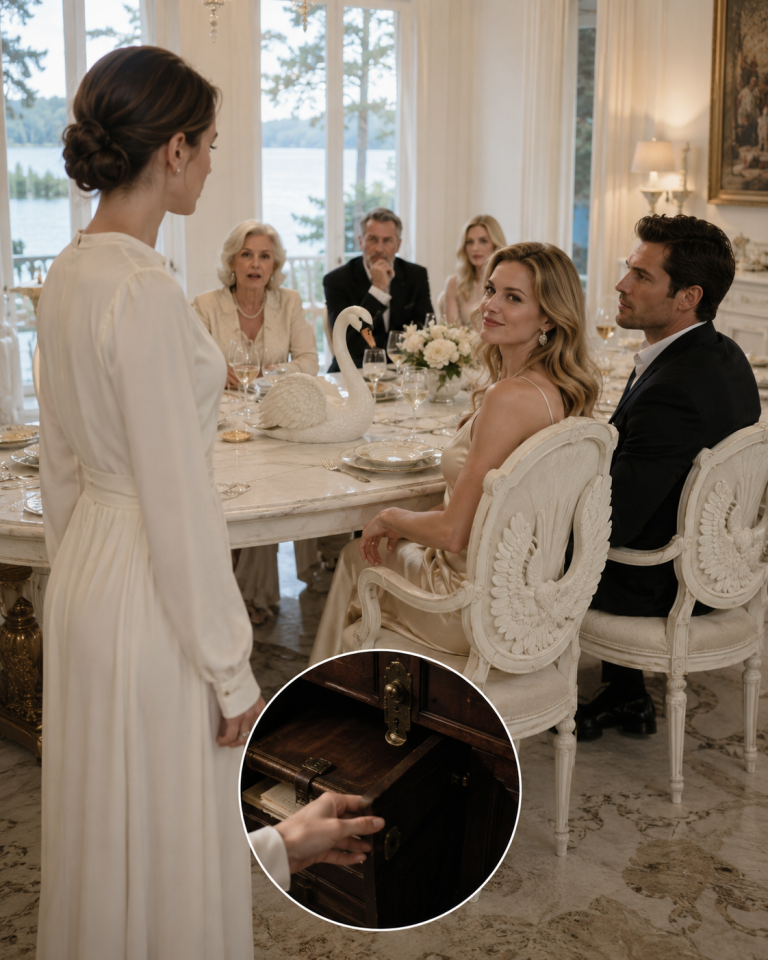
The meeting was held at midnight, in the deep-basement room that had been designed for exactly this kind of conversation: soundproof, exit-controlled, stripped of anything decorative. Roberto sat at the head of the table. To his right, Nico. To his left, Emilio. Eleven other men arranged around the long surface, all of them faces I had grown up seeing at family dinners and holiday gatherings.
I sat beside Emilio.
No one commented.
“Callum has given us everything,” Roberto began. “The Ferrara connections. The network he was building. The extent of the information he sold.” A pause. “Two of those names cost us lives. He’ll face the appropriate consequence.”
The table absorbed this without visible reaction.
“The larger issue,” Emilio said, “is what Callum described as a coalition forming against us. The Ferraras don’t have the resources to challenge us alone. They need allies, which means they’ve been recruiting. We need to understand the full scope before we can respond.”
“Which means intelligence,” I said. “Specifically, understanding which organizations they’ve approached and what they’ve been offered.”
Eyes shifted toward me.
Not with hostility. With the particular attention of men reassessing.
“Valentina has a proposal,” Emilio said.
I opened my laptop. The research I had assembled in the last forty-eight hours filled the screen.
“The Ferrara organization has been trying to expand into financial services for three years. They lack the legal infrastructure to move money at the scale they want without triggering regulatory attention. Every approach they’ve made to legitimate institutions has failed for the same reason — they can’t document provenance cleanly.” I looked at the table. “What if we offered them access to our legal framework? A structured relationship that gives them what they need and makes it prohibitively expensive for them to ever work against us.”
The room was quiet.
“You’d be giving an enemy access to your operations,” said one of the section chiefs. Rizzo. Cautious by nature, which was useful.
“We’d be giving them access to a controlled interface,” I corrected. “Managed entirely by our legal division. We see everything. They get functional help with their money problems. And they become dependent on our expertise in a way that makes alignment with the Ferraras structurally irrational.”
“Turn a potential enemy into a dependency,” Nico said slowly.
“The Ferraras can offer them fear. We offer them something more useful.”
Roberto was looking at me with an expression I recognized from early childhood: the one that meant he was seeing something new and deciding whether to trust it.
“It would take time to structure properly,” Emilio said. “But the principle is sound. More importantly, it’s the kind of move that changes the conversation from force to architecture. The organizations the Ferraras have been recruiting don’t want a war. They want stability.”
“Then we offer better stability,” I said.
The vote was not unanimous. Rizzo abstained. Two others wanted more time to consider. But Roberto called it in the affirmative, and in this room, Roberto’s call was final.
As the meeting broke up, my father stopped beside my chair.
“You think like your mother,” he said. “She was the one who suggested the arrangement with the Bratva network in 2009. Everyone told her it was too complicated. She was right.”
He put his hand on my shoulder briefly.
“I should have been asking your opinion for three years. I’m sorry for the time we lost.”
He left me sitting with that.
—
### The Ring in the Safe
Emilio found me an hour later in the small library off the main corridor, which had always been my retreat in this house. Shelves floor to ceiling. A window overlooking the garden. The particular silence of a room that held books.
He came in without knocking, which meant he had decided something.
“Your father approved the proposal formally,” he said. “We’ll begin outreach to the three organizations we’ve identified as Ferrara recruitment targets. You’ll lead the legal structuring.”
“I know. He told me.”
He sat in the chair across from mine. No desk between us. Just the space that had always carried an ambiguous charge.
“You were going to leave tomorrow,” he said.
“That was before Callum.”
“Before Callum and before the elevator.”
I looked at him.
“Before the elevator,” I agreed.
A pause.
“I am not going to pretend,” he said carefully, “that the revelation of my feelings resolves five years of distance. It doesn’t. I treated you as a complication to be managed when you deserved to be seen clearly. That requires more than a confession to correct.”
“Yes,” I said. “It does.”
“I know.”
The fire in the grate had burned low. Outside the window, the garden was dark and still.
“What I can offer,” Emilio continued, “is honesty from this point forward. The full version, not the managed one. I can offer the acknowledgment that you are the most qualified person in this family to stand beside me when I take over from my father, and that the fact that I have been in love with you for five years is not separate from that assessment but directly connected to it.”
I studied his face.
The man who had spent five years perfecting the architecture of distance was still visible underneath the honesty. But the distance was down.
“There’s something I want to show you,” he said.
He led me through the house to a wing I rarely visited — his private quarters, which were essentially a secondary office with a bedroom attached. He opened a safe set into the wall behind a painting and withdrew a small box.
“This was my mother’s,” he said, opening it. “She gave it to me when she knew she was dying. Told me the woman who wore it would have to be the kind of person who chose strength over safety and truth over comfort.”
The ring inside was a sapphire — deep blue, flanked by diamonds, set in gold that had aged into something warm and inevitable.
“I am not proposing,” he said. “We are not at that point. But I have been carrying this for three years because I knew, and I wanted you to know that I knew.”
I looked at the ring.
At him.
“Three years,” I said.
“Yes.”
“You carried an engagement ring in your safe for three years while treating me like an inconvenience.”
“Yes.” No deflection. “That is an accurate summary of my behavior, and I offer no defense for it.”
I laughed.
Not the laugh I had deployed at the party earlier — the performed one, the social one. The real kind, surprised out of me, which was the only kind worth anything.
Emilio looked at me with the expression I was going to have to get used to: the one that meant he was seeing me without any of the management systems engaged.
“I’m not going to Boston,” I said.
“No.”
“Not because you asked me not to. Because the work here matters and because leaving was partly running away and I’m not prepared to do that anymore.”
“I know.”
“And I’m furious with you for five years of distance.”
“I know that too.”
“Good.” I looked at the ring one more time, then at him. “Put it away. We have time.”
He closed the box and returned it to the safe, and the gesture was full of something that had nothing to do with deferral and everything to do with patience — the real kind, the kind that comes from certainty rather than waiting.
“There’s a council meeting at nine tomorrow,” he said.
“I know. I already sent Rizzo a brief addressing his concerns about the proposal. He’ll come around.”
“Of course you did.”
I started for the door, then stopped.
“Emilio.”
He turned.
“When you said I was the most dangerous person you’d ever met,” I said, “did you mean it as a warning or a compliment?”
“Both,” he said. “They’re not mutually exclusive.”
I went back to the party to say a proper goodbye to Nico’s engagement, and when I passed through the ballroom doors, the room felt different than it had an hour ago. Not because anything in it had changed, but because I had.
—
### Six Months Later
The Ferrara challenge collapsed in the way overextended alliances always collapsed — from the middle out, when one of the organizations they had recruited chose the better offer and the whole structure lost its load-bearing wall.
We had helped that choice along, methodically and without violence.
That was the new way.
Not the only way — this world did not permit only one way — but the one we reached for first, and second, and third. The one I had argued for in meetings that Emilio now attended with me, side by side at the table, which had required exactly one pointed conversation with Rizzo and two pointed conversations with our father, and had then become simply how things were.
Nico’s wedding to Elena Sartori was held in late spring, at the house in Tuscany that had been in the family for four generations. I was maid of honor. Emilio was Nico’s best man. We stood at opposite ends of the ceremony and walked together back down the aisle, which was not the plan anyone had written but turned out to be the plan that made sense.
At the dinner afterward, my father stood and gave a toast to the future, which was the kind of toast he gave well, all gravity and implication. And then he raised his glass toward me specifically and said, “And to the architect of our next chapter, who has her mother’s brilliance and, it turns out, considerably better timing.”
The table laughed.
I met Emilio’s eyes across the flowers.
Later, in the garden after the dancing had begun and the Tuscan dark had settled soft and warm around the old stone walls, he found me sitting on the low wall above the valley.
He sat beside me.
For a while, neither of us spoke.
“Nine months from now,” he said finally, “I take over formally. Antonio signs the documents in January.”
“I know.”
“The role we’ve built for you will become official at the same time. Legal director and strategic counsel.” A pause. “Unless the title needs to change.”
I looked at him.
“Unless it needs to change?”
He reached into the jacket of his dress suit and produced the small box.
Not a production of it. Not a ceremony. Just — there it was, held out between us in the Tuscan dark.
“I was going to wait until the transition was complete,” he said. “Until everything was stable and there were no crises requiring strategic management.” The corner of his mouth moved. “But you pointed out several months ago that waiting for stability is a way of never beginning. So.”
I opened the box.
The sapphire caught the light from the house below, the same deep blue it had been when I first saw it, flanked by its diamonds, in its warm gold setting.
“Valentina Ricci,” Emilio said, quietly and precisely, “will you marry me. Will you stand beside me, not behind me, and help me build something that lasts longer than this generation. Will you argue with me at every table and tell me when I’m wrong and refuse to let me mistake control for strength.”
I looked at the ring.
At the man who had spent five years choosing distance and three years carrying evidence of a different intention.
“You know I’m going to be right approximately seventy percent of the time,” I said.
“Sixty-three. I’ve been tracking.”
I took the ring from the box.
He slid it onto my finger with the steadiness of a man who had been certain of this for a long time.
“Yes,” I said. “Obviously yes.”
He kissed me with the particular warmth of something long decided finally becoming real, and the valley below was full of light from the house where our family was dancing, and the night was soft and unhurried, the way nights are when you have finally stopped running toward the wrong things and started building toward the right ones.
We were going to make mistakes. We were going to inherit a complicated world and navigate it with imperfect instruments and make decisions we would have to live with. Some of those decisions would be clean. Some wouldn’t.
But we would make them together.
That was the new way.
And it was, in the end, everything.
**THE END.**
—
—