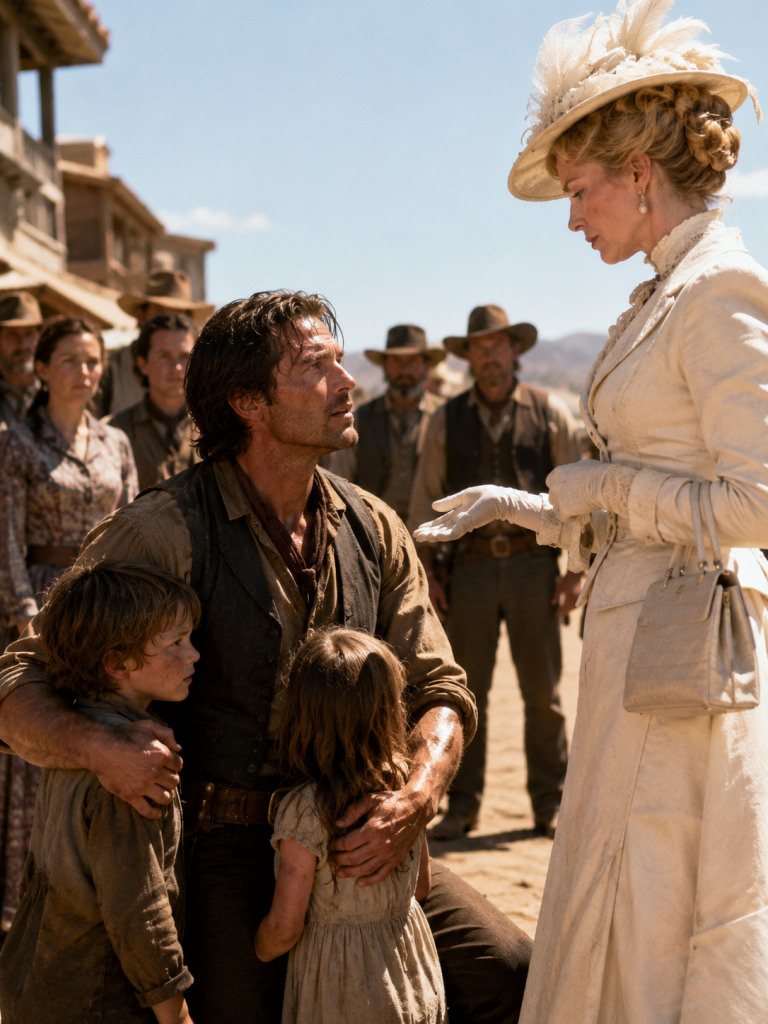
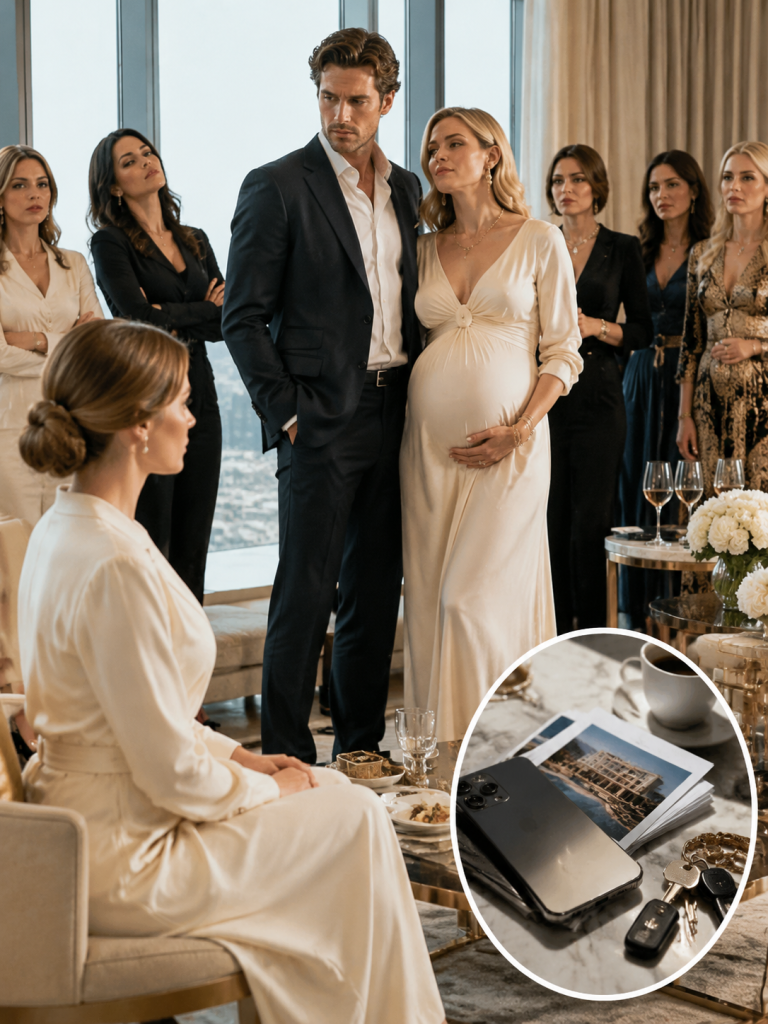
“Don’t Get In!”—Waitress Saved the Mafia Boss Seconds Before His Car Exploded

# PART 1
Her grandmother always said that instinct was just memory moving faster than thought.
Rosa Ferrara had not believed her when she was seven, watching an old woman circle a rusted Buick in a Detroit garage and announce, before touching anything, exactly which valve was failing. She believed her now.
She was twenty-nine years old, standing at the entrance of Corallo on a wet Thursday night, coat still damp from the walk to her subway stop, when the parking attendant’s hands told her something was wrong.
Not his face. Not his voice. His hands.
—
Her shift had run eleven hours. That was not unusual. Corallo was the kind of Manhattan restaurant that looked effortless to every person inside it and required the organized, sustained effort of about forty people to maintain that impression. Rosa had been one of those people for two years — floor supervisor, technically, which meant she made sure the forty people stayed synchronized while wearing the expression of someone for whom nothing was ever difficult.
It was difficult every night.
Tonight had been worse than most. A cancelled reservation that wasn’t in the system, a server who walked out at nine-fifteen, a wine pairing argument between the sommelier and a guest that she defused by agreeing with both parties simultaneously and separately. By 11:40 she had run out of stored diplomatic language.
She counted her cash. Subway fare and groceries and precisely nothing left over. Standard. The math had been the same since she moved to New York from Detroit four years ago, chasing the idea that starting over in a new city would mean something. It mostly meant her checking account stayed permanently low and her tolerance for difficult people stayed permanently high.
She put on her coat.
The door to the street opened and a party of four came in, trailing cold air and the specific energy of people who had started the evening somewhere else. Behind them, Corallo’s parking valet service cycled into the end-of-night rhythm — keys returned, cars retrieved, guests thanked and sent home.
The valet retrieving the black Bentley at the curb was not Petro.
Petro worked Thursdays. Rosa had nodded at him when she arrived at noon. This man was newer — she had seen him twice in the past week, wearing the uniform slightly wrong the way people do when the fit is borrowed rather than theirs.
Tonight he was sweating in thirty-eight degree weather.
His hands moved in small, repetitive adjustments. Key turned over and over in his palm. The kind of movement that happened when a person was waiting for a clock to run out, not waiting for a guest to emerge.
Rosa noticed this the way she noticed everything — quietly, without showing she’d noticed, while appearing to check her phone.
The guest she recognized was coming through the lobby door.
Luca Ferrante.
Not a name she knew personally. A name she knew the way you know a season — by what arrived with it. When Luca Ferrante came to Corallo, the room temperature dropped by a half-degree. Not because anyone was rude. Because everyone became more careful. He sat at table three with the same three men twice a week, ordered the same wine, and tipped exactly twenty percent, which Rosa had always thought said something specific about him, though she had never decided what.
Tonight he was moving toward the front entrance, jacket buttoned, unhurried.
The valet stepped toward the Bentley.
Rosa was already walking.
She could not have explained the logic clearly at the time. There was the sweat. There was the wrong-fit uniform. There was something off about the angle the man was holding his body, the way his weight stayed on his back foot like he expected to need to run.
And there was the wire.
A flash of blue-white under the driver’s side dashboard, catching the light for one second when the valet opened the door to place the keys inside.
Factory wiring runs parallel and bundled. Rosa knew this because her grandmother had rebuilt two old vehicles in a garage that smelled of iron and espresso and showed her granddaughter that everything mechanical had a grammar, and bad installation had an accent you could hear if you listened right.
That wire did not belong there.
She grabbed Luca’s arm from behind.
He reacted instantly — turned, one hand up, the controlled defensiveness of someone whose body had been trained to respond to unexpected contact as a precursor to danger. His eyes landed on her face.
“There’s something wrong with your car,” she said. “The wiring under the dash. Don’t get in.”
His expression did not change by much.
One second of something — assessment, calculation, the briefest possible weighing of whether she was credible.
“How sure are you?”
“Very.”
He turned to the man nearest him.
“Everyone back. Now.” He did not raise his voice. “Marcus. Perimeter. Eighty feet.”
The man called Marcus moved before the sentence finished. Two others followed. Luca wrapped one arm around Rosa’s shoulders and walked her away from the car with the unhurried, specific efficiency of a man who had been in situations requiring fast movement before and understood that fast movement looked exactly like ordinary movement.
They had covered forty feet when the Bentley detonated.
The force hit her in the back before she heard the sound. Hot pressure, a wall of it. Her feet left the pavement for a moment that felt much longer than it was. Luca went down with her, his body positioned between her and the direction of the blast, one arm over her head until they hit the wet pavement together.
Sound returned late — first a high ring, then car alarms in sequence, then screaming she could not place, then sirens starting somewhere in the network of the city.
Heat.
The smell of burning rubber and something chemical underneath it.
Luca shifted beside her.
“Rosa.”
Her name. She had not told him her name.
“Can you hear me? Are you hurt?”
Her cheek was against cold wet pavement. Her hands were bleeding. Her ears hurt. Her whole body was trying to report in simultaneously and she was sorting through it.
“I can hear you,” she said. “I think I’m okay.”
He helped her sit up slowly, checking her arms, her face, the back of her head, with the rapid attentiveness of someone conducting a damage assessment.
“The valet,” she said.
“Marcus saw him go.”
“He ran the second you stepped back.”
“Yes.”
She looked at the burning wreck.
The Bentley was not a vehicle anymore.
She was alive because she had looked at a nervous man’s hands.
Marcus appeared beside them, crouching to speak close to Luca’s ear. Luca listened. Something in his expression tightened once, then went still.
He looked at Rosa.
“The police will arrive in approximately two minutes,” he said. “I need you to understand something before they do. You are now a witness to an attempted assassination. That makes you a person of interest to the people who arranged this.”
Rosa stared at the burning car.
“You mean a target.”
“Yes.”
The first police car arrived. Then a second. Then an unmarked vehicle that came too fast and stopped too precisely.
Rosa sat on the curb with her bleeding palms pressed against her knees and thought about her apartment in Astoria, her double shift tomorrow, the message her mother had sent that she had not answered yet.
A federal agent asked her what she saw.
She described the wire. The valet. The wrong-fit uniform. The sweat.
The agent handed her a card.
Then Marcus appeared.
“Miss Ferrara. We need to move you.”
And the evening, which had already been a long one, became something else entirely.
—
# PART 2
The SUV moved north through streets still gleaming from earlier rain.
Rosa sat in the back. Her coat was torn at one shoulder. Her hair was still carrying the smell of smoke. The bandage on her right palm was already pinking through.
She said, “Where are we going?”
Luca, in the front seat, said, “Somewhere safe.”
“That is what people say when they are not going to tell you.”
He turned to look at her.
In the amber blur of passing streetlights, she saw the cut above his jaw and the fine ash still on his collar. He looked, she thought, like a man who had learned not to appear startled and had not needed to unlearn that in a very long time.
Until now.
“Upper West Side,” he said. “A secured property.”
“I have work tomorrow.”
“You do not have work tomorrow.”
Something in the flatness of that statement sat wrong.
“What have you done?”
He did not answer immediately.
Marcus, driving, kept his eyes forward.
“Your manager was contacted,” Luca said. “A family emergency was cited. Your final paycheck will be mailed.”
The car seemed to get colder.
“You quit my job for me.”
“I removed you from a location the people who did this will look for you at first.”
“You quit my job.”
“I preserved your safety and your professional reputation simultaneously.”
Rosa looked out the window.
She was not frightened. Not yet. Shock had a way of replacing fear for a little while, running itself in place of it. She was something more specific: furious in the quiet way that came from realizing a series of decisions had been made about her life by someone who had not asked.
“I don’t know you,” she said.
“No.”
“And yet you are in a position to manage my employment and put me in a car.”
“You saved my life,” he said. “That creates a situation neither of us is comfortable with.”
She looked at him.
“What kind of situation?”
“The kind where you are safer beside me than away from me until the people who built that device understand that killing you now costs them more than it gains.”
She looked at her bandaged hand.
“Is that actually true, or is that what powerful men say to justify keeping people where they want them?”
Luca was quiet for a moment.
“Both things can be true at once,” he said.
She disliked him for being honest about that.
The apartment was high enough that the park looked like a rendering of itself. Everything in it was expensive in the particular way of spaces that had been decorated for function rather than display — nothing showy, everything precise. Rosa moved through it slowly, learning its geometry.
She tried the front door.
It opened.
That surprised her enough that she stood in the open doorway for a moment.
Marcus appeared in the hallway.
“You can leave,” he said. “We are not holding you.”
“Then why does it feel like you are?”
“Because you have nowhere safe to go,” he said. “That is not the same thing.”
She went back inside.
She did not sleep until nearly four in the morning, and when she slept, she dreamed of her grandmother’s garage.
—
# PART 3
She woke to sunlight and the sound of an espresso machine.
Her coat was folded on the chair. Her tips from last night were still in the inside pocket. Someone had changed the bandage on her palm.
The clock on the wall read eleven-seventeen.
She walked out into the main room. Marcus was at the kitchen counter. The city spread below, indifferent and gleaming.
“Coffee,” he said.
Not a question.
She sat on a stool and drank it and thought.
Her checking account had sixty-three dollars. Rent was in eight days. She had student loans from a semester she never finished because her father’s gambling debt had pulled her out of culinary school three years ago, and she had been repaying that specific wrong ever since.
She was alive.
She was in a stranger’s apartment.
Her job was gone.
Luca Ferrante walked in twenty minutes later. He was carrying a pharmacy bag and a folded newspaper, had a new cut at his collarbone to go with the one at his jaw, and looked like a man who had managed three hours of sleep by deciding that was sufficient.
“Sit,” Rosa said.
He stopped.
“You’re bleeding through your collar. Sit.”
He sat.
She opened the pharmacy bag — antiseptic, gauze, tape — because of course she knew how it was organized, the same way she knew how to set a table or debone a fish, which was by having done it enough times. She cleaned the cut at his collarbone while he sat still with the careful patience of someone who had learned not to be the kind of man who refused help.
“Who did this?” she asked.
“Zeferino Drakos,” he said. “He controls narcotics distribution in three boroughs. Specifically in territory that overlaps with several of my business interests.”
“Business interests.”
“I know what that sounds like.”
“I’m not asking you to make it sound like something else.”
He looked at her directly.
“My family’s operations are mostly legitimate at this point. Mostly. There are arrangements from my father’s era that still exist. Drakos wants those routes.” He paused. “He has tried negotiation. He has tried pressure. This was the next escalation.”
“And because I stopped it, I’m now a visible problem for him.”
“Yes.”
She finished taping the bandage.
“I want three days,” she said. “Like you said to Marcus on the phone last night. I heard you.”
“Yes.”
“Three days, and if I want to leave after, I leave.”
“Yes.”
“And I am not a prisoner here. I have access to the apartment and I am not managed.”
“Correct.”
“Then I need to know the rest. The thing you haven’t told me yet.”
He looked at her steadily.
“I had you investigated.”
She had expected this. That did not make it better.
“When?”
“Within three hours of the explosion.”
“Because you needed to know if I was a setup.”
“Yes. And because I needed to understand who you are.”
“And?”
“Culinary school dropout. Father’s debt. Detroit. Three years in New York. Manager at Corallo rated you the best floor supervisor they had worked with in a decade.” He paused. “And your grandmother rebuilt cars.”
“She taught me.”
“That is why you saw what you saw.”
“No. I saw it because a man was sweating in November and holding his keys wrong.” Rosa picked up her coffee. “The wiring was just the confirmation.”
Something in his expression shifted — not quite warmth, but its precursor.
“You’d have seen it anyway.”
“Possibly. I see things.” She looked at the window. “It’s how I survived my father’s era without becoming part of it.”
He listened without performing interest. That was different from most people.
“He owed money,” she said. “Bad money. The kind that came with conditions about what your family would do to pay it back. I watched my grandmother work sixty hours a week to keep the restaurant she built so my father couldn’t use it as collateral.” A pause. “She died three years ago. He died six months later. The restaurant is still there because she put it in my name before she died.”
Luca was quiet.
“She knew he’d lose it otherwise.”
“Yes.”
“The bounty on you is fifty thousand dollars,” he said then. “Drakos posted it this morning.”
She had been watching his face and caught the moment he decided to tell her.
“For my location?”
“Alive preferred. They want to understand what you know about the car.”
“I know about a wire.”
“They don’t know that.”
She turned to face him fully.
“Then let’s make sure they do.”
He looked at her.
“What?”
“The only reason I’m valuable to them is that they think I know something that could be used against them. The way to remove the value is to make it clear I don’t.” She thought for a moment. “Or to give them something more expensive to worry about.”
“You are suggesting we use you as bait.”
“I’m suggesting that sixty hours of sitting in this apartment waiting to hear whether I can go home is not useful to either of us. Tell me what you actually know about Drakos. Let me help.”
“You are not part of my world.”
“I am now. You said it yourself.”
He looked at her for a long time.
Then: “Marcus.”
Marcus appeared in the doorway.
“Bring the file.”
—
The leak, when they found it, had been feeding information for eleven months.
His name was Pietro Alessi. He had worked the financial side of Luca’s legitimate operations for a decade, trusted enough to have routing access and event schedules. He had developed a gambling debt — one hundred and forty thousand dollars — owed to a casino that Drakos controlled through a shell company.
They offered him forgiveness in exchange for information.
He had provided schedules, property records, route maps, and Rosa’s photo from the restaurant’s security system.
Rosa sat in the back of the conference room while Luca’s senior people laid this out. She was not introduced as anything other than her first name. No one questioned her presence, which told her something about the kind of authority Luca exercised.
Pietro came in pale and shaking.
He looked at Luca. Then, eventually, at Rosa.
“I didn’t think they’d—” he began.
“You gave them her face,” Luca said.
“I didn’t know what they’d do with it.”
“You sold it to people who had already tried to blow up a car,” Rosa said.
The room went quiet.
Not because she was loud. Because she was specific.
Pietro opened his mouth.
“I need you to answer a question,” she said. “Not for him. For me. Did you know they put a bounty on a person who had nothing to do with any of this?”
He closed his mouth.
Then opened it again.
“I found out today.”
“And does it look different to you now?”
He looked at his hands.
“Yes,” he said.
“Then tell us where the communications hub is,” Rosa said. “Not because you’ll be punished if you don’t. Because it’s the only way this ends before someone else gets hurt.”
Luca watched her say it.
He did not intervene.
Pietro told them everything he knew.
—
The operation that followed was not a single dramatic night. It was eleven days of incremental pressure.
Pietro’s access gave them the communications chain. Offshore accounts mapped to three accounts held under false business registrations. A safehouses location in Queens. The fake parking attendant — a man named Stelios, with two prior arrests in New Jersey and a burner phone he had not destroyed — was located through a combination of Pietro’s information and footage the FBI had been assembling independently.
Rosa sat in on two planning sessions at Luca’s request. Not because she had tactical expertise. Because she could read rooms — could see when a plan had a gap by watching the faces of the people discussing it — and Luca had figured that out by the second evening.
“You notice the person who isn’t speaking,” he said once.
“Yes,” she said. “That’s where the problem usually lives.”
He looked at her with the expression she had started to recognize: assessment that had turned into something slightly past itself.
She looked away.
When the FBI moved, they moved on information that had been packaged correctly — sourced, verified, documented. The Queens hub was raided before dawn on the tenth day. Stelios was arrested at Newark Penn Station with a ticket to Philadelphia. Three Drakos lieutenants were indicted under a RICO framework that had been building for longer than this particular conflict.
The bounty on Rosa was formally declared void by the third day of the raids, when Drakos was focused entirely on not being buried by the federal response.
Luca came home on the eleventh evening with a cut on his arm and the expression of a man who had been awake for most of three days.
Rosa was in the kitchen. She had made braised short rib because the refrigerator had the ingredients and she had needed something to do with her hands since noon.
He stood in the kitchen doorway.
“It’s over,” he said.
“The bounty?”
“Dissolved. Drakos has larger problems. You are no longer useful to them as a pressure point.”
She turned off the burner.
“And Pietro?”
“Cooperating with federal investigators. It will take time, but the case is solid.”
She looked at the food she had made, then at him.
“Sit,” she said.
He sat.
She served him.
He ate in silence for a few minutes.
Then: “You can go home tomorrow. I’ll have security on your building for six more weeks as precaution, but it will be invisible. You will not notice them.”
“What about the job?”
“I own three restaurants,” he said. “I mentioned this before.”
“You mentioned it. You didn’t offer.”
“I am offering.”
She looked at him.
“Terms.”
“Real contract. Market salary. Right to quit without notice.” He paused. “I have not met anyone who understands why good restaurants work the way you seem to.”
“You have met many people.”
“Yes.”
“And I’m unusual to you.”
“Yes.”
“Because I see things.”
“Because you act on what you see.” He looked at his plate. “Most people notice things and decide it is not their problem. You saw a valet sweating in November and dragged a stranger away from a car bomb.”
“I saw a wire.”
“You saw the valet first.”
She looked at the window.
“My grandmother used to say instinct was just memory moving faster than thought. She meant it about cars.” Rosa picked up her fork. “I think she meant it about people too.”
Luca was quiet.
Then: “What was her name?”
“Adele. Adele Ferrara. She came from Calabria in 1968. Nineteen years old. She did not speak English and she rebuilt engines in her cousin’s garage until she had enough to open something of her own.”
“And the restaurant is still there.”
“She put it in my name the year before she died.” Rosa set down her fork. “She knew my father would lose it. She protected it the only way she could.” A pause. “It’s been empty for three years. I have not had enough to reopen it.”
The kitchen was quiet for a moment.
“What would it need?” Luca asked.
“Equipment. Repairs. Working capital for the first year.”
“Is that a lot?”
“For me,” she said, “it is everything.”
He nodded once.
“I would like to help with that,” he said. “Not as a gift. I know you would not accept a gift. As an investment in a restaurant owned by Adele Ferrara’s granddaughter, which I believe has good reasons to succeed.”
“You don’t know anything about the restaurant.”
“I know about the granddaughter.”
She looked at him.
“Terms,” she said. “In writing. I keep controlling interest. I run the kitchen my way. You have no input on operational decisions.”
“Agreed.”
“You review the financials annually. Nothing more.”
“Agreed.”
“And if at any point it feels like leverage, the deal ends.”
He met her eyes.
“It will not feel like leverage,” he said. “I have no interest in owning things that do not want to be owned.”
—
The months that followed were not simple, and they were not the version of themselves that people expected when they heard the story later.
Rosa moved back to her apartment in Astoria. She took the position at Luca’s second restaurant, a place called Sedici, which had excellent bones and a kitchen that had been running on coasting for two years. She corrected the pasta. She rebuilt the sauce program. She hired one new cook and promoted another from within. She told the pastry chef that his tiramisu was made with the wrong proportion of mascarpone and showed him the correct one, and he was offended for three days and then grateful.
She spoke with Luca twice a week — once about the restaurants, once not specifically about anything. Those second calls lasted longer than the first ones.
She was in Detroit for two weeks in November, working with a contractor on the Ferrara space. New ventilation. New line equipment. The original bar, which her grandmother had built from old church wood, preserved and refinished.
She stood in the empty room on the last evening before flying back and thought about her grandmother walking a rusted Buick in circles before announcing the failing valve.
*Instinct is just memory moving faster than thought.*
What she remembered, standing in that room, was what it felt like to build something instead of losing something.
She called Luca from the restaurant’s old phone line, which still worked because the building had never fully disconnected.
“It looks like itself,” she said.
“Good.”
“It looks like her.”
A pause.
“That is better,” he said.
She sat on the floor beside the bar because there were no chairs yet.
“I don’t know what we are,” she said. “You and me. I want to say it plainly so it doesn’t sit between us doing something we haven’t named.”
“All right,” he said.
“I trust you. That surprised me. I don’t trust people quickly.”
“I know.”
“And I want to be around you, which is different from trusting you and not the same thing.”
“Yes.”
“And I do not want to be inside your world. The part of it that requires cars and bounties and men like Pietro deciding to sell someone’s face.”
“I know that too.”
“So what does that leave?”
He thought for a moment.
“Two people,” he said, “who are different and willing to be honest about what that costs and what it is worth.” A pause. “I am not asking you to accept my world. I am asking whether there is room for me in yours.”
She looked at the bar her grandmother had built.
“Maybe,” she said.
“Maybe is more than most people give me.”
“Don’t let it go to your head.”
“Rosa.”
“What.”
“Come home.”
She got up off the floor.
“I’ll be at Sedici on Friday,” she said.
“I know,” he said. “I’ll be there.”
—
The opening night at Ferrara’s — her grandmother’s name, restored, on a new sign above the door — came the following March. Small. Forty covers. A menu that had not tried to be anything other than what it was: Calabrian food made from memory, cooked with the knowledge that certain things required neither explanation nor apology.
Luca was at the third table, third row, because Rosa had told him the first table was for people who needed to be seen and she did not need to be seen. He understood this without protest.
After service, she sat across from him over two glasses of red and the last of the braised lamb.
“Full house,” he said.
“Yes.”
“Every table.”
“I counted.”
“Two tables cried.”
She looked at him.
“The osso buco,” she said. “My grandmother’s version. People cry at food that remembers something for them.”
He looked at the room — the bar made from church wood, the photographs of Calabria on the walls, the small square tables that didn’t try to look expensive, the light that came from sources Rosa had chosen carefully to look like natural light rather than design.
“It is exactly like her,” he said.
“You never met her.”
“No. But I know her granddaughter.”
Rosa poured more wine.
“That’s very smooth,” she said.
“I meant it.”
“I know,” she said. “That’s why it worked.”
He reached across the table and covered her hand with his.
She looked at their hands.
Then at him.
She had spent four years in New York thinking starting over meant leaving everything behind. Detroit. The restaurant. The memory of Adele working the Buick in circles before announcing the failing valve. She had tried to be someone new, someone lighter, someone not carrying a dead woman’s restaurant in the back of every thought.
What she understood now was that she was not carrying it.
She was keeping it.
Those were different things.
“Thank you,” she said.
He looked at her.
“For which part?”
“For knowing the difference,” she said, “between protecting someone and owning them.”
He held her hand.
The restaurant was quiet now, the last of the guests gone.
Outside, the city moved in its ordinary way.
Rosa Ferrara, who had seen a wire in a dashboard and screamed at a stranger to get out of his car, had lost her job, her normal life, her safety, and the useful illusion that ordinary was something you could maintain forever.
She had also found her grandmother’s restaurant again.
And built something real, from the ground up, with hands that remembered how to knead dough even after the world exploded.
Not because a powerful man saved her.
Because when the door opened, she had already been moving toward it.
And it started — as most things do — not with a thunderclap or a revelation, but with something small and wrong that a tired woman noticed because someone taught her to look.
—
*THE END*
—
—