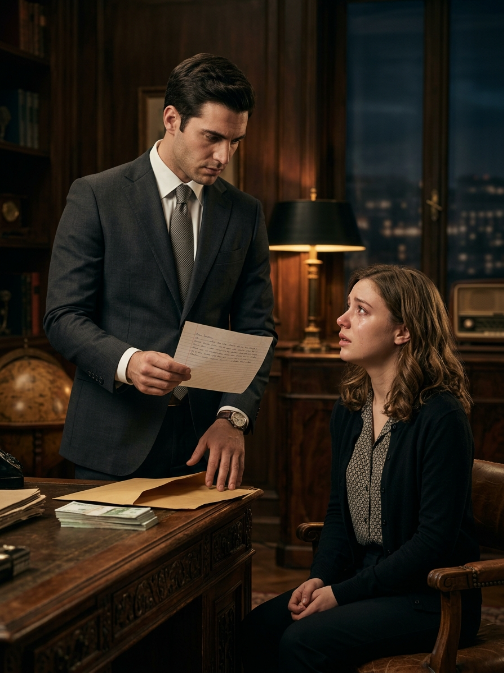
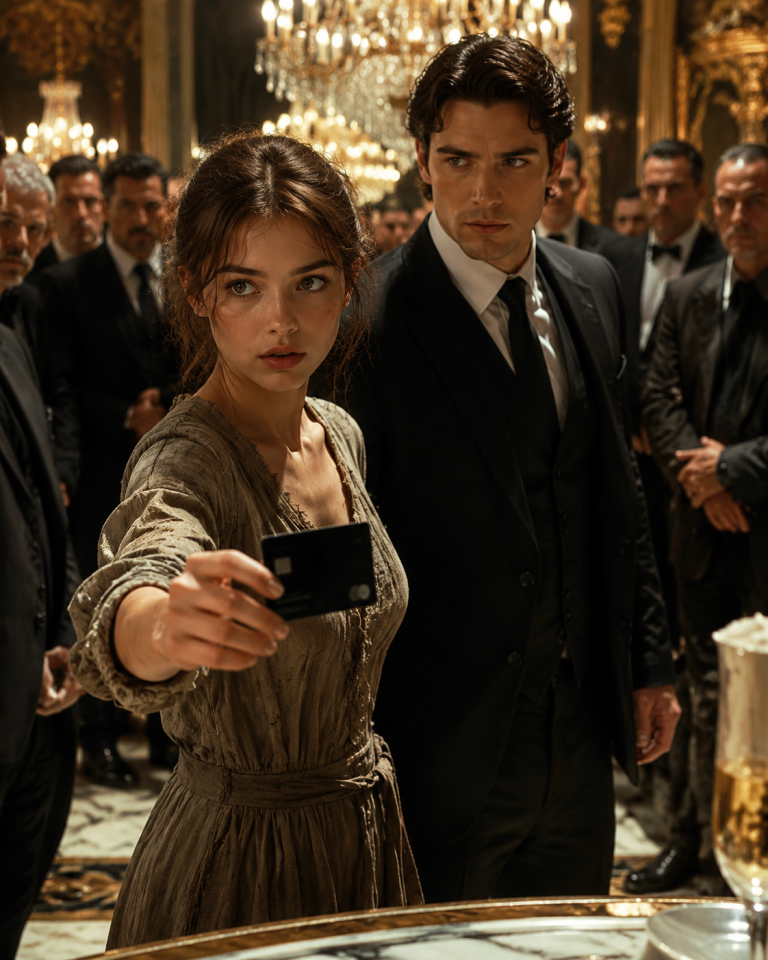
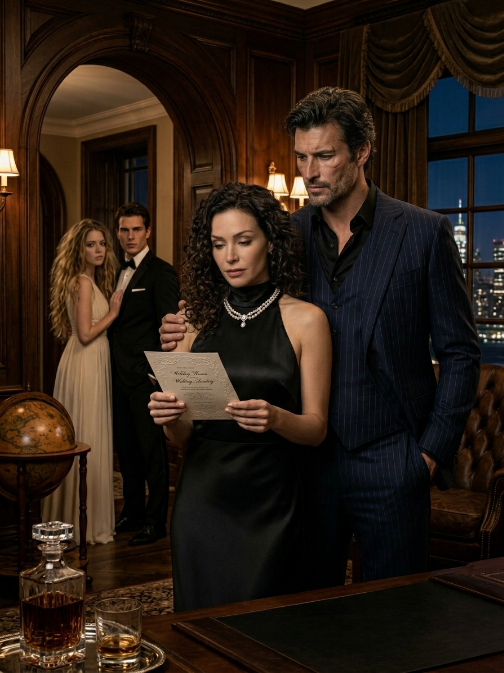
She Whispered a Dead Sicilian Lullaby—The Mafia Boss Turned White and Ordered: “Find Everything About Her”

## PART 1
She had been running long enough to know that the names mattered less than the silence between them.
Mira Vane. Claire Russo. Elena Ferretti.
She rotated them the way some people rotated wardrobes — strategically, by season, by the specific quality of danger the city was generating that month. Names were armor, and armor got damaged, and damaged armor had to be replaced before anyone noticed the crack.
Tonight she was Mira Vane, and Mira Vane carried trays at Calabrese, a restaurant on the Upper East Side where the candlelight was engineered to make wealthy faces look kinder than they were and a glass of wine cost what she paid in monthly transit fares.
The work was invisible work.
She had chosen it for that quality specifically.
Move, pour, clear. Move, pour, clear. Keep your eyes down and your expression professionally warm and let the room forget you’re in it. Twenty-six years of running had taught her that the best place to hide was in plain view of people who had been trained by money never to look at the help.
She had been working here for eight months.
That was longer than usual.
She was beginning to wonder if that was dangerous.
She was carrying a tray of empty Bordeaux glasses toward the service station when the temperature changed.
Not the air temperature. Something else. The way a room responded to a new presence the way water responded to a stone dropped into it — rings spreading outward, disruption reaching the edges.
The room at Calabrese went carefully, deliberately normal.
Men who had been laughing too loudly remembered their manners. A woman stopped mid-story and began admiring a painting she had already admired last week. Even Paolo, the floor manager, seemed to shrink as he moved — faster, quieter, like something had reminded him of his actual size.
Mira set the tray down without looking up.
Then she heard the child.
It was not a tantrum sound. She had catered enough events to know the difference. This was different — a sound trying to climb out of a small body that had run out of capacity. A sound that said: the world is too much right now and I don’t know where to put it.
She looked.
The child was perhaps four years old. A tiny suit. Dark curls. Feet that didn’t reach the floor. He had both hands clamped over his ears and his face was red and wet and he was rocking slightly, the specific trembling of a nervous system overwhelmed.
The man beside him was the reason the room had gone careful.
Raffael Sona. She knew the shape of him from photographs she had tried not to look at — the newspaper stories that ran his name below words like *alleged* and *reportedly* and *sources close to* because nobody printed the direct version. Black hair. Sharp jaw. Suit cut by someone who understood that a man like this needed to be able to move.
He was leaning toward the child with the controlled impatience of a man accustomed to being obeyed.
“Nico,” he said, low and precise. “Stop.”
The boy screamed louder.
“Too loud,” Nico choked out. “The lights — too bright—”
Someone tsked from a nearby table.
Whoever it was regretted it immediately.
Mira set her tray down.
She was doing it before she understood the decision.
The enforcer behind Raffael — scar through one eyebrow, eyes like a locked door — shifted as she approached, but Mira was already at the table, already crouching to the child’s eye level, already doing the thing that had no good explanation except that she knew what it was to be a small person in a loud world with nowhere to put the sound.
“Hey,” she said softly.
Nico’s crying didn’t stop. But he looked at her through wet lashes.
Mira reached out slowly and covered both his hands with hers, not pulling them away from his ears, just adding warmth on top.
Then, without thinking about it — the way you did the thing that lived so deep in you it preceded thought — she sang.
Just the first few bars. Barely louder than breath. An old lullaby, older than the language it was in, the kind that had traveled in women’s mouths from one generation to the next because it worked on something deeper than the mind.
The Sicilian words came without effort.
They always did.
Nico’s crying stopped mid-sob.
Not gradually. Immediately. As if someone had found the right frequency and the static cleared.
He stared at her.
“Again,” he whispered.
Mira sang it again.
The room around them had gone utterly still. The kind of still that had a specific quality — not embarrassed, not polite. Stunned.
Nico’s breathing evened out. His shoulders dropped. His hands relaxed. He looked at Mira the way four-year-olds looked at things they couldn’t explain but needed.
“You sing like Nonna,” he murmured.
Mira’s breath stopped.
She felt rather than saw Raffael Sona rise from his chair.
Her eyes moved to his face involuntarily.
He was the color of chalk.
Not anger. Something underneath anger. Something she recognized because she had seen it in mirrors for twenty-three years.
Recognition.
“What is your name?” he said.
The words arrived at the wrong temperature — not a restaurant question. Not the question a man asked a waitress.
The question a man asked someone he had been trying to find.
Before she could answer, she saw them.
Near the entrance.
Two men in dark coats. Silver rings catching the candlelight. One of them looking directly at her.
Smiling.
She knew that smile. She knew the scar beside his throat. She knew what the small gesture he made with two fingers meant, because she had last seen it in Sicily when she was six years old, right before the gunfire.
“Get down,” she said.
The first shot came through the front window before anyone could move.
—
## PART 2
Chaos ate the restaurant whole.
Crystal shattered. Someone screamed. Tables overturned with the specific sound of expensive things ending. Dante — the enforcer — pulled Nico under the nearest table with a speed that said he had been in worse rooms than this and survived them by moving faster than the danger.
Raffael grabbed Mira’s arm and slammed her behind a marble pillar as the second shot took out the wall beside them.
Not random fire.
Targeted. Professional. The kind of shooting done by people who had been paid enough to be patient about it.
Dante returned fire. One attacker dropped.
The second disappeared behind a column.
Raffael pressed Mira against the pillar, his body partly blocking hers, and looked at her with the specific fury of a man discovering he has been surprised.
“Who are they?”
Her throat was tight.
“The Gentili family,” she said.
Dante went still.
Raffael’s expression changed in a way she could not fully read.
Because the Gentili family had been erased from Palermo decades ago. Everyone in the underworld knew this. Everyone accepted it as settled history.
“Apparently,” Mira said, “some survived.”
Another shot cracked overhead.
She dropped beside Nico instinctively, covering his ears.
He pressed into her without hesitation, his nervous system already depleted, the firefight arriving on top of everything that had already been too much.
“I don’t like this,” he whispered.
“I know,” she said.
Raffael moved with terrifying efficiency. Two more men — his, appeared from positions she hadn’t noticed they were in. The second shooter’s location became a liability. Then silence, the kind that arrived after violence rather than before it.
Red emergency lights swept the room.
In the wreckage, Mira looked at the fallen shooter’s wrist.
A black serpent eating its own tail.
The Gentili crest.
Raffael crouched beside her.
“You know that symbol.”
She did.
She had been six years old the last time she saw it. She had been hiding in a flour cellar in Palermo, listening to a house burn, and a woman was singing to her to keep her from crying, and the men outside wore that mark.
“We need to leave,” she said.
Three black SUVs waited in the rain behind Calabrese. Dante scanned rooftops while the others loaded.
Raffael looked at her.
“You’re coming.”
“I’m a waitress.”
“No,” he said. “I don’t think you are.”
She got in.
Nico fell asleep against her shoulder before they cleared midtown. The lullaby — she had started it again automatically, because it worked and the child needed it — hung in the air of the SUV like something between them that had no name yet.
Raffael watched her in silence.
Finally: “My mother sang that lullaby to one person outside the family.”
Mira kept her eyes on the window.
“A little girl,” he continued. “The daughter of a woman she loved.”
“She died,” Mira said.
“She disappeared.”
The city rain blurred everything.
“What was your mother’s name?” Mira asked, though she already knew.
“Lucia Sona.”
She closed her eyes.
Twenty-three years of names.
Of running.
Of keeping a secret so small and so complete it had become the architecture of her survival.
“My real name,” she said quietly, “is Sofia Gentili.”
Dante’s head turned.
Raffael’s face did not move.
But his hands did.
They tightened.
Once.
Then he said, very quietly: “Tell me everything.”
—
## PART 3
**What Sofia Remembered**
She had been six years old, and it was a summer night in Palermo, and the orange groves smelled of something she would spend the rest of her life trying and failing to recover.
A peace dinner.
Lucia Sona had organized it — Raffael’s mother, a woman with dark eyes and an understanding that wars between families produced nothing but orphans. She had invited the Gentilis. She had believed it was possible to end something that had cost everyone too much.
Someone had told the wrong people.
Sofia remembered the table. The white cloth. Her father laughing at something Lucia had said. Her mother’s hand warm over hers.
Then the doors came in.
Then the sound of it.
She had hidden under the table first, and then Lucia had found her — in the chaos, the woman had found the child — and half-carried her to the flour cellar beneath the kitchen. Had pushed her inside and crouched at the entrance and sung.
The lullaby.
The same one.
Above them, the house was burning.
“Stay here,” Lucia had told her. “Don’t move until it’s quiet. Count the stars on the wall — I painted them there for Raffael, but they’re yours now.”
She had come back for Sofia once.
She had not come back a second time.
Sofia had counted the painted stars for three hours. When she finally emerged, covered in flour dust, everything was ash.
She had been the only survivor.
She had been found by a farmer two days later and passed through hands that changed her name and then her city and then her country until she was someone who had never been anyone she used to be.
—
In Raffael’s penthouse — black marble, floor-to-ceiling windows, security thick enough to suggest a siege had been anticipated — she told him all of it.
He listened without interrupting.
When she finished, he was very still.
“My father told me the Gentili family attacked first,” he said.
“Your father lied.”
He knew she was right. She could see that he knew.
“His name is Enzo Sona,” she said. “He built an alliance with the Gentili enforcers. He arranged the massacre to consolidate the docks, the ports, the routes your mother had been trying to protect through a peace agreement.”
Raffael was quiet for a very long time.
Then: “She knew.”
“She knew.”
“That’s why she wrote the letter.”
Mira — Sofia — looked up.
“What letter?”
—
**What Lucia Left Inside the Piano**
Nico, half-awake and stubborn about it, had pulled Sofia to a piano in the far corner of the penthouse. An old upright, slightly incongruous among the sharp modern lines. Carved roses along the wood. One chipped ivory key on the far left.
Sofia stopped when she saw it.
“This was hers,” she said.
Raffael came to stand beside her.
“She brought it from Sicily.”
Sofia touched the chipped key without thinking. Her fingers knew it before her mind did.
“She showed me,” Sofia said. “I was very small. She showed me a hiding place.”
Raffael looked at her.
Sofia crouched and ran her fingers along the lower panel’s inside edge, following the grain of wood until she found the small brass catch. She had been shown exactly once, twenty-three years ago. Her fingers found it anyway.
The panel opened.
Inside: a yellow envelope, wax seal intact.
Lucia’s seal.
Raffael reached in and took it.
He opened it with hands that were not entirely steady.
Inside: a photograph. Two women in a Sicilian kitchen, smiling, flour on one of their aprons. Lucia and Sofia’s mother.
Underneath the photograph, a letter.
Raffael read it standing.
He read it once. Then again.
Then he set it down on top of the piano and walked to the window.
Sofia picked it up.
*If this finds you, then what I feared has happened. Enzo ordered the Gentili peace agreement destroyed. He allied with their killers to take the ports and arranged the massacre to eliminate anyone who could testify. Protect the child if she survived. One day she and Alejandro — Raffael — will need each other in equal measure. The truth cannot die with me.*
The truth had waited twenty-three years inside an old piano.
“For twenty years,” Raffael said, still facing the window, “I built his empire.”
Sofia was quiet.
“Everything I grew was planted in soil he poisoned.”
“Yes.”
“Including Leo. Including Nico.” He turned. “He comes near my son over my dead body.”
Sofia believed him entirely.
Then Dante appeared in the doorway.
“Someone leaked her identity,” he said. “The entire network knows Sofia Gentili is alive.”
A beat.
“There’s more.” He looked at Raffael carefully. “We have company.”
—
**The Man Who Claimed Her**
They came through the front.
Not with guns first — a professional courtesy that lasted approximately forty seconds before it didn’t.
Nico was in the kitchen with one of Dante’s people when the first wave came through. Sofia moved toward him by instinct, and the firefight that detonated around them was the kind she had spent twenty-three years trying to stay ahead of.
She was not ahead of it anymore.
During the violence — it took nine minutes and left four of the attackers down and one of Raffael’s men with a shoulder wound — a man emerged from behind the first wave.
Older. Silver at the temples. Moving with economy.
Silver rings on his fingers.
He looked at Sofia the way people looked at things they had spent a very long time searching for.
“Sofia,” he said.
Raffael stepped in front of her immediately.
The older man lifted both hands slowly. Showing empty palms.
“I’m not here to harm her.”
“You sent men to kill her at the restaurant,” Dante said.
“I sent men to *find* her. The killing was someone else’s initiative.” He looked past Raffael to Sofia. “One that I stopped the moment I could.”
His name was Carlo Gentili.
Sophia had known that when she saw him.
She had known his face from the only photograph her mother had kept — hidden in the hollow spine of an art history book — before everything was taken.
“You were there that night,” she said.
“Yes.”
“Why didn’t you stop it?”
Pain crossed his face.
“I tried.”
She had heard that before. From people who had failed trying.
“Lucia was already dying when I found her,” Carlo said. “I reached her in the cellar after you had gone. She made me promise.”
“The same promise she made him,” Sofia said, looking at Raffael.
Carlo nodded.
“Your mother and I—” He stopped. “We knew each other before the families separated us. She married into the Gentili name under political pressure. But we—”
“Don’t,” Sofia said.
He looked at her.
“I know what you’re about to tell me,” she said. “I’ve known since I was old enough to look in the mirror and understand why I didn’t look like anyone else in the family photographs.”
Raffael turned to look at her.
Sofia held Carlo’s gaze.
“You were her father,” Raffael said.
“Her biological father,” Carlo said. “The man who raised her didn’t know.”
Sofia said nothing for a moment.
Then: “Is this why they kept hunting me?”
“No.” Carlo’s voice hardened. “They kept hunting you because Lucia told you the truth and they knew it. The letter — the evidence she hid — they suspected she had passed it to you before she died.”
He reached into his coat.
Dante’s gun came up immediately.
Carlo moved very slowly, producing a small drive.
“This is the rest of it. Everything Enzo Sona buried across forty years. Financial records. Political bribes. Murder orders. It was Lucia’s work — she spent years collecting it. I’ve been carrying it since the night of the fire.”
He held it toward Raffael.
“She always intended for her son to have it.”
Raffael didn’t move.
“Why come now?”
“Because Enzo is here,” Carlo said.
The penthouse lights went out.
—
**The Father Who Didn’t Die**
In the darkness, the rooftop shattered inward.
Mercenaries descended on cables. Professional. Coordinated. Dante shouted into comms and the return fire started immediately, but the men coming through the roof were good and numerous and Raffael’s people were already stretched.
Sofia had Nico under the kitchen counter, both arms over him, singing low and constant — not the lullaby this time, just sound, just the signal that she was there and he was not alone.
The older man who entered through the broken rooftop had a silver cane and cold eyes and walked through the chaos of his own making without flinching.
Enzo Sona.
Everyone said he had died in Geneva.
He had not.
He had simply moved to a position where death was useful.
He looked at Raffael the way powerful men looked at disappointing things they had made.
“You chose them,” he said.
“I chose her,” Raffael said.
“She’s nothing.”
“She’s the daughter of the woman you killed.”
Enzo’s expression was briefly annoyed, the way someone was annoyed by an argument they found beneath them.
Then he looked toward the kitchen counter where Sofia was holding Nico.
She felt his attention land on the child with the specific quality of something being evaluated.
She stood up.
She put herself between Nico and his grandfather.
Enzo looked at her for a long moment.
“You’re braver than your mother was,” he said.
“My mother is the reason you’re standing in a building surrounded by evidence you spent forty years trying to destroy,” Sofia said. “I’d revisit that assessment.”
Enzo’s mouth curved.
Then Raffael said: “It’s over.”
Enzo turned.
“You have nothing.”
Raffael looked at Carlo.
Carlo stepped forward and placed the drive on the marble floor between them.
Enzo looked at it.
Something moved in his face — the specific recognition of a man seeing something he had believed lost.
“Lucia,” he said softly. Not grief. Something colder. Calculation.
“She kept the evidence intact,” Raffael said. “For twenty-three years.”
“In an old piano,” Sofia added. “She knew you’d never look somewhere that sentimental.”
Enzo was quiet for a moment.
Then he nodded to his mercenaries.
They raised their weapons.
Sofia covered Nico.
Dante’s hand moved.
All the lights went out.
In the darkness: Dante’s people, Carlo’s people, the mercenaries, Raffael.
It lasted four minutes.
When the emergency lights came on again, three of Enzo’s men were down and Dante was across the room and breathing hard but upright.
Enzo had gone.
Like smoke.
—
**What Raffael Did Next**
He made the call at dawn.
Dante stood near the window with an expression that suggested he was rethinking several professional choices.
“You understand,” Dante said carefully, “that cooperating with federal investigators means—”
“I understand exactly what it means.”
“Your father built—”
“My father built a machine on top of the graves of people who trusted him.” Raffael looked at Carlo. “Including the grave of the woman who hid evidence of it inside a piano because she knew her son would eventually need it.”
Dante said nothing.
“It ends,” Raffael said. “Whatever it costs.”
—
The cost was significant.
The following weeks produced indictments across three states. Politicians who had believed themselves permanent disappeared from public life in the specific hurried way of people for whom appearing unhurried had become suddenly impossible. Accounts froze. Properties were seized. Men who had built empires from the scaffolding of Enzo Sona’s machine found the scaffolding collapsing.
Enzo himself was not found.
He had prepared for this outcome.
There was a period of looking — federal, organized, thorough — that produced nothing. His network had been designed to survive his exposure. He had exits that didn’t appear in any document.
He was somewhere in the world.
Sofia suspected he always would be.
Raffael spent a year in cooperation. It was what it was. He had built enough on top of the foundation to offer things that mattered to the investigation, and he offered them without negotiation.
Carlo Gentili gave testimony that collapsed three separate pending cases and was moved to a location that would not be disclosed.
Before he left, he stood in Sofia’s kitchen for twenty minutes and drank coffee and told her three things about her mother that she hadn’t known.
She did not call him father.
She was not sure she would.
But she kept the photograph from the piano.
—
**Brooklyn**
Eleven months after Calabrese.
A small bakery on a side street in Brooklyn — cinnamon-warm, impractical, owned by someone who had spent too long working in restaurant kitchens and had opinions about what a neighborhood bakery should smell like.
The sign said *Vane’s*, which was one of her old names, reclaimed.
Names were costumes.
But this one she had chosen for herself, which made it different.
Nico had a table in the corner that was unofficially his. He sat there with the colored pencils she kept for him and the small cup of warm milk she had started keeping ready because he arrived every Thursday with his father and always wanted the same thing, and she had decided that *always wanting the same thing* was something she could give someone without it costing her.
It had taken a long time to understand that.
She heard the bell above the door.
Raffael came in wearing a coat she hadn’t seen before, hands in his pockets, looking — after a year of what the year had been — like a man who was learning to be lighter without knowing quite how.
She handed him coffee without ceremony.
He sat at the counter.
“You were followed again?” she asked.
“By his piano teacher. He failed to mention the lesson ended early.”
“She lives three streets away,” Sofia said. “I see her at the market.”
“I know. She was trying to return his gloves.”
Sofia looked at him.
He almost smiled.
They sat in the particular quiet of people who had been through too much together to need to perform anything.
Nico looked up from his drawing.
“I learned a new piece,” he said.
“I heard you practicing,” Raffael said.
“I made it up,” Nico said, with the authority of someone who found this distinction very important.
Then he hummed a few bars.
Sofia recognized the shape of it before she identified it consciously.
The lullaby.
Not the whole thing. Not the words. Just the bones of it, the melody stripped down and rebuilt by a four-year-old who had heard it in a restaurant eleven months ago and held it somewhere in his body ever since.
Raffael looked at his son.
Then at Sofia.
“He’s been doing that for months,” he said quietly. “I didn’t want to push.”
Sofia listened to the humming.
She had carried that song through twenty-three years of names and distances and the particular exhaustion of people who had been running so long they forgot what standing still felt like.
She had learned it from a woman who sang it in a burning house to keep a child from crying.
The child had grown up.
The song was still here.
“Your mother was right,” Sofia said.
“About what?”
She looked at Nico, at his small serious face bent over his drawing, his feet swinging above the floor.
“Songs carry memory.”
Raffael’s expression did something quiet and complicated.
“She was usually right,” he said.
Sofia picked up a dish towel and turned back toward the counter.
“More coffee?”
“Yes.”
She poured.
Outside, Brooklyn went about its morning — the fruit cart, the school crossing, the woman who walked her three dogs at exactly this hour every day and had never once acknowledged Sofia beyond a nod, which was a form of neighborhood respect she had come to value.
Three years ago she would have changed her name and moved before anyone could learn her face.
She had been here eleven months.
She was still here.
That was the closest thing to settling down she had managed in twenty-three years, and she intended to stay.
—
Then the bakery door opened.
The bell rang.
Sofia looked up automatically.
A man stood in the doorway.
Old. Silver-haired. A cane she would recognize anywhere.
Enzo Sona.
The world stopped.
He looked at her across the warm space of the bakery, with its cinnamon smell and its child in the corner and its coffee going cold on the counter.
Something moved in his face.
Something she could not name.
Then he looked at Nico.
The child, absorbed in his drawing, didn’t look up.
Enzo stood there for a long moment.
Then he turned to Sofia.
And inclined his head.
Once.
The gesture of a man who had lost the argument and knew it.
He turned and walked out.
By the time Raffael looked up from his phone, the doorway was empty.
“What?” he said, reading her face.
Sofia looked at the door.
Looked at Nico drawing in his corner.
Looked at the coffee in her hands.
“Nothing,” she said.
She meant: *it’s over.*
Or: *it will have to be.*
Or simply: *the ghosts are quieter today.*
She went back to the counter.
Nico finished his drawing and held it up.
It was a star.
The kind a child painted on a wall once in a flour cellar in Sicily, to give a scared little girl something to count while she waited.
Sofia looked at it for a long time.
Then she smiled.
“For me?” she asked.
Nico considered this.
“For the bakery,” he said. “So it looks like something.”
She took it from him carefully and set it on the shelf above the register.
Then, very quietly, in the warm air of the morning, she began to sing.
Not to calm anyone. Not to survive anything.
Just because the song was hers now.
And she was finally somewhere it was safe to let it be heard.
**THE END**
—
—