She Kissed the Older Mafia Boss to Escape Her Abusive Ex—Then He Claimed, “You’re Mine Now”

## PART 1
She had known how to count exits since she was twenty-four.
It had started the way these things always started — quietly, imperceptibly, the way water found cracks in stone. One evening of walking on glass that turned into a month, a month into a season, a season into a year in which she had learned the precise geography of fear: where it lived in her body, what sound it made, how to perform the opposite of it well enough to keep a room from noticing.
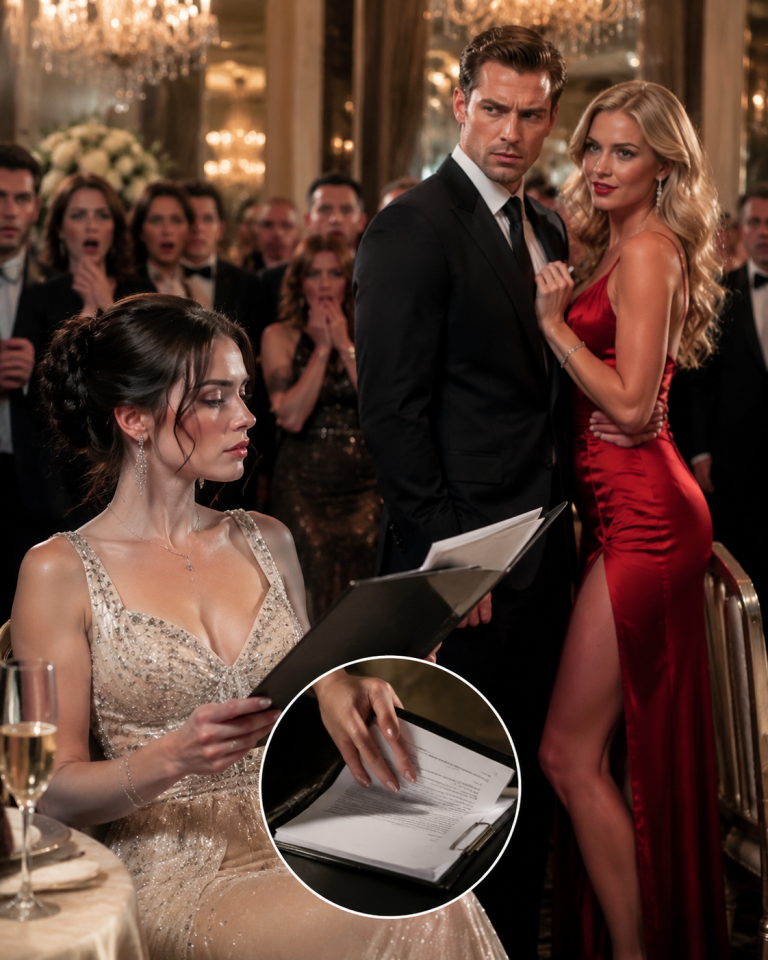
Isla Mercer stood at the edge of the Whitmore Foundation gala, champagne flute untouched, measuring the distance to every door.
The ballroom was built for beautiful lies. Crystal caught the light and fractured it into something harmless. Men in black tie spoke in the register of authority. Women in silk moved through the evening with the practiced ease of people who had learned that rooms like this required performance above all else. Twelve stories up, the city sprawled below the windows in a grid of gold, as if suffering were something that only happened at ground level.
Nathan Reid moved through the crowd.
She felt him before she saw him. That was what eight months had done to her — turned her into a person who registered threat the way birds registered weather. A shift in the air. The particular silence that fell around him when he was deciding something. He had a gift for appearing calm in public. People mistook it for warmth.
She knew it was something else.
He had left marks last Tuesday that a three-quarter sleeve could hide from a dinner party. He had told her in the car on the way here that she owed him a good evening, and the particular softness in his voice when he said *owe* had informed her nervous system of the entire conversation that would follow if she failed to deliver.
Isla had spent forty minutes in the gala bathroom deciding whether to simply disappear.
She had no money in her personal account — that was a long story involving small erosions she had not recognized as erosion until it was finished. She had a phone Nathan monitored through software installed with a smile and an explanation about security. She had a dress that was borrowed confidence, borrowed from a woman she was trying to remember she used to be.
She had nothing else.
Except exits.
Nathan was twenty feet away when she looked up and saw the man by the column.
She did not know why she noticed him. He was not performing attention the way men at these events generally performed attention. He stood near a marble pillar with a glass of something dark, watching the room with the quiet deliberateness of a man who attended parties the way other men attended chess matches. His suit was impeccably black. His face was angled, composed. Older by perhaps fifteen years. Silver threaded through dark hair at the temples.
He was the kind of person a room arranged itself around without anyone deciding to.
Nathan’s hand closed around her elbow from behind.
Isla did not flinch. She had trained herself out of flinching in public.
“You look like you’re thinking,” he said, very softly, into her hair.
That was the telling phrase. *Thinking* meant something specific in his vocabulary. It meant she was separating from the version of her he required her to be, the version with the right smile and the right distance and no interiority of her own.
“I’m fine,” she said.
“Good,” Nathan said. “Stay that way.”
He released her and turned to shake hands with someone nearby, and Isla stood for three seconds deciding whether three seconds was long enough.
Then she moved.
She crossed the floor without a plan, without words rehearsed, without anything except the animal knowledge that staying still meant worse. She reached the man by the column and looked directly at him with everything she had left, and before courage could explain itself to panic, she kissed him.
It lasted perhaps four seconds.
When she pulled back, the man was looking at her with an expression that told her he had not entirely expected this, and also that he was not remotely threatened by it, which meant he was either enormously self-possessed or simply not surprised by anything anymore.
His voice was very quiet. Accented, she thought, slightly.
“Say it quickly.”
Isla’s pulse was tearing at her throat. “The man who just touched my arm. He hurts me. He was coming toward me. If you pretend we’re together, he’ll wait.”
Something moved in his expression. Not pity. Something colder and more useful.
He shifted his weight slightly so his back was almost to Nathan. Not protective theater. Actual geometry, blocking the sightline.
“What’s your name?” he said.
“Isla.”
He said nothing for a moment. Just looked past her, cataloguing.
“Don’t look back at him,” he said. “Tell me something. Anything. Laugh in five seconds.”
“I don’t think I can—”
“Four.”
She laughed.
It came out wrong, too bright, slightly broken. But his expression adjusted and he smiled back — not warmly, but correctly, in the exact shape a conversation looked from across a ballroom.
The name reached her from two women near the staircase, dropped in the confidential tone of information being shared:
*Theo Carver.*
She had heard it before in the way one heard names that lived in the background of powerful spaces — present without being loud, consequential without announcing itself. He owned things. He moved between worlds that did not publicly acknowledge each other. People discussed him the way they discussed weather patterns in dangerous seasons.
And he was currently performing a conversation with her to keep Nathan from arriving.
Nathan stopped fifteen feet away.
She felt it like a temperature change.
Theo Carver raised his glass toward an invisible point past her shoulder and made a short, minimal gesture with two fingers.
Someone materialized from the crowd behind Nathan. A broad-shouldered man in a black earpiece who did not touch Nathan but positioned himself in a way that altered the architecture of the room.
Nathan did not move forward.
Theo looked at Isla.
“In thirty seconds,” he said, “you will walk with me to the car. Not run. Walk.”
“I don’t even know you.”
“No,” he said. “But you know what’s behind you.”
She looked at him — this composed, unsettling stranger who had not asked what she owed him for any of this, who had turned a four-second impulse into something that looked like a plan.
“Why?” she asked.
He looked at her steadily.
“Because you asked. And because men like him should cost something.”
Thirty seconds later, she walked.
—
## PART 2
The car smelled like cedar and old books.
A detail she would remember later, because it was the first thing she noticed that was not a threat assessment.
Theo Carver sat beside her in the dark rear seat and said nothing for three streets. Not awkward silence. Deliberate silence. The kind that gave a person time to stop shaking before being asked to speak.
When they stopped at a red light, he said: “You need somewhere safe for the night.”
“I can’t—”
“Not my house,” he said. “A building I own. Private floor. You will not be listed anywhere in the system. Nathan Reid will not find it.”
She looked at his profile.
“You know his name.”
“I know of him.” A pause. “He moves money through channels that touch mine. The people he works for have been of interest to me for some time.”
Isla felt cold spread through her chest.
Not because of threat. Because of implication.
“You weren’t at the gala by coincidence.”
He was quiet for one second.
“No.”
“And I kissed you.”
“Yes.”
“In front of people who remember things.”
“Yes.”
She pressed her fingers together in her lap. “Does that make me useful to you, or dangerous?”
Theo turned then, and she saw the quality she had noticed across the ballroom up close: not cruelty, not performance. Something more precise. A man who had lived long enough in difficult places to have stripped the unnecessary out of his expression.
“Both, probably,” he said. “I won’t pretend otherwise.”
“That’s a terrible answer.”
“I’m told honesty frequently is.”
Despite herself, something almost loosened in her chest.
She had lived eight months in the presence of a man who spoke beautifully and meant nothing. She had forgotten what honest sounded like.
The car stopped outside an address she did not recognize. A building that presented as apartments but felt like something else — the lobby too quiet, the front desk staff too alert, the elevator key card handed to her by a woman named Vera who spoke with the clipped efficiency of someone who managed safety rather than amenity.
The apartment had no windows on the street side.
She understood why without being told.
In the morning, she found an envelope under the door.
Inside was a new phone, a single credit card in a name that was not hers, and a folded note that read:
*Vera will explain logistics. I will come by at noon. You are not required to be here.*
Isla read it twice.
Then a third time.
She was not required to be here.
Eight months of required.
She sat on the edge of the unfamiliar bed and held the note until her hands stopped shaking.
At 11:52, a second envelope appeared.
Not from Vera.
Slid under the door by someone who had accessed the floor without triggering any of the three alerts Theo had outlined that morning.
Inside was a single photograph.
Isla.
Asleep in this bed.
Last night.
The date stamp read 3:47 a.m.
She stared at it until the room went cold.
Someone was already inside.
And they had been here before Theo.
—
## PART 3
Vera arrived at the room within ninety seconds of Isla’s call, which told Isla something about the building’s actual function. She was followed by two men who swept the room in systematic silence while Vera stood near the door with the specific composure of a person whose job involved not transmitting alarm to frightened people.
“The photo,” Vera said.
Isla handed it over.
Vera looked at it with a stillness that meant she recognized what it represented.
“Mr. Carver is on his way.”
“Someone got into this room,” Isla said. “While I was sleeping.”
“Yes.”
“This is the floor you told me was private.”
“Yes.”
“Then either your security failed, or—”
“Mr. Carver is aware.” Vera folded the photograph precisely. “He will explain what he can.”
Isla crossed to the window — no street view, only a roofline and winter sky — and put her back to it.
She thought about Nathan’s voice in her ear the night before. *Stay that way.* She thought about eight months of slowly learning to read the weather of another person’s mood as a survival mechanism. She thought about how good she had become at it. At reading things.
Theo Carver arrived at twelve minutes past noon and entered the room with the particular alertness of someone who had already gathered information on the way up.
He looked at Isla first.
Then at the swept room.
Then at the photograph Vera held out.
His expression did not change, but something tightened at the edge of it.
“The camera was cloned from outside,” he said, not to Isla, but clearly for her to hear. “Not someone inside the building. Someone with technical access to the feed.”
“Nathan,” Isla said.
Theo’s eyes moved to her. “Probably not Nathan directly.”
“But someone working for him.”
“Working adjacent to him.”
The distinction was fine enough that she paused. “What does that mean?”
Theo sat in the chair across from her, which was a different kind of signal than she expected. Not standing over the room. Sitting in it.
“Nathan Reid has a relationship with a man named Cavener,” he said. “Gerald Cavener. What Nathan doesn’t know is that Cavener has been selling him gradually for three years. Not to competitors. To an older organization that would prefer Nathan’s access to Nathan’s autonomy.”
Isla processed this. “So Nathan is being used.”
“Nathan is always the instrument, not the architect. It is the most dangerous kind of man — one who believes he is more powerful than he is and therefore takes risks that implicate others.”
“He thinks he’s terrifying,” she said quietly.
“Yes.”
“He is terrifying.”
“To you. Not to anyone who has seen what the architects look like.”
Isla looked at the photograph.
“Why am I in this?” she asked. “My father has been dead for four years. I have no money, no family left, no connections.”
Theo was quiet.
“Theo.”
“Your father had connections,” he said. “Ones you may not know about.”
The room went very still.
—
It took most of the afternoon.
Theo spoke with the patience of a man who had learned that information delivered too fast shattered instead of informed. He told her in layers: first the shape of it, then the detail, watching her face for where to slow down.
Her father, James Mercer, had been an architect. Not of buildings. Of the other kind. He had spent twenty years structuring financial instruments for organizations that existed in the space between legitimate and otherwise — not criminal by any crude measure, but useful to people who preferred their transactions to occur in unmarked rooms.
He had known Theo.
Not well. But enough.
He had known Gerald Cavener better.
And three years before his death — before his heart attack on a Tuesday morning that Isla had been told was simply a heart attack — James Mercer had built a structure that contained, inside its legal scaffolding, evidence of enough irregular activity to ruin seventeen different entities and the men who ran them.
“He hid it,” Isla said.
“He hid the key to finding it,” Theo said. “There’s a difference.”
“In what?”
“Where it lives.” He paused. “He embedded the access inside a personal record he would have known only you could interpret.”
Isla stared at him.
“My father hid evidence inside something meant for me.”
“Yes.”
“And Nathan was placed in my life—”
“To retrieve it,” Theo said, “when Cavener decided the timing was right. Nathan doesn’t fully understand that part. He was told to monitor you for other reasons. The retrieval was planned for later.”
Isla stood abruptly.
The room was too small for what she felt.
Eight months.
Eight months of Nathan’s hand on her arm, Nathan’s voice in her ear, Nathan’s particular technique for making her believe that the person she had been before him was weaker, less capable, embarrassing to remember.
And all of it had been logistics.
“He was never even angry at me specifically,” she said. “The cruelty was—”
“Control,” Theo said. “He needed you isolated and dependent before Cavener gave the instruction.”
The word *isolated* caught in her chest.
She thought of her friends she had slowly stopped seeing. Her sister she had gradually told herself was difficult to reach. The version of herself she had set aside.
Not lost. Set aside.
That distinction mattered more than she could yet articulate.
“What does Cavener want from my father’s structure?” she asked.
Theo’s expression changed slightly.
“Control of the evidence before anyone else can use it. The same seventeen entities. The ability to hold rather than expose.”
“Leverage,” Isla said.
“Perpetual leverage. It is more profitable than exposure and requires no burning of anything.”
She looked at him.
“And you?”
“I want the exposure,” he said simply.
“Why?”
“Because three of those seventeen entities have been making it structurally impossible to investigate the people who ordered my wife’s death.”
The sentence arrived without decoration.
Isla heard it.
She didn’t ask immediately. She held it for a moment, the way you held a truth that had mass to it.
“How long ago?” she said.
“Five years.” His voice did not change, but the control of it was visible in a way it had not been before. “Elena was investigating Cavener’s early structure. She was not careful enough about who knew it.”
The dead wife.
Mentioned in the same breath as leverage, as structure, as perpetual control.
Not sentiment. History with teeth in it.
“I’m sorry,” Isla said.
Theo looked at her without the expected deflection.
“So am I,” he said.
The afternoon moved into evening with the particular urgency of two people working toward a problem that required more than strategy.
Isla told him everything she remembered about her father’s habits. The things he had repeated. The phrases he had returned to. Small obsessions that had seemed like quirks — a painting he always mentioned, a particular piece of music, a phrase in Italian he had learned from her mother and used to mean something private.
Theo listened with total attention, not the performance of it, but the kind that cost something.
At seven o’clock, Vera entered with food and the news that Nathan had been to Isla’s apartment building that afternoon with two men, and that Cavener’s people had been observed near a building Theo used for secondary operations.
“They’re moving,” Theo said.
“Yes,” Vera said.
He looked at Isla.
“You don’t have to stay,” he said. It was the third time he had said something equivalent, and each time it landed differently.
“My father hid something inside a record meant for me,” she said. “You need to find it. I’m the only one who can.”
“Yes.”
“Then I stay.”
—
The record was music.
That was where Isla’s father had been most reliably himself — a Thursday evening playlist he had maintained on a physical drive since before streaming services existed, organized not by artist or album but by the emotional logic of something no external algorithm could have reproduced.
*The order is the message,* Isla said, looking at the track listing on her own laptop, which Vera had retrieved from her apartment while two of Theo’s people stood outside Nathan’s building watching the lights.
Theo sat beside her.
The track listing was twenty-three songs. Most were unremarkable. But the first letter of each title, read in sequence, spelled nothing recognizable. The third word of each title spelled nothing. The composer initials were meaningless in order.
Isla stared at the screen.
She thought about her father. His patience. His fondness for layers. His habit of making things look uncomplicated.
She thought about Saturday mornings when she was small, the house smelling like coffee, her father at the kitchen table with a newspaper and the music playing, and the way he would call her to listen when a particular song came on.
*This one, Issy. What does this one make you think of?*
She looked at the track listing again.
“Track seven,” she said. “He played it every time something mattered. Anniversaries. When I graduated. When he found out he was sick.”
Theo looked at it.
*Elegy for a Quiet Room.*
By a composer named L. Vance.
“L. Vance didn’t exist,” Isla said slowly. “He invented that name.”
Theo’s expression sharpened.
She counted the letters in the title.
Twenty-four.
The letters in the title of every other track on the playlist totaled, when added together and divided—
“It’s a cipher,” she said.
“Can you read it?”
“He taught me,” Isla said. “When I was twelve. He called it a game.”
She worked for an hour with Theo beside her, saying nothing, occasionally passing her paper when she filled one sheet. His stillness was useful. It felt like being permitted to concentrate.
When she finished, she had a forty-character string that resolved, through her father’s particular system, into a set of coordinates and an account number.
Theo photographed it.
Then looked at her.
“You have been carrying this without knowing it for four years,” he said.
“My father trusted me with it.”
“Yes.”
“He must have believed someone would come.”
Theo was quiet.
“He left a letter,” he said.
Isla looked up sharply.
“With Father Benedikt,” Theo said. “The priest at the church your father attended. I was told about the letter three months ago but didn’t know who to bring to read it. He specified his daughter.”
The room rearranged itself.
“He knew you,” Isla said.
“He trusted my objectives, not me specifically.”
“He thought you might be the one who came.”
Theo said nothing.
But she saw, in the way he did not answer, that it was true.
—
They went to the church the following morning.
It was small, worn at the edges, in a neighborhood that had been through several iterations of itself without fully deciding what it was. Father Benedikt was eighty-one, walked with a cane, and greeted Theo with the wariness of a man who had kept a secret for a long time and was cautiously relieved to release it.
The letter was in a sealed envelope inside an old hymnal, page 214, which was the chapter number of the first apartment Isla had lived in alone.
She opened it in a pew near the back.
Theo sat at a respectful distance.
*Issy,*
*If you are reading this, then the people I feared have arrived. I am sorry. I tried to give you enough time and distance. I was never certain I succeeded.*
*The man who brought you here — whatever his name, whatever his history — he is not them. He is the counterweight. I chose him from the others because he lost something to the same machinery I helped build, and that kind of grief makes a man reliable in a way that ambition cannot.*
*I owe you an apology I cannot give in person. What I built made me complicit and then made me useful to men who should not have had tools like mine. I built the exit before I died. It is yours now.*
*The cipher was always just for you. I knew you would remember the game.*
*I love you, Issy. Not the way I sometimes showed it. The real way, the quiet way, the way that was always there even when I was bad at saying it.*
*Finish what I started. And then put it down and live.*
Isla folded the letter.
Pressed it against her chest.
Said nothing for a long time.
When she finally looked up, Theo was watching her with the unhurried patience she had come to understand was not distance, but the specific care of a person who knew that certain moments required space rather than presence.
“He said he chose you because of your grief,” she said.
Theo’s expression stayed even.
“He said it made you reliable.”
“Your father was a perceptive man.”
“He was a guilty one who did something useful with it.” She looked at the hymnal in her hands. “How long did you know about me?”
“Six weeks before the gala.”
“And Nathan?”
“He became connected to your father’s structure eight months ago.”
Eight months.
The exact duration of her nightmare.
The coincidence was not a coincidence.
“Did you watch?” she asked.
Theo’s jaw tightened. “Not closely enough.”
That was not an excuse. She registered that.
“You were building a case,” she said.
“Yes.”
“And I was—”
“In it,” he said. “Already in it before I knew you were.”
She nodded slowly.
“At the gala,” she said. “If I hadn’t kissed you.”
“I was going to approach you,” he said. “Differently.”
“How?”
“With considerably more planning and considerably less surprise on my part.”
Something almost like humor moved through her.
She stood.
“We need to use the coordinates before Cavener moves again.”
Theo stood too.
“Vera has a team ready.”
“And Nathan?”
“Nathan is currently explaining to federal officers why he had surveillance software on eight phones in the past two years.”
Isla blinked.
“When did that happen?”
“This morning,” Theo said. “While you were reading.”
She thought about Nathan in a federal office. Nathan, who had made himself enormous in her nervous system, filling every room before he entered it.
Being asked to explain himself to people he could not charm.
“He won’t cooperate,” she said.
“He will when Cavener’s people realize he’s been arrested and start protecting themselves from the fallout.”
Theo moved toward the church door. Isla fell into step beside him.
Outside, the morning was cold and clear. The city went about its business.
“Cavener,” she said.
“We have three days before he moves the structure.”
“What happens after?”
Theo looked at her as they reached the car. “He is handed to the same federal investigation with a package of evidence that makes denial impossible. The seventeen entities collapse or cooperate. The people who ordered Elena’s death are named in a sworn record.”
Elena.
Said without flinching.
Without theater.
“And then?” Isla asked.
Theo opened the car door.
“Then it ends,” he said. “Or at least this part of it.”
She looked at him across the roof of the car.
“You’ve been running toward this for five years.”
“Yes.”
“What does it look like when you stop?”
He met her eyes.
“I don’t know yet,” he said. “I stopped being able to imagine it.”
The honesty of that landed somewhere quiet and important.
Isla got in the car.
—
The three days were not clean.
Cavener moved faster than expected on the second day, which required a redistribution of Theo’s resources that Isla watched from a fortified room in a building she was now able to navigate without being told where anything was. She had memorized the exits, as she always did, but this time she also knew the entrances, the security protocols, the names of the people who worked them.
That was different.
Nathan’s attempt to negotiate his way out of federal custody by offering Cavener’s connection collapsed when two of Cavener’s intermediaries, faced with the coordinates Theo provided to the investigation, decided that personal survival outweighed loyalty.
This was explained to Isla by Vera on the second evening while Theo was in three simultaneous conversations via encrypted devices.
“He moves quickly,” Isla said.
“He has been preparing this for five years,” Vera said. “Most of the speed now is simply the inevitable part.”
“The inevitable part of what?”
“Of a machine designed to fall.”
Isla thought about her father building an exit into a structure he helped design. The long patience of it. The trust placed in a daughter who would one day receive a cipher she had practiced as a game.
She thought about the way cruelty and structure often came from the same place: the belief that people were instruments.
Her father had understood that and tried to correct it.
Nathan had never questioned it.
Cavener had built a career on it.
And Theo Carver had spent five years trying to dismantle it, not because he was good — he had never claimed to be good — but because he had loved someone it destroyed.
On the third morning, Cavener was arrested at an airport.
Not by Theo’s people.
By the investigation that had been building for years, newly supplied with a forty-character access key decoded from a dead architect’s playlist.
Theo was in the room when Isla heard.
He did not celebrate. He sat very still and looked at a fixed point for perhaps thirty seconds, in the manner of someone who had been braced against a wall for so long that removing the wall required a moment to remember how to stand without it.
Isla said nothing.
She had learned, in the past three days, what his silences needed.
After a moment, he looked at her.
“Your father’s letter,” he said. “He told you to finish and then put it down.”
“Yes.”
“That part was for you. Not the evidence.”
“I know.”
He studied her. “What do you want to put down?”
Isla thought about the exits she had catalogued since she was twenty-four. The eight months of careful performance. The woman she had set aside, believing she would retrieve her later.
“The counting,” she said. “I want to stop counting exits.”
Theo’s expression changed.
Just slightly.
The particular quality of it made her look at him more carefully.
“You do it too,” she said.
“Constantly,” he said. “For different reasons.”
“The same instinct.”
“Probably.”
She looked at him across the room — this controlled, unsettling man who had answered her four-second impulse with three days of everything he had, who had told her the truth about his motives when lying would have been easier, who had sat beside her in a church pew at a distance that gave her room to grieve privately.
“The gala kiss,” she said.
He waited.
“You said you were going to approach me differently.”
“Yes.”
“What would you have said?”
He considered this with the seriousness he brought to everything.
“Probably something about your father’s work. About what I needed. Very direct. Very insufficient.”
“And instead I kissed you in front of half the city.”
“Yes.”
“Which made Nathan hesitate.”
“And made Cavener curious, which accelerated his timeline, which ultimately made him easier to catch.”
Isla laughed.
A real one.
Not the wrong-bright version from the gala. The kind that came from somewhere genuine and surprised her with its existence.
Theo looked at her when she laughed with the expression of someone encountering something unexpected in familiar territory.
“You should do that more,” he said.
“Laugh?”
“Be surprised.”
She tilted her head. “At what?”
“Anything,” he said. “You were trained out of it.”
The observation was simple and accurate and hit her somewhere she had not expected to be reached.
“My father said to put it down and live,” she said.
“Yes.”
She looked at him.
“I don’t entirely know what that looks like yet.”
“Neither do I,” he said.
“But—”
“But it seems possible,” he finished, “in a way it did not a week ago.”
The room was quiet.
Not the managed quiet of the safe building. The quiet of something unforced.
Isla crossed to the chair nearest him and sat.
Not touching. Just close.
“I kissed you in a panic,” she said.
“I know.”
“And then you just — reorganized your entire operation.”
“You were already part of it.”
“But you didn’t tell me that immediately.”
“No,” he said. “Because you had just come from eight months of a man deciding what was true about your life without asking you. I was not going to add to that in the first hour.”
She looked at his hands resting on the table.
“That was—” She stopped. “That was a very careful decision.”
“I hoped so.”
“Most people would not have made it.”
“Most people did not watch their wife walk into something avoidable,” he said, “and spend five years thinking about every decision that preceded it.”
The sentence carried its weight without theater.
Isla reached across the table and placed her hand over his.
His fingers stilled.
Then, carefully, turned over.
“I am not a man who does this easily,” he said.
“I gathered that.”
“And you are not someone who should be asked to navigate into another complicated thing immediately after—”
“Theo,” she said.
He stopped.
“I understand complications.”
His thumb moved slightly against her hand.
That was all.
But it was genuine, which she had come to understand was worth more than most things.
—
Six months later.
The criminal structures her father had built dissolved into federal proceedings. Seventeen entities negotiated, collapsed, or were simply exposed to the accounting that follows when the people protecting secrets start protecting themselves instead.
Gerald Cavener received a sentence that ended his professional existence and most of his personal one.
Nathan Reid cooperated with the investigation in the comprehensive way of a man who understood he had no remaining alternatives. He received a reduced term that required, as part of its conditions, a restraining order with Isla’s name on it.
She had not needed to request that.
The federal attorney had added it automatically, based on evidence she had provided in a statement she wrote in Theo’s dining room over three hours, without being asked to minimize anything.
Vera brought tea that she did not want, and Theo sat at the far end of the table reading something and not interrupting, and she wrote every true thing down.
Elena Carver’s death was attributed to a deliberate action by two individuals whose names appeared in her father’s evidence structure. A case was opened.
It would take time.
Theo understood time.
Isla was learning to.
On a Thursday afternoon in early spring, Isla stood at the window of an apartment that was hers — not borrowed, not Theo’s, not a building with no street view — watching the city below with her coffee in both hands.
The window faced east. You could see, on clear days, the faint glint of water in the distance.
Her phone rang.
Theo.
“You’re counting,” he said.
She had not told him she was at the window.
“How did you know?”
“You go quiet in a specific way when you’re counting.”
She smiled at the glass. “What way?”
“Like you’re doing something that used to be necessary and is now becoming optional.”
She looked at the street below. The exits — door, north, south, alley, main — presented themselves automatically. She registered them without needing them. The difference was subtle and enormous.
“I’m working on it,” she said.
“I know,” he said. “That’s why I called.”
“Suspicious timing.”
“I have dinner. If you want it.”
She looked at the city and thought about her father’s letter. *Finish what I started. And then put it down and live.*
She thought about what living looked like when you started from a cleared field.
Probably imperfectly. Probably slowly. Probably in the company of a man who counted exits too, who had loved someone the world took, who had spent five years as a machine aimed at the people who took her and was now, carefully, learning to be something less precise.
“What kind of dinner?” she asked.
“The kind with wine and no strategy.”
“That sounds unlike you.”
“I’m working on it,” he said.
She laughed.
The honest kind.
“Yes,” she said. “Come over.”
She set the phone down and stayed at the window a moment longer. Below, the city ran its ordinary business. Taxis. Foot traffic. A couple arguing at the corner and then laughing at something. The particular texture of normal life continuing its work.
She looked at the exits.
Then she turned away from the window.
This time, she left them behind.
—
—
—