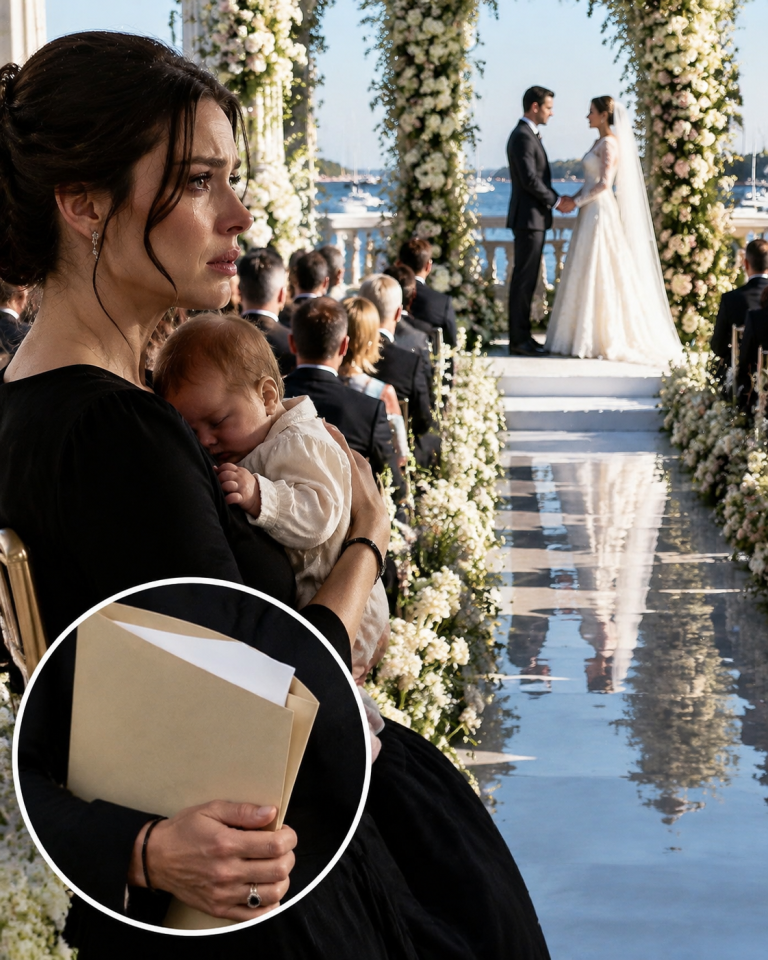
The Little Orphan Swiped a Black Card—And Exposed the Mafia Boss’s Deadliest Secret

**PART 1**
He almost didn’t look down.
That was the part Enzo Corsari would think about afterward — not the gunfight, not the video, not the silver cross. The part that stayed with him was the three seconds when he was already turning away from the mezzanine rail, briefcase in hand, transfer confirmed, car waiting on East 57th. Three seconds during which he could have gone back to being the man he had spent twenty years becoming: precise, protected, finished.
Then the laughter rose from the lobby below, and it had a particular shape he recognized.
The shape of cruelty dressed as amusement.
He turned back.
Below, in the marble atrium of Carrington Private Banking, a girl stood alone.
She was small — six, maybe seven, with dark blond hair that looked like someone had attempted a braid in a moving vehicle and given up. Her coat was a size too large. Her shoes were the kind that had been repaired more than once, the toe of the left one lighter where it had been reglued. In both hands, held against her chest with the grip of someone carrying something they’ve been told is important, was a matte black card.
Around her, Carrington glittered: men in hand-tailored suits, women with jewelry that had been appraised rather than purchased, the specific smell of money old enough to have lost its conscience. And they were all laughing.
At the child.
Harrison Voss, the branch director, was crouched toward her in the particular way of a man performing kindness for an audience.
“Tell me, sweetheart,” he said, loud enough to carry — loud enough to *intend* to carry — “where exactly did you find a card like that?”
The girl swallowed. Her eyes shone, but she didn’t cry.
“I just need to check the account,” she said. “My mama told me to come here when I turned seven. I turned seven last week.”
A woman nearby laughed into her glass. A man in an oil-money suit smiled at his companion. Someone lifted a phone.
Enzo’s hand found the railing.
Beside him, his second, Marco Testa, leaned close. “Boss. Car’s waiting.”
Enzo didn’t move.
There was something about the girl.
The set of her chin. The way she stood in the middle of their contempt and did not fold. He had seen that once before — that particular brand of dignity that belonged to people who had learned young that the world was not arranged in their favor and had decided, quietly and without drama, not to let that matter.
He had seen it in a woman named Mara Senna, fifteen years ago, in the back of a laundromat in Red Hook during the worst night of his life. She had found him bleeding behind the industrial dryers, called him an idiot in three languages, and spent the next two hours removing a bullet from his side with improvised instruments and a steadiness that made him feel ashamed of himself for the first time in years. He had left before sunrise because staying would have made her a target. He had told himself that was mercy.
He had told himself that for fifteen years.
Below him, Harrison Voss took the card from the girl with two fingers, the way you handle something mildly disgusting.
“Let’s see what we have here,” he said, sliding it into the terminal. “Maybe enough for a bus fare home.”
The lobby tittered.
The loading bar crossed the screen.
Then the number appeared.
$58,700,000.
And beneath it, in red letters, a protocol designation that should not have been visible on any terminal outside of Enzo’s private infrastructure:
CORSARI TIER ONE — RESTRICTED ACCESS.
The laughter stopped.
Every molecule of sound in the lobby simply ceased.
Harrison Voss’s face went from pink to the color of old chalk in under two seconds. The woman with the champagne glass stood motionless, the flute frozen halfway to her lips. The man with the phone put it in his pocket with the careful deliberateness of someone who had just decided they hadn’t seen anything.
The girl looked around at the sudden silence, confused.
“Is something wrong?” she asked. “Mama said the money was for emergencies. Is it enough for Mrs. Petrov’s rent? She’s going to lose her apartment and she helped us move when we had to leave in a hurry.”
No one answered.
Enzo’s grip on the railing was tight enough to leave marks.
The Corsari tier protocol was not a feature of any banking software. It was a private encryption structure his family had built after the 2012 collapse, when three capos and a federal accountant had all disappeared in the same week and the organization had needed a way to mark protected assets invisibly. Only four people had ever known how to activate it.
Three of them were dead.
He descended the marble staircase.
Each step landed quietly, the way his steps always landed — but today the lobby felt them anyway. The people who had been laughing backed toward the walls before he reached the floor. Harrison Voss straightened with the reflexive panic of a man recognizing an authority he cannot manage.
“Mr. Corsari — I wasn’t informed you were still on premises. I can explain everything—”
Enzo walked past him.
He stopped in front of the girl.
She looked up at him. Not frightened. Assessing. Her eyes were the same particular green as the woman he had left in Red Hook fifteen years ago, and he felt the recognition of that fact hit him somewhere well below rational thought.
He crouched down.
“What is your name?” he asked.
“Lucia,” she said. “Lucia Senna.”
The name arrived in his chest like a door being opened in a house he thought had been sealed.
He held out his hand. She put her small fingers into his palm without hesitation, the way children do when something in them has already decided.
“My mama told me,” she said quietly, “that if I was ever in trouble, I should find a man named Enzo. She said he had a scar on his jaw and gray eyes and he would help me.” A pause. “She said he had a good heart under all the armor.”
Enzo’s throat closed entirely.
Then the building did something buildings in Manhattan do not do.
Every exit sealed simultaneously.
Steel security panels dropped across the doors with a sound like thunder, one after another, fast enough that anyone who reached for a handle was already too late. The chandeliers flickered. The lobby lights shifted to the deep amber of emergency mode. A pre-recorded voice, calm and absolutely without warmth, announced from the ceiling: *Security protocol active. All access restricted. Please remain in place.*
Nobody remained in place.
Marco appeared at Enzo’s shoulder. “No signal. No Wi-Fi. It’s a military-grade block.”
Across the lobby, the woman with the champagne glass reached into her Birkin and produced a handgun.
The man in the oil-money suit drew a blade from each side of his vest.
Three attorneys, who had apparently not been attorneys at any point today, separated into tactical positions with compact pistols.
The receptionist at the welcome desk lifted a chrome weapon from beneath the desk surface.
Eight people. Not one of them a real client.
The entire lobby had been assembled.
Harrison Voss slid down behind the teller counter, shaking.
“They said they’d only hold you until ten,” he gasped. “They have my wife. They told me to smile and keep you here. I didn’t know there were weapons. I swear on my daughter’s life, I didn’t know.”
Enzo moved Lucia behind him.
The woman with the handgun smiled. “You’re asking yourself the wrong question, Enzo.”
“I haven’t asked one yet.”
“The right question,” she said, “is who inside your family handed them the room.”
Behind him, Lucia’s fingers found the back of his jacket and held on.
“My mama said you would keep me safe,” she whispered. “Please tell me she told me the truth.”
Eight weapons rose.
Marco leaned close, his voice barely moving. “There’s a service corridor behind the vault. I mapped this branch in 2020. Narrow. We can reach it if we go now.”
“And Lucia?”
Marco’s face did the thing it did when he had to say something that hurt him. “She’s the reason they set this up. If you carry her, we all die slower.”
Lucia heard enough.
She looked up at Enzo with the dry eyes of a child who has already used her tears for more important things.
“You can go,” she said. “I don’t want to be the reason.”
Something broke open inside Enzo Corsari that had been closed for fifteen years.
He shrugged off his jacket and wrapped it around her shoulders.
“Listen to me carefully,” he said. “Once before, I left someone from your family behind. I told myself I was protecting her. I was wrong.” He looked at her. “I will not be wrong in that same way twice.”
From his jacket lining, a Beretta appeared in his hand.
Marco exhaled. “The loud way, then.”
“The loud way,” Enzo said.
The first shot broke across the lobby like a starting gun.
—
**PART 2**
The freight elevator descended into the basement with the particular heaviness of something that had already made its decision.
Lucia stood between Enzo and Marco, swallowed inside the black jacket, her face streaked with blood that was not hers. She had not cried yet. The morning had been too large for tears — the way certain kinds of fear bypass the ordinary emotional channels entirely and go somewhere deeper, quieter, harder to reach.
Marco jammed the elevator mechanism with a length of cable. The corridor beyond the doors was concrete, ugly, and blessedly free of marble and gold. The director’s office at the end of it was a small utilitarian room — steel desk, locked cabinet, a security monitor showing three of the remaining armed figures searching the lobby above.
Marco had the cabinet open in five seconds.
Enzo sat Lucia in the chair, pressed a folded cloth against his shoulder, and inserted the drive into the computer.
One file. His name on it.
He clicked it.
Mara Senna filled the screen.
Older than memory — thinner, with new lines around her eyes and a tiredness that sat in her face the way a long illness sits. She was in a cheap motel room, a water-stained print on the wall behind her, sitting very straight in the way of someone who has rehearsed this and needs to finish before they can’t. But the eyes were the same. The same fierce, unforgiving green that had looked at him across a first-aid kit fifteen years ago and decided, without sentimentality, to save his life anyway.
“Enzo,” she said. “If you’re watching this, I’m gone.”
Lucia made a sound. Barely a sound.
Enzo turned the monitor slightly. Lucia’s hand came out of the jacket sleeve and caught his wrist.
“I want to hear her,” she whispered.
He left the video running.
“Lucia is my daughter,” Mara said. “She is not yours. I know you’ll count the months. But you were the only person I trusted enough to leave her with when I was gone.” A pause. “I kept her out of everything connected to you. I moved four times. I changed her school twice. I was careful.”
Her voice changed.
“Someone inside your organization found me six years ago. Not to hurt me. To use me. They were moving money through accounts I couldn’t trace because they bore protection codes that shouldn’t have existed outside your private system. My father was a fraud investigator — retired, not dangerous. He found the trail anyway. He was killed in a traffic incident in 2021 that no one looked at too closely.” She looked directly into the camera. “I looked at it. I found enough. The sixty-two million isn’t Lucia’s inheritance. It’s a evidence deposit. It marks every transaction that ran through a protected channel without authorization.”
Enzo was very still.
“I know what the world says you are,” Mara said. “I know what you became after that night in Red Hook. But I also know the man who let a stranger dig a bullet out of his ribs and said thank you before he left.” Her voice broke slightly, caught itself, continued. “Find that man. Lucia is going to need him.”
The screen went dark.
A folder opened automatically. Bank statements. Wire transfer records. Photographs. Voice recordings. Names he knew.
Captains. An accountant who had been with the family for twelve years. A shipping broker. A circuit judge whose name appeared in four of his more sensitive files.
And at the top of the list, highlighted in red:
SERA ANELLI.
His senior financial director. The woman who had managed his books for five years, who had sat across from him at dinner three nights ago and laughed at something he’d said about the market. The woman who had access to every protected protocol in the family system — because he had given it to her, because he had trusted her, because trust and competence looked identical until the moment they didn’t.
The terminal chimed.
A message appeared in a text window.
*Did you miss me, Enzo? — S*
The screen split.
Sera Anelli appeared — seated behind his own desk, in his office at Corsari Tower, drinking from his father’s crystal glass with the ease of someone who had been waiting to do this for a long time.
“Hello,” she said. “You look terrible.”
Enzo’s voice was entirely level. “How long.”
“Five years. Almost exactly.” She tilted the glass. “From the day you handed me the books and mistook efficiency for devotion.”
“You killed Mara’s father.”
“I arranged an inconvenient commute.”
“You used a child.”
“I used geometry,” Sera said. “You were the magnet. She was the angle of approach. You arrived exactly as I calculated.” Her expression sharpened. “Every family from here to Naples has been watching, Enzo. They’ve seen the great Corsari lion kneel in a bank lobby for a little girl in a secondhand coat. Whether you die today or spend the rest of your life running with her, I’ve already won. They know where your soft place is.”
“You’re in my office,” Enzo said.
“Yes.”
“You think that gives you my city.”
“I know it does.”
She leaned forward.
“One more thing. Turn around.”
At the far end of the corridor stood a man in a charcoal suit, silver-templed, steady-handed. Enzo recognized the stance before he recognized the face. The man who had apparently brought Lucia to the bank this morning. The man she had called, in the lobby upstairs, by the name she used for family.
Lucia saw him too.
The sound she made was not a scream. It was smaller and worse than that — the specific, rupturing sound of a child understanding that someone they trusted was not what they appeared to be.
“Uncle Dario?” she whispered.
Dario Crane looked at her with the expression of a man who has made his calculation and does not enjoy the result.
“I’m sorry, little one,” he said.
And Lucia finally cried.
—
**PART 3**
Enzo moved before the sentence finished.
He swept the chair sideways with one arm, putting Lucia out of the direct line. Marco fired from the doorway. Dario ducked, returned fire twice — one shot caught Marco in the upper arm, spinning him into the wall. Marco stayed upright, which was the most Marco thing Marco had ever done.
Enzo crossed the room into Dario, driving him backward into the corridor with the weight of a man who had long ago learned that anger, in someone disciplined, was not a fire but a precision instrument. Dario was trained — not a crude man, not desperate, a professional who had been close to Lucia for years and hated himself for it in some way that didn’t make any difference now.
He fought well.
Enzo fought with the specific motivation of a person who has only recently understood what they are fighting for.
He broke Dario’s wrist against the wall. The weapon fell. Dario swung with his other arm. Enzo caught him by the throat.
“Sera has a second team,” Enzo said. “Where.”
Dario smiled through blood. “Warehouse on the waterfront. Pier 19. But it doesn’t matter — she already has the girl’s records. Foster system backup. School files. Even if you walk out of here, she’ll never stop having something to reach for.”
Enzo looked at him.
“No,” he said. “She will reach for what I allow her to see.”
He struck Dario once, cleanly. The man dropped.
Marco appeared in the doorway, pressing his sleeve against his arm. “Boss. We need to move while we still have a window.”
Lucia stood at the edge of the office doorway.
She was not shaking anymore. She had moved through some threshold that children move through when terror becomes just another condition of the world, and what remained was a stillness that was not calm — it was something more serious than calm.
“He tucked me in,” she said. “When Mama was in the hospital for the last time, he was the one who tucked me in.”
Enzo crouched down, ignoring the pain in his shoulder.
“Look at me, Lucia.”
She did.
“Some people wear kindness the way other people wear a coat,” he said. “Because it gets them somewhere they need to go. That is not your failing. It is not something you should have seen. Children are supposed to be able to trust adults.” His jaw tightened. “You are not responsible for the lies of people old enough to know better.”
She looked at him for a long moment.
“Mama said you left because you were trying to protect her.”
“Your mama was right.”
“She said you were wrong to.”
“She was right about that too.”
Lucia stepped forward and put her arms around his neck the way a child embraces someone they have decided to keep.
Enzo held her carefully, aware of his injuries, aware of Marco watching from the doorway, aware that he was a man who had spent twenty years cutting away every tether to anything soft and had somehow ended up here anyway.
They got out through the service tunnel, emerging into a delivery alley where an old car waited — a backup vehicle Marco had placed two days ago as a habit, the way twenty years in this life taught you to leave exits you might need. The city above continued in its indifference, unaware that a war had been opened beneath it.
By noon, Lucia was in a house outside the city, wrapped in a gray sweatshirt two sizes too large, eating soup she didn’t want but Marco insisted upon. A family physician stitched Enzo’s shoulder. Another worked on Marco, who refused anything for the pain until he confirmed personally that Lucia had stopped shaking.
That evening Enzo sat by a low fire while Lucia slept on the couch, one hand still curled around the sleeve of his jacket.
At midnight she woke.
“Enzo?”
“Yes.”
“Are you my father?”
The fire made small sounds. Outside, the countryside was dark and absolutely still.
Enzo had faced men with weapons, judges with warrants, his own worst decisions laid out in front of him in handwritten ledgers. None of it had frightened him quite the way that question did.
“Not by blood,” he said.
She looked down.
“But I loved your mother,” he said. “I left her because I thought it was protection. I was wrong. I cannot change what I did, but I can keep the promise she left behind, if you’ll let me.”
Lucia reached inside the sweatshirt and pulled out a thin silver chain. A small cross hung from it — tarnished, hand-etched, the kind of object that is old enough to have been handled by many people in different kinds of need.
“Mama said this belonged to a woman who looked after us,” she said. “She said the woman was very old and very quiet and left it for me when she died. She said it would keep me safe.”
Enzo went completely still.
The cross was his mother’s.
Rosaria Corsari’s baptismal cross, the one he had placed in the coffin with her himself, the one he had watched lowered into the ground in a Greenpoint cemetery on a Thursday morning in November, seven years ago. He had believed it buried.
His mother had known Mara Senna. She had found her, somehow, in the careful invisible way his mother had always managed things — not loudly, not as a declaration, but as a quiet act of navigation. She had given her protection and given Lucia the cross, and she had done all of it without telling him, because she had understood that he was not ready to know. That he needed to arrive at it himself, by a different road, in his own time.
Even dead, his mother had been arranging his redemption.
Enzo took the cross in his hand and sat with it for a long time.
—
Three hours later, a courier delivered the contents of a safe deposit box from Queens.
Eleanor’s files — Mara’s files — were more comprehensive than the drive had shown. Bank statements tracing the movement of ninety million dollars through Sera Anelli’s shell infrastructure, using Corsari protection codes to make it look legitimate. A recording between Sera and a man named Vitale Corsetti, head of a rival family, made in a private club fourteen months ago, outlining the terms of their arrangement. A death-scene photograph from the investigation into Thomas Senna’s accident, with handwritten notations from the officer who had tried to flag it and been overruled.
At the bottom of the envelope, folded twice, was a letter.
*Enzo,*
*My father was an honest man. Sera had him killed because honest men are expensive to maintain. If there is anything left in you of the person I found behind a dryer in Red Hook, prove it doesn’t matter who’s watching.*
*— Mara*
He read it twice.
Then he made the calls.
—
Pier 19 was a warehouse of the type that cities keep because no one has yet decided what to replace them with — long, rusted, loud with water against its pilings, the kind of structure that had witnessed enough irregular business to have lost its capacity for surprise.
Sera Anelli had chosen it because it had been, for a decade, one of the Corsari organization’s unmarked logistics points. She had used his own infrastructure against him. She appreciated that kind of symmetry.
At 4:09 in the morning, a video arrived on Enzo’s phone.
Lucia was in a chair at the center of the warehouse floor, hands bound, duct tape across her mouth. She was alive. She was frightened. And she was doing something that, even through a phone screen, Enzo could read clearly: she was systematically cataloguing the windows, counting the distance between herself and each of the six armed figures in the room, studying the angles.
Eleanor’s daughter.
*Even terrified, still counting exits.*
Sera appeared at the edge of the frame. “Thirty minutes. Come alone.”
Enzo watched the clip once.
Then he called Marco.
“Can you climb with that arm?”
“Badly,” Marco said. “Yes.”
Twenty-four minutes later, Enzo walked into Pier 19 through the main door.
Alone.
That was what Sera saw.
What she did not see was Marco on the roof, using a rope and a level of stubbornness that had no medical justification. What she did not see was the three people who had answered Enzo’s calls that morning — old loyalties, careful debts, men who had been waiting to know which side was the stable one. What she did not see was the documentation that had been transmitted to the council of families at 3:47 AM, with a brief attached note: *Sera Anelli. Corsetti arrangement. Evidence enclosed. Decide.*
Sera stood under a hanging work light in a black coat, her hair perfect, her weapon resting against Lucia’s shoulder. Vitale Corsetti stood near the loading doors, old and heavy and clearly already in the process of recalculating whether his arrangement with Sera had been as sound as it appeared six months ago.
Enzo walked into the light with his hands visible.
Sera’s eyes moved over him with the satisfaction of a person whose plan is arriving on schedule.
“There he is,” she said. “The man who knelt for a child in a bank lobby.”
Enzo looked at Lucia first.
Her eyes filled when she saw him.
“I promised,” he said quietly.
Sera pressed the gun closer. “Touching. Really.” Her expression sharpened. “Do you know your problem? You still think power is about territory. It was never about territory. It was about the fact that men in your position inherit everything and women in mine are given a desk and asked to be grateful.”
“You could have left.”
“And become what?”
“Anything,” he said. “Instead you chose to become the thing you resented.”
Sera’s smile thinned.
Enzo’s eyes moved to Corsetti.
“The council received the documentation at 3:47,” he said. “Including the recordings. Including the shell transfers. Including the meeting at the Sobieski Club fourteen months ago.” He paused. “Every family that was supposed to watch me bleed tonight is currently deciding whether Vitale Corsetti is someone they want to be associated with.”
Corsetti’s face moved through several colors.
Sera’s composure fractured slightly at its edges.
“You’re bluffing,” she said.
“I transmitted it from a device they can verify. They’ve had ninety minutes to read it.” Enzo’s voice was flat. “You built this whole arrangement on the assumption that my visible weakness would make me easy to replace. You were correct about the weakness. You were wrong about what it means.”
“The girl,” Sera said, “was a weakness.”
The warehouse went still.
Enzo’s voice dropped to something almost conversational. “Say that again.”
Sera raised the gun from Lucia’s shoulder toward Enzo.
And Lucia, who had been counting exits for the last twenty-two minutes and had been waiting for the moment the gun moved away from her, threw her weight sideways off the chair.
The chair tipped.
The gun swung wide.
Enzo moved.
The skylight above shattered as Marco came through it on a rope, moving with an arm that had no business functioning the way it was and a precision that suggested rage and loyalty are more effective anesthetics than medicine. He dropped two of the armed figures in quick succession. Corsetti’s men, who had been reassessing for the past several minutes, made their decision and lowered their weapons. Old criminals have a refined ability to recognize when an arrangement has stopped being profitable.
Enzo crossed the floor through noise and smoke, taking one shot in the shoulder that he noted and set aside. Sera backed toward the doors. She fired again. He kept moving.
“You should have stayed cold!” she screamed. “This is what mercy costs you!”
He reached Lucia.
He cut the binding with a folding knife and removed the tape from her mouth with his free hand, as carefully as shaking hands allowed.
Lucia put her arms around him.
“I counted four windows and six people and the distance to the door,” she said into his jacket.
“I know,” he said. “I saw you.”
“I was trying to help.”
“You did.”
Sera raised the weapon one final time.
Marco’s shot caught her in the shoulder. Clean. Non-lethal. She dropped to the warehouse floor with more grace than the moment deserved, and she looked at Enzo from the concrete with an expression that was not defeat so much as exhausted recognition.
“You won’t be what you were,” she said.
Enzo stood with Lucia in his arms.
“No,” he said. “I’ll be something else.”
—
The council took Sera Anelli at dawn.
Vitale Corsetti signed significant territory across a folding table in a social club in Astoria before sunrise, in exchange for his continued freedom to go home and be embarrassed by his grandchildren. He kept his life because old men who have lost badly are sometimes more educational alive.
Dario Crane disappeared into federal custody after Mara’s documentation reached a prosecutor who had been looking for exactly this entry point for three years. He did not negotiate. Some things, even professionals cannot face.
Harrison Voss lost his position, his professional license, and his dignity in sequence. He kept his wife and his daughter, which was, he discovered, the only column in the ledger that had ever mattered.
And Lucia?
Six weeks later, she stood in a courtroom in lower Manhattan in a navy dress, white tights, and the silver cross of Rosaria Corsari around her neck.
Enzo sat beside her with his arm in a sling, displaying considerably less composure than he would have liked.
Marco stood behind them both, having appointed himself godfather on the grounds that no one had technically told him he couldn’t.
The judge reviewed the papers with the careful attention of someone who understood that adoption is not a transaction.
“Mr. Corsari,” she said, looking up. “You understand this is permanent.”
Enzo looked at Lucia.
She was looking back at him with eyes that had seen too much for her age and had decided, somewhere in the past six weeks, to trust anyway. That decision had not been made easily or automatically or because she had no other choice. She had made it the way people make real choices: by weighing what she knew and accepting what she didn’t and choosing forward.
“Yes, Your Honor,” he said. “That is why I’m here.”
The judge signed.
Lucia took the pen and wrote her name in the careful block letters of a child who has been told that signatures matter.
*Lucia Senna Corsari.*
She looked at it for a moment.
Then she looked at Enzo.
“It’s different,” she said.
“Yes.”
“Is that okay?”
“It’s exactly right,” he said.
Outside, the city waited with its cameras and its questions and its theories about what it meant that the Corsari name had appeared on a family court document. Enzo didn’t hide her from any of it. He carried her down the courthouse steps in full view of everyone, and the people who had been waiting to photograph his weakness found, instead, something they didn’t have a caption for.
He didn’t give them one.
Some things didn’t need explaining to people who hadn’t been in the bank lobby when a seven-year-old girl stood in the middle of polished cruelty and refused to fold.
Some things only needed to be carried, down the steps, into the light, and kept.
He carried her.
The cameras flashed.
New York saw everything and understood almost nothing.
That was fine.
The only people who needed to understand were already home.