SHE STEPPED OFF THE STAGE TO MARRY A STRANGER — AND FOUND A FOUR-YEAR-OLD COOKING SUPPER ALONE

—
PART 1
The stagecoach lurched over another rut, and Norah Callaway’s head cracked against the wooden frame hard enough to blur her vision. She didn’t complain. Complaining required energy she’d stopped wasting three states ago.
Across from her, a cattle merchant snored with his mouth open. Beside him, a woman in an expensive traveling coat held a perfumed handkerchief to her nose and stared out the window with the practiced indifference of someone who’d learned to ignore unpleasant things. Norah had learned that skill too, though not by choice.
She pressed her palm against the leather satchel on her lap. Everything she owned in the world, condensed into a bag that weighed less than hope and more than pride. Three dresses. A sewing kit. Her mother’s silver thimble. And the letter that had changed everything.
*Mrs. Callaway, your arrangement with Mr. Harlon Greer is confirmed. Stage arrives Sorrow Creek the 14th. Someone will meet you. — Reverend Morris.*
Seventeen words. That’s all it took to reshape a life.
“You’re the mail-order bride?” the woman with the handkerchief said, without looking at her. It wasn’t a question.
“I’m traveling to meet my husband.”
“Harlon Greer’s place.” Her lips twitched — not quite a smile, something colder. “I heard about his situation. Six boys and a failing ranch. You must be desperate.”
The cattle merchant cracked one bloodshot eye. “Or stupid.”
Norah’s fingers tightened on her satchel, but her voice stayed level. “I’m neither desperate nor stupid. I’m practical.”
“Practical? Is that what you call marrying a man you’ve never met? Moving to the edge of nowhere to raise someone else’s children?”
“I call it survival,” Norah said quietly. “Same as anything else.”
The truth was more complicated, but these strangers didn’t deserve it. They didn’t need to know about the factory fire in St. Louis that had taken her husband and left her with debts she couldn’t pay. They didn’t need to know about the landlord who’d suggested alternative arrangements for rent. The choice hadn’t been between marriage and freedom. It had been between marriage and the street.
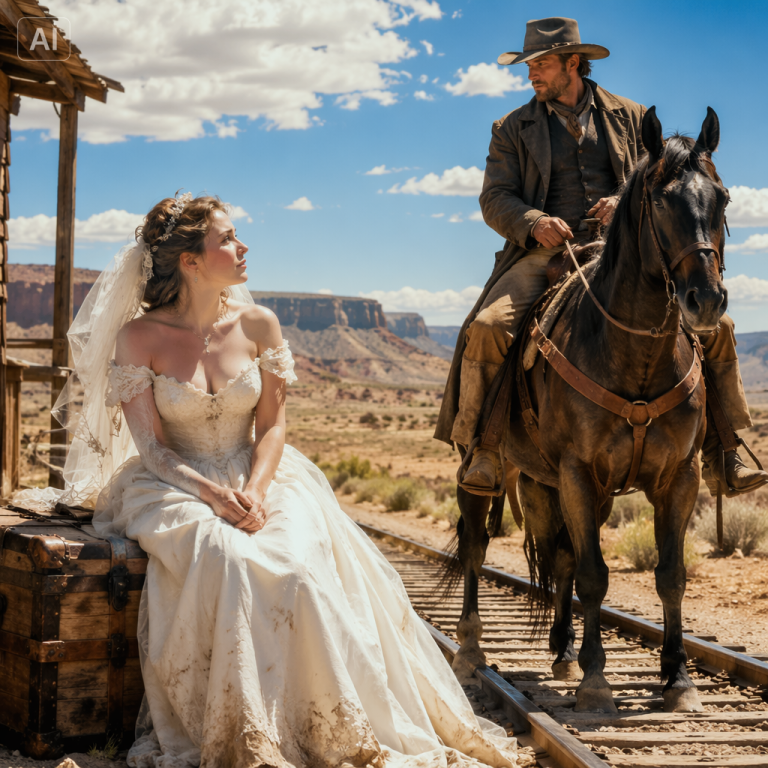
Sorrow Creek came into view as the stage crested a hill, and Norah’s first thought was that someone had given the town the wrong name. It should have been called *surrender.* Buildings leaned against each other like drunks trying to stay upright. A boy of maybe sixteen was waiting by the general store, watching her with eyes that looked decades older.
“You Mrs. Greer?”
“I’m Norah Callaway. Soon to be Mrs. Greer, I suppose.”
“Thomas.” He didn’t offer his hand. Just picked up her bag, testing its weight with a slight frown. “This all you got?”
“I travel light.”
“Good. Ranch ain’t got room for extra.”
The wagon ride out was six miles of silence broken only by hoofbeats and wind that carried dust instead of mercy. When Norah finally asked about his father, Thomas’s answers came clipped and careful. *Works hard, expects the same from everyone else.* When she asked about his mother, something in his expression shut like a door.
“She died two years back. Fever.” His eyes went hard. “Don’t expect us to call you Ma. That ain’t happening.”
“I wouldn’t ask you to.”
“Good.”
The ranch, when it finally rose out of the flat brown land, looked like something that had grown there by accident and then given up trying. Planks nailed over planks. A roof sagging in the middle. A barn missing half its doors. And out of the front door spilled boys — too many, too fast — who went silent the moment they spotted her.
Five, Norah counted. Not six.
“This is her?” asked a boy with sharp features and sharper eyes.
“Norah Callaway,” Thomas said. “The new wife.”
“We don’t need hope,” the sharp-eyed one — Cade — interrupted before she could finish a sentence. “We need someone who can cook and clean without making things worse. Last woman who came out here lasted three days before she ran back to town crying about how we were animals.”
“That was a housekeeper,” Eli said.
“Same difference.” Cade’s eyes stayed on Norah. “You know how to cook?”
“Yes. For eight people if that’s what’s needed.”
“Where’s the youngest?” Norah asked, once she’d counted the faces and come up one short.
The boys exchanged glances. “Probably in the kitchen,” Thomas said. “He’s always in there around supper time. He cooks.”
“Tries to,” Eli said flatly. “Usually makes a mess. But at least he tries.”
Norah’s chest tightened. A four-year-old, trying to cook supper because no one else had time.
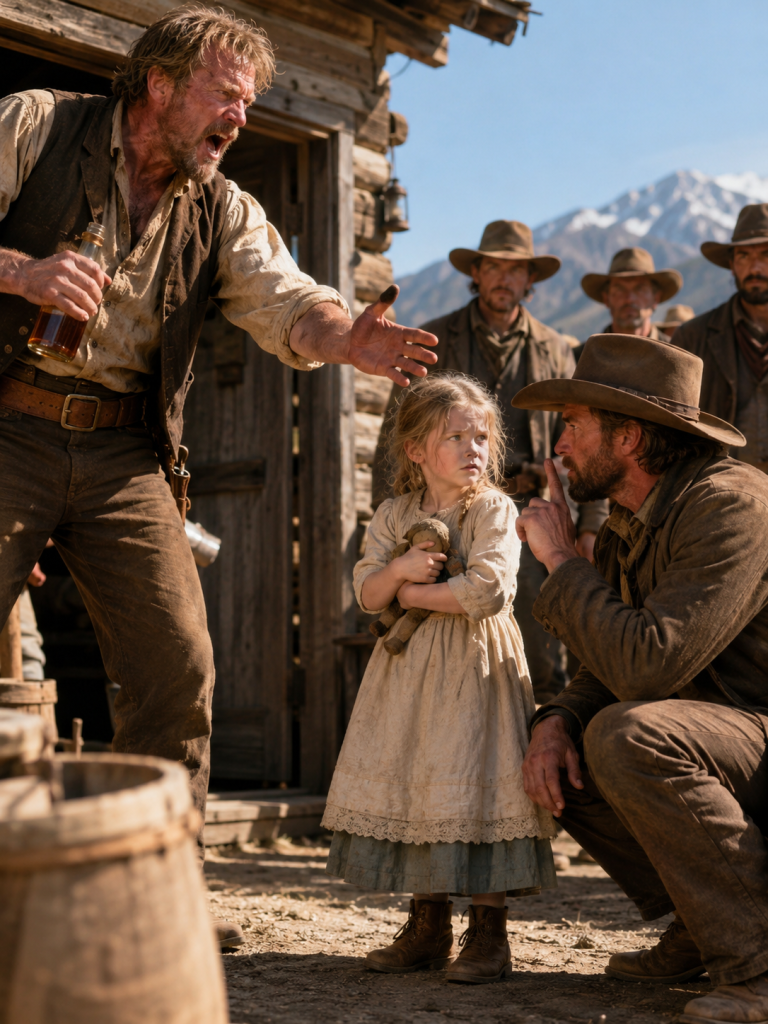
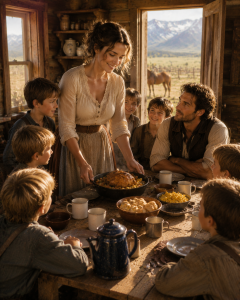
Inside, the house smelled like wood smoke and something burnt. And there, barely visible over the counter, stood the smallest boy Norah had ever seen trying to cook, dragged up on a stool, stirring a pot too large for his hands, his sleeves rolled past his elbows, his face red with heat and concentration. He looked up when he noticed her, and Norah saw an expression that would haunt her for weeks. Not fear. Not curiosity.
Resignation. The look of a child who’d already learned adults rarely helped when you needed them most.
“Hi,” he said softly. “Are you the new Ma? I’m Ru.”
“I’m Norah.” She moved closer, slow, the way you’d approach a wounded animal. “What are you making?”
“Beans. They’re supposed to be soft, but I don’t think I did it right. They’re still hard.”
She looked into the pot — burning at the bottom from too little water. “May I?” He hesitated, then stepped back and let her take the spoon. “You did well getting them started,” she told him. “But beans need more water and lower heat, or they turn into rocks.”
“I didn’t know.”
“Now you do.”
She looked around the kitchen — the disaster of it, the empty shelves, the missing systems. “Have you eaten today?” she asked the room. Ru shook his head. None of them had eaten.
“Paw left bread this morning,” Thomas said, defensive. “For six growing boys. One meal.”
Something sharp and angry rose in Norah’s chest — not at the boys, but at the situation that had taught children to accept hunger as normal.
“That’s not enough,” she said.
“It’s what we got,” Cade said with a shrug.
“It’s what you had,” Norah corrected, rolling up her sleeves. “Now you have me.”
—
PART 2
She worked fast — muscle memory from years spent in kitchens coming back like breathing. By sundown, real food filled the house for the first time in months, and the boys ate like they didn’t quite believe what was happening in front of them.
Then the front door opened, and every boy went still.
Harlon Greer looked exactly like the land he worked — worn down, stubborn, refusing to quit even when quitting made sense. His eyes moved from his sons, to Norah, to the food, and back to his sons.
“What’s this?” he asked.
“Supper,” Thomas said.
Harlon sat at the head of the table, picked up his fork, took a bite, chewed slowly. The room held its breath.
“This is the best meal I’ve had in a long time,” he said. It wasn’t flowery. It wasn’t poetic. But coming from a man who looked like he’d forgotten how to say anything kind, it landed with weight.
Later, after the boys had scattered to chores, he sat with her over coffee she’d made strong. “You know what you’re getting into here? A failing ranch, six boys, a town that probably thinks I’m desperate or insane.”
“That about cover it.”
“Close enough.” He set a heavy, rusted iron key on the table between them. “Room’s at the end of the hall. Door locks if you want privacy.” A pause. “Norah. Thank you for supper. Boys needed that.”
That first night, she should have been terrified. Instead she felt something else — something she hadn’t felt in years. Purpose. This family was breaking apart slowly, held together by nothing but Harlon’s stubborn refusal to quit and Thomas’s premature adulthood. But Norah had built a life from nothing before. She could build this too.
She didn’t yet know how much this family was hiding from her — or from each other.
She learned it in pieces over the following weeks. That Cade, twelve years old, had been sneaking off to trade ranch scraps for money because he was terrified of being the one who did nothing while everyone worked themselves to death. That Eli wanted desperately to leave for town work, and that Thomas took every mention of leaving as a betrayal only a step removed from what their mother had done by dying. That Reeve, seven, had quietly gathered every tool that could double as a weapon and laid them out on the porch, matter-of-fact, because a boy who’d stopped being a child two years ago had already accepted that danger was simply how the world worked.
And she learned, on the night three armed strangers pounded on the door asking for shelter that wasn’t storm-related at all, that a gang called Black Hollow had been quietly terrorizing the valley for years — burning barns, killing men who resisted, and that Harlon’s ranch, isolated and struggling, was exactly the kind of target they picked next.
“They’ll come back,” Eli said. It wasn’t a question.
What Norah didn’t know yet — what none of them could have predicted the night she first unlocked that rusted iron key expecting nothing more than a room to sleep in — was that within weeks she’d be standing in front of twenty armed outlaws with a rifle she barely knew how to fire, betting an entire family’s survival on one simple, dangerous idea:
That isolated people die alone. But people who choose to stand together might just survive.
—
PART 3
The morning after the men left the porch, Harlon set his rifle down and said the word out loud for the first time. *Black Hollow.* Outlaws who’d been working the territory for years, hitting isolated ranches, taking what they wanted, sometimes worse. Last year, thirty miles north, they’d burned out a family and killed the husband when he tried to resist.
“That’s Black Hollow,” Harlon said. “And they just scouted this ranch.”
“We need to tell other ranchers,” Norah said. “Organize some kind of defense.”
“They’ve got numbers and experience,” Harlon said. “We’re just farmers trying to survive winter.”
“Then we make ourselves harder to attack.”
“No.” His voice went hard. “I won’t put this family in more danger by antagonizing criminals. We keep our heads down. Hope they move on to easier targets.”
“And if they don’t move on? If they come back?”
“Then we deal with it when it happens.”
“That’s not a plan,” Norah said. “That’s hoping.”
“It’s all we’ve got.”
She wanted to argue, but the fear in his eyes stopped her. He wasn’t being cowardly. He was calculating odds, trying to protect his sons the only way he knew how. But practical wasn’t going to save them if Black Hollow decided this ranch was worth taking.
That night, Thomas and Harlon nearly came to blows over it — the same argument that had been building under this family’s surface for two years, finally cracking open. Norah stepped between them.
“You’re both scared, and you’re taking it out on each other. That’s exactly what men like Black Hollow want. They want you divided, scared, fighting among yourselves so you can’t fight them.” She turned to Harlon. “Thomas is right. You need to warn the other ranches. Isolated families are easy targets. Families working together are an army.”
“We’re not an army. Not yet.”
“But you could be.”
She laid it out plain — those scouts would report back what they’d seen, would tell Black Hollow whether this family was worth attacking, whether they were alone. But connected to other ranches, an attack here meant retaliation from the whole valley. Isolated targets got picked off one by one. Connected ones didn’t.
Harlon closed his eyes. When he opened them, something had changed. “All right. Tomorrow I ride to the Webs, then to Mercer, then to whoever else will listen. We organize. We prepare.”
“When they come,” Norah corrected gently.
“When they come,” Harlon agreed, “we’ll be ready.”
—
Harlon returned the next afternoon with Charlotte Webb, Willis Mercer, and three ranchers Norah didn’t know, one with burn scars covering half his face from a Black Hollow visit three years back that had left him without his barn but, he was clear, not without a warning of exactly what came next if you refused to pay.
“They painted words on what was left of the Morrison barn,” he said. “*Pay or burn.*”
“Protection money,” Charlotte said, hard-voiced. “They’ve been doing this for years. Picking off isolated ranches. Most people pay.”
“Do you?” Thomas asked.
“No. But I’ve been lucky. Or too poor to be worth their time.”
Harlon spread a rough map across the table. Black Hollow worked south through the valley in a pattern. Between the Morrison place and the Greer ranch sat six more properties, easy pickings, all of them isolated, all of them alone.
“So what do we do?” one rancher asked. “We can’t fight twenty outlaws.”
“Not individually,” Harlon agreed. “But together—”
“Together we’re still just farmers with hunting rifles going against men who kill for a living,” the scarred man said.
“Then we make ourselves not worth the trouble,” Norah said, and every head turned toward her.
“Explain,” Charlotte said.
Norah moved to the map. “They’re counting on us being isolated, scared, easy targets. But if we consolidate — move families and livestock to one location and defend that together — we change the equation.”
“You’re asking us to trust our lives to a woman who’s been here a month,” one rancher said, dismissive.
Charlotte’s eyes flashed. “I’m asking you to trust your lives to someone who’s kept this family alive through winter when everyone expected them to fail. Gender doesn’t enter into it. Competence does.” She turned back to the room. “I’m in. Whatever Harlon and Norah are planning, I’m in.”
One by one, the ranchers agreed — not because they believed it would work, but because every other option led to certain destruction.
The next three days were chaos. Families arrived in wagons loaded with everything they could carry. The Greer barn overflowed with borrowed livestock. Tents went up in the yard despite the snow. Norah organized it all with the efficiency of someone who’d spent a lifetime managing impossible situations — sleeping spaces, rationed supplies, cooking for thirty people with provisions meant for eight — and Charlotte worked beside her, the two women forming a partnership built on shared pragmatism and a refusal to accept defeat.
“You’ve done this before,” Charlotte observed, sorting blankets. “Managed chaos.”
“Different chaos. Same principles.”
“Most women would have run by now.”
“Running just means dying somewhere else. At least here I can fight.”
On the fourth day, smoke rose on the horizon. The Morrison place, burning again. No one spoke. The message was clear.
Black Hollow was coming.
That night, Harlon gathered thirty people crowded into the main room. “They’re coming. Probably tomorrow, maybe the day after, but soon.” He let that land. “This isn’t going to be clean. People are going to get hurt. Some of us might die.” A woman holding a baby began crying quietly. Her husband put his arm around her and didn’t tell her to stop. “If anyone wants to leave, now’s the time. No one will judge you. There’s a difference between courage and suicide.”
No one moved.
“All right, then,” Harlon said, his voice roughened. “We stand together.”
“What if they offer terms?” Thomas asked. “What if they say we can avoid bloodshed by just paying?”
“We don’t pay,” Charlotte said flatly. “The moment you pay extortion, you’re a victim forever. They’ll bleed you dry and burn you out anyway once you’ve got nothing left to give.”
Norah stepped forward. “There’s something else you should know. This isn’t just about Black Hollow. It’s about what comes after. Right now, this valley is dying — families isolated, trust gone, everyone barely surviving. That’s exactly why criminals operate here, because we’re weak and divided. But if we hold — if we prove this valley can unite and fight — everything changes. We stop being victims and become something else. A community that protects its own.”
—
Dawn came too fast and too cold. People moved to their positions in near silence — footsteps in snow, weapons being loaded. Women and children descended into the root cellar, cramming into a space meant for vegetables, not people.
Ru clung to Norah at the entrance. “I don’t want to go down there.”
“I know, honey, but you have to.”
“What if you don’t come back?”
Norah crouched, holding his small face in her hands. “I will come back. I promise.”
“Ma promised she’d get better. She didn’t.”
The words hit like a punch. Norah had no answer that wouldn’t be a lie. “You’re right,” she said finally. “I can’t promise nothing bad will happen. But I can promise I’ll try my hardest to come back. That’s all any of us can do.”
Ru hugged her fiercely, then let Charlotte guide him down into the dark.
Norah took her position near the house, a rifle in her hands she barely knew how to use. The sun rose slowly, turning the snow pink, then white, then blinding.
And then they came. Twenty riders, spreading out to flank the ranch on three sides, cutting off escape. The leader — the same scarred man from the porch — rode forward alone, hands visible, posture radiating confidence.
“You’ve made things complicated by gathering all these people,” he called to Harlon. “Here’s my offer. You pay us what the Morrisons would have paid, plus a little extra for the inconvenience. Everyone walks away alive.”
Before Harlon could answer, Norah stood up.
“No.”
The outlaw’s attention shifted to her. “And who are you?”
“Nobody important. Just someone who’s tired of men like you deciding who gets to survive.”
“Is that right? And what do you propose instead?”
“I propose you leave now, while you still can.”
The outlaws laughed. “Lady, I don’t think you understand the situation.”
“I understand perfectly. You’re bullies. You survive by making people more scared of you than they are of death. But we’re not scared anymore. We’re angry. And angry people with nothing left to lose are dangerous.” Her hands shook on the rifle, but her voice didn’t waver. “Some of you will die if you attack. Maybe all of you if we get lucky. Are we worth that risk?”
The leader’s smile faded. “You’re bluffing.”
“Try me.”
Long seconds stretched into eternity. The outlaws pulled back to confer, their body language growing agitated. Then gunfire erupted — not from the outlaws, but from behind them. Riders poured over the ridge, ranchers from farther north who’d seen the Morrison smoke and had had enough. Not enough to turn the tide completely, but enough to make Black Hollow’s odds much worse.
The scarred leader made the smart choice. He signaled retreat.
“Did we win?” someone asked, uncertain.
“For today,” Harlon said. “For today, we won.”
—
The families stayed another week, waiting to see if the outlaws would return. They didn’t. Word spread through the valley that Black Hollow had moved on to easier hunting grounds entirely. Slowly, families started drifting back to their own ranches, taking with them shared supplies, new friendships, and the knowledge that they didn’t have to face the frontier alone.
Charlotte embraced Norah at her wagon before she left. “You did good.”
“We all did.”
“No. You did something nobody else could have. You made them remember how to be a community instead of just survivors.”
That evening, Norah found Harlon at the fence line, staring out at land that had nearly been taken from him.
“What are you thinking?” she asked.
“That I almost lost everything. That I almost got my boys killed because I was too proud to ask for help sooner.” He turned to her. “Thank you for pushing me. For making me see what I couldn’t see on my own.”
He reached into his pocket and pulled out the rusted iron key. “You unlocked more than a door when you came here. You unlocked a family that had locked itself away from living.” He held it out to her. “This place is yours. We’re yours.” He said it simply, stating fact. “If you want to leave, I’d understand. You didn’t sign up for outlaws and near-death.”
“I’m not leaving,” Norah said. “This is home now. You’re home. The boys are home. Where else would I go?”
He nodded, emotion crossing his weathered face too fast to name. Then he did something unexpected. He hugged her — brief and awkward, neither of them quite knowing what to do with their arms. But it was real. When he pulled back, there were tears in his eyes.
“She would have liked you,” he said quietly. “My wife. She would have liked you a lot.”
—
Life didn’t become easy after that. Winter still had teeth. Supplies still ran low. But something fundamental had shifted. Thomas smiled more. Eli stopped talking about leaving. Cade’s anger mellowed into something closer to determination. Reeve remained quiet but less haunted. And Ru — Ru finally started acting like a four-year-old instead of a miniature adult, playing instead of surviving.
Spring came late but fierce, melting the snow and revealing land that had somehow survived another winter. On the first truly warm day, Norah knelt in a small garden plot near the house, dirt under her fingernails, happier than she’d been in years, when Ru appeared beside her with a handful of seeds.
“Can I help plant?”
“Of course.”
They worked together in comfortable silence, seeds into earth, covered gently, hoping.
“Norah?” he said after a while. “Are you my Ma now?”
The question stopped her hands. “I don’t know. What do you think?”
Ru considered it seriously. “I think Ma was Ma. But you’re something too. Something good.”
“What am I?”
“You’re Norah.” He said it like that explained everything.
“Yeah,” she whispered, pulling him close. “That’s enough.”
That evening, the whole family gathered for a real supper — not rationed, but abundant. Laughter filled the room. Even Harlon smiled. After everyone had eaten, Thomas stood up, awkward.
“I just wanted to say something. About this family. About how we almost didn’t make it. About how everything changed when someone showed up who refused to let us fail.” He cleared his throat. “We were falling apart. All of us. And you put us back together — not because you had to. Because you cared enough to try. So thank you for staying. For fighting. For being exactly what we needed.”
The other boys nodded agreement. Even Reeve looked directly at Norah with something like gratitude in his dark eyes.
Harlon raised his coffee cup. “To family. The one we’re born into, and the one we choose.”
“To family,” they echoed.
—
Norah had arrived at this ranch with nothing but a rusted iron key and resolve worn thin by too many losses. She would leave it, if she ever left it, with something far more valuable — a family, a home, a purpose, and the knowledge that she’d taken something broken and helped make it whole again. Not perfect. Never perfect. But whole enough to keep growing.
Years later, travelers passing through Sorrow Creek would ask about the woman who’d stood down Black Hollow, and the old ranchers would smile and point toward the Greer land.
*That ranch survived when everyone expected it to fail,* they’d say. *And the woman who made it happen — she started with nothing but a key and a stubborn refusal to quit. Taught a whole valley how to fight for what mattered.*
And if you visited the Greer Ranch on a spring evening, when the wildflowers were blooming, you’d find Norah in her garden — probably with Ru, or one of the other boys, helping — dirt under her fingernails and peace in her expression. She’d look up, smile that small smile that came from knowing exactly who she was and what she’d accomplished, and go back to planting.
Because that’s what she did. She planted seeds. She nurtured growth. She refused to let things die that could be saved.
And somewhere along the way, in the process of saving a broken family on a failing frontier ranch, she’d saved herself too — not from poverty or hardship or danger, but from loneliness, from purposelessness, from the slow death of surviving without ever really living.
The rusted iron key still sat on her dresser, a reminder of the door she’d opened that first night. She rarely looked at it anymore.
She didn’t need to.
The life she’d built was reminder enough.
**THE END**