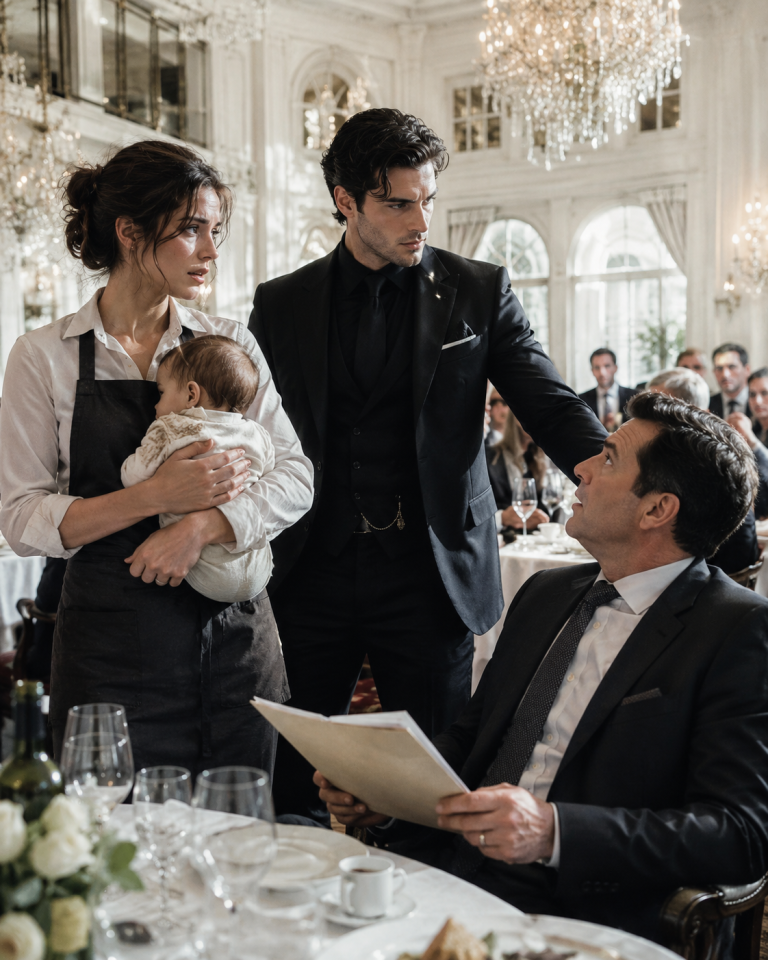
I Whispered, “Please Don’t Hurt Me”—Then the Mafia Boss Recognized Me and Silence Fell

## PART 1
The boot rose over her ribs and the only thought in Nora Callahan’s mind was: *not the ribs.*
Not courage. Not defiance. Not even prayer in any organized form.
Just: not the ribs, because they were already cracked from last week and if the polished leather came down with the weight of a drunk man behind it, something was going to give that she could not afford to let give.
Around her, the Black Diamond Club kept roaring.
Music shook the floor. Men laughed behind smoked glass. Chips moved across felt. Money changed hands in amounts that could have bought Nora three months of breathing room.
And nobody moved.
Nobody was going to move.
She was a waitress in a bad situation, and men like the one above her only mattered until they stopped being useful.
The enforcer’s name was Harlan.
He was drunk, worked up, and convinced she had been listening at a door she had only been passing.
He had pulled her hair hard enough to drag tears she refused to let fall.
Who sent you, he had said. The Volkov crew. The Cardenases.
Nobody, she had tried to answer. I am just carrying drinks.
The boot rose higher.
Nora thought of her sister asleep on the couch back home. Sixteen, still a kid underneath the teenager, still needing someone to fight for her. Sixteen and already too familiar with the specific grief of people who died on wet roads when someone else ran a red light.
So the words came out before fear could stop them.
Not a tactic. Not a weapon.
The plain truth of a body that had already been hurt once and was terrified of being hurt worse.
*Please,* Nora said.
One word. Barely a sound.
*I’m already hurt. Please don’t.*
Harlan’s boot stopped midair.
And then, from the shadows at the end of the corridor, a voice came through the music and the noise with the specific quiet of someone who did not need volume.
*Harlan.*
One syllable.
The boot lowered.
Nora did not look up immediately. Three years of surviving difficult rooms had taught her that stillness was safer than motion while the air was still deciding what happened next.
But the footsteps came toward her. Unhurried. Certain.
Power did not rush when it already owned the outcome.
*Mr. Varro,* Harlan managed.
*I was just—*
*I can see what you were doing.* The voice came level, conversational, as if they were discussing a schedule change. *The question I have is why.*
Nora lifted her head.
She had heard the name Luca Varro since her first week at this job. She had heard it the way people spoke the names of things they knew were real but hoped to never personally encounter. She had been told by her manager, by two other waitresses, and by the coat check woman who had seen more than anyone, to stay unremarkable. Don’t attract his notice. Don’t be interesting.
She had been spectacularly unsuccessful.
Luca Varro stood in the corridor wearing a suit the color of charcoal with no tie and his collar open at the throat. He was not as tall as men of consequence usually seemed to expect themselves to be, but that quality — of taking up exactly the right amount of space without apologizing for it — radiated off him in a way that made physical dimensions beside the point.
Dark hair. A jaw that suggested entire arguments had been lost against it. Eyes the color of deep water before a storm.
He was looking at her with an expression she could not read.
Not concern, exactly. Not recognition — though there was something close to it.
A tightening. A stillness inside a man who was already very still.
*Stand up,* he said.
Nora tried.
Her ribs informed her of several things at once, the most urgent of which was that standing from a position of shock and cracked bone was significantly harder than it sounded.
Luca extended his hand.
She looked at it. A strong hand. A gold signet ring on the right. No wedding band.
*I’m not going to ask twice,* he said.
There was no threat in it. Only the matter-of-fact certainty of someone who understood that waiting was itself a form of patience, and patience was something he was choosing not to spend.
She placed her hand in his.
He pulled her to her feet with the controlled care of someone who had assessed the situation and decided that causing more damage was not part of the plan.
She gasped before she could stop it.
His expression sharpened.
*You’re hurt.*
*I’m fine.*
*That’s not what I heard.*
She pulled her hand back. He let her.
He turned to Harlan.
The hallway went cold.
*She works here,* Luca said. *She is under my roof. And nobody puts their hands on my staff without my permission.* He looked at Harlan the way you looked at a problem you’d already decided how to resolve. *Marco. Take him outside. Make sure he understands our policy.*
Two men materialized from somewhere.
Harlan made protests that died unfinished as they took him by the arms.
Then the hallway was quiet except for the pulse of music through the walls.
Luca turned back to Nora.
*Your name.*
*Nora Callahan.*
Something moved through his face. Too quick to track.
*Nora Callahan,* he repeated, almost to himself. Not a question. A recalibration.
*Have we met.*
*No, sir. I’ve only been here three months.*
He studied her with the particular focus of a man looking for something he thought he recognized in a face he didn’t know.
Then the expression smoothed over.
*Go home,* he said. *Tonight’s shift is done for you. Paid.*
*I still have—*
*Go home, Miss Callahan.*
She nodded, because refusing felt like it carried its own set of consequences.
He turned toward the main room.
Then stopped.
*I don’t forget faces,* he said, without looking back. *And I never forget a debt.*
He walked through the door and vanished into smoke and music.
Nora stood alone in the corridor with broken glass around her feet and the specific ache of a night that had been terrible in three completely different ways.
She did not know what debt he meant.
She did not know why he had looked at her like that.
She only knew, with the bone-deep certainty of someone who had learned to read rooms the hard way, that her life had just crossed a line.
And there was no easy path back to the other side of it.
—
## PART 2
She should have gone straight home.
Sensible people went home after nights like that.
But sensible people had rainy-day funds and sick days and the kind of lives where missing two hours of tips was an inconvenience rather than the difference between paying the electric bill on time and paying it with a three-day-late fee on top.
Nora cleaned up the glass herself.
She knelt slowly, one hand against the wall for balance, and picked crystal fragments from the black marble with hands that were shaking and scraped. She washed them in the staff bathroom. She wrapped paper napkins around the worst cut until the bleeding went manageable, then returned to the floor with her tray up and her face arranged into the expression customers expected from women they didn’t particularly notice.
Only the room had started noticing her.
That was the first terrible change.
Men who had made her invisible for three months began watching her cross the floor. Conversations paused when she passed. A bartender who had called her *hon* without any warmth in it stepped aside to give her room at the service station.
Across the room, Luca Varro sat in the VIP section without looking at her.
Which was almost worse.
Because even without his gaze, the room rearranged itself around him the way water rearranged itself around stone, and Nora — being one of the smaller things in the water now — was being redirected by his gravity whether she wanted to be or not.
An hour later, Luca stood.
The music continued for exactly one breath.
Then conversations died, one by one, like lights switching off in a building after hours.
*A moment,* he said.
He spoke with the same conversational quiet. The DJ fumbled. The bass stopped.
*Some of you may have heard there was an incident tonight.* His voice moved through the room without effort. *One of our associates made a mistake. He put his hands on a member of my staff. He threatened her in my establishment.* A pause that had weight. *This is not acceptable.*
Nora stood frozen near the bar.
Part 2 Cliffhanger: *Nora Callahan is under my protection.*
The words went through the room like a key turning in a lock nobody knew existed.
*She is not to be questioned. Not threatened. Not touched by anyone, for any reason. Am I understood.*
Yes, Mr. Varro.
The answer came from every table. Immediate. Obedient.
Luca crossed the room toward her. The crowd parted.
He stopped a proper distance away and looked at her.
*Four years ago,* he said. *July. The produce market on Western Avenue.*
Nora’s stomach dropped.
*There was an older woman,* he said.
And the room she had spent three months pretending not to inhabit fell away. Another room appeared in its place.
Summer heat. The smell of cut fruit and herbs. A woman crumpling near a stack of peaches.
*She had a cardiac event,* Luca said. *You were the only person who stopped.*
Nora’s mouth was dry.
*You called 911,* he said. *You caught her before she hit the ground. You rode in the ambulance. You held her hand and stayed with her until my family arrived.*
The memory came back in fragments. The woman’s terrified eyes. The paramedics. The fluorescent lights of the hospital. Nora, who had been twenty, had slipped away before anyone could thank her. She hadn’t wanted a reward. She had only wanted to know the woman made it.
*If she had been alone five more minutes,* Luca said, *the doctor told us afterward she might not have survived.*
He looked at the room, then back at her.
*That woman was my mother.*
And the room went absolutely still.
—
## PART 3
The silence after those three words lasted long enough to mean something.
Three words: *that was her.*
Three words had changed the pressure in the entire room.
Nora’s fingers found the edge of the bar.
*I didn’t know.* Her voice was barely working. *I swear I didn’t know who she was. I just — she was alone and she looked—*
*I know,* Luca said. *That is exactly why it mattered.*
He looked at the room again.
*My mother searched for the woman who helped her for four years.* His voice was flat now, factual, the way people spoke when feeling needed to be managed. *She described her as a young woman who would not give her name. Who disappeared before anyone could find her.*
He looked back at Nora.
*She is under my mother’s protection. Therefore she is under mine.*
In some rooms, a mother’s protection was sentimental.
In this room, standing in front of these men, it landed like law.
He gave Nora a nod — respectful, almost old-fashioned — and returned to his table.
The room began moving again.
The bartender beside Nora exhaled slowly.
*You saved Mama Varro’s life,* he said.
Nora couldn’t speak.
*You’re untouchable now.*
She didn’t feel untouchable.
She felt like a candle someone had just lit in a dark field.
Every creature for miles had lifted its head.
—
A black car waited outside at two in the morning.
The driver opened the door.
*Miss Callahan. Mr. Varro arranged a ride for your safety.*
Nora looked at the bus stop. Then at the car.
*I usually take the bus.*
*Not anymore,* the driver said.
She got in.
Leather seats. Tinted windows. The smell of clean wool.
As the car pulled away, she looked up at the second-floor window.
Luca stood there with a glass in his hand.
Their eyes met for one second through the glass.
Then the car turned the corner and he was gone.
Nora leaned back against the seat and pressed her hands flat against her thighs to stop them shaking.
A whispered plea had stopped a boot.
A four-year-old memory had changed a man’s face.
And whatever was starting, Nora understood it was something considerably larger than her ability to refuse.
—
Home was a third-floor walk-up in a neighborhood where street parking was optimistic and the heating system held its own opinions about cold weather.
The driver waited until she was inside.
Nora’s sister Maya was asleep on the couch. Sixteen. Too tall for it. A chemistry textbook balanced on her stomach. The television on low.
Nora stood in the doorway and watched her breathe.
Maya was why she stayed. Maya was why she carried trays through cigarette smoke and bad manners six nights a week. Maya was why she had not reported the mugging last week, had not gone to the hospital for her ribs, had not taken a sick day she could not afford and filled out forms she didn’t know how to complete.
Their parents had died eighteen months ago in a pileup on the interstate that had nothing to do with fault and everything to do with a truck driver and a moment of inattention. The system had looked at Maya and seen a placement. Nora had looked at Maya and seen her sister.
She had taken every shift available.
She had become the person who held things together not because she was the right person for the job but because nobody else was there to do it.
Now a man who ran this city’s shadow economy had said her name in a room full of dangerous people and called it protection.
Nora went to the kitchen.
She slid down the cabinet to the floor and let herself shake, carefully, with her arms wrapped around her cracked ribs.
She was thirty seconds from crying when a business card in her jacket pocket pressed against her palm.
Heavy black paper. One phone number in silver ink. No name.
*Any problem, any time,* the driver had said. *You call.*
Nora looked at it until the shaking stopped.
—
The morning call came at nine.
A brisk woman named Rosa introduced herself as Mr. Varro’s assistant and confirmed that Nora was taking the day off, paid, as instructed, and that Mrs. Varro — *his mother,* Rosa said, with the gentle emphasis of someone highlighting a holy object — would very much like to see her.
*Tomorrow at noon,* Rosa said. *Lunch. A car will collect you.*
Before Nora could form a coherent objection, the call ended.
Maya was in the kitchen eating cereal.
*Who was that.*
*The assistant to the crime boss whose mother I apparently saved four years ago.*
Maya put down her spoon.
*I need you to start from the beginning.*
Nora told her. Not everything. Not the boot or the floor or the specific terror of a drunk man’s weight above cracked bones. But enough.
When she finished, Maya said, *So you saved a mafia boss’s mother by accident and then wandered into his club three years later.*
*Two and a half.*
*That is—* Maya stared at the ceiling. *That is either incredibly good luck or incredibly bad luck.*
*I cannot decide which.*
They sat in silence.
*I think you should call him,* Maya said finally.
*And say what.*
*Thank you. He saved you last night.*
*He also put a target on me by announcing my name in front of five hundred people.*
*He did,* Maya agreed. *But the alternative was what Harlan was going to do.* She looked at her sister directly. *You’re already connected to him, Nora. Pretending you’re not isn’t going to change anything.*
Nora looked at the card.
The number stared back.
*You’re sixteen,* she said.
*I’m right,* Maya said.
Nora picked up the card.
—
The phone rang twice.
*Miss Callahan,* Luca said. No hello. No who is this. Just her name, as if he’d been waiting for the call to arrive.
*I wanted to say thank you.*
*You don’t need to thank me.*
*You stopped something bad from happening.*
*You did that four years ago,* he said. *I returned a portion of the debt. That is all.*
*It wasn’t a debt.* The words came before she could measure them. *Your mother was scared and alone. I did what anyone would have done.*
A pause.
*We have established,* he said, with the faintest trace of something dry, *that this is not true.*
Nora almost smiled despite everything.
*Your mother invited me to lunch,* she said.
*She has been looking for you for four years. She wants to thank you herself.* His voice shifted. *I should warn you. She will cook for twelve and expect you to eat for six. If you have dietary restrictions, tell me now.*
*I’m fine with everything.*
*Good. The car will be there at noon.*
*I can take the bus—*
*Miss Callahan.* Not unkind. Just certain. *You have cracked ribs and a mugging two weeks old that you never reported. You will take the car.*
Nora went very still.
*How do you know about the mugging.*
Silence.
*How much do you know about me.*
*What I needed to know,* he said, *to understand what I was protecting.*
The words should have alarmed her more than they did.
*That is an invasion of privacy.*
*Yes.*
*You don’t sound sorry.*
*I’m not sorry for knowing. I’m sorry that the world gave me reason to need to.*
There was something in that — the careful placement of apology — that made her not hang up.
*You’ll be safe tomorrow,* he said. *You have my word.*
The call ended.
Maya appeared in the doorway.
*And?*
Nora looked at the card.
*I’m going to lunch with a crime family.*
*Normal Tuesday,* Maya said.
—
The Varro estate was in Oak Park, behind a gate that suggested old money even if the money’s history was complicated.
Gardens. Ivy on old brick. The kind of house that had been kept well through decades of arguments and celebrations and grief.
A woman waited at the top of the steps.
Petite. Silver hair pinned neatly. A cream blouse. Pearl earrings.
Nora recognized her before memory supplied her name.
The farmers market. The ambulance. The hand that had gripped hers with the desperate strength of someone who understood they were running out of time.
Mrs. Varro came down the steps faster than Nora expected.
*Nora.* Her voice broke gently on the name. *Oh, my dear. Let me look at you.*
She took Nora’s face between her hands — warm, papery, certain — and looked at her with eyes that had been carrying something for four years and were only now putting it down.
*I have thought about you every day,* she said. *Every single day.*
Then she pulled Nora into a hug that felt like someone’s mother.
Not Nora’s mother, who had smelled of coffee and the particular wool of the cardigan she wore for twenty years. But someone’s mother. The feeling of it.
*Come inside,* she said. *We have so much to talk about.*
Her name was Carla Varro, and she had spent twelve years being afraid of her own son’s world and three additional years being grateful to a stranger who had saved her life in it.
Lunch was homemade pasta, bread still warm from the oven, and the kind of careful attention that made honesty feel inevitable.
Nora told her about Maya.
She hadn’t planned to.
But Carla asked questions with the genuine interest of someone who listened to the answer rather than waiting for her turn to speak, and Nora found herself talking about things she kept folded small — the accident, the system, the dropped college plans, the second job, the particular exhaustion of being someone’s only anchor.
*You left school for your sister,* Carla said.
*She had no one else.*
*And you?*
*I have her.*
Carla reached across the table and covered Nora’s hand.
*You gave up your future to protect someone smaller than you,* she said. *Just as you protected me.*
*It’s not the same.*
*It is exactly the same.* Her grip was firm. *Do not minimize what you do. I have spent my life watching people minimize what women like you do. It is a cruelty dressed as modesty.*
Tears threatened without warning. Nora looked down at the pasta.
Carla slid an envelope across the table.
*No,* Nora said immediately.
*This is not for you,* Carla said. *It is for Maya.*
*Mrs. Varro—*
*A scholarship fund. Tuition. Books. Living expenses. For wherever she earns a place.*
*I can’t accept—*
*You gave me my life back,* Carla said quietly. *Let me give your sister hers.*
Nora’s throat closed.
She thought of Maya at the kitchen table looking at college websites and then quietly closing the laptop because she had worked out the numbers before Nora could hide them.
*You deserve to stand up straight,* Carla said. *So does she.*
Nora pressed her fingers over her mouth.
*Thank you,* she managed. The words felt like they weighed too little for what they were carrying.
Carla squeezed her hand.
*You are family now,* she said. *Not because of duty. Because I choose you.*
An hour later, Luca arrived.
He found them in the garden. Carla was describing the rose bed she had planted thirty years ago and the superstition, brought from her mother, that roses near a door protected the women inside.
Nora was listening with her head turned slightly, the way people listened when something was reaching them past the defended part.
Luca stopped at the path’s edge.
Something in his face changed before he had a chance to manage it.
Nora turned and saw him standing there in the afternoon light, looking at the two of them, and for one unguarded second he appeared to be a man who had been holding something very heavy for a very long time and had just realized he was allowed to set part of it down.
*There’s my son,* Carla said warmly.
Nora stood.
She and Luca looked at each other across the rose garden.
No words.
A beginning neither of them was ready to name.
—
The testing started within forty-eight hours.
Nora had expected it. The sudden attention of a man like Luca Varro made other people want to understand its perimeter.
At Rita’s Diner, where she worked breakfast shifts, a sedan idled across the street that Monday morning. Two men inside, not eating, not moving on. On Tuesday one of them came in. Russian accent. Shaved head. He ordered coffee, watched her work for forty minutes, and left thirty dollars for a five-dollar cup.
*You’re Nora,* he said before leaving. *Varro’s place.*
*Can I get you a receipt.*
He smiled like a man who had confirmed what he came to confirm.
That night at the Black Diamond, Nora watched the room differently.
Michelle, one of the other waitresses, caught her in the break room.
*Those men today,* Michelle said. *You need to tell Luca.*
*I’m not going to run to him every time—*
*That was Ivan Belen’s crew.* Michelle said the name carefully. *They are not small-time. They are testing whether the protection is real or decorative.* She looked directly at Nora. *Tell him.*
Nora looked at the black card in her apron pocket.
*Decorative is dangerous,* Michelle said. *Real is different. Find out which one you have.*
Nora waited until her break.
She found the alley behind the club and called.
Luca answered before the second ring.
*Miss Callahan.*
*There were men at the diner today. And again tonight, at the bar.* She described them. *They asked about the club. About you.*
A brief silence.
*Belen’s people.*
*Is that bad.*
*It means word is moving faster than I hoped.* His voice was contained but not comfortable. *You did the right thing calling. Where are you now.*
*Break room in about three minutes.*
*Stay there. Don’t leave through the front tonight. Marco will take you home.*
*Luca.* She said his name instead of his title because the distinction suddenly mattered. *I’m not going to be a person who can’t walk to a car.*
*Not tonight.*
*That’s not an answer.*
*Tonight it is.* Not harsh. Just firm. *This is temporary. I need to send a message first. After that, the test is over.*
She believed him.
That surprised her.
*Okay,* she said.
*Thank you for calling.*
*You said to.*
*I know. Thank you anyway.*
—
The investigation Luca ran on Nora took eighteen hours.
He had Frank Rosetti, his consigliere, compile everything. Not because he suspected her of anything. Because protection without knowledge was wishful thinking dressed as action.
What Frank returned with was a file that made the room very quiet.
Nora Anne Callahan. Twenty-four. Parents deceased eighteen months prior. Freeway accident, neither at fault. Left behind two daughters, the younger of which the state immediately flagged for placement.
Nora had prevented that by becoming Maya’s legal guardian at twenty-two.
She had left her nursing program mid-second-year to do it.
She worked sixty to seventy hours per week across two jobs. Every bill was current by a margin of days. No debt beyond ordinary expenses. No criminal record. No hidden connections. No angle.
*She’s clean,* Frank said. *Genuinely clean. Not cover-your-tracks clean. Actually clean.*
Luca had looked at the part about the nursing program for a long time.
*Her neighborhood,* he said.
*Bad and getting worse. Gang activity moving in from Hartwell. Streetlights out on three blocks of her route home. She walks alone from the late bus most nights.*
*Fix it.*
Frank had looked up. *That’s not our territory.*
*It is now. Send word. Anyone operating there has until Friday to clear out.*
*And if the Belen crew pushes back on the public declaration before that—*
*Then we have a different conversation.* Luca stood and went to the window. *Triple security on her. Keep it discreet but real. Both jobs, her building, everywhere she goes.*
*This is significant resources for one waitress.*
*She saved my mother’s life,* Luca said.
Frank had been consigliere for the Varro family for twenty-two years. He knew what to say and what not to say.
He said nothing.
*She also did it without knowing who my mother was,* Luca continued. *Without expectation. She disappeared before anyone could find her. For four years.* His hand pressed against the window frame. *In my world, Frank, that kind of person is so rare they might as well not exist.*
*And when they do exist?*
Luca looked out at the city.
*You protect them,* he said, *or you spend the rest of your life regretting what you didn’t.*
—
The first shift after everything began in earnest was different.
The room’s attention had texture now.
Men Nora had served for three months stood when she approached. A card game paused while one player nodded at her. The bar cleared space for her automatically.
She did not let it make her comfortable. She had grown up understanding that rooms changed around things they expected might become useful or useful-adjacent, and she had learned early that being impressive to dangerous people was a different category of danger.
She served the drinks. She did the work. She did not perform gratitude for the respect or apologize for the attention.
At table seven, a man with a scar across his jaw extended his hand.
*Nora, right. I’m Anton. I don’t think we’ve been properly introduced.*
Three months ago this man had snapped his fingers without looking up.
*I don’t shake hands on the floor,* Nora said pleasantly. *Can I get you something.*
Anton blinked.
She walked away.
At the bar afterward, the bartender, whose name was Dev, exhaled slowly.
*That is either going to go very well or very badly.*
*He’s been disrespectful for months,* Nora said.
*And now you can say so.*
*I could always say so.* She picked up her tray. *I just needed the room to care.*
Dev stared after her.
Michelle appeared at her elbow.
*That was either brave or foolish.*
*Probably both.*
*Good.* Michelle looked at the table where Anton sat, recalculating. *In this place, that’s the only way to survive long-term.*
—
Luca came to the end of her shift that night.
His associates moved to the bar when he stood, which told Nora something about the signal without needing it explained.
He gestured to the chair across from him.
*I still have tables,* Nora said.
*The floor is slow.* He looked at her steadily. *Sit. Five minutes.*
She sat.
He poured water from the pitcher. Pushed it toward her without ceremony.
*You look tired.*
*It’s been a complicated week.*
*Yes.* He looked at the glass. *How are your ribs.*
*Better than they were.*
*The mugging. Why didn’t you report it.*
*What would reporting it accomplish.*
He looked at her with the specific attention of someone who had asked the question and wanted the real answer, not the functional one.
*A police report creates a record,* she said. *A record creates paperwork. Paperwork creates follow-up questions. Follow-up questions at two in the morning take time I don’t have and create problems I can’t afford. And hospitals—* She stopped. *Hospitals want to know who’s responsible for you. I didn’t have an answer.*
*You have one now,* he said quietly.
Nora looked at the water glass.
*I know.*
*Does that frighten you.*
*A little.*
*Because of what I am.*
*Because of what it means.* She looked up. *I know what protection costs in your world. It costs belonging to something.*
Luca was quiet for a moment.
*In my world, yes.* He looked at his hand resting on the table. *But I am not offering to make you part of an organization. I’m offering to keep the people who would use you to reach me from doing that.*
*And if I said no.*
*The protection would remain.* His voice was direct. *Because you are already connected to me whether either of us chose it. Refusing my help doesn’t undo that. It only leaves you without it.*
Nora hated that this was true.
*What’s the difference between protection and a cage,* she asked.
Luca considered the question seriously.
*A cage,* he said, *does not tell you what the bars are made of.*
She looked at him.
He met her eyes.
*I have told you everything,* he said. *What I am. What I owe. What I intend. You can walk through this room knowing the shape of every wall. That is the difference.*
It wasn’t a complete answer.
But it was an honest one.
*How is your mother,* Nora asked.
The shift in his expression was small but complete. Formality released.
*Better since Tuesday,* he said. *She has been trying to plan Sunday dinner since she knew you existed.*
*I heard lasagna was involved.*
*Enough lasagna to feed a church.*
Nora smiled. A real one. The kind that arrived before she could decide whether it was appropriate.
Luca looked at it the way people looked at things they had been told no longer existed.
*You should get back to your tables,* he said.
*I should.*
Neither moved for one extra second.
Then she picked up her tray.
*Mr. Varro.*
*Luca,* he said.
She looked back.
*Thank you. For coming to the hallway when you did.*
Something in his face.
Not quite a smile. The structural precondition for one.
*Always,* he said.
—
Three neighborhoods south, in a warehouse that smelled of transmission fluid and impatience, Ivan Belen was having a conversation with his lieutenants.
He was a compact man with careful eyes and the working patience of someone who had survived by never moving before he was ready.
*Varro’s declaration,* he said. *Personal protection. The waitress.*
One of his men — younger, faster to conclude things — leaned forward. *It’s a soft spot. He’s emotional about her.*
*You think Luca Varro becomes emotional,* Belen said flatly.
*For his mother, maybe.*
*No.* Belen picked up his coffee. *For his mother, he became careful. There is a difference.* He looked at the cup. *If we move on the woman and the protection is real, we lose men and reputation. If we test it gently, we learn the perimeter.*
*And if the protection is decorative.*
Belen smiled without warmth.
*Then we learn that too.*
He looked at the city map on the wall.
*Watch her. Learn her patterns. Don’t touch her. Not yet.*
His lieutenant’s phone buzzed.
He read the message.
His face changed.
*Sir,* he said. *Hartwell crew says Varro’s people showed up tonight. Cleared them out of two blocks on Nora Callahan’s route home.*
Belen set down his coffee very carefully.
*He cleaned up her neighborhood.*
A silence.
*That’s not protection,* his lieutenant said slowly. *That’s infrastructure.*
Belen looked at the map.
*No,* he said. *That is a message.*
He picked up his phone.
*This changes the calculation,* he said.
—
Nora noticed the neighborhood change on Thursday morning.
She had walked that route for eighteen months. She knew which blocks to avoid and which streetlights to stay under and where the specific quality of darkness changed from ordinary to threatening.
On Thursday, the quality was different.
Three men who had stood on the corner of Morrow and Fifth for six months were gone.
The streetlights were on.
All of them.
A broken window in the bodega had been boarded up with fresh plywood.
Someone had pressure-washed the sidewalk in front of her building.
Nora stopped at the corner and looked at the street.
Then she called.
*Did you clean my neighborhood.*
Luca answered without preamble. *Yes.*
*How.*
*In the way things get cleaned in this city.*
*Luca—*
*Is it safer.*
She looked at the working streetlights.
*Yes.*
*Then the method is less important than the result.*
Nora pressed her free hand to her forehead.
*You can’t just—*
*Nora.* His voice was patient. *You have cracked ribs from a mugging on a street you walk alone because there’s no other way home. The men who created that condition have been asked to create it elsewhere. That is not complicated.*
*It’s complicated to me,* she said.
*Why.*
She didn’t have an immediate answer.
Because it felt like being managed. Because it felt like having her city rearranged without being asked. Because it felt like becoming something installed in a larger picture she hadn’t agreed to be part of.
*Because it means you’re thinking about my life,* she said finally.
*Yes,* he said simply.
*Why.*
A pause.
*Because the shape of your life matters,* he said. *And because four years ago, when no one else stopped, you did.* His voice lowered. *You reminded me that there were still people in this world who acted without calculating what it would cost them. I have not met many of those people. I find I am unwilling to stop being interested in them.*
The streetlights hummed.
*That’s not a small thing to say,* Nora told him.
*No,* he agreed. *It is not.*
*Are you saying it because you mean it.*
*I don’t say things I don’t mean,* he said. *It’s inefficient.*
Nora looked at Maya’s window, three floors up, lit from inside.
*Sunday dinner,* she said.
She heard him exhale.
*Yes.*
*I’ll come. Me and Maya.*
*My mother will be very pleased.*
*I’m not promising anything else.*
*I know.*
*I’m not— whatever people assume—*
*I know what you’re not.* His voice was steady. *I’m patient.*
After she hung up, Nora stood on the corner for another minute.
Then she walked home under working streetlights, and the street felt, for the first time in months, like something that was not entirely against her.
—
Sunday dinner was enormous, warm, and conducted by Carla Varro with the focused energy of a woman who had been planning this event longer than anyone was admitting.
Nora had worried about what to wear, what to bring, how to behave in a home that was large and old and full of the specific weight of a family’s accumulated decades.
She had brought wine she couldn’t afford. Carla had exclaimed over it, poured it, and served it at dinner without making Nora feel that it was insufficient.
Maya had arrived wary and left charmed, which Nora recognized as a more reliable character assessment than most.
*She is exactly what I hoped,* Carla said to Nora in the kitchen while Maya and Luca were, improbably, arguing about the best approach to a chemistry problem she had brought to dinner. *And you raised her.*
*My parents raised her for fourteen years,* Nora said.
*And you have raised her since.* Carla handed her a dish to dry. *Don’t discount that.*
Later, Luca walked Nora to the car while Maya said an extended goodbye to Carla.
The garden was cold and still.
*She’s good,* Luca said, meaning Maya.
*She’s brilliant and she’s been pretending not to be so I don’t feel guilty about school.*
*Does she know the scholarship is arranged.*
*She will by the end of the week.* Nora looked at the frost on the grass. *I don’t know how to thank your mother for that.*
*She doesn’t want thanks. She wants family.* He said it plainly. *She has been missing people for years. Not having someone to cook for is, to her, a genuine crisis.*
Nora smiled.
*Your mother is extraordinary.*
*Yes.* He looked at the house. *She is also the reason I understand that there are things worth being something other than what this world tried to make me.*
Nora looked at him.
The man from the corridor — controlled, cold, certain — was still there. But so was something else. Something that came out when his mother’s name was in the room.
*What did this world try to make you,* she asked.
*Entirely without mercy,* he said. *It had some success.*
*Not complete.*
He looked at her.
*No,* he said. *Not complete.*
Maya appeared at the door, bundled in her coat, waving.
*We should—* Nora started.
*I know.* He didn’t move immediately. *Nora.*
She looked up.
*Thank you for coming.*
*Thank your mother for cooking.*
*I will.* His voice was quiet. *But I meant — for coming anyway. Despite what you know about me. About this.*
She looked at him for a moment.
*I’m not pretending you’re harmless,* she said. *I haven’t done that.*
*No.*
*But I think there’s a difference between what someone is and what they’re trying to be,* she said. *And I think it’s worth paying attention to both.*
Luca was quiet for a moment.
*That may be the most generous thing anyone has said to me in years,* he said.
*It’s just accurate.*
The car came around the drive.
Nora gathered her coat.
*Sunday is good,* she said. *If the offer continues.*
His expression changed in the way it had changed in the garden that first afternoon.
*It continues,* he said.
—
The confrontation with Belen came two weeks later.
Not in the alley. Not with a knife.
In the form of a note, slipped under the door of Rita’s Diner, which suggested that one of Belen’s people had access Nora hadn’t anticipated.
*Varro can’t watch everything. Ask him what happened to the last person who relied on that.*
She called immediately.
Luca answered before the first ring was finished.
*Where are you.*
*Rita’s. There was a note under the door.* She read it.
A silence that had different texture from his usual silences.
*Don’t go to the Black Diamond tonight,* he said. *Go straight home. Marco will be there.*
*Luca—*
*Please.*
The please was unusual enough to stop her.
*Okay.*
*I mean it. Straight home.*
She went straight home.
Marco and another man were outside her building. She nodded to them and went up and made tea and sat with Maya and tried to watch television and failed.
At midnight, her phone rang.
*It’s handled,* Luca said.
*What does handled mean.*
*It means Belen’s crew has been reminded of the cost of reaching into spaces that don’t belong to them. The people who placed that note are no longer in a position to place notes.* A pause. *No one was killed. I want you to know that. But they will not test this particular boundary again.*
Nora exhaled.
*Are you all right.*
He sounded slightly surprised by the question.
*Yes.*
*And you’ll tell me if you’re not.*
Another pause. Shorter.
*Yes,* he said. *I will.*
*Good.* She pulled her knees up. *Luca. The note said — it asked what happened to the last person who relied on you.*
Quiet.
*Was there someone.*
Longer quiet.
*Yes,* he said finally. *Before my father died. There was someone who was important to our family and who was endangered because of that connection.* His voice was measured. *She survived. But it cost her things she shouldn’t have had to lose. I have thought about that for eight years.*
*Is that why—*
*Part of why,* he said. *Yes.*
*And the other part.*
She already knew the answer. But she wanted to hear him say it.
*Because of you specifically,* he said. *Because you are not someone I want the world to have the chance to cost.*
Nora sat with that for a moment.
*That’s — that’s a large thing to say.*
*I know.*
*Are you saying it because you mean it.*
*Nora.*
*I know. You said. Inefficient.*
*Yes.*
She laughed once, quietly, into the dark kitchen.
After a moment, he laughed too.
It was the first time she had heard it. Low, brief, surprised by itself.
*Sleep,* he said. *Both jobs tomorrow are covered. Rest.*
*I don’t need—*
*Maya needs you healthy.* Gently. *So do other people.*
She didn’t ask who the other people were.
She thought she knew.
*Good night,* she said.
*Good night, Nora.*
She sat in the dark kitchen for a while after the call, with the city humming outside and Maya asleep down the hall and Carla Varro’s rose pendant resting against her collarbone.
She had not asked for any of this.
She had asked only that a boot not come down on already-broken ribs.
She had asked with one word and barely a voice.
Please.
And from that word, somehow, a life had started reassembling itself into something that included more than survival.
She was still afraid sometimes. She understood what the world outside that protection looked like, because she had been living in it for three years. She understood that the men who ran it were not clean, that the things done in its name were not always things she could look at directly, that kindness and danger could live in the same person the way weather could be warm and threatening in the same hour.
But she also understood that people did not have to be entirely good to be worth trusting with specific things. And she understood that whatever Luca Varro was, he had never lied to her about it.
She got up. Washed her cup. Checked the lock.
Then she went to bed under working streetlights, and the city outside was, for once, just a city.
—
Three months later, Maya came home with a letter.
She stood in the kitchen doorway holding it with both hands and her face completely still in the way faces went still when they were processing something too large for expression.
*Nora,* she said.
*What.*
Maya held out the letter.
Full scholarship. University of Chicago. Pre-med program.
Nora read it twice.
She sat down in the nearest chair because her legs had decided independently that they were done.
Maya sat across from her.
For a moment they just looked at each other.
Then Maya crossed the table and hugged her, and Nora held on in the way she had held on to things throughout three years of holding on — not gracefully, not without shaking, but completely and without letting go until it was done.
*Mom would be annoying about this,* Maya said into her shoulder. *She would cry in front of all your friends.*
*I’m crying in front of you right now.*
*It doesn’t count if there’s no audience.*
Nora laughed.
Maya pulled back.
*Tell Carla,* she said. *Tell her first.*
Nora picked up her phone.
Then she looked at Maya.
*You did this,* she said. *I got out of the way. You did the work.*
Maya rolled her eyes in the way of a teenager being thanked for something she had already decided not to take credit for.
*You didn’t get out of the way,* she said. *You carried the whole thing for three years. You just — you finally put it down somewhere that could hold it.*
Nora called Carla.
Carla answered immediately and shrieked with a joy so complete that Nora had to hold the phone away from her ear.
*Luca!* she heard in the background. *Luca, come here, the girl got in!*
And then, distantly, the sound of a man being called to share good news, which was a sound so domestic and so ordinary that it struck Nora somewhere she hadn’t expected.
A family in a kitchen.
A piece of it belonging, now, to her.
—
*You’re different,* Dev the bartender said one evening. *From when you started.*
Nora looked up from the inventory sheet.
*Different how.*
*You used to move like you were waiting to be told you didn’t belong here.* He leaned on the bar. *Now you move like you’ve decided.*
Nora thought about this.
*I think I just got tired,* she said. *Of calculating whether I was allowed to take up space.*
*Because of Varro.*
*Because of me.* She looked at the inventory sheet. *He just — made it harder to pretend I didn’t have it.*
Dev nodded slowly.
*For what it’s worth,* he said, *you were worth protecting before he said so.*
Nora looked at him.
*I know,* she said.
She was learning to say it without condition.
—
*What do you want,* Luca asked.
They were in the garden at his mother’s house. May now. The roses beginning to open.
It had become a Sunday ritual without either of them naming it as one. Dinner with Carla. Afterward, the garden.
*From what.*
*From your life. In ten years.* He was looking at the roses. *What does it look like.*
Nora considered.
*I want to finish nursing school,* she said. *Or something like it. I want to do work that means something.*
*You could.*
*I know.* She had been looking at programs. *I want Maya somewhere she can become whatever she’s supposed to be without running out of money first.*
*Done.*
*I want to stop feeling like the ground might disappear.*
He looked at her.
*That one,* she said, *is mine to work on.*
*You’re further along than you think.*
She looked at her hands.
*What about you,* she said. *Ten years.*
He was quiet for longer.
*I want this to be smaller,* he said.
*The organization.*
*Yes.* He turned the ring on his finger. The habit, she had learned, of a man thinking through something uncomfortable. *I want it to be something I’m proud to hand down. Not this. Something different. My father began that work and didn’t live to finish it. I’m trying to finish it.*
*And personally.*
He looked at her.
*Personally,* she said.
The garden was warm. The roses were opening.
*I want Sundays,* he said.
Simple.
Nora felt warmth move through her chest like a season changing.
*That’s not a very complicated answer.*
*No,* he agreed. *But it is the true one.*
She reached over and put her hand in his.
He looked down at their joined hands with the expression she had catalogued over three months of Sundays — the one that arrived when he forgot to manage it.
*I’m still learning how to trust this,* she said.
*I know.*
*I’m not in a hurry.*
*Neither am I.*
*But I’m—* She looked at the roses. *I’m not afraid of it. Whatever this is. I’m not afraid.*
He turned his hand over and held hers properly.
*Neither am I,* he said.
And the garden was warm, and Maya was inside explaining to Carla why the periodic table was actually a narrative, and somewhere in the city that Luca was slowly and imperfectly trying to make different, a woman who had once whispered *please* to a drunk man’s raised boot was sitting in a garden with her hand held, and was not afraid.
—