SHE SIGNED HER NAME AS “PLAIN WORKING WOMAN” TO GET ON THE MAIL-ORDER BRIDE LIST — HE HAD NO IDEA HE’D JUST MARRIED THE MOST WANTED HEIRESS IN THE TERRITORY


—
PART 1
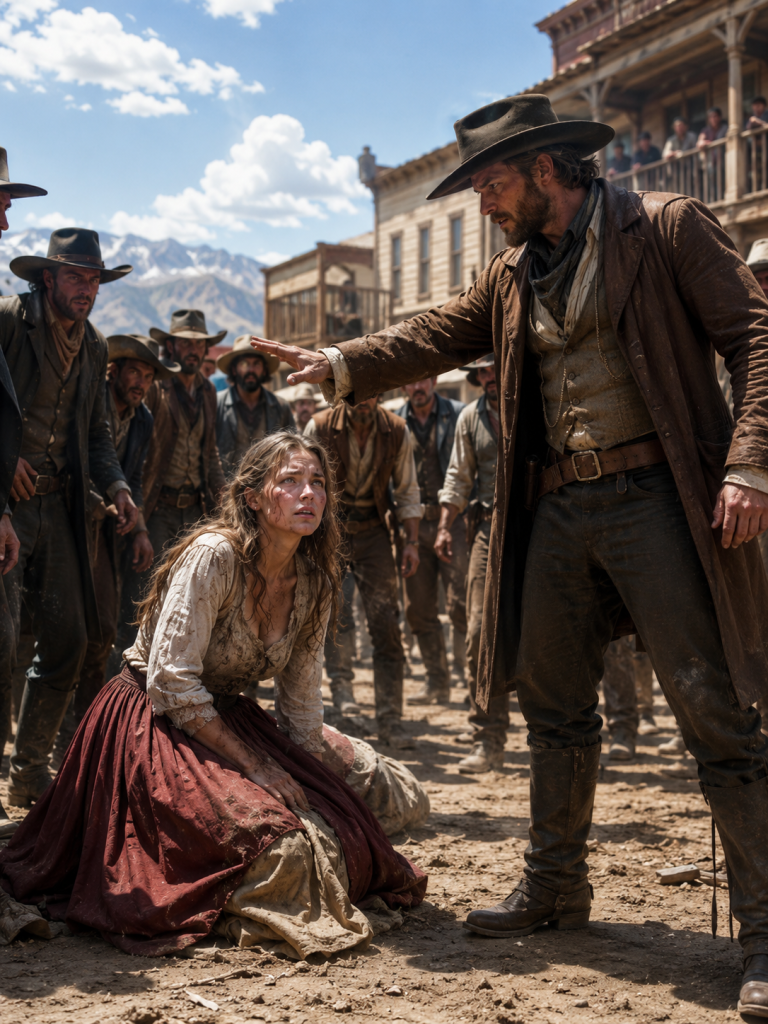
Sarah Fairfax burned her real name the day she boarded the stage west. Sarah Whitfield died in that fire — the shipping fortune, the Boston townhouse, the fiancé who wanted her dead more than he wanted her hand. What stepped off the stage in Cedar Ridge, Montana, was nobody. Plain. Unremarkable. Exactly what she needed to be to survive.
She had no idea the rancher waiting to marry her would turn out to be the only man in the territory patient enough to notice that nobody was lying.
Wade Colton stood at the edge of the Cedar Ridge depot platform, hat in hand, feeling like a man about to make either the smartest decision of his life or the dumbest. Thirty-two years old, six years widowed, a ranch that needed a partner more than it needed a wife in the traditional sense. He had written to the matrimonial agency in Denver with a short, honest letter: *Seeking a practical woman. Not looking for romance. Looking for someone who can run a household and isn’t afraid of hard winters.* The agency had sent back a name — Sarah Fairfax, twenty-six, of no particular family, seeking a fresh start.
The stage rolled in twenty minutes late, dust rising off the wheels in a slow gold cloud. Wade watched the door, expecting someone plain, someone tired, someone who matched the flat, unremarkable description in her one brief letter.
What stepped down was a woman with posture that didn’t belong to someone who’d spent her life scrubbing floors — spine straight, chin level, eyes moving across the platform with quick, deliberate assessment before settling on him. She wore a plain gray traveling dress, hair pulled back without ornamentation, no jewelry, nothing that drew the eye. And yet everything about the way she carried herself drew the eye anyway, the way a carefully banked fire still throws heat.
“Mr. Colton?”
“Miss Fairfax.” He took her bag — heavier than it should have been for a woman traveling with almost nothing. “Wagon’s this way.”
She fell into step beside him without hurry, but he noticed, three steps in, that she’d already located the exits of the depot, the number of men on the platform, the position of the sheriff’s office across the street. He’d spent enough years around cautious men — men who’d fought Indians, men who’d survived range wars — to recognize the particular alertness of someone who had learned, recently and thoroughly, that safety was not something you could assume.
“Long trip?” he asked, loading her bag.
“Long enough.” She glanced back once at the platform before climbing into the wagon, the same motion she’d make a dozen times over the following days — checking, always checking, though checking for what, he didn’t yet know.
They rode the two hours to the ranch mostly in silence, though it was not an awkward silence. She asked precise questions — the size of the herd, the number of hands, the distance to the nearest doctor — and he answered them plainly, and somewhere in the exchange he found himself telling her more than he’d told anyone since his wife Eleanor died. About the drought two years back. About the debt he’d taken on to survive it. About the loneliness of running a place built for two.
“Why answer the agency letter?” she asked, watching the grassland roll past. “You could have hired a housekeeper.”
“A housekeeper doesn’t help a man stop being alone,” Wade said, and then looked faintly surprised at his own honesty.
“No,” Sarah agreed quietly. “She doesn’t.”
The ceremony took place two days later in the front parlor of the ranch house, performed by a circuit judge passing through, witnessed by Wade’s foreman Amos and the housekeeper, Mrs. Doyle. Sarah wore the same gray dress. She said her vows in a clear, steady voice that didn’t waver, and when the judge pronounced them married, she looked at Wade with an expression he couldn’t entirely read — relief, maybe, or the particular exhaustion of someone who had been running for a long time and had just, for the first time in months, stopped.
That night, standing in the kitchen after Mrs. Doyle had gone to bed, Wade said, “I’m not going to pretend I understand everything about you, Sarah. But I noticed the way you watched the road the whole ride out here. I noticed you flinched when Amos dropped that crate outside. I’m not going to ask you to explain it tonight. I just want you to know I noticed.”
Sarah stood very still, hands wrapped around a teacup she wasn’t drinking from. “Thank you,” she said finally, “for not asking.”
“I didn’t say I’d never ask,” Wade said. “I said not tonight.”
Something in her expression shifted — not quite a smile, but something adjacent to one, the first genuine easing he’d seen in her since the depot.
“All right,” she said. “Not tonight.”
—
PART 2
The weeks that followed settled into a rhythm neither of them had expected but both found, gradually, that they didn’t mind. Sarah ran the household with an efficiency that startled Mrs. Doyle, who’d been managing the place alone since Eleanor’s death and had grown used to doing everything her own way. Within a week, Sarah had reorganized the pantry, corrected an error in the household ledger that had been quietly bleeding money for months, and rewritten the supply order to a local merchant who’d been overcharging Wade by a margin he’d never noticed.
“You’ve got a head for numbers,” Wade said, looking over her corrections at the kitchen table.
“I had a good teacher,” Sarah said, and didn’t elaborate, and Wade had learned by then not to push.
The first sign of real trouble came three weeks in, when a letter arrived at the general store in Cedar Ridge addressed to “any person with information regarding Sarah Whitfield, formerly of Boston, believed traveling under an assumed name in the western territories.” A reward was mentioned — a substantial one. The storekeeper, a gossip by trade, mentioned it to half the town before the day was out.
Sarah heard about it from Mrs. Doyle, who’d heard it from the storekeeper’s wife, and went pale in a way Wade hadn’t seen since the depot.
“Sarah.” He found her in the barn that evening, sitting on a hay bale, staring at nothing. “Talk to me.”
She told him then — not everything, not yet, but enough. A fortune in Boston shipping money. A father dead two years, leaving her the sole heir. A fiancé named Reginald Ashford, chosen by her father before his death, who had grown considerably more interested in her inheritance than in her once the will was read. An accident that hadn’t felt like an accident — a carriage wheel that had been tampered with, a near miss on a staircase, a growing certainty that Reginald intended to become a widower before he ever became a proper husband.
“I ran,” she said. “I took what cash I could carry, cut my hair, changed my name, and got on the first stage west that would take me somewhere nobody would think to look. I answered your agency letter because it was the most anonymous, most unremarkable option available. I wasn’t trying to deceive you, Wade. I was trying to disappear.”
Wade sat with that for a long moment. “The reward notice. How much?”
“Enough that half this territory would sell their own mother for it.”
“Then we handle it,” Wade said, with the same flat practicality he’d have used discussing a fence line. “We don’t panic. We don’t run. Running is what got the notice posted in the first place — it makes you look guilty of something. We find out exactly what Ashford’s claiming, and we get ahead of it.”
“You’re not angry,” Sarah said, something like disbelief in her voice. “That I lied to you. That I married you under a false name.”
“You didn’t lie about who you are,” Wade said. “You lied about your history. Those aren’t the same thing. I’ve spent three weeks watching you work harder than anyone I’ve ever met to build something honest here. That tells me plenty about who you are. The rest is just details we need to sort out.”
Something broke loose in Sarah’s expression then — not tears exactly, but close, the controlled unraveling of someone who had spent months holding herself together by sheer will and had just been told, for the first time, that she didn’t have to do it entirely alone.
“I don’t know how to fight him,” she admitted. “Reginald has lawyers. He has my father’s old business partners in his pocket. He has money, and money buys silence and cooperation in Boston in a way it can’t out here.”
“Then we don’t fight him in Boston,” Wade said. “We fight him here, on our ground, where his money doesn’t move as fast and his lawyers don’t know the terrain.” He paused. “And we find out exactly what he did to your father’s will, because if he tampered with a carriage wheel, I’d bet good money he tampered with more than that.”
—
PART 3
The first order of business, Sarah decided the next morning, was information. She wrote three letters — one to her father’s former attorney in Boston, a man named Aldous Grey whom she trusted more than any other person from her old life, one to a private inquiry agent recommended by Grey years ago for a business matter, and one, carefully worded, to a cousin in Philadelphia who might know how far the search for her had actually spread.
“You trust this attorney,” Wade said, watching her seal the letters.
“He was my father’s oldest friend before he was his lawyer. He tried to warn me about Reginald before the wedding was even planned. I didn’t listen. I should have.”
“You’re listening now.”
Grey’s reply came three weeks later, longer than Sarah had expected, and considerably more useful. Reginald Ashford had, in the eight months since Sarah’s disappearance, petitioned the probate court twice to have her declared legally dead or incompetent — either outcome would allow him, as her former fiancé and the executor named in a codicil Sarah had never signed, to assume control of the Whitfield shipping fortune. Grey had successfully blocked both petitions on procedural grounds, but Reginald was persistent, and the court’s patience was not infinite.
“A codicil I never signed,” Sarah said, reading the letter a second time at the kitchen table, her voice gone tight. “He forged it.”
“Grey seems to think so too,” Wade said, reading over her shoulder. “He says here the signature doesn’t match three other documents on file, and he’s requested a formal handwriting analysis.”
“If Reginald forged that document, that’s fraud. That’s prison, not just an inheritance dispute.”
“Then that’s our leverage,” Wade said. “Not just proving you’re alive and competent. Proving what he did to get this far in the first place.”
### I. What the Inquiry Agent Found
The inquiry agent, a careful man named Percival Cross operating out of Denver, took two months to compile his findings, and what he found justified every dollar Sarah had spent on his services. Reginald Ashford’s business affairs, once Cross started pulling threads, unraveled considerably faster than Reginald likely expected them to.
Reginald had, in the years leading up to his engagement to Sarah, quietly accumulated significant debts — gambling losses, bad investments in a mining venture that had collapsed, and a mistress in New York whose expenses he’d been covering under an assumed name. The Whitfield fortune wasn’t a courtship. It was a rescue plan, and Sarah’s continued survival was the only obstacle standing between Reginald and total financial ruin.
“He needs the money badly enough to have tried twice to kill me,” Sarah said, reading Cross’s report with a steadiness that Wade found remarkable, given the content. “And badly enough to forge a legal document rather than wait for a court to simply declare me dead through natural attrition.”
“Which means he’s desperate,” Wade said. “And desperate men make mistakes.”
The mistake, when it came, arrived in the form of a man Cross had been tracking for weeks — a private investigator Reginald had hired independently, operating under the name Jasper Reed, who had traced Sarah’s trail as far as Denver before losing it in the crowds of travelers heading further west. Cross’s report included a description detailed enough that Wade recognized the man the moment he rode into Cedar Ridge three weeks later, asking careful questions at the general store about a woman matching Sarah’s description who might have passed through recently.
“He’s here,” Wade said, finding Sarah in the garden. “Cedar Ridge. Asking questions at the store.”
Sarah’s hands stilled over the vegetable rows. “How close?”
“Close enough that we need to decide what we’re doing, and we need to decide today.”
They decided, after a long conversation at the kitchen table that stretched past midnight, that hiding was no longer the answer. Sarah had spent eight months running, and running had only ever bought her time, never safety. The only way to end it permanently was to end it publicly — to bring the fraud into the light where Reginald’s money couldn’t smooth it back into darkness.
“I want to go to Denver,” Sarah said. “Where Grey can meet us, where there’s an actual courthouse with federal jurisdiction, where Reginald’s Boston connections carry less weight. I want to file the fraud complaint myself, in person, with Cross’s documentation in hand.”
“That means Reed sees you. That means Reginald knows exactly where you are.”
“He’s going to know eventually. Better it happens on our terms, in a place we chose, with evidence already assembled, than in some moment he engineers himself.”
Wade studied her for a long moment. “You’ve thought this through.”
“I’ve had eight months of nothing to do but think it through, Wade. I just didn’t have anyone to think it through with until now.”
### II. Jasper Reed
Reed found them before they could leave for Denver — not through cunning, but through the storekeeper’s wife, who had put together enough pieces of gossip to draw a fairly accurate conclusion and mentioned it, without malice, to entirely the wrong person. He arrived at the ranch on a gray morning, alone, dressed like a man trying not to look like what he was.
Wade met him at the gate before he reached the house. “You’re looking for someone.”
“I’m looking for a woman named Sarah Whitfield. I believe your wife may fit the description I’ve been given.”
“My wife’s name is Sarah Colton.”
“I understand there might be some confusion about names,” Reed said carefully. “I represent a legitimate legal interest, Mr. Colton. I’m not here to cause trouble. I’m here to confirm a location, nothing more.”
“For Reginald Ashford.”
Something flickered across Reed’s face — not quite guilt, but an awareness that the situation was more complicated than his employer had represented it to be. “You know the name.”
“I know considerably more than the name,” Wade said. “I know Ashford forged a codicil to inherit a fortune he doesn’t have any legal claim to. I know he’s been petitioning a Boston probate court to have a living woman declared dead. I know he’s the reason my wife has spent eight months running for her life.” He held Reed’s gaze steadily. “Whatever he’s paying you, I’d think carefully about whether it’s worth what you’re actually being asked to help him do.”
Reed was quiet for a long moment, and Wade watched something shift behind his eyes — the particular recalculation of a professional man realizing his employer had not been entirely honest about the nature of the job.
“I was told this was a straightforward matter of a runaway heiress refusing a legitimate inheritance claim,” Reed said finally.
“It’s a matter of an attempted murderer trying to finish the job legally, since the carriage wheel didn’t work.”
Sarah appeared on the porch behind Wade, and Reed’s eyes went to her, taking in her face properly for the first time. Whatever he’d expected — a frightened, hunted woman, easily managed — was not what he found. Sarah stood with the same straight-backed composure she’d carried off the stage three months earlier, and she met Reed’s gaze without flinching.
“Mr. Reed,” she said. “I’d like to show you something, if you’re willing to look at it honestly instead of reporting back to a man who’s paying you to look away from the truth.”
She brought out Cross’s full report — the debts, the mistress, the forged codicil, the pattern of financial desperation that made Reginald’s motives unmistakable. Reed read through it on the porch steps in near silence, and when he finished, his expression had changed considerably.
“This is thorough,” he said.
“It’s accurate,” Sarah said. “Every document is verified. Every claim is sourced. I’m not asking you to take my word for it, Mr. Reed. I’m asking you to read the evidence and decide for yourself whether you want to keep working for a man who tried to kill his fiancée for her inheritance.”
Reed left that afternoon without confirming or denying anything to Sarah directly, but three weeks later, a letter arrived at the ranch with no return address — a copy of Reed’s original contract with Reginald, along with a note: *I don’t work for men who lie to me about what I’m being asked to do. Good luck in Denver.*
### III. Denver
They arrived in Denver in early autumn, the aspens along the foothills turning gold, and met Aldous Grey at his temporary offices near the courthouse. Grey was older than Wade had expected — silver-haired, precise, with the careful watchfulness of a man who had spent thirty years learning not to trust anyone at face value until they’d earned it.
“Sarah.” He took both her hands when she walked in, something genuinely emotional crossing his composed face. “I feared the worst for months.”
“I know. I’m sorry I couldn’t write sooner. I didn’t know who might be watching the mail.”
“A reasonable fear, given what we now know Reginald’s capable of.” Grey turned his attention to Wade, assessing him with the same careful thoroughness he’d apply to a contract. “Mr. Colton. I understand my client owes you a considerable debt.”
“Your client is my wife,” Wade said. “There’s no debt between us. Just a partnership.”
Something in Grey’s expression softened slightly at that, a small crack in his professional reserve. “Well. That’s a rarer thing than you might imagine, in my line of work.”
The filing took three days to prepare properly — Cross’s documentation cross-referenced against Grey’s own files, the forged codicil compared against verified samples of Sarah’s actual signature by a handwriting expert Grey had retained specifically for the purpose, and a formal complaint drafted alleging fraud, attempted murder, and abuse of the probate court process.
“Once we file this,” Grey said, the evening before the hearing, “there’s no going back to hiding. Reginald will know exactly where you are, and he’ll fight this with everything his remaining resources can buy. I need you to be certain, Sarah.”
“I’ve been hiding for eight months, Aldous. I’m tired of being afraid in the dark. I’d rather fight him in the light, where at least I can see what’s coming.”
Wade, sitting beside her, reached over and took her hand — not a grand gesture, just a steady one, the kind he’d been offering in small increments since the night in the barn when she’d first told him the truth.
“We’ll be certain together,” he said.
### IV. The Hearing
Reginald Ashford arrived in Denver five days after the filing, having traveled by the fastest route available once Grey’s formal complaint reached Boston through proper legal channels. He brought two attorneys and an expression of wounded, aristocratic outrage that Wade found almost impressive in its complete detachment from reality.
The hearing was held in a modest courthouse that felt entirely inadequate to the scale of what was actually being decided — a woman’s freedom, a fortune, and whether a man who had twice attempted murder would face any consequence for it. Judge Ellery Marsh, a territorial judge with a reputation for careful, unhurried patience, presided.
Reginald’s attorneys opened with the narrative they’d clearly prepared for months — a grieving, patient fiancé, a woman who had suffered a nervous collapse after her father’s death and fled in a state of mental distress, a family desperately worried for her wellbeing and safety, seeking only to bring her home and ensure she received proper care.
“My client has spent a considerable fortune searching for Miss Whitfield,” the lead attorney said, “motivated entirely by concern for a woman he loved and hoped to marry.”
Grey rose when it was his turn, unhurried, methodical, laying the evidence out piece by piece with the patience of a man who had spent thirty years learning that juries and judges alike respond better to careful construction than dramatic flourish. He introduced Cross’s financial documentation first — the gambling debts, the failed mining investment, the mistress in New York, the precise timeline showing Reginald’s desperation accelerating in the months before Sarah’s father died.
“A man in genuine financial ruin,” Grey said, “with a fiancée whose inheritance would solve every one of his problems overnight. That is motive, your honor. Now let us discuss opportunity.”
He introduced the carriage accident report next — an inspection, commissioned quietly after Sarah’s disappearance and completed just weeks before the hearing, of the wheel that had failed on the carriage carrying Sarah six days before her father’s funeral. The inspector’s findings were unambiguous: the wheel bolt had been deliberately weakened, not through natural wear, in a manner consistent with tools found in Reginald Ashford’s own stable.
The courtroom, which had been merely attentive, went entirely silent.
“And finally,” Grey said, “the codicil.” He held up the forged document. “Purporting to name my client, Sarah Whitfield, incompetent to manage her own affairs, and naming Reginald Ashford as executor in her stead. Miss Whitfield’s actual signature, verified against seventeen authenticated documents spanning a decade, does not match. I have here the sworn testimony of Mr. Elias Thorne, one of the foremost handwriting analysts in the eastern territories, confirming the codicil is a forgery.”
Reginald’s face, Wade noted from across the courtroom, had gone the particular gray color of a man watching his last option disappear in real time.
Sarah was called to testify last. She stood, walked to the witness stand with the same straight-backed composure she’d carried since the day Wade first saw her step off the stage, and told her story plainly — the accident that hadn’t felt like an accident, the growing certainty of danger, the decision to disappear rather than wait to find out if the next attempt would succeed.
“I did not run because I was mad, or grieving beyond reason, or incapable of managing my own affairs,” Sarah said, her voice carrying clearly through the courtroom. “I ran because I believed, with good reason, that the man sitting at that table intended to kill me for my father’s money. I have spent eight months building a new, honest life in Montana with a husband who has never once asked me to be anything other than exactly who I am. I am not incompetent. I am not mad. I am the woman my father raised, and I am asking this court to see the truth of what happened to me, rather than the story Mr. Ashford has paid handsomely to have told instead.”
The courtroom was utterly silent when she finished. Judge Marsh took a long moment before speaking.
“Mr. Ashford,” the judge said finally, “this court finds the evidence presented by counsel for Mrs. Colton to be thorough, credible, and deeply troubling. The petitions previously filed regarding Miss Whitfield’s competency are dismissed with prejudice. This court further refers the matter of the forged codicil, and the inspection findings regarding the carriage incident, to federal prosecutors for criminal investigation.” He paused, looking directly at Reginald. “I would advise you to retain very good counsel for what comes next, Mr. Ashford, because what I have heard today constitutes considerably more than a civil inheritance dispute.”
### V. What Was Left to Settle
Reginald was arrested three weeks later in Boston, following a federal investigation that moved considerably faster once Grey’s evidence was formally entered into the record. The mistress in New York, once approached by federal investigators, proved considerably more willing to testify against Reginald than loyal to him, having received exactly none of the financial security he’d promised her over the years. The forgery charge alone carried significant prison time; the attempted murder charge, once the carriage wheel evidence was fully investigated, carried considerably more.
Sarah received the news by telegram in Denver, sitting across from Wade at a small hotel restaurant near the courthouse, and read it twice before setting it down.
“It’s over,” she said, something in her voice that was not quite disbelief and not quite relief, but some complicated combination of both.
“It’s over,” Wade agreed.
“I don’t know what to do with that. I’ve spent eight months organizing my entire life around running from him. I don’t know how to just — stop.”
“You don’t have to know right away,” Wade said. “You’ve got time now. That’s the whole point of what we just did. You bought yourself time you didn’t have before.”
Sarah looked at him across the table — this quiet, steady man who had married a stranger for practical reasons and had, somewhere in the months since, become the only person in the world she trusted completely.
“I need to tell you something,” she said. “I inherited a considerable fortune. Grey has been managing it in trust while all of this played out, but it’s mine now, free and clear, with the codicil dismissed. I don’t know what that means for us. I don’t know if you married a practical, unremarkable woman and now find yourself unexpectedly attached to a wealthy one, and I don’t know how you feel about that.”
Wade was quiet for a moment, considering the question seriously rather than brushing it aside. “I married you because you asked precise questions about herd size and doctor distance on a two-hour wagon ride, and because you noticed I was lonely before I’d said a word about it. None of that had anything to do with money, and none of it’s going to change now that there’s money involved.” He reached across the table and took her hand. “You can do whatever you want with the fortune, Sarah. Put it in the ranch, put it in a bank, give it away. It doesn’t change what I signed up for.”
“What did you sign up for?”
“You,” Wade said simply. “Just you.”
### VI. The Ranch, After
They returned to Montana in late autumn, the aspens gone gold and falling, the first real chill of the coming winter in the air. Sarah threw herself into the ranch with the same precise energy she’d brought to everything since the day she arrived, and over the following year, the changes she made were considerable. A portion of the inheritance went toward expanding the herd and modernizing the irrigation system, work that transformed the ranch’s profitability within eighteen months. Another portion funded a small school in Cedar Ridge, built at Sarah’s insistence and named, over her strenuous objection, the Sarah Colton Schoolhouse by a grateful town council who understood exactly whose money and whose vision had made it possible.
Amos, the foreman, took to calling her “the boss’s boss” within her earshot, which she pretended to find irritating and secretly did not.
On a cold evening the following January, nearly a year after she’d stepped off the stage as a woman with no name of her own, Sarah found Wade on the porch, watching the last light fade over the mountains.
“I keep thinking about the woman who got off that stage,” she said, coming to stand beside him. “Sarah Fairfax. Plain, unremarkable, running for her life. I don’t know what happened to her.”
“She’s standing right here,” Wade said. “Just with her real name back.”
“I don’t think that’s quite right,” Sarah said thoughtfully. “Sarah Whitfield was someone who existed to inherit a fortune and marry well and disappear into a life other people decided for her. Sarah Fairfax was a woman running scared, with nothing but a stolen name and a train ticket. I don’t think I’m either of them anymore.”
“Who are you, then?”
Sarah considered the question with the same careful precision she brought to everything. “Sarah Colton,” she said finally. “A woman who built something real out of a practical arrangement, with a man who noticed she was frightened and didn’t ask her to explain it until she was ready.” She looked at him. “I don’t think that woman existed before I met you, Wade. I think you helped build her, as much as I did.”
Wade put his arm around her, and they stood together on the porch as the mountain light faded to blue, then to dark, the ranch spread out below them — the herd, the schoolhouse in the distance, the irrigation ditches that would keep the pastures green through the next drought, all of it built from the wreckage of a life Sarah had once had to burn down to survive.
“I asked the agency for a practical woman,” Wade said. “Someone who could run a household and wasn’t afraid of hard winters.”
“And?”
“Turns out I got a woman who wasn’t afraid of anything, once she stopped having to run from it alone.”
Sarah laughed — a real laugh, unguarded, the kind that had taken nearly a year to fully return to her. “That’s not what the agency letter said, Wade Colton.”
“No,” he agreed. “It’s better than what the letter said.”
Below them, the last of the cattle moved slowly toward the barn as the temperature dropped, and somewhere past the ridge line, the lights of Cedar Ridge flickered on one by one against the coming dark — a town that had, in its own slow and imperfect way, come to understand exactly what kind of woman had settled among them, and exactly what she had survived to get there.
Sarah Colton had spent eight months running from a man who wanted her dead for her money. She had spent the year since building a life that had nothing to do with money at all — a marriage built on honesty instead of convenience, a ranch built on partnership instead of hierarchy, a name that was finally, entirely, her own to keep.
That was worth more than any fortune Reginald Ashford had ever tried to steal from her.
THE END