Single Mom Collapsed at the Mafia Boss’s Party—Then Woke to Him Holding Her Baby and Declaring, “You’re Mine”

## PART 1
The stuffed bear had been in the apartment for eight months before Mara understood what it was.
It had arrived in a padded envelope three weeks before her brother Danny died, postmarked from a base in Kandahar, along with a note in his handwriting: *For Josie. Keep it somewhere she won’t lose it.* Mara had propped it on the shelf above her daughter’s crib without thinking much about it, because she had been seven months pregnant and her brother sent strange things sometimes — pressed flowers, a carved wooden spoon, once a rock that he insisted looked like Abraham Lincoln — and this was no stranger than the rest.
Josie was nine months old now.
The bear sat on the shelf.
Danny was buried in Arlington with a flag Mara kept folded in a box she couldn’t look at.
Tonight she stood in the kitchen of her apartment in Baltimore, working out whether she could pay the electricity bill and the daycare invoice from the same week, and she already knew the answer. She had been knowing the answer for three months. The math only had one solution and it kept getting worse.
Her phone was at four percent battery because she’d forgotten to charge it, which was a symptom rather than a problem, which was a symptom of everything.
When it buzzed, she almost ignored it.
*Hargrove Events — confirmed staff placement. Private residential event. Saturday. Details attached.*
She had applied to six catering companies in April. She had not expected any of them to call back, much less call back with a single-night job that paid more than she made in two weeks.
She read the email twice.
She read the rate three times.
She picked up Josie from the rug, where her daughter was attempting to put the entire stuffed bear into her mouth, and held her against her chest.
“Okay,” she said. “Okay. We figure this out.”
—
Finding childcare for a Saturday night was its own disaster.
Her neighbor was traveling. Her aunt said she had plans she couldn’t change. The two babysitters she’d used before either didn’t answer or quoted rates that consumed the entire point of the job. By Friday afternoon, Mara had run through every name she had and was sitting at the kitchen table with Josie on her lap and the confirmation email on her phone and a decision that felt like losing either way.
She went.
She packed Josie’s bag with formula and pajamas and the bear, because Josie screamed if she didn’t have it, and she told herself this was one night and the alternative was worse.
The car that came for her at five was not the kind of car a catering company sent to pick up staff. Black. Quiet. The driver looked straight ahead and did not introduce himself. When Mara asked about the event details he said only that the coordinator would brief her on arrival.
They drove forty minutes out of the city through gates that required two different kinds of document checks. Beyond the gates, a house rose from manicured grounds that were lit like a stage set.
Not a house. An estate. The kind that appeared in real estate publications as “significant residential property” and was never actually for sale.
Inside, a woman in a dark suit led Mara through a service entrance and down a corridor that smelled of old stone and new money.
She opened a door.
“The child can stay here.”
The room was a nursery.
Mara had been bracing herself for a coat closet or a supply room. Instead she stood at the threshold of something she could only describe as prepared, a room that contained exactly the right brand of formula on the shelf, exactly the right size of diapers in a stack, a portable crib and a monitor and a rocking chair.
“How did you know what formula she uses?”
The woman’s expression did not change. “We anticipated the need.”
“That’s not an answer.”
“You’ll want to change before the event begins. Uniform is on the chair.”
Mara looked at the room. At Josie. At the monitor with its green light blinking.
She thought about the electricity bill.
She settled Josie in the crib, fitted the earpiece, and whispered, “I can hear you. I’m right here.”
—
The event was the kind that didn’t need a name.
Champagne towers. String quartet. Guests who moved through the room the way water moved around rocks, finding the shape of power without touching it directly. Mara worked her assigned zone, kept her eyes on the tray, and listened to the things people said when they forgot the server was a person.
The contact waits until the third quarter.
Carver doesn’t move without Rourke’s word.
The name that mattered most to everyone was spoken in the same tone as weather: *Rourke.*
She heard it ten times before she saw him.
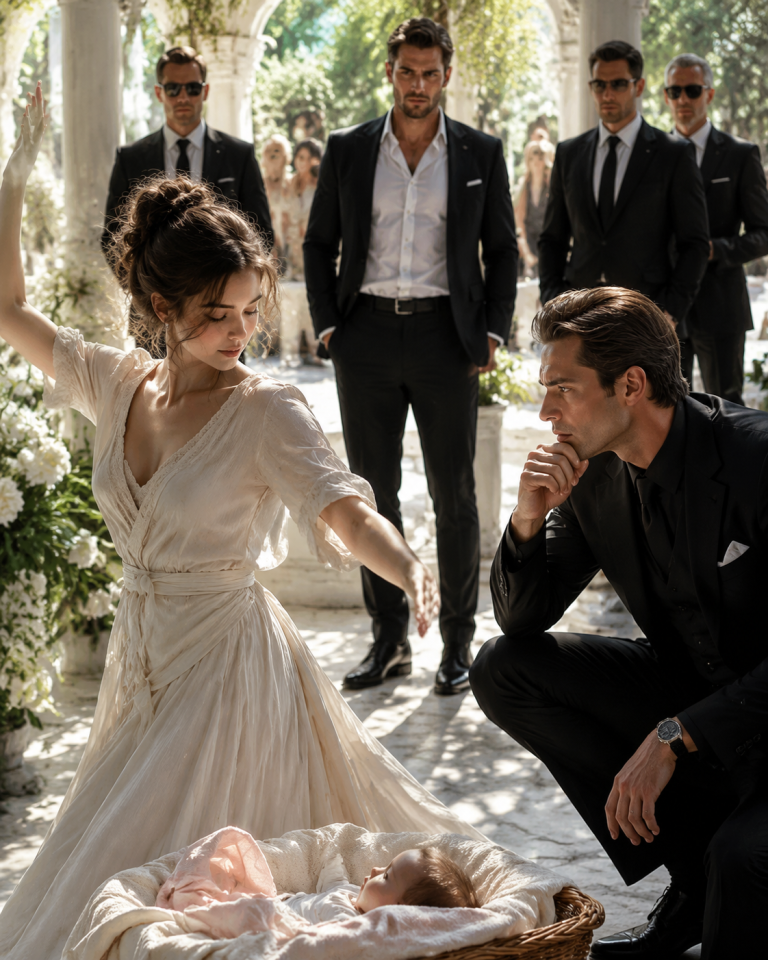
The room changed when he arrived, not loudly but completely, the way a temperature shifts when a window opens. Rourke was tall, dark-haired, broad-shouldered in a suit that fit him like it had been built around a decision. He did not need to announce himself. The room had already arranged itself.
His gaze swept the room. Settled on Mara.
And stopped.
For three full seconds he looked at her with an expression she couldn’t name — something between shock and recognition and a grief so briefly visible it might have been her imagination.
Then Josie screamed through the earpiece.
Not a sleep cry. Not a hungry cry.
Something else entirely.
The tray tilted. Mara’s hands had gone wrong. The room blurred at the edges.
She heard her own voice saying *my daughter* and then she heard nothing else, only the floor coming up, and the last thing she registered before the lights changed was Rourke crossing the room with the particular urgency of a man who had been waiting for something terrible and had just watched it arrive.
—
## PART 2
She woke in a room too large to be hers.
The ceiling was unfamiliar. The sheets were not her sheets. She was wearing something she did not own. She was out of bed before the room fully resolved, moving through the disorientation on instinct.
“Josie.”
The door opened. A woman stood outside in a uniform.
“Your daughter is in the east nursery, ma’am. She is—”
Mara was already past her.
She followed the sound of her daughter’s voice — not crying, which made the sound more confusing, not less — down a corridor and through an open doorway into morning light.
Josie was on a playmat.
Laughing.
At a man in an expensive suit who was sitting on the floor beside her, holding a block up for her inspection with the focused attention of someone for whom this was currently the most important thing in the room.
He looked up.
Rourke.
Josie lunged forward and grabbed the block from his hand with both of hers and shrieked with triumph.
Mara said: “Get away from my daughter.”
Rourke stood. Not quickly — not in the startled way of someone caught — but slowly, with his eyes on Mara’s face and something in his expression that she could not quite read.
“You fainted,” he said. “You’ve been out for six hours.”
“Where are my clothes?”
“The housekeeper—”
“Where is my phone?”
“Charging in the next room.”
“I want my daughter and I want to leave.”
“I know.”
The two words were wrong somehow. Too certain. Too unsurprised.
“Open the gates,” she said.
“Not yet.”
“I will call the police.”
“You can. They’ll come and find you in excellent health with a well-cared-for baby in a room with no evidence of anything except a guest who fainted and was given medical attention.” He paused. “Or you can sit down and let me explain why your brother Danny left a note with your name on it in my safe.”
Mara’s knees went unreliable.
He crossed to a table and opened a leather folder. Inside was a photograph, black and white, slightly creased. Two men in military gear, one of them Danny, arm around the shoulder of a man she now recognized with a feeling like cold water.
“My brother knew you,” she said.
“He saved my life in 2019. Twice.”
“That doesn’t—”
“Before he died he contacted me. He said if anything happened to him, I was to find you. He said you were holding something you didn’t know you had.”
Mara’s eyes moved to the bear.
Josie had abandoned the blocks and was now sitting with the stuffed bear in her lap, chewing its ear.
Rourke’s gaze followed hers.
“The bear,” he said.
Mara grabbed it.
Her fingers found the ribbon at its neck, and beneath it, something flat and hard that had no business being inside a toy.
Before either of them could speak, the window behind Rourke shattered.
Glass across the floor.
Josie screaming.
A message lit up on Rourke’s phone, visible from where Mara stood.
*We know where the child is. Send us the bear or neither of them leaves.*
—
## PART 3
Rourke moved before the glass finished falling.
He was between Mara and the broken window in a single motion, one arm already extended in the direction of the door, where two of his men had appeared at the sound of breaking glass.
“Get her down,” he said, and it was not a question.
Mara was already crouching, Josie pulled against her chest. The bear was still in her hand. She could feel the hard shape beneath the ribbon — flat, small, the size of a thumbnail — and she held the bear so tightly the seams pressed into her palm.
“How many?” Rourke said to his man.
“Thermal says at least twenty on the east grounds. Two already through the outer fence.”
“Time to the secondary gate?”
“Four minutes if we move now.”
Rourke looked at Mara.
She was looking back at him.
“I’m not sending you separately,” he said. “We go together or we argue about it while someone shoots at us.”
“Where are we going?”
“Out of this room first. Then we’ll decide.”
She stood.
Josie was quiet now against her shoulder, which happened sometimes when Josie understood that her mother’s body was doing the thing it did when something was serious. Nine months old and she already read the situation. Danny’s niece.
Rourke reached for the bear.
Mara pulled it back.
He looked at her.
“The card,” he said. “It’s the reason they’re here.”
“I know what it is.” She looked at him steadily. “But I’m carrying it until I understand what’s on it.”
A beat.
Something shifted in his expression.
“Okay,” he said.
They moved.
The corridor was dark and longer than she remembered from the night before. Rourke’s men moved ahead and behind them in a formation that was clearly practiced, that had clearly been done before in situations requiring the same efficiency. Mara did not ask how many times. She focused on her feet and on Josie’s weight and on the small hard shape beneath the bear’s ribbon.
The house had a tunnel.
She should not have been surprised by this. Nothing about the last twelve hours had been ordinary. But still: a tunnel, accessed through what appeared to be a wine rack that was actually a door, lit by a strip of amber emergency light along the floor.
“This way,” Rourke said.
She followed.
The tunnel smelled of stone and cold earth and the particular underground quiet that was louder than sound. They walked for several minutes, long enough for the gunfire above to become muffled and then distant.
Then the man ahead of them stopped.
His posture changed.
He said, “Boss,” in a tone that communicated a specific kind of wrong.
A figure stepped from an alcove in the tunnel wall.
Gray suit. Not young. The kind of face that had decided something long ago and stopped reconsidering.
“Ms. Aldridge,” the man said.
He knew her name.
“Give me the toy and you and your daughter walk out.”
Mara’s arms tightened around Josie.
The man raised a weapon.
He was looking not at Rourke but at her — specifically at her, at the bear pressed against Josie’s back.
“They always make it harder than it needs to be,” he said, and she understood from his tone that he had done this before and found it tedious.
Rourke said: “Carver.”
The man’s eyes moved to him.
“I wondered when you’d understand,” Carver said. “It took you longer than expected.”
“You were on my father’s council.”
“I was on the useful side of your father’s council. There’s a difference.” He kept his weapon raised. “Your friend Collins was resourceful. I’ll give him that. But resourceful men make the same mistake eventually. They trust the wrong person to carry the evidence.”
“He trusted his sister,” Rourke said.
“He trusted a woman with an eviction notice and a baby who would take a job at any address if the number was high enough.” Carver’s voice was not cruel. That was somehow worse. “I arranged the job. I arranged the car. I arranged the room that matched the baby’s formula brand, which by the way took three phone calls to verify.” He looked at Mara. “The plan was to take the bear before you understood what was in it. You were not supposed to keep it after you fainted.”
“What’s on the card?” Mara said.
Carver tilted his head. “Names. Routes. Transactions. The administrative infrastructure of a network that has been moving children through legitimate systems for eleven years. Charities. Foster programs. Placement agencies.” He said it with the flatness of someone reading a grocery list. “Your brother spent fourteen months documenting it.”
“And then he died,” Mara said.
“And then he died,” Carver agreed. “Unfortunate. He was thorough.”
“You killed him.”
“I arranged for the situation that resulted in his death. Language matters in these conversations.”
Rourke moved.
It was fast — the speed of someone who had been waiting for the exact moment and had identified it three sentences before it arrived. He did not move toward Carver. He moved toward the weapon, and what happened next was brief and violent and ended with Carver on the ground and Rourke holding the weapon and one of his men restraining Carver’s arms behind him.
Josie, through all of it, did not make a sound.
Then she made the sound she made when she was finished being patient, which was a very specific sound that communicated clearly that whatever the adults were doing it was time to stop.
Rourke looked at the baby.
Then at Mara.
“Are you hurt?”
“No.” She looked at Carver on the ground. “Is he dead?”
“No. He’ll wish he was, but no.”
She exhaled.
“Tell me everything,” she said. “Right now. All of it.”
So he did.
—
The contents of the memory card took federal investigators three days to process and another two weeks to begin acting on.
The network had been operational for over a decade. It used the infrastructure of three legitimate charitable organizations as cover for the movement and placement of children through compromised foster systems in seven states. The people involved included contractors, a deputy director at a federal agency, two state legislators, and four individuals whose names appeared in multiple Rourke-adjacent business dealings, which was why Carver had been on the inside of his father’s council and why it had taken this long for anyone to reach the evidence.
Danny Collins had spent fourteen months collecting it.
He had died in a situation that was subsequently reviewed as a result of Carver’s cooperation with prosecutors, and the review found that the mission parameters that led to his death had been altered by someone with access to classified routing information.
The investigation was ongoing.
Mara read each development in the news the way she had read Danny’s letters when he was alive — twice, carefully, searching for the shape of the person underneath the words.
She was still at the estate.
That had been her decision, not Rourke’s.
The apartment was no longer under eviction threat — the job had paid, and Rourke had quietly arranged for the original eviction notice to be reviewed for procedural irregularities, which turned out to be genuine, which was convenient — but going back to it alone felt wrong in a way she couldn’t articulate. She had a daughter who needed consistency and safety. The estate had both, in quantities her apartment never had.
She did not call it home.
She called it temporary.
Rourke called it whatever she needed it to be, which she noticed and didn’t comment on.
Their dynamic resisted easy description.
He was a man who ran operations she didn’t approve of, on behalf of interests she was still mapping. He had arranged her arrival at the estate through a manufactured job listing, which she had pointed out to him twice in detail and would point out again at a later date when she had more information. He had done all of this because Danny had asked him to, which was the kind of thing that made her feel two things at once and she was not ready to reconcile them.
On the other hand: he sat on the floor with Josie and let her destroy his tie. He answered Mara’s questions directly and without the qualifying evasion she had expected from someone in his position. He had handed her back the bear without argument when she’d taken it from him in the tunnel, and that single moment had told her more about him than anything else.
One evening she found him in the garden.
He was sitting on a bench with a glass of something he wasn’t drinking, looking at the far end of the grounds where the lights ended and the dark began.
“You come out here often?” she said.
“Not usually.”
“What are you doing?”
“Thinking about your brother.”
She sat down on the other end of the bench.
For a while neither of them said anything.
“Tell me something about him,” she said. “Something I don’t know.”
Rourke was quiet for a moment.
“He was afraid of snakes,” he said. “Genuinely, completely, unreasonably. Two tours in Afghanistan and the thing that made him uncomfortable was snakes. He found one in his gear in 2019 and I have never seen a grown man move that fast.”
Mara laughed.
It was a real laugh, sudden and sharp, and it surprised her the way real laughs did.
“He told me it was a spider,” she said.
“He told everyone it was a spider. He was very committed to the revision.”
She shook her head.
“He was embarrassed,” she said. “He worked very hard at not being embarrassed about things.”
“Yes.”
“That’s why he didn’t tell me what he found. Not really. He was afraid of what I’d think. That he’d gotten into something too big. That he’d miscalculated.”
“He hadn’t miscalculated. He knew exactly what he was doing.”
“He was twenty-nine years old and he hid evidence inside a baby toy and mailed it to his pregnant sister and got himself killed.”
The words came out steadier than she expected.
Rourke looked at her.
“He also identified a trafficking network that’s going to result in prosecutions that will end careers and possibly save lives,” he said. “Both things are true.”
She looked at the dark end of the garden.
“I know.”
“He trusted you with the most important thing he had.”
“He trusted you to make sure I was safe.”
“Yes.”
“That’s not a small thing for him to have done.”
“No.”
She turned to look at him.
“I’m still angry about the job listing,” she said.
“I know.”
“The formula brand in the nursery was a significant overstep.”
“Agreed.”
“You had me watched for months.”
“Guarded.”
“Rourke.”
“Both,” he said. “You’re right. I crossed the line between protecting you and managing your situation without your knowledge. I’m aware of that.”
She studied him.
“Danny’s letter,” she said. “The one you said he left. Can I see it?”
He reached inside his jacket and handed her an envelope.
Same handwriting. Same pressed-too-hard pen.
She opened it.
*If you’re reading this, you’ve already done at least three things that infuriated Rourke, which means he’s also done at least three things that infuriated you. That sounds about right.*
She laughed again.
Rourke looked away.
The letter continued.
*I need you to know: Rourke is not the story. The network is the story. The kids are the story. But he’s the only person I trust to keep you in one piece while the story gets told, and that’s not nothing. He’s better than his reputation and worse than his intentions. Most of us are.*
*Take care of Josie. Take care of yourself. Let someone help you for once.*
*I love you, Mars.*
*— D*
She folded the letter.
“He called you Mars?” Rourke said.
“Since I was eight.” She pressed the letter against her chest. “He thought it was funny. Mara. Mars. Like the planet.”
“Because of what?”
“Because I had strong opinions about everything and he said strong opinions were alien to him.”
“He was lying.”
“I know.” She smiled. “He had the strongest opinions of anyone I’ve ever met. He just spent a lot of effort pretending otherwise.”
She looked at the letter in her hands.
Then at Rourke.
“I’m going to stay here until the trial is over,” she said. “My daughter deserves stability and this is the most stable place available right now. That’s a practical decision.”
“Understood.”
“It isn’t anything else yet.”
“Understood.”
“But Danny was right that you’re better than your reputation.”
He said nothing.
“I’m reserving judgment on the second part,” she said.
“That’s fair.”
She stood.
Looked at the garden one more time.
“Thank you,” she said. “For not driving past when Danny asked.”
Rourke looked at her.
“He asked me not to let you disappear.”
“I know.”
“That was not a difficult instruction to follow.”
She held his gaze for a moment.
Then she went inside.
—
The spring came, and with it the first round of indictments.
Mara watched the news from a couch in the estate’s library with Josie on her lap, and Josie watched the screen with the solemn attention of someone who did not understand the words but understood that her mother was feeling something large.
The charges were extensive.
The names were recognizable.
Carver was listed fourth, below the deputy director and above the state legislators, which Rourke said was accurate and reflected the organizational structure rather than culpability.
“Does it matter?” Mara asked.
“To sentencing, somewhat. To your brother, probably not.”
She thought about that.
“He wanted them stopped,” she said. “Not ranked.”
“Yes.”
She looked at the screen.
“He stopped them,” she said.
Six months after the night of the broken window, Mara stood at the dedication of the Collins Foundation in a park in Baltimore.
Danny’s photograph was on the plaque. The one from his second tour, where he was squinting into the sun and had the slightly impatient expression of someone who had been asked to hold still longer than was interesting.
She had chosen it herself.
Josie was on her hip, wearing a yellow dress that Danny had sent from somewhere during her first week of existence, when Mara had been thirty-seven weeks pregnant and not yet speaking to him regularly because he had not called when he said he would and she had been furious at him. She had been furious at him and then he had sent a yellow dress and a note that said *for when she comes* and she had called him immediately and they had argued and laughed and made up the way they always did.
She pressed her cheek against Josie’s hair.
“You would have been his favorite person,” she said quietly.
Josie, in response, grabbed Mara’s earring.
Rourke appeared beside her.
No entourage. No suit — he was wearing a jacket and dark trousers and he looked like a person rather than a power arrangement.
He looked at the plaque.
“I should have found him sooner,” he said.
“You couldn’t have known.”
“I had resources.”
“You’re doing this now.” She looked at him. “You’re assigning yourself blame for a situation Carver engineered specifically to be untraceable.”
He was quiet.
“Danny wouldn’t want you to do this,” she said.
“I know what Danny would want.”
“Then stop.”
A pause.
“My brother trusted you,” she said. “He sent me to you. That’s not something he did lightly.” She looked at the plaque, at the photograph, at the slightly impatient squint that she would miss for the rest of her life. “Honor it by being useful instead of guilty.”
Rourke looked at her.
“You say things very directly.”
“Danny said it was alien.”
“He was wrong.”
“I know.”
Josie had given up on the earring and was now reaching toward Rourke with both hands, which she did when she had decided something.
Rourke took her.
Josie immediately grabbed his lapel and said something that was clearly important.
Mara watched.
“She’s taken a position,” she said.
“I’m aware.”
“She has excellent judgment.”
He looked at her over the top of Josie’s head.
Something in his expression was very careful and very direct.
“Yes,” he said. “She does.”
—
*The investigation ran for two years.*
*The prosecutions resulted in thirty-one convictions.*
*Three organizations were dismantled and their records audited by federal overseers.*
*Daniel Aldridge Collins was formally recognized in a congressional commendation for intelligence collection under hostile conditions.*
*Mara read the commendation in the estate library with Josie asleep in the next room.*
*She folded it exactly the way she had folded all of Danny’s letters and put it with the others.*
*Then she went to find Rourke.*
*He was in the garden.*
*He was always in the garden when he was thinking.*
*She sat down beside him on the bench where they had talked about snakes and alien sisters and the difference between being guilty and being useful.*
*”The commendation came,” she said.*
*”I saw.”*
*”He would have been embarrassed.”*
*”He would have pretended to be embarrassed,” Rourke said. “Privately he would have been pleased.”*
*She smiled.*
*”I think I’m done being angry at you,” she said.*
*He looked at her.*
*”For all of it?” he asked.*
*”For the job listing, yes. For the formula brand, still pending.”*
*He almost smiled.*
*”That’s fair,” he said.*
*The garden was quiet.*
*The lights at the far end still ended where the dark began.*
*But it was a different kind of dark than it had been eight months ago.*
*Less like a threat.*
*More like a boundary.*
*Something you could sit near without being afraid of what it contained.*
*She leaned her shoulder against his.*
*Just slightly.*
*Just enough.*
*”Danny would say we’re both being too slow about this,” she said.*
*”Danny would be right,” Rourke said.*
*”He usually was.”*
*”Yes.”*
*The garden held them.*
*Josie’s voice drifted from inside — awake, announcing something, expressing an opinion.*
*Mara stood.*
*Rourke stood with her.*
*They went inside together.*
—