A Cowboy Rescued a Mother and Her Baby From a Burned Wagon — Then One Tiny Smile Gave Him a Family He Never Expected

—
PART 1
The prairie had stopped breathing under all that snow. No birds, no wind worth mentioning, nothing but white going on forever in every direction Colt Avery looked. He’d been riding three days without a destination, which suited him fine, because destinations required a reason to keep moving, and Colt hadn’t found one of those since the war ended and took the rest of him with it.
His horse broke through frozen crust with each slow step. In his saddlebag: a canteen, a journal he never wrote in, a revolver he touched only to clean. Grief didn’t announce itself anymore. It just sat in him, quiet and permanent, the way a bullet sits in a wall long after the gun’s been put away.
That was when he saw the smoke.
Wrong kind of smoke — thin, weak, dying instead of building. Colt’s stomach went tight before his mind caught up to why. He turned his horse toward it without deciding to.
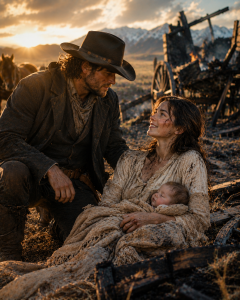
The rise in the land gave him the whole scene at once. A wagon burned down to its ribs. Wheels sunk halfway into drifted snow. What was left of the canvas roof hung in blackened strips, lifting a little every time the wind pushed through. The smell reached him before he was close enough to see clearly — burned wood laced with something underneath it, something he recognized from four years of battlefields and had hoped never to smell again. Buzzards turned slow circles overhead, patient the way only scavengers can afford to be.
Colt walked the wreck in silence. There wasn’t a word in him worth saying to a place like that.
Then he heard it. Thin. Almost lost under the hiss of wind through broken wood. A cry.
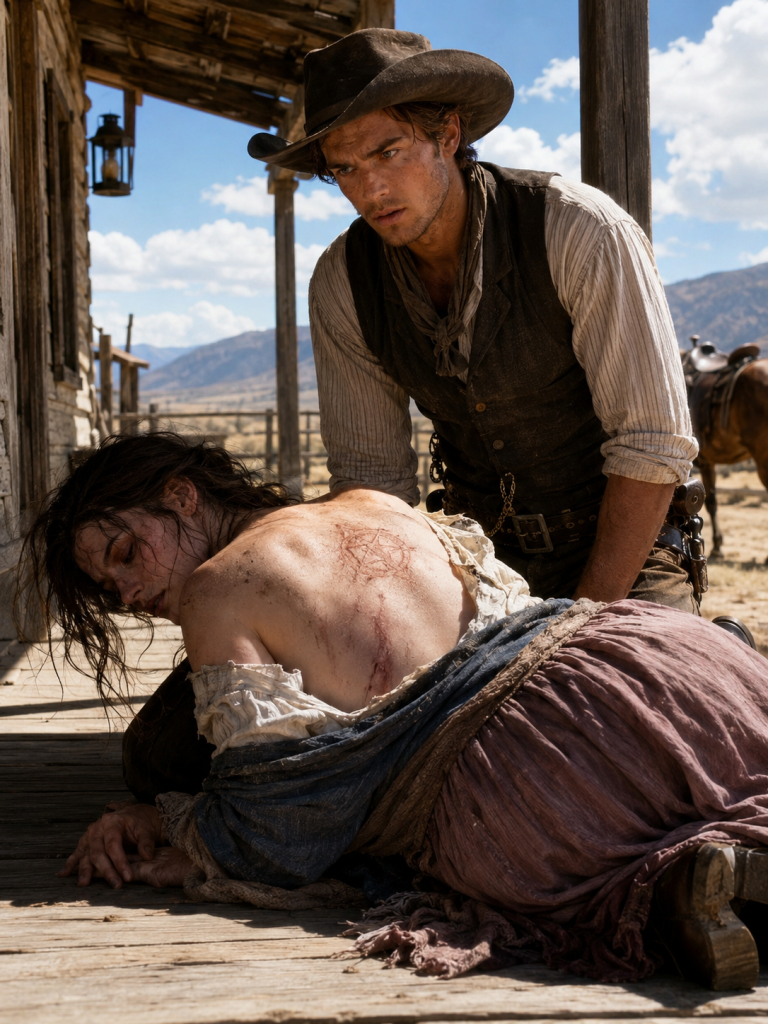
He found her behind a collapsed beam — a woman curled tight around a bundle wrapped in a torn coat, soot streaked across her face, one eye swelling dark where something or someone had struck her. Her gaze found his and held there, dim but awake, and something in it wasn’t fear exactly. It was closer to bracing. Like she’d already decided what kind of man he’d turn out to be, and was waiting to be proven right.
The bundle in her arms squirmed. Cried again.
Colt dropped to one knee and eased the blanket back just enough to see a baby’s face — cheeks raw from cold, nose bright red, and eyes that held no business trusting anyone in a place that smelled like this. The boy looked up at him and smiled anyway. Small and warm and entirely wrong for the ruin around them.
It hit Colt somewhere he didn’t have a name for anymore.
“Easy,” he said, low, barely rising over the wind. “I got you. Both of you.”
He stripped the saddle blanket off his horse and laid it over them both. The woman tried to speak — he watched her lips shape something — but no sound came, only a raw, strangled catch in her throat, like her voice had been driven so far down it couldn’t find its way back up. Rope burn circled both her wrists, raw and recent. Somebody had tied her. Somebody had left her here to burn with the wagon.
He worked fast after that. Built a fire from the dry tinder in his pack. Wrapped the baby tighter. Pulled his own coat off and draped it over the woman’s shoulders, and only once the warmth reached her did her breathing finally deepen into something steadier.
She never let go of the child. Not once, all through that long, cold night — not to eat the little food he offered, not to drink, not even to sleep, as far as Colt could tell. He sat up beside the fire and watched her watch the flames, and understood without being told that whatever she’d survived, she wasn’t done being afraid of it yet.
By morning the world had turned bright and sharp, frost lying over the burned wagon like one last blanket laid down out of mercy. The baby woke first, making small sounds with no fear in them at all. Colt handed him back to her, and she took him with slow, careful hands. Still no words. Just the weight of the boy settling against her like the only solid thing left in the world.
They rode double the rest of the day, Colt keeping the horse steady while she held the child close against the cold. By dusk, the smoke stacks and huddled rooftops of a mining town called Black Hollow rose up out of the white.
People stopped in the street to stare. Colt understood how the three of them must look — a worn drifter, a half-frozen woman, a baby wrapped in scorched blankets. More like trouble walking in than anything worth welcoming.
He didn’t stop to explain himself. He bought what coin could buy at the general store while the old woman behind the counter studied them with open suspicion, and outside, the sheriff was waiting, thumbs hooked in his belt, sizing Colt up like a debt come due.
“Drifter,” the sheriff said. “That your kin?”
“She’s with me,” Colt answered.
“That’s not what I asked.”
Colt held his ground and said nothing further. After a long moment, the sheriff stepped aside — but the look he gave Ruth as they passed lingered like a promise he intended to keep.
That night, in a borrowed barn behind the chapel, with straw for bedding and a lantern the preacher had left glowing like a silent invitation, something shifted. Ruth still hadn’t spoken a single word. But as the fire burned low and the wind pushed snow against the barn doors, she reached into a small satchel, pulled out a worn wooden carving — some small animal, smoothed soft by years of handling — and set it down near Colt’s boot.
She nudged it toward him with one finger.
He picked it up. It was still warm from her hand.
“Yours?” he asked gently.
She nodded once.
He set it back beside her, and for a long moment neither of them said anything else.
Then she reached for the coat the baby had been wrapped in that first night — the one she’d never let far from her — and turned the collar inside out. Stitched into the lining, uneven but deliberate, were five letters worked by hand: *MASON*. She touched the stitching, then touched the boy’s chest, and looked up at Colt to make sure he understood.
He did. Not a name he’d guessed at. A name she’d sewn into cloth long before the wagon burned, back when she still had a needle and thread and a reason to hope the name would matter to someone besides her.
“Mason,” Colt said, testing the shape of it. “Good name.”
Ruth’s throat worked like she meant to answer, but nothing came, just that same raw catch he’d heard the night he found her — not muteness, he understood now, but a voice locked down so hard by fear it had forgotten the way out. She nodded instead, and that was enough. But even as the warmth of that small trust settled over the barn, Colt couldn’t shake the feeling that Black Hollow was already watching them back — and that whatever Ruth had run from wasn’t finished looking for her.
—
PART 2
Three days passed that way — careful mornings, quiet work, the slow business of keeping three strangers alive under one roof that didn’t quite belong to any of them. Preacher Josiah left a food basket at the barn door each evening and asked nothing in return. Colt split wood behind the saloon, hauled hay at the stable, fixed a hinge at the church — earning what he could, saying little, expecting less.
Ruth swept the chapel steps every morning with Mason wrapped against her back. She kept her eyes down. She spoke to no one. And still, every gaze in Black Hollow seemed to catch on her the same way, uncertain whether she was harmless or haunted.
Colt watched her from a distance and understood something the town didn’t. He’d known men broken by war. But the stillness inside Ruth came from a different kind of battle — the kind fought alone, over years, with no one keeping score but her.
Sheriff Holloway found him stacking wood one morning, chewing a toothpick, hat tipped low. “Folks are asking questions,” he said. “Woman doesn’t speak. Makes people uneasy.”
“She hasn’t harmed this town,” Colt said. “She keeps to herself. Cares for her child.”
“She’s not your kin,” Holloway said. “Not your wife either. Which makes what she is my concern.”
Colt straightened to his full height. “You see much peace here, Sheriff, before we came?”
The sheriff walked off with his shoulders too tight for a man who thought he’d won the exchange.
That night, Ruth left half her bread on Colt’s side of the crate they used as a table. No words. Just a small tilt of her head. It was the first gesture she’d offered freely, and it settled somewhere warm in his chest that he didn’t examine too closely.
The town kept talking anyway. May at the general store called her *the hollow girl*. Others whispered she’d run from some scandal, that the boy wasn’t hers at all, that she dragged trouble behind her like weather. Colt had heard worse said about better people in worse places. He let it pass over him.
Two young men didn’t let it pass so easily. They cornered him behind the general store one cold afternoon, full of borrowed pride. *Say she lit the wagon herself. Say she’s touched in the head. Sheriff says strangers need watching.*
Colt didn’t raise his voice. He didn’t need to. He grabbed the nearest one by the coat, put him against the wall, and said, “I don’t start fights. But I end them. Speak about her again, and you’ll find out how fast.” They left with wide eyes and nothing more to say.
That night Ruth brushed her fingers against his shoulder when she handed him Mason to hold — small, but the first time she’d reached for him on her own.
A few nights after that, Colt woke to the sound of quiet crying. Not the baby. Ruth — soft, careful, the kind of crying that had been trained for years to stay hidden. He didn’t move. He didn’t reach for her. He only listened until it faded, and in the morning she handed him tea and finally met his eyes and held them.
Weeks folded into a fragile rhythm after that. Mason took his first steps straight into Colt’s arms. Ruth began humming — half a tune, never finished, but her voice was finding its way back to her one thread at a time. One evening she found a stub of charcoal by the stove and began drawing on the barn wall: mountains, trees, three figures standing together beneath a crooked sun.
She didn’t explain the picture. She didn’t have to.
Then one morning the town went quiet when Colt walked by. May stared too long. Preacher Josiah looked worn thin with something he wasn’t saying. Sheriff Holloway paced the street like a man bracing for weather.
That night Ruth sat outside on the chapel steps with Mason in her lap, staring hard at the tree line at the edge of town. Colt walked out and stood beside her. He didn’t need to ask.
“They found her,” he said quietly.
Ruth didn’t look up. Her fingers only tightened around Mason — and reached, without a word, for Colt’s hand instead.
—
PART 3
That night, Ruth didn’t hum. The barn stayed dark and still, the only sound the wind dragging snow across the roof and the small, even breathing of the boy asleep between them. Colt sat with his rifle across his knees and cleaned the barrel by lantern light, not because it needed cleaning, but because his hands needed something to do besides sit still while his mind ran through every version of what was coming.
Near dawn, Ruth spoke.
One word. Thin from disuse, barely more than breath. “Husband.”
Colt turned slowly, careful not to make the moment bigger than she could bear. She held his eyes and nodded once, then knelt and traced shapes in the dirt floor with one finger — a man. A second man beside him. A child. Flames rising over the shape of a wagon.
He understood the rest without needing more.
Ruth hadn’t just survived cruelty out on that frozen road. She’d escaped a marriage built on ownership — a man who’d burned his own wagon rather than let her leave with what he considered his. A man who meant to sell her and keep the boy, or worse, sell them both and call it settling a debt.
Something in Colt went cold and very still, the particular stillness that used to come right before he did something during the war he never wrote down afterward.
Two days later, two strangers rode into Black Hollow. They didn’t stop for food. Didn’t water their horses. They walked the street with the unhurried, searching look of men who’d been paid to find something specific and weren’t leaving without it.
Colt watched them from the chapel roof and said nothing to Ruth. She was already carrying more than her share of fear; he wasn’t going to hand her more before he had to.
That evening he packed supplies quietly — enough for the three of them to move fast if it came to that. When Ruth saw the bundle by the door, she shook her head, slow and certain.
She was done running.
She said it without a single word, and Colt felt the truth of it settle into him like something being asked of him he hadn’t expected to be asked. He respected her for it. He was afraid for her because of it. Both things were true at once, and he didn’t try to make them agree.
That night he circled the woods behind the livery and found the two men camped low, voices carrying just far enough. The broad one with the scar across his cheek said he’d seen her by the chapel that morning. The thinner one said they’d take the boy while the sheriff slept — Ruth would follow the boy anywhere, and that was the whole plan, simple and cruel in the way plans built around someone’s love usually are.
Colt stayed in the dark until he’d heard enough, then walked back to the barn and didn’t sleep again before morning.
At first light, Ruth dressed Mason with careful hands, wrapped him warm, pressed a kiss to his forehead like she was memorizing the shape of it. Colt touched the boy’s cheek, warmed by the low fire, and made a promise inside himself he had no intention of breaking. Then he stepped out into the cold and waited.
The two men came at mid-morning, unhurried, the way men walk when they believe the law already belongs to them. Colt stood in front of the chapel, rifle slung loose across his shoulder, hands empty and open. Calm on the outside. Every muscle in him coiled tight underneath.
“You Avery?” the broad man asked.
Colt didn’t move. “If you say so.”
They talked the way men like that always talked — about rights, about property, about the law standing behind them and not behind a woman who’d run off with another man’s child. Colt let the words burn themselves out. Then he stepped forward and put the broad man on the ground with one blow to the jaw. The thinner one lunged; Colt swung the rifle stock into his ribs and folded him over gasping into the snow.
Sheriff Holloway came running at the noise, and what he found waiting for him was Ruth — stepped out from the barn with Mason on her hip, back straight, face set, speaking for the first time in front of the whole town in a voice low but steady as bedrock.
She told them everything. That these men had burned her wagon. That they’d tied her and left her to die in the cold. That they’d meant to sell her and take her son.
The sheriff looked at the men bleeding in the snow, then at Colt, then at Ruth for a long moment before his decision came fast and final. Attempted murder and kidnapping weren’t matters he could settle with a warning, not with a witness willing to speak and rope burn still raw on her wrists as proof. He had both men bound and locked in the back room of the jailhouse to wait on the circuit judge, due through Black Hollow within the month, and sent a rider to the county seat that same afternoon with a full account of what Ruth had said. Whatever happened next would happen in front of a judge, not out behind a barn where men like that had always counted on being believed over a woman who couldn’t speak.
It wasn’t everything. But it was more than Ruth had ever gotten from a lawman before, and when Holloway told her so, plain and without ceremony, something in her shoulders came down half an inch, like a weight she’d been carrying since long before the fire had finally been set somewhere else.
That evening, Ruth placed Mason in Colt’s arms, her hands trembling — not from fear this time, but from the sheer weight of everything finally being allowed to settle. She stepped close, pressed her forehead to his chest, then lifted her face and kissed him, quiet and certain, carrying more truth in it than a lifetime of careful words ever could have.
They moved into an old caretaker’s cabin near the ridge not long after. Colt mended the roof. Ruth scrubbed the windows until light poured back into rooms that had been dark for years before them. Mason ran laughing circles across the creaking floor like the place had always been his.
Spring came slow but sure, the ground softening, the air losing its edge. The town changed with it. Preacher Josiah visited often, no longer out of duty but because he wanted to. May began leaving small gifts on the porch rail. Even Sheriff Holloway nodded to Colt on the street now with something close to respect where suspicion used to sit.
Then, on a quiet afternoon, a young rider brought a letter up from Dry Bend.
It said Ruth’s husband — Jeremiah Casey — had survived the fire he himself had set. That he was coming to claim the boy. That the law, as far as he was concerned, still stood behind him.
Ruth read it without crying. Colt read it without flinching. He fed it to the stove and watched the paper curl black and disappear, and neither of them said what they both already knew — that the letter had only ever been a warning, and warnings like that always meant the man himself wasn’t far behind it.
The circuit judge came through Black Hollow that same week to try the two men locked in Holloway’s jailhouse, and what came out in that small courtroom changed the ground under everyone’s feet. The thinner man, hoping to trade truth for mercy, testified that Jeremiah Casey wasn’t Mason’s father at all — that Ruth had been widowed young, her first husband dead of fever before the boy was ever born, and that Jeremiah had married her only after, knowing full well whose son he was raising and meaning to sell him off regardless. He testified, too, that a marshal two counties over had papers out on a man matching Jeremiah’s description under a different name, wanted for doing this same thing to another woman before Ruth.
It wasn’t proof enough to arrest a man who hadn’t yet set foot in Black Hollow. But it was enough for the judge to say plainly, in front of the whole room, that if Jeremiah Casey showed his face in this county, there’d be a cell waiting for him same as the other two — and enough for Ruth to understand, for the first time since the wagon burned, that the law might actually end up standing on her side of this instead of his.
Jeremiah didn’t come to the clearing to talk. He came to the cabin itself, three nights later, while Colt was still up at the ridge line checking a fence post that didn’t need checking — a chore he’d invented so he could see the whole valley from above. It was that height that saved them. He caught the shape of a man crossing the yard below in the moonlight, moving wrong, moving careful, and he was already running before his mind had finished naming what he was looking at.
By the time Colt reached the porch, Jeremiah had the door open and one hand locked around Ruth’s wrist, the other holding Mason pinned against his own chest like a man collecting a debt he had every intention of collecting. The two hired men stood back near the tree line, rifles half-raised, unwilling yet to commit to whatever this was becoming.
“Let them go,” Colt said. He didn’t raise his voice. He didn’t need to.
“He’s mine,” Jeremiah said. “Whatever she’s told you, he’s mine, and the law says so whether you like it or not.”
“Judge in Black Hollow says different.” Colt kept his eyes on Jeremiah’s hands, not his face. “Says you’re not his father. Says there’s a marshal two counties over with papers on you already. You didn’t come here to claim a son, Casey. You came to finish what you started with that wagon.”
Something broke loose in Jeremiah’s face — not fear exactly, but the particular panic of a man watching his own story collapse in front of witnesses. His grip on Ruth’s wrist tightened hard enough that she gasped, and Mason began to cry against his shoulder, and that sound seemed to be what finally decided things for the two men by the tree line.
“You said this was simple,” the broad one called out. “You said we’d get paid and be gone. Didn’t say nothing about a marshal, and didn’t say nothing about you deciding halfway through we’re liabilities instead of hands.”
Jeremiah’s gun came up toward Colt in the same breath the broad man’s came up toward Jeremiah. The shot that followed came from Jeremiah’s own hired man, wide and rushed, catching Jeremiah high in the shoulder and spinning him off Ruth entirely. Colt closed the last of the distance in two strides and put him flat on the porch boards before he could bring the gun to bear on anyone else, pinning the wrist until the revolver dropped and skittered into the snow.
Ruth pulled Mason free and back against her chest, both of them crying now, and it was the sound of gunfire — not the fight itself — that brought Sheriff Holloway and half of Black Hollow up the ridge road with lanterns swinging, close enough behind to see Jeremiah bleeding into the porch boards with his own hired man’s confession already spilling out of him in a panic to save his own neck.
Holloway didn’t need to hear much more than that.
Jeremiah Casey was carried down to the jailhouse to wait beside the same cell that had already held two other men that month, and the marshal from two counties over arrived inside the week to collect him on older, heavier charges that had nothing to do with Black Hollow at all. When the circuit judge returned, he did more than pass sentence — he granted Ruth’s marriage to Jeremiah annulled on the grounds of fraud, and her custody of Mason confirmed and recorded, plain and final, in the county ledger. No one would ride into Black Hollow again with a claim on either of them that the law would have to weigh twice.
Once the last lantern had gone back down the ridge road and the porch had gone quiet again, Colt turned to find Ruth still holding Mason too tight to let go, her whole body shaking with everything that had almost happened. He didn’t say anything. He simply put his arms around them both until the shaking eased, and after a long while she lifted her face and kissed him, soft and unhurried, like a door finally allowed to close behind them for good.
The next morning, Ruth carried her old wedding ring out to the fire and let it fall into the flames. Neither of them spoke as it melted down to nothing. There didn’t seem to be anything left that needed saying about it.
That afternoon, for the first time in years, Colt opened the journal he’d carried across a war and a winter without ever writing a single word in it. He wrote one line, plain and unadorned, and closed the book.
*She stayed. I stayed. Maybe that’s all love needs to be.*
Outside, the wind moved gentle through the trees around the little cabin on the ridge — not cold anymore, not quite warm yet either. Just right, in the way that things finally are once the worst of the winter has passed and there’s nothing left to outrun.
THE END