After 12 years trapped in a wheelchair, the Mafia Boss thought betrayal couldn’t hurt more—until he caught his fiancée secretly injecting him… but why did the maid’s little daughter make him stand at midnight?

PART 1
The child came through the hedge on a Tuesday afternoon like she had decided the gap was there specifically for her.
She was small — eight, maybe nine — wearing a coat two sizes too large and shoes with the left sole separating at the toe. She came through the trimmed privet with the confidence of someone who had been doing this long enough to have a method for it, and she stepped into the back garden of the Reyes estate and looked around at the baseball diamond with the specific attention of a person encountering something they have seen in photographs and are now verifying against reality.
Luca Costello watched her from the covered porch.
He had been watching his captains argue about the eastern docks through the window of the study and had turned away from the argument, as he increasingly turned away from arguments, because most of them had been happening for twelve years and had resolved nothing. He had wheeled to the porch because the afternoon light was doing something to the lake that he found, for reasons he didn’t examine, worth watching.
The child appeared to be dancing.
Not gracefully. She was moving the way children moved when they were copying something they had seen once and were reproducing from memory without the benefit of professional instruction, which meant her elbows were doing things her choreographer had probably not intended. She spun, stumbled, caught herself with a laugh, and then looked at him with the unconcerned assessment of someone who had just been caught doing nothing shameful.
“You looked sad,” she said.
Luca had not been looked at directly — not by someone who had no reason to be careful about it — in quite some time. His men looked carefully. His lawyers looked circumspectly. His medical staff looked clinically. The housekeeper who had started three weeks ago had not looked at him at all, which was the considered approach of someone who had correctly assessed the situation.
This child looked at him like the question of whether he was powerful was interesting but secondary.
“What is your name?” he said.
“Maya. My mom works here.”
“Elena Harper.”
“Yes.” She cocked her head. “Do you know why you look sad?”
“I’m not sad,” he said.
“Okay,” she said, in the tone of someone who has noted a position without endorsing it. “Do you want to see me do the part with the turn again? I messed it up before.”
He had not been asked a question that contained no threat, no calculation, and no desired outcome in some time.
“Yes,” he said.
She did the turn again and messed it up again and laughed at herself again, and Luca watched her and felt something happen in the region of his chest that he had stopped expecting things to happen in.
He raised one hand to signal the guard who had begun moving toward her.
“Leave her,” he said.
—
Her mother found them twenty minutes later.
Elena Harper came around the corner of the porch at a near-run and stopped when she saw Maya sitting on the porch steps eating the crackers that one of the staff had brought out without being asked.
“Maya,” she said. Her voice had the specific register of a parent managing terror by keeping it behind their teeth. “Come here right now.”
Maya slid off the step. “It’s okay, Mom. He’s nice.”
Elena’s eyes moved to Luca. She held the careful expression of someone who has spent years learning to maintain a neutral surface under pressure.
“Mr. Costello,” she said. “I’m so sorry. She knows she’s not allowed—”
“She’s not in any trouble,” Luca said.
Elena blinked.
“She’s welcome to come through the hedge,” he said. “Tell the gardeners to leave the gap.”
Elena stared at him.
Maya took her hand.
“Told you,” she said.
—
He had built the baseball diamond eleven years ago.
This was the kind of detail that existed in the estate’s history without fitting neatly into any of its chapters. He had built it before the collapse — before the twelve years of specialists and test results and the carefully managed life of a man in a wheelchair who had ruled Chicago from a sitting position for so long that standing was now theoretical.
He had built it when he still believed in the specific future it implied: a family, children, the particular mundane joy of watching someone learn to hit a ball. The future had not arrived. He had stopped using the diamond. His men maintained it because no one had said to stop, and because there were things in a man’s compound that existed as museums to the version of himself he had been, and no one wanted to be the person who said it was time to take down the exhibits.
Maya found it immediately.
She treated it as though it had been built for her.
This was, he thought, the most useful thing that had happened to the baseball diamond in a decade.
Tommy Reyes found it the following week. He came through the gap in the hedge after Maya, squinting at the estate with the wariness of a child who had learned to squint at things before trusting them. He was nine, maybe ten, with patched clothing and an expression that said he had opinions about the world and most of them were correct.
He looked at Luca.
“Rich men help until they get bored,” he said.
“Who taught you that?” Luca said.
“Experience,” Tommy said.
“How much experience do you have?”
Tommy thought about this.
“A lot,” he said.
He sat on the porch steps and did not speak for half an hour, watching Maya on the diamond and watching Luca watching Maya. Then he picked up the baseball that had been sitting on the step beside the railing and threw it, experimentally, at the backstop.
It made a satisfying crack.
He did it again.
By the end of the hour, he was on the diamond.
—
Luca had not ordered new medical tests in four years.
The last round had produced the same results as the ones before it. The conclusion was consistent across every specialist in three countries: vascular event at thirty-six, catastrophic damage to the neurological pathways governing lower-limb function, no mechanism of recovery identified. He had accepted this the way a man accepted weather — not with peace, exactly, but with the specific resignation of someone who has stopped arguing with facts.
Then Maya put her hand on his knee.
She did this on a Thursday afternoon, sitting beside him on the porch, because she had been doing math homework and had reached a problem she wanted help with, and she had leaned over to show him the notebook, and her hand had settled on his knee as a point of balance.
“Sometimes when I dance close,” she said, looking at the homework, “your leg tries to move. I’ve been watching.”
He looked at her.
“That’s not something legs do when they’re paralyzed,” he said.
“Mine do weird stuff when they’re asleep,” she said. “Sometimes I wake up and my whole leg is tingly and I can’t feel it right and then it wakes up again.”
“That’s circulation,” he said.
“Maybe.” She looked at his leg and then at him with the direct assessment he had come to understand was simply how she looked at things. “But I think your legs are sleeping. Not dead.”
He should have explained the neurology. He should have been kind but clear about the fact that there was a significant difference between a sleeping limb and the kind of damage that presented as paralysis for twelve years.
Instead, he said: “Why do you think that?”
She considered the question seriously.
“Because dead things don’t try,” she said.
—
He ordered new tests in November.
Not the routine kind. He called in a neurologist from Johns Hopkins and a toxicologist he found through a contact who owed him significant favors, and he was specific about what he wanted: not a reassessment of the paralysis, but a toxicological analysis of his blood and tissue, looking for markers of induced neuropathy rather than vascular damage.
The report arrived in a sealed envelope on a Wednesday morning.
He opened it in the study with the door closed.
He read it twice, because the first time he read it, he needed the second reading to confirm what the first had said.
No vascular event.
No stroke.
A compound — identified by its molecular signature, cross-referenced against a database of industrial and pharmaceutical toxins — had been introduced into his system over a period of three to six months. It had worked by suppressing nerve signal transmission in the lower spinal region. It had mimicked paralysis. It had not destroyed the pathways.
The pathways were degraded. Twelve years of disuse had cost him significantly.
But they were there.
His legs had not died.
They had been silenced.
He sat with this for a long time.
Then he opened the second envelope, which contained comparative bloodwork the house doctor had run after Maya had a dizzy spell and Luca had requested a full panel as a precaution.
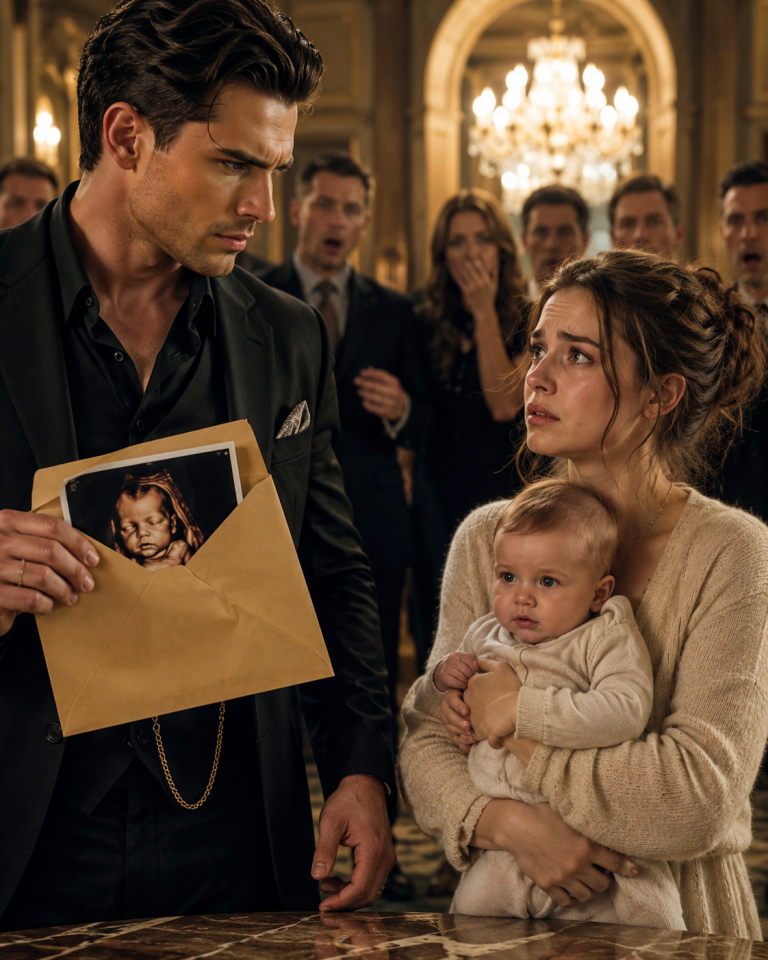
The paternity probability was 99.9997 percent.
He had met Elena Harper’s eyes twice in three weeks. Both times she had kept her face carefully arranged. He had not known the name he carried years ago meant anything to her. He had not known that the summer he spent in a South Side apartment with a woman who made him feel temporarily like a person without a history had ended in a way that required someone to raise a child alone.
He had not known because he had been poisoned six weeks after he last saw her.
He sat in the study for a long time.
Then he called Elena in.
—
She came expecting to be let go.
He could see it in the way she positioned herself near the door rather than moving toward the chair he indicated, and in the quality of her stillness — the stillness of someone who has been dismissed from enough places to have learned how to be ready for it.
“Sit down,” he said. “Please.”
She sat.
He told her about the toxicology report first. She listened without speaking. When he finished, she covered her mouth with her hand and stayed like that for a moment.
“Someone did this to you,” she said.
“Yes.”
“For twelve years.”
“Yes.”
She put her hand down.
“The person who did it,” she said. “Do you know?”
“I have a strong suspicion,” he said. “I’m building confirmation.”
She nodded slowly.
“What does this have to do with me?” she said. “And Maya.”
He put the second envelope on the desk.
She opened it.
He watched her face while she read it. He watched the careful neutral surface hold for a moment and then begin to fail, not dramatically, but in the specific way of someone encountering information that reconfigures the past twelve years of their life simultaneously.
“The summer,” she said.
“Yes.”
“I never knew your last name.”
“Costello. I was going by Luca back then. I still am.”
“You disappeared.”
“Six weeks after you last saw me,” he said, “I collapsed. I was already in a wheelchair before I understood what had happened. By the time I had anything resembling clarity, months had passed. I didn’t know about you. I didn’t know about her.”
Elena looked at the report.
Then she put it on the desk and looked at the wall.
“She’s going to ask me if this is real,” she said.
“Yes.”
“And I’m going to have to tell her.”
“Yes.”
She was quiet for a moment.
“All the things I told her,” she said. “About her father. I told her he was gone and I didn’t know where. I told her he didn’t know about her. I told her it wasn’t anyone’s fault.” She paused. “I didn’t know the last part was true when I said it.”
He waited.
“It was true,” she said.
“Yes.”
She looked at him.
“She’s going to want to know you,” she said. “She already likes you. She comes home and tells me about your conversations. She told me last week that your legs are sleeping, not dead, and I thought she was being imaginative.”
“She’s right,” he said. “Technically.”
Elena looked at her hands.
“What happens now?” she said.
“That depends on you,” he said. “I have no claim on her you don’t give me. I have twelve years of absence that I can’t explain away and can’t undo. You’ve done everything alone. You don’t owe me access to her.”
“No,” Elena said. “I don’t.”
They sat with that.
“But?” he said.
“But she’s going to come through that hedge every afternoon regardless of what I decide,” Elena said. “She’s already decided she likes it here.” She looked at him steadily. “I need to know what kind of man is on the other side of the hedge.”
“What kind do you need me to be?” he said.
She looked at him for a long time.
“Honest,” she said. “When it costs you something.”
—
PART 2
He told Maya himself.
He told Elena he wanted to, which Elena accepted after a silence that communicated she was evaluating the request against her knowledge of her daughter and deciding whether Luca was the right person to deliver this particular information to Maya specifically.
She said yes.
Maya sat across from him in the study and listened to the relevant parts with the seriousness of a child who has learned to listen to important things seriously.
When he finished, she looked at him.
“So you’re my dad,” she said.
“Yes.”
“But you didn’t know.”
“No. I didn’t know until the tests.”
She was quiet for a moment.
“Mom knew you,” she said. “A long time ago.”
“Yes.”
“And then something bad happened to you and you couldn’t find her.”
He held her gaze. “Yes.”
“And now it’s been a long time,” she said.
“Twelve years.”
Maya looked at her hands.
He waited, understanding that whatever she was about to say would be more important than most of what he had been told in twelve years, and that his job right now was to stay quiet and hold still.
“I told you your legs were sleeping,” she said.
“You did.”
“You got tests done after that.”
“Yes.”
“So I was right.”
He looked at her.
“Yes,” he said. “You were right.”
She nodded slowly.
“Then I was also right that you’re my dad,” she said.
He didn’t quite follow the logical sequence, but he understood what she was doing with it.
“Yes,” he said.
Maya slid off her chair and came around the desk and stood beside him.
She put her hand on his arm.
“You’re going to have to work really hard,” she said. “The legs thing.”
“I know.”
“And I’m going to watch, so you can’t quit.”
He felt something in the region of his chest that was becoming familiar.
“Okay,” he said.
“And you have to be honest with my mom,” she said. “She doesn’t like when people hide things.”
“I know that now,” he said.
“Do you?” she said.
It was, he thought, the most direct question anyone had asked him in a very long time.
“I’m learning,” he said.
Maya appeared to decide this was satisfactory.
“Okay,” she said. “We can try.”
—
Tommy had been placed in the estate by Marco Celli.
Luca figured this out six weeks after Tommy moved in, which was approximately six weeks after he should have figured it out, but he had been doing several things simultaneously and also Marco was his oldest lieutenant and the discovery felt like finding a hole in something you had trusted to hold water.
Marco Celli had been with him for eighteen years.
He had driven Luca to the hospital the night of the collapse. He had stood in the corridor while the first doctors delivered their verdict. He had been the first person Luca saw when he woke up in the wheelchair for the first time and understood it was permanent.
He had known, Luca now understood, that it was not permanent. He had known it was chemical. He had known because he had helped arrange it.
He had also known about Elena. About the pregnancy. He had helped ensure that Luca’s disappearance looked like what it looked like — a man who had moved on — so that no one came looking from either direction.
And he had placed Tommy near Lily.
Not maliciously — or not simply maliciously. Tommy’s placement had been insurance. A child connected to Marco, near Luca’s children, in case leverage was ever required.
Tommy didn’t know any of this.
Luca was certain of that.
He was certain because he had watched Tommy for three months with the attention of someone who had spent decades assessing the authenticity of loyalty, and what he saw in Tommy was a child who had learned to protect people he cared about through the specific mechanism of never expecting to be protected himself. That was not the profile of a child who knew he was a tool.
That was the profile of a child who had been used and hadn’t been told.
He called Tommy in.
Tommy came in with the posture he always had when being called into rooms by adults: ready to be told to leave.
“Sit down,” Luca said.
Tommy sat.
Luca told him what he had found.
He told him clearly and without qualification, because Tommy was the kind of child who could tell the difference between being managed and being told the truth, and who responded to being managed by shutting down.
Tommy sat very still through the whole of it.
When Luca finished, Tommy looked at the floor.
“My father,” he said.
“Marco Celli, yes.”
“He put me here.”
“Yes.”
Tommy was quiet.
“Maya doesn’t know,” he said.
“No.”
“You’re going to tell her.”
“Yes. When the time is right.”
Tommy looked up.
“What happens to me?” he said.
It was the kind of question asked by someone who had learned to ask it quickly, before the answer started moving.
“What do you mean?” Luca said.
“I was put here as a — thing,” Tommy said. “A piece. When you’re done with the situation, what happens to me?”
Luca held his gaze.
“Come here,” he said.
Tommy didn’t move.
“Son,” Luca said.
The word did something to Tommy’s face that was almost identical to what it had done to Maya’s face in the study, which was to say it reached something in him that was usually behind a door.
He crossed the room.
Luca put a hand on his shoulder.
“You chose to warn my men when Vanessa came to that construction site,” he said. “You chose to run toward that. You could have gone the other way. The direction you ran tells me who you are.”
Tommy’s jaw set.
“I wasn’t doing it for you,” he said. “I was doing it for Maya.”
“I know,” Luca said. “That’s how I know who you are.”
Tommy stood with that for a moment.
“Marco used me,” he said.
“Yes.”
“Without telling me.”
“Yes.”
“He’s my father.”
“Yes.”
Tommy looked at him.
“You’re not my father,” he said. “And you’re choosing me.”
Luca said: “The choosing is the point.”
Tommy’s composure held for another three seconds.
Then it didn’t.
—
Marco ran on a Wednesday.
He was intercepted at the freight yard on the south side by people who had been watching the freight yard since the first toxicology report landed. He was taken with all the evidence that twelve years of careful record-keeping had accumulated, including his own financial records, which described the arrangement with Vanessa Clarke in the specific language of accounts and transfers that made it legible to anyone who looked.
Luca did not go.
He had thought about going. He had understood for several weeks that he would have the option and had considered what he would do with it. What he decided was that Marco Celli had already had twelve years of his life, and that going to the freight yard to collect on that would require him to become the person who had ruled Chicago from a wheelchair, and he was not interested anymore in being that person.
He sent his men with instructions: Marco would be delivered to the federal prosecutor’s office along with the complete documentation. The investigation that followed would be thorough. Luca would cooperate with it.
Some of his captains looked at him as though he had said something in an unfamiliar language.
Some of them left.
The ones who stayed were the ones he kept.
—
PART 3
Vanessa Clarke came to the community center construction site on a gray October morning.
She came in a white coat and sunglasses with the specific composure of someone who had been thinking about how to enter this moment for a long time. Her car pulled up to the site gate and she got out and stood where Luca could see her clearly.
He had brought Elena and the children to see the foundation pour because Maya had asked to come and because Tommy had said he would only agree to see the site if Maya was there, which was a circuitous way of wanting to see it himself.
Elena saw Vanessa first.
Her hand went to Maya’s shoulder.
Vanessa’s gaze moved through the group and settled on Maya.
“So that’s the child,” she said.
“Vanessa,” Luca said.
“I knew about her,” Vanessa said. “I knew about Elena. I knew about the pregnancy.” She paused. “I tried to manage it before it became a complication.”
Elena’s hands tightened on Maya’s shoulders.
“You tried to hurt my baby,” Elena said. Her voice was very controlled.
“I tried to protect what I’d built,” Vanessa said. “Then Luca became inconvenient and I had to wait.”
Behind the parked cars at the perimeter, Luca’s security team had already identified the men Vanessa had brought. He had been watching them for forty seconds. He was counting.
“You waited twelve years,” he said.
“You were worth waiting for,” Vanessa said. “Your organization. Your territory. The thing you built.”
“And when I started dismantling it—”
“You became unacceptable,” she said. “You were more useful paralyzed.”
One of Vanessa’s men had begun moving toward Maya.
Luca drove his chair hard across the gravel.
The specific mechanics of what happened next were not elegant, but they were effective: he put himself between the man and Maya, took a blow to the shoulder that was meant as a distraction, and held his position while his security team moved through the response they had prepared.
Elena was pulling Maya back.
Tommy had already run.
Not away. Through.
He reached Luca’s head of security at the perimeter and delivered, in approximately fifteen words, the information that changed the calculation of the next four minutes.
The response was fast and surgical and did not produce the war Vanessa had apparently calculated she could instigate. Her men found themselves boxed in before they could establish the situation they wanted.
Police arrived through the site’s emergency system.
Vanessa was taken.
She passed Luca on the ground where he had landed after the blow.
“You should have stayed in the chair,” she said.
“I am in the chair,” he said.
“I mean stayed broken,” she said. “It suited you.”
Elena was beside him, her hands pressing cloth against his shoulder.
“Stay with us,” she said.
He looked at Maya, who was standing with Tommy’s arm around her shoulders and who was crying with the specific quality of a child who is frightened but also extremely angry.
He looked at Tommy, who was not crying and whose jaw was set with the absolute determination of a person who has just decided something permanently.
He looked at Elena, who had her hands on his shoulder and her eyes on his face.
“I’m here,” he said. “I’m not going anywhere.”
—
The recovery set him back.
For three weeks, he was in the medical wing. His shoulder was bad, but the leg regression was the harder thing — pain drove him back into the chair in ways he had not anticipated, and the work he had been doing quietly with the physical therapist from Johns Hopkins had to restart from a lower baseline.
He lay in the medical wing at night and thought about what Lily had said when she first visited him there.
“Your legs are mad,” she said.
“They are,” he said.
“That’s because you made them stop and start again,” she said. “They need time.”
“How do you know?”
“Tommy says when you wake something up after it’s been asleep a long time, it’s grumpy,” she said. “He said that’s why he was grumpy at first.”
“At first,” Luca said.
“Yes,” she said. “He got better.”
She had a point.
The drawing she left taped to the wall of the medical wing showed four figures: two tall, two small. The tall figures had arms around the small figures. One of the small figures was dancing. Underneath: *We are waiting for you.*
He looked at it every morning.
—
The first time he stood unassisted, no one was watching.
It was midnight. The wing was quiet. The parallel bars had been installed in the therapy room three weeks ago, and he had been using them with the therapist for daily sessions, and he had been improving — slowly, with significant pain and the specific frustration of a body relearning something that should have been automatic — but improving.
He went to the therapy room because he couldn’t sleep.
He stayed at the bars for a while.
Then he gripped them and pushed.
He stood for eleven seconds.
He counted.
Then he sat back down.
He went back to bed and lay there in the dark feeling the weight of what had just happened, which was not nothing.
In the morning, he told Elena first.
He told her because she was the person in the house who had already proven she would receive news without performing anything about it, and because what he had to say was not, at this point, for anyone else.
“I stood,” he said.
She looked at him.
“Last night,” he said. “Eleven seconds.”
She held his gaze.
“Maya will want you to do it in front of her next time,” she said.
“I know.”
“She’ll want to count.”
“I know.”
Elena was quiet for a moment.
Then she said: “I’ve been thinking about what you said. About not being able to give back the years.”
“You said that,” he said. “I said I couldn’t.”
“I’ve been thinking about it anyway.” She looked at her hands. “I spent twelve years angry at someone I thought had chosen to leave. Some of that anger went into learning how to be independent, and that was useful. Some of it went into places that made things harder than they needed to be.” She paused. “I’m not angry at you. I want to say that directly.”
“You have every reason—”
“I know what I have reasons for,” she said. “I’m telling you what I feel, which is separate.”
He looked at her.
“What do you feel?” he said.
She thought about it for a moment.
“Tired,” she said. “And something else. Something that I haven’t finished naming yet.”
“Okay,” he said.
“I need more time to name it.”
“I know,” he said. “I’m not going anywhere.”
She looked at him.
“That’s new,” she said.
“It is,” he said.
—
The siege was brief by the standards of these things.
The last people Vanessa had paid began to understand, in the weeks after her arrest, that the payment would not be made and the protection would not materialize, and some of them made the calculation that the time for making demands was running out. They arrived on a Thursday afternoon with vehicles and bullhorns and the particular energy of people who have decided that a dramatic conclusion was preferable to a quiet retreat.
Luca was in the study with his captains.
He said: “Bring me the records.”
This was understood.
He said: “All of them.”
This required clarification, and he provided it: he meant what he said. Every account, every route, every arrangement that existed outside the legitimate structure he was building. He had been building that structure for two months and it was not finished, but it was far enough along to receive what was left.
His captains looked at him.
One of them said: “Boss, this is everything.”
Luca looked toward the hall where Elena was sitting with the children.
“No,” he said. “That’s everything.”
The dismantling happened over the course of the afternoon. Some records were destroyed. Others were handed to attorneys who were building the legal foundation of what came after.
In the garden, glass broke in the main hall.
Maya’s voice came from somewhere in the house.
Luca moved.
He had been moving through the house for two weeks with increasing facility — not quickly, not without his cane, not without the awareness that his legs were still learning what they had been asked to forget — but moving.
He came around the corner into the main hall.
Maya was against the far wall with Tommy beside her, both of them looking at the broken window.
Elena appeared from the adjacent room.
Luca looked at the broken glass.
He looked at his children and the woman who had raised one of them alone for twelve years and had done it better than most people with full resources did it.
He gripped his cane.
He stood without holding it.
It lasted four seconds.
His legs shook.
He sat back down.
But Maya had seen it.
“Again,” she said.
“Maya—”
“Again,” she said. “Please.”
He stood again.
Five seconds this time.
Elena crossed the room and stood close enough that if he went down she could help.
Tommy stood on his other side.
Together they held the position until his legs stopped shaking.
“Okay,” he said.
“Okay,” Maya said.
Outside, the standoff ended the way these things ended when the power inside a house refused to behave like what it used to be — the men with the bullhorns found they had less leverage than they had calculated, because what they had counted on was not there anymore, and what was there instead was something they hadn’t planned for.
Luca’s remaining captains held the lines without firing.
The police arrived.
The siege was over.
—
The spring afterward was slow and ordinary in the way of springs that follow bad winters.
The Harper-Costello Community Center opened on the South Side in April. Elena ran the programming. The center provided meals, after-school programs, legal aid, and a specific service Luca had insisted on: no one who came through the door would be asked to prove they deserved the help before they received it.
Maya danced at the opening ceremony.
This was her idea and she had spent three weeks choreographing it, which meant she had spent three weeks telling Tommy he had to be in it and Tommy spending three weeks finding reasons why he couldn’t, which resolved itself on the morning of the ceremony when Tommy was discovered to be wearing his good clothes.
Luca spoke briefly. He said the center existed because certain things had been done wrong for a long time and were being done differently now, and that different was harder than wrong because wrong had infrastructure and different was building it.
He did not say much more than that.
He was learning to say what he meant and then stop.
—
On an evening in June, they were on the porch.
The lake was doing something to the light. Maya was on the baseball diamond with Tommy. Elena was beside him.
Luca stood at the porch railing.
He had been standing for approximately three minutes, which was new. His legs still had opinions about this and expressed them, but they were complying.
“I’ve been thinking,” Elena said, “about what I was trying to name.”
He looked at her.
She looked at the lake.
“It’s not quite trust yet,” she said. “Trust takes time and I know that. But it’s the direction of trust. It’s the thing that happens before trust when you’ve decided to look in that direction.”
“Yes,” he said.
“I’m looking in that direction.”
“I know,” he said. “So am I.”
She turned to look at him.
“You’re standing without the cane,” she said.
He looked down.
He had put it down to hold the railing and then stopped holding the railing at some point.
“Four minutes,” he said.
“Maya’s going to want to count next time,” she said.
“I know.”
Maya appeared at the edge of the diamond.
“Daddy,” she called. “Are you—” She stopped. She looked at him. “Are you standing?”
“Yes,” he said.
She ran across the grass.
Tommy followed at a walk that was also a run.
Maya reached the porch steps and stopped and looked up at him.
“You didn’t tell me,” she said.
“It just happened,” he said.
She thought about this.
“Okay,” she said. “But next time tell me so I can count.”
“Yes,” he said.
“I told you,” she said, with the patient certainty of a child who has been right about something important for a long time and has been waiting for the evidence to catch up. “Sleeping.”
“Yes,” he said. “You were right.”
Tommy stood at the bottom of the steps looking up.
“He did four minutes,” Elena said.
Tommy squinted at Luca.
“Bet I can get you to five tomorrow,” he said.
Luca looked at him.
“Bet,” he said.
Tommy nodded once.
Maya put her hand in Luca’s.
He held it.
Behind them, the lake went gold in the late light, and the baseball diamond waited for morning, and the house that had been a fortress for twelve years held four people who had arrived at it from different directions and had decided, separately and together, to stay.
It was not the future he had planned.
It was the future that had survived the plan.
Later, when Elena found him at the window overlooking the lake — the place he had stood before all of it, watching light on water — she stood beside him.
They were quiet for a moment.
“She was right the whole time,” he said.
“She usually is,” Elena said.
Outside, they could hear Maya and Tommy arguing about the rules of baseball with the seriousness of two children who had decided to care about the same thing, which was the closest thing to certainty the world offered.
“We,” Luca said.
Elena looked at him.
He looked at the lake.
“Not I,” he said. “We.”
She put her hand on his arm.
“We,” she said.
The word held.
It held the way things held when they were built correctly — not against the pressure of what was outside, but because of the structure of what was within.