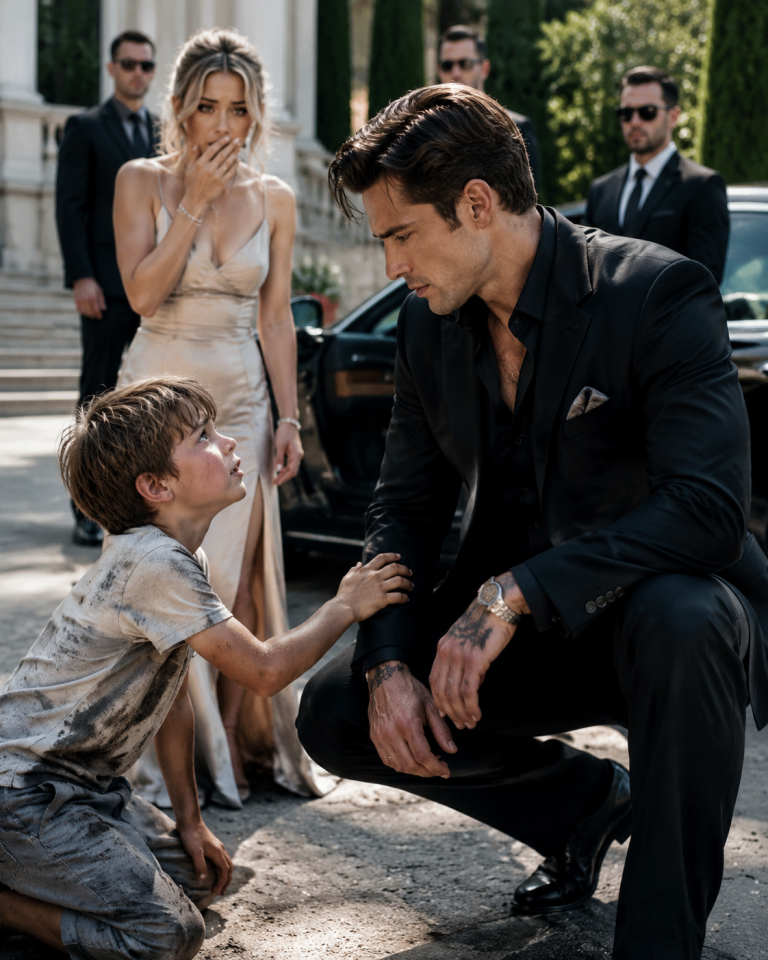
“This Marriage Means Nothing”—Until the Mafia Boss Lost Control on Their Honeymoon

# PART 1
I know the exact sound my life made when it stopped being ordinary.
It was not a gunshot. It was not a scream. It was not any of the dramatic things movies assign to turning points. It was small and accidental and utterly mine: the wet crack of a ceramic mug against a tile floor, knocked from my desk by my elbow at 9:52 on a Thursday night in November, sending coffee across a stack of student sketches I had been grading for the past three hours.
I was cleaning it up, crouched on the floor with paper towels and low-level despair, when I heard the voices outside.
That was how it began.
Not with the sound of danger.
With the sound of me, making a mess, being somewhere I technically should have left hours ago.
—
I taught art at Meridian High School in South Columbus, which is another way of saying I taught at a building that looked, from the outside, like someone had designed optimism and then run out of budget before the finish coat. The walls were bright. The hallways were clean. The parking lot lights had been broken for four months because the district had approved a donor hospitality suite renovation in October and moved the maintenance budget accordingly.
I knew the maintenance timeline because I had submitted two repair requests myself, both of which had been acknowledged and then absorbed into the institutional silence that swallowed most things that inconvenienced people with money.
I was twenty-seven years old.
My name was Clara Esposito. I taught drawing, composition, and Advanced Studio Art. I drove a car with a taped side mirror and kept three months of student loan statements in my desk drawer because some part of me believed that looking at them directly would eventually generate a solution. My parents had died within fourteen months of each other — my father from a heart attack when I was nineteen, my mother from the grief that followed — and I had inherited their apartment, their furniture, and approximately thirty-one thousand in medical and credit debt that followed me like a second shadow.
My students thought this was proof I was devoted.
I had simply never found a compelling reason to leave.
That Thursday night, I was finishing comments on a set of observational drawings when the mug broke and I heard the men outside.
At first I thought: loading dock. Sometimes deliveries came late, especially near the end of semester when schools received grant materials on compressed timelines. I heard voices, low and purposeful, and the sound of something heavy being moved. I stood and looked out the window that faced the east parking lot.
Three vehicles. Dark, no plates visible at this distance. Men moving between them with the coordinated quiet of people who had arranged what they were doing in advance.
I pressed closer to the glass.
One man stood apart from the others, slightly elevated on the loading ramp, watching. He wore a coat that looked wrong for the parking lot the same way an expensive painting looks wrong in a waiting room — not because it doesn’t belong, but because you understand immediately that it arrived here through a sequence of decisions that should have gone differently.
He turned his head.
Even at fifty yards, even through rain and bad light, the quality of attention in that movement was specific.
He was looking for something.
Someone handed him a phone.
He looked at the screen, then at the building.
My stomach folded.
I stepped back from the window.
I had seen a man in this parking lot two weeks earlier. I had been carrying a box of finished canvases to my car after the winter art show. Two men standing by a black SUV, one handing the other something small — a drive, I’d thought, or a phone. The taller man had noticed me. He’d held my gaze for three seconds with an expression that landed somewhere between assessment and dismissal.
I had filed it under *nothing*, the way women file most things that alarm them in parking lots, because the world reliably punishes us more for the noise we make than for the silence that follows.
I understood now that it had not been nothing.
I needed to leave.
I grabbed my coat, my bag, my phone — and the phone had no signal, of course, because this wing of the building was a dead zone the facilities team had been promising to address for two years. I moved toward the corridor, toward the front exit, toward the part of the building where the cell signal returned, and I was three steps into the hallway when the east door opened.
Two men entered.
They moved without urgency, which was worse than urgency. Urgency is disorganized. What these men had was purpose.
I turned and walked back the way I had come, fast, making decisions by proximity. The art supply room was twenty feet away and too obvious. The stairwell was blocked by their current trajectory. The women’s restroom at the end of the hall had a lock that actually worked because I had replaced it myself after a student complained last spring and no one from facilities had come.
I went inside. Threw the bolt. Turned off the light.
Pressed my back against the far wall and stood very still in the dark.
My phone clock read 10:04.
I typed an emergency text to the one number I thought might reach someone useful, knowing it would send the moment I had signal.
The footsteps in the hallway stopped outside the door.
A pause.
Then a knock, which was so unexpectedly civilized that I almost answered it.
“Miss Esposito.”
The voice was low and carried the particular precision of someone accustomed to being heard regardless of volume. An accent somewhere in the architecture of it, Italian maybe, the kind shaped by time in other places.
My name in a stranger’s mouth, in the dark, in an empty building.
I said nothing.
“I know you are in there,” he said. “I know you saw the parking lot. And I know you filed two maintenance complaints about the lighting in the east lot in October.”
He paused.
“I need you to understand that I am not the danger in this building tonight.”
The floor was cold through my shoes.
“The men who came in after you are,” he continued. “They are looking for a witness to an event three weeks ago. You were described to them by someone who thought you might have seen more than you did. Whether or not that is true does not currently matter. What matters is that they believe it.”
I made myself breathe.
“You can stay in there,” he said. “I can go. But the men inside this building are between you and every exit, and your phone has no signal in this corridor.”
He knew about the signal.
“My name is Adriano Morano. I came here to find you before they did. That is the complete truth. What you do with it is yours to decide.”
Silence.
Outside, somewhere deeper in the building, I heard a door open.
I threw the deadbolt.
—
He was taller than I had realized from the window, with a face built for restraint — everything about it composed, nothing wasted, the kind of structure that made it impossible to guess what he was actually thinking from a single angle. His coat was still damp from the rain. His eyes were dark and moved over me with the quality of someone performing a rapid, comprehensive inventory.
“How did you know my name?” I said.
“The maintenance requests were signed.”
“Why do you know about the maintenance requests?”
“Because the parking lot was used deliberately. Someone ensured it was dark.”
My skin went cold.
“You need to walk with me,” he said. “There is an exit through the science wing that they have not covered yet.”
“Why would I walk anywhere with you?”
“You wouldn’t,” he said. “Under normal circumstances, that would be the correct decision.”
His phone buzzed. He glanced at it without looking away from me.
“They are moving toward the main corridor. We have approximately three minutes.”
Everything in me wanted a better option.
Nothing in me could find one.
“If you are lying to me,” I said, “I will make so much noise that this building becomes a liability for everyone in it.”
Something shifted in his expression.
“You have been underestimated for a long time,” he said. “Tonight, that ends.”
I did not yet know what he meant by that.
I followed him anyway, because the sound of footsteps in the far hallway was getting closer, and sometimes the choice you make is not the one you would have made in a safer version of your life.
We reached my car. He told me to drive. He told me where. And as we pulled out of the back lot, I saw two men in the rearview mirror emerge from the east entrance and stop, scanning the darkness.
My hands on the wheel were steadier than I had any right to expect.
In the passenger seat, Adriano Morano did not speak.
He watched the mirror.
And I drove away from the school that had been my whole world for three years, into a night that had just become something else entirely.
—
# PART 2
He brought me to a house in Bexley that existed in a different gravity from my side of the city.
Not ostentatious. That was the wrong word. What the house communicated was permanence — the kind of wealth that does not advertise because it has never needed to. Iron gates, old trees, stone walls that looked like they had been placed by people who understood they would not live to see them weathered.
Inside, I was processed by the house before I had a chance to refuse: a woman named Beatrice, who moved with the efficiency of someone who managed chaos as her primary vocation, brought a dry change of clothes, tea, and a blanket with the matter-of-fact care of a person who had done this for others before and had decided that dignity was more useful than pity.
Adriano took a call in another room.
I sat in the kitchen, warming my hands around the mug, and thought about the maintenance requests.
Someone ensured it was dark.
The east parking lot of Meridian High had been dark for four months. I had assumed it was budget. The most innocent explanation, the one that required the fewest moving parts, the one that made the most sense if you believed institutions failed through neglect rather than design.
I had been filing reports into a system that someone had already decided not to act on.
That was not incompetence.
That was management.
When Adriano returned, I was ready.
“Tell me what you know about Meridian’s board and the Renata family,” I said.
He stopped in the doorway.
“Most people in your position ask what happens next,” he said.
“I know what happens next. I want to know why it happened at all.”
He studied me for a moment.
Then he pulled out a chair and sat down, and began to speak.
—
The exchange I had witnessed three weeks earlier was between a man named Elia Toretti, who managed logistics for the Renata organization, and a man named Declan Marsh, who was a facilities consultant for the Columbus school district and had a secondary arrangement with several commercial real estate entities tied to the Renata family through four layers of holding companies.
The flash drive contained contract details for school-adjacent property in the east district. Properties that were zoned for residential development, earmarked for district expansion projects that would displace specific parcels, and purchased in advance at a significant discount by the Renata organization through a nonprofit whose board included two district administrators.
I was not supposed to have seen the exchange.
Toretti had flagged me as a potential witness.
The Renatas had sent people to determine whether I could identify him.
“And can you?” Adriano asked.
“I could identify him in a photograph,” I said. “I saw his face for approximately four seconds. I remember it.”
“That is enough.”
“Enough for what?”
“Enough to make you worth removing.” He held my gaze. “And enough to make you worth protecting, if we reach the right people before they reach you.”
The mug was warm against my palms.
“What is your position in this?” I asked. “You know about the flash drive, the property deals, the school board connections. You knew where I was and what I’d filed. That is not a concerned citizen.”
He was quiet for a moment.
“Renata and my family have operated in the same city for twenty years,” he said. “For most of that time, with structured distance. A year ago, they tested the boundary in a way that cost me someone I could not afford to lose.”
He did not elaborate.
I did not push.
“This investigation into the school district connections — that’s yours?” I asked.
“The documentation is mine. The delivery of it needs someone credible outside my world.”
I understood then why he had come for me specifically.
I was not just a witness.
I was a credential.
A twenty-seven-year-old art teacher with maintenance requests and student loan debt and a spotless employment record was, in the right room, bulletproof in ways that Adriano Morano could never be.
“You need me to walk into that room,” I said.
“Yes.”
“And you need me to do it voluntarily, with my own story, in my own words.”
“Yes.”
“So what you are offering me is not exactly protection,” I said. “It is an exchange. I give you the witness testimony. You give me the documentation that makes it credible.”
His expression did not change. But something behind it registered.
“Yes,” he said. “That is the precise truth.”
I picked up the mug again.
“Then I need three things,” I said. “My own attorney. Full access to the documentation before I agree to anything. And I want to understand everything you know about the board members who approved those contracts before I say a word to anyone official.”
Beatrice, passing through the kitchen, made a sound that might have been approval.
Adriano looked at me for a long moment.
“You handle fear very quietly,” he said.
“I teach teenagers,” I said. “You learn to handle everything quietly.”
He almost smiled.
“All right, Ms. Esposito,” he said. “Let’s build the case.”
—
# PART 3
My attorney was a woman named Patricia Holm, who had worked public interest law for eleven years and had the particular energy of someone who had been angry about institutional negligence for so long it had become load-bearing.
She reviewed everything in forty-eight hours.
“This is solid,” she said, across a table covered in Adriano’s documentation. “The property transfers, the board votes, the contract timelines. Everything maps.” She looked up. “The weakest point is the exchange in the parking lot. You saw a face for four seconds, three weeks ago, under bad lighting.”
“I remember it,” I said.
“Memory is not evidence.”
“A photograph would be.”
Patricia looked at Adriano.
He slid a file across the table.
“Surveillance from a property across the street,” he said. “Taken by my people.”
“Your people were watching before the exchange happened,” Patricia said.
“Yes.”
“Which means you knew what was being arranged in that lot.”
“Yes.”
A silence.
“Then why,” Patricia said carefully, “did you not simply go to law enforcement with this six weeks ago?”
Adriano’s answer arrived without defensiveness.
“Because three of the investigators named in the initial referral have financial relationships with Renata properties. One of them attends the same golf club as the board president. I needed documentation thorough enough that no single official could absorb and bury it. That takes time.”
Patricia tapped the table once. “And now you have it.”
“Now we have it,” Adriano said. He looked at me. “Her maintenance records close the loop. They establish that the district had specific notice of the lighting failure, chose not to act, and that the inaction directly facilitated the use of school property for criminal logistics.”
“Negligence as infrastructure,” I said.
Adriano turned toward me.
“Yes,” he said. “Exactly.”
Patricia closed the folder.
“Then let’s talk about which room we walk into first.”
—
The days between that kitchen table and the board meeting were the strangest of my life in the specific way of periods where everything ordinary continues while something enormous is being assembled just outside your peripheral vision.
I stayed in Adriano’s guesthouse. Not the main house — the guesthouse, with its own entrance and its own key, a distinction he had established without being asked. Beatrice brought meals. Patricia came daily. The documentation grew.
I worked.
Not on the case. On my actual work — I had a stack of incomplete grades, a grant application for next semester’s materials budget, and a set of watercolor demonstrations I had promised to record for a colleague covering my classes. Adriano found me in the guesthouse living room at midnight on the third night, laptop open, editing a video of myself explaining atmospheric perspective.
He stopped in the doorway.
“You are behind on grading?” he said.
“Always.”
“You are hiding from a criminal organization and you are worried about your grading.”
“My students are not responsible for my situation,” I said. “Their marks are due by Friday.”
He stood there for a moment in a way that was becoming familiar: the stillness of someone processing something they hadn’t expected.
“Come to the library,” he said. “I have better light.”
I followed him.
The library was the room in his house that made the most sense of him. Not the formal rooms, not the security-monitored office, not the kitchen with its professional appointments. The library, with two walls of books that had been handled enough to show it, a reading chair angled toward a lamp, and a desk that held papers in organized disorder rather than performed cleanliness.
He worked at one end. I worked at the other.
We did not speak for two hours.
“Your parents,” he said, eventually. Not a question. He had read the background documents.
“Car accident. My father first, then my mother fourteen months later from what the doctors called cardiac complications and I called grief.”
“You were nineteen.”
“Yes.”
“And you became a teacher.”
“I became a teacher because I needed something that required me to be present every day,” I said. “Grief is expansive. It will fill whatever space you give it. A classroom full of teenagers does not give it much space.”
He was quiet for a moment.
“My brother,” he said. “Three years ago. Not an accident.”
He didn’t elaborate.
I didn’t ask.
Some information asks to be offered, not extracted.
“Is this —” I gestured at the documentation, the case, the entire apparatus we had assembled. “Is this for him?”
A long pause.
“In part,” he said. “Yes.”
I looked back at my laptop.
“That seems like a legitimate reason,” I said. “As long as it doesn’t become the only one.”
His hands paused on the papers.
“What do you mean?”
“Grief is an engine,” I said. “It is very good at keeping you moving. It is less good at telling you where to go.” I kept my eyes on the screen. “At some point the reason for the next step should be something other than the thing you lost.”
The room held that for a while.
Then he said, quietly: “You are very uncomfortable to talk to.”
“I teach teenagers,” I said. “I’ve had practice.”
—
On the Monday of the board meeting, he told me he would attend.
I told him I preferred to walk in alone.
We were standing in the main hallway, both of us dressed for the occasion in ways that acknowledged the room we were entering: I had borrowed a blazer from Beatrice’s daughter, navy, too formal for my usual register but correct for this one. Adriano looked like he had been built specifically to occupy rooms where people pretended to have power.
“They will use your presence against me,” I said. “The moment I appear with you, the story becomes about you. They will call me a tool of criminal interests. They will say everything I present is contaminated.”
“I know.”
“Then you understand why I go alone.”
“I understand it,” he said. “I don’t like it.”
“Those are not the same thing.”
He looked at me.
“No,” he said. “They are not.”
He handed me a folder.
“Everything is copied and time-stamped,” he said. “Patricia has the duplicates. The reporter from the city education desk received her package an hour ago. A compliance investigator in the state attorney’s office received his.”
“You sent it without telling me?”
“I sent the documentation I assembled. Your testimony is yours to give.” A pause. “But evidence doesn’t ask permission. It simply arrives.”
I looked at the folder.
“You’ll be outside?” I said.
“Yes.”
“Don’t come in unless I call.”
“Agreed.”
The lobby of the district administration building smelled like carpet cleaner and institutional caution. I signed in at the front desk. The woman behind it looked at my name, then at her screen, then at me with the expression of someone who had received a memo and was not sure what to make of it.
“Room C,” she said. “They’re expecting you.”
The board meeting room had a long table, seven chairs on one side, and a row of audience seating on the other that was already half full when I entered. Parents, I recognized some of them. A union representative. Two local reporters on the press side. A man in the back row I didn’t recognize who was writing in a notebook with the focused intensity of someone whose notebook mattered.
Board President Gerald Sloane sat in the center. He was a man who had learned how to project reasonableness the way some buildings project grandeur — as a function of architecture rather than actual content. Beside him sat District Superintendent Carol Farber, who I knew from three unsuccessful budget appeals and one very tense email exchange about watercolor paper.
My principal, Judith Park, was in the audience. She met my eyes briefly and looked away.
I sat down at the indicated chair, facing the board.
Sloane opened.
“Ms. Esposito. Thank you for attending.” He said it the way people say *thank you for coming* when what they mean is *we would have preferred you didn’t*. “As I’m sure you understand, the district has some concerns about recent events and their connection to staff conduct.”
“Staff conduct,” I said.
“Specifically, whether the account of events you have provided to investigators is consistent with your general reliability as a professional.”
There it was.
The preemptive frame.
Before I had said a single thing, they were building the room around me: *unstable*, *unreliable*, *a woman who sees too much in empty parking lots*.
A board member named Warren Gould leaned toward his microphone.
“Ms. Esposito, it has come to our attention that you have been residing at a private property connected to Adriano Morano, who is known to investigators as a figure associated with organized interests in this city.”
“Mr. Morano provided temporary housing after individuals connected to Elia Toretti attempted to locate me in my school building at night,” I said. “You are welcome to characterize that as an association. I would call it a practical response to a threat created by conditions this district was notified about and chose not to address.”
A short silence.
I opened my folder.
“October seventh. Maintenance request, east parking lot lighting. My signature.” I slid the copy across. “October twenty-first. Second request, same issue. My signature.” Second copy. “November third. Email to Principal Park noting unknown vehicles after hours. My signature.”
I laid out six documents.
“Three months of documentation, submitted through proper channels, acknowledged and not acted upon. The east parking lot was dark on the night in question because this district made a choice — not a mistake, a choice — to prioritize other budget items over functional exterior lighting.”
“Ms. Esposito—”
“The contract awarded to Meridian Facilities Group in September was awarded to a company that shares a registered agent with three shell entities connected to Renata Properties. The same Renata Properties that purchased three parcels adjacent to district expansion zones in advance of the zoning changes approved by this board in July.”
The room had gone very still.
Sloane’s expression had stopped performing reasonableness.
“This is speculative—”
“The transfer records are in the folder you just received,” I said. “The voting records are public. The timeline is documented. What I witnessed in the parking lot three weeks ago was a transaction between a Renata logistics manager and a district facilities consultant.”
I placed the photograph on the table.
“His name is Elia Toretti. I identified him from this image. I will provide sworn identification in any proceeding that requests it.”
The man in the back row — the reporter — had stopped pretending to write casually.
The union representative was very still.
Patricia entered from the side door.
Behind her came a man I recognized from the documentation as the state compliance investigator.
Sloane stood.
“This meeting is not the appropriate venue—”
“Mr. Sloane,” the investigator said. He set his own folder on the table. “We have a few questions.”
The room changed.
Not dramatically.
The way rooms change when something that has been held in place by shared agreement to look away stops being held.
—
The fallout was not a single event.
It was a season.
Sloane resigned on the third week after the meeting, citing health reasons that no one found credible. Warren Gould followed six weeks later, under the particular pressure of a state audit that found his personal financial disclosures incomplete in specific and documentable ways. The facilities contract was suspended. Two administrative employees were placed on leave pending investigation. The Renata family’s real estate arm retained six attorneys, which legal observers noted was two more than innocence typically requires.
Three school board seats were filled in a special election. Two of them went to candidates backed by the teachers’ union, who had spent the previous month being very loud about what the documentation had shown.
The east parking lot at Meridian High got new lights in February.
I watched them go on for the first time from my classroom window, on a Friday evening, grading the same kind of papers I had been grading on the night everything started.
Judith Park appeared in my doorway.
“The district approved your materials grant,” she said.
I looked up.
“Full amount?”
“Plus an additional line item for what they’re calling ‘program restoration.’ Apparently someone made a very specific phone call to the grants office.”
She looked at me with the expression of a person who had decided to be grateful rather than complicated about it.
“You could have told me,” she said. “At the beginning. I would have helped.”
“I know,” I said. “I wasn’t sure yet what I had.”
“And now?”
I looked at the grant approval in her hand.
“Now it’s documented,” I said.
—
Adriano came to my classroom for the first time in April.
I had returned to the school in January. He had returned to whatever his version of ordinary was — the house in Bexley, the work I only partially understood, the ongoing legal proceedings that occupied his attorneys and consumed his mornings. We had spoken regularly in the months between the board meeting and the trial dates. More often than the situation strictly required.
Neither of us had remarked on that.
He knocked on the open doorframe, which was unusual enough — most people walked straight in — that I looked up immediately.
He was wearing an expression I hadn’t seen from him before. Not the controlled assessment or the deliberate calm or the briefest flicker of something warmer that appeared occasionally in the library. This was the unmanaged version. Slightly uncertain. Completely unperformed.
“I was in the building for a compliance review,” he said. “My attorney has a meeting with the principal.”
“Yes,” I said. “I know.”
“I didn’t want to leave without—” He stopped. “I wanted to see the classroom.”
I stepped back and let him look.
It was not a grand room. Watercolor prints on the wire, student work taped in rows, paint on every surface that paint could reach, a smell of turpentine and cold coffee and the particular mineral quality of clay. A banner above the whiteboard read EVERY MARK IS A DECISION, which I had put up in September and still believed.
Adriano walked to the window that looked out over the east parking lot.
“New lights,” he said.
“February.”
“How long did they take after the requests?”
“Three months from filing to installation,” I said. “Which is actually fast, for this district.”
He turned away from the window.
“I owe you an apology,” he said.
“For what specifically?”
“For approaching the situation — initially — as if you were a resource to be managed rather than a person making a choice.” He held my gaze. “I knew what I needed from you before I knew who you were. That ordering of priorities was wrong.”
I considered this.
“You got better,” I said.
“You required it.”
“I require it of my students too,” I said. “It is not a special standard.”
He almost smiled.
“No,” he said. “I suppose it isn’t.”
I set down the papers I was holding.
“The compliance review,” I said. “Is that actually why you’re here?”
A pause.
“In part,” he said.
“And the other part?”
He looked at the banner above the whiteboard.
“I wanted to see where you worked,” he said. “I have been trying to understand for several months why you went back. After everything. Why this room.”
“Because my students are here,” I said. “Because this is the work.”
“It would have been understandable to find different work.”
“Yes. But this is mine.” I picked up a piece of chalk and turned it in my fingers. “My parents died when I was nineteen. I spent three years after that being very portable — I moved four times, changed jobs twice, kept everything I owned in a condition ready to be packed. And then I took this job, and I put my prints on the wall, and I stayed.”
He watched me.
“Staying,” I said, “is the bravest thing I know how to do.”
The classroom was quiet for a moment. Outside, through the new lights, the parking lot was even and lit and unremarkable.
“I would like to take you to dinner,” Adriano said. “When you don’t have papers to grade. Which I understand may not be a condition that regularly presents itself.”
“Friday evenings are usually available,” I said. “After seven.”
“Friday, then.”
He moved toward the door.
“Adriano.”
He turned.
“What was your brother’s name?”
A pause.
“Marco,” he said.
“Tell me about him sometime.”
He stood in the doorway for a moment.
“All right,” he said.
After he left, I looked at the east parking lot for a long moment — the lights even and reliable, the lot empty and ordinary, the night outside doing nothing remarkable at all.
Three months ago, I had filed a maintenance request that no one read.
Now it was evidence in a state investigation, a footnote in a compliance report, and the small, unglamorous beginning of a story that people were still telling wrong.
They called it a whistleblower case.
They called it a romance.
They called it the art teacher who got lucky.
None of those were correct.
I was not lucky.
I was documented.
I kept records of every maintenance request, every email, every complaint filed through proper channels that disappeared into institutional indifference. I taught my students that every mark is a decision, that negative space shapes the image, that what you leave out is as intentional as what you put in.
I had been practicing, for three years, exactly the kind of attention that made the difference.
The parking lot lights had been broken for four months.
That was not bad luck.
That was a choice.
And choices, I had learned to tell my students, leave marks.
Even the ones people make in the dark.
Even the ones no one intended to see.
Especially those.
—
*THE END*
—
—