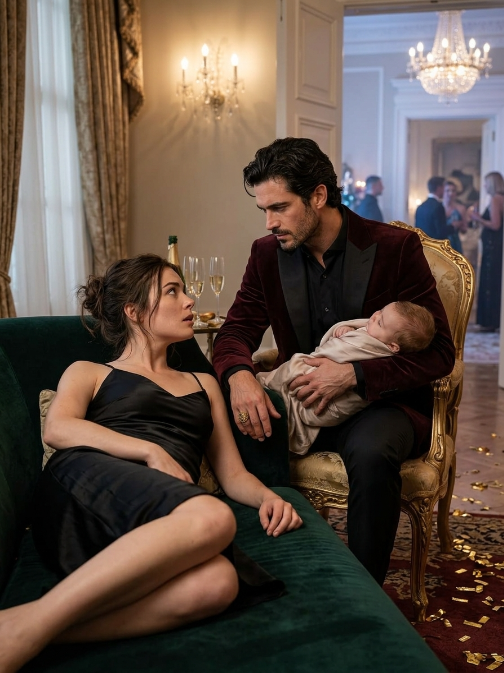
Nearly Beaten in a Dark Alley—The Mafia Boss Appeared and Changed My Life Forever

PART 1
I knew he was going to kill me the moment he smiled.
Not the wild, unraveling smile of a man who’d lost control. Tyler’s smiles were the opposite — small, deliberate, carved carefully onto his face like something practiced in a mirror. He smiled the way a surgeon holds a scalpel: with complete confidence in what it’s about to do.
Rain hammered the alley behind Portside Kitchen. I’d taken the back exit instead of the front because the front exit meant passing his truck, and passing his truck meant having this conversation in the middle of Clement Street with witnesses and streetlights and the illusion of safety. The alley had a dumpster, three broken milk crates, and the lingering smell of fryer oil. No illusions.
The first shove drove my shoulder blade into the brick wall hard enough to rattle my teeth together.
“You really did it,” Tyler said. Not angry. Conversational. “You walked into that courthouse and you told a judge I was dangerous.”
“You are dangerous.”
“Nora.” He said my name the way other people say *obviously*. “What exactly do you think a piece of paper is going to do?”
Inside the restaurant, twenty feet away through the kitchen’s service window, my seven-year-old nephew Eli sat in the last corner booth with a pile of sugar packets and a stack of napkins he’d been folding into origami animals for the past hour. My sister had been dead for eighteen months. My brother-in-law for eighteen months and three days. And Eli, who used to have two parents and a yellow house with a trampoline in the yard, now had me — a waitress who couldn’t afford childcare on Thursdays and occasionally snuck him into the booth farthest from the health inspector’s usual route.
Tyler grabbed my collar and walked me deeper into the alley.
“I’m taking the boy tonight,” he said, very quietly. “He’s my family too. His daddy was my cousin, and that makes him mine when there’s nobody else left.”
“He’s not yours.”
The backhand hit me so hard I bit the inside of my cheek instantly, tasted copper, and had to grab the dumpster to keep from going down. My ribs screamed where he’d shoved me into the wall. Above the ringing in my ears, I could hear Eli’s voice somewhere inside — high and cheerful, utterly unaware.
If I made a sound, Eli would come to the window.
I’d spent eighteen months protecting him from nightmares. I wasn’t going to let him watch this one.
Then headlights appeared at the alley’s far end.
Not the roving kind — parked. A black car, long and low, engine idling like it had nowhere to be. For one second, Tyler and I both just looked at it.
The rear door opened.
One man got out first. Enormous. Dark coat. The kind of stillness that meant he’d stood in worse alleys than this and won.
The second man emerged behind him carrying a black umbrella that he held carefully over his own head as he picked his way across the wet pavement. Charcoal coat. Dark hair. A faint scar cutting through one eyebrow. He looked at the alley the way other men look at a conference table — like he owned it and had already decided what was going to happen.
His eyes found Tyler.
Then they found me.
Then he said, quietly, to the large man beside him: “Handle it.”
Tyler actually laughed. “Back off, pal, this is private.”
The large man moved.
I didn’t see the technique. I only heard the wet crack of a joint bending the wrong direction, and then Tyler was on the pavement making a sound I’d never heard him make before: helpless.
The man with the scar walked toward me through the rain like the puddles knew better than to touch his shoes.
“Are you injured?” he asked.
His voice was lower than I expected. Not gentle — but level. Like a doctor asking, not a stranger.
“I’m fine,” I started.
Then the service window banged open behind me.
“Aunt Nora!”
Eli’s small face appeared in the frame, eyes wide and frightened, one origami crane still clutched in his fist.
The scarred man went absolutely still.
He looked at Eli. For a single, strange moment, every readable emotion left his face — not coldness, exactly. Something closer to recognition. Or calculation. Or both at once.
“Marco,” he said, without turning. “Get the child.”
“No.” I grabbed his sleeve without thinking. “Don’t you touch him. Don’t even look at him—”
He looked at me instead.
“Your ex-boyfriend will be conscious in approximately six minutes,” he said. “When that happens, the situation becomes significantly more complicated. You are bleeding. The child is frightened.” A pause. “This alley is not where you make your decisions.”
No threats. No coaxing. Just the calm presentation of facts.
That scared me more than any threat would have.
Marco lifted Eli through the window with a gentleness that seemed physically incongruous with his size. Our line cook, Dennis, appeared in the doorway behind him holding a filleting knife and looking ready to use it.
“Nora, what the hell—”
“I’m okay,” I said.
I wasn’t. My ribs had moved in a way ribs aren’t supposed to move, and the alley was tilting gently to the left, and the last thing I saw before the darkness came up to meet me was the scarred man reaching out to catch me before I hit the pavement.
He caught me.
That part I remember clearly.
—
The room I woke up in was larger than my apartment.
Pale curtains moved near windows that were taller than doorways. The sheets smelled like cedar and dry-cleaned money. Morning light came through at an angle that suggested I’d been unconscious for hours.
Panic flooded me instantly.
Then I heard the sound of small feet running down a hallway, and a voice I knew as well as my own heartbeat yelling, *”She’s awake, she’s awake, Marco she’s AWAKE—”*
Eli crashed through the door three seconds later.
He stopped just short of launching himself at me — saw my face, saw me wince before he even touched me — and instead climbed very carefully onto the edge of the bed like something made of glass.
“You scared me,” he whispered.
“I know, buddy. I’m sorry.”
“The big man says your ribs are cracked.”
“The big man’s probably right.”
“He also said you’re very stubborn.” Eli considered this. “I told him that was true.”
Behind him, in the doorway, the man from the alley stood watching us. He’d changed clothes — dark sweater, gray slacks — and without the rain and the violence around him he looked different. Quieter. Still dangerous, the way a deep river is dangerous: not loud about it.
I looked at him over Eli’s head.
“Where are we?”
“Safe.”
“That’s not what I asked.”
Something shifted almost imperceptibly in his expression. He crossed the room, unhurried, and sat down in the chair by the window. As if he’d decided the conversation required him to be seated.
“My name is Nolan Voss,” he said.
The name hit me in two stages. The first stage was nothing — just syllables. The second stage arrived about four seconds later like a slow wave.
Voss.
The Voss family.
Shipping, hospitality, real estate, and half the waterfront development in this city for the past thirty years. And underneath that, in whispers at the restaurant, in things Tyler had let slip when he drank too much: something older and darker than hotels and shipping contracts.
I looked at the man sitting quietly in the armchair and said: “You’re connected to organized crime.”
He didn’t flinch. “I prefer *connected to organized business*.”
“That’s not a denial.”
“No.”
Eli tugged my sleeve. “He made the chef make me pancakes with the chocolate chips shaped like a T-rex.”
I stared.
“With whipped cream,” Eli added seriously, like this was the crucial detail that would determine my next decision.
Nolan Voss watched me process this information with an expression that might, in better lighting, have been the distant cousin of amusement.
Then he said, evenly: “We need to discuss your nephew.”
Something in his tone made me go very still.
“What about him?”
Nolan leaned forward slightly. His dark eyes were steady, and what was in them was not warmth — but it was not cruelty either. It was something harder to name.
“Three days ago,” he said, “Tyler Reed told certain dangerous people that your nephew is my son.”
—
PART 2
The words landed like cold water.
“That’s insane,” I said. “Eli’s parents were my sister and her husband. He’s never even met you—”
“I know that.” Nolan’s voice stayed flat and certain. “And you know that. But the men Tyler told do not care about the truth. They care about leverage.”
Eli had gone very quiet beside me. Children absorb tone even when they miss the words.
“Why would Tyler say something like that?” I asked.
“Because he owes money to people who don’t issue second warnings. He offered them a story in exchange for time. He told them the Voss family had a secret child — that the boy could be used against me.”
My stomach dropped through the floor.
“Used against you how?”
“The same way any weapon is used.” Nolan stood and walked to the window. “They believe if they have the child, they have me.”
“But they don’t.”
He turned. And the way he looked at me then — measured, deliberate, carrying the weight of something he hadn’t said yet — made the back of my neck go cold.
“Last night,” he said, “three men broke into the hospital where Tyler was being treated for his arm. They were not there to help him.”
“Why were they there?”
“To confirm the story. To ask him where the boy was.” Nolan paused. “They did not ask gently.”
The room felt suddenly smaller. Eli’s hand found mine under the blanket.
“Is Tyler—”
“Alive.” A beat. “The three men are not.”
Silence.
Outside the window, the ocean moved against the cliffs far below, indifferent and enormous.
“This is why you’re still here,” Nolan said. “Not because I’ve imprisoned you. Because your apartment is the first place they’ll look, and you would not survive the second visit.”
I looked at Eli — his careful origami face, his enormous serious eyes, the small ridge of his knuckles against my hand — and felt the full weight of what Tyler had done settle into my chest like a stone.
“What’s the family?” I asked. “The one that’s coming.”
Nolan’s silence lasted one second too long.
“The Crenati.”
I didn’t know the name. But I knew the expression on his face when he said it.
“How bad?” I whispered.
He turned back to the window.
“Prepare to stay for a while.”
That night, unable to sleep, I slipped downstairs for water — and found something I was never supposed to see.
Tyler. Kneeling in a room off the library. Bloodied. Terrified. And Nolan Voss crouched in front of him, speaking very quietly, with the patient unhurried manner of a man who had all the time in the world and intended to use every minute of it.
I should have walked away.
Instead, I stood in the doorway, frozen, while Tyler’s eyes found mine across the room.
“Nora,” he gasped. “Tell him. Tell him I don’t know anything, I swear—”
Nolan did not look at me. He looked at Tyler.
And something in the quality of his stillness told me, with absolute certainty, that he had known I was standing there the entire time.
—
PART 3
I didn’t sleep that night.
Not after what I’d seen in the library. Not after Nolan had dismissed the room with a single word and walked toward me through the emptied space and said, calmly, as if we were discussing a scheduling conflict: *”You should be upstairs.”*
I’d asked him what he was planning to do with Tyler.
He’d said: *”What needs to be done.”*
I’d told him that wasn’t an answer.
He’d said: *”It answers enough.”*
I went back upstairs. I lay in the dark listening to Eli’s quiet breathing beside me and tried to map the edges of the situation I was in. A man who frightened entire organizations had decided, for reasons I didn’t fully understand, that Eli and I mattered enough to protect. Tyler, in his bottomless stupidity, had made us bait in someone else’s war. And somewhere out there, a family called the Crenati had three dead men and a theory about a Voss heir.
None of it had anything to do with me.
And yet here I was, in a mansion overlooking the Atlantic, listening to the ocean and wondering why the man downstairs had looked at Eli the way he had — that brief, arrested stillness — in the alley when he’d first seen his face.
In the morning, Nolan found me on the east terrace with coffee.
He didn’t announce himself. He simply appeared beside me at the railing, looking out over the water, and after a long silence said: “You worked at St. Agatha’s Children’s Hospital nine years ago.”
I turned. “How do you know that?”
“You volunteered in the oncology ward during your last year of nursing school.”
The memory arrived in pieces. The smell of antiseptic and stale graham crackers. Night shifts when the ward was quieter and the kids were frightened. The particular sadness of a pediatric ward in winter.
“I remember it,” I said carefully. “Why?”
Nolan’s jaw tightened — just once, just briefly, like a door closing. “My brother was a patient there. Eleven years old. Osteosarcoma.”
I went still.
“His name was Joel.”
And there it was. The memory surfacing through all the years: a thin boy with a wide smile who collected baseball cards and had inexhaustible opinions about which dinosaurs would win in a fight. I’d brought him pudding cups on overnight shifts because he said the hospital’s desserts tasted like wet cardboard. He used to save them and trade them to the day nurses for extra TV time.
“He died in February,” Nolan said. “I was in Seattle for a meeting I should never have taken. I didn’t make it back in time.”
I didn’t say anything. There was nothing to say that wouldn’t be inadequate.
“You stayed with him.” His voice didn’t crack, but it thinned, the way thin ice sounds underfoot. “The entire last shift. You held his hand.”
“I remember,” I said quietly.
I did. I remembered his hands. Small and cold and trusting.
Nolan was silent for a moment.
“That is why I stopped the car,” he said finally. “I have kept track, over the years, of the people who were kind to him. When I saw you in that alley—” He paused. “I recognized you.”
Something loosened in my chest that I hadn’t realized was knotted.
“And then you saw Eli,” I said.
“Yes.”
“And you thought—”
“I wondered.” He turned from the water. “Joel had a son. We didn’t know for years — his mother never came forward. By the time I found out, she’d moved twice. The boy would have been born around—” He stopped. “The timing was consistent.”
I stared at him.
“You think Eli is Joel’s son.”
“I thought it was possible.” Nolan met my eyes. “I was prepared to be wrong.”
“He’s my sister’s son.” My voice came out steadier than I felt. “I was at the hospital when he was born. I have a birth certificate and three hundred photographs and my sister’s entire life as proof.”
“I know.” Something crossed his face — not quite relief, not quite disappointment. Something in between. “I had it confirmed this morning. The blood type alone rules it out.”
The ocean moved below us. I wrapped both hands around my coffee cup.
“So Tyler lied,” I said.
“Tyler invented a valuable story and sold it to dangerous men.” Nolan’s voice had returned to its usual evenness — that controlled, deliberate flatness. “The lie is no less dangerous for being a lie. The Crenati don’t retract investments.”
“What does that mean for us?”
“It means we end it,” he said. “Cleanly. With documentation rather than bodies, if possible.”
I looked at him sideways. “If possible.”
“I prefer *possible*.”
“That’s reassuring.”
For a fraction of a second, the corner of his mouth shifted — not quite a smile, but its shadow. It vanished before I could be certain.
—
Over the next three days, I learned the geography of Nolan Voss.
The mansion ran on precise schedules and quiet efficiency. His staff moved through rooms like furniture — present, functional, invisible unless needed. Security was everywhere if you knew what to look for and nowhere if you didn’t. The kitchen was enormous and the cook, a Hungarian woman named Marta, had apparently decided that Eli was her personal project.
Eli, for his part, had adapted to the situation with the cheerful pragmatism unique to seven-year-olds. He’d decided Marco — the enormous bodyguard — was interesting primarily because Marco would answer any question Eli asked with a serious, complete answer, as if a child asking *why do sharks have two livers* deserved the same consideration as a board member asking about quarterly projections.
“He’s very literal,” I told Nolan, watching Marco solemnly explain the circulatory advantages of cartilaginous skeletons while Eli took notes on a napkin.
“Yes,” Nolan agreed.
“Eli thinks that’s great.”
“Eli is correct.”
I glanced over. Nolan was watching them both, and on his face was an expression I hadn’t seen there before: unguarded. Not soft, exactly. But present in a way that his usual composure didn’t allow.
“You miss him,” I said.
Nolan didn’t answer immediately. Then: “Yes.”
Joel had been twelve years younger. I could do the arithmetic of that. Nolan would have been a young man, probably already deep in the family business, watching his kid brother die in a hospital room he hadn’t been present for.
“I’m sorry,” I said. “About Joel. About not making it back in time.”
“You made it.” His voice was quiet. “That was enough.”
We stood in silence. Below us, the ocean was pale green and enormous and permanent. The weight of the past few days — the alley, the blood, Tyler, the Crenati, the impossible geometry of secrets — sat between us differently than it had yesterday. Not lighter. But more honest.
“Tyler gave them three locations,” Nolan said, shifting. “Safe houses he believed were still active. They’ve been burning them down for two days, which is a useful distraction while my attorneys compile the documentation.” He turned to look at me. “What we need from Tyler is a recorded statement. He confirms the lie, he confirms who he told, he provides the names. With that, the Crenati understand they’ve been sold false intelligence. They lose interest.”
“And Tyler?”
Nolan’s expression didn’t change. “Tyler will have the opportunity to leave this city and not return.”
“That sounds like a threat with a bow on it.”
“He broke your ribs,” Nolan said, with a flatness that carried considerable weight. “He endangered a child. The bow is a courtesy.”
I thought about Tyler in that library, kneeling on the carpet, terrified. I thought about how long I’d spent being afraid of a man who hurt people calmly, like a practiced art. I thought about Eli asking me *why does your face look like that sometimes* and me not having an answer that was the right shape for a seven-year-old.
“Okay,” I said.
Nolan looked at me.
“Okay,” I said again. “The statement. The documentation. Whatever it takes to make them lose interest in Eli.”
Something shifted in his expression — a small, precise adjustment, like a dial turning one notch.
“There’s one complication,” he said.
Of course there was.
“The statement has to come from Tyler voluntarily. If it’s coerced, it’s useless.” He paused. “He’ll only give it willingly if you’re in the room.”
I stared at him. “He’ll do it for me.”
“He believes you’ll come back to him,” Nolan said, with a quietness that wasn’t judgment. “Men like Tyler always believe that. You can use it.”
I thought about this for a long moment. Felt the familiar weight of it — the pattern, the gravity well, the thing Tyler had always known about me: that I was raised to fix things, to stay, to be responsible for other people’s consequences. He’d leaned on that for three years.
“I’m not going back to him,” I said.
“I know.”
“I’m using it once and then it’s gone.”
“I know that too.”
I looked at him. There was no manipulation in his face. No agenda in the way I’d learned to read Tyler’s expressions for hidden intent. Just the fact of him — careful and dangerous and, underneath all of it, carrying a grief nine years old that he’d never properly put down.
“All right,” I said. “Tell me what to say.”
—
The recording happened the following afternoon.
Tyler sat across a table from me in a ground-floor room with good acoustics and two of Nolan’s attorneys standing against the far wall. He looked smaller than I’d ever seen him — not physically, but in the way of a thing that’s been leaking air for days. The broken wrist was splinted. His left eye was still swollen.
He looked at me the way he always had when he wanted something: with the practiced softness he deployed before the demand.
“Nora,” he said. “I missed you.”
“I know,” I said.
“If we just—”
“Tyler.” I kept my voice even. “I need you to tell me about the Crenati.”
He went quiet. Behind his eyes, the calculation happened — fast, visible, the same math he’d been running his whole life. What’s the angle? What does she want? What do I give her to get what I want back?
“I made a mistake,” he said. “I was desperate. I owed them money and I—”
“You told them Eli was Nolan Voss’s son.”
A pause. “I thought it might be true.”
“It isn’t.”
He looked at his hands. “No. I know.”
“Say it clearly, Tyler. For the recording.”
The hesitation lasted six seconds. Then, with the resignation of a man who’d finally run out of room to maneuver, Tyler Reed looked at the small device on the table between us and said: “I told the Crenati that the boy — Elias Beckett — was the illegitimate son of Nolan Voss. That was a lie. I fabricated it to buy myself time on a debt I couldn’t pay. The child has no connection to the Voss family. I gave them that information knowing it was false.”
He gave them five names after that. Four intermediaries and the man at the top.
It took forty minutes total.
When it was done, Tyler looked at me across the table with an expression I’d never seen on him before: something emptied out, something that might almost have been shame.
“Where do I go?” he asked.
“Anywhere,” I said. “As long as it’s not here.”
—
The Crenati response came two days later.
I wasn’t present for that meeting. Nolan’s attorneys handled it, with the recording and three hundred pages of supporting documentation and the kind of legal infrastructure that costs more than I made in five years. The official story became: false intelligence from an unreliable source, no foundation in fact, all parties agreed to consider the matter closed.
Nolan told me about it afterward, standing in the kitchen while Marta made Eli’s third straight dinner of homemade pasta because Eli had expressed, at some point, that he found pasta-making *extremely interesting*.
“That’s it?” I asked.
“That’s it.”
“It doesn’t feel like enough.”
“No,” he agreed. “It rarely does.” He picked up his coffee. “But Eli is safe. That was the objective.”
I looked at my nephew — flour on both cheeks, lecturing Marta about the aerodynamics of bow-tie pasta shapes — and felt something loosen in my chest so completely that I had to look away before my face did something embarrassing.
“What happens to us now?” I asked.
Nolan was quiet for a moment. When I looked back at him, he was watching me with that expression I’d started to recognize: guarded, but not entirely.
“You can go home,” he said. “The apartment will be monitored for the next six months as a precaution. If anything changes, I’ll know before you do.”
“And Tyler?”
“Left this morning.” A pause. “He took a bus to Raleigh. He has a cousin there.” Another pause, smaller. “I’ve arranged for the gambling debt to be transferred to a man who will allow it to be repaid over time. Tyler will not be harmed as long as he’s sensible.”
I stared at him.
“You cleared his debt.”
Nolan set his coffee down. “It removed a variable.”
“That’s not why.”
He met my eyes. Didn’t answer.
“You did it because I might have been upset if he died,” I said.
“You would have been.”
“So you cleared his debt.”
“The cost was manageable.”
I thought about that for a long moment. About a man who ran his entire life at controlled distance — precise, contained, nothing wasted — and had quietly spent money to prevent me from feeling guilty about a person who had broken my ribs.
“Thank you,” I said.
He nodded once, the way he acknowledged most things: briefly, without ceremony.
—
We left on a Friday morning.
Marta had packed Eli a container of pasta and a smaller container of something she called *úton való édesség* — travel sweets — which turned out to be six extremely good almond cookies. Marco carried our bag to the car without being asked and then stood at the top of the front steps looking, Eli informed me seriously, *sad in a way that doesn’t show on his face.*
“He’ll be okay,” I told Eli.
“I know,” Eli said. “I gave him my best crane.”
I blinked. “The one with the—”
“Seventeen folds. Yeah.” He considered this. “He needs it more.”
Nolan walked us out.
At the car, I turned to say something — I wasn’t sure what. Thank you, perhaps, again, or *I’m sorry about Joel*, or one of the dozen things that had accumulated over eight days in a mansion above the ocean.
He spoke first.
“There’s a nursing position,” he said. “At St. Agatha’s. The pediatric oncology ward. They’ve been trying to fill it for eight months.”
I went still.
“I may have facilitated the posting,” he added, with the careful understatement of a man who had probably funded half the hospital’s new wing.
“You didn’t have to do that.”
“No.”
“I’m qualified on my own.”
“Entirely,” he agreed. “The position exists because the hospital needs a nurse. Whether you apply is your decision.” He paused. “I thought you should know it was there.”
I looked at him. The scar through his eyebrow. The controlled stillness. The faint, permanent gravity of a man who’d learned early that the only way to hold things together was to hold them very tightly.
“I’ll apply,” I said.
Something settled in his expression. Not relief — he didn’t have the face for relief, exactly. But its quieter cousin.
“Good,” he said.
Eli appeared at my elbow and looked up at Nolan with the frank assessment of a seven-year-old who had decided something.
“Are you going to visit us?” he asked.
Nolan blinked — a rare and genuine flicker of being caught off guard.
“That depends,” he said carefully.
“On what?”
A pause. His eyes moved briefly to mine.
“On whether you’d like me to,” he said.
Eli thought about this with great seriousness. Then: “Yes. Marta should come too. She can teach us more pasta shapes.”
The corner of Nolan’s mouth moved. Not the shadow this time.
An actual, small, real smile.
It lasted three seconds.
Then Eli climbed into the car, and the moment was over, and I stood in the pale October sunlight looking at a man who had been, in the space of eight days, terrifying and human and inexplicably kind — who had stopped a car in a rainy alley for reasons I only halfway understood, and made pasta-dinosaur pancakes, and cleared a debt, and pointed me toward a door I hadn’t known existed.
“Thank you,” I said again. It wasn’t enough. It never would be.
“Drive carefully,” he said.
I got in the car.
As we pulled down the long driveway toward the gate, Eli pressed his face to the back window.
“He’s still standing there,” he reported.
I didn’t look back. I kept my eyes on the road, on the gate opening ahead of us, on the ordinary world waiting past the estate walls. But I could feel it — the particular weight of someone watching you leave and not quite being finished with the wanting to ask you to stay.
Eli settled back into his seat.
“I like him,” he said decisively.
“I know you do,” I said.
“Do you like him?”
The road curved. The gate disappeared behind us. Somewhere behind us, a man stood on the steps of a house above the ocean, carrying grief and power and a small, careful hope he probably wouldn’t name.
“Yeah,” I said. “I think I do.”
Eli nodded, satisfied, and opened Marta’s container of almond cookies.
Outside, the light was clean and cold and October-bright, and ahead of us, for the first time in a very long time, the road went somewhere I chose.