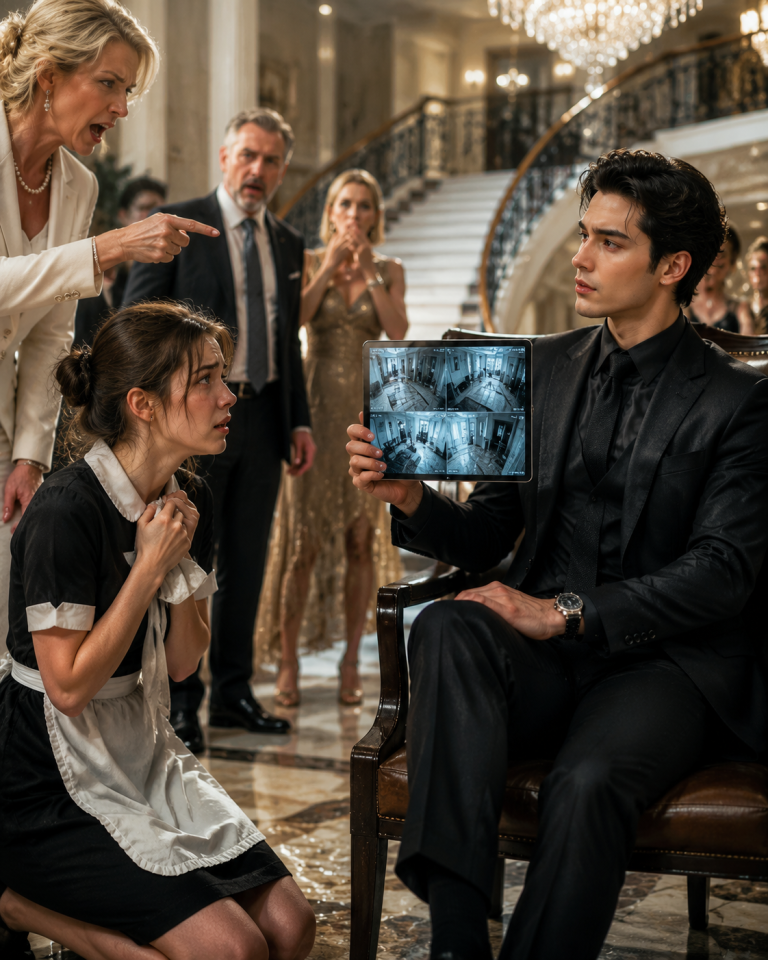
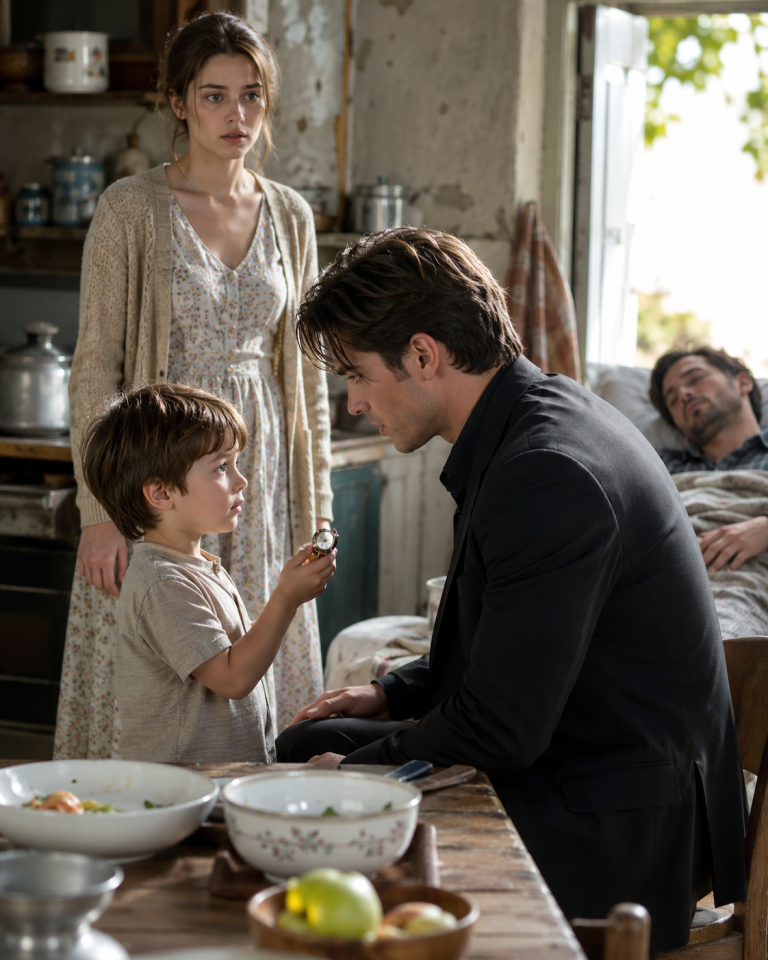
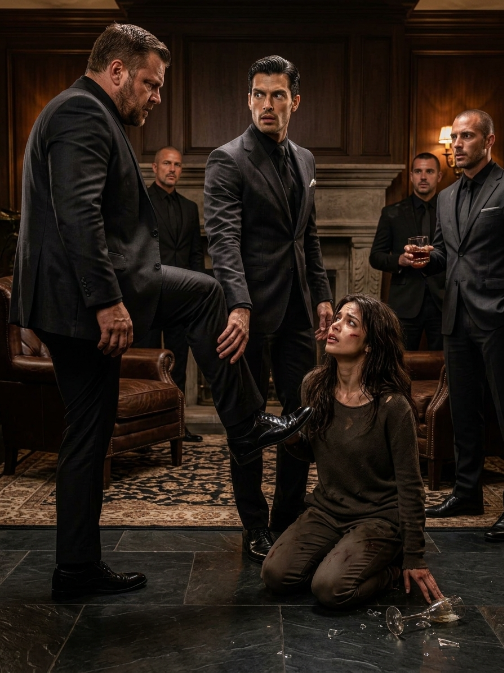
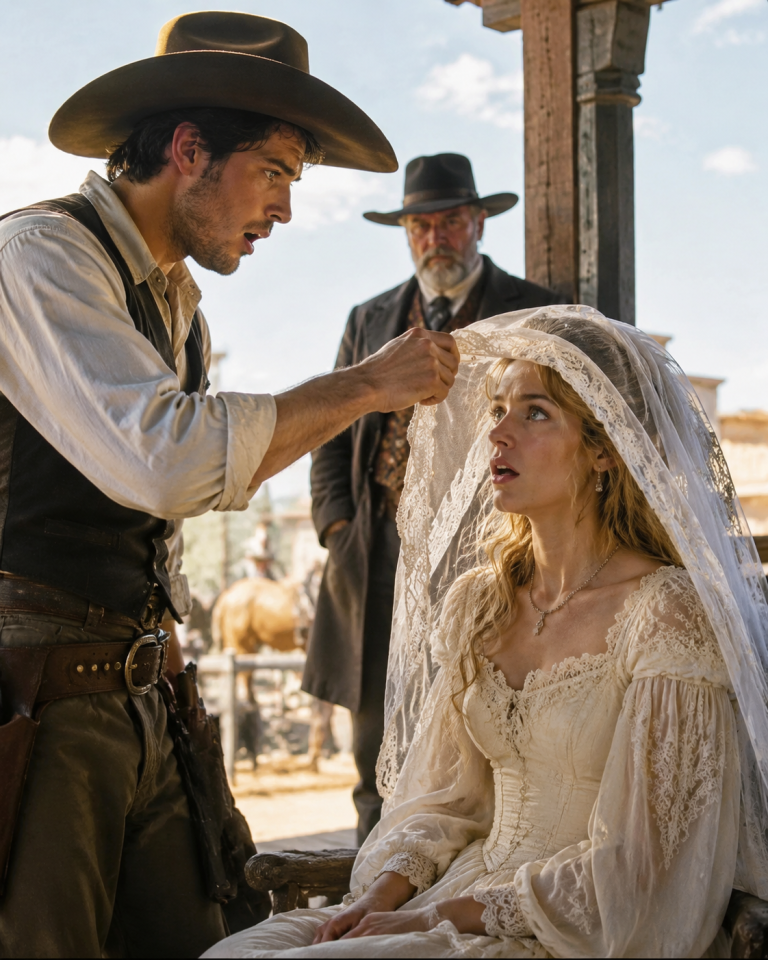
She Collapsed Amid Glitter and Chaos—The Mafia Boss Held Her Baby and Declared, “You’re Mine”

## PART 1
I have a system for counting money.
Not the way people who have enough money count it — thoughtlessly, in transactions. I count it the way my mother taught me when we had nothing, which is the way you count anything you are afraid to lose. Quarters first because they feel most like something. Then the paper bills smoothed flat, sorted by denomination, placed in order as if neatness could make them more.
On a Thursday morning in November, the count was: forty-two dollars in quarters, nineteen dollars in my checking account, two weeks behind on the electric bill, six weeks behind on rent, and a formula can for my nine-month-old daughter, Wren, that would last approximately four more days.
Wren sat on the kitchen floor chewing the ear of a yellow stuffed elephant that had belonged to my brother, Caleb. The toy was called Peanut. I had given Wren this specific toy on the specific day Caleb died overseas, because I was twenty-three and alone and I needed something of his in the room while I cried, and she had grabbed it and refused to let go.
That was nine months ago.
I had not cried since.
Survival is not compatible with grief. It is also not compatible with most forms of pride, which is why, when the email appeared at 8:47 a.m., I did not delete it.
*Private event staff needed. One evening. Immediate payment including fifty percent advance. Background check required.*
The figure beneath those lines was $1,800.
I read it three times.
I knew the company — Monroe Exclusive Events, real enough that I had applied to them four months ago and been told they’d keep my information on file, which I had translated as *no.* I had worked their kind of events before: wealthy, private, the sort where the staff was instructed to make eye contact only when spoken to and to pretend they were not people.
I was good at that.
“One night,” I told Wren.
She shoved Peanut’s ear deeper into her mouth and looked at me with my brother’s eyes.
Finding childcare was the hard part. It always was. Mrs. Ramirez was in Tucson visiting her daughter. The woman down the hall who sometimes helped had started charging rates that made the math impossible. By three in the afternoon I had called everyone and was back where I had started: sitting on my bed in black slacks and a white shirt, Wren on my hip, her diaper bag packed with formula and extra clothes and Peanut and the specific weight of a decision I had already made and was still pretending to consider.
“You are not supposed to be at work with me,” I told her. “This is the compromise that pays the lights.”
Wren grabbed my collar.
The car that arrived at four was not a staff van.
It was the kind of vehicle that did not announce itself as expensive because it did not need to — the restraint of it was its own declaration. The driver was a large man who opened the rear door without speaking and glanced at Wren with an expression I couldn’t read.
“The coordinator said there was a room for staff,” I said. “Somewhere my daughter can sleep.”
One nod.
I got in.
The estate was outside the city, past neighborhoods I’d only driven through imagining the lives inside. Iron gates with a single letter worked into the scrollwork. Security checks. Cameras that didn’t try to hide. The main house rose from the grounds like something that had been built specifically to make visitors feel small.
Inside, a woman in a black suit led me through a side corridor and opened a door to a small room.
I stopped.
The portable crib was the exact model I’d been planning to buy secondhand when I had sixty dollars to spare. The formula on the shelf was Wren’s brand — the specific one I could only afford on good weeks. Diapers stacked beside it in the size she wore now, which was not the size she’d worn three months ago.
“How did you know?” I said.
The woman’s smile didn’t reach anything. “Thorough preparation is our service.”
She handed me an earpiece and left.
I stood holding it and looking at the room assembled for my daughter, and the fear that had been sitting under everything since the email arrived came up sharp and specific: *someone has been watching you.*
I should have left.
I thought about the electric bill.
I clipped the earpiece in, tucked Wren into the crib, kissed her hair, and went to work.
The ballroom was everything I had expected and nothing I was prepared for. Crystal chandeliers. A champagne tower. Women in silk. Men who spoke at a volume that assumed the room agreed with them. I moved through it with a tray and the invisibility I had spent years perfecting.
I learned quickly that my assigned zone was a cluster of men near the east windows. They stopped talking when I approached and resumed when I retreated, but I caught enough to understand the shape of what they were waiting for.
Someone named Crane.
*He’s late.*
*Caruso won’t forgive the delay.*
*Nothing moves until Crane clears it.*
I was carrying my third tray of the evening when the room changed.
Not loudly. Not with any announcement.
The volume dropped like a hand had been laid over a speaker. Every conversation paused or turned. Heads moved toward the entrance in a single collective motion.
The man in the doorway stood still and let the room come to him.
Dark suit. Dark hair. The kind of face that had been carved for authority — not handsome exactly, but impossible to stop looking at once you started. He surveyed the room with the unhurried patience of someone who had never had to search for what he needed, because the things he needed arrived.
Then his eyes found mine.
It lasted half a second.
But in that half second something passed over his face that was nothing like the controlled assessment he gave everything else. Recognition. Shock. A grief so brief and so old it might have been a reflex.
My tray trembled.
Wren’s cry tore through the earpiece.
Not her waking-up cry. Not her hungry cry.
Her terrified cry.
I dropped the tray.
Glass shattered across marble. Someone grabbed my arm. The room tilted. I heard my own heartbeat and then I didn’t hear anything at all.
When I woke in a bed that belonged to a different tax bracket, in a robe I had never seen, the first word out of my mouth was her name.
—
## PART 2
The maid outside my door said Wren was safe.
Safe was not a location.
I pushed past her and followed my instincts down a corridor toward a sound I recognized over every other sound in the world.
My daughter’s laugh.
It came from behind a half-open door at the end of the hall. I pushed through it and stopped.
The room was not a room. It was the answer to every question I had never let myself ask about what enough might look like. Soft rugs. Wooden toys. Morning light. Music so low it was more sensation than sound.
And in the middle of all of it: Wren, sitting upright and very pleased with herself, hands flat on the floor, looking at the man crouching beside her.
He was in a suit that had survived the night better than mine had. His hands were careful and his attention was absolute — the attention of someone who was not accustomed to being patient and was choosing it anyway.
He looked up when I came in.
His voice was quiet.
“She was frightened when the alarm sounded. I had her moved here.”
“You moved my daughter without my permission.”
“I moved your daughter away from four men who were breaching the east corridor.”
He stood. He was taller than I had registered from across the ballroom, and the controlled stillness of him felt different up close — less like authority, more like something expensive being kept under careful tension.
“I need to leave,” I said.
“Yes,” he agreed. “But not tonight.”
“You can’t—”
“My name is Crane Alderly.” He said it the way people said names that had weight, not as introduction but as information. “I knew your brother.”
The room went quiet in a different way.
“Caleb is dead,” I said.
“I know.”
“He died overseas.”
“He died because someone inside his chain of command wanted what he had found.”
I held Wren tighter.
“Don’t do that.”
“I understand—”
“No. You don’t get to dress up my brother’s death in something bigger to make it bearable. He died. It was terrible. That is all it gets to be.”
Crane looked at me for a long moment.
Then he reached into his jacket and removed a folded envelope.
My name on the outside was in Caleb’s handwriting.
I recognized it before I understood it. The particular pressure of my brother’s pen — heavy on consonants, light on vowels — had appeared on grocery lists and birthday cards and one letter from overseas that I had read so many times the creases had gone soft.
My hand moved toward it without permission.
“Before you read it,” Crane said quietly, “there are things you should understand first.”
“I want to read it now.”
“What’s inside will change the shape of tonight for you.”
“Open the gates and let me leave, then.”
His silence was the answer.
I took the envelope.
I opened it.
And as I read my dead brother’s handwriting — specific, urgent, afraid — I understood two things simultaneously.
The first: Caleb had hidden something in the only place he believed no one would look for it.
The second: I had carried it into this house tonight without knowing.
My eyes went to Peanut, sitting on the rug beside Wren’s knee.
Crane’s gaze followed mine.
And from somewhere beneath the estate, an alarm began.
—
## PART 3
I grabbed Wren and the elephant at the same moment, which told me more about my own instincts than I had time to examine.
The alarm was not the kind that said *fire.* It said something else — the particular frequency of people who expected violence and had prepared for it. Doors slammed. Footsteps moved with purpose in multiple directions. A guard appeared in the nursery doorway and spoke into his radio.
Crane was already moving toward the door.
“Stay in this room,” he said.
“Tell me what’s in the toy.”
He turned.
The look on his face was the first genuinely unguarded thing I had seen from him.
“You know?”
“My brother hid things. He used to hide my birthday presents in stuffed animals when we were kids. He thought I never found them.” I pressed Peanut against my chest beside Wren. “I always found them.”
Crane looked at the elephant for a long, calculating moment.
Then he crossed the room and knelt in front of me.
His voice dropped. “There is a ledger. Names. Military officials, politicians, traffickers, private contractors. Your brother spent eight months building it. He hid the physical copy before his last mission.”
“Inside a stuffed elephant.”
“Inside whatever he trusted most.”
Wren’s small fist grabbed Peanut’s ear with the confident grip of someone who had no idea what was at stake.
“Why does he trust you?” I asked.
“He didn’t,” Crane said. “Not completely. But he trusted me more than he trusted the institutions, and in the end those were the only options.”
I looked at my brother’s letter, still in my hand.
*If you’re reading this, then the things I was afraid of have happened. Crane Alderly is not a good man in the way the word usually means. But he is the man who has the most to lose if the ledger stays hidden, and the most resources to use it if it surfaces. That is not the same as trust. It is math.*
*Don’t let them have Wren.*
*Whatever you do. Whatever it costs.*
*I’m sorry I left you with this.*
I folded the letter.
“What was my brother to you?” I asked.
Crane was quiet for a moment.
“He saved my life twice. The second time he didn’t survive it.” His voice stayed even, but it was the evenness of someone managing something large. “I owed him every option I could provide.”
“That’s why the nursery was prepared.”
“Yes.”
“You’ve been watching us.”
“Protecting you.”
“Those aren’t the same thing.”
He held my gaze. “No. They’re not. You’re right.”
The apology — clean, undecorated, without justification — disarmed me more than an explanation would have.
The alarm changed frequency.
Crane’s radio crackled.
“East gate is compromised,” a voice said.
Crane stood immediately.
“Who?”
“We don’t know. The code used was internal.”
His jaw tightened.
“How many?”
“Eight confirmed. More coming up the road.”
He turned toward the door and then stopped. He looked at Wren, and the expression that moved across his face was not the controlled assessment I had come to expect. It was something older and less practiced.
“There are things I haven’t told you,” he said.
“Clearly.”
“Not tonight because I wanted to hide them. Tonight because finding the right moment was difficult.”
“What things.”
“About Wren.”
The room temperature changed.
“What about my daughter.”
Crane sat down on the edge of the nearest chair — the gesture of a man deliberately choosing to be at eye level rather than above.
“Fifteen months ago,” he said carefully, “before your brother deployed for the last time, he came to me with information. About the trafficking network. About what they were doing with children along the supply routes.”
“Caleb told you.”
“He also told me something personal.”
I waited.
“He said that Wren’s father was not a stranger. That you had met him once, at a private event, and that you had not known his name.”
Everything stopped.
I heard my own breathing.
“Caleb found out,” Crane said quietly. “He tracked it back. He came to me because he needed to know whether I was the kind of man who would do the right thing by a child he didn’t know existed.”
“You’re telling me,” I said, very slowly, “that you are Wren’s father.”
“Yes.”
The word hit me somewhere that made my whole body go cold.
I thought about it — not for long, because the logistics were not complicated once the impossible was accepted. Fourteen months ago. A charity event where I had been working. A balcony. A man with dark eyes who had listened to me talk about my brother like it was the most important conversation he’d had all year. No names. One night. I had never expected to see him again.
I had not seen him again.
Until tonight.
“You knew,” I said.
“For three months.”
“You watched us for three months and said nothing.”
“I was trying to find the right approach.”
“The right approach was showing up at my apartment and introducing yourself.”
“You are a single mother carrying a dead man’s debt with no support network and no reason to trust anyone who arrived with money and resources. I thought the approach mattered.”
“You lured me here with a fake job.”
“The job was real.”
“The rest of it—”
“The rest of it was fear,” he said. “That is not a defense. It is an explanation.”
I stood up.
My legs worked because they had practice functioning under conditions they had no business surviving.
Wren looked between us with the uncomplicated attention of a baby who had not yet learned that adults were allowed to be completely wrong about things.
“Open the gates,” I said.
“I can’t tonight.”
“Crane.”
“The men outside have your photograph. They’ve been watching you for six weeks. They know you’re here and they know why.”
I pressed Peanut against Wren’s chest and felt it — barely, through the worn plush — a faint, hard ridge along the bottom seam that should not have been there.
My brother’s hiding places.
I always found them.
“They want the ledger,” I said.
“Yes.”
“And if I give it to them.”
“They will kill us both and take Wren.”
“Why Wren.”
Crane’s face went somewhere I did not expect.
“Because the man who runs the trafficking network has a particular belief about bloodlines. About leverage that runs through generations.” His voice was carefully controlled. “He believes children are the most reliable currency.”
“Who is he.”
“His name is Novak. He operated through military supply routes for eleven years. Your brother found the ledger. Novak’s people killed Caleb to stop it from surfacing. Now they’re here because someone told them the ledger moved.”
“Who told them.”
“That’s what I haven’t found yet.”
A knock sounded on the nursery door.
A guard entered. He was broad, quiet, the kind of man who moved as if he had learned to take up as little space as possible in order to startle people less.
“Sir. The package arrived.”
Crane looked at him steadily. “What kind.”
The guard’s expression answered before his words did.
“You need to see it.”
Crane looked at me.
“Stay here,” he said.
“You keep saying that.”
“Because you keep being the most endangered person in the room.”
I followed him anyway because my brother’s letter had told me not to trust anyone who told me not to look.
The case on the desk in the study was ordinary-looking until it wasn’t. Black metal, scuffed at the corners. The latch was stained with something dark. Crane opened it.
A severed finger, placed on cloth. A ring on it — signet style, a letter N in the face.
On top of it, a folded card.
Crane opened it without expression.
He read it once.
Passed it to me.
*Tell the woman what her daughter is worth to us. Then compare it to what she’s worth to you.*
No signature.
I looked at the ring.
“N,” I said.
“Novak,” Crane confirmed.
“He’s telling you he already knows Wren is here.”
“Yes.”
“And he’s telling you that his valuation and yours might differ.”
Crane looked at me.
“Yes.”
“What does he think she’s worth to you?”
His answer came without hesitation.
“Everything.”
I sat down on the arm of the nearest chair because my knees decided they needed a rest from this conversation.
“We’re strangers,” I said.
“I know.”
“You don’t get to—”
“I know.”
“You don’t get to decide that she’s yours when it’s convenient.”
The muscle in his jaw moved.
“You’re right.”
“That’s twice you’ve said that.”
“I’ve been wrong twice.”
I looked at Wren, sitting safely against the guard’s chest at the doorway, reaching for his lapel with confident fingers.
“She’s going to be in danger as long as that ledger is hidden,” I said.
“Yes.”
“And she’ll be in danger from Novak regardless, now that he knows about her.”
“Yes.”
“Then what we need to do,” I said, “is make sure the ledger is no longer hidden.”
Crane looked at me.
“If it goes to the right people—”
“Then Novak’s network collapses and the leverage disappears,” I said. “I’m not an idiot. Caleb spent four years overseas and I spent four years carrying the weight of every conversation we didn’t have. I understand how this works.”
“The right people are difficult to identify.”
“My brother’s letter mentioned a prosecutor in the Eastern District. Name of Vasquez.”
Crane went still.
“You read the letter carefully.”
“I read everything Caleb ever gave me carefully. He left things in writing because he trusted written things more than spoken ones and he was right to.”
Crane studied me.
Not measuring, exactly. Something else.
“We need to access the ledger first,” he said.
I stood.
“I know where it is.”
—
The seam along Peanut’s left foot had been re-stitched. Not badly — Caleb had learned to sew from our mother, and he could pass it off — but the thread color was half a shade lighter than the rest.
I had noticed it when he gave the elephant to Wren at the hospital.
I had thought: he fixed the toy. He mended it.
I had not thought: he hid something inside it because he was about to go back to a war and he was afraid he wouldn’t come home.
I sat on the nursery floor and cut the seam with a pair of scissors from the changing table while Crane stood behind me and his guards stood at the door and Wren sat in the portable crib watching me dismantle her favorite thing.
Inside the foot, sealed in a small waterproof pouch: a flash drive. A folded piece of paper, dense with names and account numbers. And a photograph.
In the photograph, Caleb stood with a man I didn’t recognize beside a low stone building in bright light. Both of them were laughing.
On the back, in Caleb’s handwriting:
*This is the day we found it. I thought you should see me happy once.*
I held the photograph for a long time.
Crane crouched beside me.
He looked at the image.
His face did something I hadn’t seen it do yet.
“He was a good man,” Crane said.
“I know he was.”
“He didn’t have to protect Wren. He found out by accident, and he could have said nothing, and your lives would have been smaller but safer.”
“But he told you.”
“He showed up at my office unannounced with photographs and a very direct question about my intentions.”
“What question.”
Crane looked at me.
“He said: if I tell you about this child, are you going to be the kind of man she deserves, or are you going to be the kind of man I’ve been watching you be.”
The weight of that settled over everything.
“What did you say?”
“I said I didn’t know yet.”
“And?”
“He said that was the most honest answer he’d gotten from me in two years, and that he’d take it.”
I looked at the flash drive in my palm.
“We need to get this to Vasquez.”
“Tonight.”
“Tonight.” I looked up at him. “And then I want a conversation about every decision you made in the last three months that affected my daughter’s life without my knowledge.”
“Yes.”
“A real one. Not managed.”
“Yes.”
“I will be angry.”
“I know.”
“And you’re going to sit through it.”
Something shifted in his expression.
“Yes,” he said. “I am.”
—
The drive to the harbor was not clean.
Novak’s people had been monitoring the road. Two vehicles came out of a side road south of the estate, and Crane’s convoy absorbed the attack with the specific discipline of men who had prepared for worse and were only moderately inconvenienced by this.
Wren slept through the worst of it, which was either a mercy or a miracle.
I did not sleep. I sat in the back of an armored vehicle with my daughter against my chest and Peanut in my hands and my brother’s flash drive in my coat pocket, and I thought about Caleb fixing the seam of a stuffed elephant in a hospital room while I held his newborn niece, and I thought: *he was saying goodbye. He knew he was saying goodbye.*
The grief hit differently at seventy miles an hour in the dark.
I let it.
At the harbor, Vasquez’s people were already there.
I don’t know how Crane had reached them. I don’t know how much had been arranged in advance. What I know is that a federal prosecutor named Catalina Vasquez, who had been building a case against Novak’s network for four years with everyone above her trying to close the investigation, received a flash drive that night containing names she had been unable to prove for a very long time.
I handed it to her myself.
I wanted to be the one who did it.
Vasquez looked at me for a moment, then at Crane, then back at me.
“Your brother,” she said.
“Yes.”
She held the drive carefully.
“He should have been here for this.”
“I know.”
“I’m sorry.”
I nodded.
Crane stood a few feet back, which was right. This was not his moment. He understood that.
—
What happened after happened in the way large things usually did: slowly at first, then all at once.
Novak was arrested in Chicago six weeks later, along with seventeen people connected to his network across three countries. The trafficking operation — which had moved children through legitimate cargo channels for over a decade — became the kind of case that federal prosecutors built careers on and lost sleep over simultaneously.
Caleb’s name appeared in the filing documents as *confidential source, deceased.* I asked Vasquez to change it to his full name. She did.
The leak inside Crane’s organization turned out to be a woman named Petra, who had been feeding information to Novak’s people for two years in exchange for the safety of a nephew who had been held as leverage. When Crane found out, he did not do what I expected. He helped Petra’s nephew disappear into witness protection and then had Petra arrested and turned over to federal investigators.
I asked him about it.
He said: *Novak used people’s love against them. I’m not doing the same thing just because the target is convenient.*
I thought about that for a long time.
—
The first real conversation happened in my apartment.
My actual apartment, with its secondhand furniture and its collection of mismatched mugs and the plant on the windowsill that I had nearly killed four times and kept resurrecting out of stubbornness.
Crane sat on my couch looking genuinely uncertain for the first time since I had met him, which was the most human I had seen him.
I said everything I had been holding.
About the three months he had known about Wren and said nothing.
About the fake job — though he maintained to the end that the job had been real, which I continued to dispute on grounds of context.
About the nursery prepared for my daughter in a house I had never been to, using details about her life that he had gathered without my knowledge.
About the fundamental difference between protection and control, which I laid out in more specific terms than he seemed to expect.
He listened.
All of it.
When I finished, he said: “You’re right. On all of it.”
I looked at him.
“Are you going to keep saying that?”
“I’m going to keep saying it as long as it’s true.”
“It’s going to be true a lot.”
“Yes.”
Wren crawled into the space between us on the couch, which she did whenever she sensed tension in a room, and sat there with Peanut in her arms looking satisfied with herself.
I had restitched the seam. Different thread this time. You could tell if you looked closely.
I looked closely.
Crane watched her with the expression he’d had in the nursery — not practiced, not performed. Something he was learning in real time.
“She’s going to be work,” I said.
“I know.”
“She’s going to be loud and opinionated and she already has very specific feelings about anyone who tries to take Peanut.”
“I noticed.”
“You’re going to have to earn this.”
“I understand.”
“Not just with her. With me.”
He looked at me.
“I know.”
Wren grabbed his finger.
He looked down at her small hand, and something happened in his face — a crack, brief and deep — before he composed himself again.
“I don’t know how to do this,” he said.
“Neither do I.”
“That’s not reassuring.”
“No,” I agreed. “It isn’t.”
Wren let go of his finger and grabbed Peanut’s ear instead, finding the re-stitched seam with her thumb and pressing it.
She did this sometimes. I had noticed it before without knowing why. The habit of a baby who had been held by a woman who was always finding loose threads and pressing them back down.
I reached over and covered her small hand with mine.
Crane reached over and covered both of ours.
Neither of us said anything.
Outside, the city made its ordinary sounds.
Inside, three people who had arrived here by the most improbable route any of them could have predicted sat in a secondhand apartment with a stuffed elephant between them and the beginning of something none of them had asked for and all of them were going to have to figure out.
That seemed, after everything, like enough.
—
*THE END*