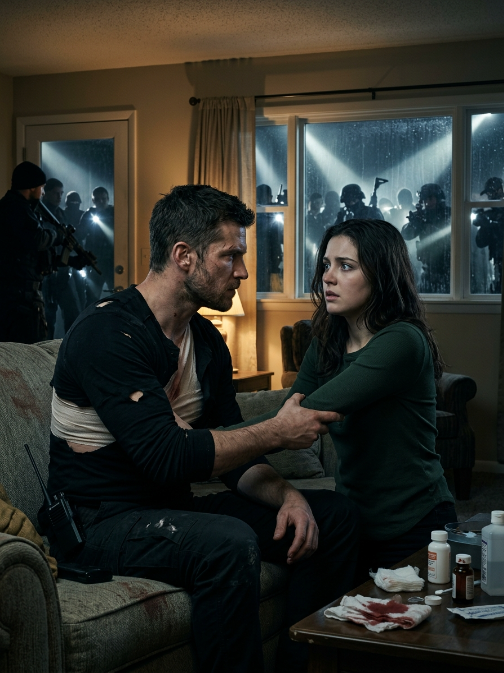
A Waitress Sheltered 15 Mafia Bosses in a Blizzard—Then He Warned, “Don’t Feed Them,” and 135 Cars Blocked Her Diner by Morning

**PART 1**
My father believed every broken thing deserved one serious attempt at repair.
Locks, screens, lawn mowers, marriages. He said it often enough that I heard it as refrain rather than philosophy. He said it to customers who came in for nails and left with more advice than they’d asked for. He said it to me when I was eight and had stepped on my bicycle chain and was crying in the hardware store back room while he bent over it with a rag. He said it when, at forty-nine, his lease was up for renewal and the terms had changed in ways that didn’t make sense, and he spent three months trying to find the break point and fix what he didn’t yet understand was not broken accidentally.
He died believing he had failed us.
I had believed the same thing for twelve years.
I was still believing it the night Daniel Reyes and his men walked into Clancy’s Lakeshore Diner in a January blizzard, sat in my section, and ate every bowl of soup I had left.
—
The storm came off Lake Erie in the particular way of Erie County January — not dramatic, not announcing itself, just arriving and staying until it had made its point. By four in the afternoon, Route 20 was polished ice. By six, both prep cooks had called out. By eight, the dishwasher had gone home with his sister, Tommy the fry cook was working his second double of the week on four hours’ sleep, and Pete Clancy, who had owned this diner since before I was born and was currently seventy-three with a hip that told weather better than the forecast, had told me three times to leave.
I had three times told him I needed the hours.
That was the whole of it. No heroism, no instinct. My mother’s cardiologist had shifted her to a new medication the month before, and the pharmacy had stopped extending store credit when the balance crossed a number I was still embarrassed to say aloud. I stayed because I needed Tuesday’s tips to close Thursday’s gap.
At 9:17, a line of black vehicles turned into the parking lot.
I counted eight of them from the kitchen window. Then the count became harder because snow was blowing horizontal across the lot and the headlights kept doubling in the glass. Tommy came up beside me and said nothing, which was worse than if he’d said something.
“We’re still open,” I said.
“Mara.”
“If they’re hungry, we feed them.”
Pete had moved from the kitchen doorway to directly behind me. He was doing the thing he did when he was frightened — breathing audibly through his nose, which was unfair because it made me feel his fear as a physical presence.
“That’s Daniel Reyes out there,” Pete said. His voice had gone very quiet.
I knew the name the way people in this part of the state knew it — at a remove, as a category rather than a person. You heard it the way you heard weather reports for towns not quite yours: relevant enough to note, not close enough to feel. Daniel Reyes ran private logistics, private security, private everything, in a way that meant public records showed almost nothing. He owned warehouses along the lakeshore. He had connections to the port authority, to municipal contracts in three counties, and to men whose names appeared in news items about things the articles described carefully without stating directly. The barbershop said dangerous. The newspaper said prominent. Both were probably right.
“Then they can be cold like everyone else,” I said, and I picked up the soup pot and carried it out before I could think too carefully about what I was doing.
Twenty-two men sat across seven tables.
The room reconfigured itself when I came through the swing door — conversations stopped, heads turned, the quality of the air changed in a way I had felt before during weather and arguments and that specific moment when a diner full of strangers realizes something is about to happen.
I set the pot on the counter.
The man at the center table was the one everyone else was oriented toward. Dark hair, dark coat, maybe forty, with the kind of face that had been shaped by decades of calibrated expression — you could read almost nothing on it except a general tiredness and something underneath the tiredness that was harder to name. He was looking at me with the careful attention of someone who was deciding whether to be surprised.
“We need to eat,” he said.
His voice was not loud. It didn’t need to be.
I wiped my hands on my apron. “Then sit closer together so I can serve everybody from the same circuit. I’ve got beef soup, bread, coffee, and one cherry cobbler I’m not cutting into pieces smaller than dignity allows. That’s tonight. No substitutions.”
A man at the far left table — tattooed, broad, with the look of someone who had been told he was intimidating enough times that he’d started to believe it — said, “She talking to us like we’re regulars, boss.”
“You ordered soup,” I said. “That makes you regulars.”
The man looked at the one called boss. Something passed between them that I didn’t fully understand.
“Soup is fine,” Daniel Reyes said.
—
I fed them in waves. Stretched the broth with hot water and the two cans Tommy found behind the dry goods shelf. Tore bread thick. Poured coffee until hands stopped shaking from cold. The cobbler I cut into precise, equal pieces because that felt like the honest way to handle it.
They ate quietly.
One of them, older than the rest, bowed his head before he picked up his spoon. Another kept rubbing his left hand as if the feeling was only now returning to his fingers. A third had a split lip he kept touching by habit. The tattooed one — who turned out to be named Marco, which he offered unprompted when I refilled his coffee — watched me set a bread basket near his elbow and said, “You’re not scared of us.”
“I’ve had a man throw a plate at me because we ran out of sweet potato fries. My fear threshold has been recalibrated.”
Marco looked like something had surprised him in the middle of his chest.
Daniel didn’t react, but I saw the arrested quality that moved through his face — not amusement exactly, more like the idea of it, observed and set aside.
When they finished, he came to the register alone.
He stood closer than strangers usually do in that line, not aggressively, just with the casual spatial confidence of a man who had stopped calculating proximity a long time ago. Up close I could see the gray at his temples and a small scar near his jaw that was too deliberate-looking to have come from an accident.
He asked what they owed. I gave him the number, which was real and not inflated.
He put cash on the counter. Triple.
“That’s too much,” I said.
“For keeping the lights on.”
“I keep them on for everyone.”
“That’s the point.”
I picked up the exact amount of the bill and slid the rest back across the counter. “I’m not taking a gratuity from a man whose name people say in a different voice.”
He looked at the money, then at me. “What voice is that?”
“The one where they check whether the door is shut first.”
Marco, from behind him, made a sound that might have been a suppressed laugh.
Daniel looked at me for a moment longer than necessary. “Your name?”
“Mara Bellamy.”
“I won’t forget it.”
“That sounds either reassuring or ominous.”
“Probably both.”
They left at eleven-fifteen. Pete locked the door and stood with his back against it breathing through his nose again.
I cleared the tables. Every bowl was scraped clean.
“Your father would’ve done exactly this,” Pete said, very quietly, from across the room.
I didn’t answer. The compliment went somewhere it shouldn’t have, somewhere soft, and I did what I always did when grief picked an inconvenient moment. I kept my hands moving.
I went home after midnight and ate crackers over my sink and told myself that weather moves through, it doesn’t stay. Men like Daniel Reyes were weather. They arrived, they changed the pressure in the room, they left.
By sunrise I understood I had been wrong about that.
At 6:09 a.m., while I was unlocking the front door, headlights appeared on Lakeshore Road. Not one pair. Not eight. A line of vehicles, moving slowly through the pale gray of early morning, filling both shoulders of the road as far as I could see through the remaining snow.
Pete came from the kitchen with a mug in one hand and froze.
I counted to forty and stopped because the count had passed the bend in the road.
“What is happening,” Pete said. It wasn’t a question.
Daniel Reyes stepped from the lead vehicle. He wore a better coat than last night, as if this visit had been considered. Behind him, doors opened down the full length of the road.
I tied on my apron.
“We make coffee,” I said.
—
**PART 2**
I opened the door before Pete could stop me.
“You said last night you weren’t inconvenient,” I told Daniel, who was standing on the step with snow still in his hair. “This is inconvenient.”
“I brought breakfast.”
“For how many?”
“The town.”
“The town is four hundred people and half of them don’t get up before eight unless something is burning.”
“Then we’ll wait.”
I looked past him at the impossible line of vehicles. “Is this a threat that’s decided to dress as gratitude?”
“No.”
“Is anyone carrying anything I should know about?”
He looked at me directly. “Nothing will come through your door.”
“That’s not what I asked.”
For a moment he was still. Then: “No. Nothing.”
“Good.” I held the door wider. “Because if one of your people frightens Mrs. Kowalski during her oatmeal, I’ll handle it myself and you can sort out the aftermath.”
Marco, directly behind him: “I believe her completely.”
Daniel glanced back at him. “So do I.”
“Come in. But everyone waits their turn, everyone tips adequately, and if the eggs run out, the eggs ran out.”
By ten o’clock, Clancy’s Lakeshore Diner had served more breakfasts than it typically sold in a week. The church basement opened when Reverend Halvorson arrived confused and found himself hosting overflow. Nothing happened the way the town expected. They ordered normally. They said please. One of them repaired the bathroom door hinge without being asked. Two shoveled the sidewalk before Pete could get his coat on. The tattooed Marco ate an entire second stack of pancakes and maintained that he was only being polite.
The whole town came to look and stayed to eat.
Daniel sat in the corner booth with coffee he mostly didn’t drink.
He watched the room with an attention that wasn’t performance. He watched me help Pete when his hip locked near the grill. He watched me kneel beside old Mr. Anagnos to tie a bootlace. He watched me step into the back hallway to take a call from the hospital, stand there for four seconds, put whatever had risen in my chest back down, and return to the floor.
Near noon, he asked me to sit.
“I’m working.”
“You’ve been working since before the sun.”
I looked at the floor. Then I sat because Pete had the front covered and because I had a question I had been holding with the coffee pot all morning.
“What is this actually?” I asked.
“A thank-you.”
“People say thank you with cards.”
“I’m not equipped for cards.”
“No, you’ve arrived with a convoy.”
His eyes lowered briefly. When they came back, something in his face had reduced — some of the public version of him had shifted. “My people were cold and angry last night. Most places lock their doors when they see us coming. You didn’t.”
“I didn’t know who you were.”
“You knew something.”
“I knew you were standing in a blizzard.”
He absorbed that. His jaw tightened once, then released.
“My world doesn’t offer that sentence very often,” he said.
“Maybe your world needs better sentences.”
Marco, two booths away, made a noise that he covered with a cough. Daniel did not look at him.
The weeks that followed were not a fairy tale, which was the thing that made them real.
Business improved because people were curious, then stayed because the food was good. Pete paid two overdue supplier invoices. My tips averaged higher. Daniel came back the following Friday, and the Friday after, and by the third week Pete had stopped mentioning the corner booth when anyone else tried to sit there.
He did not court me in any recognizable way. No flowers. No speeches. He sat, drank black coffee, and asked questions and listened to the answers in the manner of someone who believed answers were worth the time they took. I mistrusted that more than any gesture would have, because the men I’d grown up watching — the ones who wanted something — often began by making the person in front of them feel unusually heard. I waited for the angle.
It didn’t come.
What came instead was a conversation, six weeks in, during a Tuesday lull, about the photograph behind the register.
It was my father: Frank Bellamy, standing outside Bellamy’s Hardware on Main Street with a snow shovel and a smile I still missed the way you miss a specific quality of light in a room.
“He fixed things,” I said, when Daniel asked. “Anything people brought in. Anything they needed. He thought every broken thing deserved one real attempt.”
“What happened to the store?”
The room opened up that question usually kept closed. “Bad loan terms. Lease trouble. A couple of supplier contracts that fell through at the same time. He blamed himself.”
“And you?”
“I was fifteen. Adults said business was complicated and I believed them.”
Daniel looked at the photograph for a moment. “Who owned the building?”
“Why?”
“Habit.”
“Gerald Marsh. He owns this building too.”
Something crossed Daniel’s face too quickly to hold. “Does he.”
“That tone means you know something.”
“It means I recognize the name.”
“Daniel.”
He looked at me with the attentive quality he gave everything I said.
“Tell me honestly or don’t tell me,” I said. “But don’t give me half a sentence and call it information.”
He was quiet for a moment.
“Gerald Marsh does business with a developer named Victor Halloran,” he said. “Halloran buys properties the way some people collect grievances. He prefers the ones that already have occupants who’ve been worn down.”
I kept my face still. “What kind of worn down?”
“The kind that comes from health inspectors who cite violations that aren’t there. From suppliers who cancel contracts after a call from an intermediary. From loan officers who flag paperwork for early review.”
The bridge between my father’s hardware store and Pete’s un-opened lease renewal in the office drawer formed so clearly I felt cold.
That afternoon I confronted Pete about the drawer.
He sat in his office with both hands over his face. The new lease figure was not a negotiation. It was an instruction to fail on schedule.
“I was going to tell you,” he said.
“When?”
“I thought I could find a way around it.”
I looked at the framed photograph of Pete and his wife on opening day, thirty years ago. The diner was not just Pete’s livelihood. It was where night-shift nurses came to sit quietly. Where widowers learned to eat in public. Where the town held its unremarkable, necessary life.
“Don’t sign anything,” I said.
Pete gave a tired laugh. “Waitress advice?”
“Free with every refill.”
Three days later, Victor Halloran walked in.
He was not like Daniel’s people, who carried their danger inward. Halloran carried entitlement like weather — ambient, assumed. Late fifties, silver-haired, in a navy suit too polished for a diner in February. He sat at the counter and smiled the way people smile at things they’ve already decided to own.
“Coffee,” he said. “Black.”
I poured it. “Anything else?”
“Just a conversation.” He looked around the room with bright, inventorying eyes. “Clancy’s. Good bones. This corridor is due for some updating, though. New frontage, cleaner retail footprint. People attach sentiment to old places, but sentiment doesn’t generate tax revenue.”
“Depends on the place,” I said.
His smile adjusted by a fraction. “You must be Mara Bellamy.”
My hand tightened on the pot. “And you?”
“Victor Halloran. I knew your father, in a professional sense. Bellamy Hardware. Real shame how that ended.”
My father’s name in his mouth felt like a wrong note in a familiar song.
“You came in for coffee or reconnaissance?” I said.
He placed a card on the counter. “Tell Pete Harper I’d be glad to discuss a transition before the lease situation becomes more complicated for everyone.”
When he left, the diner was quiet for a full ten seconds. Then my coworker Sylvia, who had been wiping the same clean section of counter, said: “That man smiles like a lawyer dreamed him up.”
I called Daniel before I called Pete.
“He came in,” I said.
“Halloran?”
“You knew he might.”
“I suspected.”
“That is not the same as telling me.”
A pause. “You’re right.”
The admission came so immediately it removed some of my anger, which was its own kind of irritating. “He mentioned my father.”
The silence on the line changed texture.
“What exactly did he say?”
“That it was a shame what happened to Bellamy Hardware.”
Daniel’s voice became very controlled. “Mara, I need you to understand something. Men like Halloran don’t mention dead men by accident.”
“I gathered.”
“I can handle this.”
“No.”
“You don’t understand what he—”
“I understand what you’re tempted to do. I’m asking you to be lawful.”
The quiet that followed had weight.
“That word and I have a complicated relationship,” he said.
“Then work on it.”
The next morning he arrived at opening with a file folder. Not rumors, not implications. Documents. Sixty-three pages: corporate registrations, public filings, loan records, property transfer histories, building inspection records, canceled supplier contracts, old civil suits. He set it on the table in front of me and said nothing.
I read it over three nights.
By page nine, I understood Victor Halloran’s business model. It was predation organized as inconvenience. He targeted established businesses, typically in towns where the local economy had already softened, and applied pressure from multiple directions simultaneously: surprise inspections, loan technicalities, supplier disruptions, anonymous complaints to licensing boards, letters from attorneys that never quite threatened but always implied. Families surrendered because the cost of fighting appeared higher than the cost of leaving, and no single incident was dramatic enough to constitute what anyone could point to as a crime.
By page thirty-one, I found Bellamy Hardware.
I read the section twice before I believed what I was reading.
A loan officer at a regional bank connected to one of Halloran’s shell entities had flagged my father’s small-business loan for early review — not because of missed payments, because the loan had been performing correctly, but because of a coding error that turned out not to be an error at all. A building inspector later removed from his position for separate violations had cited Bellamy Hardware for structural concerns that photographs taken that same month demonstrated did not exist. A supplier had canceled a long-standing contract three days later following a call from an intermediary whose name appeared elsewhere in the file.
The building owner — Gerald Marsh — had then terminated the lease for noncompliance.
My father’s store had not failed because he was careless. It had not failed because he borrowed badly or planned poorly or lacked the resilience that men who have never needed resilience attribute to failure. It had been dismantled. Systematically, professionally, by people who had done it before and would do it again, who treated small businesses as raw material and small business owners as obstacles to be cleared.
He had spent the last years of his life believing he had let us down.
He had been trying to fight them the whole time. He just hadn’t known yet who was fighting back.
I called Daniel at 12:22 a.m.
“You knew,” I said.
“Yes.”
“Before you gave me the file.”
“Yes.”
“Why didn’t you tell me directly?”
“Because it needed to be yours,” he said. “If I handed you a conclusion, it would be my accusation. Evidence you find yourself is something you can carry into a room.”
I wanted to be angry at the calculation. I couldn’t quite manage it, because he had been right.
“He died thinking he wasn’t enough,” I said.
“I know.”
“He hired a lawyer. He went to the bank. He tried.” The words came out rough. “He carried it by himself so we wouldn’t be afraid.”
“Yes.”
“That stops now,” I said. “Halloran stops. I want to talk to whoever you know who can receive a formal complaint.”
A pause.
“How fast can you be ready?” he asked.
“Tomorrow.”
—
**PART 3**
The federal investigator’s name was Constance Pak, and she did not look like what I expected, which was my prejudice to account for. She was forty-one, compact, with close-cropped hair and a manner that was so unhurried it initially read as indifference and turned out to be the opposite. We met in a law office in Erie on a gray Tuesday, and she listened the way people listen when they are building something from what they hear.
She had been working the Halloran case for nineteen months. The problem, she explained, was the nature of the injury: distributed, documented in pieces, the victims persuaded by design that their own failures were to blame.
“People don’t report what they’ve been taught to understand as their own inadequacy,” she said.
I understood that sentence so completely it was physical.
I gave my formal statement. I brought my father’s papers — the loan notices, the inspection citations, the termination letter from Marsh that had arrived four days before Christmas twelve years ago and which my mother had kept in a shoebox in her closet because throwing it away felt like throwing away proof that something real had happened.
Agent Pak listened without managing my grief, which I appreciated more than I could say.
At the end of the meeting she slid a second folder across the table.
I opened it and saw Gerald Marsh’s name, and not as a landlord. As a listed financial participant in a new acquisition entity — a limited liability company formed six weeks ago, registered in Delaware, with Halloran’s attorneys as incorporators. The entity’s first listed acquisition target was a commercial property on Lakeshore Road in Birchfield Crossing, Ontario County.
Pete’s building.
The lease renegotiation had not been a negotiation. It had been maintenance of the current tenant’s confidence while the sale moved under them. Marsh had not adjusted the terms because Daniel’s quiet pressure had shifted his thinking. He had adjusted them to keep Pete calm.
I drove home with my hands very tight on the steering wheel.
I did not tell Daniel about Marsh that day. Not because I didn’t trust him. Because I had decided how this ended, and it ended in a courtroom, in daylight, in the same language Halloran had used to take things — paperwork, testimony, documentation — which would mean he had to live with the same architecture he had weaponized.
My father had tried alone, without knowing who or what he was fighting.
I was not going to do it alone.
But I was going to do it right.
—
The missing piece came from an unexpected direction, the way missing pieces often do.
His name was Walter Kress — seventy-one, a retired accounts clerk from a Halloran subsidiary in Akron, who had worked there for nine years and left with a kind of guilt that had settled into him like groundwater, cold and invisible and persistent. He attended Pete’s church. When Pete asked him to come by for coffee on a Saturday, Walter came in wearing the expression of someone who had been carrying something a long time and wasn’t sure the floor would hold once he set it down.
He sat in the corner booth. His coffee went cold. He held it anyway.
“Thomas Bellamy came to the office twice,” Walter said. His voice was careful. “I wasn’t in a position where I could tell him anything directly. But I want you to know — he knew something was wrong. He asked the right questions.”
My throat closed.
“He hired a lawyer,” Walter continued. “On his own. Without telling anyone in the family, because he didn’t want his wife to know how serious it had gotten.” He looked at his coffee. “The lawyer had a retainer from one of Halloran’s holding companies. Your father didn’t find that out until the foreclosure notice had already been filed.”
Twelve years of a specific kind of grief — the grief that blamed the person you lost — shifted in that moment. Not vanished. Shifted. Became something clearer and sharper and more useful.
My father had not accepted what was happening to him. He had fought it, alone, for as long as he could, and then he had died carrying the weight of a battle he had already been losing when he thought he was only beginning.
“Will you tell Agent Pak?” I asked Walter.
He looked at the table. “I should’ve told someone years ago.”
“Yes,” I said. “But years ago is gone. This is the day still in your hands.”
He nodded. “Then I’ll tell her.”
—
After Walter’s statement, the case began to move differently. Two other former Halloran employees contacted Agent Pak on their own. Three families from neighboring counties came forward after Pak reached out. I wrote a post on the town community page — careful, factual, sourced only to public records and my father’s documented story — and asked whether anyone else had experienced similar patterns from the same parties.
By Saturday, the post had been shared further than I expected. By Monday, a regional journalist called. By Tuesday morning, a letter arrived at the diner from Halloran’s attorneys accusing Pete of defamatory statements and threatening consequences if the post remained visible.
Agent Pak called me before I could call her.
“He just obstructed,” she said, with a quality in her voice I had not heard there before. “That letter names a cooperating witness and attempts to suppress documented evidence. Do not respond. Don’t post again. Don’t go anywhere alone for the next three days.”
I looked through the diner window at the road.
“Understood,” I said.
The pressure arrived on schedule. An unannounced inspection cited the kitchen for violations Pete’s regular inspector had cleared the previous month. A man in a city jacket lingered outside and told two customers the corridor might be under safety review. The front window cracked at 5 a.m. from something that wasn’t weather.
None of it was dramatic. That was how it worked. Fear came as inconvenience, repeated until ordinary people ran out of energy to resist.
I did not close.
Daniel sat in the corner booth every morning, his anger so controlled it seemed to affect the air around him without making noise. Marco sat at the counter and applied himself to coffee and eggs with suspicious dedication. I knew they were watching the cooperating witnesses — Walter, the former employees, the families who had come forward. I had asked for that specifically. What I had not asked for was retaliation.
On the fourth morning, Victor Halloran walked in.
The room responded the way rooms do when the person entering it has been the subject of everyone’s conversation for a week: it went still, then became very carefully busy.
Halloran settled at the counter as if he owned the stools.
“Miss Bellamy.” His smile was the kind that had been calculated to project reasonableness. “You’ve created quite a disruption.”
“Breakfast?” I said.
“Clarity.” He looked around the room. “Public sympathy is temporary. People have their own mortgages. Their own permits. Their own inspections to pass. Sentiment is a fuel that burns quickly.” He paused. “Your boss can’t afford an extended engagement. And your mother’s situation certainly can’t afford—”
“That was a mistake,” I said.
His smile adjusted. “Excuse me?”
“You came here because you needed me frightened. Instead you gave me a room full of witnesses who just heard you reference a sick woman in connection with a federal investigation.”
Halloran’s expression shifted by one degree. Polished, still. But shifted.
I reached under the counter and placed my phone beside the register. The call timer on the screen was running. Agent Pak had been on the line since Halloran came through the door.
“Agent Pak,” I said. “You got all of that?”
Halloran went very still.
Through the phone, level and clear: “Every word.”
Marco’s grin was slow and deliberate. “That’s unfortunate, Victor.”
Halloran looked at the phone, then at me, then at the corner booth where Daniel usually sat. The booth was empty — Daniel hadn’t arrived yet. The emptiness seemed to disturb Halloran more than Daniel’s presence would have. As if he understood that a trap made of restraint was harder to find your way out of than one made of force.
“You have no idea what you’re doing,” he said.
I picked up the coffee pot because my hands needed something to do. “My father knew something was wrong and couldn’t find the proof. I found it.”
—
Federal warrants were served the following morning at Halloran’s Erie office, two subsidiary locations, and a records facility outside Pittsburgh. The news cycle caught it by noon. His accounts were frozen. The indictment that followed ran to forty-eight counts across fraud, conspiracy, witness intimidation, and obstruction in two states.
The Marsh development was unwound as part of the cooperating testimony his attorneys offered in the weeks that followed. A new lease offer arrived for Pete, assessed value, with the option to purchase in escrow.
Pete came out of his office with the paper in his hand looking as if he didn’t trust what it said.
“Can you buy it?” I asked.
He gave a small, broken laugh. “Not unless this building starts printing tips.”
Everyone looked at Daniel.
He had arrived ten minutes earlier and had been sitting in the corner booth with his coffee, listening to everything. He met my eyes.
I spoke carefully. “Not a gift. Not a rescue. A documented investment with fair terms. Pete keeps full operational control. Sylvia gets the senior staff title she’s been doing the work of for three years. The diner stays the diner.”
Sylvia said, from three feet away, “I’m getting a title?”
Pete said, “Apparently.”
Daniel looked at me with something I was beginning to recognize as the version of his expression reserved for the moments when I surprised him. “And you?”
“A place that doesn’t vanish because someone with a better lawyer decides they want the land under it.”
He nodded once. “Then yes.”
—
The sale took time. Cases built this way always do — through patience, through documentation, through the accumulation of ordinary people willing to say what happened. Walter Kress testified. Former employees cooperated. Families from across western New York sent statements that arrived by mail and email and once by fax, on paper thin enough to suggest the machine had been sitting unused for years. Pak’s case expanded as Halloran’s records revealed more parties, more incidents, more hardware stores and bakeries and small restaurants that had been reduced to vacant storefronts while the owners quietly absorbed the blame.
My father was not alone in what had happened to him. He was simply one of many people whose failure had been designed to look personal.
Spring came to Ontario County late, the way it always did. The snowbanks shrank to gray memory. The lake went from iron to blue. My mother came home from her third rehabilitation stay with a walker, specific dietary instructions, and the fierce, unqualified opinion that Clancy’s chicken soup needed less salt.
On her first visit, she sat in the window booth beneath the photograph of my father and cried quietly for a few minutes into her napkin.
“He tried so hard,” she said.
“I know now how hard.”
She took my hand. “I hate that he carried it by himself.”
“He isn’t carrying it anymore.”
She looked over my shoulder, toward the corner booth where Daniel was sitting across from Sylvia, enduring a perfectly pleasant interrogation about whether wealthy people understood quarterly inventory. “Is that the man?”
“There’s a man,” I said.
“Is he good?”
I thought about that with the honesty it deserved. Daniel Reyes was not a simple person. The life he had built and the methods it had required were not things I could describe as clean, and he had never tried to tell me otherwise. But he had been honest about those things instead of decorating them. He had handed me evidence and stepped back. He had offered help in ways that required my consent rather than my gratitude. He had asked questions and believed the answers.
“He’s honest when it costs him something,” I said. “And he lets me be honest when it costs me something. That’s rarer than good.”
My mother looked at him again. “Good enough, then.”
—
On the Friday after the sale closed, I stayed late restocking the supply shelf. I always did that when my mind needed sorting — the physical routine of it, the small familiar order.
The diner was empty and warm under the pendant lights. Outside, Lakeshore Road was wet from evening rain, and the diner sign reflected in the puddles on the shoulder. Pete had refused to replace the sign because, he said, the flicker gave it character. I thought he was probably right.
The door opened.
Daniel came in alone, which happened rarely enough that I noticed it.
“We’re closed,” I said.
“I know.”
“You’ve been ignoring that sign since January.”
“I have an emotional investment in the building. I feel it entitles me to some flexibility.”
“Silent investors can have their entitlements reviewed.”
The almost-smile arrived. It was less almost than it used to be.
He came to the counter and placed a photograph on it. I picked it up. Twelve men stood outside Clancy’s Lakeshore Diner on a gray January morning, the parking lot still piled with blizzard snow, the sign above them flickering mid-frame. Everyone in the photograph looked exhausted and cold and recently fed.
Daniel stood in the back row with his hands in his coat pockets, looking at the camera with the specific expression I remembered from that night — a man accustomed to the world asking things of him, braced for the next request.
“Marco takes pictures when he thinks no one notices,” Daniel said.
“You all look terrible.”
“We were.”
“Then why show me this?”
“Because the next morning I sat in my car for forty minutes before I could leave.”
I set the photograph down. “Because of the soup?”
“Because of what the soup meant.” He stood against the counter, close but not crowding. “I’ve left rooms after funerals, threats, celebrations. I’ve been given things worth ten times more than a bowl of food. I’ve never had to sit still afterward because a woman gave me something for no reason except that I was hungry.”
“That shouldn’t be unusual.”
“No. But it was.”
The quiet that settled between us was not the quiet of people who had run out of things to say. It was the quiet of people who had said enough things that silence had become comfortable.
I came around the counter and stood in front of him.
“I’m not a woman who needed a dangerous man to save her,” I said.
“No.”
“And you’re not a dangerous man who needed a waitress to make him good.”
The almost-smile became complete. “No.”
“We’re two people who met in a storm and kept making choices afterward.”
“That’s the less dramatic version.”
“It’s the true version.”
He took my hand. His hold was careful — the kind of careful that came from someone who had learned that some things, handled roughly, didn’t survive.
Outside, the town was doing what towns did in the evening: settling, quieting, holding its ordinary life in the ordinary way that looked like nothing from the outside and was everything to the people inside it. The road was wet. The sign flickered. The kitchen where Pete would arrive before dawn smelled of industrial cleaner and old coffee and the persistent warmth of a place that had been feeding people since before I was born.
My father had believed every broken thing deserved one serious attempt at repair.
He had been right, and what I understood now that I hadn’t understood when I was fifteen was this: the broken thing had not been him. The broken thing had been the system that targeted him. And the repair was not a return to what had been — you couldn’t get that back, and pretending otherwise was its own kind of grief. The repair was building something different in the same place. A building Pete owned. A diner that fed anyone who needed it. A case that put the right names on file. A town that had seen what its own quiet could do when one person decided to stay open on a cold night and another person decided to come back in the morning.
Daniel stood beside me in the light of the diner.
“I’m trying to make my life cleaner,” he said. “Not simple. Simple isn’t available to me. But cleaner.”
“I know.”
“I’ll make mistakes.”
“I know.”
“You’ll tell me when I do?”
“Immediately and without softening.”
This time he laughed — a real laugh, which was still rare enough to mean something.
“Good,” he said.
I took his hand more firmly.
Outside, Harbor Creek moved through its evening. Inside the diner, the sign kept its imperfect flicker, and the light it made was warm and unsteady and exactly enough.
Months later, when Halloran was indicted, the newspapers would describe Mara Bellamy as the waitress whose statement helped the case expand. They would mention Daniel Reyes only as a local investor, which made Marco laugh so hard he spilled coffee on the very expensive sleeve of his very expensive jacket.
Families across the region would begin the process of understanding what had happened to them, and grieving what couldn’t be recovered, and rebuilding from the parts that remained. Walter Kress would testify, and then sleep through the night for the first time in eleven years.
Pete would frame the building deed and hang it above the register, next to the photograph of my father.
My mother would bring flowers to his grave and tell him his daughter had finished what he started.
And I would finally understand the thing he had been trying to teach me since I was eight years old, kneeling over a bicycle chain in the back of a hardware store.
Kindness was not the absence of power. It was a form of power that didn’t announce itself — the kind that showed up in a blizzard and stayed, that kept the lights on when the smart choice was to go home, that handed someone evidence instead of taking the easier revenge. It was the kind that cost dinner and sleep and occasionally a front window, and sometimes, if held long enough by the right people, became a receipt for the things that had been stolen, and a record that they had mattered, and a light in the window of a place that still stood.
My father would have recognized all of it.
I was glad I had finally grown into the recognition myself.