A Tiny Boy Whispered, “They Took My Sister…”—The Mafia Boss Moved Before He Could Finish

PART 1
“They took my sister.”
The boy was maybe eight years old. Standing alone on the corner of Meridian and Fifth with blood drying on both palms, tears already past the crying stage, at the point where the face just held what the body had run out of room for.
Most people walked past him.
I didn’t.
My name is not relevant to most people in this city in a way they’d be comfortable acknowledging out loud.
What is relevant: I own the Meridian waterfront, three private security firms, a logistics company with excellent accountants, and approximately forty percent of the commercial interests in Vance Harbor that the city council would prefer not to examine too closely. I am thirty-one years old. I wear good suits because good suits communicate that a conversation is already over before it begins. I have not been surprised by another human being in several years.
That was before a second-grader grabbed my sleeve on a Tuesday afternoon.
I had been walking from a meeting at the Harrow Building — a meeting that had concluded in my favor, as meetings generally did — with two of my men a half-step behind me. Meridian Avenue in November was the color of old concrete, the light going early, commuters with their heads down moving in the specific direction of anywhere that wasn’t work anymore.
The boy was standing completely still in the middle of all that movement.
Not lost. Not looking around for a parent. Just standing with that particular stillness of a child who has passed the point of hoping someone will come to them and has made a decision about what to do next.
His eyes found mine.
Something in me registered the calculation in them — this small person had looked at the people moving past him and selected me. Not the woman on the phone who might have been sympathetic. Not the older man closer to the curb. Me. In the expensive coat with the two men behind me.
He had picked the most dangerous option and walked straight to it.
Either he was extraordinarily brave or he was so far past afraid that afraid had stopped being a useful category.
“They took my sister,” he said.
I stopped.
One of my men — Reeves — shifted slightly. I raised one hand without looking at him.
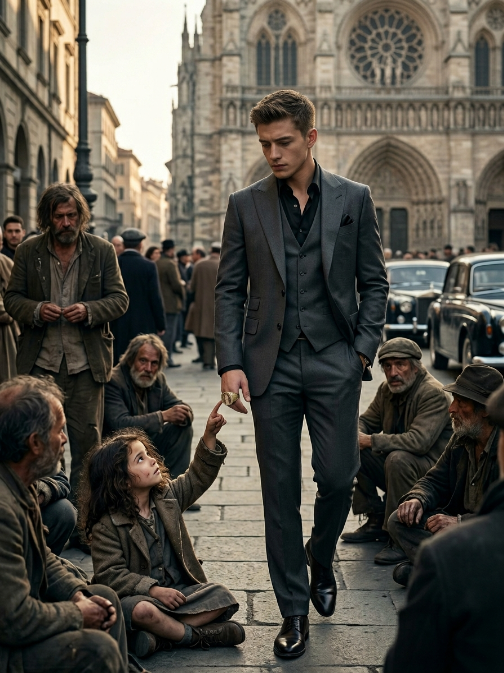
I crouched down.
Not because I was performing compassion for the benefit of the street. Because eye level mattered when someone was telling you something that required them to trust that you were actually listening.
“When,” I said.
Not are you sure, not where’s your mother, not have you called the police. The only question that was actually useful.
He blinked. He had expected something else.
“About fifteen minutes ago,” he said. “Gray van. Near Portside Park. We were walking home from school.”
Gray van. Portside Park. Fifteen minutes.
I looked at him for two full seconds, running the math on what fifteen minutes meant in a city I knew the way a surgeon knew a body — every system, every route, every place a gray van could go and the places it couldn’t.
“Your name,” I said.
“Finn.”
“Your sister’s name.”
“Iris. She’s twelve.”
“Your mother.”
“She’s at the park. The police came but they keep saying they need more—” His jaw tightened. Eight years old, doing the thing adults did when they were managing something too large for the available vocabulary. “They keep saying they need more information.”
“I know what they say.” I stood. “Take me to your mother.”
Finn looked at me with the expression of someone who has asked something from the universe and is not entirely sure the universe understood the assignment.
Then he turned and walked, and I followed a second-grader through the Meridian Avenue foot traffic without breaking stride.
Her name was Anna Cole. Thirty-eight. Elementary school art teacher, from what I would learn later. She was standing at the east entrance of Portside Park in the particular configuration of a parent in crisis — phone in one hand, the other pressed flat against her sternum as if keeping something in, two police officers in front of her who had the expressions of men reciting policy at someone who needed something policy could not provide.
When Finn appeared beside her she pulled him close without looking down, automatic, the reflex of a woman who had already lost one child today and was not releasing her grip on the other.
Then she looked up and saw me.
Fear hit her face first. Then the rapid reassessment — not a threat he’s brought, or not an obvious one, and Finn is walking beside him, and there is something about the way this man stopped on a city street and crouched to an eight-year-old’s level that doesn’t match the danger she knows she’s supposed to read in a face like mine.
“Why are you here?” she said.
Measured. Suspicious. The question of a woman who understood that help from certain directions came with weight attached to it.
I didn’t answer with reassurance. I answered with what was actually useful.
“Show me a photo of Iris.”
She stared at me for one second.
Then she unlocked her phone and handed it over.
Twelve years old. Dark hair in a braid, not quite long enough to stay in it neatly. A green jacket. Braces on the top teeth. A specific kind of smile — slightly sideways, like she found things funnier than she was letting on.
I looked at it long enough to hold it.
Then I sent it to three people whose names I would not say in front of a schoolteacher.
“Gray van,” I said. “What direction did it go.”
“North on Harbor Road,” one of the officers said, before Anna could answer. He was looking at me with the complicated expression of a police officer who knew my name and was doing the institutional calculation of how much that mattered right now. “We’ve got units—”
“You’ve got units looking for a gray van on Harbor Road fifteen minutes after the fact,” I said. Not unkindly. Factually. “What’s the van’s plate.”
“Partial. Three letters.”
I stepped away and made a call.
My network did not require warrants. Did not require press conferences. Did not require the forty-seven steps between an incident report and actual movement. It required a phone and the right person on the other end of it, and I had spent eleven years building the architecture that made the right people available at all times.
Harbor cameras. Parking structure feeds. Dock gate logs. The private footage from six commercial properties along Harbor Road that were operated by people who understood the value of a working relationship with my office.
Sixty seconds.
I turned back.
“They switched vehicles,” I said. “Commercial district near Dock 7. Different plates. Heading toward the warehouse row on Inlet.”
Anna’s hand tightened on Finn’s shoulder.
The officer beside her went very still.
“How do you—” he started.
“Is she alive,” Anna said. Not asking the officer. Asking me. Her voice was level in the way that things were level when every alternative to level was unacceptable.
“Yes,” I said. “We have eighteen minutes before a boat at Inlet Pier completes loading.”
She understood what a boat meant. I watched her understand it. The way her face reorganized itself around something too terrible to hold all at once and too urgent to fall apart in front of.
“Then go,” she said.
“You stay here with my man.” I looked at Finn. “Both of you.”
Finn looked up at me with those eyes that had already decided once today that I was the right option.
“She has her rescue inhaler in her backpack,” he said. “She needs it when she gets scared.”
I looked at him.
In eleven years of this I had rerouted plans around intelligence, around threat assessments, around weather patterns and shipping schedules and the operational capacities of people who wanted things I was moving.
I had never rerouted a plan around an inhaler.
“What does it look like,” I said.
“Blue. Small. Her name’s on the cap in marker because she kept losing them.”
I nodded once.
Then I looked at the man to my left.
“Dock 7,” I said. “Inlet row. We have eighteen minutes.”
We moved.
Behind me, I heard Anna Cole say something to Finn in a low voice, the words not carrying. And I heard Finn say back, with the certainty of someone who had made a correct assessment and was standing by it:
“He’ll get her.”
What the boy didn’t know — what Anna Cole didn’t know, what even Reeves walking beside me didn’t know yet — was what I had seen in the dock gate log that I hadn’t said out loud.
The warehouse at Inlet Pier.
It wasn’t a random transit point.
It was registered, through four layers of shell company, to a man I had been managing a dispute with for eight months.
This was not a random kidnapping.
Someone had taken a twelve-year-old girl in a green jacket to send me a message.
And they had made the specific, catastrophic error of doing it in front of her brother.
PART 2
Inlet Pier smelled like diesel and cold salt water and the specific industrial quiet of a place that did its business after dark and before questions.
We went in from the north access, which I knew because I had built two of the storage facilities on its east face and had therefore, at various points, needed to know every approach to that dock that wasn’t on a city map. Reeves had three men at the south gate within four minutes of my call. Another two at the water side.
Six men total. Against what was inside, that was enough. I had done the math on Soto’s operational capacity eight months ago and I did not recalculate it on the move.
The warehouse was registered, through Delacorte Holdings through Meridian Asset Partners through a numbered company incorporated in Delaware, to a man named Victor Soto who had been attempting, for the duration of our eight-month dispute, to renegotiate terms on three commercial piers that I had acquired in a transaction he considered advantageous to me and disadvantageous to him. He was correct about this assessment. He had been working to correct it through methods I had chosen, so far, to treat as a minor inconvenience.
That calculation had just changed.
There were four men in the warehouse. The door was not heavily secured — Soto’s operation ran on speed and discretion rather than fortification, which was a style preference that had consequences when someone like me arrived with six people and no particular need to be quiet about it.
Iris Cole was in the northeast corner, zip-tied to a support column, her green jacket on, her braid half out, her eyes open.
Not crying. Watching.
When I walked toward her she went very still — the stillness of a child who has learned in the last forty minutes that stillness was the safest response to an unknown adult.
“Your brother sent me,” I said.
Her eyes moved over me with the same quality of assessment I had noticed in Finn. Whatever ran in the Cole family, it was not the instinct to look away from things.
“He’s eight,” she said.
“He found the right person.”
She looked at me for another second.
“He found you,” she said. Not agreement. Clarification.
I cut the zip ties. Her hands were steady when she brought them in front of her. She rubbed her wrists once, efficiently, and stood without assistance.
“My inhaler,” she said.
I reached into my coat pocket and held it out.
She stared at it.
Then she looked at me with an expression I had not seen directed at me in a very long time — something between disbelief and something I didn’t have the right word for.
She took it.
“How did you—”
“Finn,” I said.
She pressed her lips together. Looked at the floor. When she looked back up, the expression had reorganized itself into something more controlled, which told me the twelve-year-old in front of me was doing the same work her brother had done on Meridian Avenue: managing something too large for the available container, managing it anyway.
“Is he okay,” she said.
“He’s with your mother.”
She walked toward the door without waiting for me to lead.
PART 3
I left Reeves to handle the four men in the warehouse in the manner that situations like this were handled — efficiently, without paperwork, with consequences that would communicate clearly to anyone who compared notes afterward.
I put Iris in the car with a man named Dalton who had worked for me for six years and had three children of his own and whose presence in a vehicle tended to communicate safety rather than threat. I told him to drive to Portside Park and to call me when they arrived.
Then I stood at the dock in the cold and made three calls.
The first was to my accountant, who understood that certain questions were structural rather than financial and who began pulling the ownership chain on Delacote Holdings from the Delaware registry.
The second was to a man named Graves who ran the Vance Harbor port authority scheduling office and who owed me a conversation he had been avoiding for four months about a container manifest discrepancy. That conversation was now going to happen tonight.
The third was to Victor Soto.
He answered on the fourth ring, which told me he was either asleep or performing being asleep.
“You made a mistake,” I said.
A pause.
“I don’t know what you’re—”
“The Cole girl is in a car heading back to her mother,” I said. “The four men you had watching her are going to have a difficult evening. I’d like you to tell me why you thought this was a productive approach to our current disagreement.”
The silence on his end was longer than it should have been.
Not the silence of a man calculating how to manage the conversation.
The silence of a man who was genuinely trying to understand what I was telling him.
I was very good at reading silences. I had been doing it for eleven years.
This one felt wrong.
“I don’t have four men,” Soto said. “I don’t have anyone near a pier tonight.”
I said nothing.
“The Cole girl.” His voice had changed — not defensive, not performing. Something closer to controlled alarm. “I don’t know who the Cole girl is.”
I looked at the warehouse.
At the door I had come through six minutes ago.
At the dock gate log that I had read on my phone at Portside Park, that had shown me this address, registered through four layers of shell companies back to Soto.
I had taken that chain at face value because I had been operating on eighteen minutes and because the logic was coherent — Soto had motive, Soto had known my movement patterns in this district, and Soto would have known that using a civilian to send a message was precisely the kind of escalation that would get my attention in a way that three months of commercial friction had not.
It was coherent.
It was also what someone would build if they wanted me to move on Soto tonight, fast, without checking the layers.
I hung up.
I went back into the warehouse.
The four men were secured. Reeves looked at me when I came in.
“None of them are Soto’s people,” I said.
Reeves went still.
“How do you know.”
“Because Soto didn’t know there was anything happening tonight.” I looked at the men on the ground — professionals, hired, not the street-level talent Soto typically used and not anyone I recognized from his established network. “Pull their phones. Carefully. I want to know who hired them.”
Reeves moved.
I stood in the warehouse and let the information rearrange itself.
The ownership chain had been constructed to point to Soto. The timing had been built to give me exactly enough information to move fast — eighteen minutes, a boat, the implication of a closing window — and not enough time to verify the source before acting.
Someone had known that I would stop on Meridian Avenue.
Had known that I would follow an eight-year-old to his mother.
Had known that the Cole family would register as leverage on me specifically — not because the Cole family had any prior connection to my operation, but because someone had watched me stop and calculated, correctly, that a man who crouched to eye level with a child he didn’t know and asked the only useful question had a particular vulnerability that could be activated.
The kidnapping had happened within two hours of my walk down Meridian Avenue.
Which meant the information had traveled inside ninety minutes.
I had been with Reeves the entire time. Two other men. Three phone calls made in front of them.
I looked at Reeves.
He was going through the phones with the efficient focus of someone who had done this before. His hands were steady. He had worked for me for three years. I knew his history, his debts, his two brothers in Allentown, the fact that he sent money to his mother in Newark on the fifteenth of every month.
I knew all of this.
I had not known, until sixty seconds ago, that knowing all of it and trusting all of it were two different categories.
Reeves held up one of the phones. “Prepaid. But there’s a contact list. One number.”
I took the phone.
The number was familiar the way things were familiar when you had seen them in a context so different from this one that the recognition took a second longer than it should have.
I had this number.
Not from Soto’s network. Not from the warehouse. From my own records.
The number belonged to a man named Carver, who handled the logistics scheduling for my commercial port operations and who had been, until thirty seconds ago, as unremarkable a piece of the infrastructure as anyone I employed.
I put the phone in my pocket.
“Get everyone out,” I said to Reeves. “Clean exit. The building stays intact.”
“And Soto?”
“Leave Soto alone.” I moved toward the door. “He’s not the problem.”
I did not go to Carver that night.
This was not restraint born from uncertainty. I knew what he had done. The evidence would take two days to make complete and another three to make useful in the specific way that made consequences durable rather than temporary — the kind of documentation that removed a person from operational capacity permanently rather than providing them with a reason to attempt something more aggressive from a position they no longer had to protect.
I spent those five days in the same pattern. Morning meetings. Afternoon calls. The logistics of three active contracts that required my attention and that I gave my attention to with the same care as any other week, because the performance of normalcy was itself a form of intelligence gathering. I watched Carver in the ordinary course of the operation. Watched him watching me watching nothing in particular.
On the evening of the fifth day I sent him a message that said: My office. Now.
He came.
He sat across from me with the file I had assembled between us and he looked at it for a long moment and then looked up.
“How long,” he said. The voice of a man who had already done his own accounting.
“Long enough,” I said. “The question I actually have is why.”
He looked at the file again.
“Soto offered a flat settlement on the pier contracts,” he said. “Plus a separate arrangement. For ongoing access.”
“To my scheduling.”
“Yes.”
“And you took it.”
“I needed—” He stopped. His hands were on his knees and he was looking at them rather than at me, which was the posture of someone who knew the explanation was insufficient before he gave it but was going to give it anyway. “I needed it to be over. The position. The work. I wanted out and I didn’t know how to ask for out.”
I looked at him.
He had worked for me for four years. He was forty-seven, competent, not a man who made large visible mistakes. He had apparently been making a very large invisible one for approximately eight months while I was building a dispute with Soto about pier contracts.
I thought about Daniel Keel. Not because I knew Daniel Keel — I didn’t. I thought about what it looked like when someone wanted out of something and found the wrong exit.
“You could have asked,” I said.
He looked up.
“People ask me for things,” I said. “It goes better than whatever this was.”
He had nothing to say to that.
I picked up the file.
“You’re done,” I said. “Tonight. The arrangement with Soto is done along with it — I’m going to have a separate conversation with him about that, and it’s going to be more expensive for him than the pier settlement would have been, which I’ll make sure he understands was a consequence of his choice of methodology.” I set the file down. “You won’t have contact with my operations or my people. The details of your departure stay between us if you give me your complete cooperation with the documentation process.”
He stared at me.
“That’s it?” he said.
“What did you expect?”
He looked like a man revising a picture he had built over months of anticipating a conversation that hadn’t matched the one he was in.
“More,” he said.
“I’m not interested in more,” I said. “I’m interested in the pier contracts, the three active logistics accounts, and making sure this specific situation doesn’t recur.” I stood. “You can go.”
He went.
Dalton called me the following Tuesday.
He had stayed in loose contact with the Cole family at my request — not surveillance, not formal. Just the kind of availability that meant if something came up, there was a number to call. I had not expected anything to come up. I had done it because Finn had said he’ll get her with the certainty of someone who had made a correct assessment, and I had found, over the subsequent week, that I did not want to be the version of events where that assessment aged poorly.
“The boy asked about you,” Dalton said. “The eight-year-old.”
“What did he ask.”
“If you were going to come by.”
I looked at the Meridian waterfront through my office window. November had gone to December. The lights on the pier were on early.
“Tell him I’m not much for dropping by,” I said.
“He said to tell you—” Dalton paused. “He said he made you something.”
It arrived through Dalton two days later.
A drawing, folded twice, on the construction paper that elementary schools provided in colors that were slightly too saturated to be restful. Done in marker — blue and black and the specific orange that children used for things that were supposed to be gold.
A man in a suit. Tall. Dark. Two smaller shapes behind him that I understood were meant to be Reeves and Dalton, from the fact that one had been given a visible earpiece that Finn must have noticed.
In the corner of the drawing, in the careful large letters of a child who was working at neatness: the one who stopped.
Not the one who helped. Not the one who came.
The one who stopped.
I set it on my desk.
I had not been described that way before — not in press coverage, not in the institutional language of the city council’s closed-door meetings about my interests, not by anyone who had needed something from me or feared something from me or been in business with me.
A second-grader had watched a city full of people walk past him and had looked at me and seen the one who stopped.
I put the drawing in the top left drawer of my desk.
Then I picked up the phone and called the Portside pier office about the Q1 container scheduling, because there were three active contracts and a restructured arrangement with a Soto organization that was no longer in a position to negotiate unfavorably, and the work did not pause because a child had gotten to something I had thought was no longer reachable.
It just waited.
That was what work did. It waited, and then it resumed, and the desk drawer was still there at the end of the day when everything else had been handled.
THE END