The Mafia Boss Thought He’d Lost Everything—Until One Night With a Waitress

## PART 1
She hit the table with her hip before she could stop herself, and the candle jumped, and the wine went sideways, and the entire restaurant decided it had urgent business elsewhere in the room.
The man at the corner booth did not move.
He didn’t flinch. Didn’t curse. Didn’t even look up immediately. Just sat in the wine-darkened silence while Clara Hess stood there with an empty tray and a face full of horror, calculating how much this was going to cost her.
Then he lifted his eyes.
She had been in Providence for three months and in this job for exactly two shifts, which meant she had not yet learned the name Kieran North in the way the city had learned it — slowly, involuntarily, the way you learned about weather.
She only knew he was the kind of man who made rooms rearrange themselves around him.
“I am so sorry,” she said. “The side door sticks. Marco told me not to use this way but I thought I had enough clearance and clearly I did not—”
“Stop apologizing,” he said.
She stopped.
He looked at the spreading red stain on the white linen.
“It looks like something,” he said.
“It looks like a disaster,” she said.
“Yes.” His voice was unreadable. “But all things do, from the right angle.”
Marco materialized from the bar with the speed of a man whose entire livelihood had just come loose. He began apologizing in three languages. Kieran North raised one hand, and Marco stopped mid-syllable, and Clara thought: *ah. So he’s that kind of man.*
“The girl keeps her job,” Kieran said.
“Of course,” Marco managed. “Of course, of course—”
“And the table gets reset.” He looked at Clara. “What would you recommend?”
She blinked. “I’m sorry?”
“From the menu. What would you recommend?”
This was not how conversations with powerful men who had just been assaulted by wine usually went. Clara had worked enough restaurants to know.
“The duck ragu,” she said, because she had eaten the staff meal and the duck ragu was genuinely extraordinary and she was too tired to perform tact. “The pasta is handmade. Marco’s grandmother’s recipe. It’s the best thing on the menu.”
Kieran North looked at her.
She had the distinct impression that most people, when he looked at them, felt examined. She only felt seen.
“I’ll have that,” he said.
She brought it.
He ate it.
He came back the following Thursday.
And the one after.
And the one after that.
Marco, who had initially expressed concern through the medium of nervous hand-wringing, eventually accepted that something had shifted in his Thursday evenings. Kieran North arrived at the same corner booth, ordered the same wine, and talked to the waitress who did not know who he was when she spilled on him — and somehow, somehow, this seemed to suit him.
Clara learned his name in her second month.
By then she had already learned other things. That he took his wine without food until she started recommending dishes. That he listened the way people listened when they hadn’t done it in a long time and were rusty at it. That his face never moved in the ways faces usually moved, except near his eyes, and near his eyes everything moved.
She told him about California and Chicago and the year in Boston she still couldn’t fully explain and the way she’d ended up in Providence, which was: she’d driven north until she stopped being afraid of the dark.
He told her almost nothing.
But he stayed for three hours.
One night in February she said, without planning to: “People in this restaurant are afraid of you.”
He poured wine without answering.
“Even Marco. And Marco isn’t afraid of anything except bad olive oil and his mother-in-law.”
“Marco is wise,” Kieran said.
“Are you dangerous?”
He looked at her.
“Yes,” he said.
“To me?”
A pause.
“Not the way you mean.”
She had been in Providence long enough by then to understand what that meant and what it didn’t.
“I know what you are,” she said.
“Then why are you still here?”
Clara thought about that honestly.
“Because you haven’t lied to me once,” she said. “And that is rarer than dangerous.”
Something shifted in his face. Not softened. Something older than soft.
She had the feeling she was the first person in a long time who had told him something true.
She was right.
After three years of silence, Kieran North had forgotten what truth sounded like coming from someone who wasn’t afraid of its cost.
Marco watched from behind the bar with the expression of a man watching weather he cannot predict.
She filled the wine.
He watched her move through the room and said nothing.
The following Thursday, he arrived fifteen minutes early.
Clara pretended not to notice.
She noticed.
—
By March, she knew he had lost a son.
Not because he told her. Because Providence had a memory, and eventually memory found its way to her.
The boy had been sixteen. There had been a car. An explosion. The kind of thing that people described in newspaper language and then never discussed again, because the man who had survived it was the kind of man whose grief was not safe to witness too directly.
On a night in late March when the restaurant was nearly empty and rain made hammers of itself against the windows, Clara finally sat across from him at closing.
“His name,” she said.
Kieran looked up from his wine.
“If you want to say it,” she added. “You don’t have to.”
He was quiet for so long she thought she had misjudged.
Then: “Marco.”
She frowned. “Like—”
“No.” A faint ghost of something. “He hated that. Thought the name was too old. He was going to change it when he turned eighteen.”
“What was he going to change it to?”
“He hadn’t decided. He kept a list. He’d cross things out, add new ones. The last one he told me was ‘West.'” Kieran looked at the table. “Because he said he was going to go west someday and never come back.”
Clara’s throat tightened.
“Did he?”
Kieran’s jaw worked once.
“Not the way he planned.”
She reached across the table and covered his hand.
He looked at her hand.
He did not pull away.
Outside, Providence rain kept up its assault, and inside the restaurant, in the amber warmth, Kieran North let himself be touched by someone who was not trying to take anything from him.
It had been a long time since that was possible.
Which was why, when the stranger arrived three Thursdays later and sat at the booth two tables over and spent most of the evening looking at Clara rather than his food, Kieran noticed it the way he noticed everything that did not belong.
“Do you know him?” Kieran asked, when the man had left.
Clara stiffened.
“No,” she said.
It was the first time she had lied to him.
He knew it instantly.
He did not press.
But later, when he had her car checked and found that the stranger had taken photographs of her license plate, the warmth he had been carefully learning to carry turned into something much older and colder.
Someone knew she was here.
And they had not come to welcome her.
—
That night, Kieran waited until Clara was closing, then appeared at the side door.
She looked at him and understood from his face that something had changed.
“Tell me about Boston,” he said.
“I already told you—”
“The year you couldn’t explain. Tell me that.”
She was quiet for a long moment.
“His name was Marcus Gray,” she said. “He wasn’t just controlling. He was connected. Money. Courts. Arrangements that weren’t quite legal and weren’t quite not.”
“And you left.”
“I ran.”
“But first?”
Her eyes met his.
“But first I took something.”
Kieran said, “What?”
“A ledger. Documents. I didn’t fully understand what was in it.” She exhaled slowly. “I was scared and I was angry and I took the thing that seemed most important because I’d spent a year watching him treat it like a weapon, and weapons don’t belong in the hands of men who use them that way.”
Kieran was quiet.
“Where is it?”
“Hidden.”
“The man tonight—”
“He works for Marcus.”
Kieran looked at her, and she saw the calculation forming — not cold, not yet, but moving toward it.
“He doesn’t own this city,” she said.
“No,” Kieran said. “He doesn’t.”
Then he said: “Tell me Marcus Gray’s full name.”
She started to answer.
And then stopped.
Because she had seen, in the last three months, what Kieran North did to people who threatened what was his. And she had not yet decided if she wanted to be what was his. And she could not figure out, in this moment, whether giving him Marcus’s name was protection or the beginning of something she couldn’t take back.
“Why?” she asked.
“Because someone took photographs of your car tonight,” he said. “And I need to know if the threat is proportional.”
“Proportional to what?”
Kieran looked at her.
“To you,” he said.
The word did what it always did, which was arrive without warning and make her chest ache in a way she couldn’t properly name.
“Gray,” she said. “Marcus Gray.”
Kieran’s expression changed.
Not in the way she expected.
Not calculation or anger.
Something that looked like recognition. Buried, but real.
He said: “Where did you hear that name?”
“From him. He told me his name.”
Kieran’s jaw worked. “He’s been using that name for two years.”
“It’s not his real name?”
“No,” Kieran said.
He looked at her with an expression she had never seen before — not the warmth he’d been careful about, not the coldness he’d built his life inside. Something stripped of both.
“His name,” Kieran said, “is someone I’ve been looking for.”
Then his phone rang.
He answered it.
His face went through something she could not follow.
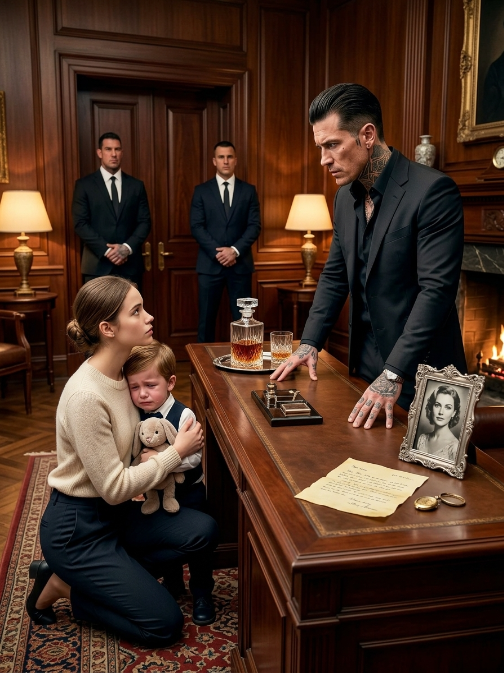
When he set the phone down, he said: “The grave on Shepherd’s Hill. The one from three years ago. Someone dug it up tonight.”
Clara stared at him.
“My son’s grave,” Kieran said.
She waited.
“There is no body in it.”
The rain was very loud against the windows.
“What?” Clara said.
Kieran looked at her steadily, and she saw then what the last three years had cost him — not just grief, but the specific exhaustion of a man who had learned to survive the wrong version of a story.
“My son is alive,” he said.
He said it the way you said things you were not yet certain you were allowed to believe.
“Or someone wants me to think so.”
—
## PART 2
His name was not Marcus Gray.
It was Aldric Crewe.
Son of a man Kieran had believed dead. Grandson of a man who had built an empire on other people’s losses and hidden it inside legitimate business like rot inside a beautiful wall. The Crewes had operated under seven names in four cities, and the name Gray had been the latest.
Clara learned this in pieces across the following three days as Kieran’s organization stripped back the shell companies and the forwarding addresses and the false paper trail that had led from Boston to a man with shiny shoes and a very practiced smile.
She sat in the estate outside Newport and read documents and answered questions and occasionally said: *yes, he said that*, or *no, he kept that locked*, or *I remember seeing that name but not understanding why*.
Kieran’s people moved around her with the specific deference of men who had witnessed something they did not quite know how to categorize.
Their employer, who had not laughed in three years, had been heard doing something in the kitchen that sounded close to it.
They were careful not to mention this.
On the third night, Kieran told her what the grave contained.
Stones. A child’s coat. A metal box.
Inside the box: a video, dated two years prior.
His son Marco — not dead, not gone — sitting in a white room, speaking to a camera.
*Dad, they told me you’re alive—*
The recording was cut.
Kieran played it once and did not play it again.
Clara sat beside him while he was very still and the Atlantic broke itself against the cliffs below and the fire in the study cast everything in a light that made the room look like something survivable.
“He never drove west,” Kieran said.
“No,” she said.
“He’s been in that room for three years.”
She did not say *we’ll find him* because that was the kind of thing that was either true or a lie, and she had learned not to offer people words as currency when the debt might not be payable.
Instead she said: “The ledger I took. What’s actually in it.”
Kieran looked at her.
“Names,” she said. “Payments. Shipments. Accounts. I never read the last folder. Marcus — Aldric — kept it locked in a separate case. I took everything. I just never opened the last piece.”
Kieran said: “Where is it.”
“Boston. A boarding house on Derne Street. Behind the radiator in the laundry room. I knew he’d never look somewhere that required him to be inconvenienced.”
That startled something brief and dark and genuine from Kieran.
“The last folder,” he said. “Is that what he came for?”
“Yes.”
“And what he’s willing to trade Marco for.”
Clara said nothing.
Because that was the shape of it, and neither of them needed it made louder.
Aldric Crewe had kept Marco alive as leverage.
And Marcus Gray had spent a year in Boston cultivating proximity to a woman who had what he needed — not knowing she would run to Providence, not knowing Providence belonged to Kieran North, not knowing the ledger she’d taken without understanding it contained a key that could unlock everything.
“He thinks he can still charm me,” Clara said.
“Yes.”
“He doesn’t know that I know what he is.”
“He thinks you’re afraid.”
“I was. For about a year.” She looked at the fire. “Then I stopped running and started making coffee in a restaurant that smelled of garlic, and some man came in every Thursday and didn’t lie to me once, and I remembered that fear is a direction, not a destination.”
Kieran watched her.
“What?” she said.
“You’re going to suggest something reckless,” he said.
“I’m going to suggest something smart. You can mistake it for reckless if it makes you feel better about agreeing.”
The fire clicked and shifted.
“He needs me to deliver the folder,” Clara said. “He won’t believe it if it comes from you. He’ll think it’s a trap.”
“It is a trap.”
“Yes. But he needs to believe I walked into it willingly.”
She met Kieran’s eyes.
“Trust,” she said.
He looked like a man being asked to do the hardest thing.
He looked like a man who understood that love that came with control wasn’t love at all.
“Where does he want to meet?” Kieran asked.
And Clara said: “The library on Benefit Street. He always liked beautiful settings for ugly business.”
—
## PART 3
**The Folder on Benefit Street**
The library was closed to the public on Sunday nights.
Aldric Crewe had keys.
That was the kind of detail that told you everything about a man — not that he had access, but that he had access *quietly*, in the specific way that suggested he had been preparing to need it for longer than anyone realized.
Clara walked through the rear entrance at seven o’clock with the black folder under her arm and the wire taped beneath her collarbone, and she did not look over her shoulder because looking over her shoulder would suggest she expected to be followed, and she needed Aldric to believe she had come alone.
She had not come alone.
Kieran’s people were in three positions around the building. Kieran himself was in the building — already inside before she arrived, in a reading room three doors down where he could hear everything the wire carried and be through the door in fifteen seconds.
Aldric was waiting in the map room.
He looked exactly as she remembered him. Handsome in the expensive, hollow way. The kind of face that learned early that beauty was currency and spent it accordingly.
“You came,” he said.
“I said I would.”
“I wasn’t sure you believed the arrangement anymore.” He gestured at the folder. “Is that everything?”
“It’s what I took.”
“The last section?”
“Still sealed.” She set it on the reading table between them. “I never understood it.”
“You didn’t need to.” He reached for it. “You just needed to carry it long enough to be useful.”
The condescension was so familiar she almost laughed.
“I want to see Marco first,” she said.
Aldric paused.
“You don’t get to negotiate—”
“I’m not negotiating. I’m telling you the condition.”
“Clara.”
“That’s the condition.” She held his gaze. “You show me he’s alive and I hand you the folder. You try anything before that and I burn it.”
She produced a lighter from her coat pocket.
Aldric’s jaw tightened.
He reached for his phone.
A video call opened.
Clara looked at the screen.
The boy was seventeen now. Thin. Pale at the edges in the way of people who hadn’t seen enough sun. But his eyes were his father’s — dark and careful and still, underneath the exhaustion, looking for an exit.
“Marco,” she said.
He stared at her. “Who are you?”
“Someone your father sent.”
His expression changed.
“He’s coming?” Marco said.
“He’s already here,” Clara said.
Behind her, the door opened.
Aldric spun.
Kieran North walked into the map room with the specific unhurried quality of a man who had been waiting three years for a room to come to him.
Marco, on the phone screen, made a sound.
“Dad.”
The word filled the map room and hit Kieran like something physical. Clara watched it land — watched the three years of cold armor take one hit it couldn’t deflect.
But he didn’t move toward the phone.
He moved toward Aldric.
Aldric backed against the shelving. “You were supposed to—”
“To what?” Kieran said. “Stay away? Negotiate? Be managed?”
“The boy—”
“Is alive,” Kieran said. “Which means you’ve been lying about that too. You’ve been using a ghost as a weapon that didn’t exist.”
Aldric’s hand went to his coat.
Clara stepped sideways.
The lighter was in her hand.
Not to burn the folder.
To do something that Aldric, looking at her, understood instantly: she had positioned herself between him and the exit, and she knew the building better than he’d realized, and she had been here before on a Thursday afternoon pretending to browse map collections because she’d learned a long time ago that you investigated men before you let them investigate you.
“Put the folder down,” Aldric said.
“Tell me where Marco is,” she said.
“That’s not how—”
“Tell me where he is.”
Kieran was very still.
Aldric looked from one of them to the other, and something in his expression shifted from charming to calculating to frightened, in that specific order, which was the order men revealed themselves in when they understood they had misread the room.
“Berkshire,” he said. “A property outside Stockbridge. Under the name—”
“Wren Medical,” Clara said. “I found it in the folder before I sealed it.”
Aldric stared.
“You said you never read it.”
“I said I didn’t understand it.” She set the folder on the table. “That’s different.”
Kieran crossed to Aldric in four steps.
What happened next was brief and professional and left Aldric on the floor with the specific comprehension of a man who had been outplayed from the beginning by people he had underestimated.
—
**The Drive to Berkshire**
They went that night.
Kieran drove. Clara sat in the passenger seat. Outside Newport, the highway opened up and the city fell away and New England spread itself out in the dark, cold and stark and honest in the way of things that didn’t bother to be beautiful in winter.
“You could have told me you’d read the folder,” Kieran said.
“I could have.”
“Why didn’t you?”
Clara looked out the window. “Because I needed to know you’d come in without knowing the whole picture. With only the pieces I gave you.”
“Why?”
“Because that’s trust.” She turned to look at him. “Not *I’ll trust you when I know everything is already handled.* Trust is bringing someone in when you’re not certain.”
The highway unreeled.
“I called Aldric Wren Medical from outside Boston,” Clara said. “Three days before I came to Providence. I told them I was a social worker following up on a long-term patient.” She paused. “They confirmed a Marco North, age seventeen, admitted under psychiatric evaluation.”
Kieran’s hands tightened on the wheel.
“He was alive and I sat in your restaurant for three months,” she said.
“You didn’t know who I was.”
“I figured it out around month two.”
He turned to look at her.
She met his gaze briefly. “I was afraid. That’s not an excuse. But I needed to trust you before I could give you something that could destroy you.”
“Destroy me?”
“Knowing he was alive and not being able to get to him. That could have been worse than not knowing at all.”
Kieran was quiet.
Then: “Did you ever intend to tell me?”
“I told you tonight.”
“After you’d arranged everything.”
“After I’d arranged enough.”
He was quiet for a long time.
The road ran through dark hills.
Then he said: “The ledger. What else was in it.”
“Names of people inside three federal agencies who were providing Aldric with information about your operations. There’s enough in there to prosecute everyone in it and shut down the cover Aldric built his protection from.”
Kieran exhaled.
“That’s what he needed it back for,” Clara said. “Not the financial records. Those were always recoverable. The agency names. Those were the only thing he needed destroyed.”
“And you gave them to—”
“The federal attorney whose card I found in the folder,” Clara said. “Three hours ago. Via encrypted file. With a cover letter explaining the chain of custody.”
The car was very silent.
Then Kieran said: “You sent my enemies to federal prosecution while I was meeting with Aldric in the library.”
“Yes.”
“Without telling me.”
“Yes.”
“Why?”
“Because you would have wanted to handle it personally,” Clara said, “and I didn’t want you to. Because the way to end this isn’t to become more of what built it. It’s to use the machinery that exists for exactly this purpose.”
She looked at him.
“I know that’s not usually how things work in your world,” she said.
“No,” Kieran agreed.
“But I spent a year learning what happens when powerful men solve problems with only the tools power provides. It just builds more things that need solving.” She folded her hands in her lap. “I wanted a different ending.”
The car crested a hill and on the other side, Berkshire County opened up in the dark.
“You are remarkable,” Kieran said.
Clara made a small sound. “I’m practical.”
“Those are not mutually exclusive.”
She looked at him.
He was watching the road.
“You’re going to be furious at me,” she said. “Tomorrow or the next day. When you’ve had time to think about all the things I managed without telling you.”
“Probably.”
“And?”
He glanced at her.
“And I’ll tell you when I am,” he said. “That seems like the thing to do.”
She looked back out the window.
“Yes,” she said. “It is.”
—
**The Boy in the White Room**
Wren Medical sat behind birch trees and a gentle institutional fence, lit with yellow light that tried to look welcoming and mostly succeeded.
Kieran’s people had come ahead. Two of Aldric’s agency contacts had already been detained by federal agents who had received an encrypted file three hours prior. The facility director was in a conference room with a lawyer from Providence who had been on retainer for eleven years and who had arrived with documentation that would take custody of one Marco North, minor, pending medical review.
It was proceeding.
All of it.
Clara sat in the car while Kieran went inside, because some things were not hers to witness.
She waited.
Forty minutes.
The birch trees held still.
Then Kieran came back out.
He was walking slower than usual.
Beside him was a seventeen-year-old boy who moved the way people moved when they were learning to trust floors again — carefully, like each step was a question.
Marco had his father’s face and his father’s eyes.
He also had something Kieran did not, which was the specific quality of someone very young who had survived something that should not have been survivable and was still, visibly, deciding what to do with that.
He saw Clara through the car window.
She got out.
Marco looked at her.
“You’re the one who called,” he said.
“Yes.”
“From outside Boston.”
“Yes.”
He studied her with seventeen-year-old frankness. “My dad looks different.”
She glanced at Kieran, who was watching her.
“Than what?” she asked.
“Than how I remembered him.” Marco’s expression was complicated. “Less like a statue.”
“People change,” Clara said.
“What changed him?”
She thought about that.
“I spilled wine on him,” she said.
Marco stared at her.
Kieran made a sound that was the closest thing to a laugh she had heard from him — quiet, genuine, startled.
Marco looked at his father.
“That’s it?” he said.
“She also argued with me repeatedly,” Kieran said. “Made recommendations about the menu. Told me difficult things without apologizing for them.”
“Dad.”
“Yes.”
Marco looked at the sky.
“You found someone who argues with you.”
“Yes.”
“Good.” The boy exhaled, long and slow, like three years of held breath. “You needed that.”
—
**Providence in Spring**
It took time.
Not everything resolved cleanly. Not everything resolved at all. The federal investigation moved at the pace of federal investigations, which was slow but real. Aldric’s network in three agencies collapsed over the following six months, which meant six months of careful navigation for Kieran as the protections he had paid for were dismantled and replaced with different arrangements.
Marco came home in February and found his media room exactly as he’d left it, which made him cry and then made him laugh at himself for crying, and Mrs. Perreira, the housekeeper who had kept the house alive through three years of careful quietude, welcomed him home by making his favorite pasta and then pretending she’d made too much by accident.
Clara kept her apartment in Federal Hill.
Kieran did not argue.
They had a standing Thursday at Osteria Luna that was not a date, technically, and also completely was.
Marco, who had arrived at the restaurant on a Tuesday evening expecting to meet a waitress and instead met a woman who handed him the squid ink pasta and said *your father made that exact face the first time I recommended it* — Marco decided, in the practical way of seventeen-year-olds who have survived too much to waste time on ceremony, that she was good.
That was the only review that mattered.
On a Thursday in April, when Federal Hill was doing its uncertain spring thing — warm enough to hope, cold enough to remind you hope was optional — Clara was closing her section when Kieran appeared at the side door.
“We’re closed,” she said.
“You say that every time.”
“It’s true every time.”
He came inside.
Marco trailed behind him, wearing an expression of someone who has been told to look natural and is instead looking maximum unnatural.
Clara looked between them.
“What?” she said.
Kieran reached into his coat.
What he produced was simple. Silver. A ring engraved with a small crescent moon, which she recognized from the restaurant sign above the door.
She looked at it.
Then at him.
“You rehearsed this,” she said.
“Several times.”
“How many?”
“More than I would like to admit.”
Marco said, under his breath: “Eleven.”
“Fifteen,” Kieran said.
“You told me eleven,” Marco said.
“I did it four more times after.”
Marco made a face.
Clara laughed.
It was the kind of laugh that had no pretense in it — full and genuine and a little rueful, the laugh of someone who had spent a long time being careful about joy and was done with that.
Kieran held the ring out.
“I will never be uncomplicated,” he said. “I will worry about your safety in ways that are occasionally unreasonable. I will overprotect and over-plan and probably drive you to distraction more than once.”
“Yes,” she said.
“I haven’t finished.”
“I know. But yes.”
He looked at her.
“Yes?” he said.
“I’ve been saying yes since the squid ink pasta,” she said. “I was just waiting for you to ask.”
Marco turned away, covering his face.
Kieran slid the ring onto her finger and then stood there as if he didn’t entirely know what to do with the state he was in, which was joy, which was an emotion he had forgotten the handling of.
Clara stepped close and put her hands on either side of his face.
“For the record,” she said quietly, “the first time I came to Providence, I drove up Federal Hill and looked at the bay and thought: this is a place where things have already happened. This is a city with a memory.” She looked at him. “I didn’t know I was going to walk into a restaurant and spill wine on someone who was trying to live inside a grave.”
“I wasn’t.”
“You were. Beautifully and stubbornly and at great personal expense.” She looked at him steadily. “But you’re not now.”
Behind them, the restaurant hummed quietly under its evening lamps.
Marco had given up pretending not to cry and was having a conversation with the wall about it.
Mrs. Perreira, who had arrived at the restaurant for no stated reason forty minutes prior and was now extremely busy in the kitchen, made no effort to conceal the sound of her weeping.
Marco, eventually, came over.
He looked at Clara.
“He really did watch this place for weeks before he let himself come in,” Marco said. “He thought maybe if he kept his distance it would stop meaning something.”
“It didn’t work,” Kieran said.
“No,” Clara agreed. “Things tend not to stop meaning something just because you decide they shouldn’t.”
Marco nodded at this like it was a lesson worth keeping.
Then he hugged his father, which was something Marco had been doing every day since February, still learning the shape of it, still grateful for the chance.
Kieran held him.
The restaurant was warm.
Outside, Providence was doing what Providence did in spring, which was light up the old brick and the bay and the cobblestones with the specific gold of evenings that had outlasted difficult winters.
Clara looked at the ring on her finger.
She thought about the year she could never fully explain and the drive north and the restaurant that smelled of garlic and the man in the corner booth who was carving himself hollow from the inside out.
She thought about Marco in a white room, talking to a camera, still believing his father was alive.
She thought about ledgers and truth and how many things survived when someone refused to stop carrying them.
Then she stopped thinking and went to find a bottle of the good wine, because some moments deserved to be inhabited rather than analyzed.
Marco made his father laugh twice over dinner.
The third time, Kieran laughed himself.
Marco pointed at Clara.
“See?” he said. “Different.”
“Better,” Kieran said.
“Much better,” Clara said.
And Marco said, simply: “Yeah.”
**THE END**
—
—