I Spent Christmas Alone While My Husband Was in Aspen With His Mistress — He Came Home to a House I Had Already Erased Myself From

PART 1
The snow crunched beneath Julian’s polished shoes as he climbed the front steps just after sunrise. Before leaving, he’d kissed my forehead and said, “Tokyo can’t wait. Emergency merger meetings. I’ll be back before you know it.”
Tokyo. That was the story he expected me to believe while I spent Christmas cuddling our two-year-old son, Harrison, by myself.
The truth was uglier. Julian had never gone anywhere near Japan. He’d spent the holiday hidden away in a luxury Aspen chalet with Isabel, a twenty-four-year-old marketing assistant who looked at him like he was the most brilliant man alive. He came home carrying imported Japanese whiskey, fake receipts, and perfectly forged travel documents because details mattered to him. He believed flawless lies made him untouchable.
When the front door didn’t open, I could almost hear the confusion spreading across his face. He unlocked it himself.
“Elena?” he called. “I’m home. That flight nearly killed me.”
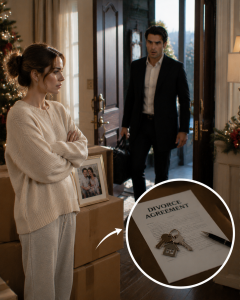
Silence. No coffee brewing. No cinnamon candles. No tiny footsteps racing across the hardwood. Only cold air and the sharp scent of disinfectant.
I knew exactly what he saw next. The Christmas tree still stood beside the window, but every ornament had disappeared. Bare branches stretched toward the ceiling while pine needles littered the floor like silent evidence.
For the first time in years, Julian panicked.
“Harrison!” he yelled, taking the stairs two at a time. He threw open our son’s nursery door. The crib remained, but the mattress had been stripped bare. The rocking chair was gone. The bookshelf was empty. The only proof our son had ever lived there was four tiny holes in the ceiling where his solar-system mobile had once spun above his crib.
Then he rushed into our bedroom. His closet looked exactly as he’d left it. My side was completely empty. Not chaotic. Not abandoned in a hurry. Deliberately erased.
He called me. Straight to voicemail. He called again. Voicemail. Then he opened our text conversation. Just three hours earlier, he’d written, *Landed safely. Can’t wait to see you and Harry.* I’d answered, *Safe travels. We’re waiting.*
Only now did he realize those words hadn’t been loving. They’d been my goodbye.
Desperate, he hurried into his office. The moment he stepped inside, he froze. A cream-colored envelope rested perfectly in the center of his polished mahogany desk. On top of it sat the diamond tennis bracelet he’d secretly bought me for Christmas. Beside it lay Harrison’s birth certificate. His family name — Blackwood — had been crossed out. In its place was my maiden name.
Before he could open the envelope, his phone rang. My attorney.
—
Julian did not answer on the first ring. For years, he had been the kind of man who never let a call control him. But that morning, silence proved more powerful than any raised voice he’d ever used against me.
“Martin,” he finally said. “Where is my wife?”
“Elena and Harrison are safe,” my attorney, Martin Hale, replied.
“That isn’t what I asked.”
“It is the only answer you are entitled to at this moment.”
Julian slid a finger beneath the flap of the envelope and tore it open. Inside were three documents: a letter from me, a formal notice of separation, and a temporary custody filing.
*Julian, by the time you read this, Harrison and I will no longer be living in the house. I know you were not in Tokyo. I know about Aspen. I know about Isabel. I know this was not the first time.*
No hysterics. No curses. Just facts.
“Your wife has requested that all communication go through counsel,” Martin continued. “You are not to contact her directly.”
“Harrison is my son.”
“No one is disputing that. And before you choose your next words, I suggest you consider that Mrs. Blackwood has documented evidence of your deception, including financial records.”
“What does she want?” Julian finally asked.
Not *is she all right.* Not *how is Harrison.* What does she want.
“She wants space. She wants honesty. She wants a parenting arrangement that protects Harrison’s routine,” Martin said. “And she wants you to read the letter before you make any decisions you cannot take back.”
The call ended. For the first time in a very long while, Julian Blackwood did what someone else had asked him to do.
He read.
*I did not leave to punish you. I left because I finally understood that waiting for you to choose us was teaching Harrison the wrong lesson… I know there were moments when you were kind. I know you love Harrison in the way you understand love. But I am writing this because I loved the man I thought you were. And because I am finally brave enough to admit he may never have existed.*
He went downstairs. The house was too clean. That bothered him most. A mess would have made sense. But I had not left in panic. I had left with a plan.
In the kitchen, he found one thing I had left behind: a chipped white mug with faded blue lettering — *Start where you are* — that had been mine since long before I married him. Inside it was his wedding ring. He had taken it off in Aspen. Isabel had laughed when he set it on the bedside table. *That feels symbolic,* she’d said. Apparently, I had read enough.
His phone buzzed. Not Martin this time. His mother.
“Tell me it is not true,” Vivienne Blackwood said, without a greeting.
“Elena overreacted,” Julian said.
Vivienne went quiet. That was worse than shouting.
“Julian, do not insult me by sounding like your father.”
—
PART 2
Across town, Harrison was asleep in the guest room of my sister Mara’s house, his stuffed elephant tucked under one arm. He did not know the shape of what had happened. To him, we were having an adventure at Aunt Mara’s.
“You look like you haven’t blinked since Tuesday,” Mara said, handing me coffee.
“I thought I’d feel more satisfied,” I admitted, watching Harrison sleep.
“Leaving isn’t a victory lap, Ellie. It’s surgery. Even when it saves you, it still hurts.”
By noon, Julian had called eleven times. By four, Vivienne Blackwood arrived at Mara’s front door — not for Julian, she insisted, but for Harrison. She held her grandson, played with his stuffed elephant, and told him his pretend hat was a very important distinction. Then, alone with me, she said something I hadn’t expected.
“My son called me this morning. He sounded exactly like his father.” She told me about Walter Blackwood — brilliant, charming, impossible to satisfy, a man who praised Julian only when he won something and left the room when he cried. “That doesn’t excuse him,” I said. “No,” Vivienne agreed. “It explains the shape of the wound. Not what he chose to do with it.”
Then she opened her handbag and handed me a small envelope. “This is for Harrison. It contains information about a trust my father established before Walter took control of the family finances. Julian cannot touch it. I want you to have at least one thing he cannot turn into leverage.”
Before I could ask more, Harrison ran back in with clementine juice on his chin, and Vivienne’s expression closed carefully. But over his head, she said one more thing, quietly.
“Julian thinks his secret is Isabel. It is not.”
That night, alone at Mara’s kitchen table, I opened the envelope. Inside: a trust document, a letter from Vivienne’s late father, Arthur Vale, and a small brass key attached to a private bank’s tag.
*My dear Vivienne — if this reaches the child’s mother, then history has taught you something after all. The Blackwood men have often mistaken inheritance for ownership. This trust is meant to protect the child who may one day need freedom from it.*
Beneath it, a note in Vivienne’s hand: *The box contains documents Walter kept hidden and Julian never asked about. Secrets rot when they are treated as heirlooms. Use what protects you. Leave what only harms.*
My phone buzzed. Martin. “Julian’s attorney sent over preliminary financial disclosures faster than expected. Several accounts are missing — one tied to a recurring monthly transfer to a private medical facility outside Denver.”
I thought of Aspen. Isabel. Julian’s confidence. “For whom?” I asked.
“That is what I do not know yet.”
Then another message arrived. Unknown number. No greeting. No explanation.
*Ask Julian what happened to Clara.*
—
PART 3
The name meant nothing to me, and somehow that made it worse. Clara was not a mistress’s name whispered through hotel corridors. Clara sounded older. Buried. Protected.
“Do not respond to the message,” Martin said over the phone. “Take a screenshot and forward it to me. Then block the number for now.”
The next morning, Mara and I stood outside the private bank listed on the key tag. Inside, a manager named Mr. Alden examined the documents with careful attention.
“This box was established under specific access instructions,” he said. “It was originally held by Mr. Arthur Vale, then transferred to Mrs. Vivienne Blackwood as custodian. The current access provision names the legal guardian of Harrison Vale Blackwood.” He turned another page. “There is also a note that the box should not be opened by Julian Walter Blackwood under any circumstances.”
A man dead before my son was born had made sure Julian could not access whatever waited in that box.
Inside, we found no jewels, no cash — only papers, folders, photographs, and a small envelope marked *Clara.*
The photograph inside showed a young woman standing beside a lake in summer, laughing at whoever had taken the picture. On the back: *Clara, June 2014.* Before Julian and I had even met.
A birth announcement clipped from a local newspaper followed. *Born to Clara Bennett, a daughter, Rose Marie Bennett.* No father listed.
Medical invoices from the same Denver facility Martin had mentioned. Bank transfer records — first from Walter Blackwood, then, after Walter’s death, from an account belonging to Julian.
At the bottom, a letter from Arthur Vale to his daughter Vivienne: *Clara Bennett was not a threat to the Blackwood family. She was a young woman who trusted the wrong people and was made invisible because the truth would have embarrassed powerful men. Walter knew. Julian knew more than he should have at his age… Julian angry. Says Clara should have kept quiet.* And then, in Arthur’s shaky script, a line that tilted the room: *The child has Julian’s eyes.*
Mara crouched beside my chair. “We don’t know the whole story,” she said gently. “We know Arthur wrote it. That’s not the same as proof.”
I needed the distinction to stay standing.
—
Martin arranged the meeting through counsel — neutral location, limited time, both attorneys present. Julian agreed within the hour. That alone told me he was frightened.
We met the next afternoon in a private conference room. Julian arrived clean-shaven, eyes shadowed with sleeplessness. I had wondered how it would feel to see him. I expected rage. Instead, I felt grief.
I placed Clara’s photograph on the table. “We are here because of her. What happened to Clara?”
Julian’s face changed — a tightening near the eyes, a small withdrawal of color.
“She worked for my family,” he finally said. “Seasonal staff at the estate. Then my father hired her more regularly.”
“How old was she?”
“Twenty, maybe twenty-one. I was twenty-six.”
I placed the birth announcement beside the photograph. “Rose Marie Bennett.”
Julian closed his eyes. His attorney tried to intervene. He waved her off.
“Yes,” he said quietly. “Rose is my daughter.”
The words did not explode. They landed softly. That made them worse.
“Were you ever going to tell me?”
“I didn’t know how.” He explained, haltingly — Clara’s breakdown after Rose was born, his father calling her unstable, threatening to destroy her life and his if Julian brought scandal into the family. “I paid for her care after my father died. I paid for Rose’s schooling. I thought that was something.”
“It was money,” I said. “Not fatherhood.”
“You’re right.”
“What happened to Clara?”
“She came to the house one night with Rose. Rose was only a few months old. Clara begged me to come outside and hold her. I didn’t. Because my father was there. Because I was ashamed. Because I told myself there would be another chance. The next week, Clara disappeared for two days. When they found her, she was confused, dehydrated, terrified. After that, her aunt arranged treatment.”
“Did you visit her?”
“No. Not for years.”
“And Rose?”
“Once. At a school event when she was five. I stood across the playground and watched her sing with the other children. She had pigtails. Red ribbons. She kept looking at the audience like she expected someone who wasn’t there.”
I stood to leave. “I spent Christmas alone while you pretended to be in Tokyo. I thought that was the betrayal I had to survive. But you did not just lie about where you were, Julian. You lied about who you were.”
“I know,” he whispered.
“No. You don’t. Not yet. It means you are going to tell Harrison the truth someday — not the details he can’t carry, but someday, you will not make him inherit your silence. And Rose. If she wants answers, you will give them. Not money. Not lawyers. Answers.”
“I don’t know if she’ll want to see me.”
“That will be her choice.”
—
That evening, Vivienne was waiting on Mara’s porch, snow gathered on her shoulders, looking smaller than she had two days earlier.
“I should have told you,” she said, before I could ask.
“Why didn’t you tell me before I married him?”
“I wanted him to become the man he promised he was becoming. I wanted to believe some truths belonged to the past.”
“They don’t.”
“No,” she said. “They wait.”
I asked her to be Harrison’s grandmother — not Julian’s messenger, not the family’s defender. Just his grandmother. She agreed, and for the first time, I saw not the wall around Julian, but the cracks in a woman who had made mistakes and was still standing at the edge of the wreckage, asking how to help.
That night, Julian sent one message — a recording of himself humming the same off-key lullaby he’d sung in the hospital when Harrison was born. I played it quietly in the hallway and cried, but not the tears of a woman waiting to be chosen. The tears of someone grieving what had been real, even inside what had been broken.
—
The next morning, Martin called with the identity of Clara’s aunt — Margaret Bennett, outside Boulder, where Rose, now twelve, was living. “There’s something unusual,” Martin said. “Clara’s care payments did not only come from Julian. There were secondary deposits over the years from a private account labeled only with initials. R.M.B.”
Rose Marie Bennett.
“She’s twelve. She can’t be making payments.”
“No,” Martin agreed. “She cannot.”
That afternoon, a certified letter arrived — no return name, only my full legal name on the front. Inside was a photograph: Julian at twenty-six on the steps of the Blackwood estate, Clara beside him holding a baby wrapped in a yellow blanket. He was looking down at the child. Not distant. Smiling.
*He held her before he lied,* the back read. And beneath it: *Rose knows where the letters are.*
—
Martin traced the certified letter’s postage two days later to a small post office outside Boulder, and from there, with Margaret Bennett’s cautious cooperation, the shape of the R.M.B. account finally came into focus. It had not been set up by a twelve-year-old. It had been set up, nine years earlier, by Vivienne — quietly, using Rose’s initials instead of her own name, funneling a portion of her personal inheritance into Clara’s care without ever telling Julian, without ever telling me, because she had wanted, in her words when I finally confronted her again, “to do one true thing that Walter’s money couldn’t touch and Julian’s guilt couldn’t take credit for.”
“You let me think it was a mystery,” I said, more tired than angry by then.
“I let myself think it was enough,” Vivienne admitted. “A quiet decency instead of a loud one. I told you secrets rot when they’re treated as heirlooms, and then I kept one more, because it was mine and I thought that made it different. It didn’t.”
The anonymous messages, it turned out, had come from Margaret Bennett herself — not out of malice, but out of twelve years of watching her niece deteriorate in a facility funded by people too ashamed to visit, and a growing, aching sense that if the Blackwood family’s carefully managed silence was finally cracking in the tabloids and the divorce filings, this was the moment, and possibly the only moment, when the truth might actually be permitted to move. She had found my number through a mutual contact at Harrison’s old pediatric practice, of all places — a small, human thread in an otherwise carefully engineered silence.
“I didn’t want to hurt you,” Margaret told me, when we finally spoke by phone. “I wanted someone with enough power to finally ask the question out loud. Rose has been asking it quietly for years. Nobody with any power was listening.”
Rose knows where the letters are.
Margaret explained the rest. Clara, in her clearer periods — and there were more of those than Julian’s abandonment had ever bothered to discover — had spent years writing letters to her daughter. Not sent. Not mailed. Written and kept in a shoebox under Margaret’s guest bed, addressed simply *To Rose, whenever she is ready,* documenting a mother’s love in a handwriting that occasionally trembled but never once wavered in its intention. Rose had found the box herself, at ten, and had been quietly reading her mother’s unsent words for two years, alone, without anyone in either family knowing she carried that weight.
“She’s twelve,” I said again, uselessly, as if repeating the number could undo what a twelve-year-old had already been forced to carry alone.
“She’s twelve,” Margaret agreed. “And she is tired of being the only person in this whole ugly arrangement who has never lied to anyone.”
—
Julian flew to Boulder the following week — not with lawyers, not with a settlement offer, but alone, on Martin’s advice and mine, carrying nothing but the humility of a man who had finally run out of better options than the truth. I did not go with him. That was not my meeting to attend, and for the first time in years, I understood the difference between supporting someone and managing them.
He came back changed, in the specific, unglamorous way that real change usually looks rather than the dramatic way people expect it to. He did not announce a transformation. He simply started doing things differently, one unremarkable Tuesday at a time. A standing video call with Rose, twice a week, that he did not cancel even during quarterly earnings season. A formal, transparent restructuring of Clara’s care — no longer a quiet, shame-soaked line item buried in his personal accounts, but an openly acknowledged medical trust, co-managed by Margaret, with Vivienne’s original R.M.B. contributions folded into it under everyone’s actual names for the first time in nine years.
He asked Rose, gently and without pressure, whether she wanted to meet Harrison someday. She said maybe. Not yet. That was, Margaret told me, exactly the kind of honest answer nobody in the Blackwood family had ever been permitted to give.
Clara herself did not recover in the way storybooks promise. Some damage does not reverse; it only becomes more livable, with enough patience and enough people finally willing to show up. But on a bright afternoon that spring, in a supervised visit at the facility gardens, Julian sat across from her for the first time in almost a decade, and by every account I later heard, he did not perform contrition or ask forgiveness he had not earned. He simply told her the truth about where he had been and why, and let her decide what, if anything, she wanted to do with that truth. She cried. He cried. Rose, sitting beside her mother’s wheelchair, held both their hands and did not let go for a long time.
—
My own divorce finalized in early spring, quietly, the way Martin had promised it could if I let the facts do the talking instead of my anger. I did not ask Julian for vengeance. I asked for honesty, for Harrison’s protection, and, eventually, for something I hadn’t expected to want: a version of co-parenting built on transparency instead of performance.
It was not a fairy tale reconciliation. I want to be honest about that. I did not fall back in love with Julian watching him finally do the right thing nine years too late for Clara and Rose. Some doors, once you understand what was kept behind them, do not reopen just because the room gets cleaned. But something quieter became possible — a working peace, built for Harrison’s sake, and eventually, once she was ready, for Rose’s.
Vivienne kept her word. She became, simply, Harrison’s grandmother — present, honest, no longer arranging what looked proper. She also, on her own initiative, began quietly funding a scholarship in Clara’s name at the local college where Clara had once hoped to study before her life narrowed into a shoebox of unsent letters. “Not to fix it,” Vivienne told me, when she mentioned it, almost shyly. “Just so her name means something other than what my husband made it mean.”
On Harrison’s third birthday, a small, careful, unremarkable thing happened that I still think about more than almost anything else from that whole terrible, illuminating year. A card arrived in the mail, addressed in careful, looping twelve-year-old handwriting.
*To Harrison. I’m Rose. I think that makes us something like brother and sister, even though we’ve never met. My mom says the most important thing about family is that you get to choose how you show up, even when you didn’t get to choose how you started. I chose to send you a birthday card. Maybe someday I’ll choose more than that. — Rose*
I read it to Harrison, who understood almost none of it and cared only that the card had a dinosaur on the front. I kept it anyway, in a drawer that was slowly filling with the kind of evidence I actually wanted to keep — not proof of betrayal, but proof of people, imperfectly, finally choosing honesty over the comfortable architecture of silence they’d inherited.
I thought, often, of Arthur Vale’s line, written years before any of us knew we would need it: *secrets rot when they are treated as heirlooms.* He had been right. But the opposite, I learned that year, was also true. Truth, once it’s finally let out into the light, does not fix everything it touches. It only, finally, gives everyone the chance to build something real instead of something merely convenient.
Harrison blew out three candles that year in Mara’s sunlit kitchen, surrounded by people who had all, in their own imperfect and overdue ways, finally stopped pretending. Somewhere outside of Boulder, a girl with pigtails and red ribbons was, for the first time in her life, being told the truth by the people who owed it to her.
It was not a perfect ending.
It was, at last, an honest one.
THE END