His Mistress Sat In My Seat At Our Daughter’s Graduation — By Fall, She’d Lost Everything She Stole

## Part 1 — The Seat With My Name On It
Ashcombe Academy did nothing quietly. Forty manicured acres in Westchester, hedges trimmed like old money, every brick looking as though someone’s inheritance had personally polished it. Graduation morning arrived dressed in white roses and brass music and the particular wealth that likes to call itself tradition.
I wore pearl gray because my daughter, Josephine, once told me I looked like a woman who owned the ending when I wore that color. My wedding ring was still on my finger, though for eight months it had felt less like a vow and more like something my attorney might eventually need photographed. A security guard greeted me by name at the door. “Mrs. Kade, front row, center aisle.” I’d earned that seat the old-fashioned way — sixteen years of packed lunches and fever nights, algebra tears and ballet recitals, the quiet devastation of watching a daughter learn her father’s attention could be scheduled, distracted, and conditional depending on his mood that week. There is no line item for that kind of labor on any balance sheet, and I’d stopped expecting one somewhere around Josephine’s tenth birthday, when Weston sent a gift by courier because a closing had run long. I hadn’t minded, not really, not at the time. It’s only in hindsight that you notice how many small absences it takes to build one enormous one. Weston hadn’t helped her pick her dress. He hadn’t sat with her through the panic attack before her thesis defense. But he’d donated three million dollars to the new arts wing, so his name glowed in embossed gold on the program — THE WESTON KADE FAMILY FOUNDATION — because men like Weston loved that word, *family*, best when it came engraved in marble he hadn’t personally chosen.
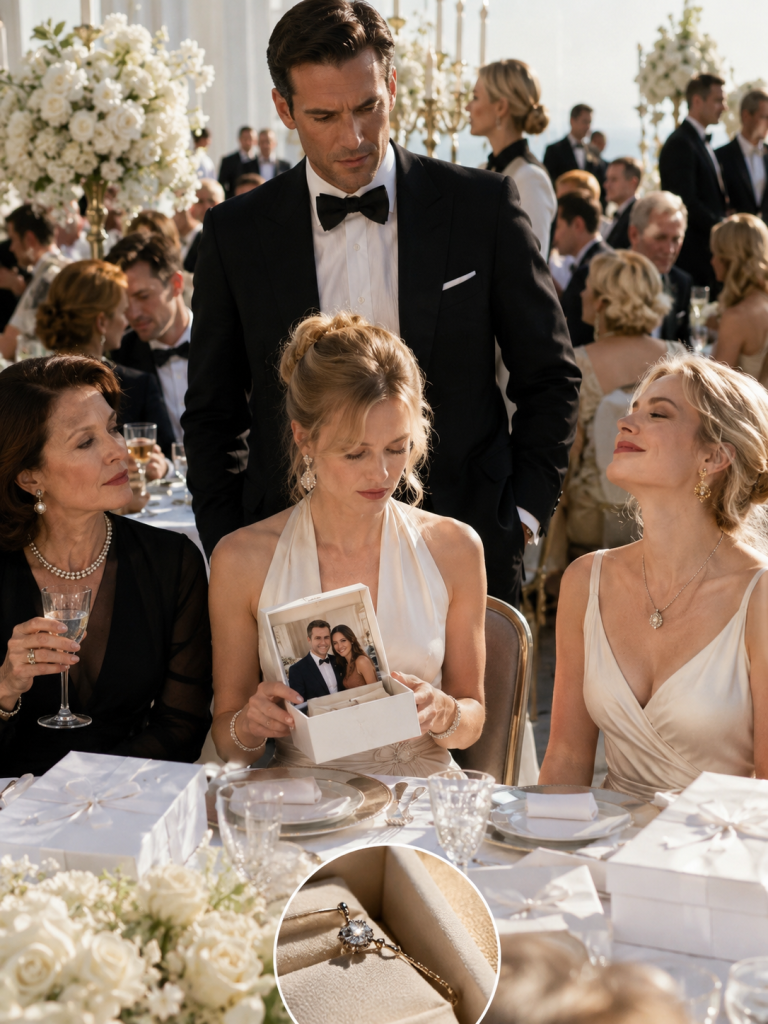
I stepped into Ashcombe Hall and didn’t understand, for one clean second, what I was looking at. There is a particular kind of disorientation that comes from seeing something impossible arranged perfectly, like walking into your own kitchen and finding a stranger cooking dinner with total confidence. Weston sat in navy and silver, handsome in the expensive, hollow way that had fooled me at twenty-six. Beside him, in the chair with my name on it, sat Isabelle Marsh — thirty-one, a former gallery consultant with a voice like warm champagne and a gift for looking wounded on camera. She wore cream silk, an obscene choice for another woman’s child’s graduation, and diamond drops I recognized instantly. Mine. Bought in Aspen on our tenth anniversary, from a jeweler who still emailed the receipts to me because Weston never handled details like that.
Isabelle saw me and smiled — not apologetically. Triumphantly.
Weston half-rose. “Camille.”
I stopped in the aisle. A few heads turned, then more; moneyed rooms pretend not to notice scandal, but they inhale it like perfume.
“That’s my seat,” I said, softly, which somehow made it worse.
Isabelle touched the satin ribbon and gave a delicate laugh. “I’m so sorry — Weston said it would be fine. I thought we were all being mature about today.”
*Mature.* The word landed like a slap wearing lipstick.
“Don’t make a scene,” Weston murmured, stepping closer.
I looked past him toward the stage, where the graduates waited behind a velvet curtain, my daughter somewhere back there twisting the silver bracelet I’d given her that morning — the one engraved *Steady. Brilliant. Loved.* “She’s my daughter,” I said.
“Our daughter,” he corrected.
“Then act like her father.”
Something hardened in his face — the man beneath the polish, the one who’d spent a year telling a family court he found sufficient reasons to call me unstable, the one who’d pushed for expanded custody of a nearly-eighteen-year-old not because he wanted more time with her, but because he wanted leverage over me in the settlement. He leaned close enough that only I could hear it.
“Don’t ruin her day.”
Something in me went very still. For months I’d wanted to scream, wanted to throw the crystal decanter he brought home smelling of someone else’s perfume, wanted to drag every lie into daylight and watch him blink under it. But I’d learned, slowly, that revenge isn’t fire. It’s ice.
I smiled at him. Then I raised my phone and took one photograph — Isabelle seated beneath my name, Weston beside her, his hand resting on the back of her chair, the Ashcombe crest gleaming above the stage behind them. A perfect composition. A family portrait of a violation.
“What are you doing,” Weston said, eyes narrowing.
“Documenting the day,” I said, and turned to sit one row back, between an investment banker’s wife suddenly fascinated by her program and a grandmother who patted my hand once, gently, like she understood everything without needing to ask.
When Josephine’s name was called, the hall erupted. She crossed the stage with a grace she’d grown out of pain, searching the front row automatically, her smile bright and hopeful and briefly, achingly young. Then she saw Isabelle. Her eyes flicked back one row, found me, and her smile vanished — small, almost nothing, a private heartbreak in a very public room. I caught it not on camera, but somewhere lower, somewhere it would stay.
Weston clapped loudly, performing fatherhood for the donors. Isabelle dabbed at dry eyes as though she’d raised the child whose milestone she’d just walked into uninvited. And I sat with my hands folded, becoming, quietly, the kind of woman my husband had never once believed I could turn into.
Patient.
## Part 2 — Diamonds, Documents, and the First Crack
By the time Weston humiliated me in public, I’d already survived him in private for the better part of a year. The affair hadn’t started with a stray text or lipstick on a collar — men like him are more careful than that. It started with absence. He missed dinners, then weekends, then Josephine’s winter concert, where she played through shaking hands searching the back row for a father who never showed. He sent flowers the next morning. Not to her. To me. White orchids, a card that read *sorry things have been tense* — because turning betrayal into weather was Weston’s particular gift.
By February he’d moved into the company’s Madison Avenue penthouse “to figure things out.” By March he’d filed for divorce. By April, a junior accountant with shaking hands told me, in a stairwell, that Weston had begun routing marital assets through shell entities in Delaware and Nevada. He had underestimated me because I’d once chosen softness, and that was his first real mistake. Before I was Mrs. Kade, I was Camille Ashford of Savannah, raised around two things: beautiful old houses and fine print. Weston had only ever paid attention to the first one.
I hired Renata Sloan the day after his filing — blunt black bob, a wardrobe entirely in ivory, a framed quote behind her desk that read *the truth doesn’t need to be loud, it needs to be admissible.* She had a reputation, I’d been told by the friend who referred her, for treating every case like an archaeological dig rather than a fight — patient, methodical, uninterested in theatrics until theatrics became strategically necessary. That suited me. I had spent enough of the marriage performing composure for other people’s benefit; I didn’t want an attorney who needed me to perform anything for hers.
She read Weston’s petition without blinking. “He’s claiming you alienated Josephine from him.”
“He missed her birthday dinner.”
“Documented?”
“Extensively.”
“He says you control the household finances.”
“I have twelve years of emails asking him to attend financial meetings. He declined every single one.”
“Good.” She turned a page. “He wants the townhouse.”
“The Fifth Avenue property?” I asked, though I already knew where this went.
“The one owned by the Ashford Heritage Trust?”
I said nothing, and Renata smiled for the first time — not warm, just appreciative. Weston’s favorite trophy, six stories of limestone and black iron, a rooftop garden where he liked to host senators and men who laughed too hard at his jokes. Everyone believed he owned it. Weston believed he owned it. It had belonged to my grandmother, Constance Ashford, a woman who wore red lipstick to church and trusted no man who called himself self-made, and when I married Weston she’d quietly moved it into a preservation trust with me as controlling beneficiary. She’d done it, she told me once over tea not long before she died, because she’d watched enough marriages in her lifetime to know that a man’s confidence and a man’s character were two entirely separate inventories, and only a fool confused the size of one for the presence of the other. He’d paid for renovations. He’d put his name on the brass plaque without asking anyone’s permission. He didn’t own one stone of it. I’d never corrected him — not out of weakness, but because I was waiting to see who he became once he assumed everything was already his.
The answer had arrived wearing Isabelle Marsh’s perfume.
I sent Renata the graduation photograph before Josephine had even tossed her cap. Her reply came six minutes later: *Excellent.*
At the reception, Weston cornered me near the champagne table. “Delete the photo,” he said, smiling for the room.
“No.”
“I’m warning you, Camille.”
“That sounded like a threat,” I said, and watched his jaw tighten right as Isabelle drifted up beside him. “This is really uncomfortable for Josephine,” she offered. “Maybe think about what’s best for your daughter.”
I turned to her. She was beautiful — I could admit that; beauty wasn’t the crime. “What’s best for my daughter,” I said, “is not watching her mother get replaced in real time by a woman who lacks the imagination to be ashamed of herself.” Her face went pale, then pink, and Weston’s knuckles whitened around his glass right as our daughter reached us, diploma in hand, cap tucked under one arm, eyes red but chin lifted.
“Mom,” she said, and walked straight into my arms.
“I’m sorry,” she whispered into my shoulder.
“No, my darling,” I said. “None of this belongs to you.” And somewhere behind her, I understood, watching Weston shift his weight and Isabelle look away, that whatever came next was never really going to be about making him suffer. It was going to be about taking away his power to make her suffer again.
## Part 3 — The House He Never Actually Owned
Two weeks after graduation, Weston took Isabelle to Capri. He posted nothing — discretion, he believed, made sin elegant — but Isabelle posted a photo of her hand around a limoncello glass, a diamond bracelet on her wrist that had belonged to my mother. I stared at it for a long time before forwarding it to Renata with the subject line *stolen marital property / separate inherited property.* Her reply: *Keep them talking.*
It struck me, staring at that photograph on a gray Tuesday morning, how little Isabelle understood about the difference between winning a man and inheriting his mess. She’d taken the bracelet the way she’d taken the seat — assuming that possession, loudly displayed, was the same thing as belonging. It never occurred to her to ask where anything had actually come from. That, more than the affair itself, was what told me she and Weston deserved each other completely, at least for as long as it lasted.
So I did. I went quiet instead of loud, stopped arguing by text, stopped defending myself to mutual friends who invited me to lunch purely to mine me for details. I smiled at luncheons, wore black satin to the museum gala, donated to Ashcombe’s scholarship fund in Josephine’s name, let Manhattan believe I was heartbroken but dignified. It was all the camouflage I needed. Behind it, Renata was building a cathedral out of paper — bank transfers, hotel invoices, jewelry receipts, security footage, a notarized trust document, a running log of custody violations: missed visits, manipulative messages, Isabelle introduced against explicit court guidance, Josephine crying in bathrooms after dinners where she “just happened” to appear.
There is a particular discipline to that kind of waiting, one nobody warns you about. It isn’t passive. It’s closer to holding your breath underwater while doing complicated arithmetic — smiling at a benefit while your attorney’s paralegal calls to confirm a wire transfer date, complimenting someone’s dress at a gala while quietly declining to correct a rumor that might, eventually, work in your favor. I learned to let people believe whatever version of me made them comfortable. Bitter. Fragile. Moving on gracefully. None of it was true, and none of it mattered, because the only audience I was actually building a case for wore a black robe and read carefully.
Then came the crack that split him open. Weston’s assistant, a young man named Marcus, called on a rainy Tuesday, voice shaking. “Mr. Kade asked me to backdate some documents. Asset transfer approvals, related to Kestrel Holdings.” One of the shell companies. “I think he’s going to blame me if this comes out,” Marcus said, and I told him to send everything straight to Renata’s office, never to me, so the chain of custody would hold. He exhaled like he’d been holding his breath for years. “I’m sorry about the graduation,” he added quietly. “My little sister graduated last year. If someone did that to our mom, I don’t think I could’ve stayed quiet either.”
Renata called that night from her car. “This isn’t just divorce misconduct anymore, Camille. This is potential fraud. Tax exposure. Perjury, if he repeats these financial declarations under oath.” Thunder rolled over the city outside my window, and for the first time in months I felt something close to peace. “Will it hold?” I asked. “It will do more than hold,” she said, in the closest thing to a lullaby her voice ever produced.
The hearing came on a bright July morning. Weston arrived in charcoal Tom Ford with Isabelle on his arm despite Renata’s warning that it would read as strategically foolish — he wanted the judge to see he wasn’t ashamed, or maybe he needed to convince himself of that more than anyone else in the room. Isabelle wore pale blue and a diamond feather brooch. Mine. I almost laughed, not because it was funny, but because arrogance had made her careless enough to wear evidence into a courtroom.
Judge Miriam Cole had silver hair, rimless glasses, and thirty years of watching wealthy men mistake volume for truth. Weston’s attorney opened with the expected performance — emotionally volatile, obstructing co-parenting, punishing him for moving on, alienating the child. I listened, still and elegant and cold. When Renata stood, she didn’t raise her voice.
“Your Honor, we have no interest in dramatizing the marital breakdown. We’re here because Mr. Kade has repeatedly disregarded temporary custody guidance, exposed the minor child to unnecessary distress, misrepresented marital assets, and introduced third-party interference into a protected family milestone.” She clicked a remote, and the graduation photograph filled the screen — Isabelle in my seat, my name on the card, Weston beside her. A murmur moved through the courtroom. “Mrs. Kade’s assigned front-row seat was occupied by Mr. Kade’s romantic partner. The child observed this while crossing the stage to receive her diploma.” Weston’s attorney rose to object; Judge Cole lifted one hand, and he sat back down.
Renata moved to the financial file next, and honesty got expensive fast. A forensic accountant named Patricia Lowell walked the court through the asset trail with the flat, unhurried patience of someone who had clearly done this before and found the theatrics of wealthy men entirely unremarkable. Marital funds moved into consulting entities. Consulting entities paid invoices to shell companies that existed, as far as anyone could determine, only on paper and in a handful of registered agent addresses in Delaware. Shell companies quietly acquired undisclosed property interests in Miami, Austin, Scottsdale — sun-belt real estate dressed up in the language of business strategy, none of it appearing anywhere on the sworn financial statement Weston had filed at the start of the proceedings. Patricia laid it out the way you’d explain a math problem to a bored student, without malice, without flourish, which somehow made it land harder than outrage ever could have. Weston stopped looking at me somewhere around Scottsdale. Then Renata turned to the part he genuinely didn’t see coming: the Ashford Heritage Trust, the townhouse, the renovations, the donor plaques, the illusion of ownership he’d cultivated for years. “Mr. Kade has represented to lenders and business associates that the Fifth Avenue residence is a marital asset,” Renata said. “It is not. It is held in trust, controlled by Mrs. Kade, protected under terms established well before any marital contribution.”
“That’s not true,” Weston said, too loud, too fast. “I paid for that house.”
“Mr. Kade, you’ll speak through counsel,” Judge Cole said, without looking up.
He turned to me instead. “You let me think—”
“No, Weston,” I said. “You assumed.” Something moved across his face that wasn’t quite regret. Recognition, maybe — seeing me clearly for the first time, and discovering the sight didn’t flatter him. Renata noted, for the record, the jewelry visible in the photographs and in the courtroom itself, purchased with marital funds or inherited by me and never disclosed in his financial statements. Judge Cole’s eyes moved to the brooch on Isabelle’s blouse. Isabelle’s hand flew to it. The feather trembled. It was the smallest thing in the world and somehow the most satisfying.
By noon, temporary orders came down — Weston’s unsupervised decision-making authority over Josephine restricted pending review, his accounts connected to the disputed transfers frozen, seven days to produce full records, a formal warning about further misrepresentation. Outside on the courthouse steps, reporters waited because money in Manhattan always travels with cameras once it starts to burn. Weston pushed through without comment. Isabelle followed in sunglasses, lips pressed thin. When a reporter called my name, I said only, “My daughter deserved a graduation without cruelty. That’s the only statement that matters today,” and it aired on every local channel by evening, spread everywhere by morning — not because I’d cried, but because I hadn’t.
The clip took on a life of its own in the way things do now, clipped and captioned and reposted by people who had never met any of us. Comments piled up under every repost — strangers noting that I hadn’t raised my voice once, that the man beside me had looked like he was watching his own funeral in real time, that a mother’s silence apparently reads, to a stranger scrolling at midnight, as something closer to armor than surrender. Josephine sent me a screenshot of one particularly dramatic caption with the message *Mom you look like a queen in a murder mystery,* and I wrote back *too much?* and she answered *not enough,* and it was the first joke either of us had made in weeks. I sat on the edge of my bed that night and laughed until it turned into something else entirely, and let it.
By Friday three investors had postponed meetings, a hotel partnership requested “clarification,” and Isabelle deleted her accounts entirely.
Three weeks later, Weston asked to meet privately at the townhouse — of course he did, wanting the stage where he’d once played king. Renata came with me, a court reporter present, a recorder visible on the library table between us. He arrived alone, thinner, his tan faded, still handsome but no longer untouchable. My grandmother’s portrait watched from above the fireplace, red lips curved as if she’d been waiting decades for this exact meeting.
The library still smelled the way it always had, cedar and old leather and rain coming in faintly through a cracked window, and for a moment I let myself notice how strange it was that a room could hold so much history without taking sides — that the same shelves that had watched Weston host senators and hedge fund men were now watching him arrive, alone, to negotiate his own exit.
“She never liked me,” he said, looking up at the portrait.
“She had taste.”
He offered to settle — keep the townhouse, drop the custody claim — and I reminded him he couldn’t challenge a trust he’d never had standing in, and that Josephine turned eighteen in October, meaning he’d been pursuing control, not custody, the whole time. “I made mistakes,” he said, the kind of apology men give once consequences arrive ahead of conscience. “You humiliated our daughter,” I said. “I didn’t think she’d react that way.” That broke something open in the room — not in me, in the truth itself. “You didn’t think,” I said, “because her feelings were never the point. Mine were. You wanted me to lose control in front of everyone so you could call me unstable. She was collateral.” Weston said nothing, and even the court reporter looked up at the silence where his denial should have been.
Then he leaned forward.
“What do you want, Camille?” he finally asked. Years ago that question would have undone me — I would have wanted repair, explanation, the man from the wedding photographs. Now the answer was simple. “I want you to leave.” Renata slid a document across the table: notice of termination of residential license. “You’re evicting me?” he said. “I’m restoring the property,” I said, and stood, and that was when the library door opened and Josephine walked in — jeans, white blouse, the silver bracelet still on her wrist, face pale but steady.
“You shouldn’t be here,” Weston said.
“I asked to be.” She set an envelope on the table in front of him. “My statement,” she said, when he asked what it was. “I kept trying to figure out what I did wrong,” she told him, voice shaking but unbroken. “Why you kept missing things. Why you brought her to places where I needed my mom. I’m not writing this because Mom told me to — she didn’t. I’m writing it because a judge needs to know you didn’t just hurt her. You used me to hurt her.”
Weston reached for the envelope, and she kept her hand flat on top of it a moment longer, not letting him take it yet, the way you hold onto something until you’re finished saying what needs to be said around it. “You always acted like I was being dramatic when I got upset about the missed dinners,” she went on. “Like I was the problem instead of a kid noticing a pattern. I’m not a kid anymore, and I noticed the pattern the whole time. I just didn’t have the language for it until this year.”
Then she told him about the scholarship fund at Ashcombe, the one with his name on it, the one actually funded quietly for five years through the Ashford trust while he took the public credit — and that she’d asked the school to rename it. “The Rose Ashford Scholarship for Girls Who Stay,” she said, Rose being my mother’s middle name, and for the first time Weston looked truly beaten. Not financially — that could be managed, spun, insured. He’d lost the story. He’d lost the version of himself he’d built for other people to admire, and his own daughter had been the one to take the pen out of his hand.
“I hope one day you become someone I can forgive,” Josephine told him. “But I’m done pretending you already are.” Then she crossed the room and took my hand, and Weston watched us the way a man watches a country he’s been exiled from — not a wife and daughter he could still divide, but a family that no longer had a door he was allowed through.
He left that afternoon with one leather briefcase. The movers came for the rest two days later. Isabelle didn’t go with him. By autumn the settlement was final — Weston paid for what he’d tried to hide, the court sanctioned his misrepresentations, the jewelry came back in evidence bags, and I sold most of it and put the proceeds into Josephine’s scholarship fund. Isabelle resurfaced in Los Angeles rebranding herself as a wellness founder; the internet remembered the brooch anyway. It always does. Weston moved into a glass apartment downtown with a view of buildings owned by men richer than he’d ever been, and became, by every account, very private.
Good. Privacy is what’s left once admiration finally packs up and leaves.
—
On Josephine’s eighteenth birthday, we held dinner on the rooftop garden of the townhouse — not a gala, not a performance, just twelve people who loved her without needing witnesses. String lights, lemon pasta, hydrangeas in blue ceramic, a cake she’d picked out herself for having “aggressively good frosting.” I’d worried, in the weeks leading up to it, that the house would still feel like a battlefield — that every room would carry some residue of the year we’d just survived. It didn’t. The rooms my grandmother had saved from demolition decades earlier seemed, if anything, to settle further into themselves once Weston’s things were gone, the way a house does when it’s finally allowed to belong to the people actually living in it.
At sunset she found me by the railing.
“Do you miss him?” she asked.
“I miss who I thought he was,” I said. “Sometimes.”
“Do you hate her?”
“Hate’s too intimate,” I said. “She took what he offered. That was ugly. But he was the one who made the vows.” Below us Fifth Avenue shimmered, all glass and gold and motion, the whole city looking, at that particular hour, impossibly alive and entirely indifferent to the year we’d both just survived. Josephine leaned her head on my shoulder. “I’m glad you didn’t yell that day,” she said. “I wanted to,” I admitted. “I know,” she said. “She sat in my seat.” “She did.” “And for a second I thought everyone would think she’d won.” Josephine lifted her head and looked at me with my mother’s eyes. “Mom,” she said, “you were the only person in that room who didn’t look small.”
Later, barefoot on the kitchen floor eating leftover cake straight from the box, she asked if I thought people got what they deserved. I thought of courtrooms and stolen jewelry, of a girl losing her smile mid-stage and a man who’d mistaken patience for weakness because he’d never once understood women raised by women like my grandmother. There was a version of me, years earlier, who would have answered that question with something gentler and less certain, unwilling to sound bitter in front of my own child. I didn’t feel the need to soften it anymore. “Not always,” I said. “But sometimes, when the record’s clean and the timing’s right, they get exactly what they argued for.” I meant it, and I meant, too, that the getting had cost something real — a year of quiet, careful patience I hadn’t chosen so much as built out of necessity, one document at a time. She laughed, bright and sudden and young, and the sound climbed the staircase and settled into walls my grandmother had once saved from demolition, like a kind of blessing nobody had to ask for.
The next morning the renamed scholarship was announced publicly. Its first recipient was a girl from Queens who’d written in her essay that she wanted to become a lawyer because “somebody should be able to speak calmly when other people are trying to scare you.” I printed that line and framed it. It hangs now beneath my grandmother’s portrait, in the library where a man once believed history belonged to whoever paid the biggest invoice, and learned, far too late, that old houses remember the women who saved them.
People still ask whether I planned the photograph — whether I somehow knew one image could unravel a life someone had spent years curating. I tell them the truth: I didn’t plan the cruelty. I only preserved the evidence. Weston had used humiliation as a weapon for years, in private rooms and quiet cars and whispered warnings at charity dinners, and he forgot the one thing that undoes that kind of weapon completely — it changes shape the moment it’s witnessed. He forgot a mother doesn’t need to raise her voice to be heard. He forgot that some women were never abandoned.
They were only ever underestimated.
I think about that word sometimes — underestimated — and how long I let it do quiet damage before I understood it could just as easily be turned into an asset. Weston had built an entire life on the assumption that I would always choose grace over consequence, that softness meant a woman had no teeth, that patience was simply another word for permission. He wasn’t wrong that I chose grace, most days. He was only wrong about what grace was for.
And when the story finally ended, it didn’t end with revenge roaring down a courthouse hallway. It ended with warm lights on a rooftop, a daughter laughing again, a house returned to its rightful name, and a woman who’d learned, at last, that elegance was never the same thing as softness, that silence was never surrender, and that love, once you strip away the illusion of it, can still leave behind something sturdier than any marriage ever was.
Freedom, as it turns out, holds its shape a great deal better than pride does.