HIS MISTRESS LEFT A GIFT BOX AT EVERY TABLE — INSIDE WAS THE EXACT DATE MY BABY DIED

**PART 1**
The ribbon was the first thing wrong — too perfect, too deliberate, tied the way a woman ties a bow when she wants you to notice how carefully she planned your humiliation.
Three hundred white boxes sat at three hundred place settings inside the Ashland Hotel ballroom, each one wrapped in silver satin, waiting like small polite bombs. I was still across the room in silver silk, the dress Julian once told me looked like moonlight, when the first lid came off two tables away and a woman gasped loud enough to carry.
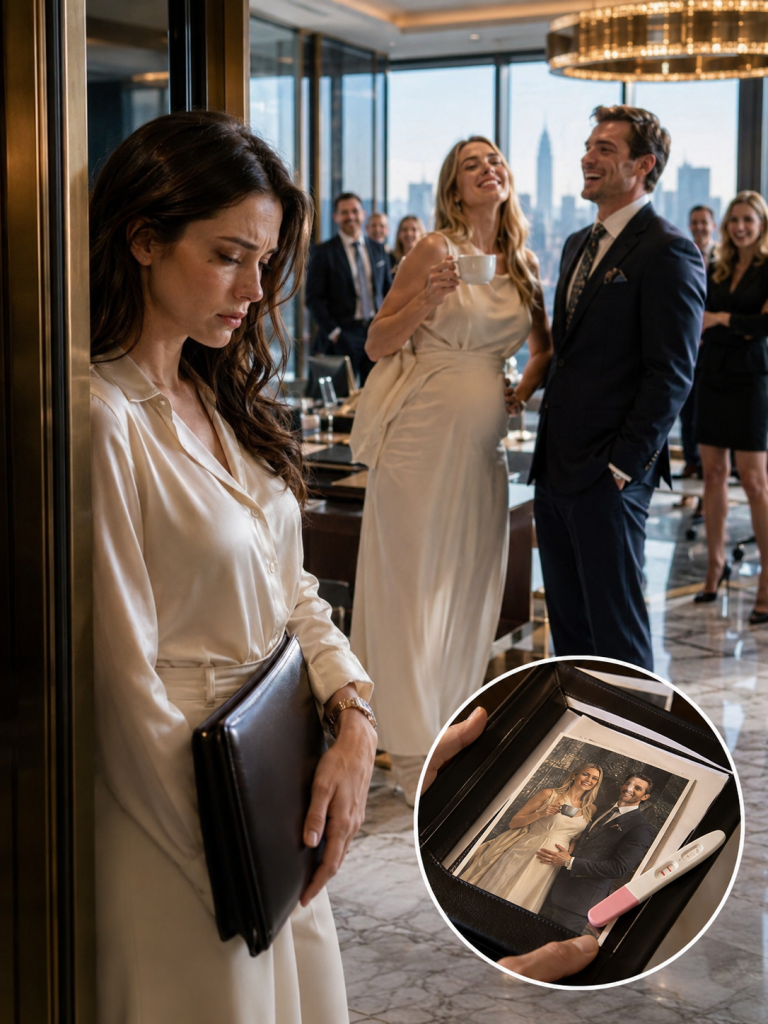
Inside every box: a glossy photograph of my husband and the woman he’d introduced to me eight months earlier as his “communications consultant,” her hand pressed flat against his chest, both of them lit gold in front of the Cape house I’d spent a decade calling home. The card beneath it read, in pearl-finish script: *Thank you for supporting our new beginning.*
I didn’t cry. I opened my own box, lifted the photograph out, and found the thing Delphine Marsh had forgotten to remove — a printer’s proof slip, wedged beneath the insert. The order date sat printed in small gray type.
It was the day I lost our son.
—
The Ashland had been built for people who believed enough marble could turn cruelty into elegance — carved ceilings, gold-veined mirrors, chandeliers bright enough to make every diamond in the room look like it was holding its breath. Three hundred guests had gathered that night for the Ashcroft Foundation’s annual gala benefiting Mercy Children’s Hospital: doctors, donors, two senators, and women who smiled with their mouths while counting scandals behind their eyes.
Julian stood near the stage in his tuxedo, one hand loose in his pocket, the other resting far too comfortably on the small of a back that wasn’t mine. Delphine wore red, because subtlety, in her worldview, was for women without cheekbones. She was twenty-nine, ambitious, and locally famous for crying only when a camera happened to be nearby.
My mother-in-law, Constance Ashcroft, had called her “refreshing” the first time we met. I had simply called her by her name, and watched her call my husband “J” whenever she assumed I couldn’t hear.
That evening Delphine moved table to table with a tray of little white boxes, performing innocence for an audience that had each paid ten thousand dollars to feel charitable for one night. *Just a small gift,* she told one table. *Something personal,* she told the next.
I was across the room speaking with Dr. Naomi Reyes from Mercy when the first box opened behind me. A man laughed under his breath and stopped the second he saw my face. Someone else held the card up to the light, as though the sentence might soften under scrutiny.
*Thank you for supporting our new beginning.*
I knew the house in that photograph down to the hinges. I’d planted the hydrangeas along its stone path myself, dirt under my fingernails, Julian promising we’d grow old there. I’d also spent one rainy afternoon inside that same house alone, bleeding into a bath towel, calling him twelve times while he let it ring.
The room tilted. My hands did not. I set my champagne glass on a passing tray before it could betray me.
Julian finally looked over. For one second, before he composed himself, I saw fear in his eyes — not guilt. Guilt has weight. Fear only calculates damage.
Constance crossed the ballroom toward me with the unhurried patience of a woman arriving to manage an inconvenience.
“Eleanor,” she said — she always said my name like she was correcting it, the way the Ashcrofts forgot my maiden name, Voss, existed at all except when they needed my father’s checks to clear. She touched my elbow. “This is not the place.”
Not *are you all right.* Not *I had no idea.* Just: *this is not the place.*
“Whose place is it, Constance?” I asked.
Her jaw tightened. “The guests are uncomfortable.”
“I can see that.”
Julian arrived beside her, moving through the stares with the ease of a man used to having exits opened for him. “Eleanor. We need to talk privately.”
“We’re at a fundraiser, Julian.”
“This has gotten out of hand.”
I looked past him at three hundred tables draped in white linen, each one holding a small box of betrayal dressed up as party favor. “Yes,” I said. “It has.”
Delphine joined him, one hand pressed to her collarbone. “Eleanor, I never wanted you to find out this way.”
The line was so rehearsed I nearly admired the delivery.
“What way did you want me to find out?”
She swallowed. Julian stepped closer. “Don’t do this.”
There it was — the command wearing concern’s clothes.
I opened the box fully. Beneath the photograph, a slip of paper had caught in the folded insert, small enough that most guests would never notice it. *Harbor Press. Proof approved. Order date: May 14. Delivery: Ashland Hotel, Ashcroft Foundation Gala.*
May 14.
The day I lost our baby. The day Julian told me he was stuck in New York because a donor meeting had run long. The day I lay in a private room at Mercy with a nurse named Renata holding my hand, because my husband did not come. The day Constance texted me, *Perhaps this is nature’s way of sparing everyone a difficult situation,* and I never told a soul, because my silence had never been weakness. It had been storage.
Delphine looked from my face to the slip in my hand. Her smile disappeared. Julian’s mouth went tight. Constance’s eyes flicked toward the stage, the donors, the board, the world she had arranged like china on a shelf.
“Eleanor,” she warned.
I folded the proof slip once and slid it into my clutch. Then I turned toward the stage.
**PART 2**
The microphone popped softly under my hand. Three hundred heads turned. The quartet in the corner stopped mid-note. A photographer lowered his camera, then lifted it again, because scandal always photographs better than charity.
Julian followed halfway before stopping — chasing me would have cost him more than letting me speak. That was always his gift. He could measure optics faster than he could measure conscience.
I found familiar faces in the crowd — Senator Halloway, who once called me the heart of the foundation; Naomi Reyes watching with quiet concern; and near table twelve, my brother Desmond, flown in from Seattle that morning, standing utterly still with one hand already inside his jacket, near his phone.
“Good evening,” I said, steadier than my own pulse. “Thank you for being here tonight for Mercy Children’s Hospital.”
They expected tears. They expected a wife unraveling so they could call it *unfortunate* over brunch later. I gave them none of it.
“This foundation was created twelve years ago, after Iris Ashcroft died of leukemia at age seven.” Julian’s sister — the family’s favorite proof of nobility, wheeled out in every brochure whenever their wealth needed to look wounded. “When I married into this family, I believed honoring her meant helping parents who were terrified and exhausted and couldn’t afford the care their children needed. I still believe that. Which is why I won’t let tonight become only what someone else tried to make it.”
Delphine, standing near the head table, had stopped performing sadness. Now she was studying me — the first sign she understood she’d misread the room. Not the ballroom. Me.
“For those of you who received a gift tonight,” I said, “please keep it. It may be useful later.”
Then I stepped down. No tears. No slap. No begging Julian to explain. People don’t know what to do with composure. It unsettles them more than grief ever could.
**PART 3**
Julian caught my wrist in the hallway just before I reached the private offices, his grip too tight for a man calling himself gentle.
“Have you lost your mind?” he whispered.
I looked at his hand until he let go. “No, Julian,” I said. “You needed to stop.”
“This is embarrassing enough.”
“For whom?”
Delphine appeared behind him. “I know you’re hurt.”
“You know nothing about me.”
“I know Julian and I are in love.”
It was such a young sentence — clean, untouched by hospital rooms, mortgage documents, funeral casseroles, or the particular exhaustion of loving a man who mistakes patience for permission.
Julian exhaled. “This isn’t how I wanted this to happen.”
“After the checks cleared, you mean.”
He winced. Delphine noticed. That was the first crack between them, small but visible.
Constance arrived with two security staff trailing her, all traces of embarrassment burned away into something colder. “Eleanor, you are making a spectacle of yourself. This family has given you everything.”
The hallway went quiet around that sentence.
“What exactly did your family give me, Constance?”
She lifted her chin. “A name.”
There it was — the family gospel, their name a cathedral everyone else was meant to kneel before. I thought of my father, Walter Voss, a machinist’s son from Fall River who’d built Voss Medical Supply out of a garage into one of the largest hospital equipment companies in New England. I thought of him teaching me to read contracts at twelve, because pretty rooms, he said, make people forget ugly clauses. I thought of the Ashcrofts smiling when he pledged twenty million dollars to rescue the foundation Julian had nearly bankrupted before we ever met.
“You gave me a name,” I said. “My father gave you solvency.”
“Don’t bring your father into this,” Julian snapped.
“You brought my miscarriage into a ballroom.”
Delphine went still. Constance’s lips parted. Julian looked like I’d struck him. Good — I hoped the truth left a mark.
“You think I didn’t know there was someone?” I said. “I knew from the restaurant receipts. From the hotel charges in Lenox. From the bracelet bought at Bellamy and Sons, charged to a corporate card the same week you told me we needed to pause fertility treatments because of cash flow.” A woman nearby stopped pretending not to listen. “Those weren’t foundation expenses, Julian. They were evidence.”
My phone buzzed once. Two words from Desmond: *He’s here.*
“You should go back to your guests,” I told them, and walked away.
—
Owen Marsh reached the Ashland at 8:17, charcoal suit, black leather folder, the exhausted patience of a man who’d spent two decades explaining consequences to people who’d never expected to face any. He’d been my father’s attorney, and mine since Dad died. The Ashcrofts called him “that unpleasant man from Fall River,” which told me everything about how much he frightened them.
He walked straight to table one, past the champagne towers, and set his folder beside my empty chair. Constance saw him first; her face changed fast enough that even Delphine noticed.
Board chair Preston Cole shook Owen’s hand, visibly relieved to have something to do with his eyes besides avoid everyone else’s. Dinner resumed around us in the strained way rooms move after they’ve absorbed a shock — every laugh borrowed, every fork set down too carefully.
“Are you ready?” Owen asked.
“Yes.”
“Ready for what?” Julian said, catching the tail of it.
Owen opened the folder. “Before dessert, the executive committee needs to review several urgent governance matters.”
Julian laughed once, short and false. “This is neither the time nor the place.”
“Interesting,” Owen said. “That was your mother’s argument earlier, when your girlfriend handed printed evidence of your affair to the foundation’s major donors.”
A fork clattered somewhere behind us. Constance hissed his name. Owen didn’t look at her. “I’m not here socially. You’re seated at a table purchased with foundation funds, in a ballroom contracted by a foundation entity, soliciting donations while concealing material misuse of charitable assets.”
Preston set down his napkin. “What misuse?”
Owen laid out invoices — fourteen months of expenses filed under community outreach, donor engagement, hospitality, brand development. Personal travel. Jewelry. Private dinners. Tonight’s printed materials, ordered through Harbor Press under the foundation’s vendor account, coded as *donor appreciation.*
Delphine stood up two tables away. “I didn’t know it was billed that way.”
“Delphine,” Julian warned.
“You told me your family handled all of it,” she said, and that was the second crack, wider now.
Constance rose. “This conversation is inappropriate.”
“Your name is on several approval emails,” Owen said. “Forwarded by the finance director this afternoon.”
The color left her face. “That’s absurd.”
I sat with my hands folded, remembering the night at Mercy, the nurse asking if there was someone she could call, me saying my husband was on his way. He wasn’t. He was at the Cape house approving photographs for tonight’s party favors. The proof slip in my clutch wasn’t just paper. It was a timestamp on abandonment.
Owen drew out a sealed envelope. “One more matter. Mrs. Ashcroft asked me not to raise this unless tonight made it necessary.”
Constance laughed, brittle. “She planned this.”
“No,” I said. I looked at the boxes still sitting on the tables around us. “She did.”
Delphine flinched — the first honest thing she’d done all night.
Owen opened the envelope. “This is the postnuptial agreement signed by Julian Ashcroft three years ago, in September.”
Julian froze. He’d signed it after the first time he was caught gambling with foundation pledges — not casino gambling, he was too polished for that, but investments and confidence he hadn’t earned. My father’s company had quietly stabilized the foundation. In exchange, Owen drafted terms. Julian signed them in Dad’s study wearing a navy sweater, believing paper could always be charmed later.
“The agreement includes a morality and asset-protection clause,” Owen said. “If marital, trust, or foundation assets were used to fund an extramarital relationship, or if conduct materially damaged Mrs. Ashcroft’s reputation, certain transfers trigger immediately.”
“That clause was symbolic,” Julian said, barely audible.
“No clause I draft is symbolic,” Owen said. “As of six o’clock this evening, Mrs. Ashcroft exercised her rights under it.”
Julian turned to me. “What does that mean?”
“It means I believed you when you finally showed me who you were.”
—
Delphine crossed to our table like the floor had turned to water. “What agreement?”
“None of your concern,” Constance snapped.
“Oh, I think it is,” Delphine said, sharp enough to cut through the room.
Owen laid down another page. “The house in Wickford, commonly called Saltbriar by the Ashcroft family, is not an Ashcroft asset. It belongs to the Voss Family Trust.” I remembered planting hydrangeas there, Constance complaining the restored kitchen felt “too new-money,” Julian telling friends the place had been in his family for generations. It hadn’t. The Ashcrofts had rented it for one summer decades ago. My father had bought it outright from its actual owners years later.
Delphine turned to Julian. “You said Saltbriar was yours. You said we could live there after the divorce. You said the nursery upstairs could be an office.”
My breath caught. The nursery — the small blue room over the water, the one white rocking chair I’d put there before I was ready to tell anyone I was pregnant, closed and untouched since May.
“Access to Saltbriar was revoked as of six-thirty,” Owen said.
“You can’t do that,” Julian said.
“I can,” I said.
He softened his face into the expression he always used when anger failed him. “Eleanor, be reasonable.”
I thought of every time that sentence had cost me a piece of myself — be reasonable when Constance seated me at the end of family dinners because wives shouldn’t outshine sons; be reasonable when he forgot our anniversary but remembered Delphine’s birthday; be reasonable when he told me grief had made me cold, as though grief arrives alone.
“No,” I said.
Owen turned another page. “The joint card was closed at six forty-five. Discretionary distributions are frozen pending review.”
“You have no authority over our distributions,” Constance said.
“Correct,” Owen said. “But Ashcroft Holdings pledged its remaining liquid collateral against a credit line guaranteed by Voss Capital six years ago.”
Preston muttered, “Dear God.”
I looked at Constance. “My father didn’t give your family money. He gave them a leash.”
The sentence traveled table to table, phone to phone. Somewhere behind me, someone was recording. Good. The internet has always loved a fall, and loves a villain a little more when she brought her own gift box.
Constance sat down slowly, and for the first time in years, she looked old — not fragile, just revealed.
“You wouldn’t destroy us,” Julian said.
“No,” I said. “You did that.”
Delphine looked at him. “You told me she was unstable. You told me she trapped you with money. You told me the baby wasn’t even planned.”
My body went cold.
“He told me,” she said, voice breaking for real now, “that the miscarriage was a relief.”
For one second the ballroom disappeared and I was back under the hospital ceiling, the monitor beeping, Renata’s hand in mine, wondering if grief could make a person physically smaller.
“Thank you,” I told Delphine, “for saying that in front of witnesses.”
Owen set a small recorder on the table. “The truth has developed a habit of entering rooms tonight.”
—
Saltbriar’s security system recorded audio in the entryways after a break-in scare years back. Julian had approved it himself, mostly for the pleasure of saying *perimeter* to contractors. Owen pressed play.
Static, ocean wind, then Julian’s voice: “She’ll get over it.”
Delphine’s, younger, softer than her performance tonight: “She lost a baby, Julian.”
“She lost an idea,” he said, and laughed.
No one in the ballroom moved. My heart didn’t break — it had broken months ago. This was only the sound of everyone else finally hearing it.
Then Constance, low and clipped: “Don’t let guilt ruin this opportunity. Eleanor is useful, but she’s become heavy.” A pause. “After the gala, Delphine should be visible.”
Delphine whispered, “You knew.” Constance didn’t answer.
Julian lunged for the recorder. Desmond reached him first, stepping calmly into his path the way our father used to step in front of a contractor trying to overcharge him. “Don’t,” Desmond said. Julian stopped.
The recording ended in silence thick enough to feel like snowfall. No one clapped. Even scandal needs a second to breathe.
“I didn’t know about the money,” Delphine said. “I didn’t know about the hospital. I thought he’d already left you.”
“He had,” I said. “He just forgot to move out.”
Preston stood, voice shaking. “As board chair, I’m calling an emergency vote to remove Julian Ashcroft from all foundation duties, pending investigation.” One by one, the board nodded — some reluctant, some eager. Boston society isn’t moral by nature, but it’s deeply allergic to liability. It always has been. I watched men who had toasted Julian at his own wedding vote against him inside of ninety seconds, their faces arranged into the same careful neutrality they probably practiced in mirrors.
Constance turned to me. “You think this makes you powerful?”
“No,” I said, standing. “It makes me free.”
“You’ll be alone.”
A year earlier, that would have landed. Not that night. Not after hospital rooms and proof slips and my dead son called an idea. “Alone is not the worst thing a woman can be,” I said. “Unloved beside her own husband is worse.”
Somewhere behind me, a woman whispered, “Amen.”
Julian reached for me. “Eleanor, please.”
There it was — the word he’d trained me to wait for, finally in his mouth, years too late. I looked at his hand until he dropped it. Then I unclasped my wedding ring — Constance’s grandmother’s, or so she’d always claimed, though Owen later discovered it had been purchased at an estate auction. Even their heirlooms were borrowed stories. I set it beside Julian’s untouched plate.
“You loved what my silence protected,” I said.
Delphine stepped back from him, whatever fantasy she’d walked in with finally burned away. “I need to leave,” she said.
“You let me hand those boxes out,” she told Julian, “because you wanted witnesses for her humiliation and privacy for yours.” She walked out through the side doors, red dress trailing like a warning. No one followed.
I returned to the stage once more. “I apologize for the delay,” I told the room, voice catching only once — not for Julian, but for the baby I never held, and the woman I’d been before grief taught me how quiet survival could sound. “My marriage is ending tonight. The work we came here for is not. My father used to say money doesn’t make people good — it only gives them more room to show what they already are.” I looked toward Desmond, who nodded once, the way our father used to nod at the end of a hard negotiation, right before he shook the other man’s hand anyway. “So tonight I’m personally matching every legitimate donation made in this room, and adding five million dollars to establish the Voss Family Patient Housing Fund, administered independently, with full public reporting — and without Ashcroft oversight.”
The room rose. Not the applause of celebration — the heavier kind, the sound of people who’d just watched a woman hand herself back to herself and weren’t entirely sure what to do with their hands afterward.
—
The divorce took eleven months. Julian fought publicly for dignity and privately for money, and got neither. The investigation turned up hotel rooms, jewelry, private travel, and invoices dressed in phrases like *donor strategy.* The press called it the Gala Table Scandal. I called it Tuesday, because healing, I learned, isn’t one dramatic night. It’s paperwork. Changed locks. Sleeping through until morning. Walking into a grocery store in leggings and remembering, with something like surprise, that no one there knows your husband betrayed you.
For the first few weeks, I moved through the house like a woman testing ice, unsure which floorboards still belonged to me. Desmond flew back twice that summer, unannounced both times, and simply sat with me while I sorted through boxes of things that used to mean something. He never once told me how to feel. He just kept refilling my coffee and reminding me, in his quiet way, that our father had survived worse rooms than this one and had never once needed anyone’s permission to leave them.
Owen handled the financial unwinding with the same unhurried precision he brought to everything. He walked me through every account, every clause, every place my name had been quietly written out of documents over the years without my noticing. “This is the part nobody warns you about,” he told me one afternoon, sliding another folder across his desk. “Not the leaving. The auditing of what leaving costs you to discover.” I signed where he told me to sign, and slowly, month by month, the version of my life that had belonged to the Ashcrofts fell away like scaffolding coming down from a building that had been finished for years.
Delphine wrote me a letter three months later — no forgiveness requested, just an admission that she’d confused being chosen with being valued, and that she’d moved back to Denver and started therapy. She wrote that she thought about the gift boxes constantly, that she hadn’t understood, until it was far too late, that she’d been recruited as a weapon and mistaken it for romance. She wrote that some nights she still heard her own voice on that recording, asking whether the gifts were too much, and Constance’s answer, and that the memory of it had taught her more about herself than any therapist’s office had managed to. I did not write back immediately. When I finally did, I wrote only one sentence: *Do not build your next life out of someone else’s ruins.* It wasn’t forgiveness. It was a map, the only kind I had left to give.
Constance tried to recover socially, hosting smaller lunches, insisting the scandal had been exaggerated by jealous people online. For a while, a few of her oldest friends still answered her calls. But the recording followed her everywhere, replayed at dinner parties she wasn’t invited to, quoted in think pieces about wealth and cruelty that named her outright. No one repeated her line about humiliation and options in front of her again. They didn’t have to. It sat down before she did, in every room she entered for the rest of that year.
Julian moved into a rented condo with a view of a brick wall. I saw him once more, at family court, wearing the same navy tie he’d worn the day my father made him sign the postnup — thinner now, quieter, visibly confused by a world where his last name no longer opened every door on its own. He waited by the elevators afterward.
“I’m sorry,” he said, and it sounded almost real. “I should have come to the hospital.”
The sentence I’d once needed like oxygen arrived a year too late to matter.
“Yes,” I said. “You should have.”
The doors opened. He stepped back. I stepped in. That was our ending — not shouting, not music, just a door closing between who I’d been and who I was becoming.
A year after the gala, Mercy opened the Voss Family Patient Housing Floor — twenty rooms, a shared kitchen, laundry machines that actually worked, soft chairs nobody had to fight over, and a small library with picture books in four languages. I asked them to skip the gold lettering and put up a small brass plaque instead: *For the families who wait, worry, hope, and stay.* A little boy with a shaved head handed me a paper flower with wet glue on opening day, and I told his mother it was perfect. She apologized twice for the glue. I told her some of the best things in my life had arrived a little unfinished.
That night I drove to Saltbriar alone, the way I hadn’t let myself do since May. The nursery was still blue-gray, the white rocking chair still under its sheet, dust catching the last of the light like something patient and unbothered by time. I stood in the doorway a long while before I walked in, pulled the sheet away, sat down, and cried — not the tidy, cinematic kind, but the whole-body kind that leaves you hoarse. For the baby. For the woman in the hospital room who kept watching the door, certain, right up until she wasn’t, that someone was coming. For every dinner where I’d swallowed disrespect to keep peace with people who fed on it and called the feeding love. I cried until the ocean outside went black and the house finally stopped feeling like a museum built around one specific wound.
Then I opened the window. Salt air. Wet stone. The hydrangeas moving below in the dark, indifferent to everything that had happened in the rooms above them, blooming anyway because that was simply what they knew how to do.
The next spring, I hosted dinner at Saltbriar — not a gala, just dinner, the kind with mismatched chairs and too much food. Desmond came with his wife and their two loud children, who ran shrieking through the hydrangeas until someone’s shoe came off in the mud. Naomi brought a bottle of wine she said she’d been saving for “a clean ending.” Owen arrived late with pie, pretending he hadn’t checked the trust documents twice before dessert out of some old professional reflex he couldn’t quite retire. Renata came too, with her husband, who admitted, red-faced, that he’d watched the scandal clip six times before realizing his own wife was the nurse mentioned in it.
We ate at a long wooden table on the terrace — no white boxes, no cards, no staged photographs, just roasted chicken and warm bread passed hand to hand without any judgment riding along beside it. Someone told a bad joke. Someone else spilled wine on the tablecloth and nobody flinched. At sunset, Desmond raised his glass.
“To Eleanor,” he said. I shook my head. “Too late,” he said, and everyone laughed. “To the woman who learned that silence can be survival, but the truth is what finally sets you free.”
I looked around the table — the children with sauce on their faces, Naomi laughing into her napkin, Owen pretending not to be moved, Renata’s husband still apologizing for the six views, the empty chair beside me that no longer felt like an accusation, only like a chair.
For a long time I’d believed a marriage ending meant a life ending. But some endings aren’t cliffs. Some are doors, and you only find that out once you’re standing on the other side of one, breathing air that finally belongs to you.
That night at the Ashland, Delphine packaged betrayal as a party favor. Julian let her place it at every table. Constance called it tasteful. I opened the box anyway, and inside I found the date that proved everything — and, underneath it, without either of them intending it, the beginning of my own freedom.
The order date was the day my son died. But my life didn’t end there. It began again the night I finally stopped explaining myself to people who’d built a career out of misunderstanding me on purpose.
When I think of that gala now, I don’t picture the photograph, or the card, or the chandelier light freezing on Constance’s face. I picture a long table by the water a year later — warm bread going hand to hand, laughter rising into salt air, a little boy’s paper flower still sitting in a jar on the windowsill at Mercy, and myself, at the head of my own life, with no one beside me who needed my silence to feel powerful.
For the first time in years, every place at that table felt like love.