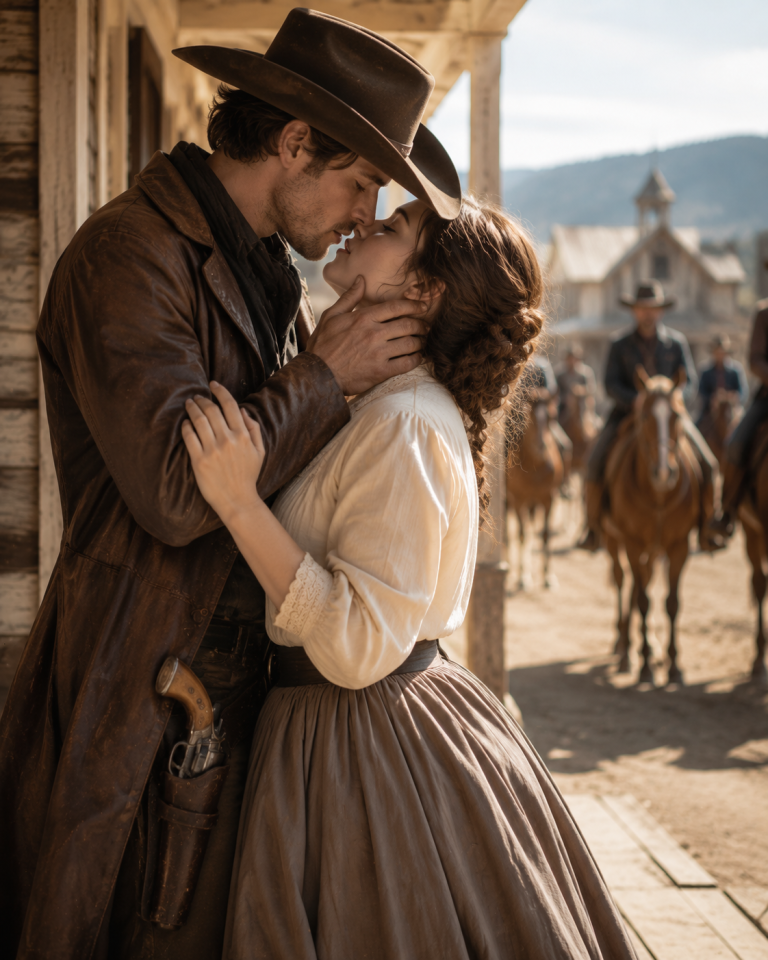
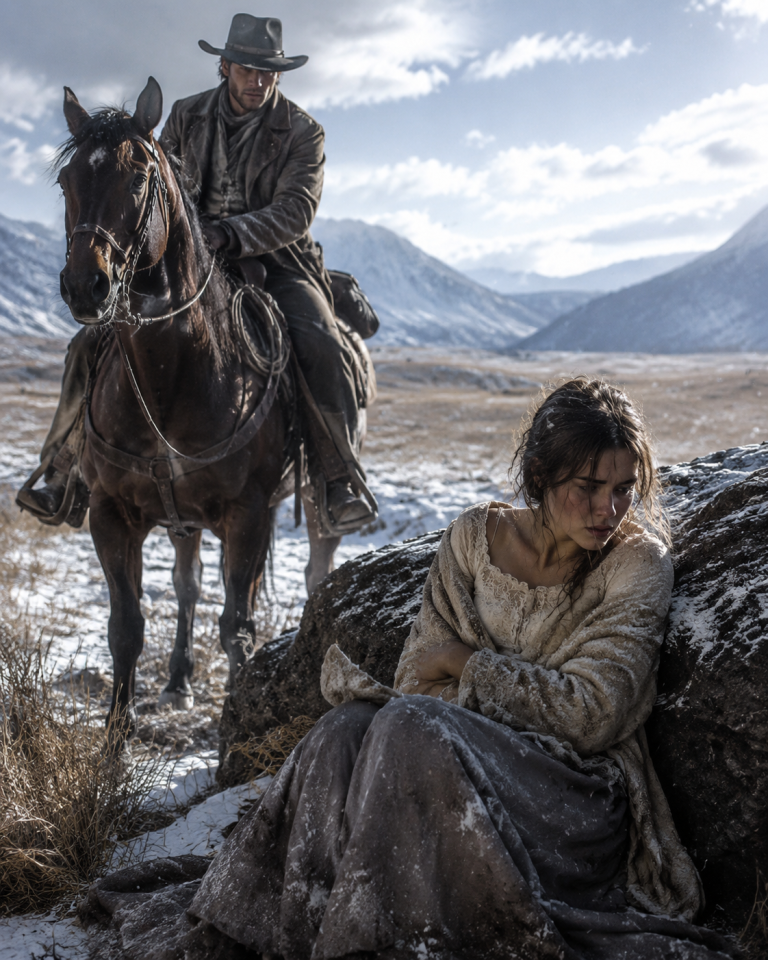
“She’s Deaf—Take Her!” her drunk father shouted, handing her over like unwanted baggage. But as the terrified girl lowered her eyes, the silent mountain man leaned close and whispered, “I know you heard every word.”

## PART 1
They called her the quiet shadow of Redstone County, the girl who never spoke and never cried, and the town had decided long ago that this was a vacancy rather than a choice. Silence in Creston, Wyoming, was not a virtue. It was an invitation. A blank space that people with bad intentions felt entitled to fill.
Nora Crane had learned this early. Silence, worn correctly, could be armor. The trick was to let men believe you were broken in the particular way that made them look past you rather than at you, because the kind of men who loved power preferred a victim who could not testify.
On a January night in 1875, the Cattlemen’s Rest Saloon crouched against the wind with yellow lamplight bleeding through its frosted windows. Inside, heat and noise fought for dominance — boot leather and cigar smoke and whiskey soaked so deep into the floorboards it would never come out. Men crowded around card tables and a chipped piano, laughing with the particular loudness of people drowning out their own conscience.
Nora stood near the central table, wrapped in a shawl that had given up pretending to be warm. Her hands were clenched beneath the cloth as if she could hold herself together by force.
Her father, Walt Crane, was on top of the table.
He had the red, watery face of a man who had been drinking since noon, mud still on his boots, a bottle in one hand. When he kicked a glass off the edge and it shattered near Nora’s bare feet, she did not flinch. She stared at the sawdust. She had learned to hold her body like furniture when he was like this — still and without opinion, because opinions drew attention and attention drew his hand.
“Who wants her?” Walt shouted, voice cracking on the words. “She’s strong. She works. Don’t talk back.” He spread his arms like a man presenting inventory. “Best part? She’s deaf. Deaf as a stone. Can’t hear you. Can’t tell nobody anything.”
The laughter that moved through the saloon was low and mean, and Nora felt it in the muscles of her back like a foot pressing between her shoulder blades.
She was not deaf.
She had stopped speaking three years ago, the night she watched her mother die and understood that sound could betray you — that a girl who cried was a girl who could be found, and a girl who could be found could be hurt worse. Silence had been the first tool she had made from grief, and she had carried it ever since.
From behind the bar, the bartender — a heavy man everyone called Lark — slammed his rag on the counter. “Sit down, Walt. You’re embarrassing yourself.”
“I need money,” Walt said. It wasn’t a confession. It was an accusation against the world. He reached down and grabbed Nora by the hair, yanking her head back, and the room leaned forward slightly with the interest of men who had nothing better to do.
Nora let her body go heavy. She fixed her eyes on the ceiling beams and counted the knots in the wood. Her father’s grip was familiar pain. Familiar pain had a bottom to it.
A voice from the back of the room said, “Ten dollars.”
The man who stepped forward was Dalton Vance, foreman for the Keller Cattle Company, a scar-faced man whose hands looked like tools for breaking things. He had the particular smell of a man who believed that owning things gave him authority over them. He moved closer to Nora with the proprietary confidence of someone inspecting a purchase.
“Fifteen,” Dalton said, lifting one hand toward her chin.
Walt barked, “Sold!” with the satisfaction of a man closing a good deal.
The saloon doors slammed open.
Winter came inside all at once — snow swirling across floorboards, lamps guttering, men cursing as cold hit their faces. In the doorway stood a figure so large and fur-wrapped he looked like something the mountain had decided to send down. Buckskin. Dark beard crusted with frost. A rifle settled on his shoulder as if it were a natural extension of his body. A knife at his thigh with a handle worn smooth from use.
The room shifted.
Some men knew him as a trapper who disappeared into the mountains and came back with pelts and gold dust. Others said he had been a ranger once, that the war had taken something from him that never grew back. Whatever they believed, they moved out of his path the way water moved around stone — without thinking about why.
He walked to the bar and set down a leather pouch with a sound like judgment. “Whiskey,” he said, in a voice that didn’t waste breath.
“We’re busy,” Dalton said, tightening his grip on Nora’s arm.
The man turned slowly.
His gaze went to Dalton’s hand. Then to Walt on the table. Then to Nora’s face. He looked at her not like a commodity but like a person standing in the middle of a fire who did not yet know they were on fire.
“Let her go,” he said.
It was not loud. It didn’t need to be.
Dalton’s grin returned. “I paid for her.”
“You can’t pay for a person,” the man said, stepping forward. “And tonight you won’t.”
Walt, sensing an argument he might profit from, puffed himself up. “I’m her father. She’s mine to do with.”
The man reached into his coat and pulled out a gold nugget the size of a walnut. He tossed it. It hit Walt in the chest and dropped into his lap with a weight that made the table creak. The room inhaled at the size of it.
“That clears whatever debt you think you’re settling,” the man said, his eyes still on Dalton. “She’s free.”
Nora’s head came up for the first time.
*Free.* The word arrived in her like a stone dropped into water. She watched the man’s face and found something she hadn’t expected. Not softness. Not savior’s pride. Just the flat, tired expression of someone who had seen something he refused to allow and intended to stop it.
He turned slightly toward her and opened a path.
“You can come,” he said, quieter now, as if the choice actually belonged to her. “Or stay. It’s yours.”
*Choice.* Another strange word. Unfamiliar as a song in a language she was still learning.
Nora wrenched her arm from Dalton’s grip and walked through the path the man had made before fear could catch up with her decision.
Behind her, Walt laughed. “She can’t hear you! She’s broken!”
The man said nothing to that. He guided her outside, lifted her onto a mule waiting at the post, and wrapped her in a buffalo robe that smelled of smoke and pine. His hands were quick and competent, checking knots and straps with the efficiency of someone who expected the world to try to kill him.
When the wind was screaming around them and the saloon light had retreated to a yellow smear behind them, he leaned close.
“I know you can hear,” he said.
Nora’s heart stopped moving for a full second.
Three years. Not one person had seen through it. Not her father. Not the men who mocked her. Not the women who watched from safe distances. This man had noticed something as small as the involuntary twitch of her ear when Dalton reached for his pistol.
He straightened and began leading the mule up the mountain without waiting for her response, as if he had said something as unremarkable as the weather.
His name, she would learn, was Cal Merritt.
—
## PART 2
The climb took two days.
The trail narrowed to a ribbon carved into sheer rock. The world below became white and black and far away. Nora rode in the buffalo robe and let the cold and the altitude do what they did — strip away everything that wasn’t essential and leave only the thing underneath.
They camped the second night in a shallow cave. Cal built a fire without fumbling, roasted rabbit over the flame, and handed her a piece without ceremony.
“Eat,” he said. Not a suggestion.
She ate. She was starved in more than one way.
He watched the cave mouth more than he watched her, listening to the wind the way a man listened when he’d learned the wind could carry useful information.
“You’re wondering how I knew,” he said finally.
Nora’s hands tightened on the meat but her face stayed still. Habit ran deep.
“When Dalton Vance reached for his gun, your ear moved,” Cal said. “Fear makes people listen even when they’re pretending not to.”
He turned his back to her and lay down near the fire, as if trust were something that could be offered once and then left alone to do its work.
She lay awake a long time, listening to the mountain breathe.
—
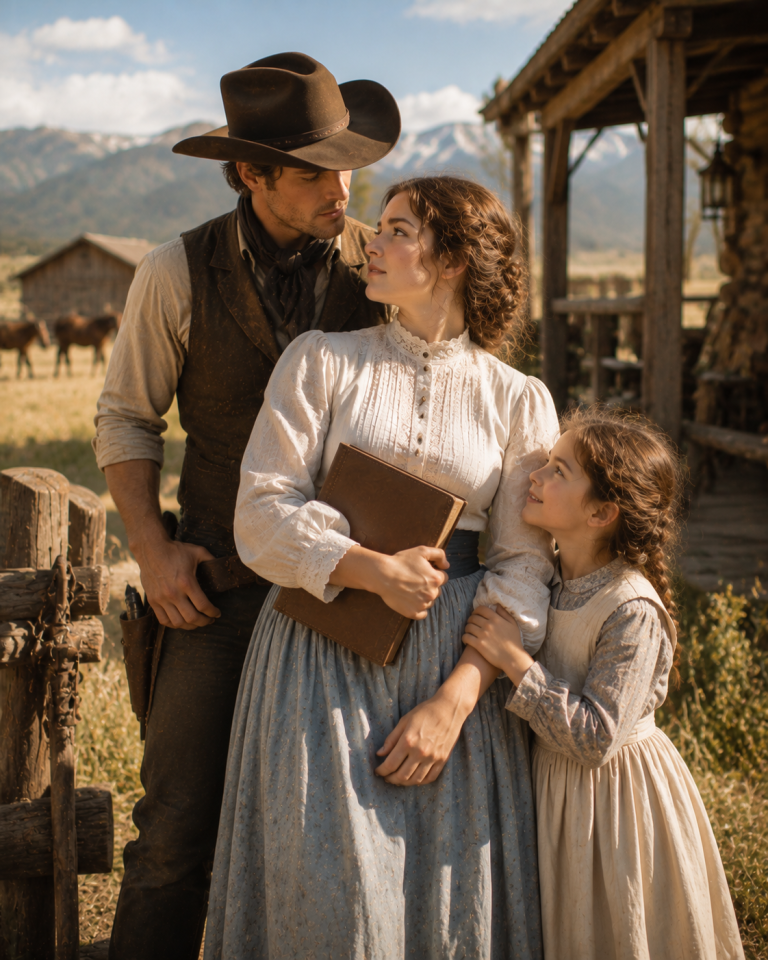
The cabin was built into a cliff like a bird’s nest, half-hidden by pine and rock. Inside: shelves of books, weapons in clean order, herbs drying from the rafters, a table scrubbed pale. The place had the disciplined quiet of a man who had once believed in rules and still kept them even when the world had stopped keeping them for him.
Cal dropped his pack and looked at her.
“I hunt. You cook. We both work.”
Nora’s throat felt like something was blocking it. She forced a sound through it so thin it barely made the air move. “Why did you help me?”
He went very still. Then he turned, and for the first time something moved behind his eyes — not sentimentality, but pain.
“Because I know who your father has been dealing with,” he said. “And I know who Dalton Vance works for.”
Nora’s breath came short. “Keller.”
Cal nodded once. “Gideon Keller has been looking for something since the night your mother died. He thinks you have it.”
The truth arrived like a fist.
The ledger. Her mother had pressed it into her hands on the last night, shaking, mouthing one word with the urgency of a woman who knew what was coming: *proof.*
Nora had kept it under the floorboard near the hearth of every place she’d stayed since, not because she understood it but because her mother’s hands had been shaking when she gave it to her, and a thing given with shaking hands was a thing worth keeping.
She nodded. There was no point in denying it.
Cal closed his eyes for a moment, like a man receiving a verdict. “Then it’s not over,” he said. “It’s just moved up here.”
Outside, snow sealed the pass like a door shut from the inside. Below, somewhere, men were already calculating the cost of climbing.
—
## PART 3
Winter on the mountain had its own logic.
Nora had spent three years surviving by disappearing. Cal Merritt spent those same weeks teaching her to exist visibly — not by telling her to be brave, but by putting her to work until there was no room left inside her for the old reflexes.
She woke before dawn. He pressed tools into her hands. She split wood until her palms blistered, hauled water from a spring half a mile up, learned to skin animals cleanly so the meat wouldn’t be wasted, because waste was a luxury the mountain didn’t offer. Cal never praised her. He corrected what was wrong and left what was right alone, which turned out to be a more efficient way of building a person than most she’d encountered.
“Fear freezes people,” he told her one evening, when she’d been staring into the fire long enough to worry him. “Work keeps them moving.”
“What do you do,” she said — and the ease of her own voice still surprised her, three weeks in — “when you can’t work?”
He looked at the fire. “I haven’t figured that out yet.”
She learned him in pieces. He had been a ranger before the war, before something happened that he hadn’t found words for yet. He had come to the mountains not because he loved solitude but because he’d run out of alternatives and the mountains didn’t ask questions. He spoke plainly and sparsely, the way men did when they’d been alone long enough that words felt expensive.
He did not touch her. He was careful about this in a way that she noticed and filed away, because men who were careful about that were rare.
One evening, when the wind had settled to a low moan and the fire was burning steady, Nora pried up the floorboard near the hearth and lifted out the ledger.
The leather was cracked and dark. Her hands shook as she placed it on the table. Touching it felt like touching the last night she’d had a mother.
Cal stopped sharpening his knife.
“Read it,” he said. His voice had changed quality.
She forced her voice through her throat and read.
Names. Dates. Numbers. Sheriff Harland Crowe. Dalton Vance. Gideon Keller. Bribes, stolen land claims, men who had disappeared listed like items in an inventory. Each entry was proof of something the town had decided not to know, because men like Keller made it profitable not to.
She reached a page near the back. An entry. A fifty-dollar payment. A name.
“Read that one again,” Cal said. His hands had gone absolutely still.
She read it slowly: *Thomas Merritt. Paid for silence. Problem resolved.*
The fire popped.
Cal stared at it as if it had become a different object. “My brother,” he said, each word pulled out with effort. “They said he left for California. They said he took money and disappeared.” He stopped. “I knew that wasn’t true. I just never had proof.”
Nora put her hand on the table, near his but not touching it.
“Now you do,” she said.
He looked at his hands for a long time. Then he nodded slowly, the nod of a man who has received something he’d been waiting for and discovered it was heavier than he’d imagined.
“Then we’re not just hiding,” he said. “We’re building a case.”
“Yes,” she said.
Something in the room changed. Not warm exactly, not the easy warmth of people who had always been comfortable with each other, but the harder warmth of two people who had recognized something in each other that the world had tried to take. He had rescued her from a saloon because he recognized cruelty he could stop. She had kept her mother’s ledger because she understood that evidence was sometimes the only thing that could outlast the people who created the evidence.
They had both been keeping something.
Now they had each other’s.
—
The mountain taught her to listen.
Cal spent the deep weeks of winter teaching Nora to shoot, to read the forest’s silences, to smell smoke before seeing it, to hear the difference between wind moving through pines normally and wind that had been disturbed by something passing through them. She learned to load a rifle in the dark. She learned that her hands, which had once shaken at the sound of a man’s voice, could be steady at fifty yards from a target.
“You survived three years by pretending to be deaf,” Cal told her one afternoon, picking up the casing she’d ejected. “That meant you were listening to everything.”
“I was hiding,” she said.
“Same thing,” he said. “The information was there. You just weren’t allowed to use it.”
She hit the target.
He didn’t comment. He moved the target farther.
She began to understand what he was building. Not a weapon exactly. A person. Someone who had been reduced to the smallest possible version of themselves and was now being allowed to take up more space.
She understood, too, that he was being built alongside her. That teaching her to listen had started him listening to things he’d been shutting out for years. Old grief, mostly. His brother’s name spoken aloud for the first time in three years.
The mountain sensed the coming trouble before they did. Birds went quiet. The forest developed a specific watchfulness. Cal began sleeping in short intervals, rifle always within reach. He had the talent of a man who had stayed alive in bad situations by refusing to pretend they weren’t dangerous.
The morning the men came, Nora was alone on the porch.
The forest went silent so completely it felt like a held breath.
She was moving for the rifle before the first shot hit the porch post, inches from her head. She was inside before the second went through the window. She fired back through the broken glass the way Cal had made her practice — not wildly, with intention — and one man went down clutching his leg with a sound she had to decide not to let stop her.
The second man was still advancing when Cal’s rifle spoke from somewhere above, once, with the flat authority of a man who didn’t miss when it mattered.
He came in through the door moments later, breathing hard, eyes moving over her in the rapid assessment of someone checking for damage.
What she saw on his face in that moment — the specific panic that moved through it before his control reasserted itself — told her something she filed away carefully.
From the dead man’s coat he pulled a notice, handwritten on brown paper. *Deliver the woman alive. Payment on receipt.*
Cal’s jaw tightened. He turned it over in his hands as if he could read something between the words.
“They’re done waiting,” he said.
“So are we,” Nora said.
He looked at her.
She looked back.
“We go down,” she said. “We take the ledger to a federal marshal. But if we just ride in, they’ll have men waiting.”
“We need to draw them into the open first,” Cal said. He was watching her with the quality of attention he used when he was deciding whether someone was ready for a thing. “Which means—”
“I’m the draw,” Nora said.
He didn’t argue. He had been watching her for months. He knew what she could do now.
“Not alone,” he said.
“No,” she agreed. “Not alone.”
—
Creston at midnight looked worse than she remembered — the kind of worn-out that happened to places that had been running on fear and greed for too long. Mud and smoke. Men in doorways with the patience of predators.
Nora rode in the way she used to: shawl pulled forward, eyes down, body small. The silent ghost. Not because she was afraid this time, but because it was still the best tool for the job, and she had learned from Cal that you used what worked.
Dalton Vance saw her immediately.
He came out of the saloon with the grin of a man who believed he was owed something that had escaped him. He caught her chin in his hand and said something about the ledger, and Nora widened her eyes and made the confused gestures of a woman who couldn’t follow words.
Dalton laughed.
He still thought she was the same person he’d reached for in the saloon. People like Dalton Vance never updated their picture of the people they’d decided were beneath them.
He pulled her toward the livery stable.
That was when the stable wall came apart.
The dynamite charge Cal had placed that afternoon tore through the timber with a sound that temporarily removed all other sounds. Fire lit the sky. Horses screamed. Men scattered in the specific chaos of people who had been confident a moment ago and found confidence very suddenly unavailable.
In the one second Dalton’s grip loosened, Nora cut the saddle strap with the knife Cal had given her. The saddlebags hit the ground and spilled worthless things — empty cloth, a handful of rocks — because the ledger was under her coat, against her ribs, where it had been since they left the mountain.
Cal was firing from the hardware store roof, measured and deliberate, targeting the men who were targeting her. Then he dropped from the roof into the mud with a force that shook the ground, and she heard the specific sounds of a man who moved like work rather than anger.
He brought Dalton down without killing him.
Nora ran for the sheriff’s office.
Her father was in a cell.
Walt Crane sat on the floor, his face swollen, his eyes finally clear in the way that only happened when a man had been scared sober. He looked at her through the bars and she watched his face make the calculation it had never made before — that she was not what he had decided she was.
“Nora,” he said. “I didn’t—”
“You did,” she said. Her voice was completely steady. “I’m not interested in the reasons.”
She took the keys from the hook where Cal had found them and unlocked the cell. Walt stumbled out into the hallway and stood there shaking. She had spent years expecting him to reach for her like something he still possessed. He didn’t. He just shook, with the specific quality of a man who had finally been shown what he was and couldn’t find a way to argue with the picture.
“You can testify,” she said. “That’s the thing you can do now.”
He nodded. Once, small, the nod of a man who understood he was being given something he hadn’t earned.
They left Creston under fire, with Dalton Vance bound and limping, with Walt following in the manner of a man who had run out of alternatives and was trying to choose the better one too late. Rooftop and doorway fire chased them through the streets until the town dropped behind and the dark opened up ahead.
The flight to Fort Laramie took eleven days.
Through rough country and high passes, abandoning horses where trails ran out, moving at night through cold that had opinions about everyone in it. Dalton Vance got quieter as the distance from Creston grew, his arrogance draining out of him mile by mile. Once a man like that understood the rope that was waiting, cooperation became appealing.
At High Knife Pass they walked into an ambush.
Cal shoved Dalton forward into the line of fire — not to kill him, but because men who were shooting at a recognized face would fire on instinct before they thought — and in that half-second of distraction, Cal and Nora returned fire from the sides of the trail. The ambush became a rout.
She discovered during this that she was not afraid in the way she had been afraid her whole life. Fear existed — she could feel it as information, as useful data about what the situation required. But it no longer occupied her completely. It did not have the whole of her.
They reached Fort Laramie at noon on the eleventh day.
U.S. Marshal Elias Cutter listened without interrupting as Cal laid the ledger on the desk. Cutter was a compact, gray-haired man with the permanent air of someone who had heard every version of every story and was waiting to find out which version this was. He read slowly, expression shifting from professional patience to professional fury.
When he set the ledger down, he looked at Nora directly.
“This can bring down Gideon Keller,” he said. “This and testimony.”
Dalton Vance, smelling clearly now what was available to him in exchange for cooperation, began talking before anyone asked. He was systematic about it in the way of a man who wanted to make himself useful before the window closed.
Walt sat in a chair against the wall and waited for his turn. When it came, he spoke in a voice stripped of its usual bluster, just the facts of what he had done and what he had seen, with no attempt to justify. The judge later gave him three years of labor, not mercy and not cruelty, but cause and consequence.
When the gavel came down, Nora felt something shift in the structure of her chest. Not happiness exactly. The specific physical sensation of a weight that had been so long in place she’d stopped noticing it.
—
Outside, spring sun was doing something Nora hadn’t expected it to do — warming her actual face rather than the face she used to put between herself and the world.
Cal stood beside her with his hands tucked into his coat and his gaze already on the distant hills. He had the look of a man who had done what he came to do and wasn’t sure what the doing had left him.
“It’s finished,” she said.
“For you,” he said.
“For you too.”
He shook his head. “Doesn’t bring Thomas back.”
“No,” she said. “But his name is in the record now. What was done to him is in the record. That’s permanent in a way the men who did it aren’t.”
Cal was quiet for a moment.
“The mountain’s still there,” he said. Not a proposal. Not a denial. Just a fact he was putting into the air between them.
“I know,” she said.
He looked at her. “I’m not easy to live with.”
“I’ve been living with difficult conditions for three years,” she said. “I’ve gotten good at it.”
The corner of his mouth moved.
“You’re not easy either,” he said.
“I’m aware,” she said.
They stood in the spring sunlight for a while, side by side, which was the shape they had settled into over the winter — not facing each other in the expectant way that demanded something, but adjacent, looking at the same direction.
“I don’t want to be free alone,” she said finally.
He turned to look at her.
“I’m not saying it because I owe you,” she said. “I’m saying it because the mountain made sense and you were the reason the mountain made sense and I’d like to not lose that when I don’t have to.”
Cal stared at a point in the middle distance for a long moment. Then he looked back at her with the expression of a man who had been very certain about something and had discovered his certainty was in the wrong place.
“I’m not what someone should want,” he said.
“I’m not asking for what someone should want,” she said. “I’m telling you what I want.”
He breathed in. Out.
“All right,” he said. Not effusive. Not theatrical. The specific plainness of a man who had decided something and meant it.
—
The morning after the hearing, she woke to an empty room.
She knew immediately, the way you knew certain things — not from evidence but from the particular quality of the air. She ran to the livery. His mule was gone. The trail was recent, heading toward the hills.
She saddled a horse and rode hard and found him at the edge of where the flat country became foothills, stopped in a way that suggested he’d been thinking about what came next since before he left.
He heard her coming, of course.
He turned, and she pulled up beside him, and they sat there on their horses with the morning working around them.
“You left,” she said.
“I was going to come back,” he said.
“You weren’t,” she said.
He didn’t argue with that. He was, she had learned, a man who didn’t argue with accurate things.
“You said you weren’t easy to live with,” she said.
“I’m not.”
“You lied by halves,” she said. “You told me the true part and left out the other part.”
He looked at her.
“The other part,” she said, “is that you’re also the only person who has ever looked at me and seen what was actually there instead of what they wanted there to be.”
He looked away. Back at the hills. Back at her.
“That’s not a small thing to say,” he said.
“No,” she agreed. “I know what I’m saying.”
The wind moved through the grass between them. Somewhere behind them, the fort was waking up, the permanent sound of a civilization running on its own logic.
“I love you,” she said. “Not because of what you did. Because of how you did it. Because you handed me a rifle and expected me to know how to use it. Because you didn’t tell me who to be after you helped me stop being what my father made me.”
Cal’s jaw moved.
“I don’t know how to do this,” he said. Meaning: the rest of it. The after part. Life as something chosen rather than survived.
“Neither do I,” she said. “But I’ve been learning new things for about six months now and I seem to be getting better at it.”
Something in his face shifted — not the dramatic shift of a man transformed, but the subtle shift of a man who had stopped fighting a thing he’d already decided.
“The cabin needs repairs,” he said.
“I know,” she said. “I noticed the north wall all winter.”
“Spring’s the time to do it.”
“It is,” she said.
He took up his reins.
She took up hers.
They turned toward the mountains — not dramatically, not with the specific urgency of escape, but with the deliberate direction of people who had finished with one thing and were starting another.
—
Creston never saw them again.
Gideon Keller’s trial lasted six weeks in Laramie, and the ledger was the spine of the prosecution’s case. Other people came forward once the first testimony was in the record — it always worked that way, the first person the hardest, the ones after easier. The sheriff was removed. Two county commissioners resigned before they were asked to. The Keller Cattle Company’s land claims were audited, and the land that had been stolen through manufactured debt was a longer process but began.
Cal Merritt’s brother’s name was formally entered into a death record in Laramie County and the circumstances marked as homicide by conspiracy. There was no ceremony for this. Cal asked for none. He sat with the fact of it for several days and then one morning got up and went out to fix the north wall of the cabin.
Nora learned, in the spring and summer that followed, that there was a version of silence that was entirely different from the one she’d spent three years inhabiting. This one didn’t have the tight, held-breath quality of armor. It was the silence of a morning when you had nowhere to hide from and nothing to hide from, and the world was asking nothing of you that you hadn’t already agreed to.
She began speaking again — not all at once, not in great floods of words, but steadily, in the way of a person who had learned that language was a tool rather than a liability and was interested in using it properly.
She told Cal about her mother. About the farmhouse. About the specific quality of the last evening, what the light had looked like through the window, what her mother had said right before.
He listened the way he listened to everything — completely, without interruption, without reaching for the meaning before she’d finished placing it.
He told her about Thomas. About growing up. About the war, in pieces, the way you told a person about a war — not all of it, not the whole shape, just the parts that made sense of the shape you’d become afterward.
They built the north wall in April.
She planted a small kitchen garden against the south face of the cabin in May, in a patch of ground that caught afternoon sun, because the growing season was short this high up and you had to use what you had.
In June, a rider came up from Laramie with papers finalizing the Keller verdict. Cal signed where required. Nora signed where required, under her own name, in handwriting that was getting steadier all the time.
The rider looked at the cabin, the garden, the two people who had built their days around each other without quite making it formal.
“You’ll need to file if you want it on record,” he said.
“We know,” Cal said.
“I can take the papers back.”
“We know that too,” Nora said. “Give us a minute.”
They went inside.
It took less than a minute.
They came back out and signed the additional paper the rider had ready, and he rode back down the mountain with the documents and what he would later describe as the distinct impression of two people who had made a decision before he’d arrived and were simply confirming it on paper.
—
The mountain in late summer had a quality that Nora had not expected: generosity.
Not the indifferent harshness she’d arrived in, which had felt like the mountain tolerating their presence. Something more like acknowledgment. The forest had its own logic and it was not human logic, but you could learn to read it if you paid attention, and she had been paying attention all year.
One evening in August she was sitting on the porch watching the light go gold over the ridgeline when Cal came and sat beside her.
They sat without speaking for a while. This was, she had discovered, one of the better things available to a person. To sit in the same silence with someone without the silence meaning anything except that there was nothing that needed saying right now.
“I’m glad you came after me,” he said.
“I know,” she said. “That’s why I did it.”
He looked at her with something she had learned to recognize over the months — a specific quality of attention that meant he was saying something he found difficult and was choosing her to say it to.
“I was going to go back,” he said. “I want you to know that.”
“I know,” she said again.
“You can’t know that,” he said.
“I know you,” she said. “That’s enough.”
He was quiet for a moment. Then: “I’ve been alone for a long time.”
“So have I,” she said. “We’ll probably be bad at not being alone for a while.”
“Yes,” he agreed.
“And then we’ll get better at it,” she said. “That’s how things work.”
He looked at the ridgeline.
She looked at the ridgeline.
The light went from gold to copper to the specific dark blue that came just before stars.
“I never said,” he started.
“You don’t have to,” she said.
“I want to,” he said. He turned to look at her directly, the same directness he’d used when he told her he knew she could hear, a long winter ago in a storm. “I love you. Not because of what you did with the ledger or the rifle or any of it. Because you fought for yourself even when the world had arranged everything to make that impossible.”
She looked at him.
“I heard you,” she said.
He almost smiled. “I know,” he said. “You hear everything.”
Above them, the first stars appeared.
Below, the world continued being the world — difficult, imperfect, arranged mostly for the benefit of people like Gideon Keller and Walt Crane. But up here, in the specific silence that was not the silence of hiding but the silence of having nothing left to hide from, two people who had survived worse sat together and listened to it.
It sounded like peace, which is not the absence of difficulty but the presence of someone you trust beside you while the difficulty happens.
They had both been learning that all year.
They intended to keep learning it.
*THE END*