A CORRUPT JUDGE TOLD THE WIDOW SHE’D MARRY A KILLER BY FRIDAY OR LOSE HER RANCH BY SATURDAY — SHE DIDN’T KNOW THE GUNFIGHTER HAD ALREADY BEEN WAITING FOR HER

—
PART 1
*”You will marry Cole Ryder by Friday, Mrs. Callaway, or you will vacate that property by sundown Saturday.”*
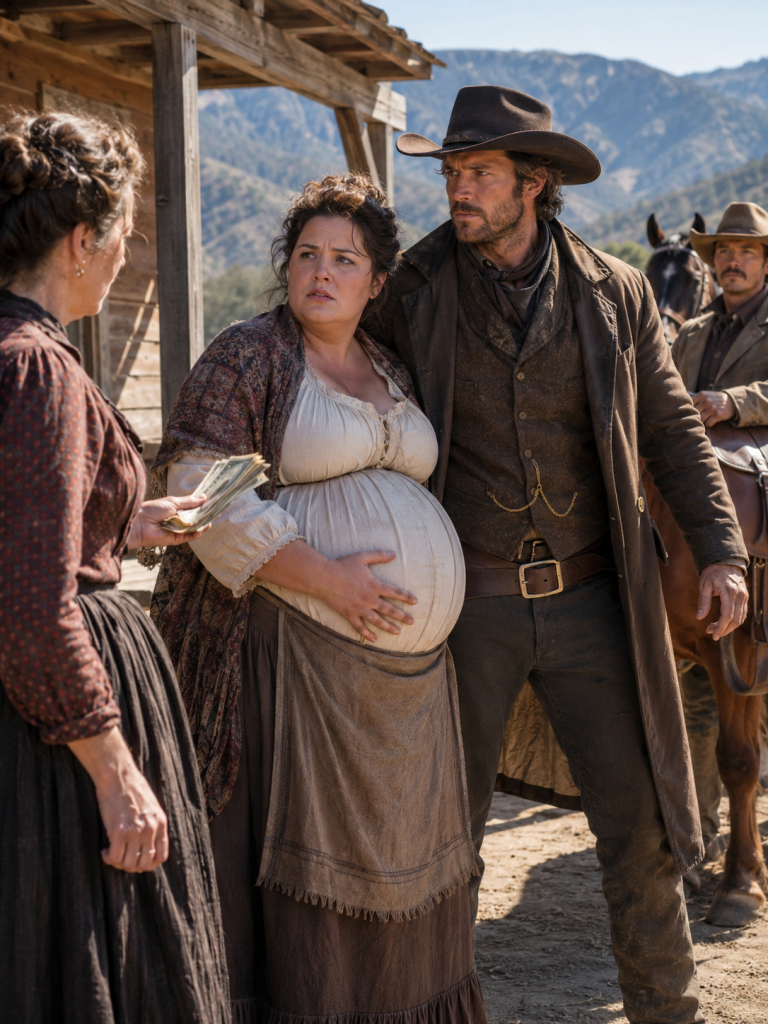
Clara didn’t scream. She didn’t cry. She stood in that Wyoming courtroom with her husband’s grave still fresh, and looked Judge Harlon Puit dead in the eye.
“My husband built that ranch with his bare hands and died wearing your town’s badge,” she said. “And you’re standing here telling me I have to marry a killer to keep it.”
Puit didn’t flinch. “I’m telling you the law.”
“Then your law is a filthy lie.”
She’d buried Ethan on a Tuesday. By Thursday afternoon, she was standing in a courtroom that smelled of pine resin and old tobacco, wearing the same black dress she’d worn to the grave, listening to a judge explain why her grief didn’t entitle her to her own land.
The argument was simple, delivered with the calm authority of a man who’d rehearsed it. A ranch the size of the Callaway property — four hundred and sixty acres of prime grassland with water rights along Clearwater Creek — could not, under Puit’s interpretation of territorial law, be legally held by a woman without a male head of household. Ethan had left no will. The property reverted to disputed status. Unless Clara produced a husband within seven days, the court would place it in receivership pending reassignment.
*Reassignment.* She’d watched him say that word and felt something go cold and still in her chest.
“And who exactly receives it, Judge? Whoever’s already lined up outside that door with their hand out?”
Puit’s face, like old saddle leather, revealed nothing. “The court will determine appropriate disposition. That is not your concern.”
“That ranch is every concern I have left in this world.”
She’d looked around the gallery. Eight men. Ranchers, merchants, a deputy who’d served under Ethan. None of them looked at her. Every one of them found something deeply interesting to study on the floor, on the ceiling, on their own hands. This had been decided before she walked through the door.
“You already have someone in mind,” she said. It wasn’t a question, and Puit knew it.
“The town council has identified a candidate willing to enter the arrangement. A man of suitable capability.”
“Capability. That’s a polite word for it.”
*Cole Ryder.*
The name landed in that courtroom like a stone dropped into still water. Clara watched the ripple move through every man in the gallery — shoulders tightening, breath held. Deputy Walsh, who’d eaten at her table a dozen times, stared at his boots like he could burn a hole through the leather.
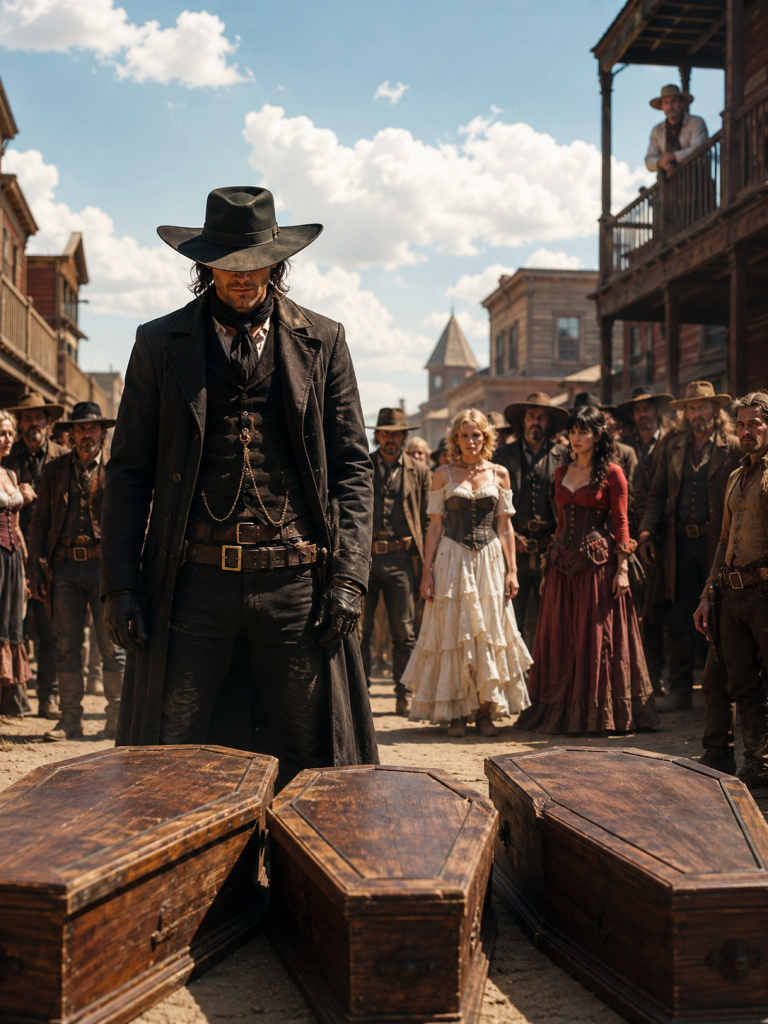
Everyone in Clearwater County knew the name. A gunfighter. A drifter. A man who’d ridden with military scouts during the war and come out the other side carrying something dark and permanent behind his eyes. He’d been in Clearwater four months, working occasional ranch labor, sleeping at the edge of town, speaking to almost no one. Thirty-four years old, with the face of a man twenty years older — not from age, but from whatever he’d survived. A scar ran from his left cheekbone to the edge of his jaw, worn like a brand he’d stopped trying to hide.
Three weeks earlier, two cowboys had picked a fight with him outside the hardware store. One had pulled a knife. By the time it was over, both of them were on the ground, and Cole Ryder was walking away unhurried, like it hadn’t been worth the effort to raise his heartbeat over. No one had pressed charges. No one had dared.
And this was the man Harlon Puit was telling her to marry.
“You cannot be serious.”
“I assure you, I am entirely serious, Mrs. Callaway.”
“He’s a gunfighter. He’s killed men.”
“He has never been convicted of any crime in this territory. He’s established a residence. And he’s agreed to the arrangement.”
That stopped her cold. “He agreed?”
“He has.”
“Why?”
“That,” Puit said, “is between Mr. Ryder and his conscience. Your concern is the ranch. Seven days, Mrs. Callaway.”
She walked out of that courtroom into the sharp Wyoming air and stood on the wooden steps, breathing through her nose until the urge to scream passed. Pete Dawson, her sixty-three-year-old ranch hand, was waiting with the wagon. He took one look at her face and said nothing. That was the mercy of Pete — knowing when silence was the only kindness left to give.
“Drive,” she said.
He drove a full mile before she asked him what he actually knew about Cole Ryder, beyond the rumors that arrived in a town three days before the man himself.
“Hard to separate the one from the other where that man’s concerned,” Pete said finally. “Rode in alone last September, one horse, one bedroll, maybe forty dollars in his pocket. Took fence work, does what he’s hired to do, never overcharges. Never been drunk since he got here. Never started trouble. When he beat those Mercer boys down, it was because they came at him.”
“He’s agreed to marry me,” Clara said.
Pete’s hands tightened, just slightly, on the reins. “I heard that was the direction things were heading.”
“Did you think to warn me?”
“Mrs. Clara,” Pete said, careful and achingly kind, “would it have changed what happened in that room if I had?”
It wouldn’t have. The trap had already been set. All she’d done by walking into that courtroom was spring it.
“I’m not marrying him,” she said. “I’ll find another way. I’ll write to the territorial governor. There has to be—”
“There’s no time for Cheyenne,” Pete said quietly. “You know that.”
She pressed her fingers together in her lap until her knuckles went white.
“Then I will find who’s pulling Puit’s levers,” she said, her voice coming out flat and precise, “and I will cut their hands off.”
Pete glanced at her sideways with something that might have been, in other circumstances, admiration. “Yes, ma’am. I believe you might.”
But they both knew she had seven days. And neither of them knew yet that a scarred, silent gunfighter was already riding toward her ranch that very morning — not to claim what a corrupt judge had handed him, but to tell her the one thing Puit hadn’t: that he had his own reasons for agreeing to this arrangement, reasons that had nothing to do with her land, and everything to do with a debt he’d been running from for three years.
—
PART 2
He rode up the track the next morning, dismounted without being invited, and let his horse drink at the trough before he even looked at her.
He was taller than she’d realized from a distance. Broad through the shoulders, lean everywhere else, with the kind of stillness that came from years of knowing unnecessary movement drew unnecessary attention. His eyes were a dark, unremarkable brown that would have been ordinary on any other face — but on his, they were the most unsettling thing about him, because they looked at her with an attention so complete it felt like being measured for something she hadn’t agreed to.
“Mrs. Callaway.”
“Mr. Ryder. I don’t remember inviting you onto my property.”
“You didn’t. Figured we ought to talk before Friday.”
“There’s nothing to talk about. I haven’t agreed to this arrangement, and I’m not going to.”
“I understand that. I wanted you to hear it from me directly, before you heard whatever version Puit and his men put out.”
“Why did you agree?”
“I already asked the judge that,” she added, when he didn’t answer immediately. “He said it was between you and your conscience.”
“Puit doesn’t know my reasons.” He touched the brim of his hat, not quite tipping it. “I’ve been watching this ranch since I got to Clearwater. I watched your husband run it. He was a good man and a fair sheriff.” A pause. “And I’ve been watching since he died — watching the men who circle a property when the person standing on it suddenly looks like easier prey.”
“I am not prey.”
“No,” he said simply. “You’re not. But Wade Mercer thinks you are. So do at least two other men I could name. And Puit’s been in Mercer’s pocket for four years, if anybody cared to look at the county land records.” He let that settle. “I don’t want your ranch, Mrs. Callaway. I don’t want anything that’s yours. But if you lose that property, you lose it to men who will strip it to the bones inside a year. And I figured at least I could be the thing standing between you and that.”
She hated that it made sense. “If I agree to this — and I’m not saying I am — what exactly are you expecting to get out of it?”
“Nothing.”
“Men don’t agree to arrangements for nothing.”
“No,” he said. “Most men don’t.” His jaw shifted. “I’ve spent the last ten years taking things and breaking things and leaving things worse than I found them. I’m not looking to do that here.” He held her gaze. “I’ll never touch you unless you ask me to. That’s a promise I’ll keep if it kills me. You run the ranch the way you see fit. I’ll follow your lead, do the work that needs doing, and stay out of your way otherwise.”
“And what does a man with your history know about keeping promises?”
It should have stung him. Instead, he absorbed it quietly, like a stone wall absorbing a thrown rock. “Not enough,” he said. “But I know this one I’ll keep.”
She had seven days. No lawyer in time, no governor, no ally with standing enough to challenge Puit in his own courtroom. She had a silent, scarred gunfighter standing in her yard, making promises with quiet, unsettling eyes.
“You sleep in the bunkhouse,” she said, without turning around. “You eat with the hands. You don’t touch anything in the main house without my permission. You don’t speak for me in town. You don’t make decisions about this property without coming to me first. Understood?”
“Yes, ma’am.”
“And if you break that promise — any part of it — I will find a way to make your life considerably more difficult than it already is. Are we clear?”
“Yes, ma’am.”
She turned back around and looked at him directly.
“Then God help us both, Mr. Ryder. Go put your horse in the second stall. Pete will show you where things are.”
What she couldn’t have known yet — what would take weeks to surface, and would nearly cost them both everything once it did — was that Cole Ryder’s reasons for agreeing weren’t only about her ranch or Wade Mercer’s greed. Somewhere three years and several territories behind him, a wealthy man with a dead son and a fortune built on buying judges just like Harlon Puit had finally found the trail he’d been searching for. And Cole Ryder had let himself be found in Clearwater County — in Clara’s yard, at her table, under her roof — because a drifter moves, but a man with a wife and a property stays put.
He just hadn’t planned on staying because he wanted to.
—
PART 3
The wedding happened Friday at ten in the morning, in the same courtroom where the ultimatum had been delivered, before Judge Puit and six witnesses Clara had not chosen. She wore the gray dress she wore for business — not the black one, because she refused to grieve this day the way she’d grieved Ethan’s; not the blue one, because she wasn’t in the business of prettifying a legal transaction. Gray. Practical. Clear-eyed.
Cole wore a clean shirt and had shaved that morning, a detail she noticed only because she’d braced herself not to care and found it annoying that she did anyway. He said the required words in a voice so level it gave nothing away. When it was done, he didn’t try to kiss her. He held out his hand formally, as if they’d just concluded a business negotiation, and she shook it.
Wade Mercer was waiting on the courthouse steps — forty-six, thick-necked, with the permanent expression of a man who’d been told he was important often enough to believe it without question.
“Well,” Mercer said, looking from Clara to Cole with a smile that had no warmth in it. “I suppose congratulations are in order, though I imagine it’s quite a step down, Clara, from a sheriff to a — ” he paused, letting the pause do the cruelty for him — “drifter.”
Cole moved faster than measured for the first time she’d seen. Not violent. Just sudden and absolute, like a door swinging shut. He stepped close enough that Mercer had to tilt his chin to hold eye contact.
“You’re going to want to reconsider that sentence,” he said, quiet, unhurried, carrying considerably more force than it looked like on the surface. “You’ve got opinions about Mrs. Callaway’s choices. Keep them wherever you keep the rest of your private thoughts, or say them out loud in front of this courthouse, and you and I are going to have a different kind of conversation. Your call.”
Mercer looked at Clara. She gave him nothing. He looked back at Cole and found a strategic retreat dressed up as dignity. “Welcome to the county, Ryder,” he said, and walked away.
“I told you not to speak for me in town,” Clara said once he was out of earshot.
“I didn’t speak for you. I spoke to him.”
“That’s a distinction without a difference.”
“It’s a difference that matters.” He paused. “I wouldn’t have done it if he’d spoken to you. But he spoke *about* you. That’s another thing.”
She turned toward the wagon. “Come on. We have work to do.”
—
**THE FENCE LINE AND THE FIRST RUMORS**
The first week taught her to walk in a house where the furniture had been rearranged in the dark. Cole rose before her every morning, already working — he’d reinforced the sagging north fence line without being asked. When neighboring hands came to discuss a boundary dispute, Cole stayed at the far end of the yard, working the barn door hinge, and never inserted himself. “Thank you for not interfering,” she said afterward.
“You didn’t need interference,” he said.
It was the fifth night that the first real trouble arrived — horses on the south pasture line, deliberate and slow, the sound of men making a point of being heard. Cole was already in the yard when she came out, standing perfectly still, watching the dark.
“Four horses,” he said. “They’re not coming in. Mercer’s men, most likely. They do this again.”
“I’m going out there.”
“If you go out there tonight,” he said, still quiet, “you give them exactly what they want. A confrontation they can shape into whatever story suits them.” He looked at her. “I’m telling you to be patient for one night. There’s a difference. I’ll be here.”
She believed him. In the morning, the fence line was undisturbed, and Cole was sitting on the yard rail with a cup of coffee, watching the sunrise. It was the first thing they built together without discussing it — silence and coffee and a fence line that held.
The second week was harder, not because of what happened between them, but because of what started happening around them. Clearwater ran on story, and the story of a widow marrying a gunfighter three days after her husband’s funeral was exactly the kind small towns couldn’t leave alone. Wade Mercer worked it — carefully, never directly, just asking questions in the right places about whether Ethan Callaway’s death had been “as straightforward as everyone assumed.”
Clara sat completely still at her kitchen table when Pete told her. “He’s accusing me of killing Ethan,” she said.
“He’s not saying it plain,” Pete said. “He’s just asking questions in the right places. The kind that don’t need answers to do their damage.”
She found Cole in the north pasture, driving fence posts with more force than strictly necessary — the way a man works when he’s containing something. He hadn’t ridden into town with blood in his eyes. He’d put his hands to work instead.
“What do you want to do about it?” he asked, when she reached him. Not what he thought should be done. What *she* wanted.
“I want to go into town tomorrow,” she said. “I want to do it exactly the way I would have done it last month. And I want you to come with me. Not to protect me. Just present.”
“All right,” he said.
—
**THE STREET IN CLEARWATER**
Mercer confronted them outside the saloon, flanked by two hands, playing to a street full of witnesses. “And when questions start circulating about how exactly a man in Ethan’s health came to die so sudden—”
Cole moved. Immediate and absolute — Mercer’s collar in his fist, his back against the feed store wall, before the two hands had finished reaching for their guns. What was in Cole’s eyes made them decide, very quickly, that they’d rather not.
“Say her husband’s name again,” Cole said, quieter than his normal voice, which somehow made it worse. “Ethan Callaway was a better man than you or I will ever be. His wife has done nothing to deserve what you’ve been putting out in this town. If I hear his name or hers come out of your mouth the wrong way one more time—” a pause — “they’ll bury what’s left.”
He released Mercer, stepped back, smoothed his jacket with a deliberateness more threatening than the grab had been.
“I know,” Clara said, before he could speak. “I told you not to speak for me. Yes, ma’am. That was — different from speaking for me.”
They drove home in a silence that had a different texture than before — charged, the way air feels before weather.
—
**THE STORM**
That night, the storm that had been threatening broke. Clara sat at the kitchen table with the ledgers by lamplight when she heard the door — Cole in the doorway, hat in hand, water on his shoulders, something quieter in his face than she’d seen before.
“I needed to apologize,” he said. “For today in town. I said I’d follow your lead. I didn’t. I’d do it again — I want you to know that. But I’d do it having told you I was going to. Not just reacting.”
“Why did it matter to you?” she asked. “Ethan’s reputation — he’s gone. What Mercer says can’t hurt him.”
“It hurts you,” Cole said. “And he was a good man. I watched him for three months from a distance. He was fair, and he was honest, and he wore that badge like it meant something. Men like that deserve better than what Mercer was doing to his name.”
She realized she’d stood up without meaning to, crossed the distance between them, raised her hand, and touched the scar on his face — not timid, but direct, the way she did most things.
“How did you get it?”
“Battle of the Wilderness, ’64. Blade, not bullet. I was lucky.”
“Were you?”
“Not everyone who came out of those woods came out standing,” he said. “So yes.”
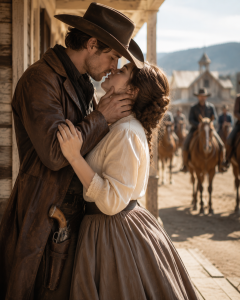
She kissed him. It wasn’t planned. It came from the same place the grief came from, and the fury, and the stubbornness that had kept her standing in that courtroom when what she’d wanted to do was fall to her knees. He didn’t pull away. He didn’t press forward either — just kissed her back with a care so deliberate it was almost unbearable, like a man handling something he was terrified of breaking. His hands never moved from his sides.
“Good night, Mr. Ryder,” she said finally.
“Good night, Mrs. Callaway.” His voice wasn’t entirely steady.
He walked back out into the rain rather than stay one moment longer than invited. She stood in the kitchen a long time afterward, thinking: *This is a problem. This is the worst possible complication.* And: *His hands never moved from his sides. He walked back out into a storm rather than assume a single thing past what I offered.*
Neither of them spoke about the kiss the next morning — or for four days after. It was Pete who finally broke the surface tension, catching Clara alone in the barn: “That man is in love with you.”
“That is not a conversation I’m having right now,” Clara said.
“No, ma’am. I expect not. Just thought you ought to know what you’re not paying attention to.”
She went looking for Cole that evening. “That night in the kitchen,” she said. “Are you all right with what happened?”
“Yes,” he said.
“That’s not an answer. That’s a syllable.”
“What do you want me to say, Clara?” — her first name, no formal distance — “I’ve spent ten years making sure I didn’t have anything to lose. It was the only way I could function. If nothing matters, nothing can be taken. And then I walked into your kitchen in a rainstorm, and you put your hand on my face, and I realized I’d made a significant miscalculation.”
“Meaning something matters now.”
“That’s what’s true.”
“I’m going to need some time to figure out what that means for me.”
“Take whatever time you need.”
She got three steps toward the house before she stopped and said over her shoulder, “For what it’s worth, I’m not sorry either.” She didn’t wait to see his face, but she heard, faintly, the slow exhale of a man releasing something he’d held for a very long time.
—
**THE MAN FROM CHEYENNE**
Eleven days later, Harold Grayson rode into Clearwater with six armed men and expensive coats that didn’t come from anywhere west of St. Louis. He took the best rooms at the Grand Hotel and started asking questions — about Cole. Where he goes. His routine. How many men were on the Callaway property.
“The kind of questions a man asks when he’s planning something,” Pete said.
Cole’s face went still in a way she’d never seen — the stillness of a man who’d been waiting for a particular sound and just heard it.
“Grayson,” he said. One word, and the weight behind it told her everything before he explained. Railroad money out of Cheyenne. Interests in twelve counties. Enough judges and sheriffs to fill a courtroom twice over.
“Judges,” Clara said, her voice very steady. “Tell me about his son.”
James Grayson — three years ago, in a town called Red Rock, drunk and mean, a gun to a woman’s head in a saloon because she’d refused him. Cole had stopped him. Killed him. He pulled first, three witnesses said so, no charges filed. But the father had spent three years and a considerable fortune tracking Cole down.
“Why did Judge Puit order our marriage?” Clara asked, each word placed like a foot on ice she wasn’t sure would hold.
“He needed a reason to keep me in one place,” Cole said quietly. “A drifter moves. A man with a wife and a property stays put.”
“Puit is Grayson’s man.”
Cole said nothing, because there was nothing to say. It had been there from the beginning — she just hadn’t had the key to read it.
“You knew,” she said. “When you agreed to the arrangement, did you know?”
“I suspected. Not Grayson specifically, but I knew Puit was in somebody’s pocket, and I knew somebody wanted me in a fixed location. I didn’t know it was this specific, and I didn’t have a better option for protecting the ranch.”
“You used my property as a base.”
“I tried to be useful while I was here.”
“Did it occur to you to tell me? To let me make an informed decision about what I was agreeing to?”
“If I told you, you would have refused the arrangement. That was my right.”
“Yes,” he said. “It was.”
The directness of the admission took the sharpest edge off her anger, because she couldn’t argue with it — she would have refused, and Mercer would have had the ranch inside a month.
“How long do we have before he moves?” she asked.
“A day. Maybe two.”
“Then we need to get ahead of it.”
—
**FIRE, AGAIN**
The attack came at two in the morning. Too many horses, too fast, then a shot, then fire — the east barn. Clara had the rifle in her hands before she was fully out the door. In the chaos that followed, she fired twice, both times at horses’ legs rather than men, wanting them down and out of the fight rather than dead. Both times, she hit what she aimed at.
It was over in twenty minutes. Three of Grayson’s men down, none dead, the rest retreating up the south road. Cole came out of the dark, unhurt, and she felt a relief so sudden it nearly knocked the breath out of her.
“Tomorrow,” she said, “we end this. All of it. Grayson, Puit, the whole arrangement.”
“Yes,” he said quietly.
They didn’t sleep. At the kitchen table, with a map of the county between them, Clara laid out her plan — not a gunfight, but a paper trail. Grayson’s railroad investments were public record. His financial partners were nervous men in Chicago. The federal marshal’s office in Denver had an open file on his land acquisitions that no witness had ever survived long enough to close.
“You’re going to go after his money,” Cole said.
“I’m going to go after his reputation, which is what his money is built on.”
Over four days, Clara Callaway waged a campaign that would have impressed a military strategist. Letters to the Cheyenne Daily Leader and the Wyoming Tribune with documented evidence of Grayson’s coercion of Judge Puit. Letters to three Chicago investment firms outlining the reputational risk of continuing to partner with a man under federal scrutiny. A letter to Marshal David Reeves in Denver, with affidavits from two county residents who’d witnessed Puit taking payment. A public letter under her own name in the Clearwater Gazette, naming names, softening nothing.
She wanted noise so loud that suppressing it would only amplify it.
On the fourth day, Harold Grayson rode to the edge of the Callaway property and waited at the fence.
“You’ve been busy,” he said, when she and Cole walked out to meet him.
“I have. Damaging the reputation of a man you don’t know.”
His eyes moved to Cole. “You killed my son.”
“Your son put a gun to a woman’s head in a saloon in Red Rock. I stopped him.”
“He was my son.”
“I want him, Mrs. Callaway,” Grayson said, turning back to her. “Step aside from this man, and I will leave your property alone. Walk away from Cole Ryder, and everything you’ve lost gets repaired.”
“I’m not stepping aside from anything,” Clara said. “Cole Ryder is my husband, and he stays on my land and under my protection. And if you push this further, every newspaper in five territories runs the full story tomorrow morning. I’ve already written it. It’s sitting in envelopes at four separate addresses. The only thing keeping those envelopes sealed is whether or not you get back on your horse and ride out of my county.”
He rode away without another word.
“He’s going to Red Canyon,” Cole said. “He’ll want terrain advantage. He’s going to send a challenge — him and his men against me, isolated, away from your ranch, away from witnesses.”
“And you’re going to go,” she said. It wasn’t a question.
“If I go, he leaves you alone.”
“That’s not a trade I’m accepting.” She held his gaze. “The marshals arrive in forty-eight hours. We need Grayson in one place for forty-eight hours. You ride out to the canyon, visible. You give him his confrontation. And I—”
“No, Clara. Absolutely not.”
“Someone has to signal the marshals. I have been holding this land together with paperwork and willpower and sheer stubbornness for six weeks against a man with more money and more men than I have. I am not a woman who needs to be kept safe in the house while the dangerous work happens outside.”
“I know that about you,” he said, his voice raw underneath the control. “That’s not what this is about.”
“Then what is it about?”
“I can’t lose you,” he said, plain and direct, with no architecture of explanation around it. “I don’t have the right to say that. But you asked me once to tell you what was true, and that is what’s true. I cannot do this if you’re in that canyon.”
“Then stay close to me,” she said finally. “That’s all I’m asking.”
—
**RED CANYON**
Marshal Reeves’s men arrived thirty-six hours later. Clara briefed them with precision, and the lead deputy, Carver, told her, “Ma’am, you’ve done about half our job for us.”
Cole rode out at dawn to draw Grayson to the canyon, with Carver’s men positioned before he arrived.
“Two hours,” Clara told him. “If you’re not out of that canyon in two hours, I’m coming in.”
She gave him twenty minutes before she saddled her own horse, ignoring Pete’s protest, and rode the long way in — low and quiet, the way Cole had taught her without meaning to teach her at all.
She heard the shots before she cleared the canyon entrance. Organized fire. She came around the last turn and took in the situation in two seconds: Cole behind a boulder, firing at three men along the west wall; Carver’s deputies pressing in from the north; and Harold Grayson himself, on foot, moving along the east wall toward a position directly behind Cole’s blind side, rifle leveled.
Cole didn’t see him.
Clara raised her rifle and fired. The shot hit Grayson in the shoulder. He went down. The shot he’d been about to put in Cole’s back scattered rock dust over nothing instead.
Cole spun, saw Grayson on the ground, saw Clara at the canyon entrance with the rifle still raised. Everything stopped for three seconds. Then Carver’s men swept in, and the firefight became aftermath — cold air, hard breathing, the smell of gunpowder.
Cole crossed the canyon floor toward her. His hands caught her arms as her feet found the ground, and he registered she was shaking — not from fear, the shaking that comes after.
“You’re bleeding,” he said.
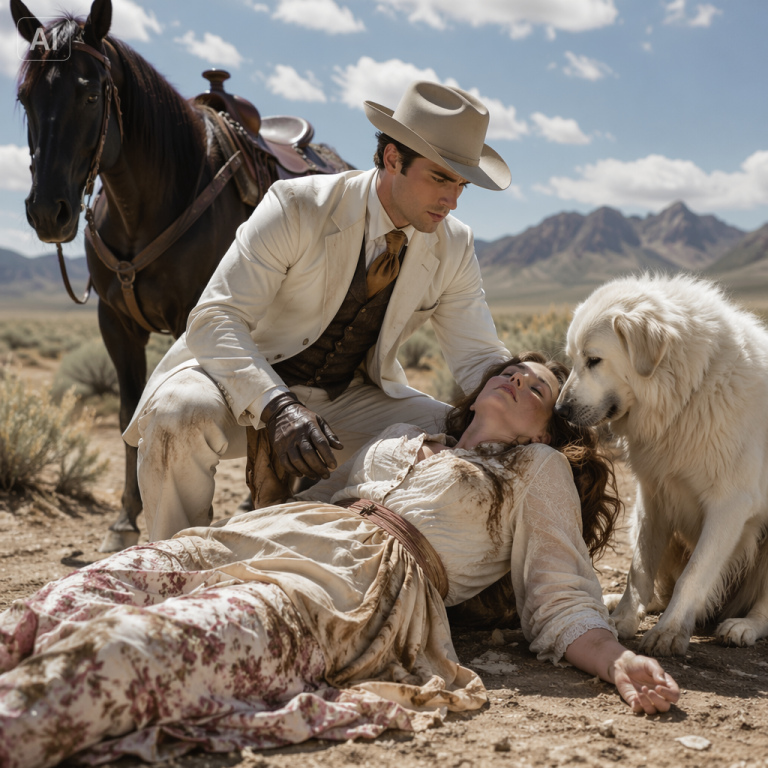
She looked down. A graze along her left side, below the ribs — she hadn’t felt it happen. Cole’s arm came around her, not quite gentle, entirely necessary, and she leaned into him because her legs had decided to make a point about the last thirty minutes.
“I didn’t survive all this,” she said into his shoulder, “just to lose you now.”
He made a sound she hadn’t heard from him before — not words, just low and rough — and his arms said everything the sound couldn’t carry.
Across the canyon, Deputy Carver clamped iron around Harold Grayson’s wrists.
—
**THE SECOND CEREMONY**
The weeks that followed moved fast — Grayson escorted to Cheyenne for federal charges, Judge Puit removed from the bench within seventy-two hours, the town repositioning its opinion of Clara Callaway with the incremental, face-saving grace small communities reserve for men they’d suddenly discovered weren’t as untouchable as assumed.
The railroad contracts came through ten days after Grayson’s arrest, securing the Callaway water rights on terms that made Pete sit down heavily and say, “Lord have mercy,” for the second time in two weeks.
One morning over the contracts, Cole said, “That’s not what you were up all night thinking about.”
“Isn’t it?”
“No.”
She set down her pen. “The marriage. It was performed under duress by a judge who has since been removed for corruption. Legally, there’s an argument it was never valid.” She kept her eyes on his. “I’m asking you — what do you want?”
“I want to stay on this ranch,” he said, after a long quiet. “I want to work this land with you. I want to be the thing standing between you and whatever comes next. Not because a judge ordered it, but because there is nowhere else I want to be.” He met her eyes with no protection around what was in them. “But if what happened in that courtroom isn’t the foundation you want, then I’d rather we build it again from something you chose freely, even if what we build is the same thing.”
“Give me two weeks,” she said.
She spent them planning, quietly, with Pete’s help and no one else’s. A dress the color of the late-afternoon Wyoming sky, ordered from Cheyenne. A word to Reverend Aldis. An invitation to two women who’d been kind to her when kindness had a cost.
On a Saturday morning in early spring, with the grass just beginning its first pale green push through the winter ground, Clara Callaway walked out to a yard full of her own people — hands, Pete with his hat in his hands and his face doing something that was not crying and not not crying — and Cole Ryder turned around and looked at her with complete, unguarded attention, stripped now of every layer of professional control.
“The first time I stood in a courtroom and said words,” she told him, in a voice clear enough for the whole yard to hear, “I said them because the ranch needed protecting and you were the protection available and I was out of options. That’s the truth, and I’m not going to dress it up into something it wasn’t.” She held his gaze. “This time, I’m standing in my yard, on my land, in front of every person I trust, and I am telling you plainly that I choose you. Not because of what you can protect me from. Because you are the most honest person I have ever known. Because you kept every promise you made me. Because you walked back out into a rainstorm when you could have stayed. Because you held on to me in a canyon like I was the only solid thing left in the world. And I felt the same way.”
The yard was absolutely silent. Something in Cole’s face opened, the way a thing opens when it’s been shut for a very long time and finally lets go.
“You’re sure?” he said, voice not entirely level.
“When have I ever done anything I wasn’t sure of?”
Reverend Aldis opened his book. This time, when Clara said yes, she said it looking directly at Cole. When Cole said yes, he said it the same way — the specific weight of a man making a promise he intends to keep if it kills him, which she now knew was the only kind of promise he made.
He kissed her. Not desperate this time, like the first. Deliberate. Chosen. The kind of kiss that says, *this is where I am, and I am not afraid of that anymore.*
—
**AN ORDINARY DAY**
Wade Mercer left Clearwater County in May, quietly, his operation reduced by half. No one made a speech about it. Harold Grayson stood trial that summer and was convicted on all counts — corruption, coercion, conspiracy to commit fraud, the illegal suppression of land claims across four territories. Clara read the verdict at her kitchen table on a Tuesday morning, folded the paper, and felt the specific quality of an ending. Not triumphant. Settled.
She went out to tell Cole, who read the headline and said, simply, “It’s over.”
“What do you want to do today?” she asked him.
The question plainly wasn’t what he expected — but that was the thing about ordinary days. They required ordinary answers, and Cole Ryder was, for the first time in a decade, in a position to give one.
“The north fence needs another day,” he said. “And Pete mentioned the irrigation channel’s running slow.”
“All right. I have the Henderson closing papers this afternoon.”
She turned toward the house, then stopped, because there was something she’d been meaning to say.
“Cole. You stopped running. You stopped three years ago in a saloon in Red Rock when you did the right thing. And you stopped again when you rode into this town and agreed to stand between me and something I couldn’t have handled alone. And you haven’t run once since.” She held his gaze. “I want you to know I see that. I see what it costs. And I’m glad you stopped here.”
He stood in the yard of the Callaway Ranch, the rebuilt barn behind him, the spring grass running all the way to the horizon, and he looked at the woman who had put her hand on his face in a rainstorm, and shot a man off his blind side in a canyon, and married him twice — once because she had no choice, and once because she did.
“I’m not going anywhere,” he said.
That was the whole truth of it. Not a promise built from obligation or desperation or the impossible mathematics of a forced courtroom arrangement, but the simple, definitive statement of a man who had found the one place in the world where staying was worth more than everything running had ever given him.
The dangerous outlaw had not destroyed the sheriff’s widow. He had stayed, and she had stayed, and together they had built something out of forced circumstances and hard honesty, and two people stubborn enough to keep choosing each other past every reason not to.
That thing they built held the way things hold when they’re made from what’s real.
And it was more than enough. And it was theirs.
THE END