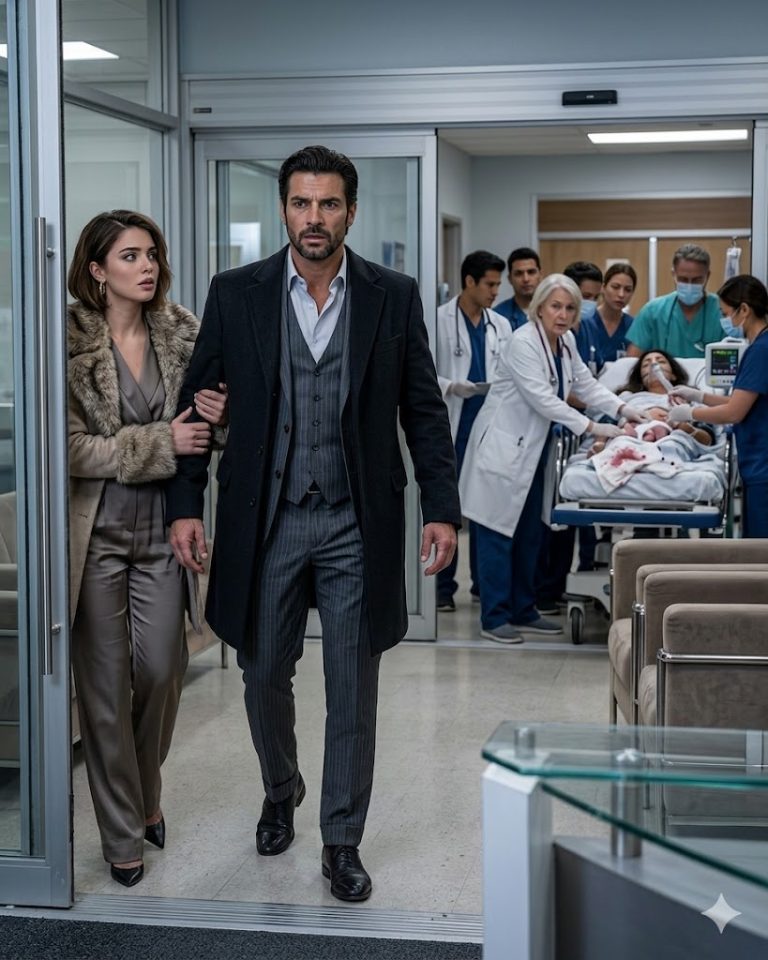
The Mafia Boss Pretended to Sleep to Test a Maid’s Son—Then the Boy Gave His Heart Medicine and Broke Him

## PART 1
The fire was the first thing Owen noticed.
Not the man in the chair — the fire. It was burning low in a stone hearth wide enough to park a car in, and the light it threw across the room was the color of old pennies. The rain outside was louder than anything Owen had ever heard in the small apartment in Bridgeport where he and his mother had lived since his dad stopped coming home. Here the windows were so tall the storm seemed personal, like it was specifically trying to get in.
Owen was eight years old and understood more than he was supposed to.
He understood, for example, that his mother’s hands had been shaking since they parked by the service entrance. He understood that the woman named Greta who had opened the back door looked at him the way adults looked at things that complicated their lives. He understood that the house smelled like money — not the new kind, not the kind that came in envelopes marked URGENT, but old money, the kind that had learned to be quiet.
And he understood that the man in the leather chair was not actually asleep.
His breathing was wrong. Not sick-wrong — Owen knew sick breathing, had catalogued its varieties over two years of hospital visits and home oxygen monitors and nights where his own heartbeat felt like a hand knocking on the wrong door. This was different. This was the breathing of someone holding very, very still on purpose.
Owen sat where his mother had pointed. The corner of the rug, near the window. He pulled his knees to his chest and watched the fire and didn’t touch anything.
For a while.
The man’s name was Adrian Voss. Owen’s mother had said it the way she said words that scared her — quietly, with space around it. She’d said: *he is not someone we upset*. She’d said: *one mistake and we lose everything*. Owen knew what everything meant. It meant his cardiologist appointments. It meant the small orange bottle in his jacket pocket. It meant the warm apartment they’d found three months ago after six weeks in his aunt’s basement.
The fire popped.
Rain sheeted down the glass.
Owen looked at the man in the chair. His face was angled toward the fire, jaw set, dark suit pressed and perfect. A thin line of silver ran through his hair at the temple, though Owen guessed he wasn’t that old. There was a scar above one eyebrow. There was also something in the set of his mouth — not cruelty exactly, but its long-term cost.
Then the man breathed wrong again.
Owen knew that breath. It lived in his memory between the sound of a cardiac monitor alarm and his father’s voice saying *people who hurt badly sometimes seem mean — don’t decide who they are until you ask where it hurts.*
He stood up.
He crossed the rug.
He put his hand on the man’s hand.
It was warm. Big. The knuckles were old-scarred the way his father’s had never been. The man didn’t move.
“Sir,” Owen said quietly. “Does your chest hurt?”
No answer.
Owen waited. When nothing happened, he looked around the room for what might help. He’d learned this in pediatric cardiology — look for what you can actually do, and do that. There was a folded blanket on the sofa, heavy wool, the kind that smelled like cedar and something older. He carried it in two trips and laid it across the man’s legs. He tucked the edge down beside the chair arm the same way his mom tucked blankets when Owen woke up coughing.
“My dad got cold when he was hurting too,” he said to the man who wasn’t asleep.
Then he went back to his corner.
He did not touch the books on the shelves, though several looked interesting.
He did not touch the large globe near the window, though it was a very good globe.
He did not touch the desk.
He saw what was on the desk — couldn’t not see it. A stack of cash so thick and neat it looked manufactured. A watch that caught the lamplight and scattered it like something alive. His mother had listed these things specifically: *don’t touch the money, don’t touch the watch*. So Owen looked at them and thought about them and put them away in the part of his mind where he put things he was choosing not to want.
Instead he looked at the photograph on the bookshelf.
A woman in a yellow dress, mid-laugh, her dark hair blown sideways. The kind of laugh that required the whole face.
She looked like someone who left warmth in rooms after she’d gone.
Owen stared at the photograph for a long time.
Then he looked at the desk again — not at the money, not at the watch, but at the small space beside them. He thought about what his father had said about people who were hurting. He thought about the wrong breathing, and the fire burning low, and the way the man in the chair held himself like something had been pressing on him from the outside for a very long time.
Owen reached into his jacket pocket.
He took out the orange prescription bottle — *Owen Hale, Digoxin 0.125mg* — and placed it carefully on the desk beside the watch.
“Sir,” he said, “if your chest is hurting, you can have one. Just one. My doctor says they help when the heart feels wrong.” He considered this. “You can borrow them. My mom gets more on Tuesday.”
The man opened his eyes.
They were darker than Owen expected. Darker and steadier, the way deep water is steady — not calm, just deep enough that the surface doesn’t show everything moving below.
He looked at the bottle.
He looked at Owen.
And at that moment the door opened, and Owen’s mother came in from the hall, and Owen watched her face do the thing it did when everything was about to go wrong at once.
—
## PART 2
Nina Hale had been gone seven minutes.
That was all. Greta had pulled her into the corridor to settle a delivery dispute, and Nina had gone because refusing Greta felt like refusing gravity, and now she stood in the study doorway and processed the room in the order things registered as catastrophic.
The blanket. Over Adrian Voss’s legs. That was Owen’s doing — she knew it before she confirmed it, because Owen blanketed things that seemed cold the same way other children collected rocks or drew horses.
Owen. Not in the corner where she’d placed him. Standing beside the desk.
The orange bottle on the desk, right next to a watch that Greta had mentioned in the kitchen once, in the hushed tone of someone noting a holy relic: *Patek Philippe, custom. He paid more for it than I make in four years.*
Nina’s vision narrowed.
She crossed the room in five steps, picked up the bottle with hands she couldn’t keep steady, and dropped to her knees beside Adrian Voss’s chair.
“Mr. Voss.” Her voice came out low, stripped to its working parts. “Please. He didn’t understand what any of this was worth. He’s eight, he doesn’t think in those terms, he was only trying to—” She stopped. Restarted. “I’ll pay for anything he’s touched. Subtract it all from my wages. All of it. I don’t care how long it takes. Please don’t call anyone. Please don’t — he has no one else. If I’m arrested, he goes into the system and his care lapses and I can’t—”
“Give it back to him.”
She stopped.
Adrian Voss was looking at her, not at the bottle, not at the desk. At her.
“He’s cold,” the man said. “And it sounds like he needs his medicine more than I do.”
Nina didn’t move for three full seconds.
Then she stood, crossed back to Owen, put the bottle in his hands, and pressed her palm against his cheek the way she always did — a check, a count, making sure he was still there and still hers.
Adrian Voss sat forward. The blanket shifted off his legs. He said, “Miss Hale. That watch.”
Nina turned.
“I can see a small fingerprint on the glass.”
The room went cold.
She turned back to Owen. He was looking at her with the expression he’d learned to wear when something was about to be his fault that wasn’t his fault, and she felt the familiar surge of something that wasn’t quite anger and wasn’t quite grief — the emotion that had no clean name, the one that came from watching a child carry weight they shouldn’t know existed.
“That’s not possible,” she said. “He didn’t touch it.”
“Are you certain?”
“I know my son.”
The air between them held.
Then Owen did something she hadn’t expected.
He reached under the collar of his sweatshirt and pulled out the leather cord that lived there always — the one with the cloudy white stone his father had worn through two surgeries and one full year of dying. He lifted it over his head. He walked to the desk and placed it beside the watch with the deliberateness of a person performing a transaction they’d thought through.
“Sir,” Owen said. “If there’s a fingerprint, you can have this. My dad said it was worth more than most things. It might not be worth as much as the watch, but it’s the most I have.”
He looked at Adrian Voss with eyes that were frightened and completely steady at the same time.
“So my mom doesn’t owe you.”
Nina’s throat closed.
Adrian Voss looked at the stone for a long moment — long enough that the fire popped twice, and the rain shifted direction against the glass, and Nina held her breath until her chest ached.
Then he stood, picked up the cord, walked to Owen, and crouched down to the boy’s height.
And what he said next was not what Nina had prepared herself for.
—
## PART 3
He put it back over the boy’s head himself.
Gently. Two large hands with old scars on the knuckles, settling the cord against the faded collar of the sweatshirt.
“Keep it,” Adrian Voss said. “There is nothing on that desk worth what that stone is. Not the watch. Not the money. Not this house.”
Owen looked at him. “Yes, sir.”
Adrian stood. He looked at the photograph on the bookshelf for a moment — the woman in yellow, the whole-face laugh — and whatever passed across his expression was gone before Nina could name it.
Then he said, “I was not asleep.”
Nina went still.
“The money and the watch are on that desk every Sunday,” he said. “They’ve been there for almost two years. Anyone Rosa brings into this house eventually comes through this room.” He said it flatly, without performance. “Seven people before you. Seven different responses.”
“You test everyone,” Nina said.
“I have learned to.”
“What were you expecting?”
“From you? I didn’t know yet.” He looked at Owen. “From him, I expected nothing. Children in situations like yours usually reach for what they’re told they can’t have — it’s not greed, it’s fear wearing the wrong shape.”
“And instead?”
“He covered me with a blanket,” Adrian said. “And then he offered me his heart medication.”
The words sat there.
Nina didn’t know what to do with them, so she did what she always did when emotion came at her sideways: she held it at a distance until she could look at it clearly.
“Why does it matter what he did?” she asked.
“Because I had already decided nobody had a price they wouldn’t accept,” Adrian said. “It made the world predictable. Ugly, but predictable.” He paused. “He proved me wrong.”
Nina studied him. “Is that good or bad for us?”
The corner of his mouth moved. Not a smile — the anteroom of one.
“Sit down, Miss Hale.”
She sat. Owen sat beside her, holding the stone through his sweatshirt, watching Adrian the way he watched things he was trying to understand.
Adrian did not sit. He went to the window and stood with his back to the room for a moment, watching the rain against the dark lawn.
“My wife’s name was Elena,” he said. “She drove herself to a doctor’s appointment thirteen months ago because I was in a meeting I shouldn’t have attended. A black SUV ran a red light on Route One.” He turned. “The plates were stolen. The vehicle was later found at a storage facility in Stamford belonging to a man named Frank Ardolino.”
“Who is Frank Ardolino?” Nina asked, though she had the feeling the name would matter later.
“Someone who has been trying to break me without being able to find the place where I break.” Adrian looked at the photograph. “He thought Elena was that place. He was right. But I didn’t break the way he expected. I went—” He searched for the word. “Inward.”
“You stopped trusting people,” Owen said.
They both looked at him.
Owen shrugged. “My dad did that too, for a while. After his first diagnosis. He said grief sometimes looks like being alone on purpose.”
Adrian Voss looked at the boy for a long moment.
“Yes,” he said. “That is exactly what it looks like.”
He opened a desk drawer and took out a checkbook, and Nina’s body went rigid before she could stop it — the instinct of a woman who had learned that men reaching for things in drawers were often reaching for power.
“How much did your husband’s treatment leave outstanding?” he asked.
“That’s not your business.”
“It is if you work in my house.”
“I clean your house,” she said. “You don’t own my life.”
Something changed in his face then — a relaxing, almost imperceptible, like a door opening inward.
“No,” he said. “I don’t.”
He wrote the check anyway. He placed it on the desk face-down and pushed it toward her.
Nina didn’t look at it.
“I don’t want your money,” she said.
“This isn’t charity.”
“It looks like charity.”
“Charity is what people give when they want to feel generous,” Adrian said. “This is different.” He looked at Owen. “A boy with a damaged heart just showed me something I’d forgotten was possible. I’m paying for the lesson.”
Nina picked up the check.
She looked at the number for a long time.
Two hundred and eighty-four thousand dollars. Every outstanding bill from Daniel Hale’s fourteen-month illness, to the dollar.
She looked up. “How do you know this number?”
“I have access to certain records.”
“That’s a violation of—”
“Yes,” he said simply.
She put the check down. Picked it up again. Thought about Owen’s cardiologist, who had become increasingly concerned about scheduling gaps. Thought about the prescription that would run out in nine days. Thought about the specific way her son’s face looked when he was pretending not to be afraid.
She folded the check and put it in her pocket.
“I’m not forgiving anything,” she said. “I’m just not refusing it.”
“That’s enough,” Adrian said.
In the following weeks, the house changed in the quiet, incremental way of things that are healing rather than being fixed.
Greta moved Nina from housekeeping to house management — not officially, not with a title change, but in practice: handling suppliers, managing the schedule, making the phone calls that Rosa used to make before her arthritis worsened. Owen was given a room on the second floor. He asked, carefully, whether he was allowed to look out the window, and the question broke something small and specific inside Nina that she had to go to the bathroom to address privately.
Owen named the view. He called it *the good window* because on clear nights he could see the constellation Orion, which had been his father’s favorite.
Adrian bought him a telescope without being asked. Then he spent an afternoon reading the instruction manual aloud, slowly, because Owen’s reading comprehension lagged in technical language and Adrian had apparently noticed without saying so. Nina stood in the doorway of the bedroom watching a man who ran four companies and had once ordered things she preferred not to know about, sounding out *optical alignment* with the patience of someone who had no competing priorities.
She didn’t say anything. She went back downstairs.
On Friday evenings they ate in the kitchen — Greta’s decision, enacted without discussion, as many of the best household decisions were. Owen explained, over pasta, why octopuses were the most intelligent invertebrates. He explained why the color blue was probably not perceived the same way by everyone. He explained, one particular Friday, why jokes were funnier when you had to wait for them.
Adrian listened to all of it.
One night he laughed at something Owen said — a real laugh, surprised out of him, nothing like the controlled expressions he maintained through business. Everyone at the table went quiet. Owen looked delighted.
“You laugh like you forgot how,” Owen said.
“Caleb,” Nina said automatically, using the wrong name — her brother’s name — the name she summoned when she meant *be careful*.
“Owen,” Owen corrected, unoffended.
Adrian looked at Nina.
“He’s right,” he said.
Three months passed this way. The check cleared. Owen’s cardiologist confirmed the follow-up schedule was sustainable. Nina learned the rhythms of the house: which deliveries came when, which staff Adrian trusted entirely and which he tolerated carefully, and which rooms held the weight of the woman in the yellow dress.
She noticed the FBI agent’s card on the refrigerator on a Tuesday in November.
She didn’t ask about it. She filed it somewhere in her mind alongside the other things she was choosing to understand slowly.
Then she overheard Marco Ricci.
It was a Thursday evening. She was passing the corridor near the east sitting room with a tray of coffee cups when she caught his voice through a cracked door — not arguing, not even urgent, just the measured tone of a man discussing logistics.
“He’s settled. The woman and the boy have made him soft.” A pause. “Ardolino wants to move before the quarter ends. The estate, the accounts, everything — while he’s distracted.” Another pause, and then: “Tell Ardolino Romano doesn’t know. We keep it that way until Saturday.”
Romano.
The name Voss had replaced. The name that went with everything Adrian had not told her and that she had chosen not to ask about.
Nina walked to the kitchen. Set the tray down. Stood at the sink and looked at the dark window for a long time.
She thought about what it would mean to tell him.
Three months ago the answer would have been simple: tell no one, protect Owen, leave if things became dangerous. She had not come here for anything except survival. She had not planned to stay. She had certainly not planned for Friday dinners and telescope assembly and a man who laughed like he’d forgotten it was allowed.
She went to Adrian’s study.
He was at his desk. He looked up when she came in without knocking — something she’d stopped apologizing for two months ago.
“Marco,” she said. “He’s talking to someone called Ardolino. Tonight in the east room. He said you don’t know.”
Adrian set his pen down.
He looked at her for a moment with an expression she couldn’t quite read — not surprise, something more complex than surprise.
“I know,” he said.
She stared at him. “You know.”
“I’ve known for six weeks. I’ve been building a case.” He leaned back. “Ardolino killed Elena. I’ve had evidence connecting him to the plates and the driver for four months. Marco has been feeding him information since before you arrived.” He studied her face. “I was waiting until I had enough to hand to a federal prosecutor.”
“The card on the refrigerator,” Nina said.
“Her name is Sandra Park. Manhattan field office. I’ve been meeting with her for two months.”
Nina sat down in the chair across from his desk without being invited.
“Marco knows I’m telling you this,” she said slowly. “He heard me in the hall.”
Adrian went very still.
“The east sitting room,” Nina said. “The door was open six inches. He would have heard my footsteps stop.”
The silence lasted four seconds.
Then Adrian picked up his phone.
He looked at Nina while it rang. “Sal,” he said when it connected. “Secure the house. Marco first. I want the east room locked and the service entrance sealed.” He paused, listening. “Now.”
He hung up.
“Get Owen,” he said to Nina.
She was already standing.
She went up the back stairs at something between a walk and a run, pushed open Owen’s door — he was awake, reading, looking up at her with the immediate alertness of a child whose early years had required it — and said, quietly, “Come with me. Don’t bring anything. Just come.”
“Mom? What—”
“Now, please.”
He came.
She brought him to the study and stood in the doorway with her hand on his shoulder and watched Adrian on the phone and watched the house through the window and tried to assess whether they were safer inside or outside.
Inside, she decided. For now.
It happened at eleven forty.
Marco Ricci knew the house the way only someone who’d helped build its security protocols could know it — he knew the blind spots, knew the service elevator codes, knew the single camera that ran three minutes behind on the east corridor. He’d left the service door on a thirty-second delay. Ardolino’s men came over the rear wall at the spot Marco had marked on a digital schematic nine months earlier.
Greta was in the kitchen.
One of the men caught her before she could call out. She fell against the counter. A cup shattered.
Nina heard it from the study and went rigid.
“Stay here,” Adrian said.
“Don’t tell me to—”
“Stay with Owen,” he said, and this time it wasn’t a command, it was something else entirely, something that landed differently, and Nina stayed.
What followed happened in other rooms, and Nina heard it rather than saw it: footsteps, two voices, a door, a sound she identified as a body impacting something structural, and then an interval of quiet that was worse than noise.
Owen stood beside her.
He held the moonstone through his sweatshirt without taking it out.
Nina put her arm around him.
Twenty minutes. Then Sal appeared in the study doorway.
“It’s done,” he said. “Three of Ardolino’s men. Marco.” He looked at Nina. “Nobody else hurt. Greta has a bruised wrist. She’s asking for chamomile tea and someone to complain to.”
Nina exhaled.
Owen said, “Is Nick okay?”
Sal blinked at the name.
“He’s fine,” he said, and there was something in his voice — surprise, or its older relative, relief.
Adrian came back twenty minutes after that. His suit jacket was gone. There was a cut above his eyebrow, which he apparently felt unnecessary to acknowledge. He looked at Owen first, then at Nina, in a way that she thought might be the most honest thing she’d ever seen on an adult face.
“You’re both alright,” he said. Not a question.
“Yes,” Nina said.
Owen crossed the room and — without ceremony, without calculation, the way children do things before adults have a chance to make them complicated — put both arms around Adrian’s waist.
Adrian went still.
His hands, after a moment, came up. One on Owen’s back, careful and sure.
“Is your chest okay?” Owen said into his shirt.
Adrian looked at Nina over the top of the boy’s head.
She looked back.
Something passed between them that neither of them had language for yet.
“Yes, buddy,” Adrian said. “My chest is fine.”
Frank Ardolino was arrested at four-thirty in the morning at a hotel in Norwalk. Sandra Park’s team had been in position since midnight. The evidence Adrian had assembled over the previous two months — shipping records, communications intercepts, a payment trace connecting Ardolino to the driver of the SUV that had killed Elena — was sufficient for federal charges that would not be reducible to acceptable outcomes by expensive lawyers.
Marco Ricci cooperated with investigators in the hospital, which surprised no one and changed very little, which also surprised no one.
Adrian spent most of December in meetings he didn’t describe in detail. He came home from them with the expression of a man paying a price he’d calculated in advance and was prepared to honor.
In January, he sat down with Nina at the kitchen table after Owen was asleep and told her the full shape of what was ending and what would replace it.
The estate would be sold. The legal businesses — two construction firms, a property management company, a small shipping operation — would be transferred to Sal’s oversight under a structure Sandra Park’s office had reviewed and found acceptable. Adrian would cooperate fully with the federal case, which meant depositions, documents, and two years of formal monitoring.
There was a house in coastal Maine where a man named Aaron Cole had already established a small architectural firm.
“Aaron Cole,” Nina said.
“Quiet name.”
“Do you like architecture?”
“I like building things,” he said. “I’ve spent twenty years building the wrong ones.”
She looked at him across the table. The kitchen was quiet. The good window above the sink showed a sky with actual stars — the storm had passed two days ago, and the weather had been clear since.
“What are you asking me?” she said.
“Nothing yet,” he said. “I’m telling you what I’m doing. What you do is separate.”
“Owen loves this house.”
“Owen would love a house where he’s allowed to be a child,” Adrian said. “He’d adapt.”
Nina was quiet for a moment.
“He asked me last week,” she said, “whether Nick was going to stay.”
Adrian was quiet.
“I told him I didn’t know,” she said.
“That was honest.”
“I’m always honest with him. It’s the one thing I decided early on.” She traced a scratch in the table surface. “His father was honest with him, even about the hard things. I think that’s why he grew up knowing how to sit in a room with a dangerous man and decide what actually needed doing.”
Adrian looked at her.
“He got that from his father,” she said. “And from watching me.” She met his eyes. “I’d like him to have someone else to learn it from. If that person is trying to become someone worth learning from.”
He was quiet for a long time.
“I don’t know if I can guarantee—”
“Nobody can guarantee anything,” Nina said. “That’s not what I’m asking for.”
“Then what are you asking for?”
“Time,” she said. “And honesty. And for you to keep coming back.”
He looked at the table. At his hands. At the kitchen around them that had become, somewhere in these months, a place where the people in it ate together on Friday evenings and argued about telescope assembly and laughed at jokes they had to wait for.
“I can do that,” he said.
In March, a boy stood on the porch of a house in Maine that smelled like pine and salt air. The telescope was set up at the railing. Inside, his mother was reading — or pretending to, which she did when she was thinking about something she hadn’t decided yet.
Through the window, Owen could see the kitchen light. A man was at the sink. He was washing dishes by hand, slowly, with the focused attention of someone who had recently discovered that ordinary tasks could be a form of peace rather than a waste of time.
Owen went inside.
“Nick. Jupiter.”
The man dried his hands on a dish towel. He didn’t say *in a minute* or *let me finish* or anything that would have required Owen to wait.
He followed Owen to the porch.
They stood at the railing. The sky over the Atlantic was enormous and very clear, the kind of clear that only happened when something that had been in the way for a long time finally moved.
Owen adjusted the scope. Checked the focus. Stepped back.
“Your turn,” he said.
The man leaned down and looked through the eyepiece.
He was quiet for a moment.
“That’s it?” he said.
“That’s it.”
“It just looks like a light.”
“That’s because we’re far away,” Owen said. “It’s the same thing everywhere. Everything looks smaller from far away than it actually is.” He considered this. “My dad said that about people too.”
The man straightened.
Owen looked at him with the same expression he’d had in the study months ago — frightened and completely steady at the same time, the particular combination that was native to children who had been through enough to know that the world was genuinely dangerous and who had decided to trust it anyway.
“Does your chest hurt today?” Owen asked.
The man looked through the kitchen window at Owen’s mother, who had looked up from her book and was watching them both.
She raised her coffee mug slightly. A small gesture. A specific one.
“No, kid,” the man said. “Not today.”
Owen nodded, satisfied, and turned back to the telescope.
Inside, Nina turned off the lamp beside her chair.
The porch light stayed on.