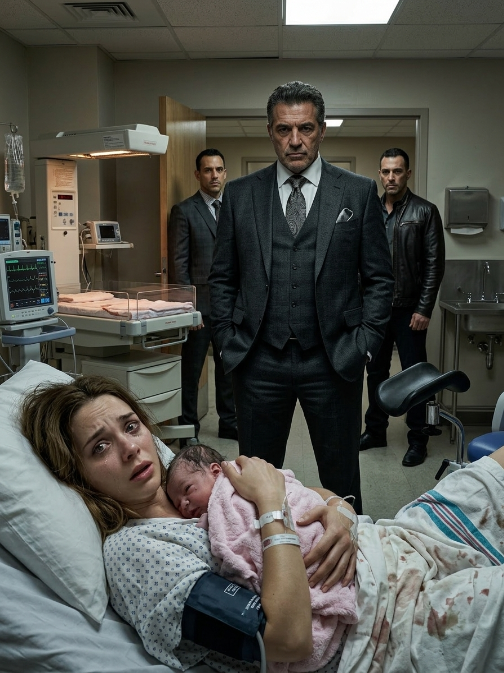
The Mafia Boss Entered the Hospital With His Lover—Then Saw the Woman He Once Abandoned With Their Child

## PART 1
He recognized her hair first.
That black hair, always slightly tangled at the end of a long shift, always escaping whatever she’d used to pin it back. He had watched it fall across his pillow a hundred times and told himself not to get attached.
The woman on the emergency gurney was unrecognizable in every other way. She was white as the pillow behind her. She was breathing through a mask that fogged and cleared in uneven intervals. She was thirty-eight weeks pregnant and her blood pressure was dropping and the nurses running alongside her were shouting numbers that meant nothing to him and everything to the doctors waiting behind the trauma doors.
But that hair.
Thea Morrow.
The bartender who had once told him he could stand in her bar and order expensive whiskey all night long but that wouldn’t make him interesting.
The woman he had held for three months like she was the only honest thing in his life.
The woman he had left before she could figure out what he was.
Declan Farris’s phone hit the carpeted floor of the VIP waiting lounge before he realized his hand had opened.
He didn’t hear it land.
He had been in the middle of an encrypted message chain with his dock coordinator, one ankle over his knee, wearing a charcoal suit that cost three months of Thea’s old rent. Beside him, Isadora Verra was describing her stomach pain with escalating irritation while he tried to calculate whether he needed to be at the warehouse by two or three.
The meeting could wait.
Everything could wait.
Declan rose from his chair without deciding to.
The double doors swallowed Thea before he reached them, and he stood at the threshold with his hand against the glass and watched the controlled violence of an emergency delivery team move her away from him again, a second time, into a room he couldn’t follow her into.
He counted backward.
Nine months.
Her apartment. The last night. Rain. He had stood at the door in his jacket and told her: *this world of mine will eventually cost you something you can’t afford to lose, and I can’t be the reason that happens.* He had said it like it was a gift. Like leaving was the generous thing.
She had not cried until he was at the elevator.
He had heard it anyway.
Nine months.
“Farris.”
Hadley, his second guard, materialized at his shoulder. “You know her?”
“Tell me where they’re taking her.”
“Sir, that’s not how this—”
“Hadley.”
Hadley stopped.
Declan turned just enough to make the point.
Hadley went to find a nurse.
Behind him, Isadora had risen from her chair. Her voice, when it arrived, was cool and controlled and designed to be heard.
“Who is she?”
Declan didn’t answer.
Because he was doing the arithmetic of nine months with the speed of a man who had built an empire by being faster at numbers than everyone around him, and the answer kept coming back the same way.
“Cormack,” Isadora said, using the family name the way only her father’s people did — like a property marker. “Answer me.”
He looked at the sealed doors.
“Go home,” he said.
“My father—”
“Go home, Isadora.”
The silence behind him had a specific texture. He had felt it before, in rooms where decisions were being made that would cost someone greatly. He just had never been the one paying.
At the nurses’ station, a woman in blue scrubs looked up at him with the particular wariness of hospital staff who had learned to recognize men who believed their money organized differently.
“The woman they just brought in,” he said. “Thea Morrow.”
“I can’t confirm patient information to—”
“She has no family in Chicago. Her mother is dead. Her brother has been unreachable for four years.” He placed both palms flat on the counter. “If she listed an emergency contact, who is it?”
The nurse checked her screen.
Her expression shifted by a fraction.
“The contact number on file isn’t—” She stopped. “It’s not active.”
“What number is it?”
She read it back.
Declan’s jaw tightened.
He knew that number.
It belonged to a shell company. His shell company. One that existed on paper and nowhere else. Accessible to three people: his attorney, his head of security—
And Margaux.
His mother.
The calculation arrived complete and terrible.
Thea had tried to reach him.
Someone had made sure the call never landed.
“I’m the father,” he said.
The nurse stared at him.
“Of her child. I am the father of her child.”
It was the truest sentence he had spoken in nine months and it felt like finally putting weight on a leg that had been broken and reset wrong.
The nurse picked up the phone.
—
## PART 2
The doctor’s name was Vivienne Osei and she did not flinch when she looked at him, which he respected.
“Peripartum cardiomyopathy,” she said. “Her heart muscle has weakened significantly. We need to deliver now and we need to stabilize her cardiac function simultaneously. The risks are serious on both sides.”
Declan heard the words.
He understood each one individually.
Together they made a sentence his mind kept refusing to accept.
“Save them,” he said.
Dr. Osei looked at him. “We’re working to do exactly that.”
“I’m not asking you to try. I’m telling you the outcome.”
The doctor’s expression did not change. “Mr. Farris. In that room, you are not the most powerful person. I am. And I am telling you that the next several hours are uncertain and that the best thing you can do is stay out of the way and let my team work.”
A different version of him might have made this into something. A threat, a negotiation, a demonstration of what his name meant to a city that lowered its voice when it said it.
Instead he said, “Can I see her first?”
Dr. Osei looked at him for three long seconds.
“Two minutes,” she said. “Don’t interfere. Don’t upset her. If I say leave, you leave without argument.”
He nodded.
The operating suite was too bright and smelled of nothing organic, all chemical and metal and the hum of machines that had opinions about her heartbeat. Thea lay in the center of it with her hair damp against the pillow and her hand open at her side and the curve of her stomach rising beneath the surgical drape like something impossible and true.
He stood in the doorway for a second longer than he should have.
Then her eyes opened.
She looked at the ceiling first. Then around the room. Then, slowly, at him.
He saw the sequence of things that moved through her face: confusion, recognition, grief, and then the specific exhaustion of a person who has been surviving alone for so long that someone showing up feels less like rescue and more like proof of everything they had to do without.
“I didn’t know,” he said.
Her expression didn’t change.
“I tried to call you,” she said. Her voice came thin through the oxygen feed. “Three times.”
“I never received them.”
“I know you didn’t.” She looked at the ceiling again. “I figured it out eventually. The number stopped working entirely by month three.”
He came to the side of the bed.
“Thea.”
She turned her head. Her eyes were wet but she was not crying. Thea Morrow had always cried deliberately, like it was something she allocated carefully rather than something that simply happened.
“You were right,” she said. “When you left. You were right that your world would cost me something.” A pause. “I just didn’t know which something.”
He took her hand.
It was cold.
Her fingers closed around his, not tightly, but with the muscle memory of someone who had once held on without thinking about it.
“Both of you,” he said.
She frowned.
“Not the baby first. Both of you. Those are the instructions.”
Something moved through her face.
Not forgiveness. That would take longer than two minutes in a surgical suite.
But the particular softness of a person remembering that they had once been known.
Then the machines changed their rhythm.
Dr. Osei appeared behind him. “We need to go.”
Thea’s hand tightened once.
Then released.
Declan stepped back.
The surgical team moved forward.
He stood in the corridor outside those doors for four hours and seventeen minutes and did not move from the spot.
Hadley brought him coffee twice. He drank neither.
Isadora sent three messages. He read none.
Sometime in the second hour, Hadley handed him his phone without explanation. The screen showed a security still from Thea’s apartment building. A woman at the door. Elegant coat. Silver ring on her right hand.
Margaux Farris.
His mother.
Declan stared at the photograph for a long time.
Then he put the phone in his jacket and went back to standing.
When Dr. Osei emerged with blood on her glove and the specific controlled relief of someone who had fought for an outcome and reached it, she said: “A girl. She’s in NICU. Healthy.”
Declan’s breath left him.
“And Thea?”
“Alive. Critical. The next twenty-four hours matter.”
He nodded.
He thanked her — actually said the words, which was not something his world required of him often and which he meant entirely.
Then he sat down on a plastic chair beside a box of tissues no one had touched and held a folded piece of paper the nurse had given him from Thea’s previous prenatal visit, addressed in Thea’s handwriting to whoever came asking as the father.
He opened it.
*Declan,*
*I spent a long time being angry at you. Some of that was fair. Most of it was just grief.*
*Her name is Wren. I chose it because wrens are small and quiet and remarkably hard to kill.*
*She’s yours. But she is not your empire. Don’t raise her in the shadow of what you’ve built. Give her a life where your name means something other than fear.*
*One more thing: if something happens to me, ask yourself who had the most to gain from keeping me silent.*
*I already know the answer. I think you do too.*
*— T*
—
## PART 3
**What Margaux Knew**
She was not hiding.
That was the first thing Declan noticed when he arrived at the house overlooking the lake at ten o’clock that night. His mother was in the dining room with a glass of wine and the particular posture of a woman who had already decided how the conversation would go.
“You knew,” he said.
Margaux set her glass down. “She was unsuitable.”
“She was pregnant with my child.”
“She was a complication.” His mother folded her hands on the table, unhurried, composed. “In our world, complications become weapons. Your father learned that twice. I made sure you didn’t.”
Declan pulled out the chair at the head of the table and sat down.
This was also unusual. He did not typically sit for these conversations. Standing was a posture about power. Sitting was a posture about duration.
“How long did you watch her?” he asked.
Margaux’s expression shifted slightly. “Long enough.”
“She drove herself to the hospital. Thirty-eight weeks pregnant, heart in failure. She drove herself because you made sure there was no one to call.”
“She could have called anyone.”
“She tried to call me.”
Margaux was quiet.
“You redirected her calls to a dead shell number.”
“Your security director—”
“Did what you asked him to. Yes.” Declan looked at his hands. “He won’t be working for me after tonight.”
A pause.
“Declan,” his mother said, in the particular tone she used when she was preparing to be reasonable, which was the most dangerous version of her. “You understand what the Salcedo alliance requires. You understand what Isadora’s family brings. A bartender’s child—”
“Her name is Wren.” His voice was very quiet. “And she has my eyes.”
Something crossed Margaux’s face.
“I haven’t seen her yet,” she said.
“No.” Declan rose from the chair. “You haven’t.”
“Declan—”
“I need you to understand something.” He stood at the door. “I am not making a dramatic declaration. I am telling you a fact. If Thea dies — if she dies, and my daughter grows up without her mother — you will not see either of them. You will not be part of this.”
Margaux stared at him.
“She almost died,” he said. “Alone. Because you decided her inconvenience outweighed her life.”
“That’s not—”
“She drove herself to the hospital,” he said again. “In a city full of people who answer my calls immediately. She had no one.”
He left his mother sitting at the head of the table and did not slam the door, because slamming would have made it dramatic rather than final.
—
**The Name Ronan Mather**
Forty-eight hours later, Thea was breathing without mechanical support.
Wren was in NICU, small and furious and equipped with lungs that had already communicated a strong preference for being held. The nurses had started calling her *the orator* because of her opinions about oxygen monitoring.
Thea had not fully smiled yet.
But she had almost smiled three times, which Declan was tracking the way he tracked everything important.
He was sitting in the chair beside her bed at 3 a.m. when Hadley knocked softly on the glass.
He stepped out.
Hadley’s expression was the particular kind of controlled that meant bad news delivered carefully.
“We found the source of the redirected calls,” Hadley said.
“Margaux’s directive.”
“Yes. But there’s something else.” Hadley held out a tablet. A communication thread, pulled from a server that wasn’t supposed to exist anymore.
The name at the other end was Ronan Mather.
Declan looked at it for three seconds.
“That’s not possible,” he said.
“No,” Hadley agreed. “It shouldn’t be.”
Ronan Mather had been Declan’s partner for the first four years of the operation. Before it was an empire. When it was still two men and a borrowed warehouse and enough ambition to be dangerous. When federal pressure had come down on both of them six years ago and someone had to disappear into a situation that couldn’t be survived, Declan had made a choice.
He had chosen to survive.
Ronan had gone into a warehouse that caught fire.
Declan had never verified the body himself.
He had been twenty-nine years old and afraid and had told himself it was the only choice available, which was the kind of story that became true if you told it long enough.
The thread showed Margaux and Ronan communicating for eight months.
Not about business.
About Thea.
Her appointments. Her address. Her prenatal care. The phone number she was given for Declan — the dead shell number — supplied by Ronan, who had apparently spent six years building something in the dark and had decided that Thea and her child were the most useful pressure point available.
*If the child is acknowledged*, one message read, *Farris turns domestic. The organization fractures. He becomes manageable.*
Declan read that sentence four times.
“Where is he?” he asked.
“Unknown. But within the city.” Hadley paused. “He came to her building twice. Thea’s letter—”
“The woman with the red scarf.” Declan looked at the thread again. “That wasn’t a woman.”
“No. The security footage is grainy. We thought—”
“It was a hood. He was wearing a hood.” Declan handed the tablet back. “He was there himself.”
Hadley’s expression tightened.
“Then he knows where she is now,” he said.
“Yes.”
“He knows about the baby.”
“Yes.”
Declan was quiet for a moment.
“I need you to understand something, Hadley. Whatever happens with Ronan — whatever he wants, whatever he’s built, whatever he’s prepared to use against me — it doesn’t touch them.” He tilted his head toward the hospital room. “Not her. Not Wren. That’s the absolute line.”
“Understood.”
“The rest is negotiable. That is not.”
—
**The Negotiation**
Ronan Mather contacted him the following morning.
Not through intermediaries. Directly, to Declan’s personal number, which meant he’d had it for some time and had been waiting for the right moment.
“You left me,” Ronan said.
Declan was standing at the window of a private consultation room, watching snow begin across the lake. “I did.”
“No defense?”
“No.”
A pause.
“Six years I have been building something.” Ronan’s voice was different than he remembered. Quieter. More certain of itself. “Not for revenge. For leverage. I want out of Chicago with enough money to make the last six years feel like a business decision rather than a sentence.”
“That’s it?”
“And I want you to know it every time you look at your daughter. What it cost.”
Declan pressed his forehead briefly against the cold glass.
“The woman and the child had nothing to do with what I did to you,” he said.
“No. But they’re what you care about now. That’s the point.”
“You threatened a pregnant woman.”
“I had your mother threatening her. I chose a different angle.”
“What angle?”
“I made sure she understood she was alone. That there was no clean path to you.” A pause. “That was crueler than a direct threat. And I knew it.”
Declan was quiet.
“What do you want?” he asked again.
Ronan named a number.
It was large.
It was not unmanageable.
“Clean exit,” Ronan said. “No more contact. No claims on the organization. No leverage retained. A wire and I’m gone by Tuesday.”
Declan looked at the snow.
Six years ago, he had made a choice that destroyed a man’s life to preserve his own.
This was the cost of it.
Not a bullet. Not a war.
A number and a Tuesday and the permanent knowledge of what he had done.
“Send me an account,” he said.
Ronan exhaled. Not relief exactly. The specific release of a man who has been carrying something very heavy and has finally set it down somewhere it can’t be picked up again.
“She’s going to be all right,” Ronan said, unexpectedly. “The mother. I looked up the condition. Most women recover.”
Declan said nothing.
“I’m sorry,” Ronan said, “about the calls. The number redirect. That was — I didn’t want her to die.”
“But you let her suffer alone.”
“Yes.”
“Go,” Declan said.
The call ended.
He stood at the window for a while longer.
Then he went back to Thea’s room.
—
**Wren**
The NICU smelled of clean plastic and something vaguely warm, like a room that had been populated by small determined people long enough to take on their quality.
Wren Farris — Thea had chosen the surname with a raised eyebrow and a “legally, for her sake, not for yours” — was four days old and had already developed opinions about the positioning of her monitoring wires.
Declan stood at the incubator with his hand inside the opening, one finger available for her to grab, which she was doing with the absolute confidence of someone who had decided this was her property now.
He was not a man who had ever thought much about children. Not because he disliked them — he simply hadn’t made room for the concept. His world had been built deliberately without soft things.
Now there was a soft thing.
She had Thea’s mouth.
She had his gray eyes, and the nurses had mentioned it three times already in the way people mention things they expect will mean something.
It did mean something.
He hadn’t figured out the language for it yet.
Thea appeared in the doorway behind him, mobile now with the careful movement of someone relearning trust in her own body, wrapped in a hospital robe and holding a cup of tea she’d been given by a nurse who had apparently decided she was personally responsible for Thea’s recovery.
She looked at the incubator.
Then at Declan.
Then at the incubator again.
“She has your stubborn expression,” Thea said.
“She’s four days old.”
“She’s been making that face since she got here.” Thea moved to stand beside him. “It says *I have decided this is acceptable and I will tolerate your presence.*”
Declan looked at his daughter.
“That’s my face,” he agreed.
Something eased between them. Not resolved — not yet, not by miles — but easier.
“Margaux,” Thea said.
“She won’t come near you.”
“That’s not what I’m asking.”
He looked at her.
“I’m asking if you’re going to spend the next six months punishing her,” Thea said, “or if you’re going to spend the next six months learning how to do this.” She gestured between the three of them. “Because those are different projects and I need to know which one I’m waiting on.”
Declan considered this.
“The second one,” he said.
“You sound uncertain.”
“I’m not uncertain. I’m—” He exhaled. “I am attempting to be honest about the fact that I don’t know how to do it, which is different from uncertain.”
Thea looked at him for a long moment.
“Okay,” she said.
“Okay?”
“That’s the right answer. The first honest answer you’ve given me since you walked back into this building.” She looked at Wren. “Now stop analyzing my daughter’s expression and put your hand back in there. She was using that finger.”
He put his hand back in.
Wren grabbed the finger immediately.
Thea stood beside him and drank her tea and watched the snow beginning outside the NICU window, and neither of them spoke for a while, which was the first quiet that had felt like rest rather than avoidance since this whole thing started.
—
**Six Months**
Chicago in spring looked like it was trying to apologize for winter.
Declan thought about that sometimes — the specific effort of the city to present itself as something reasonable after months of being inhospitable. He understood the impulse.
The penthouse no longer smelled only of coffee and encrypted communications.
It smelled of those things and also of the particular warm plasticky smell of baby things, and the lavender soap Thea used, and the bread she had started making on Sunday mornings because, as she had explained to him, *I need one activity in this building that has nothing to do with anything that matters.*
He had bought her a stand mixer without being asked.
She had thanked him with the kind of thank you that meant: *this is a good sign, don’t ruin it.*
He was trying not to ruin it.
That was, he had discovered, its own kind of full-time work. Harder than the docks. Harder than the federal negotiations. Harder than anything his empire had asked of him, because his empire only asked him to be decisive and his daughter asked him to be patient and Thea asked him to be honest and those three requirements were easier to name than to practice.
He was practicing.
Hadley knocked on the door at seven and entered with a tablet and the expression of a man delivering news he had organized into manageable pieces.
“The Salcedo investigation went public this morning.”
Declan looked up from the document he was reviewing. “How broad?”
“The shipping routes, three shell subsidiaries, and—” Hadley hesitated. “Isadora’s financial accounts are named.”
Declan set down the document.
“The alliance?”
“Gone.” Hadley’s expression was neutral. “Aurelio Salcedo will be managing his own consequences for the next several years. He won’t be in a position to—”
“Good,” Declan said.
Hadley blinked.
“Close the file,” Declan said. “And clear my two o’clock.”
“You have a—”
“Clear it.”
Hadley nodded and withdrew.
From the other room came the sound of Wren’s enthusiastic announcement of her wakefulness, which had evolved over six months from a thin newborn sound to something considerably more architecturally complex.
Declan rose from the desk.
Thea was already there when he reached the doorway — standing at the crib, talking to Wren in the low narrating voice she used in the mornings, explaining the weather and the day’s plans as though Wren had opinions about them, which she increasingly appeared to.
Thea looked up when Declan came in.
He leaned against the doorframe.
“Salcedo case went public,” he said.
“I heard Hadley.” Thea lifted Wren and settled her against her shoulder. “What does that mean for you?”
“It means a significant pressure is gone.”
“And?”
“And I’ve been having a conversation with my attorney about the dock operations.” He met her eyes. “About what stays and what doesn’t.”
Thea was quiet.
“This isn’t a performance,” he said. “I’m not telling you so you’ll say something kind about it. I’m telling you because you asked me to be honest and that’s what honest is.”
“Which parts are going?” she asked.
“The parts that move things that shouldn’t be moved.” He looked at his daughter, who was examining his face with her serious gray expression. “The parts where kids disappear.”
Thea’s breath shifted.
“Declan.”
“It was always wrong. I told myself the logic of it often enough that it stopped feeling wrong. But she—” He looked at Wren. “She has a specific expression when she doesn’t understand something. And I keep looking at that face and thinking about the ledger.”
“You can’t undo it,” Thea said. “The things that already happened.”
“No. But I can stop adding to them.” He crossed the room and took his daughter, who accepted the transfer with the patience of someone accustomed to the process. “And I can be something worth her knowing.”
Thea watched him hold Wren.
He had gotten better at it. Still slightly formal. Still slightly too careful, like a man who had never trusted himself with breakable things and was relearning. But the care was real, and Wren seemed to have decided it was sufficient, and Thea had learned to read the difference between men performing presence and men actually present.
Declan was present.
Whatever else he was, and he was many complicated things, he was present.
“She’s going to ask you hard questions someday,” Thea said.
“I know.”
“About what you were.”
“Yes.”
“What are you going to say?”
He looked at Wren, who had grabbed his collar with both fists in the grip that meant she was settling in for a while.
“The truth,” he said. “That I was a man who built something ugly and believed it was architecture. And that the ugliest thing I ever did was leave her mother alone.” He paused. “And that I came back.”
Thea was quiet for a moment.
“Coming back isn’t the end of the story,” she said.
“No,” he agreed. “It’s the beginning of a harder one.”
She crossed to where he stood.
She did not take his hand. She stood beside him, close enough that their shoulders touched, looking out the window at the city below — the lake, the skyline, the ordinary morning traffic of a place that had no idea what had happened here.
Wren made a sound between them that was possibly commentary.
Thea almost smiled.
“She sounds like you when you’re calculating something,” she said.
“She’s six months old.”
“Six months of studying us. She has data.”
Declan looked at his daughter’s face.
She did have data.
She had six months of mornings and evenings and the particular education of watching two people try, imperfectly and deliberately, to build something neither of them had a blueprint for.
He thought: *this is the most frightened I have ever been.*
He thought: *this is the only thing that has ever felt like it mattered as much as it does.*
The snow had long melted. Outside, the city was its ordinary impossible self. The lake was silver this morning and the sky was the clear blue that arrived in Chicago after storms and made you believe, briefly, in the possibility of clean starts.
He stayed at the window with his daughter and the woman he had left and come back for, and held both of them in the only way he knew: completely, carefully, and with the particular terror of a man who has finally understood what there is to lose.
It was enough.
For now, it was enough.
**THE END**
—
—