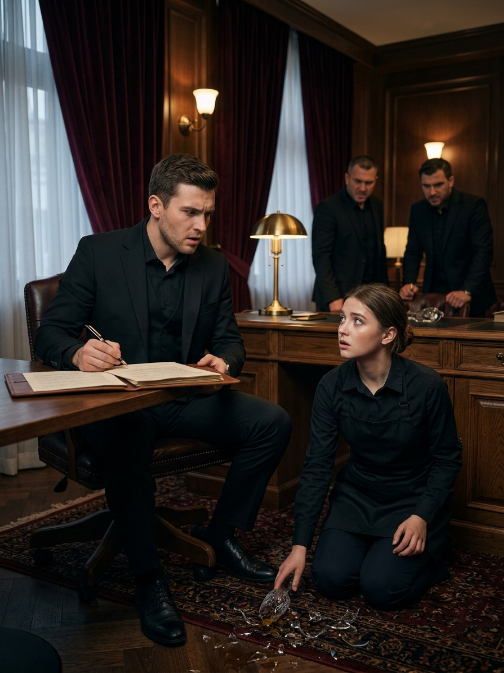
One Night of Betrayal—And the Mafia Boss Returned Home to a Divorce He Never Saw Coming

## PART 1
The last thing I did before I left was make the bed.
I want to be precise about this because it matters in ways that don’t have words yet. It wasn’t habit. It wasn’t a final act of domesticity, the kind that gets written about in books where women leave their husbands and the symbolism is heavy and deliberate. It was simply that I had made that bed every morning for eighteen years, and the act had become the way I began days, and this was the last day I was beginning in that apartment, so I made the bed.
The silk was the color of new cream. I pulled the corners tight and smoothed the center with my palm, twice, the way I always had. I stacked the pillows in the order Gio preferred, although Gio was not here and would not sleep in this bed tonight or any night I could foresee, and then I stood for a moment with my hands at my sides and looked at the room.
The room looked like a photograph of a marriage.
Everything in it cost a great deal. Everything in it had been chosen by someone with exquisite taste — some of it by me, some by the interior designer Gio had hired in the early years when we were still performing the life rather than simply living it. The nightstand lamp on his side, bronze and heavy, had come from a gallery in Florence. The rug was silk, handwoven, a shade of blue that Gio had described as the color of the Ligurian Sea. He said this with the proprietary pleasure of a man who had been to the Ligurian Sea many times and owned things that proved it.
I had not chosen the rug.
I had chosen the painting above the headboard: a small watercolor I had found at a street market in Venice on the only trip we ever took alone, before the business became the thing that occupied all the oxygen in every room. A woman in profile, standing at a window, looking out. Gio had thought it was too simple. I bought it anyway.
I had not taken it down.
I looked at it for a moment. The woman at the window. I had always identified with her more than I could explain to anyone, and I was leaving the painting behind because I needed to travel light, and also because I needed to leave some piece of evidence of who I had been here, in this apartment, in this marriage, in the eighteen years that were ending at four-fifteen in the morning.
I picked up my bag.
It was not a large bag. That was one of the things Gio had never understood about women like me: we didn’t need the whole closet. We needed what was ours. My grandmother’s ring, which I had taken from the jewelry drawer where it sat alongside diamonds he had given me for occasions he remembered because his assistant put them in the calendar. My mother’s photograph. Three cashmere sweaters in colors I had chosen myself. The leather notebook I’d been filling for two years. The documents.
I was precise about the documents.
On the kitchen counter I left an envelope with Gio’s name on it. The handwriting was steady. I had practiced steady for eighteen years, in rooms where showing weakness was an invitation.
Then I left.
—
Gio came home at four thirty-seven.
I know the time because I was two blocks away, in the back of a car, when he would have crossed the threshold. I had calculated it. I am very good at calculating things that matter, even when the people around me believe I am occupied with things that don’t.
He would have noticed immediately, the way he noticed everything structural about a room — entry points, sight lines, the geometry of who stood where. He would have stood in the foyer, jacket creased, shoes expensive on the black marble, and felt the difference in the air before he could name it.
I had thought about what his face might do.
I had thought about it for a long time, in fact. In the months of preparation, in the quiet hours when he was elsewhere and I was building the thing I was building, I had imagined many versions of his face when he understood I was gone. The face of a man encountering genuine surprise, which I suspected was rare for him. The face of a man whose first impulse would be to reach for his phone and call, and whose second impulse, arriving very quickly after, would be to realize that calling me was not going to resolve this the way it resolved other problems.
I had turned my phone off at four-fourteen.
—
He would have gone to the bedroom first.
He always went to the bedroom when he came home late, moving quietly through the apartment as if his own consideration could undo the hours. The bed would have stopped him. Not the absence of me, exactly — he had grown comfortable with my absence in that bed, had been growing comfortable with it for years in the incremental way that intimacy erodes. What would have stopped him was the making of it. The pillow arrangement. The smooth center.
The specific proof of departure rather than sleep.
He would have checked the closet next.
I had been very deliberate about what I took and what I left. The diamonds remained, which I knew would confuse him because men like Gio calculate worth in karats and he would spend some time trying to understand why I had not taken the currency. What I had taken was harder to inventory: the things that were mine before they were ours, the things that carried weight only I could feel, the documents that represented two years of building something he had no idea existed.
I had left the photograph from our wedding.
Not in the envelope. On the kitchen counter beside it, face down, with something written on the back.
This was the part I was least certain about.
I had written only: *I know exactly when I stopped being visible to you. You never noticed the change.*
—
He would find the envelope after the photograph.
He would read the note I had left inside it. I had written it many times over many weeks, revising the way I revised everything I built — with precision, without sentiment, with the economy of language that comes from finally knowing exactly what you mean.
I had not asked for anything in the note.
I had not accused him of anything he could argue with.
I had only described what had happened, from the inside, in the only voice I had ever had that was entirely mine.
And then I had described what I had done about it.
That was the part he wasn’t ready for.
That was the part that would make the blood leave his face.
—
## PART 2
Gio opened the envelope at four fifty-three.
I know because he called at four fifty-four and I watched my phone light up and go dark in the cupholder of the car. Once, twice, then a third time that lasted a little longer as if he was deciding whether to leave a voicemail. He didn’t leave a voicemail. Gio had not left voicemails in years because voicemails could be kept and listened to again, and he was careful about evidence.
He was less careful about the evidence of ordinary life. The slow accumulation of it.
The note had said:
*Gio,*
*You stopped coming home to me by degrees so small I almost believed I imagined it. That was the cruelest part — not the absence, but my own uncertainty about whether the absence was real. You taught me to distrust what I saw and heard and felt. I spent years in that uncertainty. It was exhausting.*
*I want you to know I am not angry. I am finished. Those are different things.*
*I am also not leaving with nothing.*
*Look at what I’ve been doing while you were elsewhere. Not the things you knew about. The other things. The things you never asked about because you stopped asking questions about me a long time ago.*
*I hope she was worth it.*
*I hope she was worth eighteen years.*
*Vivienne*
The documents were in a second envelope behind the letter.
He would have opened it expecting financial transfers, the quiet shifting of shared assets that betrayed wives sometimes managed in the weeks before departure. He would have expected to find something he could contest, something that gave him a legal angle, something to bring to his lawyer in the morning.
What he found was the incorporation papers for Conte&Fiori, a luxury textile company registered under my maiden name twenty-six months ago. The last two years of financial statements, which showed revenue in the third year of operation crossing eight figures. A client list that included three of his own business associates, men who had sat at his dinner table and complemented his wife on the meal.
A letter from the board of a Milanese fashion house offering to acquire the company.
The offer was generous enough that the sum appeared on the page like a language he hadn’t expected to encounter.
He would have sat down.
I hoped he sat down.
The knock at the door came at five eleven.
—
I know because I was standing on the street below.
I know because I had come back.
Not because I had changed my mind. Not because I wanted the diamonds or the watercolor or the woman in the window who had always felt like the truest portrait of my marriage. I came back because there was one thing I had not been able to decide in all the months of planning: whether to see his face when he understood, or whether to let the documents speak without my presence.
I had decided, in the back of the car two blocks away, that I wanted to see his face.
I pressed the buzzer. My old code still worked.
—
## PART 3
He opened the door before I had finished climbing the stairs.
He was in the hallway, still in his suit, jacket hanging open, tie loosened. He looked like a man who had been very sure of himself an hour ago and was recalibrating everything. I had seen that recalibration once before, years earlier, when a deal he had considered settled collapsed in a single phone call. He had stood in this same hallway with the same expression: not broken, not afraid, but suddenly aware that the map he was using was wrong.
“Vivienne,” he said.
“I’m not staying,” I said. “I came to tell you one thing in person because I thought you deserved that much.”
He stepped back. Automatic. Inviting me in the way powerful men invite things they haven’t fully processed yet — gesturing because gesture is something to do when you don’t know what to say.
I didn’t move from the doorway.
“You think you can walk out with half my assets,” he said. His voice had found its level, the tone he used for negotiations. Controlled. Offering nothing.
“I haven’t touched your assets. Every number in those documents came from work I did. Money I earned. A business I built from the beginning.” I kept my voice even. “You can verify that. I expect you will.”
He looked at me. Something moved behind his eyes — the processing, the calculation, the first genuine assessment of me he had attempted in years.
“You built a company,” he said.
“I built a company.”
“While living here.”
“While living here. While attending your dinners, your charity events, your business trips that occasionally required a wife for the photograph. While the people in that building nodded at me in the lobby and called me Signora Marchetti and thought about me for approximately as long as it took the elevator doors to close.” I paused. “I had a great deal of time.”
The silence was very large.
“You’re not an angry woman,” he said. “I know you.”
“You knew me.”
He flinched.
I had not expected the flinch. Gio Marchetti had not flinched in my presence in a very long time. I watched it move across his face — barely, controlled immediately, but real — and felt something I had not anticipated: not satisfaction, but a kind of grief. The grief of seeing too late what was always there. He was capable of being reached. He had simply stopped trying to reach me, and in the space of not being reached, I had become someone entirely different.
“The photograph,” he said. “What you wrote on the back.”
“Yes.”
“When did you stop being visible to me?”
I thought about this. Not because I didn’t know — I had always known — but because I wanted to choose the right moment, the one that was most true.
“The night of your father’s retirement dinner,” I said. “You introduced me to six people in one hour. Every time, you said: my wife, Vivienne. My wife. Not my wife who spent four months learning our supplier’s financial history to advise you before that acquisition. Not my wife who speaks four languages and used the fourth one to translate the Sorrento deal when your interpreter left sick. Just: my wife.”
A pause.
“I watched you do it and I thought: he sees a category, not a person. And then I thought: if he sees a category, I can become something else entirely and he won’t notice.”
“So you did.”
“So I did.”
He put his hand on the door frame. Not toward me. Just a place to put the weight. I watched him absorb this — not the loss of money or position or leverage, which he could manage, but the fact of it. The fact of two years of my interior life happening four rooms away from his while he was elsewhere and didn’t wonder.
“I didn’t know about the company,” he said.
“I know.”
“I should have.”
This was the closest Gio would ever come, I understood, to something like an apology. Not for the other woman — he hadn’t mentioned her and I hadn’t mentioned her and we both knew her name moved in the air between us without being said — but for the longer, quieter betrayal. The one that had given me time and space to become invisible and then use the invisibility to build something real.
“You should have,” I agreed. “But you didn’t. And now you know.”
“What do you want from me?” he asked.
“Nothing.” I let the word stand. “I built the company so I would need nothing from you. That was the point. I’m not here for negotiation or settlement or whatever your lawyer will suggest in the morning. I’m here because you are someone I shared eighteen years with, and I thought you deserved to hear the reason from me and not from a document.”
“And the reason is?”
“I stopped existing beside you,” I said. “Not because of her, though that happened too and it happened more times than once. But earlier than that, and deeper than that. You stopped being curious about me. You stopped wondering what I was thinking or reading or building or wanting. I became furniture with a face.” I looked at him steadily. “I need you to understand that this is not a loss I sustained. This is a correction I made.”
He was very still.
Below, on the street, the driver had circled the block. I could see the headlights through the tall window at the end of the corridor, passing for the second time.
“The Conte&Fiori offer,” Gio said. “Are you taking it?”
“That’s my decision.”
“It’s a significant company, Vivienne. Eight figures in year two—”
“Three.”
A beat.
“Three,” he said.
“I’m not taking the offer. I’m expanding into France.” I picked up the bag I had set on the floor. “I have a meeting in Paris on Thursday.”
He looked at me the way people look at landscapes they missed entirely the first time and are now seeing correctly.
“I spent years managing things for you,” I said. “Your schedule, your household, your image, your relationships with people whose names you forgot but whose preferences I catalogued. All of that capacity, all of that attention, all of that intelligence. You could have used it in your business. Instead you used it for a dinner party that ended at midnight.”
“Is that what you wanted? To work with me?”
“No,” I said. “I wanted you to notice I was capable of it. I wanted you to see me and wonder what I might build if you asked. You never asked.” I took a step back. “So I stopped waiting to be asked.”
The door was still open. Neither of us had touched it.
“Where will you go?” he asked, and the question was so small and so real that it cut differently than anything else had.
“I have an apartment. I’ve had it for eleven months.” I read the expression on his face. “In the 7th. Rue du Bac, if you want to know.”
“Paris.”
“I’ve been in Paris a week every month for two years.” A pause. “For work.”
He looked at me and I saw the arithmetic of it arriving — the mornings he had woken to find me already at my desk, the evenings I had returned late and said the meetings had run long, the Thursdays that were always complicated, the calls I took in the other room that he had attributed to my sister or my friends or the charitable organizations he knew I sat on the boards of.
He had never once wondered if there was a company with my name on the incorporation papers.
“I’m going to go now,” I said.
“Vivienne.”
I waited.
“I don’t know how to apologize for this,” he said. “For all of it. I’m not certain I know the vocabulary.”
“I know,” I said. “That’s not the same as an excuse.”
“No,” he agreed. “It’s not.”
There was a long silence.
“The watercolor,” he said finally. “The one from Venice. You didn’t take it.”
“I know.”
“You could have.”
“I left it on purpose.” I adjusted the bag on my shoulder. “So you would have to look at it.”
He turned to look at the bedroom, though we were too far down the hall to see the painting.
“The woman at the window,” he said.
“Yes.”
“That was how you felt.”
“For a very long time.” I looked at him for a moment — this man I had known at twenty-five, in a restaurant, when he had looked at me across a table with the full force of his attention, when being seen by him had felt like stepping into a spotlight. I had spent years trying to find the person who had looked at me that way and understanding slowly that he still existed, he simply no longer turned the light in my direction. “I don’t feel like that anymore,” I said. “I haven’t for a while. I just needed you to understand why.”
I walked to the elevator.
He didn’t follow.
The doors opened immediately, and I stepped in, and the last thing I saw before they closed was Gio standing in the corridor of the apartment we had shared, in the suit he had worn to another woman’s bed, holding the document that proved his wife had become someone he didn’t know while he wasn’t looking.
He didn’t look broken.
He looked like a man who had just understood, very precisely and far too late, the cost of incuriosity.
The elevator descended.
—
The car was waiting.
Paris in three days. The meeting in the 16th with the fabric house I had been courting for six months. The apartment on Rue du Bac, which smelled like old wood and coffee and the particular freedom of a space that belonged entirely to me. The company that had grown into something real because I had given it the same sustained, careful attention I had given everything in my life except myself.
I did not cry in the car.
I had done most of the crying already, in the months before — not for the marriage, which had been over for longer than either of us admitted, but for the version of myself that had waited so long to believe she was allowed to want something that had nothing to do with him. The woman who had stood at the window of her own life for years, watching, and had finally walked through it.
I texted my sister: *Leaving now. See you Friday.*
Then I put the phone in my bag and watched the city pass.
Milan at five in the morning was still dark, the streets wet from an earlier rain, the lights of the storefronts beginning their pale emergence. The city had always felt like his — his connections, his territory, his name on the restaurants where the host knew to bring the good wine before being asked. I had lived in it for eighteen years as a figure in his landscape.
For the past two years I had been building a different landscape.
I had not needed his permission to do it.
I had not needed his knowledge.
I had needed only what I had always had: the capacity to pay attention to things worth attending to. The discipline to work without recognition. The patience to wait for the right moment.
And the understanding, arrived at slowly and then all at once, that power doesn’t keep people — it only creates the illusion that people don’t need to be kept. That the man who never worried about losing what he had was not the man who had nothing to lose. He was the man who had stopped noticing what was walking out the door.
The car moved through the city.
Behind me, in the penthouse that would need to be divided by lawyers who would call my attorney this week and be surprised by what they found, Gio Marchetti was standing in front of a painting of a woman at a window.
I wondered if he was looking at it properly.
I hoped, for his sake, that he was.
But I didn’t turn around to check.
I had done enough waiting in that apartment.
I had a meeting in Paris on Thursday, and the flight was at seven, and outside the window the city was beginning to wake, ordinary and indifferent and entirely mine for the moving through.