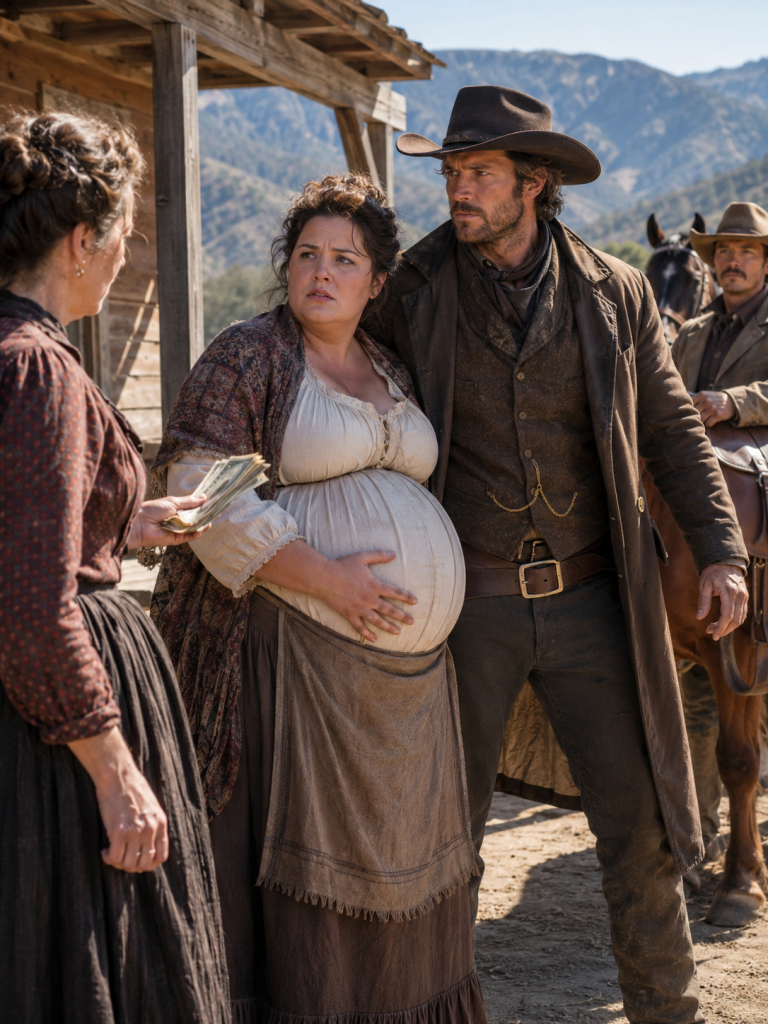
HE BUILT A HOUSE WITH HIS OWN HANDS FOR 11 MONTHS STRAIGHT — THEN STOOD IN FRONT OF IT AND REALIZED HE HAD NO ONE TO SHOW IT TO

PART 1
Wyatt Callahan drove the last nail into the porch railing, stepped back, and felt something he never expected. Absolute crushing emptiness. The house was perfect. Every board straight, every window set true, every room ready. He had spent eleven months building a future with his bare hands, and now he stood alone in front of it, listening to nothing but the wind. A man can build four walls and a roof. What he cannot build, what no hammer or hand can create, is the reason to come home.
Wyatt Callahan was not a man who wasted words or daylight. He had come to Montana territory six years ago with a used saddle, a borrowed axe, and forty-three dollars sewn into the lining of his coat. He had worked cattle drives for three years under a foreman named Hicks, who believed silence built character and complaining built nothing. He had saved money with a discipline that other cowboys found almost frightening — turning down drinks, turning down card games — because he could see clearly, stubbornly, exactly what he was saving toward. Land. A house. A life that belonged to him.
He had filed his homestead claim on a hundred and sixty acres of Montana grassland in the spring of 1883, and from that morning forward, every hour not spent working for wages was spent working for himself. He felled timber from the ridge above the creek. He hauled stone from the dry riverbed half a mile east. He dug the well by hand, going down twenty-two feet before he hit water good enough to drink, and he remembered sitting at the bottom of that hole in the dark, his arms burning, his back screaming, thinking, *this is what it costs.* He decided it was worth it.
He built the barn first, then a quarter mile of fencing post by post, then the house — built slow and built right, because Wyatt had watched his father build things fast and wrong, watched them fall apart before the decade was out, and had made himself a private promise at twelve years old that he would never do anything that way. The neighbors, such as they were, came to look in July, and old Dale Harmon walked around the structure twice without saying anything, which was the highest praise Dale Harmon ever gave to anything.
“You build this alone?”
“Every nail.”
Dale nodded slowly. “You got a wife coming?”
Wyatt said nothing, because that was the part he had not figured out yet. The hammer came down on the final porch nail on the fourth of September, 1884, and for a full five minutes he felt genuine pride — the deep, earned, bone-level satisfaction of a man who set out to do something hard and did it. Then the pride faded, and what replaced it was something he wasn’t prepared for. The house was silent. Not peaceful silent. The silence of a place waiting for something it did not yet have.
He walked through every room. He stood in the kitchen and looked at the table he’d built for four, and thought about eating at it alone. He went to the barn, saddled his gray horse Cutter, and turned south without much of a plan — just a direction. Silver Creek was sixty miles south and east, the closest thing to a proper town in the territory, a railroad junction growing fast, with a hotel and a dry goods store and a doctor and a church.
People meant women. Women theoretically meant the possibility of a wife. It was not the most romantic calculation a man had ever made. But romance, in his experience, was a luxury that came after the practical foundations were in place.
Silver Creek turned out to have a social architecture he hadn’t anticipated. The women in town knew each other, knew who was eligible and who was not, and within about four hours of his arrival, Wyatt had the distinct impression that they also knew about him. Over the next four days he met seven women — pleasant, capable, entirely wrong for what he needed, or entirely right for a life he wasn’t offering. He was beginning to wonder whether this whole idea had been poorly conceived.
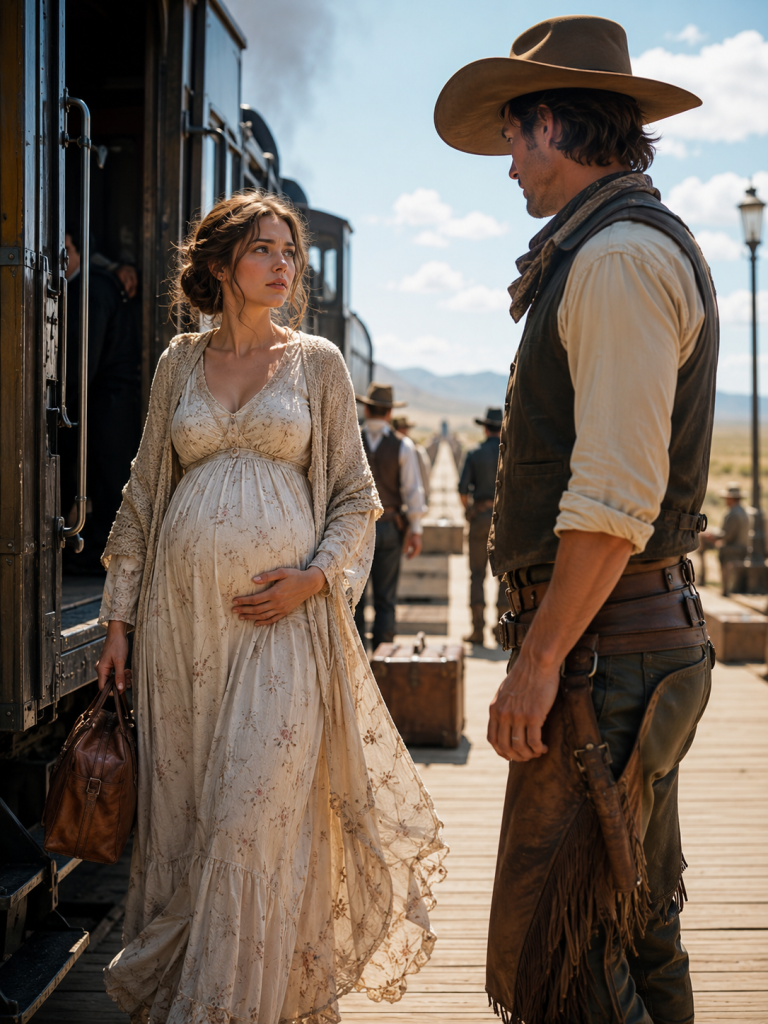
On the fifth evening, sitting in the hotel lobby trying to decide whether to cut his losses and ride home, he saw a woman walk past the window carrying a large bundle of fabric that shifted as she reached the hotel steps. She adjusted her grip with the automatic competence of someone accustomed to managing more than she could comfortably hold. Something in that small motion made him get up and open the door.
“Let me get that.”
She stopped and looked at him — brown eyes, direct without being rude. “I’ve got it.”
“I can see that. I’m offering anyway.”
A pause. “Thank you,” she said, and let him take the bundle.
That was how he met Charlotte Bennett.
—
PART 2
Her name was Charlotte. She worked at Henderson’s Dress and Alterations, delivering fabric because the shop’s regular boy hadn’t shown. Wyatt walked with her to the delivery, walked back with her, and stood on the boardwalk talking for another twenty minutes while she held the door open, clearly not quite ready to end the conversation.
She asked him straightforward questions — not about his land or prospects, but how far the ride was from his homestead, what happened when someone got sick with the nearest doctor sixty miles off, what he did in winter when the work slowed down.
“I read,” he said. “And I fix things. And I think.”
“About what?”
“Mostly about what I’m going to build next.”
She studied him a moment. “Is that what you’re doing here? Building something next?”
“Something like that.”
“I close the shop at six,” she said. “There’s a bench outside the bakery I sometimes sit at in the evenings. If you want to continue this conversation.”
“I’ll be there.”
He was there at six. He stayed in Silver Creek three more days, and every evening he sat on that bench with Charlotte Bennett. He learned in pieces that her father, a businessman who wasn’t as good at business as he believed, had died four years ago leaving debts nobody knew about. Her mother had died the year after. Charlotte had been left alone at twenty with a family name that had come to mean something unfortunate in Silver Creek. There had also been a man named Gerald Foresight, who had been attentive and then less attentive and then announced his intentions to marry someone else with very little warning.
On the third evening, Wyatt told her about the house — not the measurements, but what it had cost, what it felt like when it was done. When he finished, Charlotte was quiet a moment.
“What does it feel like now?”
“Empty,” Wyatt said. It was the first time he’d said it aloud.
“I know something about that,” Charlotte said. “A place feeling empty.”
They sat in that quiet together. Then Charlotte said, “I’ve been thinking about your question.”
“Which one?”
“The one you haven’t asked yet. But I can see you working up to it.”
“I’m not impulsive,” he said. “I wanted to be sure first.”
“And are you?”
He thought about it honestly. “Yes. I think I am.”
“I have conditions,” she said. “I won’t go somewhere I don’t understand. I need to know what the winters are like, what it costs to run the place, what happens when things go wrong — because things go wrong — and I won’t be told afterward that you handled it and not be part of handling it.”
“That’s fair. I’m not finished. I won’t be a decoration. If I’m going to a ranch sixty miles from town, I need to be useful, and I need that to be something we both agree on before I agree to anything.”
“I wouldn’t want you any other way,” Wyatt said.
Charlotte looked at him carefully. “You say that now. Men often say things now that they don’t entirely mean later.”
“I know. And I can’t prove I’m different except by being different. I understand if that’s not enough.”
Charlotte said nothing for a long moment. “It might be enough,” she said finally. “I’ll need a few more days to decide.”
“I’ve got time,” Wyatt said. “I’ll stay another week if I need to.”
She looked at him like she was recalculating something. “Two days,” she said. “Give me two days.”
—
PART 3
He gave her two days. What he didn’t know until later was that Charlotte spent them writing to Martha Harmon, a distant connection through a cousin, asking her to write back honestly about Wyatt Callahan and the homestead north of town. The reply came the second morning: *Wyatt Callahan builds things that last and doesn’t make promises he doesn’t keep. The land is hard but good land. Martha Harmon would be glad to have Charlotte as a neighbor.*
On the second evening, Charlotte sat down on the bench beside him. “I’d like to see the house before I make a final decision.”
“I’ll take you whenever you want to go.”
“That’s not what I’m asking. I’m asking if you’re willing to wait while I make arrangements to close the shop and travel up there with a chaperone and see the place properly before I commit to anything.”
“Of course. Take whatever time you need.”
“That’s not a small thing,” she said. “The town will talk.”
“Let them. They already talk about me enough. I don’t put much stock in it.”
“Why not?”
“Because the people doing the talking don’t know you. And in my experience, the people who know the least are usually the most certain.”
Charlotte was quiet, then said very quietly, “My father used to say something like that.”
“Was he a smart man?”
“He was. He made poor choices sometimes, but he was a smart man.”
“I’ll take that as a compliment,” Wyatt said, and for the first time since he’d met her, Charlotte Bennett smiled — not a polite smile, a real one, sudden and unguarded, and it changed her face entirely. Wyatt felt something settle in his chest, like a foundation stone dropping into place.
### I. The House
Three days later, Charlotte climbed into a borrowed wagon beside her neighbor, Mrs. Adeline Puitt — sixty-two, sharp-tongued, entirely unbothered by what anyone thought of anything — and rode north toward a house she had never seen. She had told almost no one she was going. The people she would have told were the same people who would have found seventeen reasons it was a mistake, and Charlotte had spent four years listening to Silver Creek explain her mistakes to her and was done with that particular arrangement.
Wyatt rode alongside the wagon, answering Mrs. Puitt’s three pointed questions about water rights, neighbors, and dangerous weather directly and without embellishment. Afterward, Mrs. Puitt gave Charlotte a look that communicated something without words.
They arrived on the second afternoon. Charlotte saw his back straighten slightly in the saddle as they came over the last rise, the small involuntary adjustment of a man approaching something that mattered to him. The house was not what she had pictured — something rough and provisional. What she saw was built with intention: clean lines, a level porch, a solid barn, fencing running straight to the horizon.
“Well, he wasn’t lying about the house,” Mrs. Puitt said.
Wyatt showed them everything — not to impress, but the way a man shows something he built and believes in. The well, the kitchen positioned to catch morning light, the root cellar. He showed her the bedroom and said, with a straightforwardness she found startling and then immediately appreciated, “I built this room large enough for two people to have space. I think that matters.”
Charlotte stood in the kitchen and put her hand on the table. She counted the chairs twice. “You built this table for four. Before you came to find anyone?”
“Yes.”
“That’s either very confident or very presumptuous.”
“Might be both,” he said. “I built the thing I wanted to have. The rest was still unsettled.”
She walked to the window and looked out at the land. “What happens in January?”
“Cold. Sometimes very cold. Blizzards that keep you inside for days.”
“How many days?”
“Longest stretch I’ve been in was eight.”
“Eight days,” she said, “with one other person. You’d better be someone worth talking to.”
Mrs. Puitt laughed outright from the other room.
That evening, on the porch, Charlotte asked him the question she’d been carrying since their second evening on the bench. “Why me? There were other women in town. Women with better reputations, better circumstances, women whose families hadn’t left them with debts and gossip. Why did you keep coming back to that bench?”
Wyatt was quiet, making sure his answer was true before he said it. “You asked about the winters. Every other woman I talked to asked me about the land — what it was worth, whether I plan to grow it. Those are reasonable questions. But you asked what happens when things go wrong. You asked what the hard parts looked like. And I thought — that’s a person who’s actually thinking about the life, not the idea of it.”
Charlotte was quiet. “That’s it? That’s the whole reason?”
“There’s also the fact that you’re the only person I’ve met in six months who says exactly what they mean. I find that uncommon enough to be worth something considerable.”
“People in town think I say too much of what I mean,” she said.
“I know. I think they’re wrong.”
She was quiet for a long time, the wind moving through the grass beyond the fence line. “I’m afraid,” she said finally. It cost her something to say it. “Of being wrong. I’ve been wrong before about a person, about what they were and what they wanted, and it cost me more than I expected.” A pause. “I’m also afraid of being right. That this is exactly what it looks like, and I’ll say yes and it will be real, and I’ll have to be equal to it every day. And some days I won’t be.”
Wyatt turned to look at her directly. “Charlotte. I am going to have days when I’m not equal to it either. I’m going to make mistakes. The question isn’t whether either of us will fail sometimes. The question is whether we’ll try to build the same thing.”
“Are you always this direct?”
“I find it saves time. Gerald was not direct,” she said, not bitterly, just as a fact.
“I’m not Gerald.”
“No,” she agreed quietly. “You’re not.”
### II. The Letter
She took one more day alone, walking the property, inspecting the barn with an attention that suggested she was calculating something specific. At noon she came back with three questions she’d composed during her walk.
“How much debt is on this property?”
“None. I built it as I could afford to build it.”
“What do you do when cattle get sick and you don’t know why?”
“I’ve got a handbook from the agricultural office, and there’s a man named Peters twenty miles west who knows more about cattle medicine than anyone I’ve met. I’ve traded work with him for that knowledge.”
“Third question. If I moved here and it didn’t work — if we tried and it was wrong — what would happen to me?”
It was the most important question, and both of them knew it.
“You’d have the same rights as any wife leaving a marriage,” Wyatt said carefully. “But I’ll tell you what I actually think. I don’t intend for it to not work. And the best answer I can give you is that I won’t make it a question you have to answer in the way you’re worried about.”
“That’s not a legal answer.”
“No. It’s a true one.”
She looked at him for a long, measuring moment. “I want to write a letter to Mrs. Harmon before I decide. I want to send it with your next supply run and wait for the answer before I give you mine.”
“All right. You’re not going to argue that you’ve already waited long enough?”
“No. You’re making a bigger decision than I am. You’d be leaving your life. I’m inviting someone into mine. That’s not the same size of thing.”
Charlotte looked at him with an expression somewhere between surprise and something more careful. “Sit down,” she said. “I’ll need paper, and I’ll need you to tell me what you’d want Mrs. Harmon to say about you if she were writing the letter herself.”
Martha Harmon’s reply came six days later. Charlotte read it at the kitchen table, then said, “She says you’re honest and you work hard and you keep your word. She says the land is good land.” A pause. “She says, ‘I’d be a fool to say no.'”
“Martha Harmon does not say things she doesn’t mean,” Charlotte said quietly.
“No. She doesn’t.”
Charlotte set the letter down. “I have two more conditions. I want to be married here, not in Silver Creek, if we can get a minister to make the trip. I don’t want half the town watching, waiting to see what they can say about it after.”
“Done. What’s the second?”
“I want to keep the account books for the ranch. Not because I don’t trust you — because I’m good at it, and because I need to feel useful from the beginning, not after I’ve proven myself for some number of months you haven’t told me.”
Wyatt didn’t hesitate. “Done.”
“Just like that?”
“You asked for reasonable things. I’m not going to make you negotiate for reasonable things.”
Something crossed her face — quick, complicated, something to do with a man who had made her negotiate for things that should never have required it.
“All right,” Charlotte said. Then, more clearly: “Yes. I’ll marry you, Wyatt Callahan.”
“Thank you,” he said. It was probably not the expected response, but he meant it entirely, and she seemed to understand that.
### III. The Wedding
The wedding was the first Saturday of October, 1884. Eight people attended, including the bride and groom. Charlotte wore a dress she’d made herself — ivory-colored wool with simple trim — and when she walked across the front room to where Wyatt stood, she looked cleareyed and direct, a woman walking toward a decision she had made and intended to keep. Wyatt thought she was the most beautiful thing he had ever seen. He didn’t say so until later.
Reverend Aldis Fitch pronounced them married with the satisfied efficiency of a man who had done this many times. Dale Harmon shook Wyatt’s hand hard and said, “Good.” Martha Harmon embraced Charlotte and said something in her ear that Charlotte didn’t repeat but that left her blinking quickly before she composed herself.
Mrs. Puitt left last, pausing at the door. “Write me,” she said.
“Every week.”
“Monthly is fine. I’m not sentimental. I just want to know you’re all right.”
The house was quiet after everyone left — a different quiet than the one Wyatt had felt alone on that porch five weeks earlier. Not empty. Settled. Charlotte stood at the kitchen window for a moment, and Wyatt understood without being told that she was adjusting, letting the reality settle into her bones. He put the kettle on without asking.
“Thank you,” she said.
“It’s just tea.”
“I know. Thank you anyway.”
The first weeks were careful and deliberate — two people learning each other’s rhythms without collision. Wyatt was up before dawn out of old habit. Charlotte needed quiet before she was ready to talk in the morning, something Wyatt discovered on day three when he asked her a complex question before she’d finished her coffee.
“I don’t think well before coffee,” she said.
“Noted,” he said, and didn’t make that mistake again.
Charlotte took over the account books in the first week, and within two hours had reorganized the entire system with a clarity that made his previous three years of recordkeeping look like what it was — a capable man doing something he wasn’t trained for.
“Your cattle costs are off,” she said at supper one evening. “You’ve been underestimating winter feed by about a third. You’re not short. You’re just not accounting for it properly at the front end.”
“You got all that in one afternoon?”
“The numbers were all there. You just hadn’t looked at them in this order.”
### IV. What the Winter Tested
The first real test came in November — a serious storm, wind working through every gap, livestock needing checking through the night. Wyatt was up at two in the morning when he heard Charlotte behind him.
“I’m coming.”
“It’s cold.”
“I know I can. I’m coming anyway.”
She was already pulling on her coat, not trying to prove anything, just doing what needed doing. They went out together, and it took both of them to get the restless cattle settled — Wyatt at one end, Charlotte moving along the other, speaking to the animals in a low, steady voice that Wyatt hadn’t known she had.
“Where did you learn that?” he asked when they came back inside, cold to the bone.
“My uncle had horses. You learn to keep your voice down and mean it.”
“You’re something else, Charlotte Callahan,” he said. It was the first time he’d used her married name.
She went still a moment, then said quietly, “I’m beginning to think I might be.”
January nearly broke them — not each other, but the land itself seemed to test what they were made of. Six head of cattle went missing over three days; two were found dead, frozen in a draw. Getting the other four back cost Wyatt two days of brutal work and a frostbitten hand that Charlotte wrapped with a controlled efficiency that barely concealed how frightened she’d been.
“You should have told me how far you were going,” she said, her voice level, her hands not.
“I didn’t know how far it was going to be.”
“Then you should have told me you didn’t know. There’s a difference between you being gone three hours and eight. I need to know which one I’m waiting for.”
“I’m sorry. You’re right. I’ll tell you.”
“You promise?”
“I promise.”
The week after, a letter came from Silver Creek. Henderson’s was closing — Mrs. Henderson moving to Billings, the girl Charlotte had trained too young to take it over alone. She was asking if Charlotte would come back temporarily, six to eight weeks, to help sort orders and finish the girl’s training.
“Do you want to go?” Wyatt asked, after a careful silence.
“That’s not the only question.”
“It’s the first one.”
“I have an obligation to Mrs. Henderson,” Charlotte said. “She was good to me when other people in that town were not. I can’t just leave her in difficulty.”
“I know what it would mean,” Wyatt said.
“Tell me what you actually think.”
“I think you should go. I think you’re right about your obligation, and I think you know it. And I think if I told you not to go, you’d do it anyway, because you’re Charlotte Callahan, and you don’t leave things wrong when you can set them right.” He paused. “And I think I’d have less respect for you if you didn’t.”
She stared at him. “You’re not angry.”
“I’m not happy about it. That’s different from angry.”
“Gerald told me I was too loyal to people who didn’t deserve it,” she said very quietly.
“I’m telling you your loyalty is one of the things I respect most about you,” Wyatt said steadily. “That’s a different statement.”
“I’ll write you twice a week,” he said as she prepared to leave. “You don’t have to.” “I want to. I’m not good at being sentimental in person. Turns out I’m better on paper.”
### V. The Letters
She left on a Thursday. Wyatt rode with her to the midpoint where the supply rider would take her south, and they parted at the same creek crossing where they’d separated weeks before — except now the space between them felt like something established, something real enough to survive six weeks of distance.
His first letter arrived Wednesday of the following week — two dense pages, small even handwriting, about the shop and Mrs. Henderson and a girl named Pearl who was quick but needed confidence more than instruction. She wrote: *I think what changes is not the place, but what you’re comparing it to. I find I am comparing everything here to there, which tells me something about where my mind has already decided it lives.*
Wyatt read that line three times, folded the letter, and put it in the inside pocket of his coat — where he kept things he wanted to keep close.
The six weeks passed in a rhythm of work and letters. She wrote about an encounter with a woman in town who’d said, with the particular pleasantness of an insult wrapped in concern, how *admirable* it was how Charlotte was *managing the situation she’d found herself in.* Charlotte wrote: *I did not respond the way I wanted to, because I am trying to be a person who does not say everything she thinks in every moment. I am finding this more difficult than expected.*
Wyatt laughed out loud reading that in an empty kitchen. He wrote back that he hadn’t been born with a filter, he’d just learned that quiet rooms were easier to work in — which wasn’t restraint, it was closer to strategy. Her reply: *That is possibly the most honest thing you have ever said about yourself. I am keeping this letter.*
In the fourth week, she wrote something he held in his hands for a long time before responding: *I have been thinking about what it costs a person to start over. Not the practical cost — I understand that part and it doesn’t frighten me. The internal cost, the cost of deciding that what happened before does not determine what comes next. I think I am still paying that cost. I think I will be for a while. I want you to know that it does not affect what I’ve decided, but I also want you to know it’s there, because I think that’s the kind of thing a person should tell their husband.*
He wrote back four pages — the longest letter he’d yet written — about his father, about the twelve-year-old boy’s promise, about carrying things forward while also carrying what came before. *I am not a patient man by nature,* he wrote, *but I am a thorough one. I will wait for whatever needs waiting for.*
Her reply was four words: *I know you will.*
### VI. Home Again
She came back on a Thursday, seven weeks to the day after she’d left. Wyatt was at the fence line when the wagon came over the rise, and he walked toward the house at a pace considerably faster than his usual gait, and didn’t examine that too closely.
“It’s still standing,” she said, looking at the house.
“I told you it would be.”
She stood in the middle of the front room, her hand going to the spines on the bookshelf he’d built her the first week. “You didn’t move them.”
“Why would I move them?”
She turned around, and whatever she’d been holding at careful distance for seven weeks was right there in her face, unguarded. “I’m glad to be back,” she said — three words that cost her something, and they both knew it.
“I’m glad you’re back. This house is significantly better when you’re in it.”
“Significantly,” she repeated.
“Immeasurably,” he said. She almost smiled. “You’ve been practicing being funny while I was gone.”
“I had time.”
### VII. The Water
Spring brought the twist Wyatt didn’t see coming — a letter from a land agent named Thomas Foresight, Gerald’s older brother, proposing to purchase the southeast quarter of the Callahan property, along the creek, at a “generous price,” citing an “inevitable” railroad expansion. Wyatt read it twice and handed it to Charlotte without comment.
“Thomas Foresight,” she said, her voice even. “He’s not inquiring. He’s moving. That letter isn’t a question. It’s the first step in a pressure campaign.” She explained: the southeast quarter held the water. Whoever controlled it controlled water access for most of the valley. “He’s not buying land. He’s buying water rights. And if he gets it, the neighboring ranchers either sell to him or watch their cattle die in a dry summer.”
“That’s not legal.”
“It’s not illegal the way he’ll do it. He won’t stop the water. He’ll charge for it. Access fees, easement agreements, all perfectly documented and signed under pressure by people who need water and have no alternative.”
“You know how he operates.”
“I watched him operate for two years. Gerald thought his brother was a businessman. I thought he was something else.”
Wyatt stood up. “Then we don’t sell.”
“It’s not simple. He won’t stop at one letter.” Charlotte looked at him. “I need you to agree to nothing without telling me first.”
“Agreed,” Wyatt said immediately.
“You’re not going to argue?”
“You just told me you know this man and I don’t. Why would I argue with that?”
“Gerald would have argued,” she said, not bitterly, just as a fact.
“I’m not Gerald.”
Thomas Foresight arrived in person in May, all polished charm and slanted facts about the railroad. Wyatt listened and said almost nothing, which made Foresight visibly nervous.
“What uncertainty specifically?” Wyatt asked, when Foresight pressed his offer.
“The railroad decisions aren’t public yet, but the route through this valley isn’t guaranteed.”
“And you’re offering to take that risk off my hands.”
“Exactly.”
“I’ll need to consider it,” Wyatt said. “My wife handles our property decisions.”
The smile stayed on Foresight’s face, but something behind it shifted. He looked at Charlotte for the first time. Really looked.
“Charlotte. I didn’t realize.”
“I know you didn’t,” she said pleasantly. “That seems to be something that happens with you, Thomas. Not realizing things until it’s too late to adjust for them.”
He left the offer on the table and rode out.
“You knew he’d come himself,” Wyatt said.
“I knew the letter hadn’t worked. He came to look you in the eye and decide if you could be managed.” She picked up the paper, glanced at it once, set it aside. “I think he decided you can’t be. And I think he realized I’m here, which changes his calculation significantly. He knows I don’t rattle, and he knows how he operates.”
She was already writing to the county recorder before the dust from Foresight’s horse had settled.
### VIII. Sixty Miles
Twelve days later, Charlotte’s worst suspicion was confirmed: Foresight had already filed an easement claim on the creek access, weeks before he’d ever ridden up to negotiate. “The visit wasn’t to negotiate,” Charlotte said. “It was to see if we knew.”
“Can he do that?”
“He did it. Whether he can make it hold is a different question.” She stood. “I need to go to Silver Creek. Not to ask for help — to file a counterclaim, to talk to the recorder in person, and to find out exactly what that filing says. Because I guarantee you it does not say what he told you it says.”
“When do you want to leave?”
“Tomorrow morning. You don’t need to come. You need to stay here with the cattle.”
“I’m not letting you ride sixty miles alone to fight a legal battle on our behalf while I stay home.”
“It’s paperwork. I’m better at paperwork than you are.”
He arranged an escort with the Coopers and the Harmons instead of arguing further. “Charlotte. Be careful.”
She folded the recorder’s letter precisely along its original creases. “Thomas Foresight should be careful. I know where everybody is buried in that family’s history, and I have an excellent memory.”
She was gone four days — the longest Wyatt had spent alone since October. He worked the cattle, fixed the barn roof, and wrote her a letter he wasn’t sure he’d send: *I think that’s what Silver Creek did to you. It taught you to look at the surface of something and ask what’s underneath. I think that skill is worth more to this ranch than the water rights. I’m glad it came with you north.*
She found it unsealed on the table the fourth evening and, reading it, said only: “Don’t lose the habit of writing those.”
The easement claim was real, filed correctly, with a legitimate basis unless challenged within ninety days. Charlotte’s counterclaim was filed, witnessed, on record — but a counterclaim alone wasn’t enough. They needed signed statements from every rancher whose water access ran through the creek, proving material harm. Seven families. Three weeks to collect them.
They rode together — Dale Harmon signing immediately (“You wrote this? It’s good,” which from Dale was a standing ovation); the Peters family, who’d tangled with Gerald Foresight before (“I’m glad you’re on our side of this one”); the young Briggs couple, still new enough to fear opposing a man like Foresight, persuaded not by pressure but by Charlotte’s plain numbers, laid out without alarm; and finally old Anderson, farthest north, wary of anything official, won over not by paperwork but by an hour of Wyatt sitting with him on his porch, talking about water and fathers and what it costs to own only what you can hold securely.
“Your wife drafted the statement,” Anderson said finally.
“She’s the one who knows how,” Wyatt said. “We’re both fighting it.”
Anderson signed. “Tell your wife she wrote it plain. I appreciate plain.”
### IX. The Ruling
Charlotte filed the supplemental objection with eleven days to spare. The ruling came in twenty-three days, in favor of the Callahan counterclaim — three pages citing the signatures of six neighboring property holders and denying the easement outright.
Charlotte read it twice, put both hands flat on the document, and said nothing for a moment.
“Charlotte.”
“I know. Give me a second.”
There were no tears — Charlotte Bennett Callahan did not cry at victories any more than she cried at difficulties — but something in her face was wide open in a way she didn’t often allow. Relief so profound it had gone all the way through to something else.
“He’ll appeal, probably,” Wyatt said.
“We’ll handle it. I want to tell the Harmons. And the Andersons, especially. They took a risk signing that document, and they deserve to know it paid.”
They rode to every family that had signed. At every stop, the reaction directed itself mostly to Charlotte — not to exclude Wyatt, just because everyone understood who had carried the weight of the thing. Old Anderson shook her hand at his gate. “Plain. You write plain and you fight plain. That counts for something.”
“Thank you for trusting us.”
“Thank you for giving me a reason to.”
Martha Harmon made them stay for supper. “You know what you remind me of? Two people building the same thing. You don’t see it as often as you should.”
Charlotte was quiet a moment. “My mother would have said something like that.”
“Your mother was a smart woman,” Martha said firmly.
Charlotte looked down at her plate, then up. “She would have liked this valley.”
### X. What Lasted
Foresight didn’t appeal. Word came in August that he’d moved his operations east, toward a county that didn’t know his history yet. “He’ll find the same problems there,” Charlotte said. “That kind of man carries his problems with him.” She wrote a factual letter of information to the Billings county recorder anyway — not accusation, just record — and let them do with it what they decided.
The second year was different from the first in every way that mattered. Not easier — the land never got easier — but tested and holding. Charlotte expanded the kitchen garden. Wyatt built her a proper workspace off the kitchen for sewing she’d never entirely stopped doing, though not for Henderson’s anymore, just because thinking with her hands was how she thought, and he’d built it without being asked twice.
“You didn’t have to do this.”
“I wanted to. The things you do in it should have a good place.”
By the third year, neighboring families were consulting Charlotte on things that had nothing to do with water rights — supply ordering systems, winter feed calculations, what a new bride from Ohio had actually agreed to by marrying a Montana rancher. Dale Harmon said at a valley gathering that Charlotte Callahan had done more for the North Valley in two years than most people did in a decade.
“Dale, that’s an exaggeration,” Charlotte said.
“It’s not,” said Martha. “It really isn’t,” said Mrs. Briggs.
That evening on the porch, Charlotte said, “I’ve been thinking about what I said to you on the bench in Silver Creek, about being afraid of being right. I was right. It is real, and I do have to be equal to it every day. And some days I’m not.”
“Neither am I.”
“I know. That stopped surprising me a while ago.” A pause. “It helps.”
“I want to ask you something,” Charlotte said. “If you had known, when you drove that last nail, how much it was going to ask of you — the work, the legal trouble, the Foresight business, the winters, all of it — would you still have ridden south to find someone?”
Wyatt thought about it honestly. “Yes. Even knowing it would be this hard.”
“Because it would be this hard?”
“Easy things don’t build anything.”
Charlotte made a sound that was definitively a laugh — real and unguarded, the same one he’d first heard on their second evening on the bench, and it still changed her face entirely, and he suspected it always would.
“Ask me again in two winters,” she said. It was what she’d said the day she agreed to marry him.
“I told you I’d ask every winter.”
“Then ask.”
“Charlotte Callahan. Was it worth it?”
She looked out at the land they’d built and defended and worked and grown — the water running undisturbed through the southeast quarter, the cattle grazing the good grass, the neighbors who came to the kitchen table and left with what they needed.
“Ask me again next winter,” she said. “And the one after that, and all the winters after that. The answer will be the same every time. But I want you to keep asking.”
“I will.”
“I know,” she said, and leaned into him slightly, not performing affection, simply being where she wanted to be.
Wyatt put his arm around her, and they sat together on the porch of the house he had built, looking at everything they had built with their lives. He had ridden south looking for a wife. He had found something the word wife was too small to hold — a partner who matched him, challenged him, knew him, fought beside him, and had never once let the hard parts make her wish she’d chosen differently.
The house was still standing. The water still ran. The land was still theirs. And on the shelf beside the fireplace, her books stood exactly where she had placed them on the second day of her marriage — on the shelf he had built without being asked, in the home she had built without being told how.
Some things you build with lumber and nails and sixty miles of Montana road and a handshake and a letter to the county recorder, and two people who decide, every single day, to build the same thing in the same direction.
That is what lasts. That is what holds. That is what a home actually is.
THE END