SHE WAITED THREE DAYS AT THE TRACKS FOR A MAN WHO NEVER CAME — Then a Stranger Rode Out of the Desert and Changed Everything

PART 1
Arizona Territory. May, 1889.
Florence had answered the advertisement in the winter, when Kansas was frozen solid and the particular loneliness of a small farm with a dead father and a sister three states away with four children under six had made the future feel like a very small room with no windows.
The man who placed the advertisement called himself a rancher and described himself as steady and serious and interested in building a life with a woman of good character. He had written letters. Three of them, over as many months, and they were — she had thought — the letters of a man who meant what he said.
*I will meet you in Tuxen,* the last telegram read. *We will marry there and begin together.*
She had believed him.
She had packed what she had, sold what she could sell, and boarded the stage to Arizona in her best dress, which was not much of a dress but was the best she had, and she had told herself this was the beginning of something.
On the platform at Tuxen, she had waited.
And waited.
And the sun had moved across the sky and the tracks had shimmered in the desert heat and no train had come carrying the man who had promised to meet her, and she had waited through the night and through the second day and now it was the third morning and the canteen was empty and her body was beginning to communicate with her in the blunt way bodies communicate when they have been asking for water for too long.
She turned her back to the wind. Looked at the ring still tied to its ribbon around her wrist.
Then the hoofbeats.
He pulled up short a few feet from the platform. Tall in the saddle. A dust line across his cheek where a bandanna had been pulled down. Eyes the color of storm clouds before rain.
“You all right, miss?”
His voice was careful. Low. Like a man who knows how to be quiet around something frightened.
“I was supposed to be married three days ago,” she said. “He never came.”
He blinked once. Glanced at the empty tracks. “You’ve been here this whole time.”
It was not a question.
He dismounted in one smooth motion, leading the horse forward.
“Name’s Cade Valon. I was headed toward the mining camp near Tubac.” He looked at her — the stained dress, the cracked lips, the particular expression of someone who has used up all their shock and is now operating on something more durable. “But you look like you need help more than they do.”
“I’m Florence Abner,” she said. “I came from Kansas.”
“Florence.” He said it quietly, like he was placing the name somewhere careful. “You have any food left?”
She shook her head.
He reached into the saddlebag. A wrapped bundle appeared — biscuits, dried venison. He handed it over with both hands, and she took it with both of hers, and she sat on the edge of the platform and ate because she was hungrier than she had allowed herself to know.
He sat beside her. Didn’t speak. Just let her eat.
“You waited three days,” he said, after a while. Quiet.
“I thought he loved me,” she said. “He wrote letters.”
“Some men write sweet lies when they know they’ll never have to face the truth.”
She did not answer. The wind moved through the dry brush. A hawk circled overhead.
“I have a cabin near the river,” he said. “Few hours’ ride. You shouldn’t be out here alone. Heat like this will kill you faster than a broken heart.”
“What would you expect in return?” she asked, without looking at him.
“Nothing.”
She turned.
He met her eyes. There was no pity in them. No calculation. Something steadier than either.
“My sister was left the same way,” he said. “Years ago. I wasn’t there to help her. I’m here now.”
She held his gaze.
“And if I come with you?”
“Then I’ll get you water, a clean bed, and a safe place to rest.” He said it simply. “Nothing more unless you want more.”
She looked at him for a long moment. He was not trying to persuade her. Not performing concern. Just offering a choice and waiting to see what she did with it.
She looked down at the ring on its ribbon. She untied it slowly, held it in her palm for a moment.
Then she let it fall into the dust by the platform.
“All right,” she said. “Take me with you.”
He helped her onto his horse with hands that were careful and did not grip too tightly. He swung up behind her. She leaned forward, resting her hands on the saddle horn, and they rode out into the desert with the sun beginning its slow descent and the tracks shrinking behind them.
“You from Arizona?” she asked, after a while.
“Grew up in Colorado. Came south after the war.”
“You fought?”
“Too young to know what I was fighting for,” he said. “Too old to forget what I saw.”
She didn’t ask more. She understood that kind of silence — the kind that is not evasion but simply the correct size of a thing.
They reached the cabin just as the sky turned gold.
Small and clean, tucked against a rocky rise. A lean-to for the horse. A well a few paces off. The door creaked when he opened it and the scent of cedarwood came out.
Inside: a lantern lit. A water basin. A folded blanket. A cot.
“You sleep here,” he said. “I’ll take the floor.”
She looked at him.
“I don’t need coddling.”
“I know.”
She stepped closer. Her eyes didn’t leave his. “But I wouldn’t mind the company.”
He didn’t answer with words. Just nodded, once, and sat beside her on the cot.
That night she did not cry and he did not ask questions. They sat shoulder to shoulder as the silence deepened around them, and for the first time in three days she did not feel alone.
—
PART 2
He was up before dawn.
She heard him through the thin log walls — careful movements, the sound of coals being tended, the smell of juniper smoke reaching her before the light did. She lay still for a moment and listened to the particular quality of a morning that had not yet decided what it would be.
When she stepped outside, he was crouching by the hearthstone with a pot on to boil. He glanced up and handed her a tin cup of hot water without ceremony. She wrapped both hands around it and stood beside him while the fire crackled and the sun came up over the dry ridge to the east, painting the ironwork rocks pink.
“You always up this early?”
“Old habit. Chores don’t wait.”
They stood in silence and watched the light change, and it was not an uncomfortable silence. It was the silence of two people who have spent a night in the same space and found that they are not allergic to each other.
“I wouldn’t mind helping,” she said. “I’m not afraid of work.”
“I didn’t figure you were.”
The goats had already broken the latch on the lean-to. One of them had achieved the top of the water barrel and was registering its triumph by crying about it.
By midmorning she had her sleeves rolled and was elbow-deep in laundry. He worked nearby, repairing a hinge on the barn door with salvaged wire. They didn’t talk much, but the quiet between them was the working kind — steady and useful, the kind that settles the breath rather than holding it.
At noon they sat on the porch with tin plates.
He had boiled beans, fried cornmeal cakes. She ate slowly and left a careful half portion, having noted without comment that his stores were not deep.
“You planning to head back east?” he asked.
“I don’t know. My father died last spring. My sister’s in Missouri with four children under six and no room for another mouth.”
He nodded, studying the distance. “Then you could stay here if you wanted. You’d be safe.”
“I didn’t come west looking for safety,” she said.
He turned to look at her. “What did you come looking for?”
She set down her plate.
“A home. Not just a roof — a place I could belong. I thought marriage would give me that.” A pause. “I thought he would.”
Cade leaned back, resting his hands on his knees.
“You don’t need a man to belong here,” he said. “You’ve got hands, a back that doesn’t bend easy, and a way of looking at the world that doesn’t flinch.”
She watched him for a long moment.
“And if I did want a man?”
“That would be your choice,” he said. “Not your cost.”
The wind lifted the ends of her hair.
She didn’t speak. But something in her chest eased — like a door that has been held shut by force finally allowed to simply close on its own.
That evening she stood barefoot at the riverbank, feet in the cool silt, the water running low and quiet over the stones. He came to stand beside her, boots on the gravel, neither of them speaking.
“The land’s harder than I expected,” she said. “But quieter. It doesn’t ask much if you treat it honest.”
She turned a flat stone over in her palm.
“I think I could learn to live here.”
“Then I’ll teach you what I know.”
She looked up at him, and for the first time since the platform at Tuxen, her face softened.
Not in weariness. Not in relief. In something that felt like the first edge of hope.
“Do you ever get lonely out here?” she asked.
“Not lately,” he said.
She didn’t smile, but her eyes warmed.
When he offered his hand, she took it. Their fingers threaded together without ceremony, without discussion, as if they were simply choosing a direction and had agreed, without words, which way to go.
They walked back through the dusk.
The desert stretched vast and quiet around them.
But that night the silence between them felt full.
—
PART 3
The days folded into each other the way good days do — quietly, without requiring announcement.
Florence stood on the ladder Cade had braced against the cabin wall, patching a sun-cracked seam in the roof with tar and burlap. The air smelled of pitch and warm pine. Below her, he held the ladder steady and only looked up when she muttered something under her breath and readjusted her grip.
“You ever roofed a place before?” he asked.
“Not unless you count a henhouse with a hole in it.”
“You’re doing better than I did my first try.”
“I’m not afraid of heights. I just don’t trust this ladder.”
“It’s honest,” he said. “Just ugly.”
She squinted down at him. “Sounds like someone I know.”
He said nothing, but she caught the faint lift at the corner of his mouth before she turned back to her work.
When the repairs were done, her arms ached and her palms stung with splinters. She came down slow, careful not to lose her footing, and when her boots hit the ground he handed her a damp cloth without a word.
They sat under the cottonwood near the well, the shade dappled and shifting. She leaned her head back against the trunk.
“I had a book once,” she said. “A story about a woman who crossed the country alone. She lost everything, but she found a peach orchard in the end.”
“I’ve never seen a peach tree west of the San Pedro.”
“It was just a story.”
He looked at her for a long moment. “You planning to write your own?”
She was quiet.
“I thought I’d have children by now,” she said. “A house with a porch. A man who held my name like it was something worth holding.”
“You still could,” he said. Quiet. Even.
She turned her head. “Do you think a person can really start over? After they’ve been made a fool of?”
He shifted, one knee drawn up. “I don’t know about starting over. But I think a person can keep going. And sometimes that’s enough to make something new.”
Florence let the silence stretch.
The wind moved through the cottonwood branches, casting shifting patterns on the ground between them.
“Did you love her?” she asked.
He looked away. “I didn’t have the chance.”
She waited.
“It was after the war. I was drifting — ended up near Durango working a freighter line. There was a girl named Marjorie. She played the fiddle like it was a second tongue. Her father didn’t like me. Said I had too much dust on my boots and not enough land to my name.” His knuckles tightened around a blade of grass. “I told her I’d come back in a year with both. By the time I did, she was gone. Married to someone with more land than time for her.”
He didn’t say more.
Florence touched his arm. Just her fingers. Just long enough for him to feel it.
That evening she sat on the porch with her feet pulled up beneath her, a needle in hand, mending one of his shirts by the last of the daylight. Not because he’d asked. Because the seams were pulling loose and she had nothing better to do with her hands. The thread moved in neat, even stitches.
Inside, Cade sorted through tools he’d brought down from the loft, his movements slow and deliberate in the lamp light.
When she came inside and laid the shirt beside him, he looked up.
“You didn’t have to do that,” he said.
“I know.”
He held her gaze. “Florence.” His voice had changed register — not urgency, something more careful than that. “I’ve been thinking. I’ve got seed I never put in the ground. Land that could take it if someone helped me keep it watered.”
She folded her arms. “You offering me a job?”
“I’m offering you a place.” He stood slowly. “You keep your name. I give you mine if you want it. We build what we can.”
“You’d marry me just like that?”
“I’d learn you first,” he said. “But I’d mean it when I said the words.”
Her breath caught — not from surprise, but from the way everything inside her went still and warm, the way things go still and warm when something uncertain has just resolved.
“I don’t care about the name,” she said.
“What do you care about?”
She reached out and touched his jaw with her knuckles.
“The man,” she said.
He stood slowly, and when he took her hands, he didn’t let go.
Outside, the wind shifted. The first stars appeared above the ridge. Inside the cabin, the space between them closed — quietly, surely, like a door being drawn shut against the dark.
—
Florence rose before the sun.
The cabin was still cool and dim, the air soft with dew on mesquite. She moved carefully, pulling on her skirt and boots without waking Cade, who had fallen asleep late after a long day clearing the far plot.
She stepped outside and crossed to the basin, pumping water slowly so the creaking wouldn’t carry. The first light caught the edge of the riverbend, glinting off the low wash of water winding south. She dipped her hands in the cold, pressed her damp palms to her cheeks.
Behind her, the door rasped open.
“You always up this early now.” His voice carried the roughness of sleep.
“I heard coyotes near the goats. Didn’t want to tempt them with a late start.”
“They’re smart enough to keep to the hills in daylight.”
“I’m not willing to bet a milk pail on it.”
She turned toward him. “You said there was a ridge path to a spring.”
“Three miles west.”
“I want to see what blooms after the frost. I haven’t walked anywhere without waiting in a long time.”
“I’ll ride with you. There’s some wild tobacco up that way I’ve been meaning to dry.”
They left after the morning meal, horses saddled with care, extra water in the canteens. Florence rode with her knees close and her back straight, her skirts gathered over the saddle horn. The trail wound through narrow cuts of stone and scattered juniper, the silence broken only by hooves and wind.
When they crested the rise, the spring came into view.
A small basin cradled by rock, fed by a thin trickle that shimmered in the early light. Around its edge: clusters of yellow primrose and trumpet-shaped flowers in soft violet, improbable and alive in the middle of all that dry stone.
Florence dismounted slowly, staring.
“It looks like someone painted the earth.”
“Things grow fierce out here,” Cade said, tying off the reins. “They have to.”
She crouched near the edge and touched a petal without picking it. “In Kansas everything was wheat and sky. This feels older somehow.”
He walked a few paces off, knelt by a patch of tobacco leaves, and began gathering them with practiced fingers. She watched the way he moved — measured, unhurried, like a man who trusted the ground beneath him.
“Did you think you’d end up here?” she asked.
“With you? With any of it?”
“Either.”
He stood and dusted his hands. “No. I figured I’d drift until I wore myself out. Some men aren’t built for settling.”
“And yet you built a place.”
“Maybe I just hadn’t found a reason to stay.”
She rose and stepped closer.
“And now?”
He looked at her fully. “Now I think about the length of a fence line. What kind of shade tree to plant by the porch.”
Her breath caught low in her chest.
She reached out, fingers brushing his as he handed her a dried stem of bloom.
“Tell me something you’ve never told anyone,” she said.
He hesitated. “When I was fifteen, I stole a colt from a man who beat his stock bloody. Rode it two counties north and told the marshall it wandered into my camp. Never gave it back.”
She smiled, soft around the edges.
“Good,” she said.
His eyes searched hers. “Your turn.”
She looked out over the spring.
“When I was thirteen, I wanted to be a naturalist. I used to press flowers between the pages of the church ledger when no one was looking. Got whipped for it when the pastor found them.”
“What stopped you?”
“I got told to grow up and marry.” She met his gaze. “And now I think I might start pressing again.”
They were quiet in the way of people who have said something true and are letting it settle.
Cade stepped closer. Not touching her. Near enough that she felt the warmth of him.
“Florence.” She turned her face toward his. “I don’t want you to feel beholden. I didn’t bring you here expecting anything.”
“I know that,” she said. “But I want you to stay.” She looked at him, steady and long. “Not because you’ve nowhere else to go. Because it’s yours too.”
“Then ask me,” he said.
She did.
He said yes in the way his eyes didn’t leave hers and his breathing didn’t change, which was its own kind of certainty.
They rode back slow, the sun high and hot behind them. When they reached the cabin, the goats were waiting by the fence, bleating with the practiced urgency of animals who have decided their needs are both immediate and unjustly neglected.
Florence laughed — the sound light and full, rising from somewhere she had forgotten was still accessible.
She reached for the gate.
—
A wagon appeared on the horizon one Friday morning.
Two mules, slow-paced, hauling something that jostled with every rut. Cade set down his spade and narrowed his eyes. Florence came to stand beside him, shading her brow.
“Expecting someone?”
“No. But I know that wagon.”
He took his rifle from the hook inside the door — not raised, just ready — and walked out to meet it. Florence followed at a distance.
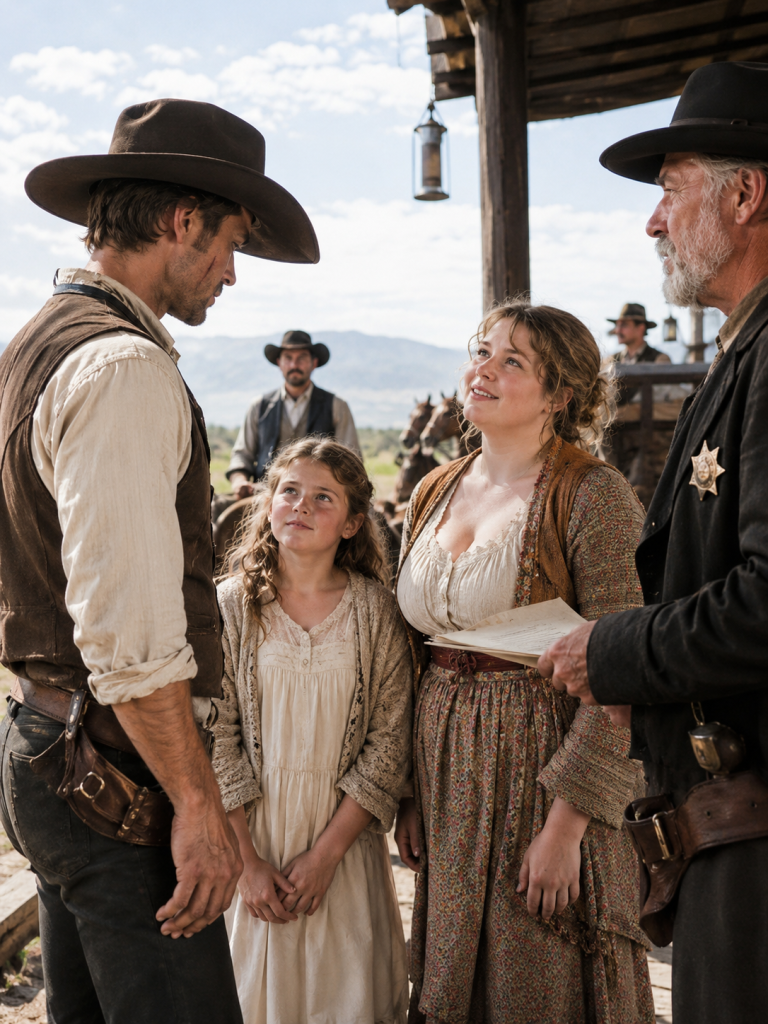
The driver was a sinewy woman with a sun-leathered face and a gap between her front teeth, sleeves rolled despite the heat. A boy of about twelve sat beside her, chewing a piece of grass with practiced boredom.
“Clara Hajj,” Cade said.
“Didn’t think you’d be so territorial, Valon,” she drawled. “Just passing through. Selling thread and vinegar. Got a sack of dried peaches if your woman wants it.”
Florence stepped forward. “What’s the price?”
Clara leaned over the side of the wagon and tossed a small cloth bundle. “For you? A trade. Heard you were stuck in Tuxen a while back.”
“Word travels,” Florence said.
“What do you want in return?”
“Soap. The kind that doesn’t smell like mule.”
“I’ve got a bar set with rosemary. Made it myself.”
Clara grinned. “That’ll do.”
The trade was made. The boy climbed down and wandered toward the goats, who regarded him with justified suspicion. Clara watched Florence the way experienced women watch people they are assessing.
“You staying put now?” she asked.
Florence glanced toward Cade. “I am.”
Clara nodded with the brief approval of someone whose standards are real. “Good. This land needs more women who don’t scare easy.”
They left by sundown, the wagon creaking west, a thin trail of dust behind them.
“She knew you from before?” Florence asked, watching the dust settle.
“We crossed trails once. She can gut a rattler faster than most men can draw.”
Florence cradled the peach bundle, fingers brushing the soft cloth.
“We’ll boil them for supper. Make a sauce.”
“I’ll start the fire.”
They ate with their knees touching under the small table, the taste of peaches sharp and warm on the tongue. That night, as the walls cooled, Florence sat with a blank piece of paper on her lap.
She looked over at Cade, who was oiling the window shutter hinges by lamp light.
“I want to write to my sister,” she said.
“Then write.”
“I don’t know how to explain all this.”
“You don’t have to explain,” he said. “Just tell her what’s real.”
She watched him test the hinge. Listened to the quiet creek of it finding its proper position.
“I want to tell her I found someone who sees me clear. Not for what I might become, not for what I left behind. Just for who I am.”
He turned toward her.
“Then say that.”
“I also want to tell her I’m not coming back.”
“You could say you’ve arrived somewhere instead.”
She dipped the pen in ink and began.
—
Cade hitched the wagon and rode into Tubac the next day to trade for nails, seed, and a bolt of gingham Florence had asked for. She stayed behind, tending the coop and mending the fence line where a jackrabbit had chewed through overnight.
When he came back late in the afternoon, the sky was heavy with building clouds and his shirt was streaked with sweat and road dust. He handed her the fabric without preamble.
She ran her fingers over it, already considering how much she’d need for sleeves.
That evening, just before the storm rolled in — thunder building in the distance, the air carrying the metallic edge of rain — he took her hand on the porch.
“I have something for you,” he said.
She looked up.
He pulled a narrow ring from his pocket. Not gold — silver, etched with desert vines. Careful work. Someone had taken time with it.
“I traded my old saddle horn for it,” he said. “Figured a man ought to do things proper even if the preacher’s a three-day ride.”
Florence stared at the ring. The breath caught hard in her throat — not from surprise, but from the feeling of something being offered without condition. Without cost. Without a version of her written into the terms.
“I know you said the name doesn’t matter,” he said. “But I’d like you to have mine. Not because you need it. Because I want to give it.”
She took the ring. Held it between her fingers.
The thunder moved closer.
“Yes,” she said.
—
They married two weeks later under the cottonwood.
Clara Hajj served as witness, her boy picking out a fiddle with more enthusiasm than skill. The sound it produced was technically music in the way that most things are technically something. Nobody minded.
Florence wore the dress she had sewn from the gingham — a clean dark blue that suited the desert light, practical enough to work in, decent enough for vows. Cade had shaved for the first time in months and nicked his chin in three places, which Florence mentioned and he pretended not to hear.
They said their vows without flourish.
Just hands joined and eyes steady and the words themselves, spoken once and meant entirely.
Afterward they stood in the field where the corn had grown waist-high, the sun dropping low behind them, painting the land in the particular gold that the Arizona desert reserves for late afternoon in June when the air is still and the work is done for the day.
Florence leaned her head against Cade’s shoulder.
“Do you still think you weren’t built for settling?” she asked.
He wrapped his arm around her.
“I think,” he said, “I just hadn’t found the place to settle into.”
—
Years passed.
The way years pass when they are good ones — not dramatically, not in the way that bad years pass, which is slowly and with vivid detail, but quietly. Accumulating.
They built a second room onto the cabin that winter, when the ground was too hard for planting and there was time to cut lumber and lay stone for a new foundation section. The work took three weeks. They argued twice about the placement of the window and agreed once about everything else.
Spring brought beans and squash planted in long rows behind the cabin, the soil dark and willing after the winter rains. Wild vines crept up the trellis Cade had built along the southern wall, clinging with the delicate determination of things that have decided where they are going.
And in the spring came Ruth.
She arrived in the way that children arrive — decisively, on her own schedule, with the complete self-possession of someone who has already made all the important decisions about themselves.
Florence’s eyes. Cade’s quiet way of observing the world before responding to it. A combination that produced, in Ruth, a child of serious attention and occasional startling laughter.
They named her Ruth because it was steady. Because it had weight. Because when you said it, it landed.
Florence pressed wildflowers into a worn ledger that she kept on the shelf beside the window — sometimes writing names in the margins, sometimes just the date and the color of the flower and the location where she’d found it. Primrose from the spring by the ridge. Desert paintbrush from the south pasture. Violet from the edge of the river, in October, after the first frost had been and gone.
Cade carved her a small bench from mesquite to sit on while she worked. The wood was pale and smooth, the grain running in a long curve, and he had taken time with it — not as a project but as a thing being made for someone specific.
The corn grew.
The goats continued to escape and continued to return when they were hungry.
Clara Hajj came through twice a year with her wagon and her opinions, and Florence traded soap for peaches and thread for whatever Clara was carrying, and their friendship — improbable, established in a ten-minute exchange over a soap bar — continued.
Florence wrote to her sister. Long letters, eventually, once she had figured out how to tell the story. Not from the beginning, not from the platform at Tuxen in the heat with the ring in her palm. But from the place she had arrived.
*I am not coming back,* she wrote. *I have arrived somewhere instead.*
—
At night they sat on the porch.
The stars spread thick above the Arizona Territory, the kind of stars that require actual darkness to become visible — and the desert provided darkness, proper and complete, every night without fail.
The sound of wind through the corn.
The occasional distant cry of something moving through the brush.
Ruth asleep inside, her breathing even and certain through the open window.
Cade’s hand in Florence’s, their fingers laced. Both of them looking at the same sky.
They had not planned this life.
They had not designed it or advertised for it or sent a telegram promising to meet it at a platform in Tuxen on a specific date. It had assembled itself piece by piece from choices made in sequence — some small, some significant, most of them barely articulated at the time, understood better in retrospect.
A woman letting a ring fall into the dust.
A man handing over food without asking what she could offer in return.
Two people sitting shoulder to shoulder through a night that needed to be survived.
A flat stone turned in a palm at the edge of a river.
A ring traded for a saddle horn.
A piece of gingham handed over in the late afternoon before a storm.
Piece by piece, choice by choice, until the life that resulted was entirely theirs — not inherited, not arranged, not assigned by someone else’s design or ambition. Built by their own hands, with their own materials, according to their own considered judgment about what was worth keeping.
Florence looked at the sky.
She thought about the woman on the platform at Tuxen — the cracked lips, the empty canteen, the ring tied to a ribbon around her wrist because she had trusted the wrong telegram. That woman had been standing very still in the heat, fixed on a horizon that was going to keep offering nothing.
She thought about the rider on that horizon.
The dust behind him. The storm-cloud eyes. The particular quality of his voice when he said *you look like you need help more than they do*.
She thought about how close she had come to a different outcome. To waiting one more day, or two, until the heat did what heat does. To taking the stage back to Kansas and the small room at her sister’s that would not have been offered but could not in decency have been refused. To a version of her life that would have been survivable, probably, but not this.
Not the porch and the stars and the corn and Ruth’s breathing through the window and Cade’s hand in hers.
Not this.
“Are you thinking again?” he asked.
“Always,” she said.
“About?”
“How close it was,” she said. “To not happening.”
He was quiet for a moment. Looking at the same sky.
“I think about that sometimes,” he said. “I almost rode through Tuxen without stopping. I was running late. I kept going back and forth about whether the detour was worth the time.”
“What decided you?”
“I saw the platform,” he said. “And someone standing on it in a dress that didn’t belong in a desert. And I thought—” He stopped.
“What did you think?”
“I thought: whoever that is, they’ve been there a while. And no one should be out there that long alone.”
She turned her face toward his.
“I’m glad you thought that,” she said.
“So am I,” he said. “Every day.”
He raised their joined hands and pressed his lips to her knuckles.
The wind moved through the corn.
The stars wheeled overhead in their old, indifferent, gorgeous way.
Somewhere in the desert, something moved through the brush and was gone.
Inside, Ruth slept.
And on the porch, the rancher and the woman who had come from Kansas and let a ring fall into the dust and chosen, instead, this — they sat with their hands together and the night around them, and neither of them needed to say anything more.
The desert stretched wide in every direction, vast and quiet and entirely theirs.
And it held.
Always.
THE END