The Widow Was Thrown Into the Street With Four Children—But When a Cowboy Said His House Had Empty Rooms, the Town Discovered Why No One Had Ever Been Allowed Inside

PART 1
The sound she would never forget was the hammer.
Not the words the banker shouted at the gathered crowd, not the creak of her own front gate, but that flat metallic strike against wood, again and again, sealing shut a door she’d walked through every day of her marriage.
Clara Whitfield stood on her own porch and watched a stranger nail paper over her life.
Her husband had been six months in the ground, crushed under a falling timber stack at a mill owned by the very bank now taking her house. Four children stood behind her in the yard, and not one of them understood why their mother couldn’t simply tell the man with the hammer to stop.
“Mama.” Her youngest daughter, Rosa, seven years old, pressed close against her skirt. “Where will we sleep?”
Clara had no answer. She had been turning that question over for three sleepless nights and had found nothing at the bottom of it but more questions.
Behind her, eleven-year-old Daniel stood with his jaw locked tight, doing his level best to look like the man of the house even as his hands shook at his sides. Nine-year-old Grace held tight to her little brother Wesley’s hand, the toddler too young to understand foreclosure but plenty old enough to read fear on every face around him.
Banker Cole Ashford turned to address the gathering crowd like a man delivering good news at a church social.
“Mrs. Whitfield has had ample time to settle her accounts. This bank cannot extend credit indefinitely, however sympathetic the circumstances.”
“My husband died in your brother’s mill,” Clara said, and hated that her voice shook saying it. “He gave that mill ten years.”
Ashford’s collar had gone damp with sweat despite the cool morning. “A tragedy. It changes nothing about the debt owed.”
Someone in the crowd murmured something sympathetic. Someone else was already eyeing her good chair like they were pricing it for purchase before sundown.
By early afternoon, what remained of Clara’s life sat stacked in the back of a borrowed wagon — two trunks, a few iron pots, her mother’s quilt, and four children perched among the wreckage like survivors of a shipwreck nobody else could see.
She took up the reins with hands that wouldn’t quite steady themselves. The church might offer a night, perhaps two. After that came charity, and after charity came the quiet conversations adults had about which family might take in which child, conversations she’d overheard once as a girl and never forgotten the shame of.
She drove the wagon forward without looking back at the house, because looking back wouldn’t change a single board of it.
Hoofbeats rose behind her.
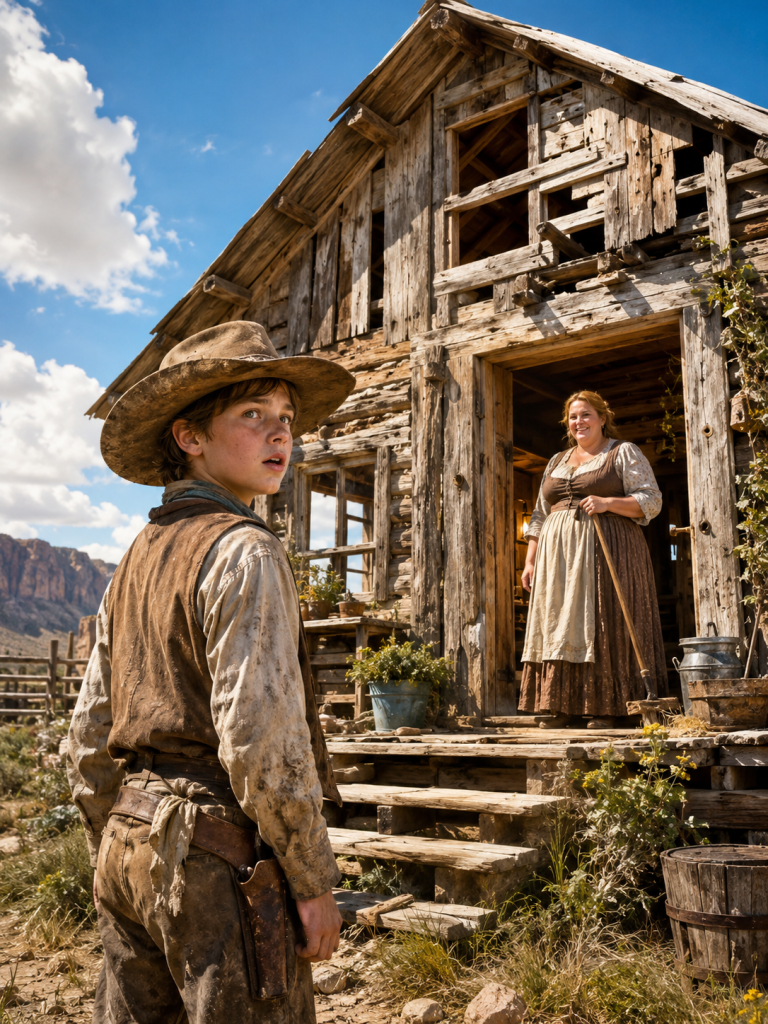
A rider drew alongside the wagon — broad-shouldered, dust-colored from a day’s hard work, with the kind of weathered calm that belonged to a man who’d buried things of his own and kept walking anyway.
“Name’s Garrett Holloway,” he said, matching her pace without crowding it. “Got a spread about five miles west. House has empty rooms going to waste.”
Clara stared at him, suspicion and a desperate, unwelcome flicker of hope warring somewhere behind her ribs.
Why would a stranger offer shelter to a ruined widow and four children he’d never laid eyes on before today?
PART 2
Clara kept both hands tight on the reins. “Why would you make an offer like that to someone you don’t know?”
Garrett’s jaw worked like the answer cost him something. “My mother was widowed when I was twelve. Four of us kids, nowhere to go. A rancher took us in for nothing but the promise of honest work. I never forgot what that meant.”
She glanced behind her — Daniel rigid and silent, Grace’s eyes red-rimmed, Wesley asleep at last against Grace’s shoulder like the smallest soldier in a war he hadn’t chosen.
The church would hold them a night, maybe two. After that, the town would start deciding things for her.
“This would be an arrangement,” Clara said firmly. “I cook, I keep house, you provide room and board and fair wages. Nothing more.”
“Nothing more,” Garrett agreed at once. “You have my word on it.”
His ranch sat beyond a stand of pine, bigger than she’d expected — an east wing with its own door, four bedrooms, a parlor gone dusty from disuse but dry and sound. For the first time that day, her children stood under a roof no banker’s hammer could reach.
That night Garrett served stew thick enough to stand a spoon in, and the children ate like they’d half-believed food might vanish before it reached their mouths. After they’d gone to sleep, he found Clara still sitting in the parlor.
“You’re safe here,” he said. “I meant what I said about the arrangement. But I’ll tell you plain — this house has been too quiet a long while.”
Clara understood then that the empty rooms weren’t the only thing this ranch had been missing. And that understanding frightened her more than Cole Ashford’s hammer ever had.
PART 3
Sleep didn’t come easily that first night.
The children managed it well enough — Grace curled beneath her grandmother’s quilt with Rosa tucked against her shoulder, Daniel asleep still in his boots as though bracing to be told to leave before sunrise, Wesley clutching half a biscuit he’d refused to relinquish even in dreaming.
Clara lay awake listening to a silence that wasn’t frightening the way the empty street outside her old house had been. This was a different quiet — the kind that belonged to a house that had simply forgotten what children’s voices sounded like.
Just before dawn she heard footsteps and slipped out to find Garrett in the kitchen, elbow-deep in bread dough, looking faintly embarrassed to be caught at it.
“Didn’t mean to wake you.”
“You bake.”
He shrugged. “My mother made sure all her boys learned.”
Clara allowed herself a small smile. “You’re doing it wrong.”
He looked down at the dough like it had betrayed him. “Figured as much.”
She stepped beside him, dusted the table, folded the dough twice, pressed it gentle and sure beneath her palms the way she’d been taught thirty years before.
“There.”
“My mother did it just like that.”
“Most good mothers do.”
His smile faded. “Mine’s been gone fifteen years.”
“My husband, six months.”
Neither spoke again for a while. Grief, she’d come to learn, didn’t need introductions to recognize its own kind.
The days settled into rhythm after that. Clara cooked and mended and scrubbed floors that hadn’t seen a proper cleaning in longer than she cared to guess. Grace planted flower boxes beneath the kitchen window. Rosa read to Wesley under the old cottonwood out back. Daniel trailed Garrett everywhere — fixing fence, checking horses, learning to swing a hammer without flattening his thumb.
One evening she found the two of them crouched over the chicken coop together.
“You’re holding those nails crooked,” Garrett told the boy.
“I know.”
“Then why keep doing it that way?”
Daniel didn’t look up. “Because Pa always fixed whatever I got wrong.”
The words hung there a long moment. Garrett took the hammer gently from the boy’s hand.
“Then we’ll learn it right together.” He handed it back. “Both of us.”
Clara turned away before either of them caught her crying.
Three weeks in, she started organizing the ranch accounts — nobody had asked her to, but the state of the drawers bothered her too much to leave alone. Bills scattered loose, invoices stuffed under ledgers, receipts curling inside old coffee tins. Numbers, she’d always believed, told the truth even when people didn’t.
She started reading in earnest. Feed costs. Lumber purchases. Property taxes. And then, again and again across page after page, the same bank.
The same signature.
Ashford Bank.
“Garrett.” She held up the ledger when he came in from the barn. “How long have you been borrowing from Ashford?”
He rubbed the back of his neck. “Couple years now. Bad droughts.”
“How much?”
“Enough.”
“That isn’t a number.”
He sighed and gave her a figure that made her stomach drop.
She turned more pages. “These interest charges — do you understand them?”
“Figured that’s just how banks work.”
Clara went very still, comparing three loan renewals side by side. Each one carried a steeper rate than the last, with no explanation attached, no new signature authorizing the change beyond a scrawl that didn’t quite match his own.
“Garrett. I think Cole Ashford has been stealing from you.”
She rode into town the next morning, not to accuse anyone but to ask questions the clerk’s office couldn’t refuse to answer. The county clerk recognized her on sight.
“Mrs. Whitfield.”
“I need to see mortgage filings. All of them, if I can.”
The clerk hesitated. “Ashford doesn’t care for folks digging through those.”
“I didn’t ask what Ashford cares for.”
An hour later she rode home with copies enough to fill a saddlebag, and a sick certainty growing with every page. Garrett wasn’t alone. Five widows. Three aging ranchers. Two wounded veterans, men who’d given a leg or an eye to something and come home to find their land going the same way. Every file carried the same pattern — quietly inflated interest, shortened deadlines, fabricated late fees, all of it just barely within the letter of the law, all of it ending the same way: land flowing into Cole Ashford’s growing portfolio.
“He’s building an empire out of other people’s grief,” she said to no one, and the words tasted like iron.
That evening she spread it all across Garrett’s dining table. Daniel watched from the doorway, silent and pale.
“This can’t be right,” Garrett said.
She pointed. “Your original note — that’s your hand. The renewal — also yours. But this amendment here—” she tapped the final page, “—isn’t.”
He stared. “I never signed that.”
“Someone did. For you.”
Daniel’s voice was small when it finally came. “He did the same thing to us. To Pa.”
Clara turned. “What do you mean?”
“After the accident at the mill, Mr. Ashford kept bringing papers by. Pa couldn’t read close print without his glasses, and they’d gone missing in the wreck. He trusted him to read it true.”
Clara closed her eyes. Her husband hadn’t simply lost their home to misfortune. He’d been robbed of it while he was already dying, by a man who’d shaken his hand at the funeral.
Word moved fast once it started moving. Other families began pulling their own papers from drawers and tins. A widow two farms over found her debt had somehow doubled without a single new loan taken. An old farmer discovered three signatures he swore weren’t his. Another rancher learned he’d been paying interest for over a year on a note that had technically already been satisfied.
By week’s end, a dozen families crowded into Garrett’s barn, lantern light catching dust in the rafters. Clara stood before them with a stack of copied documents in her hands.
“I don’t believe any of us has simply had bad luck,” she said. “I believe we’ve all been robbed by the same man, in the same way, and counted on to never compare notes.”
Nobody argued with her.
The hearing came two weeks later, the little courthouse packed past its benches. Cole Ashford walked in with his usual confidence and lost a measure of it the moment he saw the room — not one ruined widow easy to dismiss, but a dozen families, boxes of county filings, original notes laid against forged amendments, and witnesses enough to fill the gallery twice over.
Judge Pratt adjusted his spectacles. “Mr. Ashford. Did you alter the terms on these loans?”
“No, Your Honor.”
“Did you authorize these added signatures?”
“No.”
“Then perhaps you’ll explain why your own handwriting appears in the margin of every disputed amendment.”
Ashford’s hesitation lasted only a second. The whole courtroom saw it anyway.
Clara rose when her turn came, and kept her voice level though her hands trembled at her sides.
“My husband believed honest work would protect his family.” She looked at Ashford directly. “You taught him it wouldn’t.”
She lifted the first paper. “You took a home from a widow.” Another. “Land from a wounded veteran.” Another. “Hope from children who’d already lost a father.”
Her voice never rose above a steady, even pitch. “You counted on every one of us believing we were alone in it. We weren’t.”
The verdict came before sundown — fraud, forgery, illegal foreclosure on six counts and counting. Every disputed seizure was suspended on the spot, properties ordered returned, debts recalculated under honest terms. Ashford was led out in handcuffs through a courtroom that had gone from silent to weeping to something close to triumphant in the space of a single afternoon.
Change came slowly after that, the way real change usually does. Clara’s old home was legally restored to her name. The judge himself handed her the deed across his bench, and she stood holding it a long while before folding it carefully and tucking it away.
Garrett watched her face. “You don’t look like a woman who just got her house back.”
“I am glad of it.”
“Then why no celebration?”
She looked out toward the ranch windows, where her children’s laughter carried faint across the yard. “Because home isn’t always the place you lost.”
He understood her well enough by then not to press further.
A week after that, she began packing the trunks again. Rosa’s face fell. “Are we leaving?”
“Yes.”
Grace’s eyes filled. Wesley wrapped both arms around Garrett’s leg and refused to let go. Garrett carried the last trunk out to the wagon without saying much of anything, until there was nothing left to carry and no excuse left to delay the goodbye.
“You’ll always have a place here,” he said finally. “All of you.”
“I know.”
The silence that followed wasn’t uncomfortable so much as heavy with everything neither of them had said outright.
“I suppose,” Garrett started, and stopped.
She waited.
“I suppose the house goes back to being quiet.”
Clara looked at him — not the rancher who’d offered shelter out of an old debt to his own mother’s memory, but the man underneath that, the one who’d gotten used to bread shared at a crowded table and a boy following him to the barn every morning.
“You’re afraid,” she said gently.
He laughed once, short and rough. “Thought I hid that better.”
“You didn’t.”
“I got used to the noise. To the children.” A pause, his eyes finding hers. “To you.”
Her chest tightened around something she hadn’t let herself name yet.
“I kept telling myself it was only an arrangement,” he said.
“And?”
“It stopped feeling like one a long time ago.”
Neither of them moved for a moment. Then Clara reached into her coat pocket, drew out the deed to her old house, and tore it cleanly in half.
Garrett stared. “What are you doing?”
She smiled through eyes gone bright with tears. “Closing a door I don’t need open anymore.” She took his hand in both of hers. “That house was mine again, on paper. But it stopped being home the day I buried my husband, and no judge’s signature was going to change that.”
His breath caught audibly.
She looked past him to the yard — Rosa chasing Grace in circles around the well, Daniel laughing with the horses, Wesley riding high on Garrett’s own shoulders not an hour before. Then back to the man standing in front of her.
“You asked once why your offer frightened me more than cruelty ever did.”
He nodded slowly.
“Cruelty I understood,” she said. “I’d had practice with it. Kindness asked me to trust something again, and I wasn’t sure I had any trust left to give.” Her voice steadied. “I think I do now.”
“For what?” he asked, barely above a whisper.
She smiled. “For not calling this your house anymore.”
“Our house?” The words came out rough, hopeful, like he hardly believed he was allowed to ask.
“Our house,” Clara said, and meant it the way she hadn’t meant anything in a very long while.
Months later, the east wing of the Holloway ranch no longer sat empty. Laughter ran the length of every hallway most evenings, fresh bread cooled along the kitchen sill more mornings than not, and flowers Grace had planted that first spring climbed steady along the porch rail.
And whenever anyone in town asked Garrett Holloway why he’d once offered shelter to a ruined widow and her four children, he gave the same answer every time, with the same small smile aimed toward the woman hanging laundry in the yard.
“My house had empty rooms.”
Then, quieter, just for himself: “Turned out my heart did too.”
THE END