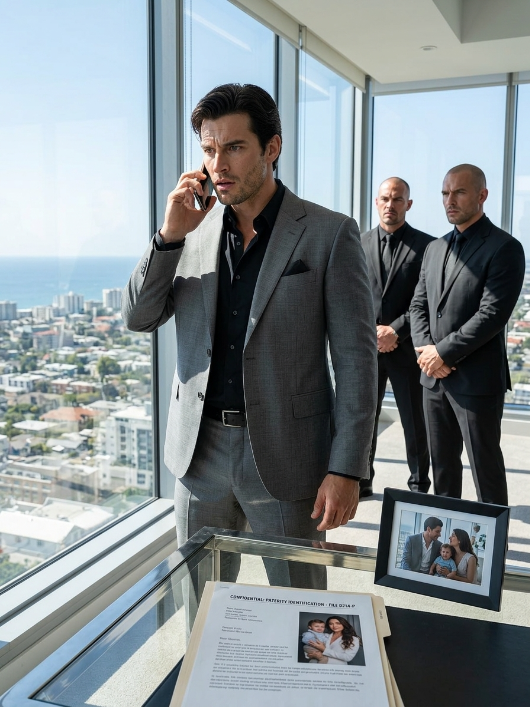
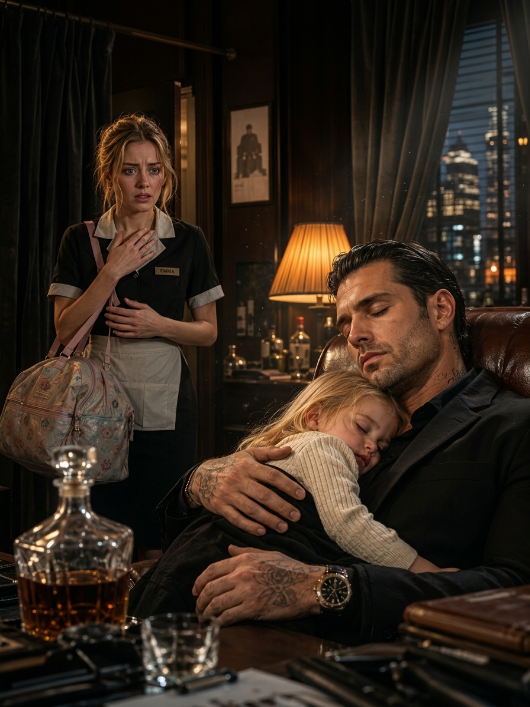
The Mafia Boss Rushed to the Hospital to Protect His Son—Then Saw a Bleeding Cleaning Lady Holding a Broken Mop at His Throat

## PART 1
I had been afraid exactly twice in my adult life.
The first time was the night my son was born seven weeks early, blue and silent, while doctors moved around me like weather I had no power over. The second time was three years later, when I realized I had built a world so dangerous that the only way to protect him from it was to never let him out of my sight.
Neither of those moments came close to what I felt when I walked through the doors of St. Catherine’s Hospital at two forty-seven in the morning and found one of my own men unconscious in the hallway.
Not injured.
Not dead.
Drugged.
Someone had put Marcus Reyes on the floor outside the elevator bank — a man who had survived a decade in my service — with the quiet precision of a person who didn’t want an alarm. Who wanted a window.
I knew what that meant.
My name is Cristian Vega. I built my empire from a single debt and a decision my father made when I was nine years old. By my thirty-eighth birthday, I controlled more of this city’s economy than its mayor, and I did it without once appearing on a list that mattered.
I was careful.
I was always careful.
Which was why I was already sprinting toward the pediatric wing before my security chief, Rodrigo, finished saying, “They got past Marcus.”
Room 517.
My son Matías.
Seven years old. Asthmatic since infancy. Hospitalized overnight for what his pediatrician had called a severe but manageable episode.
Manageable.
I had arranged three guards, two panic protocols, and a private room with no windows facing the street.
The corridor outside Room 517 smelled like bleach and something electric.
The door was ajar.
I hit it with my shoulder and entered low, gun raised, the way Rodrigo had taught me once when I was young enough to still be taught things.
A woman spun toward me from the foot of my son’s bed.
She was not a nurse.
She was not armed.
She was holding a metal IV stand like a baseball bat, both hands wrapped around the pole, her chest heaving, a cut along her jawline bleeding freely down the side of her neck. Her scrubs were dark-colored but wrong — too loose, the logo on the breast pocket torn halfway off. A custodial worker, I registered. Not staff.
She had placed herself between my son and the door.
“Don’t move,” she said.
My gun was already on her.
She did not step back.
“I mean it,” she said, her voice shaking but her feet planted. “I don’t care what you’re carrying. You come one step closer and I will put you through that window.”
She was terrified.
She was also not moving.
Matías lay behind her in the hospital bed, oxygen cannula in place, chest rising and falling, alive. The blanket was twisted, the bedside table overturned. A water cup had shattered on the floor. Signs of a struggle that had already happened.
“Where are they?” I said.
She blinked. “What?”
“The people who were in this room. Where did they go?”
Her grip shifted on the IV pole. “You’re not with them.”
“No.”
“Then put the gun down.”
“Not yet.”
“Your son is right here.”
“I know where my son is.”
Something moved through her expression — a recalibration, fast and visible, the way people adjust when the story changes under their feet. She looked at me with sharp, exhausted eyes, and then she lowered the IV stand about four inches.
Not all the way.
Four inches.
Like she was willing to revise her estimate of me without fully committing to trust.
“Two men,” she said. “One large, one shorter. Medical scrubs, wrong color. They came in about six minutes ago. I was emptying the biohazard disposal outside and saw them go in without knocking.”
“And?”
“And your son was awake and scared, so I went in.”
I looked at the overturned table. The broken cup. The cut on her face.
“With a mop?”
She glanced at the pole in her hands, then back at me.
“It was what I had.”
Rodrigo appeared in the doorway behind me, and she flinched back immediately, the IV stand snapping up to full height again.
“Easy,” I said. Not to Rodrigo. To her.
She heard the distinction. Her eyes moved to me.
“One of them went out through the service corridor,” she said. “The other one I hit with the disposal cart. He’s in the supply room. I locked it.”
Rodrigo made a short, disbelieving sound. “You locked—”
“I hit him first,” she said flatly. “Then I locked it. In that order.”
I looked at Rodrigo. He looked at me.
“Get the room,” I said.
He left.
I lowered my gun. Slowly enough that she could track it. Slowly enough that it meant something.
She lowered the IV stand by another four inches.
“You should sit down,” I said. “You’re bleeding.”
“I’m fine.”
“You have a two-inch laceration on your jaw.”
“I know. It’s my jaw.” She looked at Matías, and something in her face changed — the combat tension bleeding out, replaced by something softer and more complicated. “He cried. When they came in. He tried to be quiet about it but he cried.” She swallowed. “I have a son. Seven, like him. He makes that same sound.”
I looked at her.
Not at the cut. Not at the hands still gripping the pole.
At her face.
She was not afraid of me.
She was afraid of what had almost happened to a child who wasn’t hers.
“What’s your name?” I asked.
“Paloma,” she said.
“Paloma.”
“Reyes.” Then she caught herself. “Wait. Your guard outside—”
“Marcus Reyes. My head of floor security.”
Her expression sharpened. “Is he—”
“Breathing. Drugged.”
The color left her face. “They sedated your guard.”
“Yes.”
She stared at me.
Then past me.
Then at Matías, one more time.
“This wasn’t random,” she said.
“No.”
Her voice dropped. “So they knew the guard. They knew the room. They knew which night.” Her eyes came back to mine. “Someone told them.”
I already knew that.
What I didn’t know yet was whether the woman standing in front of me — who had just fought two trained men with a hospital disposal cart and was still on her feet — was part of it.
But she had stayed.
People sent to do harm did not stay.
I holstered my gun.
Then Rodrigo’s voice came through the earpiece, clipped and wrong.
“Boss. The man in the supply room.”
“Yeah.”
“He’s dead.”
Silence.
“Cristian.” His voice dropped further. “Poison capsule. Someone didn’t want him talking.”
I looked at Paloma Reyes, who was watching my face and reading it the way people read weather.
“What happened?” she said quietly.
“Someone cleaned up their mistake.”
“From inside the hospital?”
“From somewhere close.”
Her hand tightened on the IV pole.
And from somewhere in the corridor — too close, too careful — a door clicked shut.
—
## PART 2
Rodrigo had three men down by the time I reached the service corridor.
Not dead. Not this time. But wrong — sedated the same way Marcus had been, needles still visible in two of their necks. Professional work. The kind that required both access and patience.
This had been planned for weeks.
Paloma followed me into the corridor despite my telling her not to twice and ignoring her both times when she came anyway.
“The service elevator,” she said, pointing. “That’s how they moved. It goes to the basement parking garage. The camera in it has been broken for two months. I put in three maintenance requests.”
I looked at her.
“You filed maintenance requests about that camera.”
“I file maintenance requests about everything. It’s my job.”
“And nothing was done.”
She met my eyes. “Nothing was ever done.”
A small, terrible thing clicked into place.
The broken camera hadn’t been an oversight.
Someone had blocked those maintenance requests.
Someone with enough access to the hospital’s systems to keep a blind spot open, positioned, and ready.
My enemies had not found a gap in my security.
They had built one.
I pulled out my phone and called Rodrigo’s personal line.
“The hospital systems,” I said when he answered. “Who has administrative access.”
“I’ll need time—”
“You have ten minutes.”
I ended the call.
Paloma had moved to the elevator panel and was examining the maintenance log taped to the inside of the door.
“Three weeks,” she said.
“What?”
She pointed to a handwritten note. “Last time this was serviced. Three weeks ago. By a contractor I don’t recognize.”
She tore off the note carefully, by the corner.
“Evidence,” she said, when I looked at her. “You might need it.”
This woman — who had been mopping hospital floors in the middle of the night and had walked into a room with two killers and a child — was now preserving evidence at a crime scene.
“Who are you?” I said.
“I told you. Paloma Reyes.”
“That’s your name. That’s not what I asked.”
She looked at me.
“I’m a woman whose son was born in a hospital while two men with guns were fighting outside over a debt that had nothing to do with us.” Her voice stayed even. “He survived. I decided the next child in front of me wasn’t going to have a different answer.”
The corridor hummed with distant alarms.
From the floor below, raised voices — hospital security, finally awake, finally coming.
Rodrigo’s voice returned in my earpiece. “Boss. Administrative access. Three names. Two are legitimate staff.” A pause. “The third one.”
“Tell me.”
“The account was created eight months ago. Under your aunt’s maiden name.”
My blood went cold.
My aunt Carmela had been dead for eleven years.
Someone inside my family had created a ghost account, embedded it in the hospital infrastructure, and waited.
Not enemies from outside.
Enemies from my own blood.
Rodrigo said: “There’s more.”
“Say it.”
“Matías’s overnight admission — it wasn’t random. The nebulizer medication sent to his room this evening. We had it tested.” His voice tightened. “It was altered. Diluted enough that his episode wouldn’t resolve. Just bad enough to require overnight observation.”
They had made my son sick.
They had put him in this hospital.
They had cleared the path.
And then they had sent men to finish it.
My phone lit with an incoming call.
Unknown number.
I answered.
A man’s voice, relaxed, almost amused, said: “You move fast, Cristian. I’ll give you that. But you’re looking at this the wrong direction.”
I said nothing.
“The woman,” he said. “The one who got in the way. Ask her who her brother is.”
The call ended.
I turned slowly.
Paloma was still holding the maintenance log.
She saw my face.
And for the first time since I had walked through the door of Room 517, she looked afraid.
Not of me.
Of what I was about to ask.
—
## PART 3
“Who is your brother?”
The question came out quietly.
That was always the most dangerous version.
Paloma’s eyes didn’t move from mine. But something shifted beneath them — a tightening, a bracing, the way people look when they’ve been expecting a door to open for a long time and finally hear the handle turn.
“His name is Daniel Reyes,” she said.
I waited.
“He works for Ernesto Garza.”
The name landed in the corridor like a dropped blade.
Rodrigo made a sound in my earpiece. I pulled it out and pocketed it.
Ernesto Garza had been trying to displace my operation for four years. Not aggressively — not in ways that required open retaliation. In ways that were slower and more patient: bought judges, pressured suppliers, cultivated men inside my organization who believed loyalty had a number attached to it.
“Your brother works for my primary rival,” I said.
“Yes.”
“And you are here, in this hospital, on this floor, tonight.”
“I work here.” Her voice stayed steady. “I have worked here for two years. I work three nights a week because day shifts are full and I need the income and the schedule works around my son’s school.” She held my gaze. “I didn’t know about tonight. I didn’t know about any of it.”
“Garza used your name to get a maintenance contractor into this building.”
She blinked. “What?”
“A ghost account in the hospital’s administrative system. Created under your employee ID.”
The color drained from her face.
“They used me without—” She stopped. “Daniel wouldn’t have told them to—” She stopped again, and I watched her work through the shape of it. The realization that her brother might not have had a choice. That Garza’s people didn’t ask for volunteers.
“Is your brother aware of what was planned tonight?” I asked.
She was quiet for a moment.
“I don’t know,” she said. “And I don’t know is the honest answer. I haven’t spoken to Daniel in six weeks. He called me last month and told me to take an extra shift. Wouldn’t say why.”
Rodrigo tapped my shoulder from behind: police were coming up two stairwells. I had perhaps four minutes before this became complicated in ways that required lawyers rather than answers.
“The man who called me,” I said. “He told me to ask about your brother. Why?”
“To distract you,” she said immediately.
I looked at her.
“Think about it,” she said, with a sudden precision that was either native intelligence or practiced manipulation, and I was not yet sure which. “Your son is in that room. Two men tried to get to him. One is dead, one escaped. You have someone standing in front of you with a connection to your enemy, and someone just called you to point at her.” She held the maintenance log out toward me. “If I were part of this, why would I have filed those camera requests? They needed that blind spot. I kept trying to close it.”
I looked at the log.
She was right that it created a problem for the framing.
She was also exactly clever enough to have anticipated that I would think so.
I had survived this long by not resolving these contradictions too quickly.
“Come with me,” I said.
“Where?”
“Somewhere that isn’t a hospital corridor in three minutes.”
“My shift—”
“Is not your primary concern right now.”
She looked toward Room 517.
“I need someone to watch him,” she said.
I understood immediately: not a request for reassurance. A non-negotiable condition.
“Rodrigo,” I said.
He stepped forward.
Paloma looked at him with the particular assessment of someone who has learned to read men in difficult environments.
“You won’t let anyone in that room,” she said.
“No one breathes on that door,” Rodrigo said.
She seemed to accept that.
Then we moved.
—
The car was underground, two levels down, the matte-gray SUV idling with a driver who had been waiting thirty-one minutes without a word of complaint. Paloma climbed in without being told to, which told me something. People who had never been in these situations hesitated at the door. She didn’t.
She sat across from me and looked at the privacy screen between us and the driver.
“Where are we going?”
“A place I control.”
“That’s very general.”
“For now, it needs to be.”
She leaned back against the headrest and closed her eyes for exactly three seconds — I counted — then opened them again. The cut on her jaw had begun to clot. She hadn’t asked for anything to clean it with. She hadn’t mentioned it again.
“Tell me about Daniel,” I said.
She was quiet for a long time.
“He was thirteen when our father left,” she said. “I was eighteen. I’d just gotten a job at a bakery. Daniel started running deliveries for Garza’s people within the year.” A pause. “I thought it was temporary. He thought it was survival.” She watched the city move past the window. “By the time I understood it wasn’t temporary, he was in too deep to get out without losing something important.”
“His life.”
“His life,” she agreed.
“Does he love you?”
She looked at me. “What kind of question is that?”
“An important one.”
She considered it. “Yes. Imperfectly. But yes.”
“Then he won’t have wanted you used.”
“No.” Her voice quieted. “He won’t.”
I picked up my phone and dialed.
Three rings.
“Who is this?” A young man’s voice, wary, tight.
“My name is Cristian Vega,” I said. “Your sister is in my car. She’s not hurt. But she needs you to tell me what you know about tonight.”
Silence.
Then: “Is she safe?”
I looked at Paloma.
She made a small gesture: give it to me.
I handed her the phone.
“Danny,” she said. One word. The whole weight of sibling history in it.
I watched her face while she listened.
Whatever Daniel Reyes said made her close her eyes again.
This time for longer.
“I know,” she said finally. “I know. But they used my ID. They used my name.” Her voice hardened. “You let them use my name.”
More silence on the other end.
“Tell him,” she said. “Tell him everything you know.”
She handed me the phone back.
Daniel Reyes spoke for eleven minutes.
He told me about a meeting four months ago where Garza had outlined a plan. The hospital. The child. The administrative access through an employee ID that Garza’s man had harvested off a system Paloma used at work. Daniel had not known whose child was the target until three weeks ago.
He had spent three weeks trying to find a way out of the information without getting his sister killed.
He had not found one.
“You should have come to me,” I said.
“You would have killed me.”
“Probably,” I said. “But your sister would still be cleaning hospital floors instead of covered in blood.”
A pause.
“Is she really okay?”
I looked at Paloma Reyes, who was watching the city through rain-smeared glass with the expression of someone who has made peace with several things they hadn’t planned on.
“She’s better than okay,” I said.
—
What Daniel told me in those eleven minutes rearranged everything.
The ghost account in the hospital system was only one thread. The altered nebulizer medication was another. Both led back to a man named Fuentes — Garza’s logistics director, the architect of quiet operations that Garza himself could later deny knowing about. Fuentes had been building this for months. The hospital infiltration, the guard sedation protocol, the men in Room 517. All Fuentes.
Garza would deny it.
He would deny it well, because that was what Garza did — he hired people specifically so he could deny things well.
But Daniel had kept records.
Not bravely. Desperately. As insurance against the day he needed to run.
That day had arrived.
By four in the morning, I was sitting in a basement office I kept for conversations that required no witnesses, with Rodrigo standing near the door, Paloma Reyes sitting across from me still in torn scrubs with dried blood on her jaw, and a laptop displaying enough of Fuentes’s documentation to end three careers and one freedom permanently.
“Your brother,” I said to Paloma, “has two choices. He brings this forward officially, which protects him from Garza’s retaliation and from mine, or he disappears and this goes another way.”
She was quiet.
“I want him safe,” she said.
“I know.”
“Not just handled. Safe.”
“Paloma.”
She looked at me.
“I don’t kill people who didn’t try to kill my son,” I said.
The silence that followed had a texture to it — the particular quality of someone deciding whether to believe something they want to be true.
“How do I know that?” she said.
“You don’t. Not yet.” I leaned back. “But you’re still in this room.”
She thought about that.
“He needs to be out of the city,” she said. “Whatever arrangement you make, it has to include distance.”
“Agreed.”
“And I need it in writing.”
Rodrigo made a sound.
I held up one hand and he stopped.
“Writing,” I said.
“I know what verbal agreements are worth from men in your position.”
“You’ve dealt with men in my position.”
“I’ve cleaned up after them for two years. That’s education enough.”
A beat.
I picked up a pen.
—
It took six days to dismantle what Fuentes had built.
Not cleanly. Nothing in my world dismantled cleanly. But thoroughly enough that Garza found himself answering questions from people who wore badges and recorded conversations, which was its own kind of ending.
Fuentes was arrested on a Tuesday.
Garza followed on Thursday, under charges that originated from documents Daniel Reyes provided in exchange for relocation and a new name in a city far enough away that the math was simple.
Daniel called Paloma the night before he left.
I was not in the room for that conversation. I didn’t ask what was said. Some things are not mine to know.
Matías was discharged on the fourth day, officially recovered, with new protocols in place for his care and a private physician I trusted with the specific kind of trust that could be revoked permanently.
He remembered Paloma.
Children remember the people who were afraid on their behalf. It registers differently than the people who are paid to protect them.
“She hit the bad men?” he said.
“She did.”
“With what?”
“A hospital cart.”
He considered this. “That’s good.”
“Yes,” I said. “It is.”
—
I found Paloma on her next shift.
Not dramatically. Not with cars and guards. I walked into St. Catherine’s at ten in the morning like a man visiting the hospital, which was true, and I took the elevator to the fifth floor, where a custodial cart sat outside Room 512 and a woman in clean scrubs was wiping down a hallway window with the deliberate thoroughness of someone who had decided that what was in front of her deserved full attention.
She heard me coming.
Turned.
Looked at me for a moment.
“You didn’t have to come in person,” she said.
“I know.”
“You could have sent Rodrigo.”
“Rodrigo is not a person you send to thank someone.”
She turned back to the window. “I don’t want money.”
“I know that too.”
“Or protection. Or a job in your organization. Or anything that comes with a complication attached.”
“I know.”
She stopped wiping. “Then what?”
I had thought about this for six days. In the margins of meetings, in the hours between sleeping and not sleeping, in the car on the way to the hospital where my son had been lying in a bed because someone had decided he was useful as leverage.
What I had arrived at was not complicated.
“My son asks about you,” I said.
She turned around fully.
“He wants to know if you’re okay,” I said. “He asks every morning. Not about the men who came into his room. About you.”
Something moved through her face.
“He’s seven,” she said.
“He’s seven. And he was awake when you came in with that IV stand. And he remembers.”
Paloma was quiet.
“His mother,” I said. “She died four years ago. Cardiac event, no warning. He has good people around him — Rodrigo, the nannies, the tutors. Good people.” I paused. “But he doesn’t ask about them in the mornings.”
She looked at me for a long time.
“You’re not asking me to be his mother,” she said.
“No. I’m asking if you’d be willing to meet him. Officially. Outside a hospital room, not mid-crisis, when he’s not terrified and you’re not bleeding.”
“And then?”
“And then nothing predetermined. You decide what it means.”
She searched my face.
I had learned, in those six days, that Paloma Reyes searched faces the way other people read maps — looking for the route, the exits, the places where the road turned without warning.
“What about you?” she said.
“What about me?”
“Are you asking only about Matías?”
The question was direct. She was always direct. I had begun to understand that this was not aggression — it was efficiency, developed by a person who had been given too many indirect answers at critical moments.
“No,” I said.
She waited.
“I’m asking about you,” I said. “In a less specific way, for now. Because you walked into a room with two men and a gun because there was a frightened child in it, and I would like to know the rest of what makes a person do that.”
“You already know the rest.”
“You told me about your son. About Daniel. About your father leaving.” I held her gaze. “That’s the outline. I’d like to know the actual story.”
Something loosened in her face. Not all the way. Enough.
“I’m not good at receiving things,” she said.
“I’ve noticed.”
“I will probably argue with most of what you offer.”
“That seems likely.”
“And I don’t do anything that puts my son at risk.”
“Paloma.”
“I mean it.”
“I know.” I paused. “I have a son. Do you think I would ask you to trade one child’s safety for another’s?”
She looked at the window she’d been cleaning. At the city below it. At whatever she was weighing against whatever she was afraid of.
“Coffee,” she said.
“What?”
“You can start with coffee.” She went back to the glass. “Somewhere public. Daytime. No Rodrigo.”
“Done.”
“And you pay for it.”
“Obviously.”
“I’m just making sure.”
I almost smiled.
“Friday,” I said. “There’s a place on Amsterdam Avenue.”
“I know the one.”
Of course she did.
She worked in this neighborhood.
She knew every corner of it.
—
Fourteen months later, Matías stood on a stepstool in our kitchen, very seriously instructing Paloma’s son Tomás on the correct method for flipping a pancake.
Tomás was not listening.
Tomás was seven years old and primarily interested in whether he could flip the pancake onto the ceiling and have it land back in the pan, which was not a skill Matías had thought to develop but which he immediately agreed was important.
Paloma stood next to me at the counter, watching them with the particular expression of a woman calculating which of several possible disasters was most likely to occur.
“The ceiling,” she said.
“Probably not,” I said.
“The floor.”
“Almost certainly.”
“I’m not cleaning it up.”
“You work at a hospital. Cleaning things is your professional skill.”
She elbowed me.
I caught her arm and she let me keep hold of it, which still, every time, felt like something I had not fully expected to earn.
Rodrigo appeared in the doorway, looked at the children, looked at us, and retreated without a word.
He had been doing this for months.
He claimed it was because the kitchen smelled like burned butter.
We did not challenge this.
Outside, it was raining — October rain, the kind that muffled the city and turned the windows silver and made the apartment feel, for the duration of it, like the only warm place in the world.
Matías got the pancake halfway to the ceiling.
Tomás screamed with joy.
The pancake landed on the stovetop and began to smoke.
Both boys scattered.
Paloma moved to the stove without hurrying, turned off the burner, and looked at the pancake with the expression of someone who has faced worse.
“It’s salvageable,” she said.
Matías peered around the corner of the doorway.
“How bad?” he asked.
“Bad,” she said.
“But salvageable?”
“Everything is salvageable,” she said, “if you’re not too precious about what it looks like when it’s done.”
He thought about this.
“Okay,” he said, and came back into the kitchen.
Tomás followed.
I watched Paloma scrape the burned edge of the pancake into the compost bin, watched her redirect both boys back to the stepstool with the calm authority of a woman who had spent years managing chaos in hallways where people were afraid, and thought about the night I had walked through a hospital door and found her standing at the foot of my son’s bed with a metal pole in both hands.
She had been terrified.
She had not moved anyway.
I had spent my adult life surrounded by people who were not afraid of me.
What I had not understood, until Paloma Reyes, was that the rarer and more valuable thing was someone who was afraid, and stayed anyway.
Not because of money.
Not because of power.
Because there was a child in the room.
She looked up from the stove and caught me watching her.
“You have that look again,” she said.
“What look?”
“The one like you’re about to say something serious.”
“I’m not.”
“You are.”
I was.
But there were pancakes burning and children in the kitchen and a window full of silver rain, and the serious thing had been true for several months already, which meant it could wait another twenty minutes.
“Later,” I said.
She studied me.
“How much later?”
“After the pancakes.”
“All of them?”
“All of them.”
She looked at the pan.
Then at me.
“You’d better hope Tomás stops trying to hit the ceiling,” she said.
“I have every confidence in Matías’s instructional ability.”
A crash from the corner.
An egg on the floor.
Both boys stared at it.
Paloma turned back to the stove.
“I’m not cleaning that either,” she said.
“Rodrigo,” I called.
His voice came immediately from the hallway: “Still not my job.”
Matías and Tomás began laughing.
Paloma’s shoulders shook.
And in a kitchen that smelled like burnt butter and October rain, in a life that had been rebuilt from a hospital hallway and a woman who did not run, I found the thing that all the power and all the money and all the fear I had accumulated had never once managed to provide.
Something worth protecting that was not afraid of being found.
—
—
—