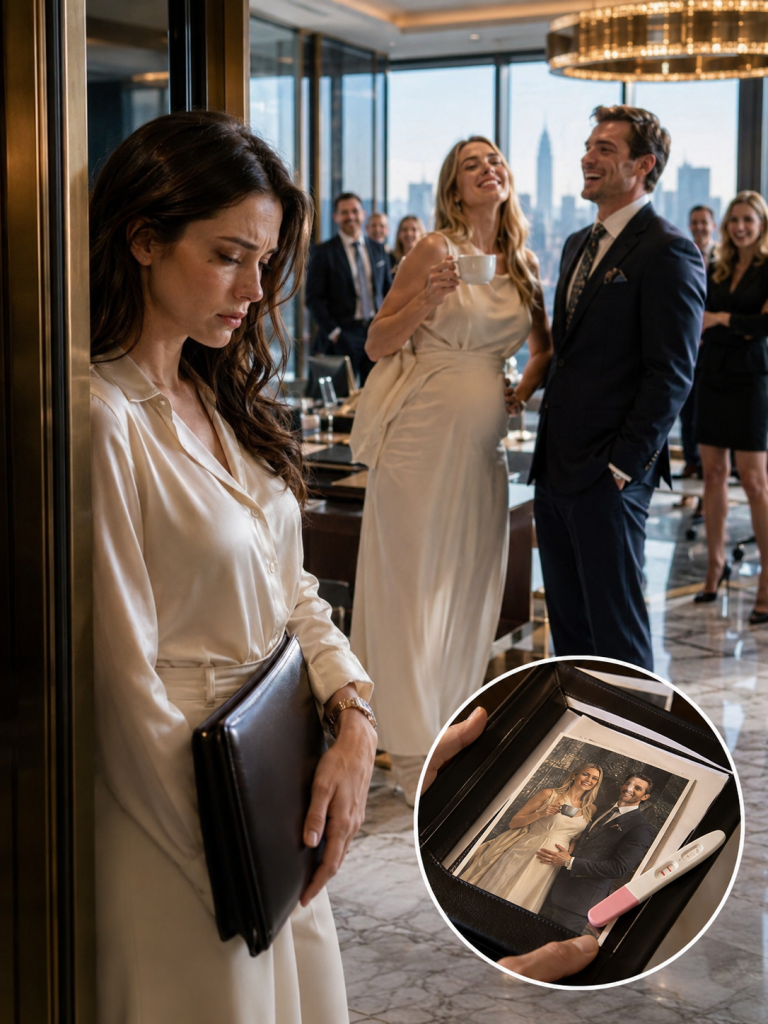
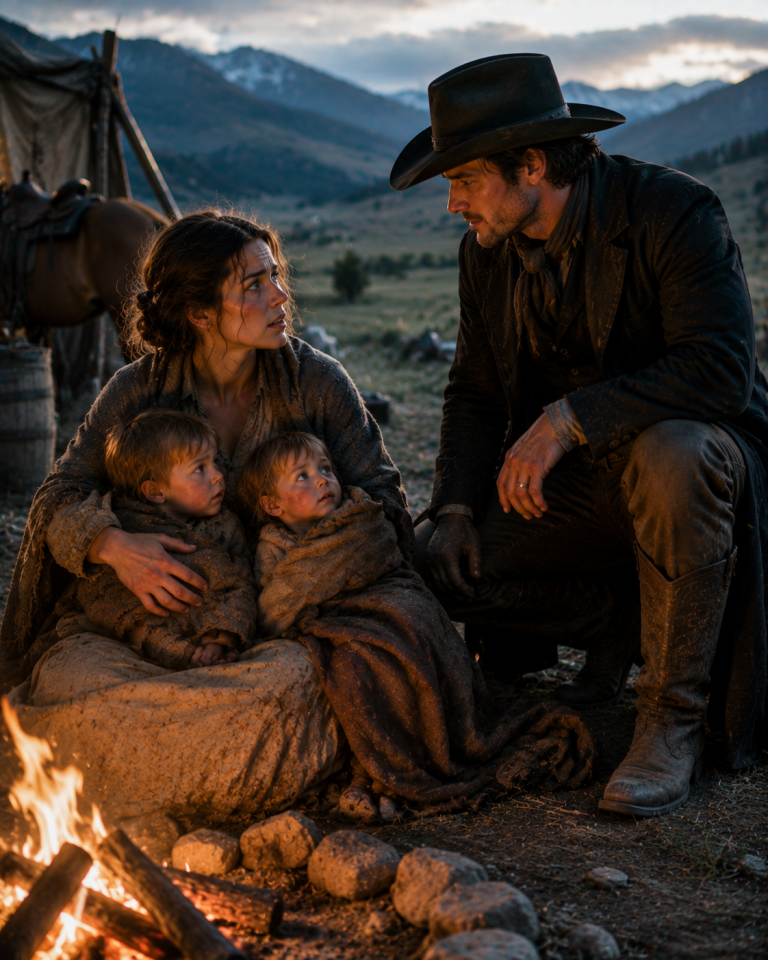
She Thought She’d Be Fired—Instead, the Mafia Boss Held Her Daughter Asleep in His Arms

## PART 1
She almost didn’t open the door.
The supply closet outside the private office was supposed to be empty at 11 p.m. on a Thursday. Claire Mercer knew the schedule of every locked room in the Reeves Club the way she knew the bus routes and the overnight pharmacy — by necessity, the way single mothers learn the geography of survival.
She had been hiding in that closet for forty minutes with Mia in the carrier against her chest, the baby drowsing in the warm dark while the dinner service wound down two floors below. Her neighbor Mrs. Flores had twisted her ankle on the front steps at six that evening, and Claire had spent the next two hours making three phone calls that went unanswered before accepting the thing she’d been trying not to accept: she had no one.
So she’d brought Mia with her.
The carrier was covered by Claire’s coat. The diaper bag fit under the linen shelf. She had planned — precisely and naively — to work the floor until midnight, change and feed Mia in the third-floor bathroom during her break, and be home before the baby made a sound worth explaining.
That plan dissolved when Mia began fussing at half past ten with the particular impatience of a fifteen-month-old who had run out of patience for good ideas that didn’t involve her.
Claire had slipped into the supply closet. She’d rocked. She’d hummed. She’d offered the bottle she’d warmed in the staff kitchen when no one was watching, and Mia had taken it with both hands like she was conducting a negotiation.
Now the baby was nearly asleep again, and the corridor beyond the door was quiet.
Except for the office.
The door two feet to Claire’s left belonged to Dante Reeves.
She knew whose door it was. Everyone at the club knew. The office at the end of the private hall was not listed on any staff map and was not cleaned without an appointment that required three approvals. Its occupant arrived and departed through a private entrance and was discussed among the waitstaff in the specific tone that people used for weather systems — carefully, as something you tracked and tried to stay clear of.
Dante Reeves. Forty-one years old. Owner of the Reeves Club and, depending on which whisper you believed, of considerably more than that. Newspapers printed his name in proximity to words like *alleged* and *connected* and *under investigation*, then retracted the proximity when the papers received letters from attorneys with better offices than the reporters’ entire buildings.
He had a face that made rooms go quiet when he entered.
Claire had seen him twice at a distance and had been grateful for the distance.
Which made what happened next entirely unfair.
The sound was small — barely anything. A sigh, maybe, or the shift of leather. Low enough that Claire would have missed it if Mia hadn’t heard it first.
The baby lifted her head from Claire’s shoulder and stared at the door with the sudden alertness of a child who has identified something interesting.
“No,” Claire whispered. “Absolutely not.”
Mia reached for the door handle.
“Mia.”
The handle was lower than it should have been — old hardware, the building was from 1922 — and Mia was taller than she’d been three weeks ago, and the latch clicked before Claire’s hand could intercept it.
The door swung inward six inches.
Claire caught it with her palm, heart stopped, ready to pull it shut again—
And saw Dante Reeves asleep in his chair.
She should have left. She understood that immediately and completely. The correct action was to pull the door shut with no sound and walk with deliberate calm toward the staff staircase and spend the rest of the shift pretending this hallway did not exist.
She did not leave.
Because Mia made a sound — a small, interested sound, the sound she made at the cat she was not allowed to pet at the shelter on Western Avenue — and Dante Reeves’s eyes opened.
The eyes were darker than Claire expected. She had braced for something cold and found something worse: alert. Fully, immediately, completely alert in the way that people are alert when they’ve spent years waking to threats and have learned to arrive at consciousness armed.
He looked at Claire.
Then at Mia.
Claire waited for him to say something that would end her employment.
Instead, something happened in his face that she could not immediately name. Not softness. Nothing as simple as that. More like a door had opened behind his eyes that he hadn’t chosen to open.
“She yours?” he said.
“Yes.” Claire’s voice came out steadier than her pulse. “I’m sorry. I’ll go.”
“She’s not crying.”
Claire blinked.
“I was expecting crying,” Dante said. He looked at Mia with an expression that continued to resist categorization. “Most people cry when they see me.”
“She’s fifteen months old. She doesn’t read newspapers.”
Something moved at the corner of his mouth.
He lifted one hand — the gesture people make when they’re indicating a chair — and Claire, who later could not explain this decision to herself, walked into the office and sat down.
Mia twisted in the carrier, reaching toward the man across the desk with the universal toddler gesture that meant *that person seems interesting and I would like to touch their face.*
“She does that,” Claire said. “She doesn’t know better yet.”
“Teaches herself people aren’t dangerous?”
“Something like that.”
“And if they are?”
“She’s fifteen months old,” Claire said again. “I handle the dangerous parts.”
Dante looked at her with an expression that might have been the beginning of respect.
He reached forward slowly, not to take Mia — just to offer one finger within her reach. Mia grabbed it immediately with both hands and pulled with the considerable determination of someone who had been awake since five that morning.
Dante allowed this.
That, more than anything else, disarmed Claire completely.
“You’re not going to ask me why I brought her?” Claire said.
“I know why. Mrs. Flores slipped this afternoon.”
Claire stared at him.
“I own the building across the street from yours,” he said simply. “I know when people fall.”
There was a silence that should have been ominous and instead was just — strange. Quiet. Mia yawned enormously and leaned back against Dante’s finger with the complete confidence of someone who had decided this was fine.
“I’ll leave after I feed her,” Claire said. “I won’t bring her back.”
“Feed her now. You can finish the shift.”
“Mr. Reeves—”
“Dante.”
The word landed with such finality that Claire didn’t push it.
She fed Mia while the office held its peculiar quiet around them, and at some point Mia fell asleep, and at some point Dante, who had not slept properly in — he said — almost two years, fell asleep in his chair with the baby against his chest beneath his jacket, and Claire sat across from them both in the office of the most feared man in Chicago and understood, fully and absurdly, that she was not afraid.
She was trying to figure out what to say when he woke.
What she said was nothing, because what woke him was the knock at the door.
One of his guards. Pale. Tense in the specific way that guards were tense when something had already gone wrong.
Dante came awake with the same complete alertness as before, one hand immediately steadying Mia without waking her.
“Boss,” the guard said. “There’s someone asking for Claire at the rear entrance.”
Claire’s stomach dropped.
“Who?”
The guard looked at her. Then at Dante. Then back at her with the expression of someone delivering information he would prefer not to deliver.
“He says his name is Nathan Price.”
The name entered the room like a dropped key.
Claire felt the floor shift under her.
Beside her, she watched something cross Dante’s face — not recognition, not yet, but the beginning of it — and she thought: *the ring*, and she thought: *oh no*, and she thought nothing else because Dante had placed Mia gently into her arms and was already moving toward the door with the controlled velocity of a man who had been waiting for something for a very long time.
“Lock this behind me,” he said.
“Dante—”
“My voice only.” He stopped in the doorway. “Is it really him?”
Claire’s throat had closed.
“I don’t know,” she said.
Dante looked at her once more. A long, measuring look.
“You know the name.”
“He was Mia’s father,” Claire whispered.
The change in Dante’s face was the fastest and most complete thing she had ever witnessed.
He looked at Mia. Looked at Claire. Looked at Mia again with something in his eyes that had no name she had the vocabulary for.
Then he stepped out into the corridor and the door closed and Claire sat with Mia in the dark office of the Reeves Club and locked the door and waited for the world to make sense again.
It didn’t.
The music downstairs stopped mid-song.
Then the first gunshot came.
—
## PART 2
Mia started crying at the second shot.
Claire pressed her back against the wall beside the desk and held her daughter and listened to the night rearrange itself into something unrecognizable. Footsteps. Shouting. Two more gunshots and then a sound she had no reference for — heavy, structural, like a wall absorbing something that walls weren’t designed to stop.
Then the elevator at the far end of the office opened.
Claire spun.
A man stumbled out of it and caught himself against the frame. Snow melting from a dark coat. Blood at his neck, his left hand, spreading through the fabric at his ribs. He was thinner than she remembered. The beard was new. The eyes were not.
“Nathan,” she said.
He found her across the room the way he had always found her in crowded places — immediately, like he’d never stopped looking.
Then his eyes dropped to Mia.
The world left his face and was replaced by something better.
“She has my nose,” he whispered.
“She has your ears,” Claire said, and her voice broke on it. “You left.”
“I had to.”
“You disappeared.”
“I know.”
“You could have—”
“I couldn’t.” The two words cracked open. “I tried to write. I tried — they were watching everything. Everyone near me, everyone I—” He stopped. “I thought you’d be safer if I was gone.”
The gunfire downstairs surged again.
Nathan flinched toward it — not away from it, toward, the instinct of someone braced to absorb something — and Claire saw fear in his face. Not for himself.
He crossed to her carefully, one hand pressed to his ribs.
“I need you to listen,” he said. “We don’t have much time.”
“Who’s shooting?”
“People who’ve been looking for me.”
“Because you stole something.”
His eyes sharpened. “Who told you that?”
“No one yet. I guessed.” She looked at Mia, then back at him. “Nathan. What did you take?”
Before he could answer, a weight hit the office door from outside. Not a knock.
An impact.
Nathan’s hand went to the back of his waistband and came back with a gun, and Claire grabbed Mia against her chest and thought: *this is the life he came from*, and the thought was not judgment, it was just the truth arriving in her body and settling in her bones.
“You brought this here,” she said.
“It followed me here,” he said. “There’s a difference.”
Another impact. The door shuddered.
Mia cried harder.
Nathan’s face crumbled at the sound — not collapsed, crumbled, the way something crumbles when a force it’s been resisting finally gets through.
“That’s my daughter,” he said.
“Yes,” Claire said. “She is.”
The lights went out.
Red emergency glow painted everything in terrible color.
Outside the door, men went quiet.
All of them.
Even Nathan’s breathing changed.
“Who made them stop?” Claire whispered.
Then a woman’s voice came through the door.
Elegant. Calm. The voice of someone who had never once needed volume.
“Nathan.”
Nathan went white.
Claire stared at him.
He did not look at the door.
He looked at Mia with the expression of a man counting what he might lose.
“Nathan,” Claire said. “Who is that?”
He turned.
And what she saw in his face was worse than fear.
“Our mother,” he said.
Claire thought she’d misheard.
“Your—”
“She runs everything Dante built his career trying to escape.” Nathan gripped her arm. “She isn’t here for you. She’s here for the child.”
Outside, Dante’s voice cut through the door.
“You don’t come near her.”
The woman laughed — short, genuine, without cruelty but somehow colder for it.
“You were always the dramatic one.”
The elevator was still open behind Nathan.
He pressed the button to hold it.
But before they could move, the office door exploded inward.
Wood and smoke and the smell of something burning.
Dante stood in the frame breathing hard, blood from a cut above his brow painting the side of his face. Behind him, through the smoke, a woman in a white coat stepped forward with the unhurried grace of someone who had never once been required to rush.
Silver-haired. Beautiful. Completely untouched by the chaos she had walked through.
She looked at Mia.
She smiled.
And said, softly, to no one in particular:
“She has his eyes.”
Nathan went still.
Dante went still.
Not because of the woman.
Because she was not talking about Nathan.
She was talking about someone else.
Someone who had supposedly been dead for ten years.
The elevator doors began to close.
Claire stepped inside.
Nathan followed.
Through the narrowing gap, she watched Dante’s face — the face of the man who had held her sleeping daughter an hour ago with something almost like gentleness — show an emotion she had not believed his face capable of.
Genuine fear.
Then the doors sealed shut.
And the elevator descended into the dark.
—
## PART 3
**What Nathan Stole**
The building below the Reeves Club had three sub-levels nobody on the payroll knew about.
Nathan knew, because Nathan had spent three years working for Dante before he started looking at what the organization actually moved and couldn’t unknow what he found.
He took them to the second sublevel — storage, concrete walls, a boiler that made the kind of industrial noise that covered conversation — and sat down on a crate with his hand pressed against his ribs.
Claire held Mia and looked at him.
“Tell me all of it,” she said.
Nathan told her.
He’d been running courier jobs for Dante’s legitimate side when he found the ledger. Not stumbled — found, deliberately, because he’d been asked to move a locked case between two warehouses and had grown up in Dante’s world long enough to know that locked cases contained the things people most needed to keep quiet.
He’d made a copy.
The ledger contained eighteen months of financial records from a man named Santoro — a name that meant nothing to Claire and apparently meant everything to everyone who mattered in Chicago. Payments to federal judges. Wire transfers through three shell companies to a sitting senator. Payments to someone inside federal intelligence who had been selling the names of protected witnesses for four years.
People had died for those names.
“So you took it,” Claire said.
“I couldn’t not take it.” Nathan’s voice was flat with the tiredness of someone who had been saying this to himself for seventeen months. “If I’d left it, people would keep dying and nobody would know.”
“You could have gone to the FBI.”
“Half the people in the ledger have FBI business cards.”
Claire was quiet for a moment.
“But you memorized it,” she said.
Nathan looked at her.
“Before you hid the physical copy,” she said. “You memorized it.”
A pause. “How did you—”
“Because you used to read the menu at the diner three times and then recite it back to me from the next room to make Mia laugh.” Claire shifted the baby on her hip. “You have a photographic memory and you’d have known that a physical document could be found or destroyed.”
Nathan stared at her.
“I love you,” he said.
“Don’t,” Claire said. “Not yet. Tell me the rest.”
“They burned my car to send a message. When I realized Santoro’s people had also found out about — about you, about Mia — I knew I had to come back. I couldn’t—” He stopped. Tried again. “I left a message for Dante. In the music box.”
“What music box?”
“The one I sent you. Two weeks before Mia was born.” He looked at her. “You never opened it.”
Claire’s stomach turned over.
“Nathan, I thought you were gone. I gave Mia the music box when she started teething. She chewed on the—” She stopped. “Oh God. Is it still at the apartment?”
“If Mia chewed it, the compartment might have—”
Footsteps on the stairs above them.
Dante appeared a moment later with two of his men, a jacket that had been white an hour ago, and the specific expression of someone who has spent an hour reconfiguring everything they understood about the last seventeen months.
He looked at Nathan.
Nathan looked at him.
The two men across the room from each other were so similar in the way they went still that Claire’s chest ached at it.
“You should have told me,” Dante said.
“You would have handled it.”
“Yes.”
“That’s why I didn’t.”
Dante turned away briefly. When he turned back, something had been decided behind his eyes.
“There’s something you need to know,” Dante said. “Both of you.”
He pulled a photograph from his jacket and placed it on the crate between them.
Claire leaned forward.
A man she didn’t recognize. Older. Silver-haired. A face that had Dante’s bone structure and Nathan’s mouth.
“Your father,” she said.
“My father is dead.”
“That photograph was taken eleven weeks ago,” Dante said. “The man you’re looking at has been living under three different names since his supposed death ten years ago.”
Nathan’s hand tightened on the crate edge.
“He’s alive.”
“He’s been alive the entire time.”
A silence settled over the three of them.
Then Dante said, “And the woman who came through my office tonight — our mother — has known for years.”
Nathan’s face became very still.
“She didn’t tell you.”
“No.”
“Why?”
Dante looked at Mia, who was watching both of them with the wide-eyed assessment of a child absorbing information she would not be able to use for years.
“Because she says blood matters more than anything,” Dante said. “And apparently she has a different definition of blood than either of us learned.”
From upstairs came a sound that was not the club settling or the boiler cycling.
A sound that had pattern and direction and the specific quality of organized movement.
“How many?” Nathan said.
Dante’s jaw tightened. “Enough.”
The lights in the sublevel went out.
—
**The Siege and the Music Box**
Dante moved Claire and Mia into the utility room at the back of the sublevel while his men took positions on the stairs. The shooting was brief and one-sided in a way that said more about his men than about the attackers’ intentions — they weren’t trying to hold the building. They were searching it.
“They don’t want the ledger,” Claire said, in the dark, Mia pressed against her chest.
Dante crouched beside her. “No.”
“They want Nathan to reproduce it from memory.”
“Yes.”
“And they want Mia because—” She stopped.
“Because my father believes children inherit obligations,” Dante said. “He built a system on blood debt. Caleb’s daughter would owe what Nathan owes.”
Claire held Mia tighter. “That’s insane.”
“I know.”
“She’s fifteen months old.”
“I know.”
A burst of movement outside the door. A shout, then silence.
Dante stood.
“I need to go.”
“I need the music box,” Claire said.
He looked at her.
“Nathan hid something in it. A message. Instructions. If he memorized the ledger, he would have left a key — a sequence, a cipher, something that could reconstruct it in a usable form.” She looked up at him. “Without it, Nathan’s testimony is a man’s word against a senator’s. With it, it’s proof.”
Dante was quiet for a moment.
“Where is it?”
“My apartment. Unless Mia broke the compartment.” She paused. “She has a habit.”
“I’ll send someone.”
“Send someone you trust.”
“I trust two people.”
“One of them is Nathan and he’s bleeding.”
“The other is standing in this room.”
Claire stared at him.
He said it without weight, without performance. The way facts were stated.
“I’ll go,” she said.
“No.”
“It’s my apartment. I know where everything is. I know whether the compartment has been opened.” She held his gaze. “And if someone is already watching the apartment, a woman with a baby is less visible than one of your men.”
Dante looked at her for three long seconds.
Then: “My car. Driver. You don’t go inside until he clears the building. You come straight back.”
“Yes.”
“Claire.”
She was already wrapping Mia tighter in the carrier.
“I heard you,” she said.
—
The apartment was quiet. The driver walked the building once and signaled.
Inside, Mia’s room smelled like sleep and baby shampoo and the specific smell of a space that had been lived in by just the two of them for fifteen months. Claire stood in the doorway for one second — one only — and let herself feel how much she wanted the next hour to already be over.
The music box sat on the shelf above the crib.
It was wooden, painted pale blue, with a dancer on the lid that had been chewed into abstraction by a determined fifteen-month-old. Nathan had sent it without a note. It had arrived six days before Mia was born, when Claire was still convinced he was gone and never coming back, and she had cried over it for twenty minutes and then put it away because crying over objects was a luxury she couldn’t afford with a baby coming.
She turned it over in her hands now.
The base had a small inlay — decorative wood grain, she’d always assumed. She pressed along the seam.
A panel shifted.
Inside: a folded piece of paper, dense with numbers. A cipher key, hand-written. And beneath it, a flat drive the size of a fingernail.
Claire exhaled.
She took both.
She was three steps from the door when her phone buzzed.
A message from an unknown number.
*Your apartment is being watched from the building opposite. Leave through the rear. The drive is the only copy. Don’t let it leave your body.*
Claire looked at the message.
Then she looked out the window.
Across the street, a lit window. A shape.
She walked to the rear of the apartment, into the kitchen, out the back door and down the fire stairs while Mia slept against her chest, and she thought: *Nathan knew they’d come here*, and she thought: *he sent me a warning anyway*, and she thought: *he’s been protecting us from inside a trap for seventeen months*, and somewhere in the walk from the fire stairs to Dante’s waiting car, she decided that she was not going to be afraid anymore.
She was going to be angry.
Angry was better.
—
**The Cathedral**
The information on the drive confirmed what Dante had suspected for a decade and refused to confirm because confirming it would have required him to look directly at his own father.
Gerald Reeves — dead ten years, supposedly, a car accident outside Indianapolis — had built the trafficking infrastructure that Santoro operated through. Had built it, funded it, and then stepped back and let Santoro’s name attach to it while Gerald watched from a comfortable anonymity in three rotating locations.
The intelligence contact selling witness names was Gerald’s man.
The senator in the ledger was Gerald’s senator.
Santoro hadn’t been hunting Nathan to protect himself.
He’d been hunting Nathan because Gerald asked him to.
“He wanted Nathan to disappear permanently,” Dante said. “Not because Nathan stole the ledger. Because Nathan was going to expose the operation and my father needed the ledger and Nathan’s memory both buried.”
“And instead,” Nathan said, from the couch where Maria — a woman in her sixties who treated Dante with the exasperated affection of someone who had been managing him since he was eight — had cleaned and bandaged his ribs, “I ended up here.”
“Where is he?” Claire said.
Both men looked at her.
“Your father,” she said. “Right now. Tonight. Where is he?”
Dante and Nathan exchanged a look.
“Santoro told us before they took him in,” Dante said carefully.
“Good,” Claire said. “Then let’s go.”
“No,” Nathan and Dante said simultaneously.
“The drive and the cipher are enough to convict them in federal court,” Dante said. “You don’t need to—”
“You’ve been protecting me for fifteen months,” Claire said to Nathan. She said it without heat. Just fact. “You disappeared so Mia and I would be invisible. You memorized a ledger so that if they burned the evidence, you’d still be the evidence. You sent a warning to the apartment tonight when you could have let me walk into the building blind.”
Nathan’s throat moved.
“I couldn’t—”
“I know.” She crossed to him. “I know why you left. I’m not angry about the leaving.” She took his face in her hands, carefully, around the bruising. “I’m angry that you spent seventeen months carrying this alone.”
He closed his eyes.
“So we finish it,” she said. “All of us. Tonight.”
She looked at Dante.
“You’ve been running from your father your whole life,” she said. “Not literally. But in every choice you’ve made that tried to be different from his choices.” She paused. “You can’t be different from him and also let him keep going.”
Dante was quiet for a long time.
Then he said, “Maria.”
“Upstairs,” Maria said, from the kitchen doorway. “Already asleep. I’ll be here when you get back.”
Claire kissed Mia’s forehead in the room upstairs and let herself breathe her in for thirty seconds.
Then she went back downstairs.
The three of them went to the cathedral.
—
The building was west side, prohibition-era, abandoned since the nineties, its stone towers black against the November sky. Dante’s men surrounded it in a silence that felt organized and final.
Gerald Reeves was in the tunnels below the nave, in the exact location that Santoro — now in federal custody and apparently willing to be cooperative when cooperation was the better option — had described. He was older than the photograph. Smaller than the myth.
He looked at his sons across the underground chamber and said, “You were always better at the dramatic entrance than the follow-through.”
Nathan started to step forward.
Dante put a hand across his chest and went first.
“You kept him,” Dante said.
“He was useful.”
“He’s your nephew’s father.”
Gerald’s eyes moved to Nathan. “He made choices.”
“So did you.” Dante’s voice was the same temperature it had been all night: not cold, not hot. Simply final. “You built a system that sold people. Names. Addresses. Witnesses. You let Santoro take credit for it so you could disappear, and then you let Nathan take the blame for exposing it because it was convenient.”
Gerald tilted his head. “You sound like you’re reading from something.”
“I memorized it,” Dante said. “From Nathan’s ledger.”
For the first time, something moved in Gerald’s face.
“The drive,” he said.
“Is already with the federal prosecutor’s office. Along with Nathan’s cipher, his testimony, Maria Reyes’s corroborating evidence, and a recording of the conversation you had forty minutes ago with Santoro’s former financial officer.”
Gerald looked at the walls.
“How long?” he asked.
“Months,” Dante said. “Once I found out you were alive, I had time to be patient. You taught me patience.”
Gerald’s hand moved toward his coat.
Nathan shot first — shoulder, clean, deliberate — and Gerald went to the floor.
Not dead. Not mortally wounded. Down, and staying down, and surrounded by federal agents who had been in position since the convoy arrived.
Nathan crouched beside his father.
Gerald looked at him with an expression that might have been regret or might have been calculation and Nathan decided, quietly, that he was done trying to tell the difference.
He stood up.
He walked to the stairs.
Claire was waiting at the top with her arms open.
—
**Three Months Later**
The lake house Dante had bought under a name that didn’t appear in any of the news coverage had a porch that faced east, so the light came in hard and bright in the mornings and woke Mia up consistently at 6:15, which everyone had adjusted to with varying degrees of grace.
Nathan was at the grill because Dante had insisted, apparently forgetting that Nathan had once burned water in the apartment on Pilsen.
“Those are not burgers,” Dante said, from the porch railing.
“They’re fine.”
“They are charcoal.”
“That’s flavor.”
“That’s a fire code violation.”
Claire laughed before she could stop herself.
Dante looked over.
It had been doing that lately — catching her laugh the way you caught sunlight, turning toward it without deciding to.
Claire had noticed and chosen, for now, to let the noticing exist without naming it.
Mia had no such patience.
She toddled across the grass with both arms out and hurled herself at Dante with the confidence of someone who had decided, many months ago in a locked office in the middle of a Thursday night, that this person was safe.
Dante caught her.
He always caught her. That was the thing about him that nobody who only knew the reputation would have expected — the reflexes were always there, the arms always came up, and Mia always landed precisely and safely and with great personal satisfaction.
He held her against his chest.
She pressed her ear over his heart the way she had that first night.
Nathan watched from the grill, spatula in hand.
“She likes you better than me,” he said.
“She knows me longer,” Dante said.
“You met her after I did.”
“Yes. But I was there the night she discovered burgers.”
Nathan pointed the spatula at him.
“I am genuinely going to ruin you,” Nathan said.
“You couldn’t even ruin those burgers.”
Claire sat on the porch steps and tilted her face toward the sun.
Behind her, Dante set Mia in the grass and she immediately chased a bird with the full ambition of someone who had never once caught one and remained entirely committed to the attempt.
Nathan abandoned the grill and sat on the steps beside Claire.
After a moment, he took her hand.
She let him.
Some things didn’t require explanation.
Some things just required showing up, and staying, and choosing again and again to be the person who stayed.
Dante remained on the porch, watching his family.
That was the word — *family* — that he’d been practicing letting himself use.
It fit differently than he expected.
Not tight. Not heavy.
Warm.
Like a room you’d been locked out of for years that someone had finally left open.
**THE END**
—
—