HE RODE THROUGH THE NIGHT TO PAY FOR HER FREEDOM — She Woke to a Stranger’s Voice Saying She Had Been Sold While She Slept

PART 1
Montana Territory. April, 1879.
Harland Zayn had seen Matthew O’Connor slap his wife in the dry goods store the previous fall, and then smile. That was the thing he could not let go of — the smile, after, casual and complete, the smile of a man who had done nothing unusual.
Harland had not stepped in.
He had stood in the aisle with a bag of flour in his hands and told himself it was not his business, and he had gone home and the thought of it had sat with him through the winter like a stone in a boot that he couldn’t reach.
When he heard O’Connor at the saloon two nights ago — bragging, genuinely bragging, loud enough for the whole room, *she’s too much trouble and I’ll make something off her yet* — Harland had set down his drink, left the coin on the bar, and gone home to saddle his horse.
He had ridden through the night.
He had paid the man everything he was owed.
And now he was crouching beside a straw mattress in the dark before dawn, watching a woman try to reconstruct the shape of her own life from information that had just restructured everything.
“Because no woman should be sold like cattle,” he said. “And because I knew what kind of man he was. I saw him hit you last fall.” He paused. “I should have stepped in then.”
She looked up at him. Her voice, when it came, had steadied. “Why now?”
“Because I heard what he was planning. He said it at the saloon two nights ago, like it was nothing. Like you were nothing.” His jaw tightened. “You are not nothing.”
Evelyn O’Connor looked at this man — the weathered face, the trail dust, the steady hazel eyes — and made the calculation that people make in a matter of seconds when they have nothing left to lose.
She believed him.
“I need to pack,” she said.
He stepped back to give her room.
She moved through the cabin without hesitation, taking what was hers: a satchel, a few clothes, a locket from the mantle that held her mother’s face. Nothing else in the house had ever truly been hers, and she did not pretend otherwise.
They rode out as the sky paled.
She was silent for most of it, her eyes on the horizon, processing. When her horse stumbled on a loose stone, Harland reached out and steadied the animal with a calm hand. She looked at him and gave a small nod.
It was not much. But it was the beginning of something.
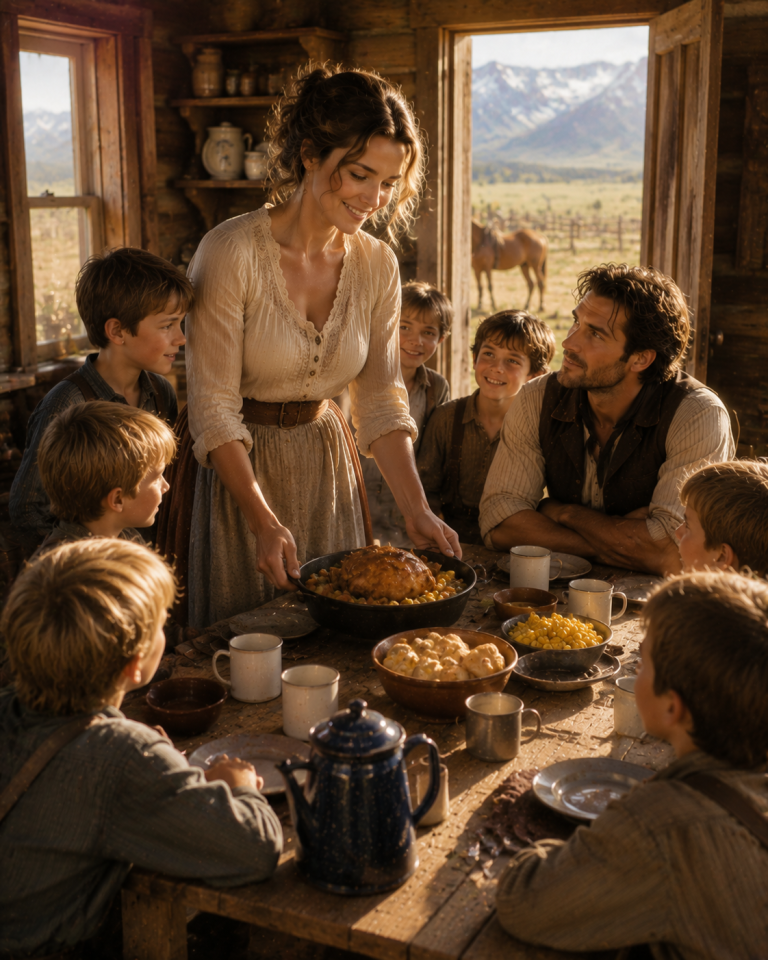
By late afternoon they reached his land — fences running along the hills, cattle in the lower fields, a small house near a barn with smoke from the chimney.
She looked at it.
Then at him.
“This is yours?”
“Built it myself. Took five years.”
She swung down from her horse, her legs stiff from the long ride, and stood looking at the property in the late light.
“Why did you really come for me?” she asked.
He hesitated.
“Because you looked like someone who had not had a choice in a long time,” he said. “And I wanted to give you one.”
She turned toward the house.
“Then I choose to stay. For now.”
He smiled, just slightly. “Fair enough.”
That night she sat on the porch while he fixed dinner. The sky moved through orange to deep blue, and she wrapped a blanket around her shoulders and looked out over the land that was his, that might be hers too in whatever definition she decided on, and she tried to identify what she felt.
When he brought her a plate, he sat on the steps rather than beside her, leaving the space between them as something she could choose with.
“I don’t know what I’m supposed to feel,” she said, after a while. “Angry. Relieved. Lost.”
“You can feel all of it,” he said.
She looked at him. “And you? Why are you alone out here?”
He took a breath, eyes on the horizon. “I lost someone a long time ago. After that, I didn’t see the point in chasing much else.”
“And now?”
He looked at her then. “Now maybe I’m starting to see different.”
She held his gaze. The wind pulled at her hair. Something shifted in her chest — slow, unfamiliar, but not unwelcome.
In the room across from hers that night, Harland sat at the edge of his bed, thinking about the way she had looked at him. Not with fear. Not with suspicion. With the careful attention of someone trying to understand something she had not encountered before.
He reached for the lamp. Paused.
He smiled, quietly, to himself.
For the first time in a long while, he was not alone either.
—
PART 2
The first week passed without ceremony.
Evelyn rose early, dressed in the quiet of her small room, and helped where she could — chickens, porch, water from the pump behind the shed. Harland didn’t hover. He gave her space, offered instruction when she asked for it, and let her find her own rhythm without requiring her to declare intentions.
One morning she stood at the corral fence watching him work a chestnut mare along the rail. The animal was skittish, quick to bolt, watching him from the corners of her eyes. He didn’t press her. Just moved slow and patient, letting her circle until she stopped on her own.
“You’re good with her,” Evelyn called.
He rested his arm on the rail. “She belonged to my brother’s boy. He passed last winter.”
“I’m sorry.”
He nodded once. “She hasn’t trusted anyone since. Not even me. Not really.”
Evelyn looked out at the pasture.
“Maybe she’s waiting to see who stays.”
He didn’t answer. But something in the set of his shoulders shifted — like her words had reached somewhere deeper than she’d aimed.
That evening she chopped carrots while he cleaned tack near the stove, the air smelling of leather and thyme and the last light stretched long over the grass.
“You ever work with horses?” he asked, without looking up.
“Once. Before I was married. My uncle had an old team, gentle things. I used to sneak them apples.”
“You want to try with the mare?”
She looked at him. “Would she even let me near?”
“She might. You don’t carry a heavy hand.”
She set down the knife.
“I’d like that.”
The next afternoon, Harland stood back while she approached the mare with a halter in her hand. Steps slow and even. No reaching. No speaking. Just the presence of someone who understood that trust was not taken but offered, and you had to make yourself worth offering it to.
When her fingers touched the animal’s neck, there was a pause in the air — something fragile presented and received.
Harland let out a long breath. “She’s never let anyone get that close.”
Evelyn smiled, barely. “She reminds me of someone.”
The days stretched with spring coming. Snowmelt rushed through the creek behind the barn. Meadowlarks called from the cottonwoods. One afternoon Evelyn caught herself humming while she swept the porch, and stopped, and held the surprise of it.
She brought him a folded shirt one evening — mended at the seams where they’d pulled loose. She held it out without a word. He took it and studied the tiny stitches.
“Didn’t have to do that,” he said.
“I know.”
He held the shirt a moment longer. “Thank you.”
She turned to leave. Paused in the doorway.
“What was her name?”
He looked up. “Who?”
“The one you lost.”
He set the shirt down. “Clara.”
She stepped back inside just enough to meet his eyes.
“You don’t have to tell me more. I just didn’t want her to be forgotten.”
His voice, when it came, was quiet. “She died of consumption. We weren’t married long.”
Evelyn said nothing. Just gave a small nod and left him to the silence.
A few nights later, a storm rolled in from the west.
She lit a lamp and sat watching lightning split the sky, and a soft knock came at her door. Harland stood there, shirt sleeves rolled up, his hair damp from checking the barn.
“You all right?”
“Just listening.”
He hesitated, then came in and handed her a mug. “Chamomile. Grows out near the shed.”
She took it. Her fingers brushed his. “Thank you.”
He didn’t sit, but stood at the window. “Storms used to scare me when I was a boy. My father used to say thunder was just the clouds arguing about who got to water the earth first.”
She smiled at the window glass. “That’s kinder than what my mother used to say. She said it was the voice of God reminding us not to forget him.”
He looked out at the dark fields. “Maybe it’s both.”
They stood in the lamplight while the storm raged outside, and neither of them moved toward the other, but neither moved away.
“I’m not sure what comes next,” she said quietly.
“You don’t have to know yet.”
She looked down at the mug. “You keep giving me space like I’m going to run.”
“I give you space,” he said, “so you know you don’t have to.”
She looked up.
“Would you be all right if I stayed?”
His answer came without pause.
“Yes.”
—
PART 3
By late May the land had turned green with the particular abundance of spring in Montana — insistent, almost aggressive, as if making up for the months of refusal.
Calves bawled in the lower pasture. Fresh shoots pushed up through the rows Harland had tilled near the creek. Evelyn spent her mornings in the garden on her knees, fingers in the dirt, learning which plants wanted sun and which preferred shade. Her back ached by midday, and she respected the ache, because it was the kind that came from making something grow.
Harland had been gone since dawn, checking fence lines on the northern ridge.
She didn’t notice how different the quiet felt when he was absent until she was already noticing it — the way the stillness settled differently in her chest. Not empty, exactly. Just shaped differently. Like a room where someone has moved the furniture and you keep reaching for the chair that’s no longer there.
She was standing from the garden when his horse appeared on the ridge trail, hooves kicking up dust. She brushed her hands on her skirt.
He swung down with a stiffness that hadn’t been there yesterday.
“You’re limping,” she said.
“Stepped wrong on shale coming down from the ridge. Nothing to fuss over.”
“Let me see.”
He blinked, surprised, but didn’t argue.
She led him to the porch bench, fetched a basin, and rolled up his pant leg without ceremony. The ankle was swollen, already turning purple, tender under her careful fingers.
“You said nothing to fuss over.”
“Didn’t feel like much at the time.”
“You always underplay things.”
“Only when someone’s watching.”
She wrapped the ankle tightly with a strip of muslin and tied it at the back.
“Two days off it. No riding. No repairs.”
“I have cattle to move.”
“Then you’ll teach me how.”
He looked at her for a long moment. Then he nodded.
The next morning he sat at the fence while she rode the bay gelding across the pasture, guiding the cattle with short calls and pressure from her knees. She kept her back straight, eyes ahead. When a steer broke toward the treeline, she circled wide and cut it off before it could bolt.
Harland watched with his arms crossed.
“You ride like someone who’s had to fight for space.”
She didn’t smile, but her eyes went to him. “Maybe I have.”
That afternoon, thunderheads gathered without breaking — the oppressive heat kind, pressing against the back of the neck. Evelyn soaked a cloth and laid it across his ankle where he rested in the barn shade. She sat beside him on the ground, back against the wall.
“I found a letter in the loft,” she said quietly. “Tucked behind a rafter. It was addressed to your brother. You never sent it.”
He didn’t speak for a moment. “I wrote it the day Clara passed. Thought I owed him something. But I couldn’t find the words to say it right.”
“You told me her name,” she said. “That was more than I expected.”
“I didn’t want her forgotten.”
“She’s not.”
They sat in the hush of the barn, flies moving in the rafters, the smell of hay and old wood around them.
“You ever think about what comes next?” he said, after a while. “If you had a choice.”
“I do have a choice now.”
He nodded slowly. “Then what would you want? If no one else was deciding.”
She looked toward the open barn doors, where cottonwood light filtered through in shifting patches.
“I’d want soil under my nails and no fear in my chest,” she said. “I’d want to wake up and know the day ahead belongs to me.” A pause. “And maybe — if it was right — someone to share the quiet with.”
He didn’t move.
“You’d have all that here,” he said. “If you wanted it.”
She pulled her knees close, chin resting on them. “I’ve never built anything lasting. Not really.”
“Then maybe this is where you start.”
—
That night she lingered on the porch after supper.
The lanterns cast warm light through the windows. Harland came out without being invited, lowering himself onto the bench beside her with a careful breath.
She watched the stars come out, one then several then the whole expanse of them.
“I used to think peace was something that happened when everything else stopped,” she said. “When the noise went quiet.”
“And now?”
“Maybe it’s knowing where you are is where you’re meant to be.”
He leaned back, his shoulder close to hers. “I think it’s both.”
She turned her head to look at him in the dim light.
“You’ve been patient with me.”
“I didn’t want to take anything from you,” he said. “Only offer what I had.”
She reached out slowly and placed her hand on top of his. Not grasping. Just resting there.
He didn’t move. But something in his jaw loosened.
“I’m not afraid here,” she whispered.
He looked at her.
“Neither am I.”
The porch held still as the night deepened. Evelyn let herself believe, for the first time, in something steady. Something that would still be there by morning.
—
The first calf was born just past midnight.
Its cry broke into the stillness like something pulled out of the earth itself, and Evelyn heard it from her window and was on her feet before the thought had finished forming. Her bare feet found the floorboards, the lantern was lit, and she was crossing the yard to the barn.
By the time she got there, Harland was already kneeling in the straw beside the heifer. The calf lay slick and blinking, legs trembling with the effort of first breath.
He looked up when she stepped inside, lamplight catching the sweat at his temple.
“She did it clean,” he said. “No breach.”
Evelyn crouched beside him, skirts trailing in the straw. “It’s a good sign.”
“Strong too.”
They stayed until the calf found its legs — the wobbling, stubborn, entirely determined first effort of something new insisting on itself. When they stepped out into the night again, the stars were sharp and clear, the air damp with spring.
Harland glanced toward her. “You didn’t hesitate.”
“I didn’t want to miss it.”
He looked at her a moment longer. Then: “You never do.”
The next morning she came into the kitchen and opened the small drawer beside the stove. She pulled out the folded map he’d left there months ago — handdrawn lines, pencil notes about grazing routes and water sources, the cartography of someone who knows their land from the inside.
He came in from hauling wood, shirt damp at the collar. She held the map out.
“I want to learn how this land works,” she said. “Not just ride fences or plant beans. I want to understand what keeps it alive.”
He took the map. His eyes searched hers.
“It’s a long learning,” he said.
“I’m not leaving.”
He laid the map flat on the table, smoothing the creases with his palm.
“Then I’ll show you.”
The hours that followed were steady and quiet. He showed her how the soil changed near the riverbend where the cottonwoods grew thick. How to read the clouds when the cattle went uneasy. She asked few questions and forgot nothing.
That evening they sat under the lean-to shed behind the barn, watching the light fade behind the hills.
“I used to think places like this were only for people who’d done everything right,” she said. “The kind of folks who came from solid names and clean starts.”
“You still think that?”
“I’m starting to see different.”
He set aside the towel he’d been folding. “Nothing here’s perfect. But it’s honest. That counts for something.”
A breeze moved through the tall grass. The scent of sage came with it, and dry earth, and the particular smell of this piece of Montana that she was beginning to know by sense rather than by name.
“My mother used to tell me I’d marry a man who built things with his hands,” she said. “Said I needed someone who could hold a storm back just by standing still.”
He didn’t smile, but something in his expression changed.
“Did you believe her?”
“I think I wanted to.”
“Do you now?”
She didn’t answer right away.
“I believe in what I see,” she said. “And I see a man who holds steady no matter what’s breaking around him.”
He held her gaze, the silence between them full of something unspoken but known.
—
The next day they repaired the windmill together.
Evelyn climbed the ladder first, hammer in her belt, and Harland passed the boards up one by one. Her hands were sure on the wood. When a gust caught the loose edge of her skirt at the top, she didn’t flinch — just braced, adjusted, continued.
She paused at the summit and looked out toward the horizon. The river cut between two low hills, silver in the afternoon light. The fields below, the fences, the barn, the small house with smoke from the chimney.
“What do you see?” he called up.
She took a breath.
“Enough,” she said.
That night at supper — boiled potatoes, beans, the simple meal of working people at the end of a day of real work — she reached across the table and laid her hand over his. No words. Just skin against skin.
He turned his palm under hers and his fingers closed gently.
Neither of them spoke until the lantern burned low.
When she rose to clear the plates, he rose with her and took one from her hands.
“You don’t have to do everything yourself,” he said.
“I know,” she said. “But I want to.”
They moved around the kitchen in easy rhythm — passing things, rinsing, putting away — and the air between them felt different from what it had been at the beginning. Not heavy. Not expectant. Just settled.
Later, in the hush before dawn, Evelyn sat upright in bed and looked out through the open window. The moon was low, casting pale light across the barn roof.
She didn’t feel like a guest anymore.
For the first time since waking to a stranger’s voice in the dark — since the word *sold* had rearranged the architecture of her life — she believed the word *free*.
—
By midsummer, the garden had gone wild with confidence.
Beans climbing the trellis in tight coils. Corn tasseling early. Squash blossoms opening like they had been waiting for someone to see them. Evelyn moved through the rows each morning with the ease of someone who has learned the language of a place — knowing which plants were ambitious and which needed coaxing, which responded to morning water and which preferred the evening.
She carried a basket of cucumbers and early potatoes to the porch one afternoon to find Harland mending the front door hinge.
“You ought to let that wait,” she said. “Too hot to be fussing with hinges.”
“Door swung open last night with the wind. Nearly woke the whole valley.”
She set down the basket and leaned against the post.
“You ever think about putting up a second room on the house?”
He paused. Screwdriver mid-turn. “For what?”
She drew a slow breath. “For me. If I’m staying.”
The tool lowered in his hand.
“I thought you already were.”
“I know,” she said. “But I’d like it to be mine. Not just a place where I was taken in.”
He stood and brushed the dust from his trousers.
“Then we’ll build it together,” he said. “Not a room on the side. A proper bedroom off the back, where the light comes in early.”
Her mouth curved — not quite a smile, but close.
“That’s exactly where I was thinking.”
They dug the foundation that week, side by side with shovels and spades, measuring by rope and eye. He showed her how to square the corners with string and stakes. She showed him how to set brick with a steadier hand.
One morning while fitting the first beam, her foot slipped on the top rung of the ladder. Harland caught her wrist before the fall could take her.
“You all right?”
“Just missed the rail.”
“You don’t have to climb if the height’s no good.”
“I want to,” she said. “I’ve never built walls that were mine to sleep behind.”
He didn’t let go of her wrist right away. His thumb brushed the inside of it, just once. Then he helped her down and they stood close enough to feel the warmth rising from each other’s skin.
That night she found him by the stream, whittling.
Fireflies blinked low over the water. Frogs made quiet music in the reeds. She sat beside him in the grass.
“You always come down here when you can’t sleep.”
He tilted the piece of wood in his hand — she could see the shape emerging, the beginning of a carved horse.
“Started when I was a boy. Place calms the mind.”
She watched the blade move slow and sure. “What calms your heart?”
He looked at her.
“You do,” he said. “Even when you don’t mean to.”
She reached out and touched the edge of the carving.
“You ever think you’d have another chance at this?”
“At peace?”
“At love,” she said. Voice quiet.
He set the carving down carefully.
“I didn’t think I’d want it again. Until you.”
She turned toward him. “I don’t want to be something you settle into because it’s quiet.”
“You’re not quiet,” he said. “You’re steady. That’s different.”
She leaned in then — not with hesitation, but with the particular knowledge of someone who has thought carefully about something and made a decision.
Their lips met softly, then certainly. The kind of kiss that didn’t need to apologize for existing.
When they parted, her forehead rested against his.
“I want to stay,” she whispered. “Not just on the land. With you.”
His hand came up, gentle at the curve of her neck.
“I want that too,” he said. “Every day.”
—
They married in August, beneath the cottonwoods near the creek.
No church. No preacher. Harland’s neighbor — a retired army man with a quiet voice and a steady hand — spoke the words. A few people came to witness it.
Evelyn wore a dress she had dyed herself with onion skin and walnut shells, the color somewhere between gold and brown, the color of late summer light. Harland wore his cleanest shirt with the collar stiff and his boots polished for the occasion. He had nicked his chin in three places shaving, which she had noticed and mentioned and he had not acknowledged.
After the vows they shared cider and bread with those who had come.
The carved horse sat on the edge of the table, finished now. Harland had etched Evelyn’s initials into the saddle, small and precise, the kind of mark a person makes when they want something to last.
The new room was finished by September.
It was not large, but it was hers — soaked in morning light, smelling of fresh pine, with quilts she had sewn from old shirts and fabric scraps he had offered without commentary. He built her a bookshelf from rough lumber, solid if not elegant, and she filled it with the few volumes she had carried from her mother’s house across years and distance.
As the weather cooled, their days settled into the rhythm of a life that had been constructed rather than fallen into — each element chosen, each arrangement agreed upon, each habit established because they had both decided it was worth keeping.
She taught him to steep mint for aches. He taught her to read the sky for the weight of snow.
Shared chores. Shared meals. Shared silences that felt like conversation between people who have learned to speak in more than one register.
One evening in the early frost, he came in from the barn and found her at the kitchen table by candlelight, bent over something she was writing.
She looked up.
“I was thinking about building a root cellar come spring.”
He hung up his coat. “I’ll dig it with you.”
She reached for his hand.
“You don’t have to do everything with me.”
“I want to,” he said.
She stood, and her arms circled him slow and sure.
“I never knew love could feel like this,” she said, quiet against his shoulder. “Like something earned.”
He held her close, his voice low at her temple. “That’s what it is.”
—
Years later, the ranch bore new fences, a second barn, a root cellar full of winter provisions, and a boy with Harland’s quiet eyes and Evelyn’s steady will.
They raised him among horses and the sound of the river, teaching him not just how to work the land but how to love it — how to read it, how to listen to it, how to treat it as something that responded to your honesty.
And every morning before the sun crested the hills, Harland would rise and press his lips to Evelyn’s shoulder as she stirred beside him.
Not a grand gesture. Not a declaration.
Just the smallest possible confirmation that she was there and he knew it and was glad.
She had woken once to a stranger’s voice in the dark, telling her she was free. She had not understood what freedom felt like then — it had felt, initially, like nothing so much as the removal of something, like the space left by an absence.
Now she understood it differently.
Freedom was not the absence of constraint. It was the presence of choice.
The choice to stay. The choice to build. The choice to lay your hand on top of someone else’s in the lamplight, without words, and have them turn their palm to meet yours.
The choice to believe, finally, that what you had built would still be there in the morning.
They didn’t chase more than they needed.
They built what mattered.
And they stayed in love every single day.
THE END