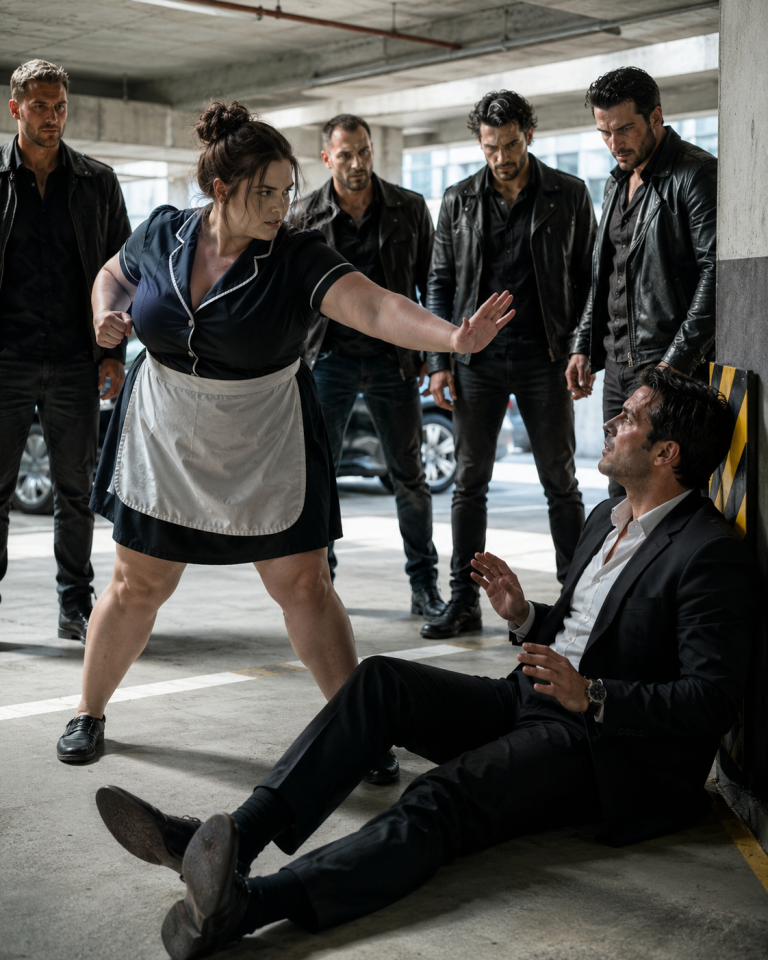
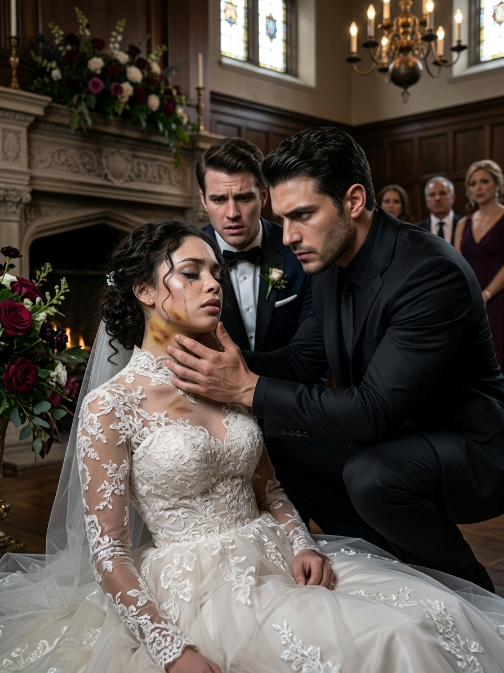
She Walked Out of the Ballroom Broken—Then the Mafia Boss Chased Her Into the Rain

## PART 1
She didn’t plan to destroy her marriage in front of the mayor of Chicago.
But then, she hadn’t planned a lot of things. She hadn’t planned to spend twelve years becoming invisible. Hadn’t planned to be thirty-four years old with no bank account, no friends she was allowed to keep, no version of herself she could still recognize in the mirror. Hadn’t planned to stand in a coat closet off the kitchen of the Grand Meridian Hotel while her husband told her the truth he’d been dressing up as love for over a decade.
“You want to know what you actually are to me, Nora?” Daniel’s voice was pleasant. Almost gentle. He straightened his cufflinks against the light. “You’re a placeholder. A very beautiful, very expensive placeholder. Until I find someone worthy of the Hargrove name.”
He patted her cheek.
Then he walked back out to his birthday party.
Nora stood in the dark between the coats and the catering carts for sixty seconds. She counted them. She heard the band shift into something upbeat. She heard laughter. She heard Daniel’s voice carry over the crowd, warm and generous, the voice that had once made her feel like the most important person in any room.
She walked out.
The ballroom was all crystal and candlelight, two hundred guests in their finest, Daniel at the center of it with his arm around Vanessa Cole—his “invaluable business partner,” introduced three times tonight with the particular emphasis of a man enjoying a private joke. When he caught Nora’s eye across the room, he smiled.
Her hand moved to her throat. The anniversary necklace. Presented an hour ago with a kiss for the cameras, diamonds catching every light in the room. Ten years of marriage distilled into a piece of jewelry.
She unclasped it.
The chain was delicate. It broke clean.
The diamonds hit marble like scattered rain, bright and brief, rolling under heels and chairs and the shoes of people who went abruptly, completely silent.
Two hundred people. Not a sound.
Daniel’s face moved through several expressions very quickly: disbelief, then fury, then the careful reconstruction of concern that she recognized as his public setting.
Nora walked. No shoes—she’d taken them off an hour ago, feet aching. No coat, no phone, no plan. Just the doors at the end of the room and the cold air beyond them and the absolute certainty that she would not survive another hour inside this building.
“Nora.” Her sister-in-law Kate’s voice, sharp with panic, chasing her down the steps. “Nora, stop. Do you understand what you just did in there? The mayor is at that table. His investors—”
“He called me a placeholder.” The rain hit her face. Cold and immediate. “He pulled me into the coat room and told me I was a placeholder until something better came along. Then he went back to Vanessa and gave a toast to the people who make life worth living. He looked right at her when he said it.”
Kate’s hand dropped.
“Then he spent the last hour letting every person in that room believe we were celebrating our marriage.” Nora stepped back. “Tell him not to wait up.”
She walked.
The streets of downtown Chicago blurred. She had walked six blocks in wet stockings before the cold became its own kind of clarity, cutting through the white noise in her head and leaving something sharp and quiet behind. She found a bench. Sat down. Watched a couple cross the street under an umbrella, her head on his shoulder, both of them laughing at something private.
Nora couldn’t remember what that felt like.
“Excuse me.”
A woman stood a few feet away, young, holding a work jacket out like an offering. “I work at the café around the corner. You’re going to get hypothermia.”
Nora wanted to say she was fine. Pride was a reflex. But pride was a luxury, and she’d spent all her other ones already tonight.
“Thank you,” she said instead.
The café was warm and quiet—half-empty at this hour, the kind of place that minded its own business. The woman’s name was Amara. She brought tea without being asked and disappeared with a discretion Nora hadn’t experienced in a long time. Nora pressed the towel to her face and did the inventory she’d been avoiding for twelve years.
No job. Daniel had asked her to leave her position at the arts foundation two years in—beneath the wife of Daniel Hargrove, he’d said, smiling. No money. An allowance, monthly, transferred to a card she was required to account for. No friends; they’d been discouraged with such steady patience she hadn’t even noticed them going. No family close enough to call. Her mother had been dead for four years. Her father had chosen Daniel’s money over her long before that—owed him something substantial from a failed business deal, and had been cooperative ever since.
She was thirty-four years old and she had nothing.
A shadow fell across the table.
She looked up.
The man was dark-haired and contained in the way of people who have decided long ago that they don’t need to perform. Expensive suit worn loose, tie undone—not disheveled, just unconcerned. His eyes were almost black. He didn’t smile.
“Mind if I sit? You look like you could use company.” A pause. “Or I can leave. Your call.”
No pressure. No demand. An actual choice, offered without expectation.
“Sit,” Nora said.
He slid into the seat across from her. His name was Luca.
“What happened?” he asked.
She meant to give him a short version. Instead, the real one came out—the coat room, Vanessa, twelve years of being managed into disappearing. He listened without performing sympathy, without offering solutions, just listening with the full attention of someone who was genuinely present.
When she finished, something shifted in his expression.
“Daniel Hargrove,” he said quietly.
Her stomach tightened. “You know him.”
“I was at the hotel for a different event. Different floor.” He paused. “I was walking past the coat room when he brought you in. I heard what he said.”
The air went out of the café.
“I also heard him laugh about it after you left. Made a joke about hormones. His friends found it funny.”
Rage moved through her in a clean, quiet wave.
Luca reached into his jacket, set something on the table. A card, heavy stock, just a name and number. “When you’re ready to stop surviving and start fighting—call me.” He stood, added several folded bills beside it. “For a hotel room tonight. Amara knows a place. It’s safe.”
“I can’t take that.”
“You’re not taking anything. I’m making an offer.” His voice was even. “Men like Daniel count on you being alone and too afraid to fight back. Don’t prove him right.”
He left before she could respond.
Nora sat with the card in her hand for a long time. Heavy stock. Just a name: Luca Ferrante. And a number.
She thought about the coat room. About *placeholder*. About twelve years of slowly, carefully being unmade.
She tucked the card into her bra—the only safe place she had—and drank her tea.
She didn’t know yet what the name Luca Ferrante meant in this city. Didn’t know why the way he’d moved through the café made other people find reasons to look away. Didn’t know that he’d been building a case against her husband for six months before she’d walked out of that ballroom.
She only knew that someone had followed her into the rain without wanting anything from her.
In twelve years, she couldn’t remember that happening once.
—
## PART 2
The pounding started at dawn.
Nora was upright before she was fully awake, heart slamming, the small hotel room snapping into focus around her—peeling wallpaper, locked door, morning gray at the window. Then the voice outside: *Chicago PD. Ma’am, we need to verify your well-being.*
Luca had called it exactly.
She grabbed the hotel phone with shaking hands, dialed the number on the card.
He answered before the second ring.
“Police are outside,” she said. “Daniel filed a missing person’s report, didn’t he.”
“Don’t open the door.” His voice was calm, already in motion. “Tell them you’re contacting your attorney. You’ll come to the station with legal representation within the hour.”
“I don’t have an attorney.”
“You do now. Her name is Patricia Osei. She’ll be there in twelve minutes. Room number?”
“How did you—”
“I started making calls the moment I left that café. Room number, Nora.”
She gave it to him.
“Say it back to me,” he said. “You are not the one who did something wrong.”
Her throat tightened. “I’m not the one who did something wrong.”
“Again, like you mean it.”
She meant it.
Patricia Osei arrived in eleven minutes—silver-haired, steel-spined, with a suit that cost more than Nora’s entire allowance for the month and eyes that catalogued the situation in about four seconds. “We’re going downstairs together. You confirm you’re safe and you left voluntarily. You don’t explain. You don’t apologize.”
Daniel was in the lobby.
He’d constructed his expression carefully: relief layered over concern, with a hint of hurt for the sympathetic audience. When he moved toward her, Patricia stepped between them like a door closing.
“Mr. Hargrove. Any contact with my client goes through me.”
His mask slipped. Just a fraction. She’d spent twelve years learning to read that fraction.
“When did you get an attorney?” he said quietly, the pleasant voice very thin now. “Yesterday you didn’t have anything.”
“A lot changed yesterday.” Patricia’s smile was surgical. “The police interview was brief. Yes, she was Nora Hargrove. Yes, she’d left voluntarily. No, she didn’t need to return home.”
In the lobby doorway, Daniel caught her arm as she passed. Light grip. Almost gentle. Twelve years of living inside his moods and she could feel the storm beneath it.
“You’re throwing away everything over one conversation.” His voice was intimate, only for her. “Our home. Our life. I was drunk, Nora. I didn’t mean—”
“You meant every word.” She met his gaze. “And you were right. I was a placeholder. But I’m done holding that place.”
His fingers tightened.
“Remove your hand,” Patricia said clearly, “or I’ll have you arrested for assault in front of these officers.”
He released her. His smile was ice.
“I’ll see you in court. I hope he’s worth it.”
In the car, the shaking finally caught up with her. “He’s going to destroy me,” she said. “He has the mayor, he has half the judges in this city—”
“And Luca Ferrante has the other half.” Patricia opened her tablet. “Tell me everything about your marriage. Start at the beginning. We’re building something that will take Daniel Hargrove apart piece by piece.”
Nora took a breath.
And for the first time in twelve years, she started talking.
—
## PART 3
The beginning was a debt.
She’d been twenty. Her father, Warren Davis, had borrowed from Daniel Hargrove to save a failing business. When the business failed anyway, Daniel had come to dinner. He’d looked at Nora across the table and decided she was an acceptable form of repayment.
She hadn’t known that at the time. She’d thought it was romantic. He’d made her feel that way—attentive, focused, like the only person in a room who mattered. The feeling lasted until the morning after their wedding, when she’d suggested he take a work call on the balcony to enjoy the view and he’d looked at her like she was something stuck to the bottom of his shoe.
“I’ll take business advice from someone whose only qualification is looking decorative,” he’d said pleasantly, and gone back to his call.
By year three, she had no job, no friends, and an allowance that came with a detailed accounting requirement.
Patricia’s fingers flew across her tablet as Nora talked. When she got to the part about the fertility conversations—Daniel’s vague discouragement of children for years, the appointment two years ago when she’d finally pushed for testing and the doctor had gently informed her that Daniel had undergone a vasectomy three years into their marriage—Patricia stopped typing.
“He didn’t tell you.”
“He said it was a minor procedure. Said he hadn’t mentioned it because he didn’t want to worry me.”
“When was this?”
“Two years ago. That was when I first tried to leave.” Nora’s voice was flat. “I made it to the driveway. He brought me back inside. The bruises lasted a week. His personal doctor wrote it up as a fall.”
“That doctor’s name.”
“Nathaniel Cole. He’s Vanessa’s father.”
Patricia set down her stylus. “Of course he is.” She made a note. “Dr. Cole is going to wish he’d asked more questions.”
The office door opened and Luca walked in, looking different in daylight—sharper, more defined, the kind of person who occupies a room completely without trying. He sat beside Nora, close enough that she could smell his cologne, and looked at Patricia. “Where are we?”
“Building the foundation. Financial control, physical intimidation, medical deception, systematic isolation.”
“Good.” He turned to Nora. “Daniel gave an interview to the Tribune this morning. He’s describing you as fragile, untreated, a devoted husband begging for his wife’s safe return.”
She read the headline on his phone. *Real Estate Mogul Pleads for Wife’s Safe Return.* The photo showed Daniel looking haggard and worried. She recognized the expression. He used it for cameras.
“He’s rewriting the story before I can tell mine.”
“Which is exactly why we’re telling yours first.” Luca spread photographs across Patricia’s desk. “These were taken over the past six months. Daniel with Vanessa at the Peninsula. Daniel with a woman named Carrie—she’s married to his partner at the Lakeshore development. And this one.” He tapped a photograph. “Taken three weeks ago. Vanessa, at dinner. Notice the ring.”
Nora looked closer. Her grandmother’s ring. The one Daniel had told her was stolen during a move six years ago.
“We have the jeweler’s records,” Patricia said. “He had it resized.”
The bile was immediate, acid and clarifying.
“You’ve been watching him for six months,” Nora said slowly. “Before you ever saw me. Why?”
Luca was quiet for a moment. “Daniel Hargrove built his real estate empire too quickly. Properties acquired through zoning changes that happened in days instead of months. Permits that bypassed standard channels. The kind of efficiency that has a very specific explanation.” He leaned back. “I’ve been in this city long enough to know the difference between a businessman and someone who owns the referees. I wanted to know who he’d paid.”
“And did you find out?”
“We found a great deal.” He paused. “But when I walked past that coat room—I decided I was done waiting.”
There was something in the way he said it. Not performance. Just fact.
Nora looked at the photographs. At the ring on Vanessa’s finger.
“What do we do first?”
Patricia’s smile was sharp as anything Nora had ever seen. “We tell your story. And we let him react.”
—
The press conference was Patricia’s idea and her architecture entirely.
Twenty-four hours after leaving the Grand Meridian barefoot in the rain, Nora stood at a podium in a hotel conference room and read a prepared statement to fifteen reporters and twice as many cameras. She described twelve years of control without violence—the allowance, the accounting, the managed isolation, the vasectomy she hadn’t been told about, the bruise that a doctor had called a fall. She described Vanessa and Carrie and the grandmother’s ring sized for someone else’s finger.
She described the coat room.
When she finished, one reporter pushed forward. “Mrs. Hargrove, your husband says you’ve refused mental health treatment. How do you respond to concerns about your stability?”
Nora looked directly into the camera. “I respond that making your partner doubt their own sanity is a classic tactic of control. I’m not unstable. I’m done being quiet. And that terrifies him.” She paused. “Those are very different things.”
Patricia pulled her from the podium before the follow-up questions began.
Daniel’s counter-statement arrived within the hour. Defamatory. Erratic. A woman in crisis, lashing out. His attorneys filed for a psychiatric evaluation before she could testify to anything.
The public didn’t care about the attorney’s statement.
*#BelieveNora* was trending by noon. Women who had worked for Daniel came forward. Women he’d dated before Nora came forward. Three sponsors withdrew from his foundation by four o’clock.
“He’s bleeding,” Patricia said with quiet satisfaction.
“He hasn’t started yet,” Luca replied.
—
The call came from her father.
Nora took it in Patricia’s office, recording device running.
Warren Davis sounded exactly as she’d expected—gruff, disapproving, already on the wrong side. “Daniel called me this morning. He’s worried about you. We’re worried about you.”
“He called you a placeholder, Dad.”
“Every marriage has rough patches—”
“He’s been having affairs for years. He controlled every dollar I spent. He had a vasectomy without telling me and let me spend four years wondering if there was something wrong with me.” Her voice didn’t shake. “He had the doctor who covered up my bruises write it as a fall.”
Silence.
“You knew he was controlling,” she said. “You knew what kind of man he was when you introduced us. And you kept taking his money anyway.”
A long pause. “Elena, he’s connected to everyone in this city. Judges, the mayor, business partners everywhere. You can’t fight him without—”
“I already have people who aren’t afraid of him.” She thought of Luca. “Goodbye, Dad.”
She nodded to Patricia, who ended the call.
“He’ll come around,” Patricia said carefully.
“Maybe. But not today, and I don’t need him today.” Nora pressed her hands flat on the desk. “What do we do next?”
—
The safe house was a penthouse in the West Loop—sleek, modern, floor-to-ceiling windows over the lit city, a kitchen stocked with actual food, a bed that looked like rest rather than obligation. A security guard named Bernard stood outside the door with the easy stillness of someone accustomed to waiting.
Nora stood at the window with a glass of wine and watched Chicago.
Her new phone buzzed.
*Luca: Just checking in. Settling okay?*
She stared at the message. He’d gotten the number from Patricia. She typed back: *Yes. Thank you for this. It’s beautiful.*
*It’s yours as long as you need it. Get some rest.*
She typed: *Can I ask you something?*
*Anything.*
*Were you really in that hotel by coincidence?*
The response took longer. *No. I was there because of Daniel. But I wasn’t planning to act yet.* A pause. *Then I heard what he said to you.*
*Why does that matter? You didn’t know me.*
*I had a sister,* he wrote. *Her name was Maria. She married someone like Daniel. I tried to get her out for two years. She wouldn’t come.* A longer pause. *She died three years ago. Left a note. Said she couldn’t take it anymore.*
Nora’s chest ached.
*When I saw you walk out,* he continued, *I saw her. Every version of her that chose differently.* A final pause. *I couldn’t save her. But you were standing right there.*
She set the phone down. Picked it up again.
*She would have been proud of you,* she typed.
*Maybe. Or maybe she’d tell me I’m obsessive and I need to mind my own business.* A beat. *Get some sleep, Nora.*
She finished the wine.
Outside, the city blazed on without her.
—
The morning of the pounding was already familiar now—this time it was Patricia at the door, coffee in hand, expression grim. “Daniel held a press conference at six a.m. Devastated husband. Fifty-thousand-dollar reward for his wife’s safe return. Implied she may be a danger to herself.”
“He escalated faster than we expected.”
“We escalate faster than he expected.” Patricia thrust a coffee into Nora’s hands. “We have thirty minutes. You go in raw, you read the statement, you say nothing else.”
Nora looked at her reflection in the dark window. No makeup yet, borrowed clothes, hair she’d slept in.
“Okay,” she said.
She was ready.
—
The psychiatric motion was heard by a judge named Carmela Reyes, who had the expression of someone who had stopped being impressed by expensive attorneys approximately fifteen years ago.
Daniel’s lead counsel—polished, practiced—presented his argument: erratic behavior, emotional instability, documented concerns from family members.
“Which family members?” Judge Reyes asked.
“Her father, Warren Davis—”
“I have a declaration here from Warren Davis,” Patricia said, standing, “stating he provided no such statement and that his daughter left voluntarily following years of abuse. He’s sitting in this gallery if you’d like to confirm that.”
Nora turned slightly. Her father was in the back row, smaller than she remembered, looking at his hands.
The motion was denied in four minutes.
Daniel caught her arm in the hallway. His grip was light. She felt the threat inside it the way you feel weather changing.
“You’re making a mistake,” he said quietly. “Everything we built—”
“You built a prison.” Nora looked at him with the full clarity of someone who has finally stopped being afraid of a particular storm. “I just lived in it.”
Luca was at her other side before Daniel could respond. He didn’t touch anyone. He simply stood close enough that the calculation in Daniel’s eyes shifted.
“You know what you are?” Daniel said to him, pleasant and poisonous.
“Someone standing between you and her.” Luca’s voice was mild. “That’s all that matters right now.”
Security moved them apart.
Outside the courthouse, Nora breathed cold air and felt something unfamiliar in her chest.
She wasn’t afraid.
She couldn’t remember the last time she hadn’t been afraid.
—
The break came from a man named Theodore Marsh—former business partner, current witness, present because Daniel had destroyed his marriage, his reputation, and his relationship with his children over a development deal five years ago.
He met them in a parking garage with a flash drive and shaking hands. Emails. Wire transfers. Recorded conversations. Three aldermen, two city inspectors, a judge. Half a million dollars in bribes to push through Daniel’s waterfront development.
“Every transaction is documented,” Theodore said. “Daniel kept records of everything. It’s what’s going to destroy him—he was meticulous.”
“Why now?” Patricia asked.
“Because I got a death threat last Tuesday.” His voice cracked. “I have two kids. I can’t wait for the right moment anymore. I just want him to face something real.”
Luca made a call, speaking quietly. Security for Theodore and his family, arranged before the conversation was finished.
Patricia was already reading the files on her laptop. Her face went very still.
“This is enough for a federal referral,” she said.
“I know,” Luca said. “Make the call.”
—
The next two weeks moved in the way of significant things—forward, relentlessly, with a momentum that generated its own heat.
Forensic accountants traced Daniel’s money through seventeen shell companies. Three former business partners added their statements. Patricia compiled a case file that filled two binders and a separate drive. The FBI—who had, it emerged, been watching Daniel Hargrove for eight months and waiting for a sufficient anchor—received Theodore Marsh’s documentation and moved into active investigation within forty-eight hours.
Daniel, for his part, did not stop.
He filed a counter-suit claiming Nora had been stealing from him throughout the marriage. He gave a second interview, this one tearful, describing his discovery of her father’s financial crimes and his years of attempting to protect her from the truth of Warren Davis’s character.
*Devoted husband. Criminal father-in-law. Unstable wife.* The narrative was tidy. It got traction.
Nora watched it from the penthouse, sick to her stomach.
“He’s rewriting everything,” she said.
“Let him.” Luca sat across from her, calm in the way of people who have been through worse. “Rewritten stories collapse under evidence. That’s why we’re building evidence.”
“He has real information about my father, doesn’t he. Not fabricated.”
A pause. “Possibly some of it.”
“Then I need to talk to him.”
The conversation with Warren Davis happened the next morning—coffee shop, early, her father already there when she arrived. He looked like he’d aged years in a week.
She didn’t speak first. She slid a folder across the table: copies of what Daniel’s attorneys had filed.
He looked through it slowly. When he looked up, she saw the answer before he said a word.
“Some of it,” he said quietly. “Not all. The amounts are inflated, the timeline’s been manipulated to make it look worse. But the foundation.” He set the folder down. “Yes. I borrowed money I shouldn’t have, from accounts I didn’t have the right to touch. I paid it back. Every cent, over three years. But I have no paper trail—I thought it was better that way at the time.”
“And the affair.”
His hands stilled.
“Daniel mentioned a name. Linda Chen.”
Warren Davis looked at the table for a long time. “Your mother was sick,” he said finally. “I was terrified and I was weak and I made the worst choice I’ve ever made. She never knew. I made absolutely certain she never knew.”
“So, he’s had this over you for years.”
“He knew from the beginning. I think that was partly why he was interested—he wanted people he could control.” His voice broke at the edges. “I chose his money over you, Elena. Over your safety, over my own conscience. I told myself it was complicated and it wasn’t. I was a coward.”
Nora sat with that for a moment.
“I need you to go public before he can use it,” she said. “The affair, the borrowing, all of it—your account, on your terms, before his. You take away his ammunition.”
“That will destroy what’s left of my reputation.”
“It might. Or it might show people that he collects damage on everyone around him and uses it like a leash.” She met his eyes. “That’s what he did to me for twelve years. I’m not letting him do it again.”
Her father was quiet for a long time.
“Okay,” he said.
—
That night, Luca’s forensic team confirmed that the bank statements in Daniel’s counter-suit were forged. The account numbers were authentic; the transactions had been fabricated. The casino photographs of Warren Davis were real, dated accurately—but to eight years ago, before his recovery, manipulated to appear recent.
Luca spread the analysis across the kitchen counter, and for the first time in days, Nora felt the weight shift.
“The whole thing is a bluff,” she said.
“Not entirely. Your father did have those problems. But everything Daniel filed is either exaggerated, fabricated, or stolen from the wrong timeline.” Luca looked up. “And when we prove that, it doesn’t just discredit his counter-suit. It proves he’s willing to forge evidence. Which is a very different problem for him in the context of a federal investigation.”
“We turn his trap into his destruction,” Patricia said from the doorway, already typing.
Her father’s interview aired the following evening. He sat in front of a local news camera and told the truth—the affair, the gambling, the borrowed money and its repayment, all of it, in the flat, careful voice of someone who has decided that the only dignity remaining is honesty.
“Marcus Hargrove knew all of this,” he said. “He collected it. He kept it for twelve years and used it as a leash on my daughter. That’s the kind of man he is. Not a victim. Not a devoted husband. A collector.”
The interview changed the shape of the story.
*#BelieveNora* returned and this time it didn’t leave.
—
The call came at two in the morning.
Nora heard Luca’s voice through the walls of the penthouse, clipped and low, and knew before he knocked on her door that something had changed.
“Daniel liquidated three offshore accounts this morning,” he said. “Fifteen million dollars. He’s trying to hide assets before the federal freeze.”
“The FBI knows?”
“They know. They’re moving.” His jaw was tight. “He also called your father this afternoon. Told him if you testify before the grand jury, he’ll release not just the fabricated documents—but a version of events that ties you to the borrowed money. Claims you knew, that you helped cover it.”
“That’s not true.”
“No. But it’s another delay, another angle of attack, another way to make you look unreliable as a witness.” Luca’s eyes were steady. “We have seventy-two hours before the grand jury date. What do you want to do?”
Nora thought about what Daniel had said in the coat room. About twelve years of carefully, methodically being unmade.
“I want to testify,” she said.
“Even knowing what he’ll do to your reputation in the process?”
“Especially knowing that.” She met his eyes. “He’s counting on me being too afraid of what people will think. That’s how he’s always controlled me. And I’m done.”
Something moved in Luca’s expression.
Not surprise. Something quieter and more permanent than surprise.
“Then we fight,” he said.
—
The psychiatric motion was denied, as noted.
What followed was a subpoena and a preparation process that consumed every hour of the next week. Patricia drilled Nora on testimony architecture, cross-examination tactics, how to stay present under pressure. Luca’s team continued building the financial case. Theodore Marsh, under protection, prepared his own testimony.
Daniel filed an emergency motion to delay.
It was denied.
He then did something none of them had fully anticipated: he called Nora directly.
She was in the penthouse, and she almost didn’t answer—unknown number, two weeks of those going to voicemail. But something made her pick up.
“We need to talk.” His voice was silk and threat, indistinguishable from each other the way they had always been. “One hour. The Peninsula bar. Just us.”
“I’m not meeting you anywhere.”
“You are.” The threat surfaced. “Because if you don’t, I’ll make sure every detail about your father—the real details, not the ones I fabricated—becomes public record. The gambling. The embezzlement. The mistress while your mother was dying.” A pause that landed like a fist. “Ask him about Linda Chen. Ask him what your mother really died of. Grief works on the body in interesting ways.”
“That’s blackmail.”
“That’s a business conversation. Come alone, or I make sure what’s left of your father’s life looks exactly the way I want it to look.”
The line went dead.
Nora sat very still.
Then she called Luca.
—
They arrived at the Peninsula fifteen minutes early.
Three of Luca’s people were already positioned—hotel guests, to look at them, but she’d learned to see the way they covered exits and angles.
Daniel was at a corner table with a glass of scotch, and she hated how composed he looked. He stood when she approached. The perfect gentleman, even now.
Even knowing Luca stood behind her chair.
“You brought support,” Daniel said pleasantly.
“She brought her attorney,” Patricia said from behind them both.
Daniel’s smile didn’t shift. He was very good. He’d always been very good.
He slid a folder across the table. “This contains everything I have on your father. Enough to ruin him. I want you to understand I’m not the villain you’ve decided I am—your father is. He stole. He cheated. He destroyed himself and let you live in the rubble.” He opened his hands. “I protected you from that. For twelve years I protected you.”
“You managed me,” Nora said.
“I loved you. In the only way I know how.”
“That’s not love. That’s ownership.”
His expression shifted. Just slightly. “Drop the grand jury testimony. Refuse to cooperate with the FBI investigation. I bury this folder and we both walk away intact.”
Nora reached for the folder.
Luca’s hand came down on hers. *Don’t.*
She pulled away from him gently. She opened it.
Bank statements. Photographs. Documents. Her father at a casino table—the date in the metadata would later confirm this was eight years old, but she didn’t know that yet. The name Linda Chen in a text exchange. Transfers from account numbers she recognized from her father’s old business.
The room tilted.
“I need to think,” she said.
“You have until tomorrow noon.” Daniel stood, smoothed his jacket. “I’ve always been patient with you, Nora. One more day.”
He touched her shoulder as he passed.
“Still beautiful when you’re broken,” he said, and walked away.
The silence that followed was complete.
Then Luca crouched in front of her chair, forcing her eyes to his. “Look at me. He’s lying. I don’t know the shape of it yet, but he is lying. We will prove it.”
“The documents look real.”
“Documents can be made to look real. That’s why we have forensic accountants.” He held her gaze. “Don’t give him this. Whatever he has, real or fabricated, we find the truth. And we use it.”
Patricia was already on her phone. “I’m calling Warren. He needs to tell us everything before morning.”
—
Warren Davis told them everything.
Some of it was true. The gambling—eight years past, recovered, verifiable. The borrowed money—repayable and repaid, without documentation, but traceable through his bank records if you knew where to look. The affair with Linda Chen—true, during his wife’s illness, ended before she died, unknown to her.
None of it was current. All of it had been catalogued by Daniel for twelve years, waiting.
And the bank statements in the folder were forged.
Luca’s team confirmed it before dawn. Account numbers authentic, transactions fabricated—the same technique as the counter-suit. The same pattern.
“He does this,” Luca said, spreading the forensic analysis on the table. “He takes something real and he inflates it, extends it, makes it look worse and more recent than it is. He’s been doing it for years to business partners, to witnesses, to anyone who might threaten him.”
Patricia looked up from her screen. “When we expose this—and we will—it doesn’t just kill his blackmail attempt. It adds evidence of witness tampering to the federal file.”
“So, we call his bluff,” Nora said.
“We do more than that.” Luca’s expression was very clear. “We release the forensic report to the FBI and to the prosecutor before you testify. We document the blackmail attempt. We turn everything he gave you into an exhibit.”
Her father looked at his hands. “I’ll go to the press,” he said. “This morning. Before noon. I’ll tell my own story—the truth, the whole truth, everything. If he can’t use it against Nora, he can’t use it against anyone.”
“Dad—”
“It’s the only thing left I can do right.” He looked at her with twelve years of bad choices in his eyes and something underneath them that might, with time, become something better. “Let me do this.”
She let him.
—
Warren Davis’s interview aired at nine-thirty in the morning.
He was calm and thorough and unsparing about his own failures. He named Daniel Hargrove by name. He described how a man with the instinct of a collector had spent years accumulating damage on the people around him and using it as currency.
“He tried to use my failures to silence my daughter,” Warren Davis said. “My failures are mine. They don’t belong to her. They never did.”
By ten-fifteen, Nora’s attorney received confirmation from the federal prosecutor’s office: the blackmail attempt was documented, the forensic analysis of the forged documents was received, and Nora’s testimony before the grand jury would proceed as scheduled.
At eleven-forty, the psychiatric emergency motion Daniel had filed in a final attempt at delay was denied.
At noon, Daniel’s deadline passed.
—
Nora testified for four hours.
She was calm the way of people who have already survived the worst and know it. She described twelve years of overheard phone calls—bedroom conversations, late-night negotiating, Daniel celebrating when permits cleared in forty-eight hours that should have taken six months. She named an alderman. She described the evening he’d come to the table with the particular satisfaction of a man who’d just solved something expensive, the offhand joke about the judge whose price was *surprisingly reasonable.*
She had been invisible in her own marriage for twelve years.
In that room, under oath, invisible turned out to be the most useful thing she’d ever been.
The grand jury heard her.
—
The indictment came down on a Tuesday.
Fifteen counts. Bribery, fraud, money laundering, racketeering, and—because of the documented blackmail attempt—obstruction of justice.
Daniel Hargrove’s bail was set at ten million dollars.
Nora watched the news coverage from Patricia’s office—the press outside his building, the lawyers making statements, his face briefly visible as he was escorted through cameras he could no longer control—and felt something she hadn’t expected.
Not triumph. Not satisfaction.
Quiet.
“You alright?” Luca asked.
“I thought I’d feel something larger.” She set down her phone. “I just feel like it’s finally over.”
“Part of it is.” He handed her a cup of coffee. “The rest will take time.”
“The trial.”
“The trial. Then sentencing. Then the rest of your life, which is the part I’d like to focus on.”
She looked at him.
He’d said it simply, without ceremony, the way he said most things. But it landed differently now—not an offer she was evaluating for safety, not assistance she was calculating the cost of, just a statement by someone who had been present at every significant moment of the worst and most clarifying weeks of her life and had never asked for anything except that she keep fighting.
“Tell me about Maria,” she said.
They had never talked about it properly. She’d only had the text messages, the late-night fragments. He told her now—the full version, from the beginning. His mother first: a woman who had finally escaped when Luca was eight, who had been found three months later and brought back, and who had died two years after that in the way of people who have been broken past the point of trying. Then Maria: younger, bright, drawn to exactly the kind of man their father had been, and ultimately unable to leave him in time.
“I spent two years trying to make her see what was happening,” he said. “Every approach I could think of. Resources, evidence, a way out. She kept saying I didn’t understand, that it was more complicated than I thought.” He was quiet for a moment. “She wasn’t wrong that it was complicated. She just ran out of time to find her way through.”
“She would have been proud of the work you do,” Nora said.
“Maybe. Or maybe she’d say I’m trying to control the outcome the same way he did, just from the other direction.” His mouth curved slightly. “I think about that sometimes.”
“Is she why you do this? Really?”
“She’s part of it.” He looked at her. “But you’re not a cause, Nora. You haven’t been for a while.”
She knew what he meant. Had known for some time—the coffee he brought without asking, the way he listened, the patience that never felt like performance. She’d been afraid to name it because naming things had been dangerous for twelve years.
“I’m not ready,” she said carefully. “Not for anything that looks like what I just came out of.”
“I know.”
“I need to figure out who I am without someone’s version of me overwriting everything.”
“I know that too.” He didn’t look away. “I’m not going anywhere, Nora. When you’re ready—if you’re ready—I’ll be here. And if you decide you’re not, I’ll still be here. Just in a different capacity.”
She thought about what Daniel had said in the jail, the last time she’d seen him face to face—that she hadn’t won anything, that she’d just traded one powerful man for another. She’d carried that sentence for weeks.
But Daniel had never once asked her what she wanted. Had never offered her a choice and meant it. Had never looked at her and said: *Your call.*
Luca had said those words the first night they met. At a corner table in a café, in the rain, with no agenda she could see.
She reached across and took his hand. He held it without making it into anything.
“One thing at a time,” she said.
“One thing at a time,” he agreed.
—
The trial began in February.
It lasted sixteen days.
Nora testified again—this time in open court, under cross-examination by Daniel’s lead attorney, who tried every available angle: the affair with Luca that had never occurred, the mental instability that no medical record supported, the criminal father whose crimes she’d allegedly known about and concealed.
She answered every question in the same clear, unhurried voice.
The jury deliberated for three and a half hours.
Guilty on all fifteen counts.
The judge—the same woman who had denied Daniel’s motion to block her grand jury testimony—sentenced him to eighteen years in federal prison, citing particularly the documented blackmail attempt against a witness and his complete and consistent failure to demonstrate anything resembling remorse.
Nora watched him led from the courtroom.
She thought, briefly, of the girl she’d been at twenty—meeting a charming, powerful man at a dinner her father had arranged, thinking the attention meant she mattered. That girl had spent twelve years slowly being convinced she didn’t. She thought about everything it had taken to stop believing that.
Outside the courthouse, a reporter pushed through to her.
“Mrs. Hargrove—what would you want people to know about surviving an abusive marriage?”
Nora paused.
“That the word *leaving* makes it sound simple,” she said. “Like a door you walk through once. It’s not. It’s a choice you make every day for months, sometimes years. Every day you choose not to go back. Every day you choose yourself a little more.” She looked at the camera. “And I want abusers to know something too. Power isn’t permanent. Control requires cooperation, and eventually—we stop cooperating.”
The footage ran for weeks.
—
Six months later, Nora founded the Hargrove Survivor Fund—the irony of the name intentional and satisfying, funded by the divorce settlement and named as a permanent reminder of what the money had been built on. Patricia served as legal director. Warren Davis, sober and quiet and slowly rebuilding something, answered phones and did whatever needed doing.
Luca arranged security for women in the program who needed it. He did it without fanfare, as he did most things.
Within a year, the fund had helped two hundred and forty women leave situations they had believed were inescapable.
On a winter evening, Nora was going through the fund’s intake records when Luca appeared in the doorway with takeout and the expression of someone who had something to say.
She looked at him.
He sat down across from her, set the food between them, and placed a small ring box on the desk.
“I’m not proposing,” he said.
“That’s a ring box.”
“It’s a question box.” He opened it. The ring was simple—a clear stone on a plain band, nothing performative about it. “I’m asking if this is something you want. Not something you owe me, not something I’ve earned, not something you’re accepting because you think you should. Just—if you want this.”
She looked at the ring.
She thought about the woman she’d been two years ago, barefoot in the rain, with nothing. She thought about the woman she was now—who ran a foundation, who had testified before a federal grand jury, who had survived a trial and her father’s failures and her own grief and had come out the other side of all of it knowing her own name.
She thought about the man across the desk, who had never once told her what she was. Had only ever asked.
“Yes,” she said.
He smiled. Not the calculated, managed smile she’d spent twelve years reading for hidden information. A real one, brief and warm and entirely for her.
“Okay,” he said.
They ate the takeout.
Outside, Chicago moved on in its own complicated, relentless way, and inside a small office full of files and the work of undoing harm, two people sat across from each other in the ordinary, extraordinary quiet of a life that was genuinely, finally, entirely their own.
—
Three years after that, Nora stood at a conference in Washington watching a woman she’d never met take the stage to describe the two years it had taken her to leave and the three weeks it had taken the Hargrove Survivor Fund to give her a new beginning.
Luca was in the seat beside her. Their daughter—six months old, already loud with opinions—was at home with Warren Davis, who had turned out to be a surprisingly attentive grandfather.
“You built this,” Luca said quietly.
“We built this.” She watched the woman at the microphone—clear-eyed, steady, talking about choice. “I just started walking.”
She thought, briefly, of Daniel Hargrove in a federal facility somewhere, eleven years remaining on his sentence. She didn’t think of him often. He had been a chapter. Chapters ended.
She thought instead of the woman in the rain. Thirty-four years old, barefoot on wet cement, holding shattered diamonds, with nothing in her hands and everything still ahead of her.
That woman had needed someone to follow her into the rain and remind her she was worth following.
Now Nora spent her days being that person for someone else.
It was the best thing she had ever done with her life.
And she had chosen every single piece of it herself.