The Bride Fainted Before Saying “I Do”—Then the Mafia Boss Saw the Bruises She Tried to Hide

## PART 1
I remember the exact moment I stopped being afraid of dying.
It was 6:47 a.m. on my wedding day, standing in a hotel bathroom with a bag of ice pressed against my cheekbone, watching the bruise bloom purple under bathroom light, and thinking — with a strange, exhausted calm — *this is the last time I will stand in front of a mirror and make myself disappear.*
I didn’t leave.
That’s the part people don’t understand, later. When they hear the story, they imagine a woman who found her courage at the altar and ran. They want that clean narrative — the moment of revelation, the dramatic escape, the triumphant exit.
The truth is messier.
My name is Isadora Vance, and I walked toward the altar anyway.
Not because I was weak. Because I had been taught for nine months that my pain was a private matter, that my fear was unreasonable, and that the bruises — when they finally came — were evidence of my own failure to keep the peace.
The ballroom at the Aldervane Hotel was perfect.
Ivory peonies and trailing greenery on every column. Candlelight warm enough to soften anything. Three hundred guests in pressed silk and polished shoes, all of them waiting for the moment I walked down the aisle and became the property of Cresswell Alderton III.
My mother sat in the front row with a handkerchief already at her eyes. She had been crying since breakfast, and for two hours I had told myself it was joy.
It wasn’t joy.
She knew.
My father sat beside her with the stillness of a man who had made a decision he already regretted and was now committed to seeing it through.
He knew too.
Cresswell stood at the altar in a bespoke ivory suit, dark-haired and beautiful in the way things are beautiful when they are designed to be looked at rather than lived with. He had the easy, practiced patience of a man who had never once doubted he would get what he wanted. He watched me walk toward him the way a man watches an acquisition arrive.
When I reached him, he took my hand.
His grip landed directly on the bruise beneath my glove.
“You look stunning,” he murmured. Then, quieter, without moving his smile: “Don’t you dare embarrass me.”
The priest began.
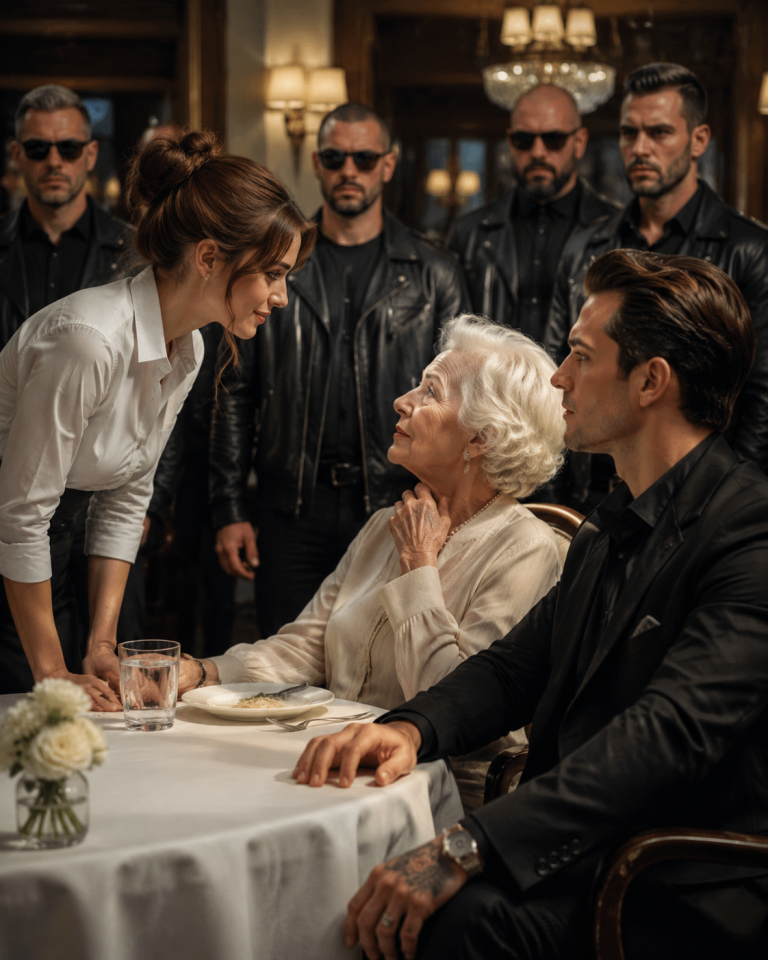
I looked out at the ballroom — at the flowers, the faces, the camera crew Cresswell’s publicist had arranged — and I noticed, near the back of the room, a man standing alone.
He did not belong there.
Not because he was poorly dressed — he was, in fact, dressed better than almost anyone in the room, dark suit, no tie, the kind of understated elegance that signals money too settled to announce itself. He didn’t belong because he was the only person in the room who was not watching the ceremony.
He was watching me.
His name came to me before I could question how I knew it.
Rhys Calder.
Everyone in certain circles knew that name. Hotel groups. Shipping. Private equity. The kind of man whose name appeared in newspapers only when his lawyers had decided they couldn’t stop it.
Some called him ruthless.
Some called him the last honest businessman in Chicago.
Some said other things in lower voices.
He was not smiling.
He was not clapping.
He was watching me the way a person watches a building they believe is structurally unsound — still, focused, measuring what no one else is willing to see.
Our eyes met.
And in that moment, something inside me broke open.
Not courage. Not yet.
Just recognition.
Someone in that room could see me.
Not the dress. Not the lace. Not the performance of a woman walking carefully toward a life she had not chosen. *Me.* The woman with ice burns on her cheek and a grip-shaped bruise beneath her glove and nine months of practiced silence behind her eyes.
The priest said my name.
“Isadora Vance, do you take Cresswell Alderton to be your—”
Cresswell’s hand tightened.
My vision doubled.
The peonies smeared into white fog. The candlelight scattered. My chest locked and my knees dissolved and I understood, in the clean language of my own body, that it had finally stopped cooperating with the lie.
I fell.
Not gracefully. Not cinematically. The way a body falls when it has simply run out of the resources required to keep standing.
My mother’s scream cut through the room.
Cresswell crouched beside me, and I saw his face change — from fury, to calculation, to the practiced expression of a concerned groom.
“Help her,” he said, loudly enough for the room.
Then, close to my ear, in the voice I knew: “Get up. *Get up.*”
I couldn’t.
From somewhere very far away, I heard footsteps.
Not hurried. Measured.
The kind of steps that part a room.
And then someone crouched beside me, blocking Cresswell’s light, and lifted the edge of my veil.
I looked up into the face of Rhys Calder.
He looked at my cheek.
Something in his expression went terribly still.
“Who did this to her?” he said.
His voice was not loud.
That made it worse.
Cresswell’s composure cracked at the edges. “She fainted. It’s the heat. You are a guest here, Calder, not a—”
“Who hit her.”
Not a question the second time either.
I watched Cresswell’s jaw tighten. I watched him recalibrate. I watched him perform wounded dignity for an audience of three hundred people while the bruise his hand had made three days ago sat visible on my face, foundation smeared by cold sweat and marble.
Rhys Calder removed his jacket and placed it over me.
Not romantically. Not performatively. The way you cover something that has been exposed without its consent.
Then he looked at the priest.
“This ceremony is finished.”
The room inhaled.
Cresswell stepped forward. “You have absolutely no authority—”
“She hasn’t said yes.”
Three words.
And they changed everything.
Because they were true. And because truth, when spoken plainly in a room full of people who have been pretending not to see it, is impossible to put back.
Cresswell reached for me.
Rhys Calder’s hand was already there.
I did not see him move. One moment Cresswell’s fingers were reaching for my shoulder. The next, Rhys had his wrist, and Cresswell’s face had gone the particular gray of a man who has just understood that the room has shifted and he is no longer the most dangerous person in it.
“If you touch her,” Rhys said quietly, “this ends differently than you want it to.”
Then he lifted me into his arms.
He carried me down the aisle.
Not a single person tried to stop him.
Outside, the December air hit my face like a hand. Cameras flashed. Security scrambled too late. Behind us, Cresswell called my name.
I flinched.
Rhys felt it.
His arms steadied. Not possessive. Anchoring.
“Don’t turn around,” he said.
I didn’t.
But what I didn’t know — what I couldn’t have known, still lying bruised in a stranger’s arms on the steps of the Aldervane Hotel — was that Rhys Calder had not walked into that ballroom by accident.
My father had put him there.
And the reason why was about to change everything I thought I knew about who had betrayed me.
—
## PART 2
The SUV was warm and black and felt like the inside of a held breath.
My mother climbed in immediately, taking my hands, saying my name over and over like a prayer she’d forgotten the words to. My father appeared at the open door — ashen, diminished, standing at the edge of what he’d done and couldn’t undo.
“You called him?” I said.
My father’s mouth moved.
“I didn’t know how else to stop it.”
Rhys, already in the vehicle, said nothing. He had learned something, I would discover later, about letting women ask their own questions.
“You knew,” I said to my mother. “How long?”
Her silence was an answer.
All of it.
The whole nine months.
I turned my face toward the window as the SUV moved. Chicago opened around us in glass and winter light, indifferent and ordinary, the city continuing to exist while my life rearranged itself at speed.
At the hospital, a female doctor cut the sleeves from my dress without comment and photographed each bruise with the quiet, specific efficiency of someone who had done this before. Purple across my ribs. Yellowed green at my collarbone. Fingerprints, still fresh, around my wrist.
“Do you feel safe?” she asked.
I laughed. The sound that came out surprised me.
“I don’t know what that is yet,” I said.
A police officer arrived.
A victim advocate.
Questions in careful voices.
And I understood that for nine months Cresswell had trained me to believe that my pain required his permission to be real — that bruises needed his explanation, that fear needed his validation, that I was the unreliable narrator of my own life.
I looked at the officer.
“I want to file a report.”
My mother made a small, broken sound from the corner.
I did not look at her.
Rhys, standing just outside the doorway, closed his eyes briefly. Like a man who had been waiting to see which way something fell.
By that evening, the Alderton family’s publicist had released a statement.
*Isadora Vance experienced a medical episode during the ceremony. Cresswell Alderton remains devoted and supportive as she receives care. The family asks for privacy at this time.*
By morning, the gossip sites were calling me a runaway bride.
By noon, anonymous sources were describing my “history of instability.”
By 3 p.m., a photograph of Rhys carrying me from the hotel had been reframed as a scandal — rival billionaire, they called him, interrupting a society wedding for reasons of his own.
I read all of it on my phone in a hospital bed, getting progressively more furious, until Rhys appeared in the doorway with two cups of coffee and said, without preamble: “Don’t read comments from people who weren’t in the room.”
“You can’t tell me what to read.”
“No,” he agreed. “But I can tell you what they’re worth.”
He set down the coffee and sat in the chair across the room.
And then he said the thing that made the floor shift beneath everything I thought I understood about that day.
“Your father didn’t call me two nights ago, Isadora.”
I looked at him.
“He called me four months ago. The first time you came to the Alderton house with broken skin on your arm and told your mother you’d fallen.”
The room went very quiet.
“He called me every week after that,” Rhys said. “He told me about each one. He couldn’t bring himself to stop the wedding. But he wanted someone in that room who would.”
I stared at him.
“Why you?”
His jaw tightened.
“That,” he said, “is a longer answer than tonight allows.”
—
## PART 3
He told me the longer answer three days later, in a private room at Northwestern Memorial, when I could sit up without the world tilting and my mother had finally gone to sleep in the chair by the door.
He told it quietly, without drama, the way people tell things they’ve carried a long time.
He and my father had worked together years ago — before Cresswell, before the Alderton world, before my father had become the version of himself who stared at his lap and pretended not to notice. When Rhys was building his first hotel group, still more stubborn than solvent, my father had backed him. Not with money. With something harder to find: he’d written a letter to a city council that was blocking Rhys’s permits, and that letter had cost my father a business relationship worth twice what the favor was worth.
“He did it because it was right,” Rhys said. “I never forgot that.”
I looked at the photograph he placed in my hands. My father, younger, standing outside a construction site beside a man I didn’t recognize — and Rhys, barely thirty, dark-eyed and serious, already carrying that watchful stillness.
“When he called me,” Rhys said, “he was someone who had let fear corrode him for years. But something in him still recognized that what was happening to you was wrong.” He paused. “I think he needed someone to walk through the door he couldn’t.”
I looked at my father’s face in the photograph.
I thought about the man who used to read to me on Sunday mornings. The man who had cried at my college graduation. The man who, eleven months ago, had sat across a dinner table while Cresswell’s hand closed around my wrist and said nothing.
“I don’t know if I can forgive him,” I said.
“I didn’t say you should,” Rhys replied.
That surprised me. People always wanted women to move toward forgiveness quickly. To name it, perform it, demonstrate grace. As if our healing existed to make the people who failed us more comfortable.
Rhys just sat in the chair near the door, keeping space between us, and did not tell me how to feel.
—
Cresswell came to the hospital on the second day.
He did not come alone.
He brought his mother, two lawyers, a private physician, and an arrangement of white peonies that he had probably instructed an assistant to order.
I heard his voice in the hallway before I saw him. That particular measured warmth — the public voice, the performance of devotion — and it moved through me like cold water.
Rhys had stepped outside when the commotion started.
I was the one who got up.
My mother reached for me.
I moved past her.
Wrapped in a hospital robe, bruised and not bothering to hide it, I walked to the doorway.
Cresswell saw me.
His face shifted through its routine: fury, then pain, then the soft wounded expression designed for witnesses.
“My love,” he said.
“Don’t.”
He took a step forward. Rhys’s security blocked him without theatrics.
Cresswell looked at me over their shoulders.
“You’re unwell, Isadora. You need rest and proper care. Come home.”
“I am home,” I said. “This is me, having left yours.”
His mother, Philippa Alderton — silver, elegant, the architecture of cruelty refined over decades — stepped forward.
“Isadora, you’re confused. What happened was a medical episode under extraordinary stress. No one needs to assign blame.”
I looked at her.
For years, women like Philippa had made me feel provincial. Too emotional. Too soft for the world her son occupied. She had a talent for making my pain seem like a social error.
“You saw the bruises last month,” I said. “At the engagement dinner. You told me foundation had a beautiful finish.”
Her expression didn’t change.
But something did.
“You knew,” I said. “And you chose the wedding.”
Philippa’s voice cooled. “Marriage requires a woman to understand—”
“I understand perfectly,” I said. “That’s why I’m not coming back.”
Cresswell’s composure broke at the edges.
“You file charges and this becomes ugly for everyone.”
“It was already ugly,” I said. “You just counted on me keeping it quiet.”
“You will regret—”
“Cresswell.” Rhys’s voice, behind me. Not loud. The kind of quiet that functions as a door closing. “She has given you her answer.”
Cresswell stared at him.
That old calculation ran behind his eyes — how far, how much, what this costs, whether he can absorb it.
Then he looked at me, and for one unguarded second I saw the thing underneath the performance. Not love. Not even anger. Something colder. The affront of a man who had been told no by something he believed he owned.
“Think about what you’re throwing away,” he said.
I thought about the ice bag at 6:47 a.m.
About standing in front of a mirror and deciding.
“I already did,” I said.
They left.
I stood in the hallway until their voices disappeared around the corner, and then my legs chose their own timing and I sat down on the floor against the wall.
Rhys sat down beside me.
We stayed there for a while, on the floor of a hospital hallway in our respective versions of wreckage.
“You did well,” he said.
“I’m terrified.”
“I know.” A pause. “Both things.”
—
The legal process was slow and ugly and nothing like the clean narrative the internet had already written about me.
My hospital photographs became exhibits. My statement became a case file. The wedding footage circulated online in pieces, each clip stripped of context, the comments dividing me into camps — victim, villain, actress, opportunist.
Some people believed me.
Many didn’t.
Strangers analyzed the angle of my fall, the timing of Rhys’s entrance, the convenient presence of cameras.
I read all of it.
Then I read it again.
Then I called Rhys and said: “Tell me the truth about whether you knew there would be cameras.”
A pause.
“Cresswell’s publicist arranged them,” he said. “I expected them. Yes.”
“Did you use them?”
“I walked down the aisle knowing they were there. I didn’t hide from them.”
I thought about that.
“That’s not the same as staging it.”
“No,” he said. “It’s not.”
“But you let the room see.”
“I let the room see what was already true,” he said. “I didn’t create the bruise.”
I pressed my phone against my chest for a long moment.
“I know,” I said finally.
“Are you angry?”
“A little.”
“Fair.”
“I’ll get over it.”
“Take your time.”
I did.
—
My mother called every day the first week. I answered every third call, then every second, then every one.
She cried through most of them.
One afternoon, six weeks out, she said: “I told myself the wedding would settle him. I told myself that men like Cresswell simply needed their lives to come together before the pressure stopped.”
“You thought marriage would make an abusive man gentle,” I said.
“I wanted to believe it.”
“You chose to believe it.”
Silence.
“Yes,” she said quietly. “I chose.”
We were both quiet for a while.
“I love you, Mom. But I don’t trust you right now.”
Her breath shook. “Tell me how to earn it.”
I didn’t have an answer that day. But I didn’t hang up either. That felt like a beginning.
—
My father was harder.
He appeared outside the safe apartment Rhys had arranged through a women’s legal foundation — a fact I discovered from the advocate, not from Rhys, who seemed genuinely irritated when I brought it up.
“You fund this building,” I said.
“Under a separate entity, yes.”
“Why didn’t you tell me?”
“Because it wasn’t about you when I set it up. And it shouldn’t be about me now.”
I stared at him.
He looked almost annoyed at being credited for it.
“My sister needed a place like this once,” he said. Then: “Don’t ask me more than that tonight.”
I didn’t.
But later, standing at the window watching the river, I thought about a younger Rhys Calder with a violent father and a sister to feed, and an older version of my father writing a letter that cost him more than it needed to, and the long strange thread that connected that moment to this one.
—
When my father came to the door, he brought soup from the diner we’d gone to every Saturday when I was seven.
I stood behind the glass.
He looked smaller than my memory of him.
“Did you know?” I asked. “Before the wedding. Before Rhys. Did you know he was hurting me?”
His face twisted.
“I suspected.”
Worse than yes.
“You walked me down the aisle.”
“I thought—” His voice broke. “I told myself I could manage it after. That once you were settled, I could talk to him, negotiate, make him understand—”
“Negotiate with a man who was hitting your daughter.”
He lowered his head.
“I was a coward.”
“Yes.”
He pressed his hand to the glass.
“There’s something else,” he said. “Something I haven’t told your lawyer.”
He reached into his coat.
An envelope.
“The Aldertons didn’t just threaten the company,” he said. “They paid me. They called it a business rescue. Four hundred thousand dollars, wired to the company account three months before the wedding, after I agreed not to interfere.”
The floor dropped away.
“You were paid.”
“I told myself it wasn’t what it was,” he whispered. “God help me. I told myself I was protecting the employees. The house. Your mother’s prescriptions.”
I looked at him through the glass.
At the man who used to carry me on his shoulders. Who cried when I graduated. Who watched me walk toward an altar in pain and signed a bank receipt and told himself it wasn’t a betrayal.
“Give the envelope to my lawyer,” I said.
He pushed it through the door slot.
“I don’t expect forgiveness.”
“Good,” I said.
He nodded, absorbing it.
He left the soup.
I threw away the soup.
I kept the envelope.
—
That envelope changed the shape of everything.
The case expanded. Financial coercion. Forced marriage arrangement documented across email chains. Witness intimidation. Evidence that the Alderton family had not merely failed to stop Cresswell — they had actively funded the removal of obstacles.
Philippa tried to settle.
The offer came through three layers of lawyers: eight million dollars and a public statement confirming the wedding had been postponed due to my health.
My lawyer slid the document across the table.
Rhys sat beside me, saying nothing. He had learned to give my decisions their own silence.
I read the clause requiring me to state that Cresswell had never intentionally harmed me.
I thought about ice bags and concealer and nine months of being trained to distrust myself.
I slid the document back.
“No.”
—
The charges didn’t reach trial.
Not because Cresswell was innocent, but because the case reached critical mass before the Alderton family could contain it.
Rhys’s investigators found two other women. A former personal assistant who had relocated to Seattle under a settlement agreement. A college girlfriend whose medical records documented three “accidental” injuries during their relationship.
Both had been paid to disappear.
Both had watched video of me falling at the altar.
The assistant called my lawyer first.
“I watched her drop,” she said. “And I recognized the dress. The way she walked. The way she held herself so carefully.” A pause. “I used to walk like that too.”
That sentence kept me awake for two nights.
Not because it was sad.
Because it meant my most broken moment had become someone else’s permission to be believed.
The DA announced charges in late spring. Assault. Coercive control. Witness tampering. Financial crime charges followed for Victor Alderton, Cresswell’s father, tied to the payments made to mine.
Cresswell was arrested outside a private members’ club on a Thursday morning. He wore sunglasses. He looked furious.
Not ashamed.
That told me everything I needed to know about the limits of his self-awareness, and why my healing could not depend on his comprehension of the harm he had caused.
—
At his sentencing, I gave a statement.
Navy suit. No veil. No makeup covering anything that needed covering.
I looked at the judge, not at Cresswell.
“On my wedding morning, I stood in a hotel bathroom at 6:47 a.m. with a bag of ice against my face, and I thought about whether I would still be alive in five years if I walked down that aisle. That thought had never occurred to me before he put it there.”
My voice trembled. It did not stop.
“He told me I was lucky to be chosen. He told me my fear was dramatic. He told me the bruises were evidence that I needed to be calmer, steadier, more careful with his moods. I believed him for nine months because he said it every day and I was surrounded by people who needed me to keep believing it.”
I paused.
“At the altar, my body told the truth before I could. I think that was the last thing he could not control — that my body refused to sign what he needed me to sign.”
I turned then, and looked at him.
He was staring at the table.
“I am done being legible to people who need my silence,” I said. “That’s all.”
He received his sentence without looking at me.
I walked out of the courtroom into pale afternoon light, and for the first time in over a year, I stood still on a pavement and breathed without calculating anything.
—
Eight months after the wedding that didn’t happen, I became director of the Threshold Project.
Named because threshold was where it changed — the moment you crossed from the life you were in to the one you were building. Threshold was where Rhys had stood when he asked *may I come in* instead of entering. Where my mother had pressed her hand to the glass. Where my father had pushed through an envelope that cost him everything and offered nothing in return but the truth.
The project built transitional housing for women leaving dangerous relationships. I designed every detail. Not cold or clinical — human. Large windows. Wide hallways. A communal garden. Bathrooms with good mirrors and strong locks. A legal clinic with private rooms and no time limits. Childcare. A library.
Places where women could exist without performing survival.
On the day we broke ground, my mother stood at the edge of the site, hesitant, holding a small box.
Inside: a pair of earrings I’d loved as a teenager and thought were lost.
“I found them in your old room,” she said. “I thought you’d want them back.”
I took the box.
“I’m in therapy,” she said. “I’m learning the difference between keeping peace and allowing harm.”
I looked at her.
“That’s an important difference.”
“I know it came too late.”
“Yes.”
She nodded.
Then I hugged her. Briefly. Honestly. I let her cry against my shoulder and I did not try to absorb it or manage it or tell her it was fine.
It wasn’t fine.
But we were still standing.
That was something.
—
My father testified.
He stood in front of the grand jury and admitted everything — the payment, the cowardice, the months of looking away. His company collapsed in the months after. The house was sold. His reputation did not survive the headlines.
When I saw him outside the courthouse, he looked lighter.
That was the strange part. Not happy. But lighter. Like a man who had been carrying something in his chest for so long he’d forgotten what it felt like to breathe without it.
He handed me a letter.
He told me I didn’t have to read it.
I waited two weeks.
Inside, he had written down memories of me as a child. Specific ones. The way I used to draw houses with impractical windows. The morning I cried for an hour because a bird hit the kitchen glass. The night of my mother’s first surgery when I’d stayed awake beside her chair until dawn because I couldn’t stand for her to be alone.
At the end, he wrote: *I knew exactly who you were. I forgot that protecting you meant protecting who you were, not protecting my own comfort. I am sorry I remembered too late.*
I cried for an hour.
Then I put the letter in a drawer.
Apologies can be real and still not repair what they’re apologizing for. Both things.
—
Rhys and I did not fall in love the way the internet wanted us to.
There was no single moment. No dramatic declaration in the rain. No kiss outside the courtroom.
There were instead a hundred small moments of him learning to be in proximity to a woman who needed space before trust, and of me learning that safety could coexist with someone complicated if the complication was honest.
He was not simple. He never claimed to be.
One evening, standing on the roof of the Threshold Project building during construction, I asked him directly: “Tell me the truth about what you are.”
He was quiet for long enough that I knew he was choosing the real answer.
“I have done things in the last fifteen years that I can’t call clean,” he said. “I made money in ways that required me to make peace with certain realities. I told myself I was pragmatic. Sometimes I was.” He looked out at the city. “I’ve spent the last five years restructuring. Not because I was caught. Because I decided I didn’t want the version of myself I was becoming.”
“Is that finished?”
“Largely.”
“Largely isn’t done.”
“No. But it’s honest.” He looked at me. “I won’t give you a false account to make you comfortable.”
I thought about that.
“Why did my father trust you? Knowing what you were?”
“He said he trusted the version of me who knew how to be helped and remembered it.” He paused. “He said the men who remembered their debts were rarer than the men who could pay them.”
I looked at Rhys for a long time.
“I’m not afraid of complicated,” I said. “I’m afraid of dishonest.”
“I know.”
“I need you to keep being this honest when it costs you more than tonight.”
“I know that too.”
I stepped back. Not away — just enough to be choosing the distance.
He let me.
That was when I understood something about him: that the most reliable thing about Rhys Calder was that he had learned the difference between wanting something and being entitled to it. He wanted plenty. He understood entitlement was the thing he had to be most careful of.
—
The Threshold Project opened on a Thursday in October.
The morning was cold and bright, the sky that particular Chicago blue that looks like it was cleaned overnight. Rhys stood near the back, as he usually did at things I’d built.
Women came.
Mothers with their children in arms. Women alone. Women with sisters. Women with lawyers. Women who looked the way I had looked on my wedding morning — careful, guarded, reading every room for exits.
I stood in the courtyard among the white peonies I’d planted on purpose — reclaiming that particular flower, refusing to let a bad man’s aesthetic become a permanent wound — and I said what I meant.
“The first time I understood what this building could be, I was standing in a hospital room thinking that the only question left was whether I got to choose my own life. I had forgotten that was a choice available to me. I had been taught, carefully and systematically, that my choices required his permission.”
I looked at the open doors.
“These doors open from the inside. That seems like a small thing. It is not a small thing.”
The applause came slowly, then built.
Rhys met my eyes from across the courtyard. He was not clapping. He was just watching — that same watchful steadiness from the ballroom, the look that had first made me feel seen.
He mouthed something.
I read his lips.
*You did it.*
I shook my head.
*We did,* I mouthed back.
He shook his head.
Disagreeing, as usual.
—
After the ceremony, after the ribbon-cutting and the speeches and the first residents receiving their keys, I found him in the garden.
“I missed you,” I said. “The last few months.”
“I know.”
“I kept distance on purpose.”
“I know that too.”
“I needed to know if I was choosing you or leaning on you.” I looked at him. “The difference matters.”
His jaw tightened the way it did when he felt something he wasn’t sure he had permission to say.
“And?” he said.
“I’m choosing,” I said. “That’s different from before. Everything before was choosing from fear. This is choosing from—” I paused. “From something that isn’t fear.”
He looked at me steadily.
“What is it?”
“I don’t have a clean word for it yet.”
His mouth curved.
“Take your time.”
“I know.” I stepped closer. “Stand here.”
He didn’t move immediately. He waited — one breath, two — making sure the invitation was real and not reflex.
Then he closed the distance between us.
His hand came up slowly, and I let it rest against my face. Not the bruised cheek. The other one. Careful and deliberate, the way he did most things.
“I am very glad your father called me,” he said quietly.
“I know,” I said. “I’m still angry at him.”
“Yes.”
“But I’m glad too.”
—
A year and a half after the wedding that didn’t happen, I stood in the bathroom of the Threshold Project’s administrative office and looked at my face in the mirror.
No foundation covering anything.
No performance.
Just me, with my particular history written in the small lines around my eyes and the particular way I held my jaw, which a therapist had once told me would soften over time and which was indeed, slowly, softening.
My phone lit up.
A message from my mother: *I saw the news. I am proud of you. Not because you survived something, but because you built something. Those are different. I’m learning to know the difference.*
And from my father: *The building is beautiful. So are you when you’re free. I think I forgot what that looked like.*
I stood with both messages on my screen for a long moment.
Then I walked out into the hallway, where Rhys was waiting with coffee from the place I liked and that particular patience that was, I had come to understand, not natural to him but chosen.
He had chosen to practice it.
That meant more than ease.
“Ready?” he said.
I thought about the ballroom. About 6:47 a.m. and a bag of ice. About nine months of learning to make myself small, and the single morning my body finally refused.
I thought about the first woman who had moved into the first Threshold apartment. She had stood in the center of her new living room holding the key in both hands, and she had said, very quietly: *I forgot they make keys you get to keep.*
That was what I had been building toward.
Not revenge.
Not recovery in the sense of returning to who I was before.
A key I got to keep.
“Yes,” I said.
Rhys offered his arm.
I took it.
Not because I needed steadying.
Because I wanted to.
And outside, the city waited — imperfect and loud and full of people navigating their particular damage toward their particular version of what came next — and we walked into it together.
Every step mine.
Every step chosen.
Every step belonging, finally and completely, to no one but me.
—