HER HUSBAND GAVE HER CHARITY-BALL TABLE TO HIS MISTRESS AND TOLD HER TO USE THE SIDE DOOR — SHE WALKED IN THE FRONT WEARING HER GRANDMOTHER’S DIAMONDS INSTEAD

—
**PART 1**
There is a particular kind of quiet that settles over a woman in the half-second after she reads a sentence that ends a marriage, before she has decided what to do about it — not shock exactly, more like the stillness of a house right before a storm makes up its mind. Vivienne Hartley Calder was standing in that quiet now, in her dressing room on the sixty-third floor of the Whitmore, her hair already pinned, her diamonds already locked at her throat, reading the same six words on her phone for the third time.
*Side door. No drama, Vivienne.*
She thought about her grandmother, who had once worn these exact eight stones to a Senate dinner and made three men change their votes before dessert, and wondered what Eleanor Hartley would have made of a granddaughter being asked to enter her own family’s ballroom through the service corridor because a man had decided another woman’s comfort mattered more than his wife’s name on the deed.
Preston’s text sat glowing on the screen: *Slight change tonight. Celeste will host the Calder table. Use the side entrance. No drama, Vivienne.*
Twelve years, Vivienne thought. Twelve years of mistaking her silence for weakness because it happened to wear pearls.
Her assistant Nora hovered behind her, one hand pressed to her mouth. “Mrs. Calder — should I call the driver around to the service alley?”
Vivienne looked at her own reflection — black silk cut clean across the collarbone, a dress that didn’t beg to be admired because it already knew the room would obey it — and smiled.
“No,” she said. “Tell Daniel to bring the Rolls to the front.”
“The main entrance?”
“The only one that matters.” Because women with deeds, she thought, do not use side doors.
The Hartley Foundation Winter Ball had been hers, in every way that mattered, long before she’d become Mrs. Preston Calder. Her mother had chaired it after her grandmother; Vivienne had taken it over at twenty-eight, when people still assumed her grief made her decorative, and turned it into the most photographed winter event in New York. And every year, without exception, the center table beneath the largest chandelier belonged to the Hartley family. Not Calder.
Hartley. Her name.
The Rolls stopped at the main entrance. Daniel opened her door; cameras shifted; a few people gasped softly, the particular gasp of the wealthy when cruelty becomes entertainment and they realize the victim has arrived early enough to watch her own humiliation unfold in real time.
“Vivienne! Over here!”
She paused on the carpet just long enough to give the lenses a clean angle. A woman about to ruin a man should always leave good photographs behind.
Inside, Marissa Quinn, the hotel’s event director, rushed toward her pale beneath her makeup. “Mrs. Calder — I’m so sorry. There’s been a seating adjustment.”
“I heard.”
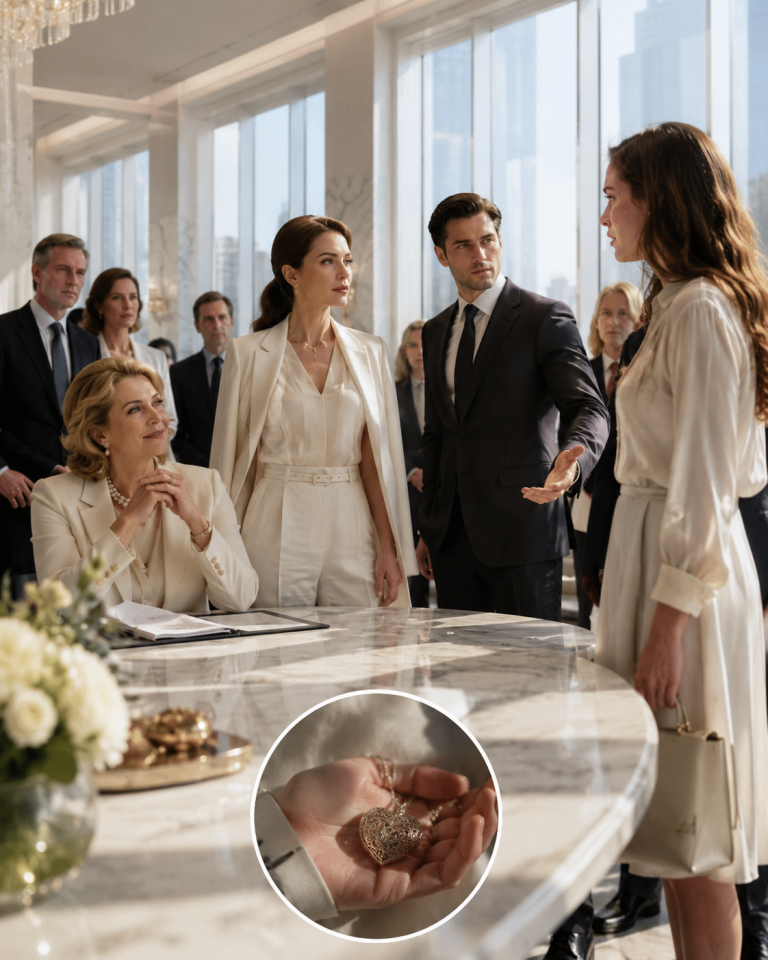
At the far end of the ballroom, beneath the central chandelier, white calla lilies rose from a silver urn beside a gold-printed card: *CELESTE WYNN. HOSTESS, CALDER-HARTLEY TABLE.*
Not mistress. Hostess. Preston had always preferred a softer word for a dirty thing.
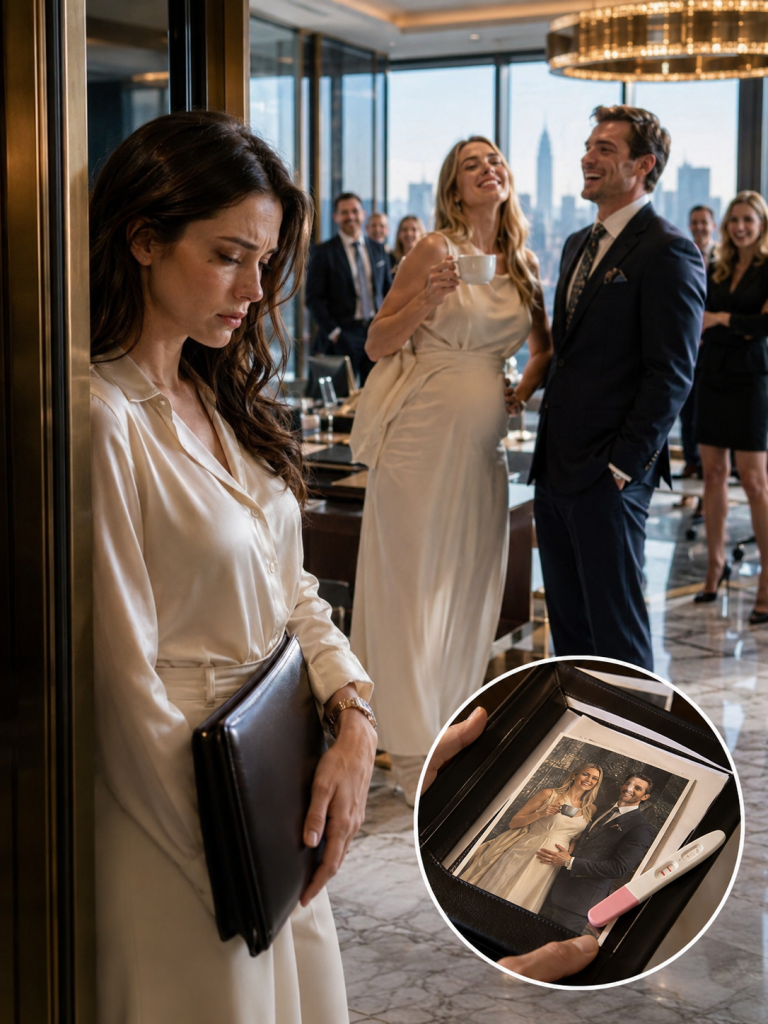
Celeste Wynn sat in Vivienne’s chair, ivory satin, hair engineered by a team that feared unemployment, a diamond bracelet glittering at her wrist — Vivienne’s bracelet, the tenth-anniversary gift Preston had bought her in Aspen with money he’d once claimed was reserved for “family liquidity.” She hadn’t worn it in three years. Apparently Celeste had.
Preston stood behind the chair, one hand resting on its back — possession disguised as manners. He saw Vivienne, and for exactly one second his face changed. Not guilt. Preston had never once been burdened by that. Calculation.
Then the smile returned, the same campaign-poster smile that had once convinced Wall Street he was visionary and convinced her father he was safe.
“Vivienne,” he said, reaching her. “You were supposed to use the private entrance.”
“I know.”
“This is not the place.”
“It rarely is, for men who choose public cruelty.”
His eyes went flat behind the smile he kept aimed at the cameras. “Do not embarrass me tonight.”
“You put your mistress’s name on my table,” Vivienne said quietly, “and you’re worried I’ll embarrass *you*?”
“She’s not my mistress. She’s our new strategic consultant.”
“Is that what we’re calling hotel suites now?”
His fingers brushed her elbow — not quite gripping, not quite gentle. “You’ve had a difficult year. You’re emotional.”
*Emotional.* Preston’s favorite small knife. He’d used it the day she asked why six million dollars had moved out of a charitable holding account into a Delaware entity she’d never approved. He’d used it the day she found Celeste’s lipstick in his study drawer at Greenwich. He’d used it the day she noticed a private jet manifest listing two passengers to St. Barts while she sat beside her mother in an oncology waiting room.
*Emotional* meant: *I have been caught, and I dislike your tone.*
Vivienne removed his hand from her arm with two fingers. “I’m perfectly composed.”
“Then act like it. Celeste has donors at that table. Important donors. You can sit this one out.”
*Sit this one out.* At her foundation. In her hotel. At her table.
That was when a familiar voice cut through the tension behind her.
“Vivienne.”
—
**PART 2**
Julian Vale stood near the entrance in a black tuxedo that fit him like discipline, silver at his temples now, just enough to make him look more dangerous than handsome, though he had always managed to be both. Not old money — sharper than that. He’d built Vale & Strickland into the most feared private litigation firm in the country by turning secrets into settlements and settlements into silence.
He had also, a lifetime earlier, kissed her in the rain outside a law library at Columbia, before she’d chosen the man her father preferred instead.
Tonight, he was her attorney.
Preston’s eyes narrowed. “Vale. I didn’t know you were invited.”
“I wasn’t invited by you,” Julian said, looking at Preston the way a surgeon looks at a tumor.
“He was invited by me,” Vivienne said.
“Is there a reason your divorce attorney is at a charity ball?” Preston’s voice had gone thin.
The word *divorce* moved through the air like perfume. Two nearby women stopped pretending not to listen.
“I attend many charity events, Preston. Tonight happens to be especially charitable.”
“This drama ends now,” Preston said, unease crossing his face before he recovered it. “You will not walk into that room and create a scene.”
“No,” she said. “You already created it.” Then she walked past him.
The ballroom quieted in waves, silence rolling outward from the entrance as heads lifted and forks stilled, the string quartet faltering half a measure before recovering. Vivienne moved down the center aisle, black silk whispering around her legs, straight toward table one.
Celeste rose halfway from the chair. “Vivienne, I hope this isn’t awkward.”
“It was. For a moment.”
“I’m sure this is just a misunderstanding,” Celeste said, with a small breathy laugh. “Preston told me the foundation needed a fresher public face this year.”
*A fresher public face.* Several people audibly inhaled.
Vivienne lifted the place card from its holder and turned it over. Tiny hotel print on the back listed the table number, and beneath it, when she asked Marissa for the master seating binder, she found the full arrangement in black and white: *CELESTE WYNN — HOSTESS. PRESTON CALDER — CHAIRMAN. VIVIENNE CALDER — AUXILIARY SEATING.*
“How lovely,” Vivienne said, closing the binder gently. “A fresh face is useful when the old lies start to rot.”
“Enough,” Preston said, stepping close.
“No,” Vivienne said softly. “Not yet.”
She took the empty seat beside Celeste — not because it had been assigned to her, but because it faced the stage, because every camera in the room could see her from it, because revenge, like champagne, should be served cold enough to make the glass sweat.
Marissa hovered nearby, torn between two masters and increasingly certain which one actually held the deed. Preston stood frozen at the head of his own table, watching his wife settle into a chair with the unhurried calm of a woman who had clearly stopped needing his permission for anything, in a ballroom that had never, not once, technically belonged to him at all.
—
**PART 3**
**What the Binder Didn’t Say**
Marissa set the leather seating binder down and lingered, visibly uncertain whether her job that evening was to serve the chairman or the woman whose family name funded his chairmanship in the first place.
“Marissa,” Vivienne said pleasantly, “who approved the change to the master list?”
“Mr. Calder’s office, ma’am. Two days ago.”
“And who owns the Hartley Foundation’s charter, Marissa? Whose signature authorizes any change to the board table?”
Marissa’s eyes flicked, involuntarily, toward the small brass plaque near the ballroom entrance — one Vivienne had walked past a thousand times without needing to read it, engraved with her grandmother’s name and, beneath it, the foundation’s governing structure. “Yours, Mrs. Calder. The Hartley Family Trust holds the controlling interest.”
“Then Mr. Calder’s office authorized a change it had no authority to make,” Vivienne said, and turned the seating binder around so it faced the table, so anyone leaning close enough could read *AUXILIARY SEATING* printed beside her own name in a font someone had clearly enjoyed choosing. “I’d like that corrected before the invocation, please. And I’d like the foundation’s outside counsel to have a copy of tonight’s original seating request, along with whatever email authorized it.”
“I can have that pulled within the hour.”
“Julian will collect it,” Vivienne said, and Julian, still standing at the edge of the table with the particular patience of a man who had spent two decades waiting for exactly the right moment to become necessary, nodded once.
Preston’s jaw worked. “You’re making a scene over a seating chart.”
“I’m making a record,” Vivienne said. “There’s a difference, and you’ve never once bothered to learn it.”
A waiter refilled water glasses around them with the studied blankness of hotel staff trained to notice everything and react to nothing, and Vivienne found herself, for one strange moment, grateful for the ordinary choreography of the room continuing around her — proof that whatever came next, the world itself was not going to stop simply because her marriage finally had.
**The Six Million Dollars**
The foundation’s annual remarks began at nine, and Preston, still chairman in title if nothing else, took the podium first — the same easy charm that had carried him through a hundred boardrooms, thanking donors, thanking the city, thanking, with visible warmth, “the fresh energy Celeste has brought to this year’s committee.”
Vivienne let him finish. She had learned, across twelve years, that interrupting Preston mid-performance only made him more convincing; it was always better to let him build the entire structure himself and then simply point out, calmly, which parts of it were load-bearing lies. She watched him work the room the way she’d watched him work a hundred rooms before this one, admiring donors’ watches, complimenting a senator’s daughter’s dress, gesturing warmly toward Celeste every few sentences as though her presence there were simply the natural evolution of a foundation that had, in his telling, been badly in need of modernizing.
She thought, watching him, about the man he’d been at twenty-six, before Wall Street had taught him that confidence could substitute for character indefinitely if delivered with enough polish. She had loved that man, or a version of him convincing enough to feel like love at the time. She found, sitting there in her grandmother’s diamonds, that she no longer needed to reconcile the two versions of him. They were simply the same man, wearing different amounts of proof.
When the applause settled, she rose from her seat — not storming, not shaking, simply standing the way she had stood a thousand times before at this exact podium, in this exact ballroom, at galas her own family had funded since before Preston Calder had ever learned to tie a proper bow tie.
“Before we move to the paddle raise,” she said, taking the microphone from a startled emcee with the easy authority of someone who had never once needed to ask permission for it, “I’d like to make a brief correction to tonight’s program, on behalf of the Hartley Family Trust, which retains sole authority over this foundation’s governance.”
A ripple moved through the room, quieter than the one at the entrance but considerably more attentive.
“Six weeks ago,” Vivienne continued, “six million dollars moved out of this foundation’s charitable holding account into a Delaware entity called Meridian Advisory Partners. I did not authorize that transfer. As chairwoman of the Hartley Family Trust, I am the only person with authority to approve movement of restricted charitable funds.” She let her gaze settle, briefly and without malice, on Celeste. “Meridian Advisory Partners is registered to a Ms. Celeste Wynn.”
The silence that followed had actual weight to it. Preston’s face, for the first time all evening, lost every trace of its practiced calm.
“That’s outrageous,” Celeste said, standing so fast her chair scraped audibly against the marble. “I run a legitimate consulting practice—”
“You run an LLC that received six million dollars of restricted scholarship funding three days after Preston granted you signing authority on a foundation account you were never appointed to,” Julian said, stepping forward with a folder he had been holding, Vivienne understood now, since the moment he’d walked through the door. “I have the wire confirmations, the account authorization forms, and the board resolution — forged, I should add, since no such resolution was ever passed by the actual board of directors.” He set the folder on the podium beside Vivienne, calm as a man delivering a weather report. “The Manhattan DA’s office received copies of all of it this afternoon.”
**What the Room Understood**
Two of the foundation’s largest donors, seated near the stage, exchanged a look Vivienne recognized instantly — the particular expression of powerful people recalculating, in real time, exactly how much of their own reputation was currently sitting adjacent to a man whose charm had just been revealed to be load-bearing for something considerably uglier than a midlife affair. One of them, a shipping magnate named Osgood who had personally underwritten the previous year’s scholarship class, actually stood and walked toward the exit mid-speech, phone already at his ear, in a way that told Vivienne he had likely just remembered a call he urgently needed to make to his own compliance department.
“Vivienne,” Preston said, low, urgent, the microphone still close enough to catch the edge of his voice, “you don’t understand the full picture.”
“I understand it perfectly,” Vivienne said. “You used my grandmother’s foundation, funded by my family, governed by a charter with my name on it, to launder money into an account controlled by the woman you were sleeping with, and then you sat her in my chair and told me to use the side door so I wouldn’t notice.” She turned to the room. “I’m not asking anyone here to take sides in a divorce. That’s tedious, and frankly none of your business. I’m asking you to understand that every dollar you’ve donated to this foundation over the past six weeks has been sitting in an account this man had no legal authority to control, and that as of tonight, that account is frozen pending a full independent audit, which the trust will fund personally to ensure not one cent of anyone’s actual gift was compromised.”
Applause did not begin uncertainly this time. It simply didn’t begin at all — the room too busy, Vivienne understood, doing arithmetic of its own, recalculating a decade of galas and golf outings and quiet assurances about a man’s integrity that had all, apparently, been performed with the same fluent confidence he’d brought to a stolen bracelet and a stolen chair.
Celeste looked down at the diamond bracelet on her wrist, then up at Vivienne, something in her expression shifting from defiance toward the specific, dawning panic of a woman realizing she has been handed evidence rather than jewelry. “He told me the account was legitimate,” she said, quieter now. “He told me the board had approved it.”
“He tells people a great many things,” Vivienne said, without cruelty, because she found she genuinely didn’t need it anymore; the facts were doing every bit of the work she required of them. “I’d call your own attorney before this evening ends, if I were you. And I’d take that bracelet off before the DA’s office asks you to explain where the money for it actually came from.”
Celeste’s hand rose to the clasp automatically, the same reflexive instinct Vivienne had seen in other cornered people before — the impulse to physically distance yourself from the thing that will be used against you, even when the removal changes nothing about what’s already been documented. She unclasped it and set it on the white tablecloth between them without a word, the diamonds catching the chandelier light one last time in a room that had already, collectively, stopped finding them impressive.
Preston stood at the podium’s edge, watching the story he’d spent months constructing come apart in real time, his hands opening and closing at his sides in a gesture Vivienne had never once seen from him in twelve years of marriage — the specific helplessness of a man who has always had a next sentence ready and has finally, completely, run out.
**What Preston Lost**
The board of the Hartley Foundation removed Preston as chairman within the week, a formality more than a decision, since the Hartley Family Trust had held the actual controlling vote the entire time and had simply, for twelve years, never once needed to exercise it against her own husband. Julian’s forensic team traced the full scope of the Meridian Advisory diversion — eleven million dollars across four months, not six, once the earlier transfers surfaced — and delivered the complete file to the district attorney’s financial crimes unit before the month was out.
The forensic accountant Julian brought in, a meticulous woman named Priya Anand who had a talent for making shell companies confess their own architecture, found that Preston had begun the diversions almost a full year before Celeste ever appeared in the Hartley kitchen — small transfers first, easily explained as consulting fees, growing bolder and less careful as the months passed and no one, least of all his own wife, had ever once thought to check. “Men like this rarely start with the crime that finally catches them,” Priya told Vivienne, laying out a timeline that stretched back further than either of them had initially expected. “They start with something small enough to feel like a rounding error. The scale always comes later, once they’ve convinced themselves no one is actually watching the account.”
Vivienne found she was not surprised by the timeline, only by how completely she had trained herself, across twelve years, not to look.
Preston’s plea, when it eventually came, spared him the maximum sentence in exchange for full restitution to the foundation and a permanent bar from serving as an officer or director of any nonprofit organization registered in the state of New York. His attorneys negotiated hard on the restitution figure, arguing his personal assets could not absorb the full eleven million without liquidating holdings that predated the marriage, but Julian, who had anticipated exactly this argument months earlier, produced documentation showing the Greenwich house itself had been purchased using foundation-adjacent funds routed through the same account structure — closing off, one by one, every avenue Preston’s team tried to open.
Celeste was never charged; she had cooperated fully once she understood the actual stakes, providing the paper trail of every instruction Preston had given her, and left the city within the season for a considerably quieter life upstate, the diamond bracelet returned by courier the week after the gala with no note attached at all. Vivienne did not need one. Some apologies are simply better left unwritten, since writing them tends to imply the writer believes they’re owed a reply.
**What Vivienne Kept**
The divorce settled within four months, on terms Preston’s attorneys had little leverage to contest given the considerable weight of what Julian had assembled. Vivienne kept the Hartley name, which had, in fact, never actually left her — kept the foundation, kept the Greenwich house she found, once emptied of Preston’s belongings, she still genuinely loved for the light in its east windows rather than for anything it had once represented about her marriage.
There were harder weeks in between the gala and the settlement than the story usually gets credit for containing. Vivienne found herself, more than once, sitting alone in her grandmother’s old study with Eleanor’s private correspondence spread across the desk, rereading letters written decades before Preston Calder had ever entered a room she cared about, looking for some instruction she could apply to the particular, disorienting work of rebuilding a life around a version of herself she was still, in many ways, learning to trust again. She did not find a single sentence that solved it outright. What she found instead was proof, letter after letter, that her grandmother had survived several men considerably worse than Preston and had never once let any of them rename what already belonged to her.
Nora stayed on through the transition, quietly managing the small daily logistics of a household reorganizing itself around one name instead of two, and told Vivienne once, folding linens in the Greenwich kitchen, that she had never once, in six years of employment, seen her employer look as unguarded as she had in the weeks right after the gala — not happier exactly, but considerably less occupied with managing everyone else’s comfort at the expense of her own.
She did not rename the foundation. Her grandmother’s name had been carved into that brass plaque since before Vivienne was born, and it stayed there, because it had never once, through the entire ordeal, actually been in question.
She hired an independent compliance director within the month — a former SEC examiner named Rosalind Chen who set up dual authorization for any transfer above ten thousand dollars, and who told Vivienne, on her first day, that she intended to make the Hartley Foundation “the most boring nonprofit balance sheet in Manhattan.” Vivienne told her that was the nicest compliment anyone had paid the foundation in twelve years, and meant it entirely. Rosalind’s first act was a full forensic sweep of every account the foundation had ever held, going back a decade, uncovering nothing further, which Vivienne understood, reading the final clean report, was its own kind of quiet vindication — proof that whatever else Preston had corrupted, he had at least confined the worst of it to the final desperate year of a marriage already ending in every way that mattered.
Julian remained her attorney through the last of the settlement paperwork, and then, on an ordinary Tuesday neither of them had planned particularly carefully, asked her to dinner in a capacity that had nothing to do with billable hours. They met at a small restaurant in the Village neither of them had ever taken anyone else to, deliberately, because Vivienne had specifically wanted, for the first time in longer than she could comfortably remember, a room that didn’t already contain a version of herself she needed to perform for.
“I’ve been waiting a very long time to ask you that without a case file between us,” he admitted, turning his glass slowly on the tablecloth, the closest she’d ever seen him come to looking genuinely uncertain about anything.
“You could have asked sooner,” Vivienne said.
“You weren’t finished yet,” Julian said. “I wanted to see who you’d become once you stopped needing a side door.” He paused. “I would have waited considerably longer than twelve years, if that’s what it took. I want to be clear about that, in case you were ever wondering.”
She found, across that quiet table, that she believed him completely — a rare enough feeling, after twelve years of learning not to, that she let herself simply enjoy it, without immediately looking for the catch beneath it.
The following winter, the Hartley Foundation’s ball returned to the Whitmore under Vivienne’s sole chairmanship, the center table beneath the largest chandelier bearing, for the first time in over a decade, only her family’s name. She wore black silk again, and her grandmother’s diamonds, and walked through the front entrance the way she always had, cameras finding her clean and unhurried on the carpet, no message on her phone asking her to enter any other way.
Rosalind Chen stood near the registration table that evening, reviewing the final donor ledger with the particular satisfaction of a woman who had spent a full year making the foundation’s books so thoroughly unremarkable that she’d had to invent new categories of boredom to describe them. “Cleanest fiscal year in the foundation’s history,” she told Vivienne, before the doors even opened. “Every dollar accounted for. Nothing anywhere that couldn’t survive being read aloud in this exact room, to this exact crowd.”
Vivienne found she liked that description of success better than any she’d heard in twelve years of galas — not growth, not prestige, simply the plain, structural fact of nothing left to hide.
Marissa Quinn, still the hotel’s event director, greeted her at the door with none of the previous year’s tremor in her hands. “Table one is set exactly as requested, Mrs. Hartley,” she said — Hartley now, not Calder, the name Vivienne had quietly restored to every piece of foundation stationery the moment the divorce cleared. “Would you like me to walk you through the seating chart, just to confirm?”
“I trust it,” Vivienne said, and meant it, in a way she hadn’t been able to say about anything in that ballroom for longer than she cared to calculate.
Julian met her just inside the doors, no folder under his arm this time, nothing to manage or negotiate, simply an offered hand and a room full of people who had finally, entirely, stopped whispering about which door she’d used to get there. He wore the same black tuxedo, or one very like it, and the same quiet confidence, though something in his face had softened over the year in a way Vivienne suspected mirrored something in her own.
“Ready?” he asked.
“I’ve been ready for a year,” she said. “I was simply waiting for the right table to walk to.”
She took his hand, and walked in beside him, straight down the center aisle, past the calla lilies and the winter-white orchids and the string quartet that had, this time, never once faltered, to the table that had always, in every way that mattered, been hers — and found, settling into her own chair beneath her own family’s chandelier, that the diamonds at her throat had never once, in an entire year, felt lighter.
**THE END**