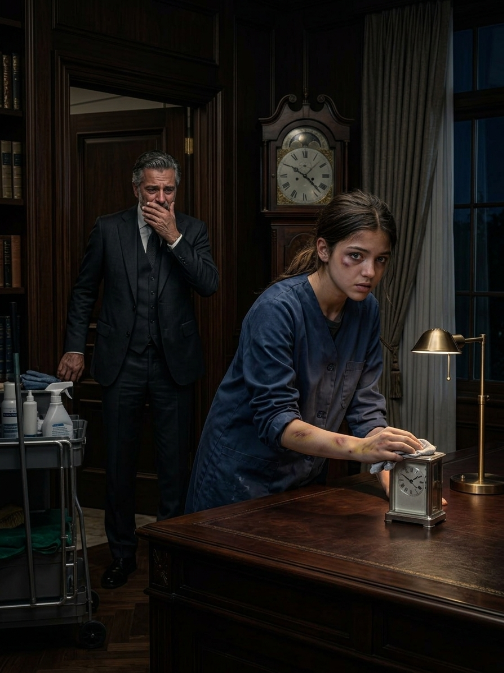
At Gunpoint, a Broke Single Mom Had Seconds to Save the Mafia Boss’s Paralyzed Daughter — But the Moment the Little Girl Moved Her Finger, Everyone Realized a Betrayal Had Been Hidden in Plain Sight

PART 1
She was counting coins when they came.
Not dramatically — just the specific, methodical accounting of a woman who had run out of better options. Forty-three cents in nickels, two dimes, one quarter she had been saving for the vending machine because she had skipped lunch again. Thirty-one dollars and some change, total, in a wallet that had seen better decades.
Delia Marsh pressed the heel of her hand to her eyes and did the math she already knew the answer to.
Noah’s upgraded inhaler: sixty-two dollars without the coupon, forty-eight with. The overdue electric notice taped to the refrigerator: past the grace period, which was a phrase designed to make you feel the failure was character rather than arithmetic. The rent — she didn’t do the rent math anymore. She did it in her sleep and woke up tired.
Outside the Riverside Community Clinic, October rain hit the windows hard enough to sound like something breaking.
She had been many things before she became the woman behind the cracked plexiglass at the midnight intake desk. She had been the best student in her rehabilitation science cohort at the university. She had been the granddaughter of a man who treated children with neurological injuries before anyone had protocols for it, who called her hands blessed with stubbornness. She had been someone with a plan.
Then she had married Marcus Chen, who seemed like a plan and turned out to be a gambling habit with a face, and who had left four months before their son was born with the savings account and an apology that cost him nothing.
Now she was thirty and tired and counting coins.
She was about to go wake Dr. Aldrich for the midnight inventory when the headlights came.
Not one. Three, arriving fast, with the particular synchronized quality of vehicles operating as a unit.
Delia stood.
The clinic doors opened with a sound like a gunshot.
Four men entered.
She had time to note the suits, the systematic way two of them cleared sight lines without appearing to, the third at the back entrance — and then the fourth, who entered last, and around whom the room rearranged.
He was not the tallest. He was not the broadest. He was simply the one the other three watched before they moved, which told her everything she needed to know about the hierarchy. Dark hair. A scar that bisected his left eyebrow. Cheekbones that looked assembled for efficiency rather than aesthetics. He moved through the door and stopped, scanning the room with the precision of someone who did this everywhere he went.
In his arms, wrapped in a dark coat, a child.
He laid her on the nearest exam table.
“Doctor,” he said.
The word came out flat. Not a request.
Delia saw the child and her training arrived before her fear. The girl was small — seven, maybe, though illness had thinned her to look younger. Dark hair damp against her temples. Her body in rigid, arching spasm, back off the table, hands clenched, lips carrying the particular blue-gray of impaired oxygen exchange.
Dr. Aldrich stumbled out of the break room. “We’re closed—”
One of the suited men shifted his jacket.
Dr. Aldrich went white.
The man with the child said, without looking up: “Spinal cord injury. Cervical. She has spastic episodes. Her diaphragm is locking. Treat her.”
Dr. Aldrich moved toward the cabinet.
Delia came around the plexiglass door.
“Stop,” she said.
Four guns moved in her direction.
Dr. Aldrich went still. Delia did not.
She had learned, in six years of managing a sick child alone with limited resources, that fear was a thing you either used or got used by. She walked to the exam table and looked at the girl’s neck.
She had seen this pattern in her grandfather’s case files. Not in any textbook Dr. Aldrich had recently consulted.
“What he’s about to give her will drop her blood pressure,” she said. “And if you try to intubate through a locked throat, you’ll do permanent damage.”
The man in the dark coat turned slowly.
His eyes found hers.
“Who are you?”
“The person trying to keep your daughter alive while everyone else reaches for the wrong medication.” She met his gaze. “You need to decide in the next ten seconds whether you trust me, because those are seconds she doesn’t have to spare.”
He looked at her for a moment that lasted longer than it should.
Then he raised one hand, and the guns lowered.
She worked.
Her grandfather had taught her before she had language for what he was teaching — the pressure points, the muscle sequencing, the specific rhythm of coaxing a body out of a protective lockdown it had confused for protection. She had modernized his methods, refined them, practiced them on research models and in academic settings and then practiced them on her own son on the nights his airway tightened and there was no help coming.
“I need you to hold her legs,” she said, without looking up. “Steady, not restraining. You. Her father.”
Nobody spoke.
She looked at him directly. “Now.”
A visible shock moved through the room.
He came forward.
His hands — large, scarred at the knuckles — settled over the child’s legs with extraordinary gentleness.
Delia worked.
She kept her voice low and even, talking to the girl in the same tone she used with Noah during bad nights, the tone that said *I am here and I am not afraid and you can borrow that.* The girl’s eyes were unfocused but open. She tracked sound.
“Come with me,” Delia said. “One breath. Big one. Follow my hands.”
For a terrible minute nothing changed.
Then something in the girl’s back released.
A click she felt through her palms. The arch softened. The chest expanded — violently, involuntarily, the body seizing the air back from itself. The blue at her lips faded toward pink.
The girl cried.
It was a thin, exhausted sound, but it was a sound.
The man across from Delia did not move.
She looked at him. He was staring at his daughter with an expression that had no armor left in it.
She stroked the girl’s damp hair. “There you are. You’re safe.”
The girl’s eyes found hers. A second of trust, pure and immediate, the way children offered it before they learned better.
Delia stood.
The man in the dark coat was looking at her differently than he had thirty minutes ago. Not warmly. But with the specific quality of attention that meant she had moved from one category into another in his accounting.
“Your name,” he said.
“Delia Marsh.”
He said it once, quietly. Storing it.
One of his men put a thick envelope on the desk. Then they gathered the child, wrapped in the coat again, and left.
Delia stood in the clinic’s harsh light with the specific exhaustion of having done something very difficult at very close to capacity.
She looked at the envelope.
She thought about Noah’s inhaler.
She opened it.
—
Three days later, the money was almost gone.
It paid the electric bill, two months of back rent, and the inhaler with the pharmacy coupon and fourteen dollars left over. Relief had the duration of a deep breath — necessary, sustaining, not enough to run on.
She was sitting at the kitchen table at seven in the morning when Noah appeared in the doorway.
He was five, brown-eyed, with the specific gravity of children who had spent enough time around adult worry to have absorbed some of it. He was holding his stuffed bear with one hand and his rescue inhaler with the other, which meant he had already done his morning check.
“Mama,” he said. “Is thirty-one dollars a lot?”
She turned to look at him. “Where did you hear that number?”
He pointed at the wallet on the counter.
She closed her eyes briefly.
“Come here,” she said.
He climbed into her lap. She put her chin on his head.
“Thirty-one dollars is enough for today,” she said.
“Is today enough?”
She held him tighter. “Yes.”
She meant it. She intended to keep meaning it.
The next morning, the black Lincoln was waiting in the alley.
—
She had known, somewhere in the back of her training, that helping a man like that in the way she had helped him would not conclude at a clinic counter with an envelope. She had known and had made the decision anyway, because the child was in front of her and she did not know how not to help a child in front of her.
The man inside the car introduced himself as Dominic Reyes, and he said: “Mr. Calloway would like to speak with you.”
Calloway.
She knew the name the way everyone in the city knew the name — not directly, but through the careful spaces in conversations, the things people stopped saying when certain topics came up, the way certain shipping operations survived investigations that should have ended them.
She thought about Noah.
She got in the car.
—
The estate was the kind of place that had been built to communicate something, and what it communicated was: the people who own this have made a fundamental decision about how they relate to the rest of the world. Iron gates. Cameras that tracked the car. Men at the perimeter.
Elliott Calloway was in a study with dark wood and old paintings and the specific quality of a room where serious things had been decided.
He was younger than she had expected for the weight of the name — somewhere in his mid-thirties. He sat behind a desk and did not stand when she entered, which she noted.
“Sit,” he said.
“I’ll stand,” she said.
He looked at her.
“I have work at noon,” she said. “So let’s be direct about what this is.”
He opened a folder.
“Delia Anne Marsh. Thirty. Incomplete rehabilitation science doctorate. Left six credits from completion. Son, Noah, five. Severe asthma.” He turned a page. “Ex-husband Marcus Chen, gambling debt, fraud charges, currently in violation of his supervised release.”
Her jaw tightened. “You investigated me.”
“You treated my daughter. I investigate anyone who touches my family.”
“Then you know I’m not interested in whatever you’re about to offer.”
He closed the folder.
“My daughter’s name is Cecile,” he said.
The shift in his voice was subtle and complete.
“Eighteen months ago, a car bomb destroyed the vehicle my wife was driving. Cecile survived. My wife did not.” He held her gaze. “Cecile has had spinal episodes since then. Four physicians, three cities. The standard approach has been sedation during episodes and management of the condition. She has not spoken a full sentence in fourteen months.”
Delia looked at her hands.
“What you did in four minutes,” he said, “they told me was not achievable without surgery.”
“It’s not magic,” she said. “It’s therapy. Repetitive, slow, daily therapy that children hate and makes them angry and requires someone willing to make them angry for long enough for the muscles to remember what they’re supposed to do.” She paused. “And I’m not licensed to practice independently.”
“I’m not interested in your license.”
“That statement is why people are afraid of you.”
A pause.
“Yes,” he said.
He stood.
She held her ground.
“I’m offering you a position as Cecile’s therapist. A salary that would be described as substantial by anyone’s accounting. Your debts resolved. Noah moved into a medical suite on the estate with a respiratory specialist and full care.” He stopped close enough that she registered cedar, cold, expensive fabric. “In exchange, you treat my daughter. You follow security protocols. You don’t repeat what you see.”
Noah with a doctor. Noah not counting coins in his head when he looked at the inhaler.
“What if I say no?” she said.
Something moved in his face. “Then you go home to your life. And the people who now know you stabilized my daughter’s episode remain interested in what leverage you might represent.”
She hated him for that.
Not because it was a threat but because it was true, and the distinction mattered.
“My son’s medical needs are primary,” she said. “Non-negotiable. No weapons in his room. No armed men near him without my consent. No using him as a control mechanism.”
Elliott studied her.
Then: “Agreed.”
—
PART 2
Moving into the estate felt like entering a language she didn’t speak.
Noah adapted immediately. He loved the bed, the cook, the therapy dog that materialized within forty-eight hours because someone had noted, in the file she was apparently not supposed to know existed, that dogs made him “breathe calmer.” He slept through the second night without waking, and she stood in his doorway at three in the morning crying silently because she had forgotten what his sleeping face looked like when it wasn’t working.
Cecile’s room was a different matter.
It was expensively furnished and functionally empty. White walls. Curtains drawn. A motorized wheelchair facing the corner. Shelves of unopened gifts. No music, no drawings, no color.
The child sat with her hands in her lap and looked at nothing.
Delia walked to the window and opened the curtains.
“She prefers them closed.” Elliott in the doorway.
“She is seven,” Delia said. “She prefers what she has been taught to tolerate.” She turned. “If I’m doing this, I determine the therapeutic environment. Sunlight. Warm water. Music. Normal conversation. No one speaks about her condition in front of her as though she isn’t in the room.”
His jaw set.
Cecile’s left hand moved. Just slightly, just the fingers.
Delia saw it.
So did Elliott.
He left.
The work was brutal in the specific way that rehabilitation was brutal — not dramatic, just relentless and unglamorous and full of setbacks that felt like failures and weren’t. Cecile fought her with a focused, silent fury that Delia recognized as the anger of a child who had learned to stop expecting anything and was furious at the expectation being reintroduced.
She kept going.
Two weeks in, she brought Noah to the pool.
The large guard whose name turned out to be Santos moved to block them at the door.
“Unauthorized—”
“He’s five,” Delia said. “Assess the threat level and make a decision.”
Santos’s mouth twitched. He stepped aside.
Noah sat at the pool’s edge with a toy boat that had a broken mast. Cecile floated in Delia’s arms, stiff, staring at the ceiling.
“Hi,” Noah said. “I’m Noah. My mom says you’re the bravest kid she’s ever worked with. She doesn’t say stuff she doesn’t mean.” He held up the boat. “This won’t float right. The mast broke so it tips. I’ve been trying to fix it but I need someone who knows about weight distribution.”
Cecile’s eyes moved.
Slow, barely perceptible. But they moved.
To Noah.
Noah placed the boat on the water. It listed immediately to the right.
Cecile’s right hand, which had been clenched for weeks, opened.
Her fingers reached for the boat.
She adjusted the ballast with small, deliberate pushes.
The boat steadied.
Noah stared at it. “You fixed it.”
Cecile’s throat moved.
“The weight,” she said. Her voice was hoarse from disuse. Small. “You had to distribute the weight.”
Delia went very still.
From somewhere above them — the second floor balcony — she heard a sound that was not quite human and not quite not. She looked up.
Elliott had both hands on the railing. His face, which she had seen controlled and cold and in grief, had nothing on it now except the open shock of a man hearing something he had stopped believing he would hear.
His daughter’s voice.
He looked down. Found Delia’s eyes.
She looked away first.
That evening, the first threat arrived in a white box at the gate.
—
The box contained a child’s drawing — crayon, deliberately childish — and a note.
*The boss is distracted. New therapy. New weakness. Sick boy, sick girl. Every kingdom falls when the king starts caring about small things.*
Elliott read it once.
“Sloane,” said Santos.
Delia looked between them. “Who is Sloane?”
“Victor Sloane has wanted the eastern routes for eight years,” Elliott said. He set the note down.
Delia looked at him. “My son.”
“He’s safe.”
“That’s not what I asked. You told me your world would stay away from him.”
“I told you I would protect you. My world came to you before I had the chance to make the boundaries clear.”
“That is not the same thing.”
“No,” he said. “It isn’t.”
She slapped him.
The room went electric. Santos moved forward, stopped.
Elliott’s head had turned with the impact. He brought it back slowly.
“You promised me he would not be in this,” she said.
“I know.”
“Fix it. Or we leave.”
“If you leave unprotected, you become more accessible, not less.” His voice was even. “I’m not saying that to hold you here. I’m telling you the arithmetic of the situation.”
“Then change the arithmetic.”
Before he could answer, the alarm system screamed.
Forty-five minutes later they were in an armored vehicle heading north.
—
PART 3
The safe house was on the Maine coast, three hours out, and the road there was dark and long.
Noah fell asleep against her shoulder before the city disappeared. Cecile was in the front passenger area with Santos, wrapped in a blanket, watching the dark landscape out the window with the expression of a child who had learned to study what she was moving through.
Elliott drove.
Delia watched the trees in the headlights and thought about the specific quality of being in a situation where the correct decisions had already been made and you were now simply in the consequences of them.
“My wife wanted to leave,” Elliott said.
She looked at him.
He kept his eyes on the road. “Before the bomb. She had been asking for two years. She understood what I had built and what it had cost, and she believed I could build something else. She was right.” A pause. “She made an appointment. For herself and Cecile. Vermont, she said. Clean air, good schools. She was going to wait for me there while the transition completed.”
“What happened?”
“The bomb happened before the appointment.”
The trees.
“I became worse after that,” he said. “I told myself it was necessary. It was grief dressed as strategy.” He was quiet for a moment. “Cecile stopped speaking the night her mother died, and I hired the best people money could reach, and every one of them told me the condition was severe and intractable and required management rather than recovery.”
“And you believed them.”
“I believed them because believing them was easier than hoping otherwise.”
She turned to look at the back seat. Noah, asleep. Cecile, awake.
The girl was watching the same dark trees. But her hands, Delia noticed, were loose in her lap.
Open.
—
The safe house was a compound pretending to be a lodge, and Delia could not have said she felt safe there but she felt enclosed, which was its own category.
She put Noah to bed in a room that had a window facing the ocean. He wanted to see the water but it was too dark, so she told him it would be there in the morning and he accepted this with the faith of a child who still believed in the reliable return of things.
Cecile’s room adjoined his through a connecting door.
“I want to leave it open,” Cecile said.
Delia looked at her. “Okay.”
“So I can hear him breathe.”
Delia held very still.
“When Mama’s heart monitor stopped,” Cecile said, “no one told me for a long time. But the sound stopped and I knew.” She looked at the connecting door. “Noah’s sound is good.”
“Yes,” Delia said. “It is.”
“Will he be okay?”
“His lungs are getting stronger every week.” She sat on the edge of the bed. “And you’ve been helping him. When you tell him to breathe like you showed him — he does it better when it comes from you.”
Cecile considered this. “Why?”
“Because you understand what it feels like to fight for air. That’s different from someone who doesn’t.”
The girl was quiet for a moment.
“My therapist before you,” Cecile said. “Dr. Voss. He said I shouldn’t try to walk. He said my injury made it too difficult.” She said it carefully, the way children repeated things they had been told to accept. “He said I should focus on the chair.”
“What do you think?”
“I think I want to try.”
Delia looked at her steadily. “Then we’ll try.”
The fourth morning, she set up parallel bars in the great room.
Santos had built them from the lumber he found in the garage, working from a diagram Delia drew on a paper towel, and the result was rougher than any facility equipment but solid. She tested the weight distribution twice.
Cecile stood between them.
Her legs shook.
“I can’t,” she said.
“You can be frightened and do it anyway,” Delia said. “Those aren’t opposites.”
“What if I fall?”
“Then I catch you. That’s what I’m here for.”
Cecile’s eyes filled. “Mama didn’t get caught.”
Delia did not look away. She heard, behind her, Elliott’s breath change.
“No,” she said. “She didn’t. And that is real and terrible and it will always be real. But you are here. Your father is here. Noah is here.” She held the girl’s gaze. “We catch each other now.”
Cecile sobbed once.
Then she dragged her right foot forward.
One step.
Delia heard Elliott make a sound behind her that she would not look at directly, the same way she didn’t look directly at certain things that were too bright.
Cecile took another step and went down, and Delia caught her, and they both sank to the floor together.
“I did it,” Cecile said, crying against her shoulder.
“Yes,” Delia said. Crying too, she realized. “You did.”
—
The assault came on the sixth night.
She woke to the alarm and was moving before she was fully conscious — the corridor, Noah’s room, Cecile’s room, hands on both children, moving them toward the interior of the house because the windows were bright with something outside.
Santos appeared from the kitchen corridor with blood on his temple and Noah under one arm.
“Move,” he said. Not loud. Precise.
The thing about violence, she thought later, was that it clarified everything. There was no room for anything except the sequence: *here, here, here, keep moving.* She got the children behind the stone fireplace column in the great room. A man came through the side door and she grabbed the fire iron and drove it into his knee without a conscious decision, and he went down, and Santos finished it.
Then the safe room.
Inside, Delia pressed a kitchen towel against Santos’s shoulder wound while Noah gripped Cecile’s arm and breathed harder than he should be.
“Hey,” Cecile said. To Noah. Directly. “Look at me. Breathe like the pattern.”
He looked at her.
He breathed.
The rhythm steadied.
Delia looked at Cecile, who was sitting straight with her hand on Noah’s arm, and thought: *here*. Here was the work. This seven-year-old girl, in the middle of the worst kind of night, using something she had been given to give something back.
By morning, the assault was over and contained.
Elliott opened the safe room door.
He looked at both children. At Santos. At Delia.
“They knew this location,” he said. “Which means it came from inside.”
—
They went to New York.
Two days in a secured floor of a building that Elliott clearly owned, and then a folder arrived on the table.
She opened it herself because Elliott seemed unable to.
Photographs. Bank transfers. A name she recognized.
Marcus.
Her ex-husband’s face. Thinner now, meaner in the eyes.
“He owes Victor Sloane a considerable sum,” Elliott said. He was standing at the window. His voice was very controlled. “He identified you from surveillance footage outside the estate. He sold information — your schedule, Noah’s medical routine, the access patterns — for debt forgiveness and a payment.”
Delia looked at a photograph of Noah on the daycare playground.
“He sold Noah,” she said.
“Yes.”
She looked at the photograph for a long time.
Elliott turned. “Say the word.”
She understood what he meant.
She had known, somewhere in the weeks she had been living inside his world, that this moment would eventually arrive in some form. The moment where the instrument he was would turn in her direction and offer itself.
She thought about the fire iron.
She thought about Cecile saying *breathe like the pattern.*
She thought about a boy who had asked his mother if they were going to be okay.
“No,” she said.
Elliott went still.
“He testifies,” she said. “Everything he knows about Sloane. About the information he sold. About the debt.” She met Elliott’s eyes. “In front of people who aren’t you. In a room where it becomes a matter of public record. Not because I believe in abstract justice, but because I need my son to be able to look at whatever happened to his father and see that I chose the thing I would have chosen in the world I want him to live in.”
Elliott studied her.
“Sloane’s network is extensive,” he said. “Marcus alone doesn’t—”
“I know,” she said. “But he knows other things. Pieces. And pieces become cases when there are prosecutors who want them.” She held his gaze. “You own lawyers. You know federal attorneys. Use them for something that doesn’t end with a body in the harbor.”
The silence lasted a long time.
“You understand that the case that builds from this,” he said carefully, “will reach back into my operations.”
“I know.”
“It will cost me significantly.”
“I know.”
“You’re asking me to cooperate with a process that may end large parts of what I’ve built.”
She looked at him steadily. “I’m asking you to be a man your daughter can name without lowering her voice. That was what your wife wanted. That’s what I’m asking.”
He looked at the folder.
Then he picked up his phone.
—
The calls Marcus made, once he understood the alternative, produced names. The names produced other names. The other names produced a federal case that would take fourteen months to build and would dismantle several things that had been considered dismantling-proof.
But before any of that, a different name emerged.
Dr. Harold Voss.
Elliott’s private physician. Cecile’s primary treating doctor since the bombing. The man who had told Elliott, on three separate occasions in three separate years, that Cecile’s recovery was unlikely and that hope was something to be managed rather than encouraged.
The folder was thicker than the one with Marcus in it.
The medical trust established in his wife Isabel’s name, managed by Voss, controlled against Cecile’s continued disability. The experimental therapy referrals that had never arrived. The consultations with other specialists that had been summarized in written reports rather than direct meetings, because direct meetings risked the specialists contradicting the narrative.
Two years of a child kept still so a man could stay comfortable.
Delia looked at the file for a long time.
Then she looked at Elliott.
His face was the face of a man doing something very specific with something very large. Managing it. Compressing it into a container that would hold long enough for the next decision to be made.
“Where is he?” she said.
“Reachable.”
She thought about Cecile between the parallel bars. *What if I fall?* *Then I catch you.*
“I want to be there,” she said.
“That’s not—”
“I want to be there.”
—
The confrontation was in a building near the harbor that smelled of salt and cold concrete and the specific mustiness of a space used only when ordinary spaces were unavailable.
Voss was older than she expected from the file. Silver-haired, precise in his bearing, the quality of a man who had been correct about enough things to have confused being correct with being trustworthy.
He did not deny the trust accounts. He did not deny the blocked referrals. He explained them as judgment calls, which was a category of lie that made her angrier than outright dishonesty would have.
“Her prognosis was genuinely poor,” he said, to Elliott. “The decisions I made were within the bounds of reasonable—”
“She walked,” Delia said.
He looked at her.
“Four weeks ago she took three steps. Yesterday she crossed a room. She spoke coherently for twenty-seven continuous minutes.” Delia kept her voice level. “You told her father that independent movement was unlikely. You told him hope required management. You kept him managing his daughter’s condition instead of treating it, and you managed his grief into compliance for two years.”
Voss’s expression shifted. “You don’t understand the complexity—”
“I understand that a child’s muscles were capable of responding to appropriate therapy and that no appropriate therapy was ordered. I understand that a man who controlled the terms of a medical trust benefited from that child remaining dependent.” She held his gaze. “I understand enough.”
Elliott had not spoken.
He was standing very still in the way she had learned to read as the most serious version of his attention.
When he moved, it was quickly.
She said his name once.
He stopped.
She walked to him. Not between him and Voss. Beside him.
“She is going to walk into rooms for the rest of her life,” she said. “She is going to grow up. She is going to understand what happened to her and what was decided on her behalf.” She kept her voice low. “What she is going to be able to know about her father — the whole thing, the real thing — includes this moment. What you do now.”
Elliott’s hands were at his sides.
She could see the cost of the decision forming in him.
He took a breath.
“Call the federal prosecutor,” he said to Santos. “I have information she’ll want.”
Voss looked at him with an expression that moved through several stages quickly.
“Elliott—”
“No,” Elliott said. “The last decision you made on my behalf was the one I’m going to spend years undoing. You don’t get another one.”
—
Fourteen months later.
The clinic on the south side of the city had been the original Riverside Community Clinic, which had been renovated without fanfare and without the kind of naming that required a ribbon and cameras, because Delia had said, specifically, that she did not want her name or Elliott’s name on the building. She wanted a name that told people what it was for.
The sign read: *Isabel Calloway Pediatric Rehabilitation Center. Community-Supported. Free to Access.*
Noah ran down the hall in the sneakers he had picked himself, which were red and slightly too big because he was five and growing fast and she had learned to buy ahead.
Santos, who had left armed employment and taken a position managing clinic security with the specific seriousness of a man who had decided to protect things differently, stood near the entrance looking determinedly neutral about everything.
Elliott was by the window in the lobby in a suit that still cost more than the clinic’s first month of operating budget, looking like a man who had not yet made peace with ribbon cuttings.
“You look like you’re expecting something to go wrong,” Delia said.
“I have operational experience that makes that a reasonable default.”
“This is a children’s clinic.”
“Children are unpredictable.”
She almost laughed.
The hallway went quiet.
Cecile appeared at the far end.
Not in the wheelchair.
She moved carefully, one hand trailing the wall — not for support, Delia knew, but from habit, from the months of the parallel bars. Her steps were uneven and deliberate and entirely hers.
She walked the full length of the corridor.
She stopped in front of her father.
She looked up at him.
“Papa,” she said. “You’re standing in the doorway.”
Elliott looked at his daughter.
Then he did something Delia had not seen from him.
He laughed.
Not controlled. Not contained. Something that came up from somewhere it had been waiting, cracking out of him without permission.
He dropped to his knees and Cecile put her arms around his neck.
Delia felt Noah’s hand slip into hers.
“Mom,” he said. “Is she better?”
She looked at Cecile holding her father. At the clinic full of light and children and people who had never previously had access to this kind of care. At the particular quality of a room where something has been repaired rather than replaced.
“People don’t get better the way things get repaired,” she said. “They learn how to carry what happened to them and still move forward. That’s different.”
“Is it harder?”
“Yes,” she said. “And better.”
Noah thought about this.
“She’s still brave,” he decided.
“She is,” Delia agreed.
Cecile looked over her father’s shoulder at Delia.
The look was the look of a child who has been through something and is still here, and knows both things are true, and has decided what to do with that.
Delia nodded.
Cecile nodded back.
Elliott stood. He moved to where Delia was standing, and he stopped beside her, and they watched the clinic do what it was built to do.
“I’m still learning to be in rooms like this,” he said.
“I know.”
“It feels different from what I’m used to.”
“Different how?”
He was quiet for a moment.
“Like something could actually last,” he said.
She looked at him.
She thought about the clinic counter and thirty-one dollars and the specific decision she had made when a child was in front of her and there was no one else. She thought about parallel bars and a voice saying *breathe like the pattern* and a girl walking the length of a corridor because someone had refused to believe she wouldn’t.
“Things that are built right last,” she said. “That’s the whole theory.”
He looked at her steadily.
“Then I would like to keep building,” he said.
“You’ll need to be patient,” she said. “It’s slow work.”
“I’m learning patience.”
“From who?”
He glanced at Cecile, who was now explaining something to Noah with the animated focus of a child with new information to share.
“From her,” he said. “Mostly from her.”
Delia watched her son listen to Cecile with the wide-eyed seriousness of a child encountering someone who knows things he doesn’t.
She thought: this is what it looks like when things go right.
Not perfectly. Not without cost. Not without the specific weight of everything that had to be paid and endured and chosen and let go. But right.
She had been a woman who counted coins at a midnight clinic desk, and she had made a decision in the direction of a child she didn’t know, and the ripples of that decision had moved further than she could have calculated.
She was still adding up what it meant.
She thought she would be adding it up for a long time.
She was okay with that.
She had always been good at math.