The Mafia Boss Came Home Early—Then Caught His Maid Saving His Daughter and Exposing a Traitor

PART 1
The flight from Lisbon had been silent the whole way back.
Not unusual. Matteo Ferrara preferred silence to the careful conversation of men trying to read a room. He had dismissed his security detail at Lisbon Portela before boarding the private charter, telling them to follow on a commercial flight in the morning, telling himself it was about giving them rest and knowing the truth was he wanted an hour to think without being watched.
The Istanbul deal had collapsed before it opened.
Two of his men were dead.
And someone who knew his schedule, his contacts, and the specific security codes for the Lisbon rendezvous had given that information to the people who were supposed to be sitting across a table from him.
Matteo Ferrara had been in this business long enough to have made a long list of enemies and a very short list of people he trusted absolutely. Tonight, that short list was getting shorter.
He entered the Milan estate through the side gate at twenty past one in the morning, bypassing the main guard rotation with his own key. He had built the estate after his wife died — after the explosion on the Via Giordano that had taken her and very nearly taken Lucia, their youngest, who had emerged from the burning car unable to speak and had not spoken since.
That was fourteen months ago.
The estate was three floors of reinforced stone and tinted glass, perimeter cameras, guard rotations every forty minutes, and the specific silence of a house designed to feel impenetrable.
It was the kind of silence that said: nothing can reach you here.
That silence lasted as far as the east corridor.
Then he smelled it.
Iodine.
Fresh blood.
Matteo moved.
Not cautiously — moving cautiously in a secure corridor meant accepting that danger had already penetrated far enough to warrant care, and accepting that meant arriving too late. He went fast and quiet and had his weapon in his hand before he reached the kitchen doors.
The light came through the crack first.
Then the sound.
A woman’s voice, low and controlled: “—breathe when I tell you, not before. Fia. Eyes on my hands. Don’t look at the ceiling.”
He hit the door with his shoulder and came in hard.
Everything stopped.
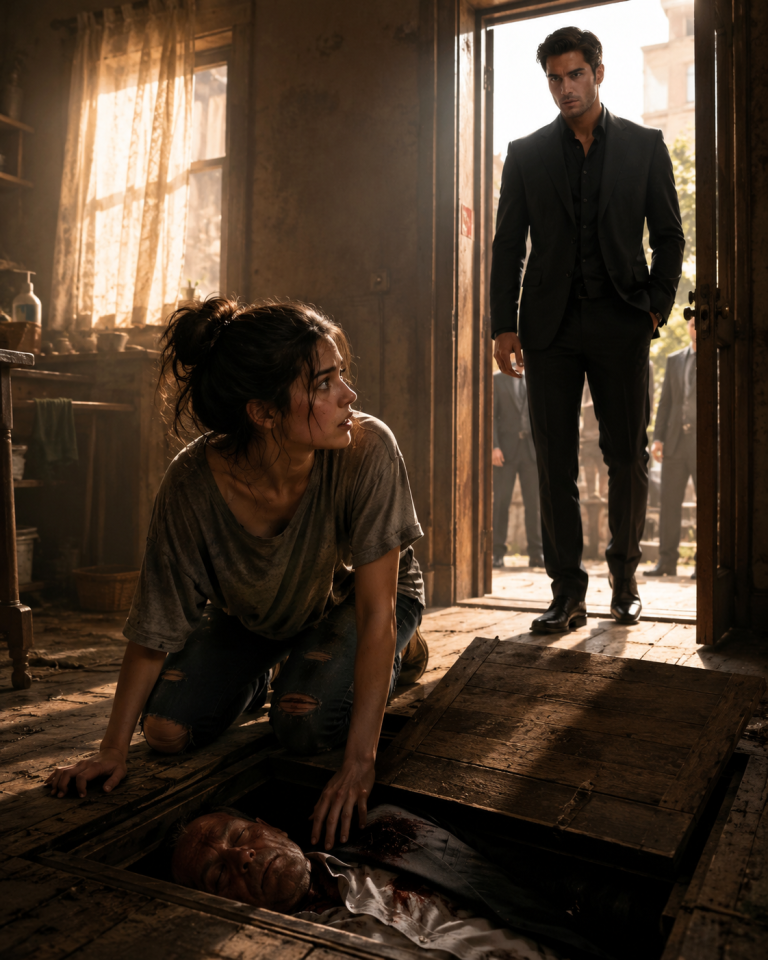
His twenty-year-old daughter Sofia was on the kitchen island with her left leg cut open at the outer thigh, jeans slit to the knee, blood soaking into a white towel pressed beneath her. Her face was white and damp and she was biting down on something folded in her teeth.
His fourteen-year-old daughter Mattea was beside her, holding a lamp angled to illuminate the wound, her own face rigid with the effort of not falling apart.
And on the far side of the island, at the epicenter of all of it, was the woman Matteo had hired six weeks ago and barely spoken to since.
He had never learned her surname.
He knew her first name — Serena — and that she had arrived with reasonable references and a quiet quality about her that he had found reassuring without knowing why. She kept the house, helped with the girls, and disappeared so effectively into the background of daily life that on most days Matteo could not have told you which rooms she had been in.
Right now she was standing over his daughter with bloody latex gloves and a curved suture needle still threaded.
On the other side of the island, standing on a step stool and gripping the edge of the counter, was six-year-old Lucia.
She was looking at Serena.
She was talking.
“Don’t be scared, Fia,” Lucia was saying. “Serena is fixing you. She’ll fix it.”
Matteo had not heard his youngest daughter speak in fourteen months.
He had not moved in four seconds.
His hands had not moved either.
Then Serena looked up.
Her eyes were steady — hazel, clear, measuring him with the specific calmness of someone who had assessed the room before he entered it and had already determined that his anger was a secondary problem.
“Put the gun down, Mr. Ferrara,” she said. “Your daughter can see you.”
His jaw tightened.
“What happened in this house.”
“The wound is sutured but not sealed,” she said. “If Sofia moves sharply, or if she panics from you yelling, the knot can pull. I have two stitches remaining.”
“I am not yelling.”
“You have a gun out in a kitchen with a child standing on a step stool. The effect is the same.”
Sofia made a sound behind the cloth in her teeth. A plea.
Matteo clicked the safety and holstered the weapon.
“Finish it,” he said.
Serena turned back to the wound without acknowledgment.
He watched her work.
He had seen field stitching before. He had seen trauma surgeries performed in worse conditions. What he was watching now was not a woman imitating medical competence. She was moving with the economy and precision of someone whose hands had done this many times, in worse places, with fewer supplies.
The final knots were tied. The bandage was packed and wrapped tight, secured with careful tape. She peeled the gloves off, dropped them in a sealed bag she had produced from somewhere, and washed her hands at the sink with her back to him — but he could see she was already scanning the room in the reflection of the window above the faucet.
She was not relaxing.
She was still assessing.
Matteo looked at his daughters.
Sofia had pulled the cloth from her mouth and was crying silently in the way she did when she was trying not to. Mattea still held the lamp, arms shaking now that the crisis part was past. Lucia had descended from the step stool and was standing very close to Serena’s side.
Not hiding behind her.
Standing beside her.
Like she had decided this was where safety lived.
Matteo set his hands flat on the island across from Sofia.
“Tell me,” he said.
Sofia’s eyes went to Serena first.
Serena gave the smallest possible nod.
And Sofia whispered a name that hit Matteo harder than anything he had heard in Lisbon.
A name from inside the house.
—
PART 2
Matteo looked at Serena.
“Send the girls upstairs,” he said.
“They will be safer—”
“Together,” she said. “Your rooms are at the end of the west corridor. Lock it from inside. Turn on the white noise generator on the nightstand.” She was already looking at Mattea. “Take your sister. Lock the door. Text me when you’re inside.”
Mattea, who was fourteen and had her mother’s competence under pressure, didn’t ask questions. She collected Lucia’s hand and moved.
At the door, Lucia looked back.
“Serena,” she said.
“I’ll come soon,” Serena said.
Lucia went.
When the corridor was empty, the kitchen went very quiet.
“The man Sofia heard,” Matteo said. His voice was measured in the way that came right before it stopped being measured. “Ruffino. He has been my logistics head for nine years.”
Serena didn’t answer, which was answer enough.
“How did you know it was him.”
“I didn’t,” she said. “I know that two hours ago, the east garden camera began looping. The same image repeating. I noticed it because I go through those camera feeds before I sleep — I have since my first week here.”
Matteo’s hands went still.
“You monitor my surveillance.”
“I watch the parts of your house that face the areas where your children sleep,” she said. “I don’t have access to the operational feeds. I watch for shadows that move wrong at three in the morning.”
He looked at her.
She continued. “Sofia heard two men in the east garden. She recognized Ruffino’s voice. When she moved to retreat, she disturbed something and they fired. The bullet caught the stone planter. The fragment caught her thigh.” She paused. “She came through the laundry entrance because the east-side guards were not responding.”
“Not responding.”
“Someone changed the rotation.”
Matteo turned to the security panel on the wall.
Systems normal. Perimeter secure.
He entered his primary override code.
Access denied.
He entered the secondary.
Access denied.
The kitchen was silent except for the sound of the refrigerator and his own breathing.
“The internal radio channels are compromised,” Serena said. She opened a lower cabinet and removed one of his emergency satellite radios from a compartment behind the cookware. She held it out. “Use this one.”
He took it.
“You knew where that was.”
“I knew where all of them are,” she said. “I learned your house the way I learn every house I work in. Not to spy. Because knowing exits is the same as knowing how to protect the people inside them.”
He turned the radio on, tuned it, made two short calls to men he could verify were not in the building that night.
Then he looked at her properly for the first time.
She was perhaps thirty, perhaps older — a face that had been young for a long time and had then stopped pretending to be. Her uniform sleeves were rolled, and the scars on her forearms were visible. Old scars. Some surgical. Some not.
“Who are you,” he said. “Actually.”
Her face changed.
Not open, but something shifted underneath the controlled surface.
“My name is Serena right now,” she said. “That’s real. The rest—” She stopped. “Now is not the right time.”
“There are men in my house who want me dead,” he said. “Whatever you are, I need to know it.”
She looked at him for a long moment.
Then the lights went out.
Complete darkness.
Sofia’s voice carried from somewhere upstairs — a short, sharp sound of fear.
Serena clicked on the tactical flashlight in her hand — she had it before the lights were fully off — and kept the beam low, pointed at the floor.
“East wing,” she said.
From the house speakers, a voice filled every room.
Ruffino.
“Matteo. You’re home early.”
Matteo’s hands did not shake. They never shook.
“Tell me what you want,” he said toward the nearest sensor.
“What you went to Lisbon for,” Ruffino said. “The account numbers. The routing codes. The offshore structure. Give me those, and your daughters are a separate matter.”
“A separate matter,” Matteo repeated.
From the speaker came a second voice.
His brother-in-law, Carlo Esposito. His dead wife’s brother. A man he had kept employed out of loyalty to Adriana’s memory and who had been useless at the work and incompetent at gratitude and had, it appeared, solved both problems by attaching himself to someone with a plan.
Carlo said: “Hello, Matteo.”
The name came out of Sofia’s mouth upstairs like a question she couldn’t believe she was asking.
“Uncle Carlo?”
Serena’s face said nothing.
Her hand found a kitchen knife on the counter beside her and she turned it handle toward Matteo.
She had already decided what the night required.
—
PART 3
The kitchen had three ways out.
Serena knew them all and moved to cover the primary one, pressing her back to the wall beside the main entrance with the specific positioning of someone who had learned not to stand in door frames. Matteo was at the opposite wall. Between them: the island, the lamp they had already turned face-down so it cast no shadow, and the careful tactical silence of two people who had never spoken about this kind of thing but were moving in the same grammar.
“The account information isn’t here,” Matteo said, loud enough for the sensors. “It was never here. It never left my head.”
Carlo made a sound through the speakers. “That was always your arrogance. You believe nothing works without you.”
“Most things don’t.”
“Then you’ll give us what we need because you don’t want a demonstration.”
“What demonstration.”
A door crashed somewhere on the upper level.
Matteo moved before the echo finished.
Serena was already ahead of him.
She went up the north stairs, the service ones, which did not creak because she had noticed they didn’t creak three weeks into her time in the house when she had been moving quietly to avoid waking Lucia in the night. She moved fast but soft, the way she moved everything — not like someone trained for silence but like someone for whom silence was simply the default mode of a body that had spent years in situations where noise had consequences.
Matteo was behind her by two steps.
He did not tell her to step back.
At the top of the stairs, the west corridor stretched ahead.
His daughters’ locked room was at the end.
In front of it stood a man Matteo recognized as one of Ruffino’s crew — outside personnel, not house staff, someone who had been introduced at a perimeter security meeting six months ago as a consultant.
He had a hand on the door handle.
He hadn’t gotten through it yet.
Serena went wide and came at him from the angle he wasn’t watching.
What followed was approximately four seconds of violence.
She took the weapon from his hand, used his own momentum to put him face-first into the corridor wall, and had his arm locked at an angle that produced immediate stillness. She took his radio. She pressed a knee into the back of his knee and he went down.
She handed Matteo the weapon.
Then she crouched beside the man, efficient, and used a zip tie from her pocket on his wrists.
Matteo stared.
She looked up. “He’ll have a headache.”
“Where did you get a zip tie.”
“First week.”
He could not decide whether to ask more questions or continue down the corridor.
He continued.
From behind the locked door: “Papa?”
Mattea’s voice. Alive.
“Locked,” he said. “Stay.”
“There was a man—”
“Handled. Stay.”
He could hear Lucia’s voice behind Mattea’s — not words, just sound, just the presence of a child who was still speaking, whose voice he had been waiting to hear for fourteen months, and even now, in the middle of this, something in his chest released a tension he hadn’t known he was holding.
He and Serena moved to the south end of the corridor.
Ruffino’s voice came through the radio again, now on Serena’s confiscated frequency.
“Three minutes, Matteo. Then I stop asking nicely.”
Matteo pressed transmit. “I need four.”
A pause.
“Buying time,” Ruffino said. “Always buying time.”
“It’s what I have tonight.”
Matteo looked at Serena.
“The east stairwell leads to the second floor balcony,” he said quietly. “If Ruffino is managing this from the house, he’ll be somewhere he can see both major exits.”
“The study,” she said.
He hadn’t said the study.
“How.”
“Because that’s where I would be,” she said. “High ground, sight lines to the main entrance and the garden, access to the internal system terminal.”
“And Carlo?”
“Carlo isn’t military. He’ll be staying close to Ruffino and trying to look useful.”
Matteo almost smiled. It didn’t reach his face.
“Let’s go.”
They moved.
The east stairwell was dark, but Serena kept the flashlight aimed at the floor and Matteo kept his weapon steady at his side, and they went room by room through the second floor in the specific systematic way of people who were thinking ahead and not just reacting.
At the study door, Matteo put his hand on the handle and Serena positioned herself at the hinge side.
She produced something from her jacket.
A syringe.
Matteo looked at it.
“Field sedative,” she said. “Fast onset. Safe margin. Non-lethal.”
“Where did you get that.”
“I have a kit. I’ve had it since—” She stopped. “Later.”
He pushed the door.
Ruffino was at the internal system terminal, exactly where Serena had said.
Carlo stood near the window.
Ruffino turned fast.
He was fast. He had always been fast. Nine years in Matteo’s service had built a man who was competent and capable and who had apparently decided that competence deserved more than what Matteo had provided.
He raised his weapon.
Matteo fired first.
Not center mass.
The shoulder.
Ruffino dropped.
Carlo backed against the window with his hands out, a man in the middle of a situation he had imagined very differently.
“It’s not what you think,” Carlo started.
“My daughter is downstairs with a bullet graze on her leg,” Matteo said. “Don’t tell me what I think.”
Carlo’s mouth closed.
Serena moved to Ruffino on the floor, assessed the shoulder wound with the fast professional efficiency she had been displaying all night, and applied pressure while Matteo secured Carlo with the zip ties from her pocket — she had more than one, apparently — and then stood over them and called the radio frequency that connected to his men in the city.
Within forty minutes, Ironwood was no longer in the hands of people who had arranged to take it.
—
He found Serena in the kitchen at six in the morning.
Dawn was coming through the east windows in thin gray lines. The blood had been cleaned from the marble. Sofia had been transferred to the private medical room on the ground floor. Mattea was asleep on the chair beside her. Lucia was on the sofa outside, curled under a blanket that Serena must have brought from upstairs.
Serena was at the sink, washing something from her sleeve.
“My wife’s clinic,” Matteo said.
She didn’t turn.
He leaned against the doorframe. “Adriana funded an emergency medical evacuation network through a charity she never put her name on. Three years ago, one of the surgeons the network extracted was a woman named Dr. Sara Bellini. A trauma specialist who had testified against a weapons trafficking network and had her clinic burned down and her fiancé killed and was then declared dead in the attack.”
Serena’s hands went still at the sink.
“She was found by Adriana’s people,” Matteo continued. “Given new documents, a new name, a new life. The file I found in Adriana’s private correspondence six months after she died said: if anything happens to me, find her. She knows.”
Serena turned around.
“What did Adriana tell you to find her about,” she said.
“She said: she’ll know how to protect the girls if I can’t.”
The kitchen was quiet.
“She never told me your name,” Matteo said. “She said I wouldn’t need it. She said I would know her by how she looked at my children.”
Serena’s face had the quality of someone hearing something spoken aloud after a very long time of carrying it silently.
“She was the one who got me out,” she said. “I had nothing. I was a dead woman with no country and no name. She came to the clinic herself. Adriana Ferrara, who I had never met, sitting in the ruins of what had been my operating room, telling me that she had a husband and daughters and that the world she moved through produced too many wounds and she wanted someone who knew how to close them.”
“She planned for this.”
“She planned for everything she could think of.”
Matteo was quiet for a long time.
“She never told me,” he said.
“She said keeping one secret from you was safer for everyone involved.” A pause. “Including you.”
The truth of that settled like something that had been waiting to settle.
He crossed the kitchen and stood at the island — the same marble where Sofia had bled and Lucia had found her voice and Serena had worked with gloved hands and a steadiness that had no right to exist in a woman who had walked through the kind of fire she had walked through.
“Tell me your name,” he said.
“Serena Bellini,” she said. “That’s who I am now.”
“And Dr. Sara.”
“Also who I am. It doesn’t have to be one or the other.”
He looked at her.
“Lucia spoke,” he said.
Her expression changed. Just slightly. But the change was real.
“She’s been building to it for weeks,” she said. “Small things. Sounds first. One word at a time when she forgot to be afraid of them. Last night—” She stopped. “Last night, she wasn’t performing for anyone. She just needed her sister to know she wasn’t alone.”
“What do you do differently with her than everyone else.”
“Nothing different,” she said. “I just don’t ask her to be ready before she is.”
He looked at his youngest daughter asleep on the sofa and thought about the fourteen months of specialists and therapy rooms and careful questions and the particular silence that had followed each of them, and understood that the thing that had been missing was not the right technique.
It was the right presence.
The wrong people asked Lucia to get better because they were watching her.
Serena had been quietly getting better herself, in the same house, and Lucia had learned the difference.
—
The weeks after the attack changed things in ways that could not all be named.
Ruffino recovered from the shoulder wound in federal custody and spent his recovery answering questions from investigators who had been building a case on the trafficking network for three years and had been waiting for someone on the inside to crack. He cracked. Carlo was arrested the same morning and faced separate charges for conspiracy and facilitation, and spent his first week in custody complaining that he had been the victim of circumstance.
No one believed him.
The men who had moved through Ironwood that night were identified and processed. The corrupted guard rotation was reconstructed. The security system access was revoked, changed, and rebuilt with new protocols. Matteo spent two weeks doing the work himself rather than delegating it, because he had learned, at twenty past one in the morning with the smell of iodine and blood in his kitchen, that there were things he should not have allowed to exist at the distance of a delegate.
Sofia’s wound healed.
The scar stayed, and she kept it visible for a while because she said it made her feel like she had survived something instead of been survived by it, which was a distinction Matteo thought about for several days.
Mattea asked to help rebuild the security protocols.
He let her.
She was good at it.
Lucia began speaking in full sentences the week after the attack, and no one made a production of it, which seemed to be the correct approach. She ate breakfast every morning and explained at length which birds she had seen in the garden and what she thought they were thinking, and Matteo listened every morning, and Serena listened from across the table, and Mattea listened while checking her phone and occasionally contributing a bird fact she had looked up, and the kitchen became something it had never been in Matteo’s memory of it.
A place where ordinary things happened.
One morning, Matteo arrived to find Serena making coffee and Lucia standing on the step stool demonstrating to her the proper way to fold a napkin.
“You have to do the corners first,” Lucia said. “Papa does them wrong.”
Serena glanced at him over Lucia’s head.
“I’ll keep that in mind,” she said.
He poured coffee and sat down and did not go to the office for an hour, which was not something he had done since Adriana died.
—
The conversation happened on a Thursday evening in March.
Sofia was at physical therapy. Mattea was studying. Lucia was asleep. The house was quiet in the genuinely peaceful way rather than the tactical way, and Serena was in the garden where she had taken to sitting in the evenings with a cup of tea and the particular stillness of a person who had spent years in noise and was still learning how to trust silence.
Matteo sat beside her on the low stone bench near the east wall.
The planter where the bullet had hit the stone was there — repaired, but with one irregular mark left visible in the repaired section. Serena had asked him to leave it.
“I received an inquiry,” she said.
He waited.
“A trauma surgery program at Humanitas. Under my real name — the legal risk is gone, all of it, now that the trafficking case has gone to trial. They want a department lead.”
The sky above Milan was going dark at the edges and warm in the center. Somewhere in the garden, a bird made a sound neither of them could identify.
“Is that what you want?” he asked.
She looked at him.
“That’s the first time you’ve asked me that as a genuine question,” she said.
“You’ve been here for nine months,” he said. “I should have been asking it earlier.”
She turned the tea cup in her hands.
“I was a surgeon before I was anything else,” she said. “I stopped for reasons that were not mine to choose. The reasons are gone now.”
“Then you should go back.”
“I’m not leaving your daughters,” she said. “I want to be clear about that. Whatever I do and wherever I do it, I am not leaving them.”
Matteo looked at the stone wall.
“Lucia called you by name last night,” he said. “In her sleep.”
Serena didn’t answer immediately.
“Children attach,” she said, finally. “That was always the risk of staying.”
“Was it a risk for you?”
She looked at him.
He was looking at the wall still, but she looked at him, and after a moment he turned.
“Adriana told me,” he said, “that the women in my life would have to be very particular kinds of women. Not strong in the way I was used to thinking about strength. She said: the best protection is the kind that doesn’t need to announce itself.”
Serena was quiet.
“She was describing you,” he said. “She had never met you, but she found you and she described you.”
“She described what she needed,” Serena said. “I was just the closest match.”
“I don’t think that’s true.”
She looked at the garden.
“I came here for the girls,” she said. “I want you to know I’m not confused about that. Whatever else has happened—” She stopped.
“Whatever else has happened,” Matteo said carefully, “has happened.”
She almost smiled.
“You are terrible at this.”
“Yes.”
“You are comfortable giving orders and uncomfortable with anything that requires asking.”
“Correct.”
“And you’ve been sitting here for ten minutes working up to asking me something.”
“Also correct.”
She looked at him.
He looked back.
“Stay,” he said. “Not as the woman Adriana sent. Not as the housekeeper. Not as any category I’ve put you in since you arrived.” A pause. “I’m asking you to stay because my daughters are more themselves when you’re in the room and because I am—” He stopped. “Learning something.”
“What are you learning.”
“That a house isn’t a fortress,” he said. “That I spent years building walls and told myself I was protecting them and I was actually—” He didn’t finish.
“Keeping them in,” she said.
He exhaled.
“Yes.”
She held the tea cup and looked at the sky.
“I’ll take the surgery position,” she said. “Part time, initially. The department has evening clinics two days a week and I can manage the overlap.” She paused. “I’ll stay.”
“The girls—”
“Will know I have work that matters to me,” she said. “That’s a good thing for them to know.”
He looked at her.
“And me?”
She turned.
“You,” she said, “are also learning. I’ll stay for that too.”
—
Elena’s Clinic opened the following autumn.
Not named for Adriana — named with her, which was a distinction Matteo had understood only when Serena explained it. The clinic treated victims of violence who could not navigate formal medical systems: undocumented families, women in dangerous situations, people who needed care without records.
It was funded quietly.
Serena ran the trauma unit.
The girls attended the opening.
Sofia stood at the entrance and welcomed people with the ease of someone who had decided that her own scars were an introduction rather than an apology.
Mattea managed the administrative setup with the focused competence she brought to everything and pretended not to be pleased when people commented on it.
Lucia spent the evening distributing paper flowers she had folded herself, explaining to each person she gave one to that her mother would have liked them.
Matteo stood in the back.
He watched his daughters moving through a room that existed because of choices made by a woman who died and a woman who survived and a six-year-old who found her voice because someone in the same house was quietly healing.
Serena appeared beside him.
“Lucia has been giving those flowers to everyone,” she said.
“I noticed.”
“She ran out of paper and started folding napkins.”
“She’s been doing that since March.”
“I know. I taught her.” She looked at him sideways. “You learned the corners wrong.”
He almost smiled.
“I know.”
She took his hand.
Not for the room. Not for demonstration.
Just because it was time.
Matteo Ferrara had built his empire on the premise that power was protection — that if he made himself unmovable enough, nothing could reach what he loved.
He had been wrong about the architecture.
A fortress kept people alive.
But it was not the same as keeping them whole.
He had learned the difference at twenty past one in the morning in his own kitchen, with the smell of iodine in the air and a woman who moved like a blade and a child speaking for the first time in fourteen months and his gun pointed at a ceiling while someone looked up at him and said:
*Put it down. You’re scaring the girls.*
So he had.
That was the beginning of becoming a father instead of just a protector.
Not one dramatic decision. A hundred small ones after.
Every morning that he sat down to breakfast instead of going to the office.
Every question he asked when he had previously given orders.
Every door he opened instead of reinforced.
Every time he let his daughters be something other than things he was keeping safe.
Love was not the opposite of danger.
It was the thing danger could not afford to destroy, and didn’t, when you stopped treating it like a weakness and started treating it like the whole point.
He stood in the clinic with Serena’s hand in his and Lucia folding paper flowers and Sofia greeting strangers at the door and Mattea counting chairs and understood that all of it — the loss, the betrayal, the night in the kitchen, the girl who finally spoke — had been pointing here.
Not to an ending.
To a foundation.
Something you could build a life on.
Something a fortress never was.