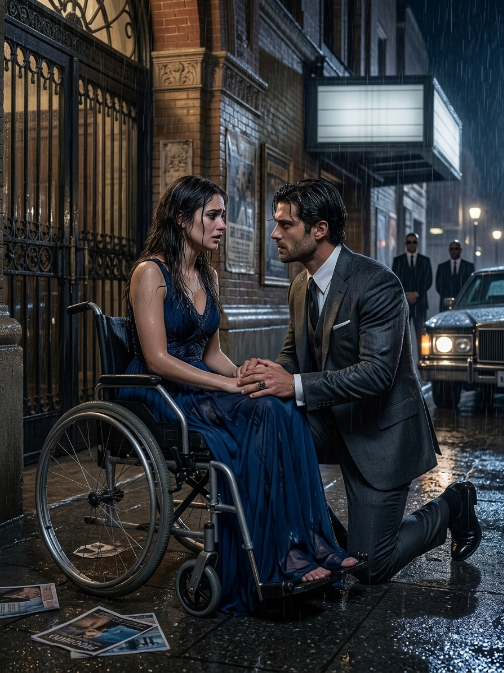
SHE TRAVELED 2,000 MILES TO MARRY A STRANGER — THEN HE TOLD HER HE’D NEVER WRITTEN A SINGLE LETTER

PART 1
November, 1883.
The Bitterroot Valley, Montana Territory.
The last letter had arrived in Baltimore on a Tuesday.
Clementine had read it so many times the paper had gone soft at the folds. *My dearest Clementine — the Montana sky is vast, but it is empty without a woman’s grace to share it. I will await your arrival at the Valley Depot. You shall know nothing but warmth and security from that day forward.* She had held it against her chest in the cold of her rented room above the tailor’s shop — the shop that was no longer hers, that had been auctioned two weeks after her father’s funeral to satisfy debts she hadn’t known existed — and she had let herself believe it.
She had wanted to believe it so badly.
The matrimonial advertisement in the Baltimore Sun had felt like divine intervention. A cattle rancher in Montana Territory. Widowed. Established. A man named Gideon Cross who wrote letters full of careful poetry and practical promises, who had paid for her stagecoach ticket all the way from Baltimore without being asked, who had described his ranch with such specific, loving detail — the white-painted house, the south-facing pastures, the river that ran clear even in August — that she had begun to feel she already lived there.
She had been twenty-six years old, alone, and out of options. She had packed everything she owned into a heavy leather trunk and traveled two thousand miles toward a stranger’s handwriting.
Now the stagecoach was gone.
Ezekiel Cobb — the driver, a grizzled old-timer who smelled of tobacco and animal fat — had not even waited for the station master. He had dropped her trunk into the frozen mud with a grunt that passed for apology and cracked his whip before she’d properly descended the coach steps. Something about the pass closing. Something about the storm. She had called after him, but the wind had swallowed her voice whole, and the coach had disappeared into the white like it had never existed at all.
The Valley Depot was a shuttered tin-roofed way station on the edge of nowhere.
There were no buildings beyond it. No roads she could identify in the accumulating snow. The afternoon light was already surrendering to a thick slate-gray dark that arrived early and stayed long at this altitude, and the cold was not the polite cold she had known in Baltimore — the kind that stung the nose and reddened the cheeks and retreated indoors with you. This cold had intention. It moved through her worn wool coat like the coat wasn’t there. It turned her feet to wood inside her boots. It froze the tears on her eyelashes before they had finished forming.
She was going to die here.
The thought arrived with a strange, flat clarity. Not in the panicked way she might have expected, but as a simple assessment of facts: she was alone, she was freezing, the light was going, and there was no one coming.
Then the snow shifted.
It wasn’t the wind. The wind had a particular sound — a sustained, shapeless howl — and this was something else. A heaviness. A displacement. She backed against the timber wall of the way station, her heart slamming against her ribs, as a silhouette separated itself from the white curtain of the storm and stepped onto the rotting platform.
He was enormous.
That was the first and most immediate fact about him, the fact that organized all other facts around it: the man was simply enormous. Six feet and something, broad as a doorframe, clad in a bear fur coat so thick and dark he looked like the wilderness had taken a human shape and decided to walk around in it. A battered Stetson was pulled low over his face. A frost-laden beard obscured everything below his cheekbones. A Winchester rifle hung across one shoulder with the casual ease of a man for whom the rifle was not a weapon so much as an extension of his body.
He stopped.
He looked at her — or she thought he did; it was difficult to be certain with the hat brim and the shadow and the gusting snow between them.
The silence stretched for what felt like a full minute.
Then he reached up and pushed the brim of his hat back, and she saw his eyes: dark, sharp, flint-colored in the dying light. Alert in the way that wild things are alert, tracking everything simultaneously without appearing to focus on anything at all.
*I’ve been waiting out here.* His voice was a low, grating rumble, a sound that came from somewhere deep in the chest, the kind of voice that expected to be heard without raising itself.
*Mister —* Her frozen lips struggled with the shape of the words. *Mister Cross?*
Something moved behind his eyes. Not recognition. Not warmth. Something subtler and less comfortable — a narrowing, a recalibration.
*You know my name?*
*Of course I do.* She reached into her coat pocket with a trembling gloved hand and produced the bundle of letters tied with faded blue ribbon. They were the only proof she had that any of this had been real. *I am Clementine Harper. Your — your bride.*
Gideon Cross looked at her.
He looked at the letters in her hand.
He looked at the heavy trunk half-buried in the snow behind her.
He looked back at her face, at her frozen cheeks and her ridiculous Baltimore wool coat and her eyes that were trying very hard not to show how terrified she was.
*Lady,* he said slowly. *I’ve been tracking a wounded elk through this powder for three hours. I was waiting out here to see if the beast circled back to the timber line.* A pause. *I ain’t waiting on no bride.*
The cold, in that moment, became absolute.
—
She didn’t cry.
She wanted to. The tears were there, behind her eyes, behind the frozen dignity she had been maintaining since Baltimore because dignity was the only thing she had left that nobody could auction. But when the bottom fell out of her world on that rotting platform, what came instead of tears was a very specific, very focused kind of fury — at herself, at the letters, at the man named Gideon Cross who had apparently never written a single one of them.
*The ranch,* she said. Her voice was a whisper. *The letters. The ticket you paid for —*
Gideon let out a long, slow breath, white vapor dissolving into the storm. He looked at her with an expression she would come to recognize later — not coldness exactly, but the particular blankness of a man who has been handed a problem he didn’t ask for and is calculating the most efficient way to survive it.
*There ain’t no ranch, Miss Harper.* He glanced at the sky, reading it the way she might read a clock. *And if we stay out here flapping our jaws, we’re both going to be frozen stiff as cordwood.* He nodded up the dark slope behind the way station. *My cabin is a mile up the ridge. Can you walk?*
She looked at the slope. She looked at the storm. She looked at this enormous, terrifying, completely unknown man who was apparently her only option.
*I don’t think I have a choice,* she managed.
He didn’t offer his arm.
He picked up her heavy trunk — both hands, one motion, the way a person picks up a satchel — and slung it over his left shoulder. His right hand closed around her upper arm with a grip that was firm enough to be a command.
*Step where I step,* he said. *Do not stop moving. If you sit down in the snow, you won’t get back up.*
She believed him entirely.
—
PART 2
The mile up the ridge was the longest mile of her life.
The wind came at them in waves, not steadily but in battering surges that hit without warning, driving ice crystals into the exposed skin of her face like thrown glass. The snow was knee-deep in places and deeper in others, and every step was a negotiation between her body and the mountain — her body losing, consistently, and Gideon’s grip on her arm making up the difference.
Twice her legs gave entirely.
Both times, the iron grip hauled her upright before she’d fully fallen, and he didn’t slow, didn’t speak, didn’t acknowledge the collapse except by maintaining forward momentum, as if stopping for even a moment was simply not a category of action he recognized.
She focused on his boots.
That was the only way through it: watching exactly where his feet broke the snow and placing hers in the same prints, one step, then the next, then the next, the tunnel of her vision narrowing to just that — his boots, the trail they made, the next step — until a golden glow appeared through the trees like something she’d invented from oxygen deprivation.
They fell through the door.
Gideon kicked it shut behind them, threw the bolt, and the roar of the blizzard became muffled, distant, something happening to other people outside. The silence inside the cabin hit her like a physical thing — a sudden, enormous absence of sound that her body didn’t know what to do with.
She collapsed onto the rough-hewn floorboards.
Just: collapsed. Her legs gave and she went down and she stayed down for a moment, her lungs pulling at air that smelled of curing leather and black coffee and the residual warmth of a fire that had been burning all day.
Gideon stepped over her.
Not unkindly. Efficiently. He dropped her trunk by the door with a heavy thud and moved directly to the fireplace, throwing a log onto the embers with one hand and swinging the cast iron kettle over the flame with the other.
*Get near the hearth,* he ordered, pulling up a crude wooden chair. *Take off your boots.*
He crouched beside her.
And the gruff, enormous mountain man who had just dragged her a mile through a blizzard reached out, with surprising, entirely unexpected gentleness, and unlaced her frozen boots himself.
—
PART 3
The circulation came back into her feet in a slow, agonizing prickle that made her clench her jaw against the pain.
Gideon rubbed her stockinged feet between his massive, calloused palms with the focused, unsentimental attention of a man who had dealt with frostbite before and understood that sentiment wouldn’t save the toes. He didn’t look at her face while he did it. He watched her feet, checking the color of the skin, pressing at the joints, monitoring his work with the same pragmatic thoroughness he might apply to treating an injured animal.
It was the most intimate act of practical kindness she had ever received, and it was offered by a man who had spoken perhaps forty words to her and none of them gentle.
She reached into her coat.
Her fingers found the ribbon-tied bundle and she drew it out carefully, the way you handle a thing you’ve carried a long distance. The top envelope still bore the elegant, looping cursive — *Miss Clementine Harper, care of the Baltimore Sun* — in the handwriting she had memorized over eighteen months of correspondence.
*You must be Gideon Cross,* she said. Her voice had found itself again — steadier than she expected, firmer. *There is no mistake. These letters bear your name and your signature.*
Gideon stopped.
He took the bundle from her. Held it in his big hands by the fire, and the light moved across his face in a way that revealed things the storm and the darkness had hidden — the lines around his eyes, the particular set of his jaw, and then the muscle that jumped beneath his beard as he looked at the handwriting.
He dropped the letters onto the table.
Not gently. With the controlled deliberateness of a man suppressing an impulse.
*Miss Harper.* His voice had gone quiet in a way that was more unsettling than loudness would have been. *I ain’t wrote a letter in ten years. Truth be told, I can barely string a written sentence together. I’m a trapper. I live on this mountain, and I die on this mountain.* He looked at the fire. *I sure as hell didn’t write those.*
*Then who did?*
The question was barely a sound. It was the sound of a person whose last solid thing has just shifted beneath them.
Gideon was still staring into the flames. His jaw tightened, then released, then tightened again.
*I know that handwriting,* he muttered. Quieter than anything he’d said yet. Like a man saying something he’d been hoping he wouldn’t have to say. *God forgive him. It’s Jeremiah.*
—
The name landed in the warm cabin like something cold.
*Jeremiah,* Clementine echoed.
*My younger brother.* Gideon stood. The cabin, which had seemed merely small, shrank further around his pacing. *He’s got a silver tongue and hands that can forge a signature blindfolded. Last I heard, he was running with the Ketchum boys down near the Wyoming border. Robbing payroll trains, mostly.* A beat. *The law put a dead-or-alive bounty on his head two years back. Haven’t seen him since.*
Clementine wrapped the wool blanket Gideon had tossed her more tightly around her shoulders. The fire was doing its work — she could feel the warmth beginning to reach her core, the slow, careful process of being thawed — but a new cold was settling in to replace it. The cold of understanding.
She hadn’t been corresponding with a lonely rancher.
She had spent eighteen months exchanging careful, hopeful, intimate letters with an outlaw on the run. She had read those letters in her rented room above the tailor’s shop. She had slept with them under her pillow. She had cited specific passages to her friend Mara over the particular longing that lives in the carefully-read words of a person who believes, with their whole lonely heart, that they have finally been truly seen.
*Why?* The word came out cracked in the middle. *Why would a train robber court a woman in Baltimore? Why pay for my ticket? Why send me here, to your cabin?*
Gideon stopped pacing.
He leaned against the stone mantle, crossed his arms, and looked at her. Not the tracking look from the platform — something more direct than that. The look of a man deciding how much truth a person can handle at once and settling, reluctantly, on all of it.
*That’s the question, ain’t it.* His voice was flat. *Jeremiah don’t do nothing without a payoff. He doesn’t run a game unless there’s money on the table.* He held her gaze. *You’re a pretty thing, sure, but a man running from the hangman’s noose doesn’t order a bride for the romance of it. What did you bring with you?*
The blood left her face so completely she felt it go.
She looked away. Into the fire. Into the orange and amber dance of it, the safe, mindless, indifferent warmth.
*Don’t lie to me,* Gideon said. Not loud. Not threatening. A simple, flat statement of terms. *If you’re caught up in one of Jeremiah’s schemes, your life is in danger. And now, seeing as you’re sitting in my cabin, mine is too.*
Another silence. The fire snapped.
*Money,* she said. The word tasted the way she imagined ash tasted. *He asked me to bring money.*
*How much?*
*Three thousand dollars.* Each word was its own small humiliation. *It was everything left from my father’s estate after the bank took the shop. In his last letter — in Jeremiah’s last letter — he told me the local banks couldn’t be trusted. He said he’d negotiated to buy a cattle herd, but the seller demanded cash. He asked me to bring my inheritance. He promised he’d match it tenfold and put the deed to the ranch in my name the day we were wed.*
She raised one finger toward the leather trunk sitting by the door, snow still melting from its straps.
*It’s in a false bottom stitched into the lining.*
Gideon let out a long, heavy breath through his nose. He walked to the window, a small, frost-edged rectangle of darkness, and looked out into the storm. His reflection looked back at him from the glass — grim, thinking.
*Jeremiah is brilliant,* he said finally, quietly, in the voice of a man giving a devil his due. *He’s too hot to show his face in any town. The marshals have the territory locked down.* He turned from the window. *So he uses my name. Courts a desperate woman back east, builds up eighteen months of trust, designs a drop point — my cabin, completely off the grid, completely unregistered — and gets her to carry three thousand dollars of clean, untraceable cash right to his doorstep. No banks. No witnesses. No trail.*
*He tricked me,* Clementine said.
She said it quietly. Without excuse or softening. She had wanted the fairy tale so badly that she had seen what she’d needed to see and ignored the rest, and now she was sitting in a stranger’s cabin in a Montana blizzard with every dollar she owned in a false-bottomed trunk, and the man who had written her love letters was a wanted criminal.
*I have nothing left.*
She buried her face in her hands.
The sound she made was not quite crying — it was something before crying, something that lives underneath crying, the sound of a person confronting the full shape of their own ruin without the buffer of hope.
The cabin was quiet except for the fire and the wind.
Then there was a soft, heavy clink of tin on wood, and a cup of black coffee was placed into her hands.
She looked up.
Gideon was crouched in front of her. Up close, without the storm between them, his face was different than she’d catalogued from a distance — the weathered lines of it ran deep, yes, and the beard was substantial and frost-bitten, but the eyes were not unkind. They were careful. Watchful. The eyes of a man who had learned, probably at some cost, to observe before he acted.
*Drink,* he said. Softly, this time.
She drank.
The coffee was scorching and bitter and completely without any of the refinements she’d grown up expecting from coffee, and it was exactly right. It grounded her. It reminded her body that she was alive and warm and, for this moment, safe.
She lowered the cup.
*What do we do?*
Gideon stood. His expression had shifted into something she hadn’t seen on him yet — focused, efficiently, a different kind of alertness than the hunter’s patience on the platform. He walked to the heavy wooden chest at the foot of his cot and threw the lid back.
*The law ain’t what you need to worry about right now.*
He began pulling out ammunition.
*What do you mean?*
*I know my brother,* Gideon said. His voice was level and completely serious in the way that real danger, not performed danger, sounds. He loaded the Winchester with the methodical precision of repetition — the same motion, the same intervals, the hands knowing the work so well they didn’t require thought. *He knows this mountain better than anyone except me. He knew this storm was coming — the barometer’s been dropping two days.* He set the rifle down, reached back into the chest, produced a heavy Colt revolver, checked the cylinder with a practiced spin and snapped it shut. *The storm grounds the coaches. It blinds the marshals. It clears the board.*
He looked at her directly.
*Jeremiah set the timing of your arrival perfectly. He used the blizzard as his cover to travel. He’s not waiting for the weather to pass, Miss Harper.*
The fire cracked.
Clementine looked at the heavy oak door. At the iron bolt across it — thick, solid iron, a real bolt, the kind that held — and understood, in a sudden cold sweep of clarity, how very much depended on the difference between a solid door and an unlocked one.
*He’s coming for the money,* Gideon said quietly, resting the rifle across the table. *And he’s likely out there in the whiteout right now, making his way up the ridge.*
—
The next hour was its own particular kind of silence.
Gideon moved through the cabin with a systematic, unhurried thoroughness that was either deeply reassuring or deeply terrifying and Clementine couldn’t decide which. He loaded every firearm she could identify. He bolted the rear shutters. He checked the chimney draft. He assessed the door’s hinges with two fingers and a frown, then braced a length of timber against the frame as reinforcement.
He was not frightened.
That was the remarkable thing. He was — alert, yes. Focused. But the fear she would have expected from a man preparing for his brother to arrive with dynamite was simply absent, replaced by something more efficient and more frightening: readiness.
*If he knows I’m here, won’t he expect a fight?* Clementine asked. Her voice came out steadier than she’d earned.
*Jeremiah relies on my sense of family,* Gideon said, sliding the shutter bolt home on the rear window. *Reckons I won’t shoot my own blood. He’s banked on it before.* He paused, his hand still on the shutter. *Ten years ago in Abilene, he shot a faro dealer over a bad hand. I took the beating from the local law to give him a head start to ride out.*
He turned.
*He expects the same blind loyalty today.*
He picked up the double-barreled shotgun, broke it open, inspected the breeches.
*But he crossed a line bringing an innocent woman into his filth.* He snapped the shotgun shut. *And he crossed a line bringing his trouble to my mountain.*
*There’s more than just the marshals,* Clementine said. She had been turning pieces over while he worked, assembling what she knew from the letters — the careful, orchestrated letters — against what she now understood about who had written them. *He mentioned Josiah Flint. The cattle buyer. Was any of that real?*
*No.* Gideon set the shotgun on the table beside the Winchester. *Flint’s a fiction. Something to explain the cash.* He paused. *Word in the valley is that the Union Pacific hired Pinkerton agents after the last train job. A senior operative named Arthur Pendleton. He doesn’t take prisoners, and he doesn’t stop. Jeremiah needs your three thousand to buy passage out of the territory — South America, probably. It’s his only way out before Pendleton puts a bullet in him.*
The wind chose that moment to drop.
The howling simply — ceased. Not gradually, not tapering off, but cut, as if someone had closed a door on it. The sudden absence of sound in the cabin was so complete that Clementine could hear the fire breathing.
Then the thud hit the door.
Heavy. Deliberate. A knock, but the kind a fist makes when it’s larger than average and not particularly interested in being polite.
Clementine’s coffee cup hit the floor.
Gideon was at the side of the door in a single movement, Winchester raised, pressed flat against the log wall. He held up one hand to her — absolute stillness, absolute silence — and she obeyed with the total compliance of a person who has placed all available trust in one other human being.
*Gideon.* The voice from outside was muffled by the timber but entirely audible in the new quiet. It was different from Gideon’s — smoother, lighter, a voice built for persuasion. Musical, almost, even shouted through a blizzard. *Open up, brother. It’s colder than a well-digger’s boots out here.*
*You’ve got a lot of nerve coming up this ridge, Jeremiah.*
A low chuckle filtered through the door. *I knew you’d be home. I see you found my little package from Baltimore.* A pause, casual, as if they were discussing the weather. *Is my beautiful bride keeping you company? Be a good host and unbolt the door. I’ve got a long ride ahead of me and I just need to collect my dowry.*
*There’s no money here for you.* Gideon’s voice was smooth and completely convincing in its flatness. *The stage was empty. She didn’t make it through the pass.*
*Now, Gideon.* The charm dissolved from Jeremiah’s voice like sugar in rain — fast, complete, leaving something metallic underneath. *Don’t play me for a fool. Ezekiel Cobb runs that stage, and Ezekiel likes whiskey. I paid him a visit before I came up the mountain. He said he dropped a pretty little bird with a heavy leather trunk right at the depot. I know she’s in there.*
Clementine pressed herself against the fireplace stone. Her back to the heat, her eyes on the door, her heart making a sound she could feel in her teeth.
*I ain’t alone, brother.* Jeremiah’s voice again, lighter now, almost cheerful. *Brought Dutch Higgins with me. You remember Dutch from the Wyoming jobs. He’s got a stick of mining dynamite that says you open this door, or we blow it clean off its hinges.* A pause. *I don’t want to hurt you, Gideon. And I surely don’t want to hurt Miss Harper. Just hand out the leather trunk and we ride away.*
Gideon looked at her.
Across the length of the small cabin, in the fire-thrown shadows, his eyes found hers and held them. Then, deliberately, he looked at the cast iron kettle on the iron grate over the fire. The water inside had been heating since they’d arrived — it was boiling now, the lid trembling slightly against the pressure, steam wisping from the spout.
He mouthed two words.
*Be ready.*
He moved to the door. His boots were completely silent on the floorboards — she hadn’t noticed that before, how quietly a man that size could move when he chose to.
*All right, Jeremiah,* he called out, pitching his voice to sound resigned, depleted. *Don’t light that fuse. I’m throwing the bolt.*
His left hand reached out. Slid the bolt back with a loud, deliberate clank.
But he did not pull the door open.
He stepped back two full paces, raised the shotgun to his shoulder, and waited.
—
The door came off its frame.
Not opened — *taken*, with a violence that sent it crashing inward, filling the cabin with a simultaneous explosion of cold air and white snow and the roar of the wind that had been waiting outside the whole time. For a fraction of a second the doorway was solid white, completely blinding, and then two shapes materialized in the brightness.
Gideon fired the right barrel.
The blast in the enclosed space was catastrophic — not just the sound but the pressure of it, a wall of compressed air that hit Clementine in the chest and set her ears ringing. The buckshot tore through the doorframe, splintering wood into shrapnel, and the larger figure on the right — a hulking mass in a buffalo coat, undoubtedly Dutch Higgins — screamed. He dropped something onto the snow-covered porch and fell backward into the storm, clutching his shoulder.
What he dropped was hissing.
But Jeremiah was already inside.
He had gone low under the blast, a trained, instinctive roll that carried him across the threshold and brought him up in a crouch in the middle of the cabin floor, a Colt Peacemaker gripped in both hands, hammer cocked, pointed at his brother.
And Clementine saw him properly for the first time.
He was — beautiful, was the terrible word that arrived first. The same dark coloring as Gideon, the same broad frame, but where Gideon was a thing built by weather and time and honest labor, Jeremiah was something assembled deliberately, arranged for effect. His face would have been striking without the jagged scar across his cheekbone. With it, he was something you couldn’t look away from. His eyes were wide and very bright with the particular energy of a person who is cornered and knows it and has decided that knowing it is not the same as accepting it.
*Don’t do it, Gid!* His voice cracked at the edges. *I’ll put you down, I swear to God —*
Gideon was already dropping the empty shotgun, reaching for the Winchester.
And the fear left Clementine.
That was the strangest part: the moment it mattered most, the fear simply withdrew, like a tide going out. What replaced it was something she had no name for — a focused, animal clarity, the same clarity, she suspected, that Gideon had been operating on from the beginning. She was not going to die in this cabin. She was not going to be a victim in someone else’s story.
She had not come two thousand miles for that.
Her hands found the iron handle of the kettle.
It was heavy — heavier than she expected — and the iron handle was scorching even through her sleeve, and she gripped it with both hands and stood in a single motion and screamed — not with fear, not with distress, a different kind entirely, a sound that came from the bottom of her lungs and had intention in it — and she threw it.
The arc of boiling water caught Jeremiah across the left side of his face and neck.
The sound he made was not a scream exactly. It was something that came before screaming, something involuntary and raw, and he dropped the Peacemaker and staggered backward, both hands flying to his face.
Gideon crossed the cabin in two strides.
His fist connected with Jeremiah’s jaw with the sound of falling timber, and Jeremiah Cross — charming, brilliant, silver-tongued Jeremiah Cross, who had written eighteen months of beautiful letters to a desperate woman in Baltimore and then sent her through a blizzard to carry his money — dropped to the floor like a felled tree.
Outside, the dynamite reached its end.
The explosion came up through the floorboards before it arrived as sound — a deep, bone-level percussion that shook the entire structure and sent the remaining window glass across the cabin in a glittering spray. The blast wave hit Clementine and Gideon together — he had covered the distance between them in the half-second after Jeremiah fell, and when the pressure wave arrived he was already pulling her down behind the overturned table.
The door frame, what remained of it, disappeared.
The wind came in like it had been waiting.
For a long time neither of them moved. The ringing in her ears was total. The cold was immediate and serious. The smell of sulfur and burning wood mixed with the pine-clean scent of the storm and the residual warmth still coming from the hearth, where the fire had survived the blast through pure stubbornness.
Slowly, Gideon pushed himself up.
He was bleeding slightly from one ear — the concussion of the blast at close range. He checked it with two fingers, assessed the blood, dismissed it. He stepped over his unconscious brother and moved to the ruined doorway, Winchester raised, peering out into the white.
*Higgins is gone,* he said. His voice had a roughness to it that hadn’t been there before — the blast had taken something from it, at least for now. *The explosion threw him down the ridge.* He paused. *He won’t survive the storm with that shoulder.*
He turned back to the cabin.
Jeremiah was beginning to groan, the slow, involuntary sounds of a man returning to consciousness from somewhere he hadn’t chosen to go. His face, on the left side, was an angry red, the beginning of blistering already visible. He would carry the burn for the rest of his life. He would carry the scar beside the other scar.
Clementine sat up.
She looked at the kettle near Jeremiah’s boots. She looked at her own hands, still trembling from the grip and the heat and the decision. She looked up at Gideon.
He was looking at her.
The rugged, weathered, utterly unreachable face had shifted into an expression she couldn’t quite classify — somewhere between astonishment and a deep, quiet respect that he hadn’t known he was going to feel and hadn’t prepared a container for.
*Remind me,* he drawled, wiping a smear of soot from his forehead. *Never to ask you for a cup of tea.*
The laugh that came out of her was not elegant. It was not the laugh of a Baltimore woman who had been properly raised. It was breathless and borderline hysterical and completely genuine, and it lasted until the reality of their situation reasserted itself: the cabin was open to the blizzard, the fire was their only heat source, and there was a wanted outlaw bleeding on the floor.
Gideon was already moving.
He pulled a coil of heavy hemp rope from the wall and bound Jeremiah’s wrists and ankles with an efficiency that suggested he had done this before, in similar circumstances, and had learned from the cost of doing it imperfectly. He dragged his brother away from the doorway and positioned him near the hearth with a practicality that contained, somewhere beneath it, a sliver of the care one has for family even when that family has burned every bridge.
*What do we do now?*
She asked it quietly, pulling her coat around her as the wind found new paths through the ruined wall.
Gideon took the heavy table and braced it across the doorframe. Not sufficient against a serious breach — but sufficient against the wind, sufficient to reclaim the warmth, sufficient for the night. He moved with a steadiness she had been watching all evening and was finally beginning to understand: it wasn’t the absence of feeling. It was the discipline of not letting feeling get ahead of the work.
*We patch the door,* he said. *We keep the fire going. We wait for morning.*
He picked up the forged letters from where they had scattered across the floor, mixed now with broken glass and soot and snow. He held them for a moment, looking at the elegant looping handwriting that his brother had used to build an elaborate, patient trap out of one woman’s loneliness and one man’s name.
Then he looked at the leather trunk in the corner. Intact. Undisturbed.
*Then we load him onto my pack mule,* Gideon said, his voice carrying the specific finality of a decision already made. *Take him down to the valley and hand him to Pendleton and the Pinkertons.* He set the letters on the table. *There’s a five-hundred-dollar bounty on his head. I reckon that belongs to you. For the trouble.*
Clementine looked at the letters.
She had loved those letters. That was the truth she hadn’t let herself look at directly yet — she had loved them genuinely, had believed in the man they described, had built an entire future in her imagination from the materials of his fiction. The loss of them was real, and she wasn’t going to pretend otherwise.
But.
She looked at Gideon Cross. The man who had pulled her through a blizzard, rubbed the frostbite from her feet, poured her coffee, put his body between her and his brother’s revolver, and who was currently bracing a table against a destroyed doorframe with the focused calm of a man who does not yet know that he is being observed.
*The letters,* she said. *They described a ranch.*
Gideon stopped. He turned.
*A partnership,* she continued. *A safe place. A man who wanted to build something real.* She met his eyes — the dark, careful, watchful eyes that she was beginning to understand saw significantly more than they advertised. *Were any of those things a lie?*
He was quiet for a long time.
The fire shifted behind her. The wind moved across the patch of table-covered doorway and found its edges and continued anyway, carrying the cold in around the corners. Jeremiah breathed slowly on the floor, unconscious and bound, the villain of the piece reduced for now to background detail.
Gideon looked at her the way she had seen him look at terrain when they’d climbed the ridge — reading it. Taking inventory of what was real and what only appeared to be.
*Miss Harper,* he said finally. His voice had gone to something she hadn’t heard from him yet — quieter than usual, without the frontier distance that kept it safe. *I don’t know much about writing poetry. And I ain’t got a white-painted ranch house.* He paused. *But I’ve got a hundred acres of prime grazing land on this ridge. And I know how to build.*
He looked at her steadily.
*If you’re willing to stay, we could make those letters tell the truth.*
The fire snapped. The wind pressed at the seams of the cabin. Her brother-in-law-who-wasn’t lay snoring on the floor with his hands tied and his face burned, and outside the blizzard did what blizzards do, which is whatever they want.
Clementine Harper looked around the shattered, ruined, bone-cold, improbably warm single room in which she had survived the worst night of her life.
She looked at the forged letters on the table. At the trunk with three thousand dollars intact in its false bottom. At the cast iron kettle on the floor. At the man with soot on his face and frost in his beard who had just offered her, with no flourish whatsoever, exactly what she had come two thousand miles for.
*I believe,* she said, and a small genuine smile arrived on her face like weather breaking, *that I would like that very much, Mr. Cross.*
—
The spring thaw of 1884 came late to the Bitterroot Valley, but when it arrived, it came with conviction.
Arthur Pendleton and his Pinkerton operatives had taken custody of Jeremiah Cross at first light the morning after the blizzard, while the snow was still blue in the shadows and the valley was completely still. Pendleton was a small, precise, unremarkable-looking man who carried himself with the specific authority of someone who has never once been uncertain of his own competence. He had looked at Jeremiah in Gideon’s ropes, at Clementine’s burned hands, at the destroyed doorframe and the blast crater on the porch, and he had reached into his coat and produced a bank draft for five hundred dollars without a single unnecessary word.
He had also, at Gideon’s quiet request, examined the leather trunk.
The three thousand dollars was there. All of it. Clean and untraceable, exactly as Jeremiah had designed. Pendleton had looked at Clementine over the rim of his spectacles and informed her that the Union Pacific Railroad, in recognition of her material assistance in the apprehension of a wanted criminal, would be taking no action regarding the cash. It was hers.
She had held the words in her hands for a moment — *it is yours* — and felt something that had been clenched inside her since her father’s funeral begin, very slowly, to release.
The ranch went up that spring.
Gideon built the way he did everything: methodically, without waste, with a attention to what would endure over what would simply look good quickly. Clementine had expected, vaguely, that she would assist — perhaps with the interior, with the domestic arrangements, with the selection of appropriate furniture. She had not expected to find herself on the roof at seven in the morning with a hammer, or hauling stone for the kitchen fireplace, or learning to read the particular shade of cloud that meant real weather was building versus weather that would talk about itself and move on.
She had not expected to be good at it.
The summer revealed things about the ridge that the winter had kept hidden: a meadow behind the south pasture that ran gold with wildflowers in July; the way the light came off the mountains in early morning, sideways and specific, as if selecting its objects carefully; a creek in the lower quarter of the property that ran cold and clear even in August, exactly as the letters had described it.
She had told Gideon that, one evening in late August, sitting on the new porch he’d built facing the valley.
He’d been quiet for a moment.
*Jeremiah did his research,* he’d said finally. *He always did. He was the one who read everything, remembered everything. Knew which details would land.* He’d looked at the valley below them, fading now into the blue-purple of early evening. *He just didn’t care what happened to the people in the story after he was gone.*
*He got the story right,* Clementine had said. *He just got the man wrong.*
Gideon had looked at her then with the expression she had been cataloguing since November — the one that appeared when something surprised him, when the careful control he maintained over his face encountered something it hadn’t prepared for. He held it for a second, then looked back at the valley.
*I expect he did,* he’d said.
The Cross Cattle Company was registered with the territorial government in the fall of 1884, the deed bearing two signatures in the clerk’s office in Missoula: *Gideon Thomas Cross* in the large, utilitarian print of a man who writes rarely but legibly; and *Clementine Marion Cross* in a handwriting that had changed in the past year, she had noticed — less careful, more settled, the handwriting of a woman who had stopped performing composure because she no longer needed to.
Jeremiah Cross went to trial in Denver in February of 1885.
The evidence was extensive, the Ketchum boys having provided considerable cooperation in exchange for reduced sentences. Jeremiah received twelve years in the federal penitentiary in Leavenworth. He stood at sentencing with his chin up and his scarred face composed, and Clementine, who attended with Gideon because she believed in facing things directly, watched him and tried to feel something simple about him — anger, or satisfaction, or the clean closure of justice. What she felt was more complicated: the grief of a story that had been real to her even if it had never been real to him. The eighteen months of letters. The careful, patient construction of a woman’s hope.
He had known exactly what to offer. He had just been offering it on behalf of someone else without knowing it.
After the sentencing, standing in the cold gray Denver street, Gideon had stood beside her in his good coat — not the grizzly fur, the wool one she had bought him in Missoula because it was appropriate for courtrooms and he had no opinion on the matter — and said nothing. He was good at that: understanding when silence was what was needed, and providing it without making you feel abandoned in it.
She had taken his arm.
He had looked down at her hand on his coat sleeve with the expression she knew now as his version of warmth — contained, steady, a thing you had to look for. Then he had covered her hand with his, and they had walked back to the hotel through the cold Denver morning without either of them needing to explain what it meant.
—
The spring of 1886 came early.
The wildflowers in the south meadow appeared in late March, which Gideon said was unprecedented in his experience of the ridge, and which Clementine took as the mountain making a small concession to optimism.
She was in the kitchen of the white-painted ranch house — not Parisian white, a practical Montana white, the kind that held through winters — when she heard him on the porch. The characteristic weight of his footstep, the pause, the particular quality of silence that meant he was looking at something and deciding whether it required words.
She went to the door.
He was standing at the porch rail, looking out at the south pasture where the first of their cattle — a modest thirty-head herd, the beginning of what would eventually be a substantial operation — were moving through the new grass. The morning light came sideways off the mountains, the way she had learned to love it, and it caught the frost still in the air and made it look, briefly, like everything was lit from inside.
He turned when he heard her.
She had a letter in her hand. From Baltimore — from her friend Mara, who had stayed in touch faithfully and who wrote long, wonderful, terrible letters full of news Clementine was increasingly glad to be distant from. She had been going to read it to him over breakfast.
She didn’t read it to him over breakfast.
She stood in the doorway of the ranch that Jeremiah had invented and Gideon had built, with the Montana morning coming in around the edges of the mountains, and she looked at her husband — the man who had never written her a single word, who had offered her a hundred acres and an honest pair of hands and kept the offer simple and solid ever since — and the letter stayed in her pocket.
*The cattle are moving well,* she said.
*South pasture’s soft still,* Gideon answered. *Another week before I push them through.*
*Coffee’s on.*
*I know.* He looked at her for a moment, in the direct, unhurried way that still occasionally undid her, even after three years. *Clementine.*
*Gideon.*
*It’s a good morning.*
She looked out at the pasture. At the frost-lit air and the slow movement of the herd and the mountains still holding snow on their upper shoulders while the valley floor had surrendered it weeks ago.
*Yes,* she said. *It is.*
She turned back inside. She heard his footstep on the porch boards — the characteristic weight of it — and then the door closed behind them both, and the morning went on being what it was: real and cold and lit from inside.
Not what the letters had promised.
Better.
—
*THE END*