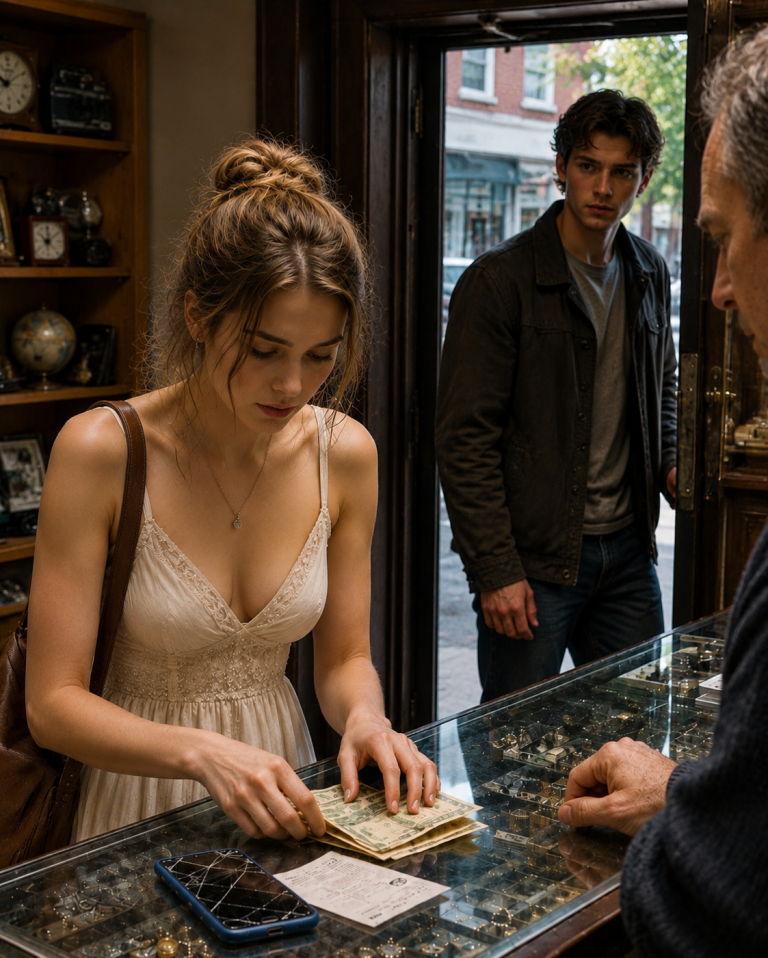
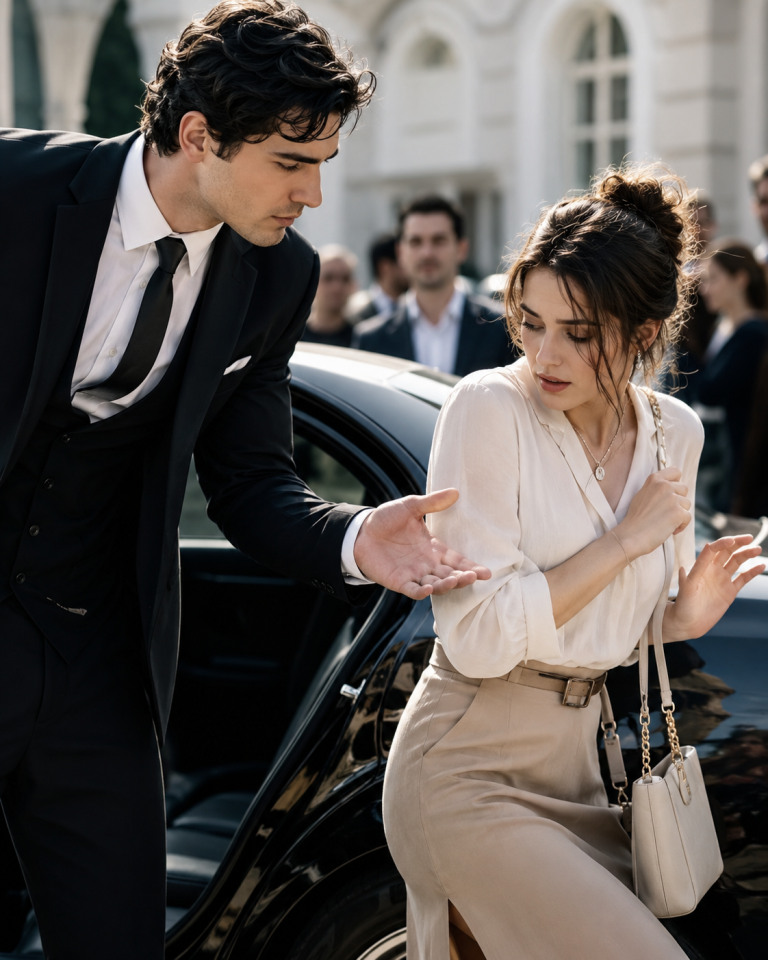
No One Returned for the Paralyzed Dancer—Then a Mafia Boss Knelt Beside Her and Chose Her Over His Empire

## PART 1
My sister’s engagement party had a ramp.
I know that because I specifically called to ask, three days before the event, and was assured three separate times that the venue was accessible. So when we arrived at the Harmon Estate and I looked up at the eight marble steps between the car and the front door, I did not say what I was thinking. I sat in my chair and waited while four of my brother-in-law’s groomsmen figured out, with great awkward ceremony, how to carry me up.
My name is Cara Vellum. I am twenty-six years old. I was a ballet dancer until fourteen months ago, when a delivery van ran a light at the intersection of Clement and Third and I became instead a woman who required significant coordination from near-strangers to enter a building with stairs.
I had been told I should feel grateful.
I had a roof. I had family. I had the specific medical privilege of being injured in a country with functional emergency services. I had all my cognitive function and both my arms and a prognosis that included the word *possible* attached to various hopeful outcomes.
None of that made the eight marble steps less humiliating.
Inside, the party was exactly what engagement parties at the Harmon Estate were: beautiful, expensive, loud in the specific way of wealth performing itself, and equipped with no fewer than three people who spent the evening speaking to me in the particular gentle register reserved for children and those deemed unable to fully follow the conversation.
I smiled until my face hurt.
Then I found the terrace.
Someone had left a side door propped open — a caterer, probably, coming and going with trays — and the terrace beyond it was stone, unlit, open to the October night. I wheeled out without announcing myself to anyone. The air was cold and smelled like rain coming. I parked near the edge where the terrace met the garden and looked at the city glowing below the ridge.
I did not think about Marcus, who had been my fiancé, who had left seven weeks after my injury with a speech about needing a life partner who could be fully present for him. I did not think about how he was now inside with his new girlfriend, the tall redhead who appeared to be fully present in every way he required. I did not think about what Tuesdays had meant — advanced class at four, rehearsal after, the particular joy of a body that did exactly what I asked of it.
I was not thinking about any of this.
I was just sitting outside in the dark.
The rain arrived before I registered the sky changing. Fine at first, then heavier, soaking through the wrap I’d borrowed from my sister’s coat closet. I should have gone inside. I was aware of this. I didn’t move.
A door opened somewhere behind me.
Then someone said, “You’re getting wet.”
I turned.
He was standing in the doorway — not a caterer, clearly, given the quality of his suit — looking at me with an expression that was neither the practiced sympathy I received from people who knew about the accident nor the careful neutrality of people who were pretending not to have noticed the wheelchair. He was simply looking at me. Like a person.
“I’m aware,” I said.
He stepped onto the terrace. He was tall, dark-haired, with the kind of face that was more compelling than conventionally handsome — angular, controlled, carrying some private weight that lived at the back of his eyes.
“Party getting to you?” he asked.
“I needed air.”
“It’s a reasonable party.”
“It is,” I said. “My sister is happy. That part’s good.”
“But you’re out here.”
“Yes.”
He looked at the city below, then at me. “I was going to ask if you needed help getting back in.”
“I don’t.”
“I know. That’s why I asked instead of assuming.”
That stopped me.
“Okay,” I said.
“Okay you need help, or okay you heard me?”
“Okay I heard you.” I looked at him. “Who are you?”
He opened his mouth to answer, and behind him the terrace door opened again.
The men who came through were not guests.
They wore dark clothing and they moved with the specific deliberate pace of people who were looking for something — not panicked, not searching, but *hunting* — and the man beside me went very still in the way that people went still just before something happened.
“Get away from the door,” he said. Quietly. To me.
“Why?”
“Please.”
I wheeled backward. The men scanned the terrace, and one of them made eye contact with the man beside me for a fraction of a second that contained something I could not name.
Then they went back inside.
The man in the expensive suit let out a slow breath.
“Those men are looking for me,” he said, still quietly. “They’re going to find me in approximately four minutes. When that happens, you don’t want to be nearby.”
“Who are you?”
“Someone who made enemies.” He turned to me. “I’m going to be honest with you. You can go back inside and be safe. Or you can come with me and I can take you somewhere safer than here, but it involves leaving with a stranger and a certain amount of uncertainty.”
I looked at him.
I looked at the door he’d come through.
I looked at the city below us, gleaming in the rain.
My sister’s party was inside. My sister was inside, celebrating with the family that had spent the last fourteen months hovering and apologizing and treating my injury like a communal grief they were all managing together. Marcus was inside with the redhead. The four groomsmen who had carried me up the stairs were probably inside doing something photogenic near the champagne tower.
“Give me your name first,” I said.
“Niccolo Vasari.”
I did not know it. But he said it the way certain names were said — not as introduction but as disclosure. Like he was giving me information he was not required to give.
“Cara Vellum,” I said.
He looked at me for one moment, steady and direct, rain darkening the shoulders of his jacket.
“Can I push your chair? It’s faster.”
“Yes,” I said.
He didn’t hesitate, didn’t make it into a production. His hands found the handles and we were moving, and I did not feel managed or diminished or like a problem being solved. I felt like a person going somewhere with another person who had decided where they were going.
We reached his car through the side garden, away from the valets.
He lifted me in without ceremony. Asked first. Waited for my nod. Did it with care and without the particular brand of pity that made being lifted feel like being reminded of everything you’d lost.
He folded my chair. Loaded it. Got in the driver’s side.
“Where are we going?” I asked.
“Away from the people looking for me.”
“That’s not specific.”
“I know.” He looked at me. “Are you cold?”
“A little.”
He turned on the heat without comment, pulled out of the estate, and headed east through the rain-glossed streets.
I watched his profile in the dashboard light and thought about the fact that I had left my sister’s party with a stranger.
Then I thought about Marcus. About the eight stairs. About the three people who had spoken to me like I was learning English. About the way I had sat in the rain until I was soaked because going back inside felt worse.
“Your enemies,” I said. “Are they the kind who follow?”
He checked the rearview mirror.
“Yes,” he said.
“Are they following now?”
He checked again.
“Maybe,” he said.
And then the headlights appeared behind us, and his hands tightened on the wheel, and the word *maybe* cashed itself in.
—
## PART 2
The car accelerated.
Not dramatically — he didn’t gun the engine or screech the tires, just a steady, purposeful increase in speed that told me this was a situation he’d been in before. I pressed my hand against the door and watched the side mirror.
Two vehicles. Keeping distance but keeping pace.
“Same men from the terrace?” I asked.
“Possibly worse.” He took a turn onto a narrow street I didn’t recognize. “They work for a man named Mikhail Dravic.”
“I don’t know that name.”
“Consider yourself fortunate.”
He turned again. The streets narrowed further, warehouse district, no residential traffic. He killed the headlights, then cut the engine, and we rolled silently to a stop beneath an overhang.
Darkness.
The pursuing cars passed on the main road and didn’t turn.
We sat in the quiet for forty seconds, maybe sixty.
“Clear,” he said finally.
“For now.”
“For now,” he agreed.
We drove the rest of the way with headlights off until we reached a building that looked ordinary from outside — converted industrial, the kind that appeared in every reclaimed neighborhood — and became something else once we were inside. Security. Staff who moved with economy. Rooms that were cleaner and quieter than the street suggested.
His home.
Or one of them, I suspected.
He sat across from me in a room with pale walls and very little furniture and asked me if I wanted tea, which was the most ordinary thing anyone had said to me all evening, and I laughed, and he looked briefly surprised, and then something in his face softened.
“Yes,” I said. “Please.”
While someone brought the tea, he told me about Dravic. Not everything — I could tell there were sections he was editing, selecting, presenting in a specific order. But enough. Niccolo ran operations that overlapped with Dravic’s in ways that made them competitors, and Dravic’s preferred resolution method involved demonstrations of consequence rather than negotiation.
“And me?” I said. “Why would they care about me?”
“They saw you with me. They don’t know who you are, but being unknown makes people interesting to men like Dravic.” He held his cup. “Once you’re interesting, you’re manageable leverage.”
I absorbed this.
“So I’m in danger because I happened to be on a terrace.”
“Yes. I’m sorry.”
“Are you usually this honest?”
“When it benefits someone to know the truth, yes.”
“And when it doesn’t?”
“I use judgment.”
I looked at him.
He looked back.
“My phone’s here,” I said. “I should call my sister. She’ll notice I’m gone eventually.”
“Probably wise.”
My sister answered on the second ring with the voice of someone who was four glasses of champagne into celebrating and hadn’t yet taken inventory.
“Car? Where are you? Mum’s looking—”
“I’m okay. I left early. I’m at a friend’s. Don’t worry.”
“You *left*? How did you — did you call a cab? You should have told someone—”
“Sophie.” I kept my voice even. “I’m fine. Congratulations again. I’ll call you tomorrow.”
A pause.
“Are you sure you’re okay?”
“I’m sure.”
“Because you seemed—”
“Sophie. Tomorrow.” I lowered the phone.
Niccolo had not moved. He sat with his hands wrapped around the tea and an expression that was not pity but was adjacent to something.
“What?” I said.
“Nothing.”
“You were thinking something.”
“I was thinking you’ve had a long night before tonight even started.”
The observation was accurate enough that it made my chest hurt.
“I used to dance,” I said, which was not what I’d planned to say.
“I know.” At my look: “I noticed the way you held your posture. The shoulders. The back. It’s trained.”
“I was with the city ballet. Before—” I gestured at myself, at the chair, at the general situation.
“What happened?”
“Delivery van. An intersection. The usual kind of accident that isn’t really an accident.”
“Fourteen months ago.”
“Fourteen months.” I turned the cup in my hands. “People keep waiting for me to be better. My mother. My sister. The doctors. Marcus — he was my fiancé — he waited six weeks and then left because I wasn’t progressing fast enough.” I looked at the window. “Mostly I’m tired of being the project everyone hopes will resolve.”
Niccolo was quiet.
“You sat in the rain tonight,” he said, “until you were soaked, rather than go back inside.”
“Yes.”
“Because inside was worse.”
“Yes.”
He nodded once, as if this made complete sense, and did not offer a single word of comfort or prescription. That absence, I realized, was its own kind of comfort.
His phone buzzed.
He read it.
Everything in him changed.
“Three vehicles,” he said. “Moving toward this building.”
“Dravic?”
“His people. They tracked the car.” He stood. “We need to move.”
“How?”
“I have another location.” He looked at me directly. “I’ll get you out of this, Cara. That’s a promise.”
Something about the way he made it — not as reassurance, not as performance, but as simple fact — made me believe it.
“Then let’s go,” I said.
He moved behind my chair, and I didn’t stop him, and we went.
—
## PART 3
The second location was nothing like the first.
Where his city building had the spare elegance of a man who understood that spaces could be functional without being warm, this place — a house at the edge of a forest above a lake, two hours from the city — was genuinely lived in. Not by many people, or recently. But the signs were there: books on the shelves that had been read, not arranged. A kitchen with a real larder. A fireplace with ash in it.
“You come here,” I said.
“When I need to think.”
“It doesn’t look like a fortress.”
“That’s the point.”
He set me up in a room on the ground floor — wide door, accessible bath, low furniture — with the efficiency of someone who had considered the logistics before I needed to ask. I didn’t comment on this because I was tired, and because it would have required me to explain why it mattered, and I was also tired of explaining that.
For two days, we existed in a suspended parallel world.
Niccolo handled calls on the porch, voice low, face controlled. He cooked badly. I told him so. He burned the garlic three times in a row with a composure that suggested he had decided not to let garlic win. I managed the parts I could reach and let him do the rest without ceremony. We ate at the low table near the window and talked about things that were not the crisis — his foster care childhood, which he mentioned in the abbreviated way of someone who had made peace with it by not making much of it; my training, the specific physical vocabulary of a body that had spent fifteen years learning to be an instrument.
“My first teacher said the body remembers,” I told him.
“Does yours?”
“The muscles do. Certain things. But the signals don’t go all the way through anymore.” I looked at the window. “I’m working on finding out what’s still possible. The window is apparently still open, physiologically. But it requires time and specific therapy and a certain amount of sustained hope, which I’ve been running low on.”
He didn’t say *you’ll get there* or *I believe in you* or any of the things people said when they wanted to encourage someone without sitting with the actual difficulty.
He said, “What do you need to hold the window open?”
The question was so practical it startled me.
“A good specialist,” I said. “The right program. Someone to call me out when I’m using exhaustion as an excuse to not try.”
“I can help with the first two.”
“You don’t have to—”
“I know I don’t have to.”
He looked at me the way he’d looked at me on the terrace — simply, without performance.
“Then yes,” I said. “That would help.”
On the third night, someone shot through the front window.
Not a sniper — it was fast and inaccurate, a warning rather than an attempt, which Niccolo explained afterward in the tone of someone distinguishing categories of threat for my benefit. He was already moving when the glass broke, his body between me and the window, and we were out the back before the second shot came.
The cabin had a boat.
Of course it did.
He got me in with the practiced ease of someone who had run from places before, and we cut across the dark lake while lights from the treeline told me the people Niccolo had been managing for days had finally found us.
“How?” I said.
“Internal,” he said, and the word cost him something.
He had a second phone, a burner, and he called a number he kept in his head while I sat in the bow of the boat and watched the lake close behind us.
The dock on the far side had a vehicle waiting. I didn’t ask how. We drove through the forest to a third location — a motel that had clearly been chosen for anonymity over comfort — and sat in a room that smelled like bleach and old carpet while Niccolo was on the phone.
He came off it looking like something had shifted.
“Internal means someone who knows your movements,” I said.
“Yes.”
“Someone close.”
He sat down on the single chair, which was an interesting choice given that I had the bed and there was nowhere else and it was four in the morning.
“My brother,” he said.
He said it with a specific flatness that was not the absence of feeling but the containment of too much of it.
“You have a brother.”
“Had. He died — I was told he died — three years ago. Fire at a property.” He was looking at the wall. “Marcus found communications six weeks ago that made no sense if Nico was dead. I’ve been trying to trace them.”
“And now?”
“And now I know the communications were from him.” He looked at me. “He’s working with Dravic.”
“Why?”
He was quiet.
“Because I stopped looking,” he said. “When they told me he was dead, I accepted it. I buried him in everything except ceremony and I moved on.” His jaw tightened. “He didn’t die. He was in a situation that required help and I accepted a report instead of investigating it myself.”
“What situation?”
“He owed Dravic money. He had been doing work for him. I didn’t know — I was managing my own operations and we were estranged and I—” He stopped. “I left him there. By accident. But it was still leaving.”
I sat with that.
“He chose to help Dravic against you,” I said.
“Yes.”
“That’s his choice.”
“It came from somewhere.”
“Grief comes from somewhere. Betrayal still belongs to the person who commits it.”
He looked at me.
“I’m not saying you didn’t fail him,” I said. “You probably did. But you didn’t make him choose this. And whatever happens next, that distinction matters.”
He was quiet for a long time.
“Marcus is coming,” he said finally. “My second-in-command. He’ll be here by morning. We’ll handle Dravic through channels that should have been used three weeks ago, and we’ll deal with — ” He stopped. “With my brother.”
“What does *deal with* mean?”
“Bring him in. Give him the chance to walk away from Dravic. Or not.”
“And if not?”
“Then we part again, and this time I accept what I accepted wrong the first time — that I can’t control what he chooses, I can only control what I do about it.”
I thought about that.
“You built an empire on control,” I said.
“Yes.”
“You’re terrible at it, in some directions.”
He almost smiled. “I’m aware.”
“The things that matter most,” I said. “Those are the ones control doesn’t work for.”
He looked at me across the bleach-scented motel room.
“No,” he said. “It doesn’t.”
—
Marcus arrived at seven, competent and efficient, with a doctor and clean clothes and news that took thirty minutes to deliver.
The doctor attended to a cut on Niccolo’s forearm that I had not known about until the sleeve came up. Four stitches. He sat through it without expression.
I made him look at me afterward.
“You were injured last night and didn’t say anything.”
“It was minor.”
“That’s not the point.”
He held my gaze.
“You’re right,” he said. “I should have said something.”
“Yes.”
“I didn’t want to add to what was already—”
“That’s not your call to make for me,” I said.
He accepted this without defense.
Slowly, over the following hours, the situation resolved in the way that crises resolved when competent people applied sustained attention — not cleanly, not without cost, but toward an endpoint.
Dravic was removed from his position by the combined pressure of three families who had decided his recklessness was a liability. The details of this were delivered to me in edited fragments; I did not press for more.
And Niccolo’s brother, whose name was Enzo, agreed to a meeting.
I was not present for it. Niccolo didn’t ask me to be and I didn’t offer. Some things needed to happen without audience.
He came back from it two hours later.
“He’s going to leave the city,” he said. “He’s going to go somewhere else and build something else. Dravic has nothing to offer him anymore.” He sat down. “I transferred money to an account he can access. I told him it doesn’t fix anything. He said he knew.”
“Did you talk to him?”
“We talked.”
“Did you tell him what you told me? That you stopped looking?”
“Yes.”
“What did he say?”
“That he stopped asking.” Niccolo looked at his hands. “We both made the same mistake in different directions.”
I thought about that.
“Will you see him again?”
“I don’t know. I told him where to find me if he wanted to. And I left the door open, which I should have done three years ago instead of accepting a report.”
“You can’t change three years ago.”
“No.”
“You can change now.”
He looked at me. “You’re very direct.”
“I was a dancer. We spent years learning to see exactly what the body was actually doing versus what we thought it was doing. The gap between those two things is where mistakes live.”
He was quiet for a moment.
“I want to help with your therapy,” he said.
“You mentioned that.”
“I’m repeating it because I want to be clear it’s not a transaction. It’s not in exchange for anything. It’s because you said the window was still open and I don’t want you to have to hold it open alone because of resource limitations.”
I looked at him.
“Why?” I said.
He held my gaze.
“Because you sat in the rain at your sister’s party until you were soaked through, and no one came to find you,” he said. “And that seems like something that should have a different ending.”
My throat did something complicated.
“That’s not a reason to fund someone’s medical care.”
“It’s a reason to care whether someone has what they need.”
“Niccolo—”
“Also,” he said, “because I want to see you in water again.”
I stared at him.
“At the lake last night,” he said. “Before the shooting. For about thirty seconds, when you were watching the moonlight on the water, you looked — ” He stopped.
“What?”
“Like yourself,” he said. “Not the version you perform for rooms full of people who mean well. The actual one.”
The words found the place in me I’d been defending for fourteen months.
“I don’t know what to do with you,” I said.
“You don’t have to know yet.”
“I’m not an easy situation.”
“I don’t want easy. I want real.”
“You might not like real.”
“I’ve met real tonight,” he said. “I like it considerably.”
—
The months that followed were not simple.
They were the kind of complicated that required honesty at inconvenient moments, that included conversations about what he did and what I could accept, that involved my sister eventually learning the broad outlines of a story I delivered carefully and watching her face cycle through alarm and then, eventually, a complicated kind of understanding.
He came to the first therapy appointment with me.
He sat in the waiting room and read something on his phone while I went through the initial assessment with a specialist whose reputation was considerable and whose practice was apparently difficult to access. Niccolo did not make this observation about the access and I did not ask questions about how it had been arranged.
After the appointment, in the car, I said: “She thinks I have a reasonable chance.”
“I know.”
“You asked?”
“After you went in.”
“You interrogated my specialist.”
“I asked a question.”
“Niccolo.”
He looked at me.
“Thank you,” I said.
He started the car.
There was a pool at the facility. He learned the lift mechanism on the second visit and operated it without commentary from that point forward. I swam. My arms were stronger than they’d been in fourteen months. The water held me differently than memory held me, which was its own kind of recalibration.
He sat at the pool edge sometimes.
I told him once that he didn’t have to.
“I know,” he said.
“Then why are you here?”
“Because you told me what it feels like in water.”
“When did I—”
“Third day at the cabin. You said it was the closest thing to what dancing used to feel like.”
I stopped swimming.
He looked down at me from the edge.
“You remember everything,” I said.
“I pay attention.”
“It’s a little—”
“Much?”
“I was going to say unusual.”
“Ah.”
I floated on my back and looked at the ceiling.
“In ballet,” I said, “there’s a thing called *épaulement*. The turn of the shoulder and head. It’s the thing that separates someone who can execute the steps from someone who’s actually dancing. Because any technically competent person can do the steps. But the *épaulement* — that’s about understanding the space around you. Where you are in relation to everything else. What the gesture means, not just what it looks like.”
He was quiet.
“What reminded you of that?” he said.
“You,” I said. “The way you pay attention. You’re always aware of the space.”
“Is that a compliment?”
“I’m not sure yet.”
He said nothing, which was sometimes better than saying something.
I swam another length.
—
Six months after the party, I stood for the first time in the therapy pool.
*Stood* was perhaps generous — the water provided significant support, and the therapist was right there, and I needed both rails. But my feet were on the floor of the pool and my body was vertical, and those facts, while not miraculous, were real.
Niccolo was at the edge.
He didn’t say anything when it happened. He watched. And his face did the thing it did when he was letting something reach him instead of managing it from behind the controlled exterior — the expression that I had learned to recognize as his actual face rather than the face he showed rooms.
Afterward, in the car, I said: “Don’t say anything about it.”
“I wasn’t going to.”
“You were going to say something impressive.”
“I was going to say that you looked exactly like yourself.”
I turned to look at him.
“You said that before,” I said. “On the terrace. Well, not in those words. But.”
“I meant it the same way.”
“What does it mean, *like yourself*?”
He considered.
“It means the thing you’re doing matches the person doing it,” he said. “Not a performance. Not management. Not the version of yourself you’ve adjusted to fit other people’s comfort. Just you.”
I looked out the window.
“I was so good at the performance,” I said. “For a long time. After. Because the grief of it was too large to let people see and I didn’t want to be the damaged one everyone was carefully handling.” I paused. “I still do it sometimes.”
“I know.”
“Does it bother you?”
“When I see you do it,” he said, “I want to take whoever made the performance necessary and have a very direct conversation with them.”
I laughed.
“That’s a threat.”
“It’s a feeling,” he said. “I’m working on not acting on all of them.”
“How’s that going?”
“Mixed results.”
We drove through the city, which was doing the thing cities did in late spring — opening up, the cold having retreated, people reclaiming public spaces with the particular relief of the seasonal.
“I want to tell you something,” I said.
“Okay.”
“Fourteen months ago, when the accident happened, the doctors said *possible* about a lot of things. Possible recovery. Possible progress. Possible outcomes. And I spent nine months treating *possible* like it was a consolation prize. Like it was just the kind word for *probably not.* Like hoping for it was a way of setting myself up to feel stupid later.”
“And now?”
“And now I’m standing in pools. Not perfectly. Not yet. But I’m standing.” I looked at my hands. “And I think the reason is not only the therapy or the specialist or the right program. I think some of it is that someone asked what I needed instead of deciding for me. And I answered honestly. And it turned out honesty was part of what I needed.”
He was quiet.
“You’re telling me I helped,” he said.
“I’m telling you that the specific way you helped mattered. The asking instead of assuming. The not making it about your feelings about my situation. The fact that you saw me as—” I stopped.
“A person,” he said. “Not a case.”
“Yes.”
He pulled to the curb near my building.
“I see you,” he said. Not dramatically. Just as a statement of fact.
“I know,” I said. “That’s the thing.”
I opened my door. He came around — I had stopped protesting this weeks ago, not because I needed it but because it had stopped feeling like help and started feeling like the way we moved through spaces together.
At the door I turned.
“Come upstairs,” I said. “I’ll make tea.”
“You make it better than I do.”
“You burn it.”
“I’ve been practicing.”
“Upstairs,” I said. “You can show me.”
He folded my chair and followed me inside.
The tea was fine.
He had been practicing.
—
Later, much later, sitting by the window with the city doing its evening things below us, he said: “Do you ever think about dancing again?”
I considered.
“I think about it differently than I used to,” I said. “I used to think about it as the thing I lost. The life that got interrupted. Now I think about it as something I know. The way my body moves, even in the chair. The way I understand space. The *épaulement*.”
“What’s changed?”
“You asked what version of myself I wanted,” I said. “The night at the cabin. You asked which version I wanted, not which version I was going to recover toward.”
“I remember.”
“I didn’t answer then.”
“No.”
“I want the version that knows what she knows,” I said. “The version that was a dancer and is now something else that includes having been a dancer. Not a before and an after. Just a person who has kept going.”
He was quiet.
“That’s who I see,” he said.
I looked at him — this complicated man with the foster care history and the difficult brother and the empire he was slowly trying to make less complicated, this man who had found me in the rain at my sister’s party and asked before lifting me and remembered small things I had said at four in the morning and learned to make tea without burning it.
“I wasn’t looking for this,” I said.
“Neither was I.”
“I’m still figuring out how much I can handle.”
“Take the time.”
“I might need a lot of it.”
“I have time,” he said.
“Niccolo.”
“Yes.”
“I love you,” I said. “I think I’ve been trying not to for a while, and I’m fairly tired of trying not to.”
He looked at me.
Something in his face did what it did when he stopped managing it.
“I love you,” he said. “I’ve known it for a while and I didn’t want to say it first because I didn’t want you to feel—”
“Obligated?”
“Positioned.”
“I don’t feel positioned.”
“Good.”
“Come here,” I said.
He crossed the room and crouched in front of my chair — not in the performing-emotion way, not in the dramatic-gesture way, but in the practical way of bringing himself to my eye level because that was how the conversation worked.
I kissed him.
Not a tentative kiss. Not a question. The kind of kiss that was an answer to something that had been asked a long time ago and taken this long to receive.
He kissed me back, and his hands were on my face, and neither of us was managing anything.
Outside the window, the city was doing what it always did.
Inside, for the first time since a delivery van had run a light and taken everything, I was not measuring my life by the distance between who I had been and who I was.
I was measuring it by what I had.
Which was considerable.
Which was this.
*The epilogue lived in the ordinary things: a pool and a progression, a man who showed up to appointments he hadn’t been invited to, a specialist who said the word probable where she had said possible. A sister who eventually got the full story and spent one evening cycling through alarm and ended on something like awe. A brother who sent a postcard from somewhere warm, no return address, just the fact of still existing.*
*And a woman in a wheelchair in a sunlit kitchen, burning toast slightly, watching a man who claimed to have been practicing tea and had in fact been practicing for months, and deciding that this was the version of herself she had been moving toward without knowing where she was going.*
*Not the before. Not the after. Just the life.*
**THE END.**