At the worst auction in town, a widower raised his hand for a mother and her children no one wanted — but when the youngest whispered his dead wife’s name, the entire West began to unravel.

## PART 1
The summer of 1882 landed on Laramie, Wyoming Territory like a judgment that refused to blink.
Heat sat on the courthouse square the way debt sat on a man’s chest — thick, heavy, and impatient with anyone who still believed in relief. Men clustered under porch awnings with hats tilted low and the particular look of people who had been ground down past the point where they could still call it temporary. Caleb Granger stood among them with a mortgage notice damp in his palm, the ink smeared where his thumb had been worrying the same sentence for a week: *Final demand. Arrears outstanding. Property subject to action.*
He had not come to the courthouse square to buy anything.
He had come because watching other people struggle made his own feel less solitary, and because grief was easier to carry in company than alone. Hannah had been gone four months — fever in April, the kind that came without warning and left without apology — and the house at Northridge Ranch had been wrong ever since. Not broken. Wrong. The silence between rooms had changed quality. The sounds that used to mean she was somewhere in the building were gone, and in their place was a quiet that sounded like an accusation.
He had not cried in public. He had come close, once, standing in her kitchen with the coffee grounds in his hand and nothing to do with them.
The auctioneer, a man named Dodd, had a voice like a man who enjoyed what he did. “Fine breeding stock, gentlemen. Opening at twenty.” Hands went up without hesitation, the reflexive motion of men who had been doing this long enough that it required no thought. Caleb barely tracked it. His mind had drifted to the last morning, to Hannah reaching for his hand and saying, *Don’t turn into stone, Caleb. Stones don’t grow anything.* He’d nodded like he understood. Grief was a language you didn’t learn until you were forced to speak it.
Then a ripple moved through the crowd.
Not loud. A hush that spread like water finding its level.
Caleb followed the line of stares.
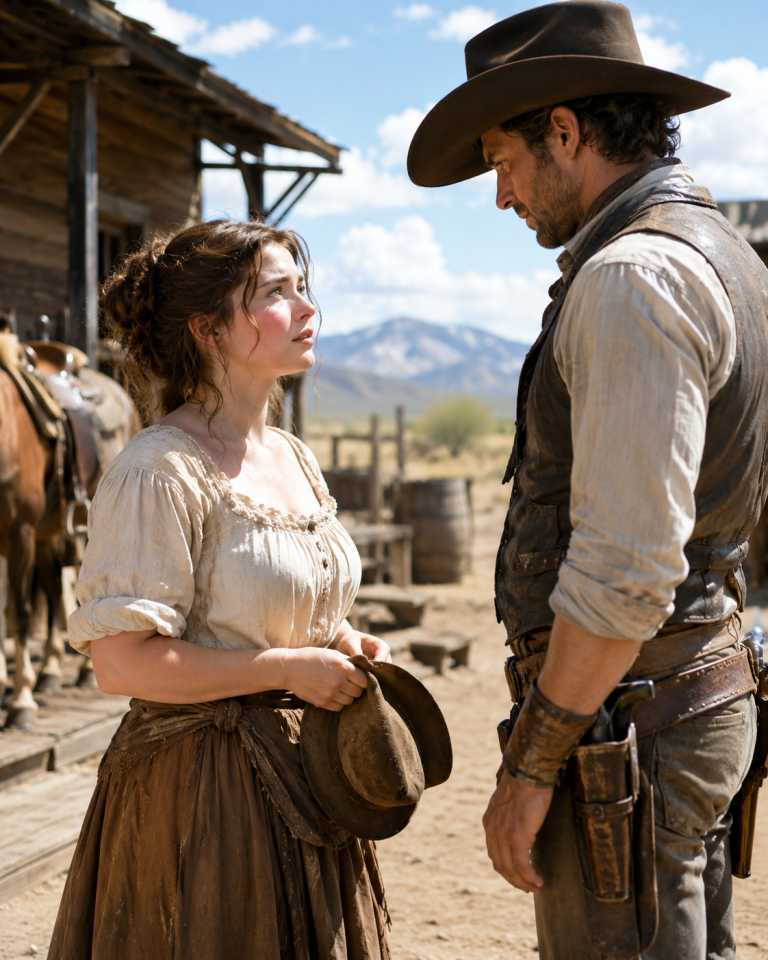
A woman stood at the top of the courthouse steps with five children arranged around her like a constellation that had decided not to scatter. She wore a faded dress that had been mended until the mending was structural — thread and intention holding it together more than original cloth. Her chin was up. Her posture was the posture of a woman who had been afraid before and had decided that being afraid in public was a luxury she could not afford.
Five children: a teenage girl with the watchful eyes of a person who had learned to read rooms; twin boys standing shoulder to shoulder in the way of children who had long ago assigned themselves to guard each other; a small blonde girl half-hidden in the woman’s skirts; and a baby on her hip, fists clenched against the heat.
Hank Mullins, from the general store, sidled close to Caleb. “That’s the Hart family,” he said, in the tone people used when they were naming something they knew would get worse. “Husband died two months back, owing the bank nearly two hundred dollars plus interest. Land didn’t cover it. She was a schoolteacher before she married. Smart as a whip, they say.”
Caleb watched the teenager step closer to her mother when someone in the crowd laughed at something that hadn’t been funny. Watched the girl become a shield through proximity, because that was the only currency available to her.
The feeling that tightened in Caleb’s chest was the feeling of watching a calf caught in a fence line — the kicking, the futility, the knowledge that if you didn’t intervene the next thing you found would be worse.
Dodd cleared his throat.
“Final item,” he called, and the words settled on the square like something dropped from a height. “Due to outstanding debts of the late Thomas Hart, we are offering for auction the labor assets of the estate. One widow capable of household management and instruction. Four children suitable for light work. One infant. Opening at fifty dollars for the lot.”
The square held its breath for a moment.
Then a voice from the back said, “Fifty,” and the world resumed its cruelty as if it were a scheduled errand.
Caleb turned.
Silas Crowe stood with three men at his back, broad-shouldered, neatly dressed, the kind of man who had made so many decisions about what other people were worth that his face had stopped registering them as decisions at all. He surveyed the Hart family with the look he used on cattle.
Another voice offered sixty. Crowe raised it to seventy without expression.
Caleb’s stomach had gone past nausea into something colder. He looked at the teenage girl. Her jaw was set. He looked at the twins, who had gone perfectly still. He looked at the small blonde girl peeking out from her mother’s skirts with an expression of confused terror that had no language for what was happening to her.
Then he heard Hannah’s voice as clearly as if she were standing beside him.
*Stones don’t grow anything.*
He felt his arm go up before his mind had finished approving the action.
“A hundred,” he said. His voice cracked slightly on the number, as if it didn’t recognize itself.
Heads turned. A murmur moved through the crowd. Someone behind him whispered, “Granger’s lost his senses.”
Crowe’s eyes found him. His mouth twitched with the irritation of a man who had been challenged by someone he considered below the threshold of relevant opposition. “One twenty-five,” Crowe said.
Caleb’s hand went to his pocket without quite meaning to. One hundred and thirty-seven dollars, assembled by selling his spare horse and Hannah’s silver brooch, every cent of it already promised to the bank. He did the arithmetic in his head and came up short and bid anyway.
“One thirty-five,” he said.
“One forty,” Crowe said, flat and certain.
The floor dropped out from under Caleb. He had nothing left. And then, from his left, Hank Mullins stepped forward and pressed folded bills into his hand.
“Twenty,” Hank said. “Don’t argue.”
Doc Ellison pushed in on the other side, smelling of soap and carbolic. “Forty here,” he said, and his expression dared Caleb to return it.
A woman Caleb barely knew from the Methodist congregation held out five dollars with a hand that shook slightly. A young ranch hand tossed in ten like he was throwing a rock at something he didn’t have the reach to hit directly.
The money came from pockets that were not full. From hands that had calluses and their own versions of Caleb’s mortgage notice.
He turned to face Crowe with money that was not his own and a feeling he could not have named.
“Two hundred,” he said.
Even Dodd paused.
Crowe stared at him. The square went so quiet Caleb could hear the baby hiccupping against his mother’s shoulder. Crowe’s eyes moved over the gathered money, over Caleb’s face, over the neighbors who had materialized behind Caleb in the specific way that people materialized when they had made a decision they hadn’t admitted to yet.
“Not worth it,” Crowe said. His voice was mild. His eyes promised something different.
Dodd’s hammer came down.
“Sold to Caleb Granger for two hundred dollars.”
Applause moved through the crowd — uneven at first, then stronger, as if the town needed the sound to convince itself it had witnessed something decent rather than something it should have prevented.
Caleb didn’t feel like a hero. He felt like a man who had stepped off a cliff and was hoping very hard that there was ground somewhere below.
The woman came to him with her children trailing. She stopped at a distance that was respectful and deliberate, and up close he could see the intelligence in her face and the exhaustion arranged carefully behind it. She had the bearing of a woman who had decided that dignity was not a luxury but a necessity, the one thing that couldn’t be auctioned.
“Mr. Granger,” she said. Her voice was steady in the way of a teacher calling roll. “My name is Eliza Hart. I want it said plain: we are not broken things. We are not charity. We will work for our keep.”
The teenage daughter watched him from behind her mother with the evaluating stillness of a judge.
Caleb tipped his hat because he didn’t know what else to do with his hands.
“Ma’am,” he said, “I reckon I expect you to live. That’s all I can say honest right now. Anything else we’ll figure out as we go.”
Eliza’s eyes moved over his face looking for the hidden portion, the catch, the thing that explained why a man would spend money he didn’t have on strangers. Whatever she found — or didn’t find — made her shoulders come down by a fraction.
“Then we will,” she said, and the two words sounded like an agreement between people who would hold each other to it.
—
## PART 2
The wagon road to Northridge Ranch took them past the edge of town where gossip couldn’t keep pace. Prairie opened up on both sides, grass shimmering gold under the sun, hawks using the thermals for entertainment.
The youngest girl, Maisie, climbed onto the seat beside Caleb without asking, small hands gripping the wagon board as though she could anchor herself by determination. Behind them, Eliza held the baby against her shoulder and hummed something low and steady, and the sound moved through Caleb with a disorientation that took him a moment to name: it was close to the sound of Hannah singing while she worked, and for a moment he couldn’t breathe around it.
Then it became something else. Not a wound. A thread. Something connecting the empty house to the idea that it might not always be empty.
“How far?” called the teenager, Nora, from the wagon bed.
“Eight miles,” Caleb said. “Before supper if the horses cooperate.”
One of the twins — Ben, he thought, or Bo — leaned over the side. “Do you have a dog?”
“A dog and an attitude,” Caleb said. “Ranger. His greatest threat is licking people to death.”
Maisie giggled. The sound landed in Caleb’s chest like a match.
The ranch looked smaller than he remembered when it came into view. The house sat near the creek, barn roof sagging in one corner, chicken coop listing. He felt the embarrassment of poverty offered as a home. Then Nora’s voice cut through.
“Better than behind the courthouse,” she said, with the flat practicality of a girl who had already done the relevant comparisons.
Ranger exploded around the corner of the barn, all velocity and tail, and the twins lost their careful posture immediately. Maisie grabbed Ranger’s fur as if she’d been waiting to hold something that would let her.
That night Caleb gave the Hart family Hannah’s room, because it was the right thing and because he didn’t know what else to do with rooms that had become too heavy. They ate beans and cornbread, and the table was noisy with questions and the scraping of chairs, and the noise was not painful. It was the opposite of painful. It was the sound of a house being used.
On the porch afterward, under a sky so full of stars it looked generous, Caleb waited for guilt to arrive. Instead something else came: responsibility. Heavy, human, practical. The feeling of a coat put on because the weather required it.
In the morning he woke to coffee and bacon, and for a disorienting moment he thought he had been wrong about Hannah, that grief had been a bad dream. Then he heard the twins arguing over biscuits and the world arrived again, but differently.
Eliza sat at his table with papers spread in front of her.
“Mr. Granger,” she said, “I hope you won’t take offense. I looked at your account book. Only what was left open,” she added, before he could respond to the heat in his face. “I was measuring the situation.”
Nora flipped bacon at the stove. “Mama’s good with numbers,” she said, as if this explained the only things that mattered.
Eliza slid a sheet toward him. Columns, tight and neat. “You think the cattle keep you alive,” she said, “but your wheat is what saves you when you’re not looking. Your problem isn’t only the debt. You’re guessing.”
Caleb stared at the figures and felt the heat that came from being shown your own blind spot.
“So what do I do?” he said.
She pointed to the wet patch near the creek, described what could grow there. Outlined egg prices, food preservation, how a plan presented to a bank was different from a problem presented to a bank. She spoke with the authority of someone who had been thinking about numbers since before he put her in a wagon, and he forgot, sitting there, that yesterday she had been a line item on an auction sheet.
“The mortgage notice,” Caleb said, because his fear always swung back to it.
“We buy time,” Eliza said. “Banks prefer promises they can measure. Give them a blueprint and they may extend instead of take.”
Nora slid a plate in front of him and watched him with the frank assessment of a girl who wanted to know what kind of man he was when the information was inconvenient.
Caleb ate. For the first time in four months, the food tasted like fuel rather than penance.
That afternoon Eliza brought an envelope from her bag. Her voice took on the specific weight of a door being opened.
“Before Thomas died,” she said, “he was in negotiation on a beef supply contract with a railroad camp in Colorado. Over two thousand dollars if delivered. Requires a hundred head minimum.”
“I have sixty on a good day,” Caleb said.
“Which is why we partner,” she said. “And before you ask — yes, that means talking to men who may not wish us well.”
Neither of them needed to say Silas Crowe’s name. His shadow reached every fence line in Albany County.
“He won’t agree,” Nora said quietly, and the twins went silent in the way of children who understood that powerful men were a weather pattern.
“Then we find others,” Eliza said. “But first we stop letting fear do our thinking.”
Caleb looked at her.
He had spent four months letting fear do exactly that — letting it hollow him until the world fit inside a shape grief had made. Eliza’s presence did not dissolve the grief. It shoved it into motion, which turned out to be what he had needed and had not known how to ask for.
“All right,” he said. “We try.”
—
## PART 3
Silas Crowe did not wait for them to get comfortable with their courage.
Two mornings later, hoofbeats came up the drive with the specific cadence of men who had decided something before they left. Ranger barked until he ran out of authority. Crowe arrived with three men behind him, including a rat-faced man named Sutter who spat tobacco near Caleb’s porch steps as a greeting.
Crowe surveyed the ranch the way he surveyed anything he was considering acquiring. His eyes moved to Eliza, to the children, to the evidence of a household that had started becoming one.
“Granger,” Crowe said. His voice was the voice of a man who had been reasonable his whole life when he was winning. “Heard you made a spectacle of yourself in town.”
“State your business,” Caleb said. His rifle was near but not raised. Raising it was an invitation.
“I’m offering to buy the Hart family,” Crowe said. “One thousand dollars.”
The number hit Caleb with the physical weight of what it represented: mortgage settled, barn repaired, cattle bought, the specific relief of certainty. For a heartbeat, temptation came wearing Hannah’s face, whispering that survival was the same as goodness.
Eliza stepped close and said, quietly, “May we speak?”
When Caleb nodded, she said: “Don’t.”
Her voice was not panicked. It was precise.
“He’s not buying workers,” she said, low and direct. “He’s buying control. Families go to his ranch and come back quieter. Some don’t come back at all. He doesn’t want labor, Caleb. He wants the leverage that comes with having something you care about.”
Caleb looked at Nora. At the twins. At Maisie with her hand in Ranger’s fur, watching him with the patient trust of a child who had decided he was safe and was waiting for the universe to confirm it.
He turned to Crowe.
“They’re not for sale,” he said.
The words came out steady. As if they had been waiting.
Crowe’s expression didn’t change much. The air did.
“Men like you don’t survive mistakes,” Crowe said, pleasantly.
“Then I’ll learn,” Caleb said.
Crowe’s mouth found the shape of something that wasn’t a smile. “This isn’t finished,” he said, and rode out leaving dust and implication behind him.
—
The retaliation came on a night without wind, when the sky was too clear, the kind of night that dropped its guard.
Caleb woke to smoke.
He was off his cot before he fully understood why, moving toward the smell before his mind had named it. Flames were climbing the barn wall, orange against the dark, eating wood with the patient focus of something that had decided on this before it started.
“Fire!” he shouted, and the house came awake.
Eliza was moving before he finished the word. “Nora — creek,” she said, her voice the voice of a woman directing a disaster she had already, in some part of herself, anticipated. “Take the little ones.”
Ben and Bo disobeyed immediately. They arrived at the bucket line anyway, carrying water with the desperate efficiency of boys who didn’t know the difference between bravery and its younger sibling. Caleb ran, hands shaking not from fear of the flame but from the knowledge of what it meant — that this fire had not been an accident, that it was a message written in kerosene, that Crowe was answering his “they’re not for sale” with a language older than courts.
They fought hard. They lost the roof.
When dawn came, the barn stood as a black skeleton in early light. Hay gone. Tools ruined. A season’s planning turned to ash.
Nora found a charred plank near where the fire had started. Letters carved into it deep enough to survive: *S.C.*
Eliza stared at the plank without speaking.
Then: “Crowe.”
Caleb wanted to ride out and end it in the simple, final language that the West sometimes used. He turned and saw the children watching him — Maisie with both hands over her mouth, the twins very still, Nora with her jaw set — waiting to see what kind of man he was when he was cornered.
He let the impulse pass.
Sheriff Eli Whitaker came at midmorning, moving with the careful deliberateness of a man accustomed to walking in shadow. He examined the burn pattern, smelled the kerosene, looked at the carved letters, and sighed with the exhaustion of a man who had seen justice lose too many times to pretend otherwise.
“You got proof?” he asked.
“Carved letters and a long history,” Caleb said.
“Letters carved in burned wood won’t hang a man like Crowe,” Whitaker said. “He’s got friends where feelings don’t carry weight.”
Eliza stepped forward with Henry on her hip. “What protection do we have?”
Whitaker looked at the children and then away, as if looking too long would make him responsible. “Lock your doors. Don’t travel alone. Stay visible.” He paused. “That’s what I can offer without starting something I can’t finish.”
When the sheriff left, the prairie felt larger and the ranch felt smaller.
Ben said, “Are we going to leave?”
Caleb answered without thinking about it. “No. We rebuild. We don’t let a bully decide what we do with our lives.”
Eliza’s hand rested briefly on his forearm. One moment, brief and deliberate. The specific contact of a person saying *I heard you* without using words.
—
The bank meeting the following week was a different kind of war.
Mr. Sloane, the banker, sat behind polished mahogany and studied Eliza’s carefully prepared figures the way a man studied something that inconvenienced him. Caleb sat with his hat in his lap, feeling out of place in a room where wealth did not smell like sweat or smoke.
Eliza spoke without hesitation: wheat yields, vegetable projections, the railroad contract, a letter of endorsement she had obtained from a Colorado cattle association through correspondence Caleb hadn’t known she was maintaining. Sloane’s eyebrows rose at the letter. Came back down.
He leaned back.
“There are rumors,” he said, and the word had the texture of something he found useful rather than uncomfortable, “about your household arrangement.”
Caleb’s temper moved toward the surface.
Eliza set Henry into Caleb’s arms and stood.
“Mr. Sloane,” she said, “if this bank intends to foreclose because you prefer gossip to mathematics, I’d ask you to say so plainly.”
Sloane’s nostrils thinned. “This institution considers community standards—”
“Then you should also consider,” Eliza said, mildly, “what territorial authorities make of certain land claims and cattle sale records that don’t survive close reading. My late husband kept records. Not out of spite — he believed in accurate bookkeeping. I don’t want enemies. I want to build a home. So let us find an arrangement that serves both of us.”
Silence stretched until it had physical weight.
Then Sloane cleared his throat, dipped his pen, and offered a six-month extension with fees that amounted to a tax for surviving. It was not generosity. It was time.
Outside, Caleb exhaled for what felt like the first time in an hour.
“Where did you learn to do that?” he asked.
Eliza’s mouth curved. “From being underestimated,” she said. “It’s a very thorough education.”
—
The rebuilding of the barn brought the town.
Not all of it. Some came because they cared, some because they were curious, some because they had decided — without quite admitting it to themselves — that Silas Crowe had been extracting rent from their consciences for long enough. Hank Mullins swung a hammer with the fury of a man with outstanding grievances. Doc Ellison showed the twins to drive nails straight and addressed them as if they were men, and Caleb watched Ben and Bo grow three inches under the words. Nora organized supplies with the precision of a girl who had been managing limited resources since before she had language for it.
Eliza moved among the workers the way a general moved — nursing Henry between issuing instructions, feeding men who pretended they didn’t need feeding, watching the ridge line without appearing to watch it.
Then dust rose on the road.
Crowe came back with more men than before, spreading out across the yard like he was practicing possession.
Caleb stepped forward with the rifle visible and lowered. The line between holding ground and inviting conflict was a narrow one and he had learned its dimensions.
“State your business,” he said, for the third time.
Crowe looked at Eliza with the specific contempt of a man who had decided a woman’s intelligence was a provocation.
“You,” he said, “are the reason men get ideas above their station.”
Eliza took one step forward. Her voice was the voice of someone who had nothing left to lose from speaking clearly.
“I’m the reason children sleep without fearing they’ll be sold to the highest bidder,” she said. “If that threatens you, it tells me everything I need to know about you.”
A murmur moved through the workers. Crowe’s face darkened with the color of a man unused to being answered publicly.
“This isn’t finished,” he said. Again. And this time it sounded less like prophecy and more like a man repeating himself because he’d run out of material.
—
The real attack came before midnight.
A rifle shot split the darkness and glass broke in the kitchen. Maisie screamed once, and then Eliza had her hand over the girl’s mouth and both of them in the safest corner, and Maisie understood and went quiet.
Caleb came up with his Winchester. Eliza appeared beside him with a shotgun, hands steady.
“Thomas taught me,” she said, quietly, and Caleb understood that the West had never been gentle enough to leave women defenseless for long.
Outside, muzzle flashes blinked in the dark. A voice — Sutter’s nasal laugh — shouted something about giving up the woman and the children. A second volley punched through the shutters. Smoke rose near the barn again.
They were trying to burn their way to a surrender.
Caleb could not win a gunfight in the dark with children in the crossfire. He did the only thing available: he stalled. He shouted back. He kept them engaged while Eliza went to the back room and gave Nora instructions in a whisper.
“Ben, Bo — stay flat,” Nora hissed in the dark. “Maisie, hold Ranger. Whatever you hear, you don’t move.”
The trust with which the three younger children obeyed was a thing Caleb did not have words for.
Then, from the direction of town, hoofbeats.
Many of them. The specific sound of a group of people who had made a decision together.
The attackers hesitated. Sutter cursed. Sheriff Whitaker’s voice boomed out of the dark: “Drop your weapons!”
The yard came apart into chaos for a few minutes, and then it was over.
Two of Crowe’s men were in irons. Sutter was down near the water trough, wounded and cursing. The rest had dissolved into the dark.
Caleb walked out onto the porch with Eliza and the children close around him, and he looked at the line of neighbors who had come — Hank, Ellison, five or six others, rifles in hand, faces set with the specific fury of people who had made a decision they should have made sooner.
Whitaker tipped his hat to Eliza with an expression Caleb had not seen on him before. Respect that didn’t need to explain itself.
“Mrs. Hart,” he said, “I’m sorry it took gunfire to move the town. But it’s moving now.”
Eliza went inside and returned with a bundle wrapped in oilcloth. She handed it to Whitaker.
“My husband’s records,” she said. “Land claims. Cattle transfers. Payments. Names and dates.”
Whitaker opened the oilcloth and began to read. The changes in his expression as he turned pages were the changes of a man who had been waiting for enough weight to act.
“This is sufficient for a territorial warrant,” he said. “Crowe can’t intimidate paper. Not this much of it.”
—
What followed was not tidy.
Crowe fled before the warrant could reach him, because men who had built empires on intimidation knew when the terrain had shifted. But his network came apart under examination the way such networks always did — one person talking, then another, then the silence that had protected him becoming too expensive to maintain.
The railroad contract became real. Two neighboring ranchers who had been watching the situation joined in partnership with Caleb, forming an arrangement that could meet the hundred-head minimum without requiring any single operation to overextend. The first delivery came in September. The payment that came back was the first money Caleb had held in months that didn’t arrive already spoken for.
Eliza’s kitchen garden exploded along the creek in late summer. Maisie danced between the rows with the specific joy of a child who had been told she could. Ben and Bo grew into the ranch work with the enthusiasm of boys who had found tasks that respected them. Nora began teaching Maisie letters in the evenings, her voice softer when she read aloud than in any other context, as if she were reclaiming something her mother’s life had been before the debt arrived.
Caleb still missed Hannah. Some nights grief sat beside him like an old guest who had forgotten to leave. But it no longer convinced him that the purpose of the future was to mourn the past. Hannah had told him not to turn into stone. He had very nearly done it anyway. The Hart family’s arrival had not replaced what he’d lost. It had given the loss somewhere to go other than inward.
By October, the church in Laramie held a different kind of event than the town had expected in the summer’s aftermath.
Caleb stood at the altar in a borrowed suit that fit approximately right. Eliza walked down the aisle in a dress altered from fabric that had belonged to Hannah, because the past did not have to be erased to make room for what came next. Nora followed as maid of honor with her chin lifted in a pride she made no effort to conceal. The twins stood beside Caleb with the solemnity of boys performing a ceremony they understood to be important without fully understanding why. Maisie scattered wildflowers with the seriousness of someone doing sacred work. Henry was in Doc Ellison’s arms, beloved by half the town with the particular communal affection that settles on a baby who has survived something.
Reverend Parker said things about families chosen rather than inherited, about the way home could be made from ash if enough hands refused to stop working.
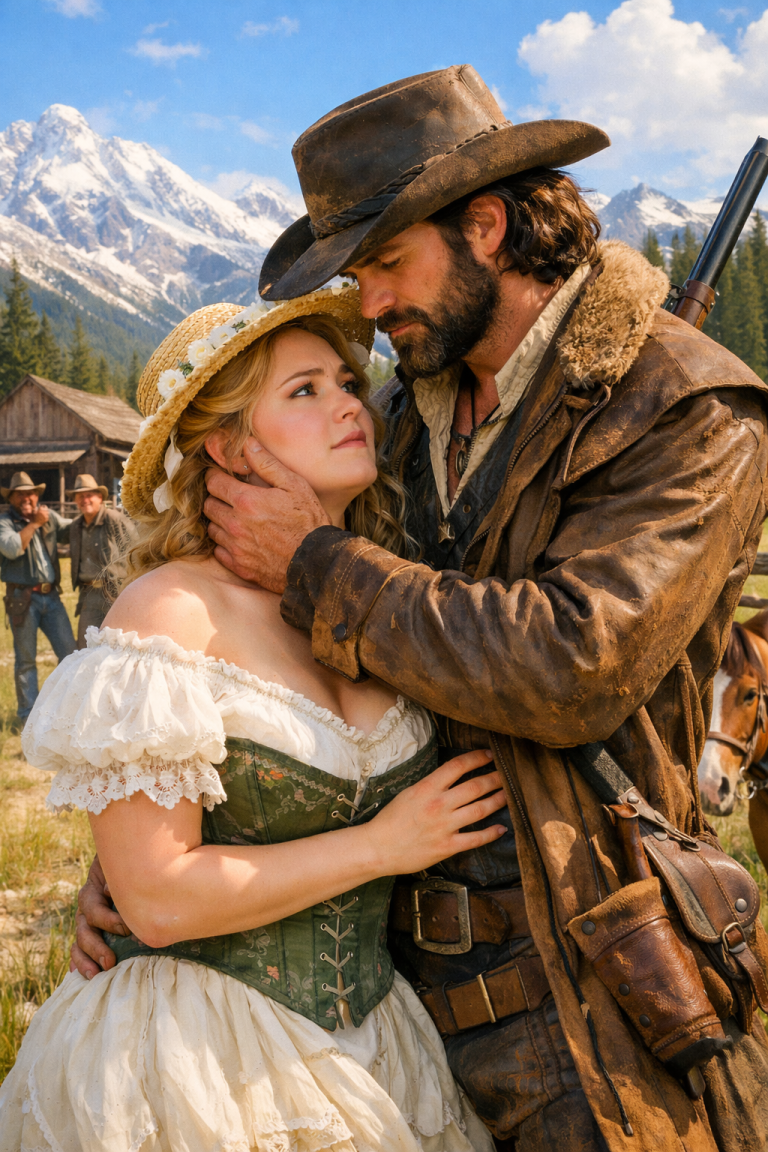
When Caleb looked at Eliza, he saw not a woman he had rescued but a woman who had, with equal accuracy, rescued him.
“I do,” Caleb said, and the words were not a formality. They were a decision, made in full knowledge of what decisions cost.
Eliza’s “I do” arrived with tears that did not apologize.
—
After the celebration, after Hank’s too-loud toast and the children’s laughter and the improbable arrival of joy into a year that had tried very hard to prevent it, Caleb found Eliza on the church steps for a moment of quiet.
The wind carried the smell of harvested grain and distant cook fires.
“Any regrets, Mr. Granger?” she asked, smiling in the way of a person who had learned to want things again and was practicing.
Caleb considered.
“One,” he said.
Her smile held still, waiting.
“I nearly turned into stone,” he said. “That’s the only one.”
Eliza’s eyes softened. “Stones don’t grow anything,” she said, and Caleb felt the world do something unexpected in his chest — something that was not grief and not its opposite but something made from both, the way new wood was made from old trees.
She had said Hannah’s words without knowing she’d said them.
“We’ll grow plenty,” Caleb said.
Eliza took his arm and turned toward the hall where their assembled, improbable, chosen family was making the noise that families made when they were alive.
“Then let’s go back in,” she said. “They’re waiting.”
And Caleb followed her through the door, into the light and the noise and the future that had arrived the morning he’d lifted his arm at an auction and not yet understood what he was reaching for.
It was not the future he had planned.
It was better than the one he had nearly settled for.
A family, it turned out, was not something you bought.
It was something you built, one brave and terrifying choice at a time, until the world had no choice but to recognize it as real.
*THE END*