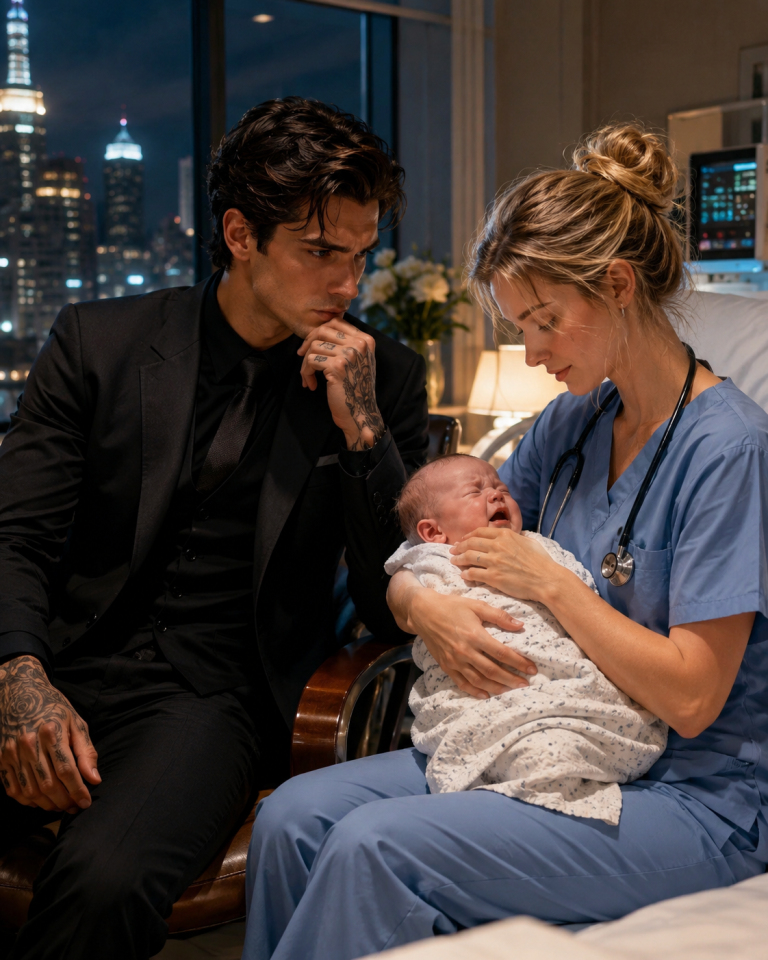
Trapped Alone in the ER, She Whispered a Name She Was Never Supposed to Know—Then the Mafia Boss Walked In

PART 1
The nurse asked her name and Alina understood, in that moment between the question and her answer, that names were currency.
She was bleeding through her dress. The pain in her lower abdomen came in waves that made her vision narrow to a pinpoint, then widen again as though someone were adjusting the aperture of her consciousness against her will. They had wheeled her through corridors under lights too bright to be kind, and she had tracked the precise moment the ER staff’s professional courtesy shifted into something sharper — the moment they understood she was not a simple case.
She had seen that shift before, in a different context, three years ago.
“Alina,” she said when they asked. “Alina Voss.”
The nurse was young, maybe thirty, with efficient hands and eyes that did not look away when uncomfortable truths arrived.
“Do you have someone we should contact?” the nurse asked, already knowing the answer would be complicated.
Alina closed her eyes.
Daniel would come. Of course he would. He would arrive in a tailored coat with the correct expression, and he would speak to the doctors before she could form a complete sentence. He would explain her history — her “episodes,” her sensitivity, her tendency to catastrophize. He would turn her body into a story he controlled, the way he had controlled everything for three years.
That had not happened all at once.
It had happened with flowers, with apologies that felt genuine because Daniel had perfected the architecture of sincerity. It had happened with dinners where he managed who called her, which friends she kept, what conversations were safe to have. It had happened with doctors, private doctors who reported to his family clinic and who smiled without making eye contact.
It had happened with his mother’s presence in every decision.
It had happened because Alina, at twenty-six, had believed that safety was the opposite of excitement, and she had been so tired of excitement.
Now she was twenty-nine, bleeding in a hospital, and beginning to understand the shape of the trap.
They moved her to a trauma bay. Someone cut her dress open. Someone else pressed hard against her abdomen and she heard herself make a sound that belonged to an animal, not a person.
“Internal bleeding,” a doctor said.
“How far along?” another voice asked.
The question came to her like news from a foreign country.
Pregnant. Yes. Eight weeks. She had not told Daniel yet because she had spent the last three days understanding that the nausea, the bleeding, the dizziness was not stress.
The clinic had disagreed.
Dr. Brenner at Aster Hall Medical Group, the private practice where Daniel’s family had connections, had seen her yesterday. He had pressed on her stomach without imaging, declared her stress-induced, given her a prescription for anxiety she did not have, and sent her home.
Daniel had been in the waiting room. He had looked relieved.
That was when she understood he did not want this baby.
More specifically: someone did not want this baby, and Daniel was following instructions.
“Ma’am,” the nurse said. “We need a contact.”
Alina opened her eyes. The nurse’s face swam into focus — kind, competent, and absolutely unable to help.
There was no one to call.
Her parents were gone. Her old friends had dissolved years ago, one unanswered invitation at a time. Her colleagues from before marriage had moved on to other offices, other cities, other lives where a woman like her — accomplished, sharp, useful — did not disappear.
She had been useful once.
She had translated contracts. She had noticed inconsistencies. She had read people the way other people read maps. Men had listened to her.
Then she had met Daniel and chosen safety.
Safety looked like drowning in slow motion.
“There’s someone,” Alina whispered.
The nurse leaned closer.
Three years collapsed into one name.
Rafael.
Alina’s mind rejected it. Rafael Moretti was the man she had walked away from, the man who had let her walk, the man she had married Daniel to escape. Rafael was danger she had not been brave enough to live inside.
But Rafael was also the only person in the city who could reach her without Daniel being able to stop him.
Rafael was the only person who had ever looked at her like she had value that came from her own calculation, not from her willingness to be managed.
“Rafael Moretti,” she said.
The nurse went perfectly still.
Alina felt the room’s climate change around that name.
“Are you sure?” the nurse asked carefully.
Alina could not answer again. Pain was pulling her under. The lights were compressing into tunnels. She heard “surgery” and “stabilize” and “call now,” and then darkness arrived with the weight of something final.
The last thing she heard was the nurse’s voice, steady and certain.
“Find the number. Do it now.”
—
PART 2
Rafael answered on the first vibration.
He stood at the floor-to-ceiling window of Moretti Tower, fifty stories above the Chicago River, watching rain move across glass. Behind him, the conference room had emptied of everyone except Vincent, his chief of security, who had learned long ago not to ask questions Rafael would not answer.
“A woman,” the nurse on the phone said. “Emergency room. She gave your name.”
Rafael’s posture did not change. His voice came out flat.
“What woman?”
“Alina Voss. Maiden name Carter.”
The pause that followed was long enough that Vincent looked up.
Rafael closed his eyes. “Which hospital?”
By the time Rafael reached the ER, the floor had reorganized itself around his presence. Hospital security did not move. Doctors looked at the ceiling. A path opened like water finding low ground.
The surgeon found him in the surgical corridor and offered facts the way a man offers flowers to someone he hopes will not strike him.
“She’s alive. Internal bleeding from a ruptured vessel. We’ve repaired it. She’s stable.”
“The pregnancy?” Rafael asked.
The surgeon’s face shifted. “There’s a heartbeat. Still there.”
Rafael felt nothing for three seconds. Then, very quietly, “She’s pregnant.”
“Eight weeks, maybe nine. The lack of treatment before arrival complicated the situation significantly.”
Rafael understood what that meant: someone had sent her home bleeding.
His hands uncurled.
“Move her to private recovery. Secure floor. Tell me who discharged her.”
The surgeon told him.
Rafael turned to Vincent. “Dr. Howard Brenner, Aster Hall Medical Group. Find out who owns the group.”
“Daniel Voss sits on their board,” Vincent said immediately. He had already been working.
That mattered more than it should have.
Alina woke once during the night. Her eyes found Rafael before she understood what she was seeing.
“You’re not real,” she whispered.
He was sitting in the chair beside her bed, waiting the way men like Rafael waited — with the patience of a hunter who understood that time was a resource.
“I’m real.”
“You don’t come back,” she murmured. Her voice was rough, still sedated. “I left.”
“You called me.”
Pain crossed her face. “I didn’t have anyone else.”
“You should have.”
She said something then that he would remember for the rest of his life:
“I used to.”
Rafael stayed beside her until morning, holding her hand because she had asked him to, because the machines beside her bed were keeping her alive, and because someone needed to know that she had not disappeared.
—
PART 3
By sunrise, the floor had become something between a hospital wing and a fortress.
Vincent moved through it with the same efficiency he brought to every problem — checking security footage, identifying the discharge physician, tracing financial transfers. By 8:00 a.m., he had placed a tablet in front of Rafael.
“Daniel’s finances don’t match his public profile,” Vincent said. “Money routing through medical nonprofits, consulting groups, offshore accounts. Structured transfers. Someone’s moving capital.”
Rafael looked at the footage of Alina leaving the townhouse. She pressed one hand to her side, walking too fast, fear precise in every movement. A dark sedan waited across the street, engine running, lights off.
The car was not there to help.
“Who’s moving it?” Rafael asked.
“Still working backwards. But there’s a holding structure — Fairchild Holdings, medical-focused, controlled by Evelyn Voss.”
Daniel’s mother.
Rafael knew of Evelyn Voss the way one knows of a natural disaster — as something powerful, inevitable, and fundamentally indifferent to human consequence. She chaired hospital boards. She managed philanthropic funds. She made people’s careers bloom or collapse during luncheon conversations.
No one questioned her methods because her results looked clean.
“Dig into the Fairchild structure,” Rafael said. “Find what’s underneath it.”
Alina was conscious when he returned to her room. This time her eyes tracked him without confusion.
“They didn’t bring me here to help,” she said.
“No.”
“Evelyn.”
It was not a question.
“I need you to tell me,” Rafael said, “exactly what you know.”
Alina pushed herself higher despite the pain. She told him about the filing inconsistencies she had noticed. About Daniel’s phone call, heard while pretending to sleep. About the term *Fairchild Covenant* appearing in documents that disappeared from her browser history within hours. About Dr. Brenner’s discharge note, deliberately vague, signed the day before she collapsed.
“I was pregnant,” Alina said. “They needed me not to be.”
Rafael’s jaw tightened.
“Not the baby,” she continued. “The pregnancy itself. Because someone’s control of something transfers when a child is born.”
Vincent entered with a file, his expression compressed.
“The Fairchild Covenant,” he said. “Created 1987. Medical holdings control transfers from Evelyn to her son upon the birth of his legitimate child. It’s a trust protection. Meant to prevent exactly what Evelyn has apparently been doing with the holdings.”
Alina looked at Rafael.
“They manufactured my anxiety,” she said quietly. “So Daniel would believe I was unstable. So he would let them manage me. So that when I became inconvenient, he would be grateful when his mother offered a solution.”
“What solution?” Rafael asked, though he already knew.
Before Alina could answer, movement erupted outside the room.
Vincent moved before Rafael spoke. The door to the secure recovery wing shuddered once and did not open again.
Catherine, a woman Rafael kept for situations exactly like this, entered from the adjacent bathroom with a compact pistol held steady. She had auburn hair and the demeanor of someone who had stopped feeling surprised by human behavior years ago.
A man in hospital scrubs appeared at the supply entrance.
He had an ID badge. He had the look of someone professional. He had the wrong shoes.
“You can stop there,” Catherine said.
The man stopped. He smiled.
“Daniel Voss sends his regards,” he said.
Alina’s breath caught.
Then she spoke, her voice sharp with sudden clarity:
“No. He doesn’t. Daniel sends apologies. Explanations. Legal language. He hides behind people. He doesn’t write lines like that.”
Catherine’s mouth flickered something almost like approval.
The man’s smile died.
Rafael crossed the room and caught the man’s wrist before he could reach beneath his jacket. The movement was not violent. It was final.
“Who sent you?” Rafael asked.
“Daniel Voss,” the man said.
“Evelyn,” Alina corrected, and watched recognition cross his face.
That one word was enough.
Vincent and Catherine secured him in under thirty seconds. The syringe clattered onto the floor — small, professional, designed for unconsciousness or something worse.
Rafael did not kill him.
Alina watched that decision register like a choice deliberately made.
Instead, he called a detective she recognized from a federal corruption case. The man was handed over with footage, false badge, and testimony. Within hours, the federal building had opened a file.
The investigation that followed was not explosive. It was surgical.
Evelyn Voss’s medical network had been moving capital for years through the careful disguise of charitable care. Daniel’s finance firm had moved the money quietly. Brenner had signed whatever paperwork was required. All of it had been designed to survive scrutiny because scrutiny never typically touched people respectable enough to withstand it.
Alina’s pregnancy had been the variable they could not control.
Not because she was fragile, but because she was dangerous — she had noticed the pattern and, more critically, she had kept the knowledge instead of asking for permission to have it.
Daniel appeared that evening with two attorneys. He did not look like a man anymore. He looked like a child who had finally understood his mother was not protection.
“I need to explain,” he began.
“No,” Alina said. “You need to testify.”
His attorneys stiffened.
“Against your mother,” Alina continued. “You tell federal prosecutors everything. The transfers, the pressure, the conversation about the trust, the instruction to manage my medical care. All of it.”
Daniel looked toward Rafael.
“He can’t help you,” Alina said. “Neither can I. This is your choice.”
It took him two hours to make it.
By midnight, federal prosecutors had enough to move. By morning, Evelyn Voss had been arrested leaving her house in a Hermès coat, still believing respectability was armor.
The trial lasted through summer.
Alina testified for six hours. She named dates, accounts, conversations. She did not cry until after it was over, in a bathroom, alone.
But her testimony was clean enough that no jury had any choice but to understand what had happened: a woman had threatened the carefully constructed empire of a woman more powerful, so the powerful woman had tried to erase her.
Evelyn received eighteen years.
Daniel accepted a plea deal and disappeared into federal custody.
The Aster Hall Medical Group was placed in receivership and dismantled by prosecutors who found exactly what Alina had suggested they would find — fraud, falsified records, money laundering, and the quiet infrastructure of an organization designed to silence discomfort before it became inconvenient.
Alina gave birth to a daughter in late autumn.
She named her Grace.
Rafael held the baby as though she were an equation he did not yet understand but was determined to solve.
“You look terrified,” Alina said from the hospital bed.
“I am.”
“Good,” she said. “That means you understand what you’re holding.”
Months later, when reporters asked her the story, Alina gave them the version that sounded like romance. A woman in danger. A man who arrived. The mafia boss who made everything right.
She never told them the fuller truth.
She never said: I walked into the darkest night of my life alone. I was bleeding, afraid, betrayed by the man I had chosen as safety. At the edge of dying, I remembered a name the world taught me to fear. I whispered it not because I loved him, but because I understood what he was capable of doing to protect something he wanted.
I whispered it because calculation, sometimes, is the only love that survives betrayal.
She never said: When he arrived, everyone froze. But I did not remain frozen. I woke. I testified. I watched the woman who tried to erase me face consequences. And by the time I walked out of that hospital, I was no longer the woman Daniel Voss had tried to disappear or the woman Rafael Moretti had once let go.
I was Alina Carter.
But sometimes, late at night, when her daughter slept and the city hummed beneath her, she would think about the moment she whispered his name.
She would remember the calculation behind it.
She would touch the scar on her body where the rupture had been repaired, where a blade had reached inside and changed everything.
And she would understand that the only person who had ever truly saved her was herself.
The rescue was simply what she had arranged to happen next.
THE END