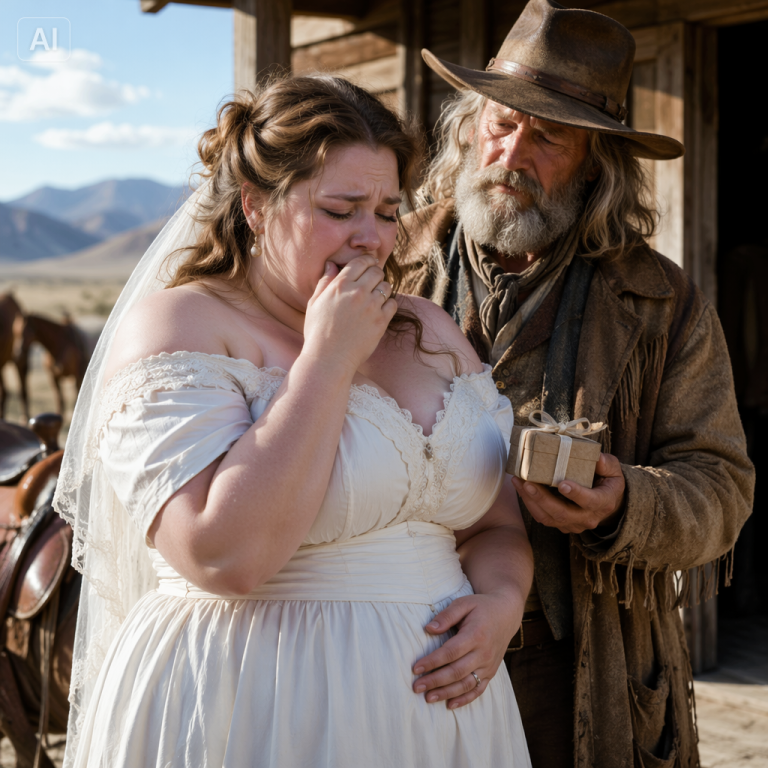
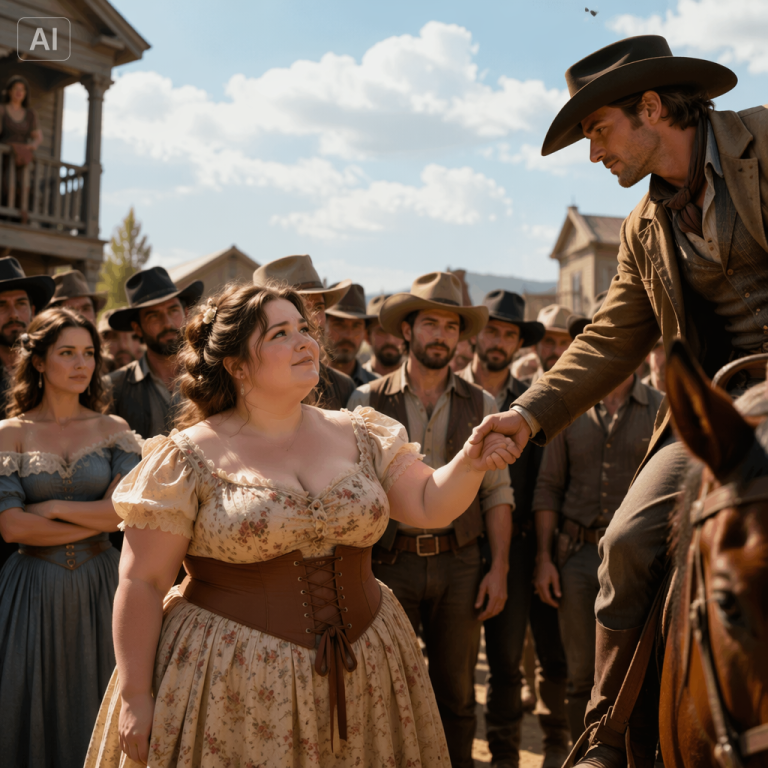
After Three Years of Bruises and Silence, She Collapsed at the Dinner Table — Then a Mountain Man Opened the Door Holding Her Missing Letter

Part 1
The blood had already soaked into the oak floorboards by the time the wind found its way through the broken doorframe, mixing with the snow that came howling in sideways off the peaks.
For three years, the town of Cedar Bend had listened to Mara Holloway scream, and for three years, not one neighbor had unlocked a door for her. No respectable man had crossed the street to find out why. No lawman had come, because nothing resembling justice had ever stirred in him.
The man who finally walked through Mara’s threshold that night didn’t belong to Cedar Bend at all.
He came down out of the mountains wrapped in grizzly hide, frost crusted in his beard, snow heavy on his shoulders, carrying a silence more dangerous than anything Garrison Holt had ever once threatened her with. The storm seemed to have summoned him straight off the peaks — not to finish what Garrison had started, but to end it permanently.
Cedar Bend had been built on silver, timber, debt, and fear, and to the outside world in the winter of 1878 it looked like a frontier town on the rise — mills smoking, the bank prosperous, the church bell ringing out over streets lined with new houses and old secrets nobody discussed. To Mara, it was a frozen graveyard where everyone still breathing had quietly agreed to behave as though they weren’t.
She was twenty-two years old, married three years to Garrison Holt. *Married* was the word the town used, because it sounded respectable. *Sold* was the word that actually lived underneath it. Her father, a failed assayer ruined by whiskey and bad cards, had handed her over to settle a debt no daughter should ever have been made to pay.
On their wedding day, Garrison had looked every inch the frontier gentleman — charcoal broadcloth, dark hair oiled back, a gold watch chain crossing his waistcoat, his handsome face arranged into the solemn expression men wear when they fully intend the world to admire them. The women had envied her. The men had congratulated him. The minister spoke of duty and obedience, and Mara, young enough still to mistake fear for nervousness, told herself she’d simply learn to be a good wife.
Monsters rarely look like monsters in daylight.
The first time Garrison struck her, it was over a misplaced silver spoon.
It wasn’t a slap. It was a closed-fist backhand that split her lip and sent her sprawling into the mahogany table. She landed hard on the imported rug, tasting copper, too shocked even to cry. Some small part of her actually waited for the apology — for the stunned remorse of a man who’d lost his temper and would now beg forgiveness.
Garrison knelt beside her instead, his breath thick with bourbon and peppermint.
“A careless wife reflects a weak husband, Mara,” he whispered. “And I am not a weak man.”
That was the night the heavy oak doors of Holt House closed permanently on her freedom.
After that, the beatings became the metronome her whole life ran on. Garrison was methodical, careful — he cared deeply for his reputation, and that meant he learned how to strike without leaving marks where the bankers’ wives might notice. He never touched her face before a social engagement. He aimed for ribs, stomach, back, thighs — places bruises could bloom unseen beneath crinoline and high collars.
Mara learned invisibility the way other women learned the piano. She learned the tiny shift in Garrison’s jaw that meant trouble at the bank. The heavy, slow tread on the porch stairs that meant she needed to send the terrified young housemaid, Nessa, home early before the violence started. A glass set down too gently, which somehow always meant worse than a glass thrown.
She learned to breathe shallow when her ribs cracked. She learned to press raw meat against swelling. She learned to smile when the dressmaker, a kind woman named Opal Fenn, noticed yellowing marks near her collar and asked, with trembling politeness, whether she was quite well.
“Terribly clumsy of me, Opal,” Mara would say, eyes down. “I fell against the washstand.”
Opal would nod too quickly. “The floors are dreadfully slick this time of year, Mrs. Holt.”
That was the cruelest part. Cedar Bend knew.
It wasn’t a large enough town for screaming to vanish completely behind velvet curtains and carved doors. On still nights, when wind didn’t cover the sound, neighbors heard porcelain shatter. They heard heavy thuds. They heard Mara’s muffled weeping and Garrison’s voice rising into that low, controlled, poisonous register that frightened people far more than shouting ever could.
But Garrison held their mortgages. He owned the only bank in three counties, the lumber mill, the deeds to half the surrounding ranches. He decided who got credit extended before winter and who watched their pantry shelves go bare in January. People could pity Mara, plenty did — but pity didn’t pay a note.
Sheriff Cyrus Wade wore a tin star and possessed the spine of a man who’d sold his off in pieces, one favor at a time.
In her second year of marriage, Mara managed to run. Garrison had taken his leather razor strap to her back until blood soaked clean through her nightgown. She fled barefoot through freezing mud, crossed three streets in the dark, and arrived at the sheriff’s office nearly senseless with pain.
Wade wrapped her in a blanket. Gave her coffee. Listened while she shook so badly the cup rattled against its saucer.
Then he loaded her into his wagon and drove her straight back.
“He’s your husband, Mara,” Wade muttered, refusing to meet her eyes while Garrison stood calmly on the porch waiting. “A man’s home is his castle. You just need to try harder at being an obedient wife.”
Garrison thanked the sheriff and pressed a rolled twenty-dollar bill into his palm. Once the wagon pulled away, he dragged Mara inside by her hair.
The beating that followed kept her bedridden a full week. Garrison told the town it was winter influenza.
By the third year, the vibrant girl who’d once sketched wildflowers in the foothills was nearly gone entirely. Mara weighed barely a hundred pounds. Her collarbones pressed sharp against thin skin. Her body had become a shifting map of violet, blue, and sickly yellow. She no longer prayed for rescue. She prayed for the cold to finally take her, or for Garrison to one day strike too hard and simply not have to wake up again.
But Garrison was precise. He liked his possessions alive.
The end of that life began on the eve of their third anniversary.
November had brought early winter down off the Rockies. The sky hung low over Cedar Bend like bruised iron, and the cold sharpened until frost bloomed across every window of Holt House. Garrison had spent the day in a meeting with railway men, a meeting that had gone badly — the line intended to bypass the town by ten miles, costing him thousands in projected freight monopolies.
He came home in a rage.
The door slammed hard enough to rattle the windows. Mara, sewing near the hearth, felt dread plunge through her before she even saw his face. She stood too fast, and her sewing basket tipped, spilling thread across the rug.
“Garrison,” she began. “May I take your coat?”
He didn’t answer. He crossed the parlor in three strides, his face flushed dark, eyes black with a fury too old to be only about a railroad. He struck her so viciously her feet left the floor. She crashed into the stone hearth, her skull cracking against the iron fire dog.
White light. Then ringing. Then blood, hot and familiar, filling her mouth.
She tried to push herself up onto hands and knees. The room spun. Through the blur she saw his brass-heeled boots moving toward her.
“You are nothing,” Garrison hissed, driving a kick into her stomach that emptied her lungs entirely. “My whole empire is bleeding, and I come home to a worthless, barren wretch who can’t even keep a floor clean.”
He seized her hair, wrenched her head back until her neck burned, fist raised, and something in his eyes was pleasure as much as rage.
*Let this be the one*, Mara prayed silently, eyes shut. *Let it finally end tonight.*
Outside, while Cedar Bend crouched behind locked doors and drawn curtains, the wilderness was making its own decision. High in the peaks, a blizzard had been gathering power for hours, and descending through the worst of it came a man who belonged more to the mountain than to any town below it.
His name was Garth Ransom, though the rare few who spoke to him at all called him Ash.
He stood better than six feet four in moccasins, broad through the shoulders and deep in the chest, wrapped in a massive grizzly-hide coat that made him look less like a man than some myth cut loose from the timberline. A pale, jagged scar crossed his face from temple to jaw, left by a starving cougar three winters back. His beard was thick, dark, flecked with snow. His eyes were a glacial gray that missed little and forgave even less.
Ash trapped for a living, coming down from the high country only twice a year to trade pelts for powder and salt. He despised civilization — its noise, its lies, its cowardice dressed up as propriety. Men in towns hurt each other behind badges and law books, then called the result order. Ash lived by rougher rules. In the wild, respect had to be earned, threats got dealt with directly, and cruelty without purpose was something even predators didn’t bother practicing.
The blizzard had forced him down early that year, two heavily laden mules struggling through waist-deep drift while ice struck his face like buckshot. Even for a man of his endurance, a night fully exposed in that storm meant death. When the dim lights of Cedar Bend finally appeared through the whiteout, he cursed under his breath — he had no wish to be among people — but he needed shelter regardless.
At the livery he tied off the mules, tossed the trembling hostler a silver dollar, and pushed on through the drifts toward the saloon.
The streets stood empty. Wind tore down the main road, ripping a shop sign clean off its hinges. As Ash passed along Sycamore Street, head bowed against the gale, a sound cut clean through the storm.
A scream. Muffled, desperate, raw with terror enough to lift the hair along his neck.
He stopped.
Snow whirled around the great bulk of his coat. He turned toward the largest house on the street — a grand two-story structure, its frosted windows glowing yellow from within. In the wild, when something screamed like that, it was already caught in the jaws of something stronger.
But this wasn’t the wild.
This was supposed to be civilization.
The scream came again, followed by the heavy, sickening thud of a body striking a wall.
Ash knew that sound.
He looked up and down the street. Lamps burned warm in neighboring windows. A curtain twitched next door, and the minister’s wife peered out — the moment she caught sight of him standing huge in the snow, she yanked the curtain shut and snuffed her own lamp.
The town was listening. The town was doing absolutely nothing.
A cold fury began coiling tight in Ash’s chest. He didn’t know whose house this was. He didn’t know the story behind the scream. He didn’t care about paperwork, marriage, reputation, or law. He only knew something helpless was being beaten to death inside a cage while the rest of the pack pretended deafness.
Inside Holt House, Garrison had lost whatever restraint he normally preserved for appearances. The railroad deal, the whiskey, the humiliation, the old familiar pleasure of breaking something smaller than himself — it had all finally boiled over completely. Mara lay crumpled near the front door, left arm bent at an unnatural angle, blood running from a deep gash on her forehead, matting into her hair and soaking her collar.
She had stopped crying. She had drifted past tears into the numb gray twilight that sometimes comes just before death.
Garrison stood over her, sweating despite the cold draft. He reached down, fisted the collar of her ruined dress, and began dragging her limp body toward the heavy oak door.
“You want to be cold, Mara?” he spat. “You’re useless to me. Sleep in the snow tonight and let’s see how long you last out there.”
He fumbled at the brass deadbolt with hands slick from her blood, threw it back, reached for the handle, fully intending to hurl his wife straight into the blizzard and let the storm finish what his fists had begun.
He never touched the knob.
The heavy oak door exploded inward with the force of a cannon shot.
Part 2
Wood shrieked and splintered. Hinges tore clean from the frame. The whole slab crashed down across the parlor floor, sending dust and a wash of snow skidding over the rug. The blizzard roared straight into the room, snuffing the nearest lamps and dropping the parlor into chaotic shadow, lit only by the orange flicker of the hearth.
Garrison stumbled backward, arms thrown up against the flying splinters, and dropped Mara to the floor.
Standing framed in the ruined doorway, wrapped in the white fury of the storm, was a nightmare given shape.
Ash stepped over the broken door. He said nothing. He demanded no explanation. His gray eyes swept the room in a fraction of a second — shattered porcelain, blood on the rug, a battered woman on the floor, a well-dressed man sweating over her like a butcher at his block.
Garrison recovered first, arrogant even through the shock.
“Who in hell do you think you are?” he roared over the wind. “This is my home. I am Garrison Holt, and I will see you hanged for—”
Ash crossed the room in two strides.
Garrison realized too late that his name and his money meant absolutely nothing to the man in front of him. He scrambled for the writing desk where he kept a loaded revolver in the top drawer. His fingers had just brushed the grip when Ash’s hand closed around his throat.
The grip was total. Ash lifted him clean off the floor with one arm.
Garrison’s hands flew to his neck, manicured nails breaking uselessly against Ash’s weathered wrist. His eyes bulged. His boots kicked against the wainscoting, finding nothing.
Ash drew him close. “You talk too much,” he growled, and drove his fist into the man’s ribs.
It wasn’t a blow meant to teach a lesson. It was meant to stop a man who hadn’t managed to stop himself in three years. Bone cracked beneath it. Garrison tried to scream, but the grip on his throat crushed the sound down to a wet gasp.
Ash let him drop. Garrison hit the floor and rolled onto his side, coughing blood, clutching his ruined chest, reduced from tyrant to whimpering wreck in under ten seconds.
Ash gave him no further attention. He turned to Mara.
Through a blur of pain and blood, she saw him kneel beside her and thought, for one strange moment, that death had finally come for her — only wearing grizzly hide instead of wings. When his hand moved toward her, she flinched hard and threw up her uninjured arm to shield her face.
The gesture made Ash’s jaw tighten visibly.
“Easy,” he said, his voice dropping into something low and impossibly gentle for a man built the way he was. “I ain’t going to hurt you, little bird.”
He stripped off his massive coat and draped it over her, still warm with his own heat, carrying the wild scent of smoke, pine, and hide. For the first time in three years, Mara felt something that seemed almost impossible.
Safe.
“My arm,” she whispered through chattering teeth.
“I know.” The same hands that had just broken Garrison’s ribs handled her with deliberate, careful restraint, testing the break as lightly as he could manage. “Clean snap. I’ll set it — but not here. The jackals are coming.”
Boots crunched on the porch outside. Garrison, spitting blood near the desk, managed a weak wheeze. “Wade. Kill him. Shoot him.”
Sheriff Cyrus Wade stepped into the ruined doorway with two armed deputies behind him, a double-barreled shotgun shaking visibly in his hands. His eyes swept the wrecked door, the snow blowing across the floor, Garrison bleeding by the desk, Mara wrapped in bear hide, Ash standing over her.
“Step away from the woman,” Wade stammered. “You’re under arrest for assault and breaking and entering. Hands up.”
Ash stood. He did not raise his hands. He turned fully toward the sheriff, his chest rising and falling slow, his gaze stripping away the badge and the authority and the pretense until only a frightened, compromised little man remained underneath.
He took one slow step toward the shotgun.
“Stop right there,” Wade squeaked. “I’ll shoot. I swear it.”
“No, you won’t,” Ash said.
He pointed at Garrison. “You knew exactly what he was doing to her. The whole town knew. You let a dog chew on a lamb for three years and called yourselves men for it.”
Wade swallowed hard, eyes flicking to Mara’s bruised face and away again. “Ain’t my business what happens in a man’s own home. The law—”
“The law ends where the snow line begins.”
Ash took another step, close enough now that Wade had to tilt his chin up to hold his gaze. “I’m taking her. You want to stop that, pull the trigger right now. But I promise you this, Sheriff — if the first barrel doesn’t kill me, I will feed you the second.”
For several long seconds the parlor held a silence worse than the storm outside. Snow blew across the rug. Garrison groaned. The deputies shifted their feet but didn’t raise their weapons.
Wade stared into Ash’s eyes and saw absolute certainty there. This man wasn’t afraid to die, and he wasn’t afraid to kill either.
The shotgun lowered.
“Take her,” Wade whispered. “Just get out of my town.”
Ash didn’t thank him. He turned his back on all three armed men as though they’d simply ceased to exist, bent, and slid his arms beneath Mara. She gasped as her broken arm shifted but bit down hard on the cry. He lifted her easily, the great coat swallowing her small frame whole.
“Rest now,” he murmured against her blood-matted hair. “You’re done bleeding tonight.”
Then he stepped over the shattered door and walked straight into the teeth of the blizzard.
The cold struck instantly. Mara barely felt it. She pressed her face into his wool shirt and listened to the steady thud of his heart while, behind them, Cedar Bend faded into white. The storm swallowed their tracks entirely.
By dawn, Mara Holt had vanished from the town that had watched her suffer and chosen, every single time, to do nothing.
Part 3
The climb into the high peaks should have killed them both.
The blizzard erased the game trails, buried the cliff edges, turned every familiar rise into a wall of white. Ash moved through it not by sight but by memory and the kind of instinct only solitude could carve into a man. For six hours he carried Mara against his chest, shielding her from the worst of the wind. Her blood froze into the fur of his coat. She drifted in and out of consciousness, the throb in her broken arm and the steady drum of his heartbeat the only things tethering her to the world at all.
Near dawn, the storm finally began to break. The sky bled into bruised purple, and through the thinning wind a cabin appeared, tucked against a sheer rock face at the timberline.
Ash kicked the door open and carried her inside — a single-room trapper’s redoubt of thick unpeeled pine, chinked with mud and horsehair, smelling of smoke, hide, and dried herbs. He laid her on a bed of layered elk hides in the corner, struck flame from kindling already laid by the hearth, and soon had a fire roaring against stone.
He stripped away the ruined remains of her dress with quick, efficient hands, not lingering, not looking where he had no need to look, working only to keep her alive. He wrapped her bruised body in heavy wool and pulled down a leather pouch from a shelf.
“This is going to hurt, little bird,” he said.
Willow bark, clean rags, two flat wooden splints. Mara looked up at him through glassy eyes, said nothing, only bit down on the edge of the blanket and nodded.
With a swift, sickening pop, he pulled the bone back into alignment. Her muffled cry filled the cabin. Her body arched, then went limp.
For nearly three weeks she hovered between life and death. Infection took hold in the cuts on her face and scalp. Fever burned through her until the cabin walls blurred and the present dissolved into nightmare — back in Holt House, hiding under the table while Garrison hunted her with the strap.
The blows never came in the dream. Instead a massive hand pressed cool cloths to her forehead. A deep voice hummed half-remembered hymns beside the fire. Ash fed her broth by the spoonful, changed her dressings, boiled rags clean, packed snow against fever-hot cloth, kept the fire burning day and night, and slept in short stretches in the chair with his rifle across his knees.
When she whimpered, he woke. When she cried out, he spoke her back into the room. When she begged not to be taken home, he told her, again and again, “No one is taking you anywhere.”
He never touched her carelessly. He never raised his voice. He never once demanded gratitude. He didn’t ask what had happened to her until she was strong enough to tell it herself.
When the fever finally broke in late December, Mara woke to a world buried in snow. The cabin was warm, smelling of woodsmoke and roasting meat. Ash sat by the hearth cleaning a heavy buffalo rifle with slow precision.
“You fought hard,” he said without looking up, a faint smile touching his beard.
Her throat felt raw. “Why did you save me?”
The first clear thing she’d said in nearly a month.
He set the rag down and met her eyes. “I don’t hold with cages,” he said. “And I don’t hold with men who hurt things smaller than themselves.”
Down in the valley, another sickness had taken root.
Garrison had survived. Ash’s blow had shattered ribs and punctured a lung, but the town doctor had drained the fluid and kept him alive. He lay propped among pillows in his study, pale, breath wet, hatred burning brighter than the pain. His humiliation bordered on madness.
He summoned Sheriff Wade. “Draft a warrant,” he wheezed. “That mountain savage broke into my home, assaulted me, abducted my wife. She’s a hostage.”
Wade knew it was a lie. He nodded anyway.
But Garrison didn’t trust the sheriff to climb a mountain — Wade was a coward, useful only behind a desk and useless in snow. So he sent a telegram to Denver instead, bypassing the Pinkertons, who asked too many questions, and hired a notorious manhunter named Silas Crowe — a former bushwhacker who’d turned wartime skills into bounty work, known for bringing men back dead, frozen, or barely able to speak. Garrison offered him five thousand dollars to bring Mara back alive and Ash’s head in a sack.
Crowe chewed a matchstick through the whole offer. “Snow’s too deep now, Mr. Holt. Come spring thaw, though, the mountain opens up. I’ll gut that bear man like a trout.”
While Garrison plotted below, winter claimed the high country fully.
For Mara, it became both prison and sanctuary — crucible and cure all at once. At first she was too weak to stand, her arm aching in its splint, her face pulling tight where the cuts healed. But the cabin stayed warm. Ash stayed steady. Outside, snow piled higher than the windowsills, sealing the world away.
The silence frightened her at first. In Holt House, silence had meant waiting — meant Garrison was thinking, meant some offense had been discovered and punishment was already taking shape. The mountain’s silence was different. It didn’t wait to hurt her. It was vast, indifferent, clean. It asked nothing of her except attention.
Ash taught her how to listen to it — the difference between wind across an open ridge and wind moving through timber, when snow had crusted hard enough to bear weight, what tracks near the cabin meant: hare, fox, elk, lynx, and which direction spoke of hunger, which of danger, which of simple passage.
As her strength returned, Mara refused to remain an invalid. The first time she tried to carry firewood, she nearly dropped the load and swayed with the effort. Ash stepped forward, then stopped when she stiffened.
“I can do it.”
He removed half the wood from the pile instead. “Do that much first.”
Not pity. Measure. She accepted it.
By January she could cross the cabin without leaning on the wall. By February she stepped outside in wool, breathing air cold enough to burn. By March she could chop kindling one-handed well enough to keep the stove fed. Her crooked arm healed straight in bone if not entirely in memory. Calluses rose on her palms. Her shoulders filled back out. Her eyes, lowered for three years out of habit, began slowly to lift.
The woman in silk who flinched at footsteps disappeared, and in her place stood a woman in buckskin and wool, hair braided tight against the wind, lean and strong, hands marked by work that belonged to no one but herself.
Ash never softened the mountain for her. That, too, was its own kindness. He taught her to set snares, skin a catch without wasting meat, sharpen a blade, patch moccasins, bank coals, melt snow safely, and read the sickly sweetness in the air that sometimes preceded an avalanche.
“Fear keeps you alive,” he told her one evening by the fire. “Panic gets you killed. Learn the difference.”
Mara looked down at her hands, red from cold water and work. “I spent three years afraid.”
“No,” Ash said. “You spent three years trapped. There’s a difference.”
“A big one.”
The evenings became where the rest of the world slowly surfaced between them. Ash spoke reluctantly at first, of the war, of seeing enough killing done under flags to mistrust any man who spoke too easily about honor, of wanting distance enough to wash blood from memory.
Mara told him of her father, of betrayal wearing the face of family. She told him of the first blow, then the second, then the years after, the sheriff driving her back, Nessa crying in the pantry, Opal pretending not to see. It came in pieces, never in order, the way trauma usually surfaces.
Only once did he interrupt before she finished. When she described Wade returning her to Garrison’s porch, Ash’s hand tightened around his tin cup until it bent.
“Go on,” he said when she stopped.
Devotion grew between them in practical ways, never announced. He rose earlier to check the snares so she wouldn’t have to step into the bitter predawn, then noticed she resented it and started waking her instead. She learned how he took his coffee. He carved a new handle for her knife to fit her hand exactly. She hummed while grinding coffee beans, and he pretended not to listen.
Neither spoke the word love. There was too much danger left in it.
But one March night, with wind screaming over the ridge and firelight throwing shadows across the ceiling, Mara woke from a dream of Garrison unable to breathe, sitting up and clutching the blanket, every muscle braced for a blow that never came.
Ash was beside her instantly, not touching, only close. “Cabin,” he said quietly. “Mountain. Fire. Snow outside. Me here. No one else.”
She repeated it because he told her to. *Cabin. Mountain. Fire. Snow outside. You here. No one else.* Her breathing steadied. Only then did he take her hand, and she let him.
In April, as the days lengthened and snow began softening at the edges, Ash placed a lever-action rifle into her hands.
“A wolf won’t care if you’re a woman,” he said. “Neither will the men Garrison sends once the ice melts.”
Cold moved through her despite the sun. “He’ll send men?”
“Yes.”
“You know that for certain?”
“I know men like him.”
He adjusted her stance in the clearing. “Pull it tight to your shoulder. Exhale. Squeeze — you don’t jerk, you don’t pray, you squeeze.”
The first shot bruised her shoulder badly enough she nearly dropped the rifle. Ash didn’t smile. “Again.”
She practiced until her shoulder went black and blue, until her ears rang and powder clung to her clothes, until she could hit a pine cone off a branch at fifty yards and reload without fumbling. She was no longer waiting to be rescued. She was preparing to defend her own sanctuary.
By late May of 1879, the mountain thawed. Drifts that had stood like walls began to weep. Crowe came up with three hardened gunmen and Garrison Holt himself, who insisted on witnessing the reclamation of what he still called his property.
Part 4
The morning of the attack was too still. Mara noticed it before she understood why — the birds had gone quiet, the wind had thinned to nothing. Ash had gone down to check the creek snares, leaving her at the cabin tending the fire and steeping willow bark. She was kneeling at the hearth when a rifle crack split the morning.
She froze. Not Ash’s heavy buffalo rifle — sharper, higher. A sniper’s shot.
Down at the creek, Ash threw himself behind a granite boulder as a bullet tore through his left shoulder, spinning him hard enough to knock the rifle from his hand. Blood darkened his sleeve into the melting snow. Above him on the ridge, Crowe and two of his men held the high ground.
“Keep him pinned,” Crowe shouted. “Holt’s headed for the cabin.”
Inside, Mara heard boots on gravel and her breath slowed. Once, footsteps had meant terror. Now they meant decision.
The door didn’t burst inward the way Ash’s had through Holt House. It opened slowly, deliberately. Garrison stepped through, grotesquely out of place in the high country in his fine wool coat and bowler hat, a silver-plated revolver in his hand, disgust crossing his face at the rough log walls before his eyes found her.
Then he smiled — the same cold, dead smile that had once frozen her blood entirely.
“Look at you,” he said. “Covered in dirt. Smelling like an animal. I spent three years trying to make a lady of you, and you ran off to play mountain woman for some savage.”
A year earlier, those words would have folded her completely. The woman standing before him now was not the girl he had broken.
Mara rose slowly. She did not tremble. For the first time, she saw him clearly — not a god of violence, not the owner of her fate, but a cowardly little man who had only ever relied on money, locked doors, and silence to feel powerful at all.
Garrison raised the revolver at her chest. “Get your coat. We’re going down the mountain. You’ll tell the whole town he tortured you, and I’ll watch him hang for it.”
“I am not going anywhere with you, Garrison.”
Her voice was steady. His face darkened with familiar rage as he thumbed back the hammer. “You worthless—”
He stepped forward to seize her.
Mara moved with the speed Ash had drilled into her for months. The Winchester leaned against the table behind her. She reached, brought it up in one fluid motion, seated the stock to her shoulder, exhaled, and squeezed.
The blast filled the cabin. The bullet struck Garrison square in the chest and threw him backward. His revolver clattered to the floorboards. He hit the doorframe, slid down the rough wood, leaving a dark smear behind him, and sat there gasping, staring at the hole in his fine coat as though wealth itself should have stopped the bullet.
He looked up at her in shock. Tried to speak. Blood bubbled past his lips instead. No words came. His head fell to one side.
Garrison Holt was dead.
At the creek, Ash heard the shot and thought only of Mara. Rage burned through him so fiercely the pain in his shoulder simply vanished. He broke cover and charged the slope through gunfire, caught one of Crowe’s men under the jaw with his rifle stock, dropped him cold, drew his hunting knife to finish the rest.
Then the firing stopped.
Crowe, watching through a spyglass from the ridge, had seen Garrison fall in the cabin doorway. The contract was dead. The paymaster was dead. Crowe was a brutal man, not a sentimental one, but brutality required no stupidity to go with it — there was no profit in dying for a corpse. He tipped his hat toward the mountain, whistled to his last remaining man, and faded back into the timber, leaving the dead where they lay.
Ash ran the final stretch to the cabin, clutching his bleeding shoulder, expecting to find Mara broken or worse.
Instead he found her standing in the doorway with the smoking Winchester still in her hands, spring sun catching the gold in her braided hair, Garrison’s body lying at her feet.
She looked down at it, then up at him. Lowered the rifle. Stepped over the dead man entirely and walked straight into Ash’s arms.
“Are you hurt?” he breathed into her hair.
“No,” Mara whispered, looking out over the wide sweep of the Rockies, warm spring wind on her face. “For the first time in my whole life, Ash, I am completely whole.”
Part 5
They did not go back to Cedar Bend. Not that day, not the next, not ever.
There were practical matters first — survival allowed no dramatic pauses. Ash’s shoulder bled badly, the bullet carving a deep channel through muscle. Mara boiled water, cut away the torn cloth, washed the wound with hands that stayed steady right up until she saw how close the shot had come to bone.
“You all right?” Ash asked, watching her face.
“I killed him.”
“Yes.”
“He’s dead.”
“Yes.”
Her breath trembled once. Then she pressed a clean cloth to his shoulder. “I thought I would feel joy.”
“What do you feel?”
She considered it. Outside, meltwater ran hard over the rocks. Garrison’s body lay beyond the door, already strangely irrelevant in a way she’d never imagined possible. For three years he’d been the center of her terror; even after Ash carried her away, some dark room of her mind had kept a door open in case he came through it.
Now that door stood open with nothing behind it.
“I feel empty,” she said.
Ash nodded. “Good. Empty means there’s room.”
The shaking came later, once his wound was bandaged and the floor scrubbed clean of blood. It began in her hands, then moved through her arms and chest until she had to sit on the floor by the hearth. Ash lowered himself across from her, careful of his shoulder, and waited. He didn’t tell her not to tremble. He didn’t tell her it was over, as though a single body outside could erase three years.
At sunset they carried Garrison away from the cabin together, beyond the timber to a ravine where spring melt ran beneath dark rock. It wasn’t a burial. It wasn’t ceremony. It was simply an ending, marked with enough stones to keep scavengers off.
“You need not honor him,” Mara said.
“I’m not,” Ash answered, hat in hand. “I’m marking that no man should make so little of his own life.”
That night, for the first time, Mara slept without dreaming of Holt House at all.
Down in Cedar Bend, the story unraveled slowly. Crowe and his last man sold two horses at the livery, drank in silence at the saloon, and left town before sunrise two days later. Someone asked where Garrison Holt had gone.
Crowe’s smile was thin. “Up the mountain.” “And?” “And the mountain kept him.”
That was enough to start the whispers. Sheriff Wade sent no posse — told himself the passes were too dangerous, that a proper search needed preparation, that he must proceed carefully. Mostly he did what he’d always done: nothing.
But the town began to change anyway, not from sudden courage, but because cowardice always checks first who still holds the power. With Garrison missing, notes came due and no one knew who could enforce them. Men who’d owed the bank walked freer down the street. Women who’d heard Mara scream started speaking her name aloud — in kitchens first, then churchyards, then over the counter at the dry goods store. Nessa left Holt House for work with Opal Fenn. Opal, who’d spent three years pretending not to see bruises, wept once in her back room and then began saying aloud exactly what she’d seen all along.
The minister preached one Sunday on the sin of looking away. No one missed the point. His own wife sat white-faced in the front pew, hands clenched white at the knuckle, remembering the curtain she’d shut on Mara’s last night in town.
By June, a hunter’s report brought word of bones found high along an old trapper trail. A scrap of expensive wool clung to one stone; a cracked silver watch with Garrison’s initials lay nearby. Wade sent two deputies up instead of climbing himself. They came back pale and quiet.
Officially, Garrison Holt had died in the high country pursuing his abducted wife and her captor. Unofficially, everyone understood enough to handle the truth carefully. Months later, when men from Denver finally examined the bank’s ledgers, the town discovered Garrison had been quietly robbing nearly all of them — forged signatures, inflated debts, mortgages altered to keep families afraid and obedient. Many of the debts people had nearly starved themselves to pay had never legitimately existed at all.
Justice came late. But greed, it turned out, kept excellent records.
By then, Mara and Ash had moved deeper into the high country, away from the trails Crowe had followed, into a hidden valley west beyond a narrow pass where elk summered and no wagon could reach. They built a second cabin before winter, Ash felling timber, Mara learning the rhythm of an axe not as desperate exercise but as creation. By September, smoke rose from their new chimney.
She marked a sunny patch near the creek that first autumn. “Next spring,” she said, when Ash asked what she’d plant there. “Something that blooms.”
He nodded as though this mattered every bit as much as meat or powder. “Then we’ll fence it.”
Winter returned, and this time Mara met it standing. There were still hard nights — wind striking the walls hard enough to summon Holt House back into her mind, a dropped pan that made her flinch, Ash’s sudden movement from sleep sending fear through her before reason caught up. Ash carried his own ghosts from the war, nights he stepped outside because the walls felt too close, days his silence sharpened around gunfire only he could still hear. They learned each other’s darkness without ever trying to own it. That was their particular tenderness.
By spring, columbine and paintbrush and wild flax grew behind the fence Ash built, some taking root, some not, the mountain accepting no sentiment from flowers any more than from people — but enough green came up to make Mara kneel in the dirt and laugh out loud.
“You laughing at dirt now?” Ash asked, a brace of rabbits in hand.
“At life,” she said.
“Fair enough.”
Their love resembled nothing of the stories Mara had once been told respectable women should want — no drawing rooms, no calling cards, no church ladies nodding approval. There was a trapline, a garden, a cabin smelling of smoke and pine, a man who handed her a sharpened knife the way another man might hand over a rose.
He never asked her to marry him — not from any lack of love, but because he distrusted the word *wife* after what had been done to her in its name. For a time, she was grateful for that. Then, late in their second summer, she found him mending a mule pack outside the cabin and said his name.
He looked up.
“I will not have Garrison be the only man who ever called me wife,” she said, shoulders square. “I know what a man can make of marriage. I also know what it was meant to be before men like him made it ugly. I want to choose it. I want the thing he used to cage me turned into something I walk into freely.”
Ash rose slowly. “You asking me?”
“Yes.”
“I’ve got no preacher.”
“I don’t require one.”
“No paper.”
“I’ve had enough of papers to last several lifetimes.”
“No ring.”
She allowed herself a faint smile. “Can you not trap one?”
He laughed — a rare, deep sound that rolled out across the valley and startled a bird from the brush. The ring, when he finally made it, was iron, hammered from a broken trap and smoothed until it no longer caught on cloth. He apologized for its roughness.
She put it on anyway. “It’s honest,” she said. “That’s more than gold ever managed for me.”
They spoke their vows at dawn beside the creek, the mountains the only witness, with no one present who could lie about what had happened there. Ash promised never to cage her. Mara promised never to disappear inside fear without reaching for him first, if she could manage it. It was no church ceremony, but it was binding in every way that mattered.
Years passed. Down in Cedar Bend the legend grew in every direction at once — in some versions Ash tore Garrison apart with his bare hands in the parlor; in others Mara died in the snow and haunted Sycamore Street until the bank finally failed; in still others she’d become some wild white-haired woman of the peaks, rifle always loaded, hunting down men who raised their hands to wives.
The truth was quieter, and considerably stronger. Mara lived. She woke each morning beside a man who had carried her out of hell but never once treated her as something he owned for having done it. She worked, planted, hunted when necessary and spared when she could. She filled pages with sketches of alpine flowers and storm clouds, and once, carefully, the ruined doorway of Holt House exactly as she remembered it — then turned that page and never drew it again.
In Cedar Bend, Holt House stood empty for years until Opal Fenn bought it cheap, with help from four widows whose mortgages Garrison had falsified, and turned it into a boarding house for women with nowhere safe left to go. Sheriff Wade left town before anyone decided what to do about his cowardice; some said Pueblo, some said drink finally took him. Nobody searched especially hard for the truth of it. Nessa married the liveryman’s son and named her first daughter Mara. Opal kept a rifle behind the boarding-house desk from then on and never again pretended not to see a bruise.
Five years after the night of the blizzard, a young woman appeared at the edge of Ash and Mara’s valley, half-frozen, carrying an infant beneath her coat and terror in both eyes. Ash found her tracks first. Mara brought her in, warmed the baby, sat beside the bed through the night. When the woman tried to apologize for needing help, Mara took her hand.
“You knocked,” she said gently, though the woman hadn’t, not really. “That’s enough.”
By then Mara understood something Cedar Bend had never grasped while she screamed behind those walls: suffering becomes death only when every door stays closed. So hers didn’t. More women came over the years, guided by rumor or desperation or someone in town who knew which trapper trail to point toward. Some stayed a week. Some stayed the winter. Some left with new names and steadier hands. None were ever turned away for the inconvenience of their pain.
On certain winter nights, storms battering the shutters, Mara would sit by the fire and remember the sound of that door breaking inward, the cold, the blood, Garrison’s fist in her hair, the prayer that death might finally come — and then the impossible sight of Ash stepping through the wreckage in bear hide and snow. For a long time she believed he had saved her.
Later she understood the fuller truth. He had carried her away. He had warmed her, set the bone, sat through the fever, taught her the mountain. But the life built after that had never been handed to her — she’d raised it herself, log by log, shot by shot, seed by seed, breath by breath. Ash hadn’t made her whole. He had simply given her room enough to discover the broken pieces had always belonged to her alone, and that she alone got to decide what shape they’d finally make.
One evening many years later, autumn turning the aspens gold, the first dusting of snow on the high peaks, Ash found her at the creek cutting back dead stems before frost. Her hair, once pale gold, carried silver now. The scar at her temple had faded to almost nothing. The iron ring sat worn smooth on her finger.
“Storm coming,” he said, standing behind her.
“Tonight?”
“Tomorrow, maybe.”
She rose, brushing soil from her hands. “Then we should bring in more wood.”
He smiled. “You always say that like we don’t already have enough wood for three winters.”
“I know what it is to be cold.”
His expression softened. “Yes,” he said. “You do.”
They stood together while wind moved through the pines. Below them, beyond the folds of mountain and forest, towns still made monsters into gentlemen when the suits were fine enough. Men still hid cruelty behind doors and called it law. Neighbors still sometimes heard, and chose, every time, not to act.
But above the snow line, another law held entirely. No cage stood unchallenged here. No scream went dismissed as merely private. No person was property.
Mara leaned into Ash’s side — not because she needed the support, but because she chose the closeness freely.
“Do you ever miss the world below?” she asked.
“No.”
“Not any part of it?”
He considered it. “Coffee was easier to come by.”
She laughed, the sound carrying clear and unafraid over the creek. Ash looked at her the way he’d looked at her for years now — not as the broken woman he’d lifted from blood and snow, but as the woman who’d stood in a cabin doorway with a smoking rifle in her hands and declared herself whole.
The mountains darkened toward evening. Behind them, the cabin waited warm, windows lit, its door strong but never barred against anyone truly desperate. The first flakes began to fall before they reached the porch.
Once, snow had been the thing Garrison meant to use to kill her.
Now it came soft over her own land, covering old tracks, quieting the world, making every light in that cabin burn that much brighter.
Ash opened the door. Mara stepped inside of her own free will.
And the storm closed gently behind her.