SOLD TO A GRIZZLED MOUNTAIN MAN TO PAY HER FATHER’S DEBT — THEN HE LOCKED THE DOOR AND HANDED HER SOMETHING THAT SHATTERED EVERYTHING

Part 1
The Bitterroot Mountains cast long shadows over Oakhaven, Montana Territory, and on the morning of October 14th, 1883, the shadow falling across Clara Higgins was the longest of her life.
She was folding her best wool skirt into a canvas trunk, humming without meaning to, when her father’s boots creaked on the stairs. She didn’t look up. She already knew the sound of a man circling bad news before he says it.
“Unpack the trunk,” Josiah Higgins said from the doorway.
Clara’s hands went still over the fabric.
“The stage leaves Thursday, Father. If I miss the train in Bozeman, I lose my place at the Normal School.”
He didn’t answer right away. That was worse than anything he could have said.
“You’re not going to Boston,” he told her finally. “I made an arrangement.”
The floor seemed to tip beneath her.
“What kind of arrangement?”
“I owed money. To the bank. To Elias Cobb at the mill.” The words spilled out of him too fast, the way a man talks when he’s already ashamed of what’s coming. “They were going to take the store, Clara. Throw us out in the snow.”
“And how does that involve me?”
“Silas Montgomery bought the debt. All of it. Paid it in gold dust and coin.” Josiah couldn’t meet her eyes. “In exchange, he asked for you.”
The room went silent in a way Clara had never heard a room go silent before.
She knew the name. Everyone in Oakhaven knew the name — the trapper who lived high in the Bitterroots and came down twice a year to trade furs for salt and ammunition, a towering, wordless man rumored to be pushing fifty, with a scar down his cheek that people said came from a grizzly. A ghost of the high timber.
“You sold me,” Clara whispered. “To a stranger old enough to be my grandfather.”
“He’s respectable. Quiet. Doesn’t drink.”
“I am *going to Boston.*” It was the first time in her life she had screamed at her father, and the sound of it frightened her almost as much as his answer. She snatched her acceptance letter off the bed — the letter she’d hidden under a floorboard for three years, the letter that had cost her seventy-four dollars of blackberries and mending — and thrust it at him like a shield.
He knocked it out of her hand.
“You belong to him now. The papers are signed. Sheriff Caldwell witnessed it himself. He comes Saturday.”
Clara sank to the floor and wept until her ribs ached, watching the letter settle in the dust like something already dead.
The three days that followed were their own quiet cruelty. Women at the well looked at her the way you look at livestock headed for slaughter. Mrs. Beatrice Goggins made sure to say it loud enough to carry: *traded for a ledger of bad debts… she’ll be dead of fright by Christmas.* Even Sheriff Caldwell took his hat off and studied his boots when he passed her on the boardwalk, unable to hold her eyes.
On Friday evening the bell over the store door chimed, and Clara looked up from her sweeping into the doorway — and there he was.
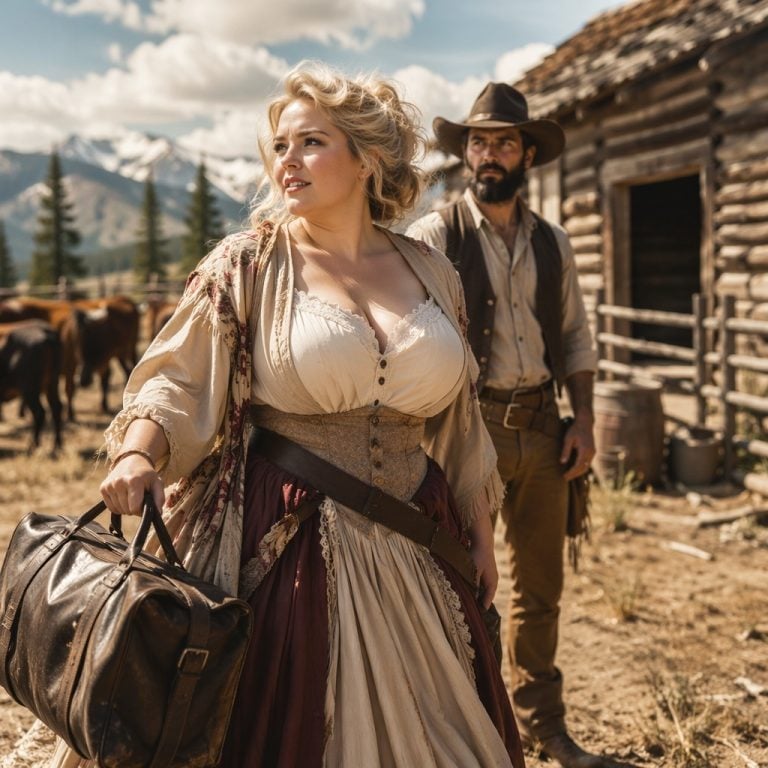
He was bigger than the stories. Well over six feet, shoulders wide under a buffalo coat, hair gone iron-gray at the temples, a silver scar cutting stark across a weathered cheek. But it was his eyes that stopped her breath. Pale blue. Winter-sky blue. Watching her with something quiet and unreadable that she couldn’t name.
He didn’t say a word. He set a burlap sack of provisions on the counter, nodded once, and walked back out into the dark.
Clara stood gripping the broom handle so hard her knuckles went white.
Saturday brought a cutting November wind and a wedding with no flowers, no music, no one smiling. Clara wore her one good dress and refused to look higher than Silas Montgomery’s chest. The preacher rushed the vows like a man in a hurry to be rid of the whole affair.
“I do,” Silas said. His voice was low, graveled, the first words she’d ever heard him speak.
“I do,” Clara answered, and the two words closed over her like a lid.
No kiss. Just a hand — large, calloused, barely touching — resting for a moment on the small of her back as he guided her out into the cold.
The ride into the mountains took five hours in silence broken only by wind and hoofbeats. Clara sat rigid, hands knotted in her lap, filling the miles with every terrible thing she’d ever read about rough men and rougher cabins — dirt floors, bloody hides, a life spent as somebody’s beast of burden.
Halfway up, the cold turned vicious enough that her teeth started chattering. Without a word, Silas pulled the wagon to a stop, took off his own heavy coat, and settled it over her shoulders. It smelled of woodsmoke and pine. He drove the rest of the way in his shirtsleeves like the cold didn’t touch him at all.
“Thank you,” Clara whispered.
He gave her one short nod and nothing else.
When the wagon crested the last ridge at dusk, Clara expected a shack. What she found instead stopped the breath in her chest — a cabin built with real craft, glass in the windows, smoke curling warm and gold from the chimney.
Inside it was worse — or better, she couldn’t yet tell which. Swept floors. Bear rugs. A stone hearth. Bookshelves built into the walls on either side of the fire.
“I’ll see to the mules,” Silas said, low, and stepped back out, leaving her alone with the crackling fire and the terror she’d been carrying since Wednesday.
Because she knew what came next. He had bought her. Paid her father’s ruin in gold. And now, alone in a locked cabin eight thousand feet up a mountain no one else would ever climb, it was time for him to collect.
When the door opened again half an hour later, Clara Higgins was already bracing herself for the worst night of her life.
She had no idea it was about to become the strangest one instead.
Part 2
The latch fell with a sound like a verdict.
Silas stomped the snow from his boots, hung his hat, and crossed toward the fire without looking at her — which somehow made it worse. Clara backed a half-step toward the wall before she caught herself doing it.
He stopped. Turned. Looked at her properly for the first time since the church.
Whatever he saw in her face made something shift behind his eyes.
“Sit down, Clara.”
She obeyed before she’d decided to, her knees too weak to argue. She shut her eyes in the rocking chair and gripped the arms, waiting for the sound of his boots closing the distance.
Instead, she heard him walk *away*. Toward the iron-bound chest at the foot of the bed. The creak of a hinge.
“Open your eyes.”
His voice had dropped into something she hadn’t heard from him yet — softer, careful, like a man handling something that might break.
Clara made herself look.
Silas stood a few feet off, holding something in both hands, and he crossed to the little table beside her chair and set down, one at a time, three things that made absolutely no sense together.
A leather pouch that clinked with the unmistakable weight of gold.
A dog-eared envelope she would have known anywhere, because she’d slept with it under her floorboard for three years — her acceptance letter to the Massachusetts State Normal School.
And a scuffed black case that he opened with one scarred finger against the brass clasp, revealing, nestled in faded velvet, a violin with a mother-of-pearl inlay across the tailpiece.
Clara made a sound she didn’t recognize as her own voice. Her hands flew to her mouth.
It was her mother’s violin. The one Josiah had sold four years ago for a month of whiskey. The one she had cried over for weeks, certain it was gone the way her mother was gone — completely, permanently, past any hope of getting back.
“I tracked the merchant to Idaho two years ago,” Silas said, watching the fire instead of her. “Bought it back.”
“I don’t understand.” Clara’s voice broke over every word. “What is this?”
Silas stepped back and folded his arms, the firelight carving deep lines into a face that had, until this exact moment, told her nothing at all.
“I didn’t buy your father’s debts to buy a wife, Clara.” He said it to the flames, not to her. “I bought them to get you out of that house before he gambled you off to a man who’d actually hurt you.”
He nodded toward the table like it cost him something to look at it directly.
“The gold’s for your fare and your first two years’ tuition. The letter’s yours. The violin belongs to you.”
Clara sat frozen in the rocking chair, tears sliding hot down her face, staring at the mountain man the whole town called a savage — the man who had just handed her back her entire life on the one night she’d been certain it was ending — and she understood, with a cold, dizzying clarity, that everything she thought she knew about Silas Montgomery was wrong.
Which meant she had absolutely no idea what he wanted from her instead.
Part 3
The fire cracked and settled, and the silence that followed Silas’s words felt enormous, filling every corner of the cabin. Clara sat with her fingers hovering over her mother’s violin, too afraid to touch it, as if touching it might prove this was a dream she’d wake from back in her father’s store.
“You bought my father’s debts,” she said finally, her voice small in the big room. “You married me in front of the whole town. Just to set me free.”
Silas hadn’t moved from where he stood near the door, his shadow long across the floorboards. He began unbuttoning his cuffs, slow, deliberate, the way a man does something with his hands so he doesn’t have to look at what he’s saying.
“The marriage was necessary,” he said. “Josiah Higgins is a desperate man, and desperate men don’t honor handshake deals. If I’d handed him gold for your freedom outright, he’d have gambled it away by sunrise and sold you to the next man with cash in his pocket. Being your legal husband was the only thing the law in Oakhaven would respect enough to leave you be.”
Clara looked at the gold. Enough for tuition. Enough to build a life on. A fortune, sitting on a plain wooden table like it was nothing.
“But why?” she pressed. “You don’t know me. We’ve never spoken a word to each other before today.”
Silas let out a breath that seemed to cost him ten years. He crossed to the bookshelf instead of answering right away, running a scarred finger along the spine of a leather-bound Emerson like he needed something solid to hold onto.
“I know what it looks like,” he said, “when a bright light gets snuffed out by a man’s pride.”
He turned his head just enough that the firelight caught the full length of the scar on his cheek.
“That wasn’t a grizzly, Clara.”
She went still.
“Fourteen years ago I was an engineer for the Union Pacific. Ambitious. Greedy for the work. I moved my wife Margaret and my daughter Abigail into an overcrowded rail camp in Wyoming Territory because I wouldn’t step away from the job long enough to build them a proper home.” His jaw worked once, twice, before he could keep going. “A boiler blew on one of the engines I’d rushed the inspection on. Piece of shrapnel took my cheek. That’s the scar. The real tragedy came a week later, when cholera swept the camp.”
His voice, when it came again, had gone somewhere flat and far away.
“Margaret and Abigail died two days apart. I had a fortune sitting in railway stock, and it couldn’t buy either of them a single more breath.”
Clara felt the ache of it land in her own chest, sharp and sudden. The beast of Oakhaven. The silent ghost of the high timber. He was nothing of the sort. He was a father who’d buried his whole family and carried the weight of it up a mountain where no one could ask him to explain the scar.
“When I saw you in your father’s store,” Silas went on, quieter now, “reading books while he drank away everything you’d built for yourself — I saw Abigail. I saw the life she never got the chance to live.” He finally turned to face her fully. “I couldn’t watch Josiah drown you the way I let that camp drown my girls.”
He crossed to the window, where the first flakes of a coming storm had begun to spiral past the glass.
“Northern Pacific runs out of Bozeman April second. Passes are too dangerous before then — there’s a blizzard moving in tonight that’ll bury this cabin to the eaves by morning. You’re safe here until the thaw. The bed’s yours. I’ve got a cot in the front room.”
He said it plainly, like a man reciting the terms of a business arrangement, and then he banked the fire, and the first night of Clara Higgins’s marriage ended with her alone in a strange bed, clutching a violin case to her chest, crying — but for the first time in a week, not from grief.
—
The blizzard arrived exactly as promised, and it did not let go for four months.
Snow buried the trail to Oakhaven under eight feet of white, sealing the cabin off from the rest of the world as completely as if it had been dropped onto the moon. And inside those log walls, something neither of them had expected began, slowly, to take root.
Silas was not a man who used ten words when two would do, but Clara learned quickly that his silence wasn’t coldness — it was economy. He split wood before dawn so the cabin would be warm when she woke. He set snares and came back with rabbit and grouse without ever once mentioning that he’d walked three miles through drifted snow to do it. He noticed, without being told, that she favored her left hand when the cold made her right one ache, and started leaving her mittens by the washbasin without comment.
Clara, for her part, refused to sit idle and be a debt he’d already paid twice over. She took over the cooking, the mending, the small domestic order of the place, and discovered — turning over the spines on his shelves one gray afternoon — that Silas Montgomery owned more books than the Oakhaven schoolhouse.
“You read Hawthorne?” she asked one evening, holding up a battered copy of *The Scarlet Letter*, genuinely startled.
“Slow winters,” Silas said, from his chair by the fire, not looking up from the harness he was mending. “Man needs something besides his own thoughts for company.”
It was, for him, practically a paragraph. Clara found herself smiling before she caught it.
In the evenings, while wind screamed against the log walls and the stove ticked and settled, she read aloud from Dickens, and sometimes she played — carefully, the catgut still fresh and unfamiliar under her fingers — her mother’s violin. Silas would sit whittling or mending, eyes closed, and Clara noticed that the deep lines around his mouth softened whenever the music started, like something in him unclenched for the length of a song.
Late in February, playing a lively reel too fast for the cold-stiffened strings, one of them snapped and lashed across her knuckles. She hissed and dropped the bow.
Silas was out of his chair before she’d finished flinching.
He knelt in front of her, and took her hand in both of his — hands that could split a cord of wood in an afternoon, closing around her fingers with a gentleness that undid her more than any tenderness had a right to.
“I’m all right,” Clara breathed. Her heart was doing something that had nothing to do with the sting on her knuckles.
Silas looked up. Their faces were close enough that she could see, for the first time, that his eyes weren’t simply pale blue — they had flecks of gray in them, like the winter sky just before snow. She had spent the last four months cataloguing him as the ghost of the high timber, the beast the whole town warned her about. What she saw instead, in that close, firelit second, was a man of enormous strength and deeper sorrow, with a heart that had survived a wreck most people never walk away from.
Something shifted in her chest, quiet and terrifying. Boston, the gaslit streets, the Normal School — all of it, which had felt like her entire future for three years, suddenly felt like a story she’d read once, about someone else.
Silas seemed to realize, almost at the same moment, that he was still holding her hand. He let go and stood too fast, retreating to the far side of the room like the fire had grown too hot.
“I’ve got spare catgut in my pack,” he said, to the wall, not to her. “I’ll string it tomorrow.”
Neither of them mentioned it again. But after that night, Clara caught him lingering in the doorway some mornings, listening to her hum over the cookstove a beat longer than he needed to before stepping out into the cold. And she caught herself watching the set of his shoulders as he split wood, and thinking things about a man twenty-nine years her senior that made her face go hot even alone in an empty room.
There was a night in early March, the last real storm of the season, when the wind got inside the chimney and moaned like something grieving, and Clara woke to the sound of Silas up and pacing the front room in the dark. She found him standing at the window, one hand braced on the frame, staring out at a white nothing.
“Bad dream,” he said, before she could ask. It wasn’t an explanation. It was a door he was choosing to leave open a crack instead of shutting entirely.
She came and stood beside him anyway, not touching, just close enough that he’d know she wasn’t leaving.
“Was it them?”
He didn’t answer for a long moment. The fire had burned down to coals, and in the near-dark his face looked younger and rawer than she’d ever seen it.
“Fourteen years,” he said finally, “and I still hear Abigail coughing some nights. Wake up reaching for a canteen that isn’t there.”
Clara thought of her own mother, the winter fever, the six years she’d spent folding that grief into something small enough to carry without anyone noticing. “Grief doesn’t leave,” she said quietly. “It just learns to sit further back in the room.”
Silas looked at her then, really looked, the way he had the night of her wedding, except this time there was no fear in her to read — only a kind of recognition, two people who’d each buried someone and kept walking anyway. He didn’t say anything else. He didn’t need to. He reached out and, for the first time since the night of the broken violin string, took her hand again, and they stood together at the window until the wind finally quieted and the coals burned down to nothing, and neither of them mentioned it come morning — but neither of them pretended it hadn’t happened, either.
—
By the last week of March, the snow had gone soft and gray and begun to run in streams down the mountainside, and the pass to Oakhaven opened for the first time in four months.
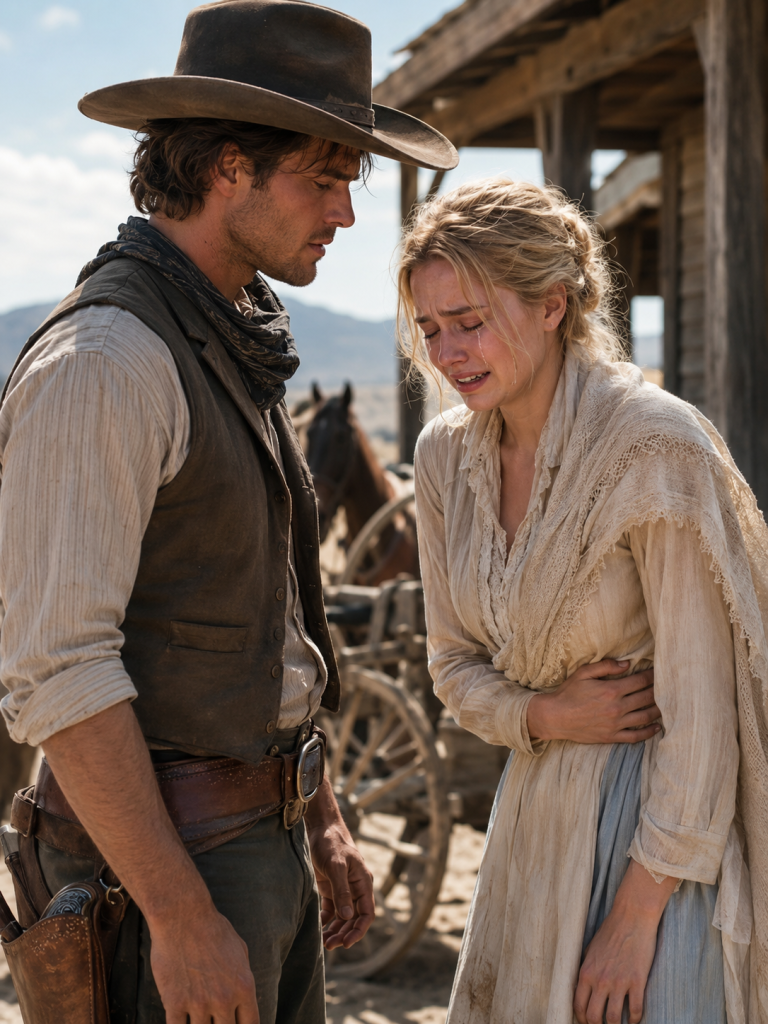
Clara stood on the porch the morning of their departure, watching Silas load her canvas trunk into the wagon, and felt something in her chest tear slowly down the middle.
“Keep the gold hidden till you reach the bank in Bozeman,” he told her, businesslike, handing her the same leather pouch he’d set on the table the night of their wedding. “Your ticket’s already paid.”
She took it. Her fingers stayed wrapped around his a half-second longer than the exchange required.
He didn’t ask her to stay. She understood, watching his face stay carefully, deliberately unreadable, that he wasn’t going to. He’d promised her freedom the night he married her, and Silas Montgomery was not a man who broke a promise, even one that was quietly killing him to keep.
The ride down to Oakhaven passed in a silence that felt entirely different from the silence of the ride up in November — heavier, and somehow far more painful.
When the wagon rolled into the muddy main street, whispers rippled through the town like wind through wheat.
“She ain’t dead after all,” Mrs. Goggins muttered, loud enough to carry, to a woman beside her at the mercantile door.
The saloon doors banged open before the wagon had even stopped. Josiah Higgins staggered out, eyes bloodshot and wild, and closed a hand around Clara’s arm before she could climb down.
“That money’s mine,” he said. “I’m your father—”
Silas moved before Clara could pull free. One hand closed on Josiah’s collar and threw him bodily into the mud of the street, hard enough that the crowd gasped back a full step.
Sheriff Caldwell started forward, hand hovering near his belt, and stopped cold when Silas’s voice cut across the street like a blade drawn from a sheath.
“My wife boards that stage,” he said, flat and final. “Anyone lays a hand on her answers to me.”
Nobody moved. Even the sheriff swallowed and looked away.
Silas turned back to Clara. He reached into his coat and drew out the paper ticket she’d been dreaming about for three years, and held it out to her. His hand — the same hand that had thrown her father into the mud without breaking a sweat — was trembling.
“Go,” he said, and his voice had dropped into something Clara had never heard from him, something raw and quiet, meant only for her ears in a street full of watching people. “Go be a teacher. Go find your bright lights, Clara.”
Clara looked at the ticket. She looked past it, at the stagecoach that was supposed to be the end of every hard road she’d walked since she was sixteen years old.
Then she looked at Silas Montgomery. At the silver scar cut across his cheek. At the shoulders that had carried her trunk like it weighed nothing, and carried a grief for fourteen years that would have broken most men in one. At the eyes that had seen exactly who she was on the one night her own father had looked at her like a line item in a debt ledger.
She understood, standing in the mud of a street that had pitied her for a month, that Boston had never actually been the dream. Boston was just the shape her dream had taken because it was the only shape available to her at sixteen. What she’d actually wanted — the whole time, under the acceptance letter and the hidden dollars and the blackberries picked at dawn — was somewhere she could breathe. Somewhere safe. Somewhere she mattered to someone for reasons that had nothing to do with what she could produce or what she was worth on a ledger.
She had already found it. It was eight thousand feet up a mountain, behind a locked door that had turned out to be the safest room she’d ever stood in.
Clara reached out — and didn’t take the ticket.
She laid her hand over his instead.
Silas went completely still. She felt the breath catch in him, sharp, like she’d struck a nerve he didn’t know was exposed.
“The Normal School turns girls into spinsters who teach other people’s children how to want things they’ll never get to have,” Clara said, and her voice came out steadier than she felt, carrying clean across the silent street. “I’m already a married woman, Mr. Montgomery. My place is with my husband.”
“Clara.” His voice cracked on her name, just slightly, just once. “You don’t have to do this. You’re free. I meant that.”
“I know you did.” She smiled, and felt tears she wasn’t ashamed of this time slide down her face. “That’s exactly why I’m choosing to stay.”
She turned to the stage agent before her father could find the wind to argue further.
“Mr. Fletcher, you can refund that ticket to my husband. I won’t be needing it.”
Josiah scrambled up out of the mud, sputtering. “Clara, you can’t — he’s a savage, girl, you can’t mean to—”
Clara looked down at her father, at the man who had sold her for a ledger of bad debts and was now horrified she wouldn’t stay sold, and felt nothing rise up in her but a quiet, exhausted pity.
“No, Father,” she said. “He’s a gentleman. And he’s the only family I have left worth keeping.”
She turned without another word and climbed up onto the buckboard, back straight, chin level, ignoring the gasps rippling through the gathered crowd behind her.
Silas stood frozen in the street for a long moment, staring at her like she might dissolve if he looked away. Then something broke loose in his face — the years, the grief, the careful distance he’d kept for four months — and a slow smile spread across features that had forgotten, somewhere along the way, how to do it. It erased ten years off him at once, and Clara realized, watching it happen, that she was the first person to see that smile in a very long time.
He climbed up beside her and took the reins, and as the wagon turned back toward the mountain, he reached over and laced his fingers through hers.
He didn’t let go for the whole ride home.
—
Clara Higgins never boarded a train to Massachusetts.
She built a schoolhouse instead — in the valley below the Bitterroots, with lumber Silas cut himself and glass windows he ordered special from Bozeman because he remembered, without her ever saying so twice, how much she’d loved the light coming through the ones in his cabin that first night. She taught the children of miners and trappers their letters and their sums, and on Sundays she played her mother’s violin on the porch while Silas sat below the steps, no longer a solitary ghost haunting the high timber, but a man rebuilding, slowly and deliberately, everything he’d once believed he’d lost the right to have.
Oakhaven eventually dried up and blew away, the way mining towns do. The general store closed. Mrs. Goggins’s gossip outlived her by exactly no time at all.
But the cabin in the Bitterroots stood for the next forty years, and if you’d asked anyone who knew them — the schoolchildren grown old, the grandchildren who grew up hearing the story — they would have told you the same thing Clara used to say herself, every October, on the anniversary of a wedding day she’d once wept through in a borrowed dress.
That the coldest night of her life had also been the night someone finally handed her the truth instead of a lie, and that some doors don’t lock you in.
Some of them lock the rest of the world out, so that for the first time, you’re finally safe enough to be found.
THE END