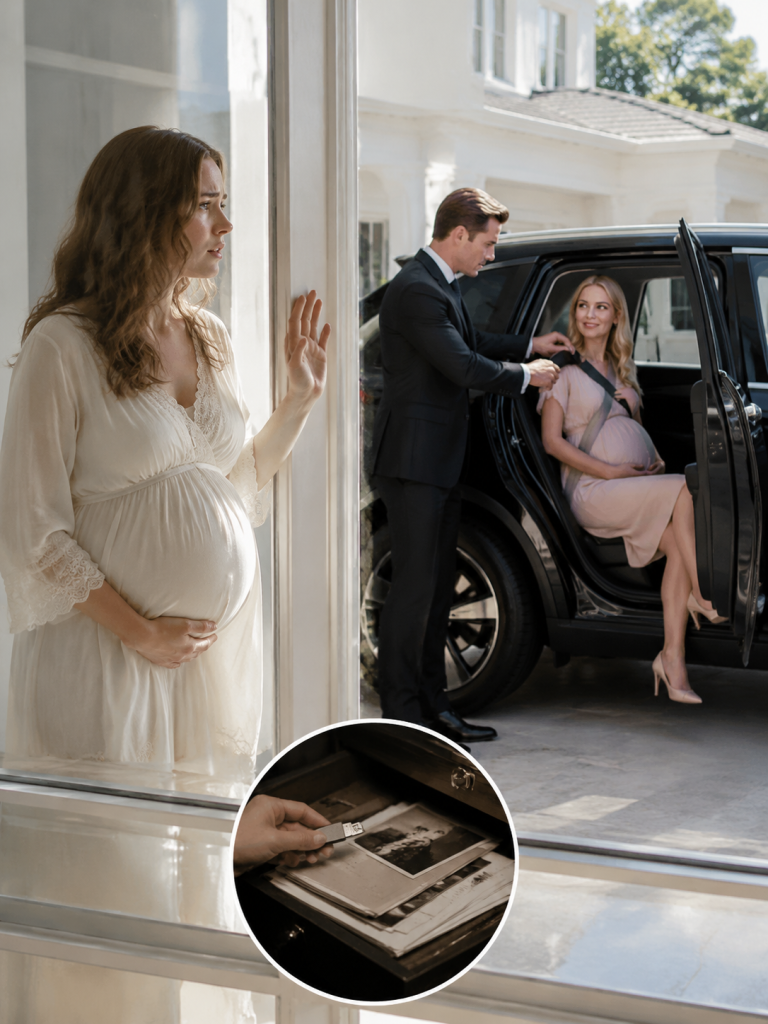
The Billionaire Mafia Boss Chose Another Woman While His Daughter Was Being Born—But When Midnight Came, the Baby’s First Cry Revealed the Secret His Family Had Buried

**PART 1**
Before the numbness had left her legs, before the medication had finished deciding whether to stay or go, before she had learned the precise weight of her daughter in her arms, a small boy appeared in the doorway of Room 312 at Allegheny General.
He was wearing frog pajamas and a green zip-up hoodie and one untied sneaker, and he was carrying a paper cup of hot chocolate that had clearly been warm an hour ago and wasn’t anymore. He had the specific lost quality of a child who had wandered somewhere he understood was wrong and was deciding whether to admit it.
He did not look at Sera first.
He looked at the bassinet.
“Is that yours?” he asked.
Sera Holt’s throat was raw. Her hair was damp against her temples. Her body felt like a house that had been through something structural — the roof still on, the windows still whole, but something fundamental about the relationship between floor and ceiling had shifted.
“Yes,” she said. “That’s mine.”
The boy took one careful step closer.
“Where’s the dad?”
At that precise second, Sera’s phone lit up.
She saw the notification without meaning to. A photograph, sent from a number she didn’t recognize, of a man she had spent three years believing in. He was at a restaurant — the kind with candlelight and chairs that cost more than monthly rent — with his jacket open and one hand resting over the hand of a woman named Adrienne Vale.
Adrienne Vale, whose photograph appeared in charity coverage and whose family name was on two buildings and a children’s hospital wing and who had smiled at Sera once at a gala, very briefly, the way a woman smiles at something she’s already decided is temporary.
Sera stared at the photograph.
She had used everything she had for the labor. There was nothing left for crying.
She turned her head toward the bassinet. Her daughter’s fingers were curled beside her cheek, impossibly small, already holding on to nothing and everything at once.
The boy in the doorway asked again, softer: “Where’s the dad?”
Sera reached for the edge of the hospital blanket and tucked it carefully beneath her daughter’s chin.
“He chose somewhere else,” she said.
The boy frowned. This did not fit his understanding of how fathers worked.
“What’s her name?”
Sera had planned to say the name for the first time with Matteo beside her. She had imagined him leaning over the bassinet, whatever armor he wore in public set aside, his voice doing the thing it sometimes did when he forgot she was watching — going quiet and real.
But Matteo was across the city with Adrienne Vale’s hand under his.
So Sera said the name to a lost child in frog pajamas.
“Wren,” she said. “Her name is Wren.”
The boy nodded. “That’s a bird name.”
“It is.”
“My grandma’s middle name is Rose. That’s a flower.”
“Both work,” Sera said.
He seemed to find this satisfactory. He looked at the hot chocolate, decided against it, and wandered back out into the hall.
Sera was alone again.
Her phone vibrated.
A message followed the photograph.
*Thought you should know.*
No name. No explanation. The sender had already become a blocked number.
Sera set the phone face down.
Outside the window, October was doing what October did to Pittsburgh — bringing down rain and stripping the trees early and turning the bridges over the rivers dark and beautiful against a gray sky. Somewhere on the floors below, the city continued its Tuesday evening.
She had driven herself here.
Her water had broken at 4:47 in the morning. She had called Matteo twice, then a third time, then stopped because three unanswered calls told her what she needed to know and she had work to do. She drove with a folded towel on the seat and one hand on the wheel and contractions rolling through her every seven minutes, and at admissions the nurse had asked, “Is anyone meeting you?” and Sera had said, “He’s on his way,” because that was what you said, because the alternative was a truth she wasn’t ready to say in a bright lobby to a stranger.
Eleven hours later.
Room 312.
And a photograph.
She had met Matteo Greco at a donor reception for a community arts program, standing behind the registration table with a lanyard and a clipboard. He had arrived late, which she noted, and he had stopped at her table, which she noted, and he had looked at her in the specific way of a man who had not been surprised by something in a long time and was experiencing the novelty of it.
“You’re the only person in this room who looks bored,” he had said.
“I’m not bored,” Sera had said. “I’m efficient. Bored and efficient look similar from a distance.”
He had smiled. Later she would understand that the smile was what he chose to give her, selected from several options. At the time it had simply looked like a real smile.
Greco Development owned the restored warehouse district along the water. Greco Logistics moved materials across four states. The Greco Family Foundation gave scholarships and endowed libraries and planted trees in neighborhoods the Greco family had quietly controlled for two generations. People said other things about Matteo in lower voices, in specific rooms, but Sera had not yet been in those rooms.
The first year, she had felt chosen.
By the second, she had begun to understand that chosen and owned were close enough in his vocabulary that he sometimes confused them.
When she told him she was pregnant, he had gone very still for almost a full minute before he kissed her forehead and said, “This changes everything. I’ll do right by you, by both of you, I swear it.”
She had wanted so badly to believe him.
And she had. Almost all the way to the delivery room.
At 9:53 p.m., someone knocked.
Not a nurse. Not Matteo’s signature knock, which was four quick raps, impatient even in hospitality.
Three knocks. Even. Almost apologetic.
“Come in,” Sera said.
The door opened slowly.
A man stood in the threshold.
He was older — late fifties, maybe sixty — with the build of someone who had been powerful longer than she’d been alive and had simply learned to carry it more quietly over time. Silver hair. A dark wool overcoat still damp from the rain. His hands were at his sides and visible, which she registered without knowing why it registered.
He did not cross the threshold.
“Ms. Holt,” he said.
Sera’s hand moved toward the bassinet.
The man noticed this. He also noticed the precise arrangement of the room — the bassinet within reach of the call button, the bed angled so no one could approach Wren without first passing Sera.
His expression shifted.
Not surprise. Recognition.
“My name is Frank Caruso,” he said. “I’m sorry to come like this.”
Sera knew the name.
People who had paid attention to the old neighborhoods of Pittsburgh for long enough knew it — the North Side crews, the long arm of organizations that had once controlled streets and docks and the particular commerce of fear. Frank Caruso had survived three trials and one attempt on his life and had been described in newspaper profiles, when they dared, as “semiretired.”
Semiretired, in her experience, was a word people used about men who no longer needed to be visible to be present.
“Why is Frank Caruso at my hospital room door?” Sera asked.
“Because I heard a nurse say you were alone.”
“That’s not an answer.”
“It’s the start of one,” he said.
“Start it and finish it or leave.”
He looked at her for a moment.
“There’s a lawyer I’d like to bring. Tonight, before Matteo Greco arrives. Before you’re too tired to understand what I need to tell you.”
Sera looked at her daughter.
Wren’s mouth was moving in sleep, small and serious, searching for something she couldn’t yet name.
“Tell me first,” Sera said. “The lawyer comes after I decide.”
Frank nodded.
“Can I sit?”
“Chair by the window. Don’t come near her.”
He sat exactly where she told him.
—
**PART 2**
“Matteo’s father died fourteen months ago,” Frank said. “Officially, the business passed to Matteo. Unofficially, the family fractured. His cousins wanted the northern contracts. His uncle wanted the shipping. Adrienne Vale’s family wanted political access and a legitimate face for money that needed one.”
Sera said nothing.
“Two years ago,” Frank continued, “Matteo made a private arrangement with Adrienne’s family. Not marriage — not yet. But a promise of it. In exchange for protection, influence, and judges who return calls faster than they answer subpoenas.”
“He told me she was a development partner.”
“She is. But she donates other things as well.”
Sera’s hands were very still on the blanket.
“He wasn’t at the restaurant because he lost track of time,” Frank said. “He was there because she demanded proof. His people told him you were in labor and he calculated that he had a window.”
“He knew I was in labor.”
Frank paused.
“He was in the parking lot this morning,” Sera said.
Frank’s stillness deepened.
“I thought I imagined it. I was in pain. But I saw his car near the east exit when I pulled in. I called him from the walkway.” She looked at Frank. “He let me go inside alone.”
Frank looked at the window.
“Ms. Holt,” he said, “I need to tell you the rest. And you won’t be able to unknow it.”
Wren stirred. A small sound, half-protest.
Sera lifted her out of the bassinet, ignoring the pain this cost her, and held her daughter against her chest.
“Tell me,” she said.
Frank leaned forward.
“The Greco family trust has a provision. Old money, old terms. Full control passes to the direct heir only when a blood successor is recognized by the family council.”
Sera heard him.
She heard the sentence rearrange her understanding of the past nine months. Of Matteo’s silence when she told him. His careful calculation behind the kiss on her forehead. Every phone call she’d talked herself out of worrying about.
“He knew,” she said.
“When you told him, he understood what it meant for the trust. Not just for the child — for him. For everything he’d been trying to hold together since his father died.”
“And Adrienne?”
“Found out five months ago. She demanded you gone. He refused because you were necessary. So they compromised.”
Sera heard a sound that was coming from her own chest.
“What does compromise mean?”
Frank’s voice lowered. “An apartment in his building. A private doctor. Money, support, forms to sign. He would frame it as care. And when you were settled in, when you were dependent, when your world was small enough — they’d begin building a record. That you were struggling. Overwhelmed. That he needed to step in.”
The room tilted.
“My daughter,” Sera said.
Frank did not answer quickly.
“Tell me the rest.”
“Forged psychiatric notes. A background investigator’s report on you — your student loans, your mother’s medical debt, the eviction at twenty-three. Every vulnerable thing, compiled and ready to be a story.”
Sera closed her eyes for one second.
Her mother had worked the overnight cleaning shift at a law firm for eleven years while Sera was in school. She had died at fifty-six with her debts mostly paid, quietly proud of that fact, without understanding that someday a man she’d never met would use them as a weapon against her daughter.
“There’s a lawyer on her way,” Frank said. “I called her before I knocked because I wasn’t sure I’d have the nerve to knock.”
Sera opened her eyes.
She looked at Wren.
Her daughter’s face was solemn and searching and utterly indifferent to the machinery of the world that had been built around her arrival.
“Her name?” Sera said.
“Margaret Voss. She’s argued family law in Allegheny County for twenty-two years. She does not like men who make plans about children.”
“What do you get from this?”
Frank looked at the window. “Another time.”
“Now,” Sera said.
He was quiet for a moment.
“My mother’s name was Rose,” he said. “She had a flower name, like your girl’s bird name. She left the man who hurt her when I was nine years old and there was no one on the other end. She went back because going back was the only door that stayed open.”
Sera held Wren tighter.
“I kept the worst parts of myself away from my family,” Frank said. “That’s what I told myself. That the damage I did to other people’s lives stayed away from the people I cared about. It didn’t. It never does.”
He looked at Sera directly.
“Tonight I can make sure that one child has a door that stays open. That’s what I get.”
Sera looked at her daughter.
“Call the lawyer,” she said.
—
**PART 3**
Margaret Voss arrived at Room 312 at 10:47 p.m. wearing a gray coat, leather bag over one shoulder, and the expression of a woman who had heard many versions of this story and had never once found the telling easy.
She did not ask Sera if she was certain.
She pulled a chair directly to the bedside, opened a yellow legal pad, and said: “Start at the beginning. Not the dramatic beginning — the real one. The day you met him.”
So Sera did.
She told her about the donor reception. The registration table. The slow smile she had not understood was a selection from options. The three years of being carefully managed inside a life that felt like hers because she had been allowed to choose the curtains and the coffee and the books on the shelves.
She told Margaret about the pregnancy test and the long silence before the kiss on the forehead. She told her about calling him three times while contractions rolled through her and driving herself here and telling the admissions nurse he was on his way.
She told her about the photograph.
Margaret looked at it once. “Do you know who sent it?”
“No name.”
Frank said, “Adrienne Vale.”
Sera turned.
Frank had his phone out. “A man was brought into the ER earlier tonight. Knife wound. He had a document drive and your name written on a piece of paper. He works at Greco Development. He was trying to reach me with what he knew before Matteo’s people reached him.”
Margaret looked at Frank with the flat assessment of a woman who had dealt with many complicated sources.
“He’s awake?” she asked.
“Fifteen minutes ago.”
“I’ll need his statement.”
“He’s expecting your call.”
Margaret turned back to Sera. “Adrienne sent the photograph expecting you to call Matteo in distress. To give them something to use.”
“I didn’t call him,” Sera said.
“I know.” Margaret looked at her. “You named her instead.”
That landed differently than she’d expected.
Sera nodded.
At 11:22 p.m., Margaret filed an emergency motion from her laptop balanced on the rolling hospital tray. Frank arranged for two men he trusted to retrieve Sera’s belongings from Matteo’s apartment on the north side before Greco’s people understood the night had turned.
At 11:47 p.m., the hospital security director came up to the maternity ward and positioned an additional guard at the corridor entrance.
At 12:09 a.m., Matteo called.
Sera watched his name move across the phone screen.
Three years of weather, she thought. When he was pleased, the room warmed. When he went distant, she had spent days rearranging herself to bring him back. She had excused his silences and reframed his absences and chosen, again and again, the explanation that required the least of her.
She did not answer.
A voicemail appeared. Then another. Then a text.
*You’re upset. Don’t do anything you can’t undo. I’m coming. We’re a family.*
A minute later: *Clara, don’t make me handle this through lawyers.*
Margaret read it and made a small precise sound.
“There he is,” she said.
Frank, at the window, said: “He’s in the lot.”
Matteo came through the maternity ward at 12:31 a.m.
He came prepared for a different kind of woman than the one he found. He had white flowers — the kind sent to hotel rooms and to funerals — and his face was arranged into concern the way it was always arranged into whatever the room required.
Two of his men were turned back at the nurse’s station. He came alone.
He registered Frank first. Something moved in his eyes — quick and cold, then controlled.
Then he saw Sera.
He had planned for a version of Sera that was raw and frightened and grateful for his arrival. He had not planned for Sera upright in the bed with Wren in her arms, Margaret Voss beside her, Frank near the window, and his own text messages face-up on the tray table.
“Sera,” he said, and put warmth into it. “What is this?”
Margaret stepped forward. “Mr. Greco. I’m Margaret Voss, counsel for Ms. Holt. Any communication regarding Ms. Holt or her daughter goes through this office.”
Matteo didn’t look at Margaret.
He looked at Sera with the specific quality of attention she had once found flattering and now recognized as assessment.
“You went through something terrible today,” he said softly. “I wasn’t here. That’s on me and I’ll live with it. But you don’t need these people. You need to come home.”
“There is no home,” Sera said.
His expression shifted. Genuine pain — she could see it, and she had expected the sight to pull at her, but instead she observed it as she might observe rain against glass. Present. Not touching.
He took a step forward.
Frank moved his head.
Not even a full shake. A quarter inch.
Matteo stopped.
His gaze moved to the bassinet.
For the first time that night, he saw his daughter.
Something real moved through him. Sera had spent three years learning to read his face, and this was not performance. He looked at Wren with an expression that had not been selected from options.
“She’s mine,” he said.
Sera held Wren closer. “She’s herself.”
Matteo’s jaw tightened.
“Clara, don’t say things other people told you to say.”
“Sera,” she said.
He blinked.
“You’ve called me Clara twice tonight. My name is Sera. You’ve known that for three years.”
He recovered quickly. He always recovered quickly. “You know I sometimes—”
“You were in the parking lot this morning,” she said.
The room changed.
Matteo’s face went still in the specific way of a man whose calculation has been interrupted.
“I called you from the walkway,” Sera continued. “I was in labor. You were fifty yards away. You let me walk in alone.”
Frank’s eyes narrowed.
Margaret went very quiet.
Matteo said: “I couldn’t risk Adrienne’s people seeing me arrive at a hospital with you. There were things I needed to manage before I could—”
“Were they watching?” Sera asked.
He stopped.
“Were Adrienne’s people watching the hospital?”
No answer.
Just the sound of rain on the window and Wren breathing and the quiet machinery of the monitoring equipment.
“Answer her,” Margaret said.
Matteo’s voice dropped into something that was meant to sound like privacy between them.
“I made a mistake. I made several. But I love our daughter, and you know that, and I am asking you not to let people who don’t know us make decisions for us.”
Sera looked at her daughter.
She thought about what it would mean for Wren to grow up watching her mother make this calculation and arrive at the wrong answer. She thought about the three years she had spent excusing and reframing and choosing the version that required the least of her. She thought about her mother working overnight shifts at a law firm, quietly proud of paying what she owed.
She looked up.
“You love her,” she said. “I believe that.”
Something shifted in his face.
“But you would have taught her that love is a structure you build around people to keep them where you need them. That love means access. That love means ownership.” She held Wren’s gaze, her daughter’s dark unfocused eyes finding her face with the patience of someone who had arrived very recently and was still learning the important things. “That’s not what I want her to learn first.”
Matteo looked at her for a long moment.
Then he set the flowers on the counter. He didn’t throw them. He placed them with the precise deliberateness of a man storing something for later.
“You’ll regret making me a visitor in her life,” he said.
Margaret stepped fully between them. “Mr. Greco. You’re leaving. Emergency orders are being filed this evening. If you make contact outside this office, I’ll ensure every member of the Allegheny County family court bench understands the full context of why.”
Matteo looked past Margaret at Frank.
“This is a long way from retirement,” he said.
Frank looked back at him with the equanimity of a man who had nothing left to prove.
“People like you,” Frank said, “keep making retirement complicated.”
Matteo’s eyes returned to Sera one last time.
The calculation was still visible in them. The pivot to the longer game. The assessment of how many pieces could still be moved.
Wren made a small sound — not a cry, just a comment, the sort of sound newborns make when they are expressing a general position on the world.
Matteo heard it.
His face changed a final time, into something that had no strategy in it at all.
Then he left.
—
By the following noon, Margaret had the emergency protective order in place.
Frank arranged a furnished apartment in Lawrenceville through a woman named Delia, who owned the building and had two daughters of her own and told Sera upon meeting her, “You knock on my door anytime, day or night, there’s no wrong hour.” She left a pot of soup outside the door that first evening.
A maternity ward nurse named Phyllis, who had been taking notes since 4:47 a.m. without being asked, signed a statement documenting the hours of Sera’s labor, the unanswered calls, the admission to the ward alone. Phyllis had been doing this for twenty-one years. She had seen many women come through Room 312 alone and had never found a way to prevent it. Signing the statement was the thing she could do now.
The photograph from the restaurant was entered into evidence.
So were Matteo’s texts.
So were the forged psychiatric notes, which the investigator Margaret hired traced to a private company that had done similar work for two other family court proceedings involving Greco-affiliated interests.
Three weeks later, one of Matteo’s attorneys withdrew from the representation. Then a second. The business pages noted that federal investigators had opened a preliminary inquiry into certain financial structures within Greco Development, which had nothing and everything to do with Sera.
None of it moved fast. Real proceedings never did.
Sera appeared in family court for the first time in January, in a dress she had bought with the last of the money in her checking account because she had decided she would not look like someone who needed saving. Margaret was beside her. Wren was home with Delia, who had already negotiated babysitting terms with the same firm efficiency she applied to building management.
Matteo was across the courtroom.
He looked thinner. Still put-together. Still the man who could arrange the weather in a room if given enough notice.
The judge reviewed the evidence without expression. He asked three questions of Matteo’s counsel, each of which revealed that counsel had not been given accurate information about several of the exhibits.
The order was granted. Primary custody to Sera. Supervised visitation only, at a neutral location, pending further review.
When Sera left the courtroom, Matteo said her name.
She stopped because she was already a different person than the one who would have kept walking.
He stood ten feet away with two bailiffs observing.
“Does she laugh?” he asked.
The question surprised her. It was the wrong question for a man trying to control a situation. It was the right question for a father.
“Yes,” Sera said.
“At what?”
She thought about it.
“At the radiator,” she said. “It makes a sound when it starts up in the morning. She looks at it every time like she’s caught it doing something it shouldn’t.”
His throat moved.
“She has your ears,” he said.
“I know.”
“I would have—”
“I know,” Sera said, and she meant it fully. “But you would have built a world around her that she would have spent her whole life trying to see past. I won’t let her inherit that as her first understanding of what love is.”
He looked away.
There was nothing left to say between them that was not for lawyers.
—
Spring came early that year.
Wren was six months old and had developed opinions about everything: the sound of certain birds outside the window, the specific blue of a blanket Delia had given her, the presence of Frank Caruso, who visited once a month with an unpretentious directness — he appeared, he asked if anything was needed, he held Wren for exactly as long as she tolerated it, and then he left.
Sera had asked him once, in March, sitting at Delia’s kitchen table with coffee between them, what he expected from all of this.
“Nothing,” he’d said.
“That’s not an answer.”
“It’s the true one.”
She’d looked at him. “I’ve been learning to distrust answers that sound too clean.”
He’d almost smiled. “Good. Keep doing that.”
“Then try again.”
He’d looked at the window for a moment.
“I knocked on your door the night you gave birth alone,” he said, “and you let me in anyway. You checked the exits before you listened to me. You protected your daughter before you had any information. You made a decision under the worst conditions possible and it was the right decision.” He looked at her. “I’d like to see what comes after that. That’s it.”
Sera had held that.
“That’s still not nothing,” she’d said.
“No,” he’d agreed. “I suppose it isn’t.”
He left the door open on the way out and Wren had immediately lost interest in the rattle she’d been holding and watched the door until it closed, which Frank seemed to find privately significant.
In June, Wren stood for the first time.
It happened in the morning, in the kitchen, with no audience except Sera and the radiator, which Wren acknowledged briefly before becoming absorbed in the project of standing. She held the edge of the low kitchen cabinet, took her hands away, stood for three seconds with the astonished expression of someone who has discovered they are capable of something they had not entirely planned, then sat down.
She looked at Sera.
“I know,” Sera said. “Do it again.”
Wren did it again.
By October — Wren’s first birthday, the month Pittsburgh stripped its trees and shone rain on its bridges and did the things it did in autumn — Wren could cross the living room in seven wobbling steps before sitting down decisively, as if she’d decided the destination could wait but the effort was the point.
Frank came on the birthday.
He arrived with a paper bag of warm rolls from a bakery three blocks over, which he handed to Delia, who had decided weeks earlier that Frank Caruso was difficult in ways she didn’t mind and useful in ways she appreciated.
Wren was in the living room attempting to cross the space between the couch and the coffee table when he came through the door. She registered his arrival and took three steps toward him before sitting down abruptly and looking at the floor with the expression of someone recalibrating.
“She’s assessing the terrain,” Frank said.
“She does that,” Sera said.
Frank crouched down to her level. He did not reach for her. He simply became available.
Wren looked at him.
She had her father’s dark eyes and Sera’s way of holding very still when she was deciding something.
She took two more steps and grabbed his knee with both hands.
He put his hand briefly on her back, steadying her.
Sera watched from the kitchen doorway.
She was thinking about Room 312 and the three knocks and the man who had stood in the threshold with his hands visible and waited to be told he could come in. She was thinking about all the places a person could stand and how much it mattered, in the end, which side of the threshold they chose.
Margaret arrived twenty minutes later with a birthday card Wren immediately tried to eat and news that the federal inquiry into Greco Development had expanded in scope and would likely affect the pending custody review.
Delia put on music. Wren expressed a strong opinion about the song.
Frank stood near the window watching the birthday party with the specific quality of attention of a man who understood he was in the presence of something he had not earned and was not owed and would not take.
Sera came to stand beside him.
“You look like you’re doing math,” she said.
“I’m trying to understand what I did right,” he said. “To be here.”
“You knocked,” she said.
He was quiet.
“That’s it,” she said. “The whole thing. You showed up at a closed door and you knocked and you waited. Most people don’t know how to do that.”
He looked at Wren, who was attempting to interest Margaret in whatever she had found on the floor.
“She’s going to be something,” he said.
“She already is,” Sera said.
Outside, Pittsburgh moved through another October. The bridges stood over the rivers. The rain came down the way it always did, indifferent and beautiful. Somewhere below the window, traffic moved with the tired patience of people going home.
Sera stood in her own kitchen, in her own apartment, with her daughter’s birthday happening around her, and she thought about what home had meant three years ago and what it meant now.
Three years ago, home had been a permission structure. A set of doors she’d been allowed to use as long as she occupied the right amount of space.
Now home was Wren looking for her from across the room. It was Delia’s soup. It was Margaret’s flat competent voice on the phone at seven in the morning. It was three knocks on a closed door from a complicated man who had asked nothing and given something she hadn’t expected.
Wren crossed the room in nine steps this time. No sitting-down at the end. She reached Sera’s knees and looked up at her with the total certainty of someone who has found exactly where she was going.
Sera lifted her.
“You made it,” she said.
Wren grabbed her collar.
Frank, from across the room, watching: “She’s going to say that to you for the rest of your life. Every time she does something new.”
Sera looked over her daughter’s head at him.
“Is that a prediction?”
“It’s a fact,” he said. “Children remind you who you are to them. She’ll keep showing you.”
Sera held her daughter.
She thought about the photograph on the phone, face-down. The long silence before the kiss on the forehead. The three years of believing, and the one night of understanding, and everything that had grown out of the understanding.
She thought about the woman who had driven herself to a hospital in early labor and told the admissions nurse he was on his way, because the truth was too large for a bright lobby at five in the morning.
She thought about what it had cost to stop telling that story.
“Margaret,” she said.
Margaret looked up from whatever she’d been reviewing.
“Add Frank to the emergency contact list. For Wren.”
Margaret looked at Frank. Frank looked at Sera.
“I already did,” Margaret said. “Three months ago.”
Sera raised an eyebrow.
“You brought him rolls,” Margaret said. “I made a judgment call.”
Delia laughed from the kitchen. “I signed off on it.”
Frank, who had survived three trials, one attempt on his life, and sixty years of a world that rewarded men who gave away nothing, looked at a group of women who had apparently organized themselves around him while he was visiting and made a sound that was close enough to a laugh.
Wren, hearing it, turned to look at him with her father’s dark eyes.
Then she pointed at him.
“Yours?” Sera asked her.
Wren considered.
She put her head against Sera’s chest and kept the point aimed at Frank, which seemed to mean: yes, but on her terms.
“On her terms,” Sera told him.
“Understood,” he said.
He picked up the rolls. Delia took them and disappeared into the kitchen. Margaret went back to her papers. The birthday party continued the way ordinary evenings did, with small sounds and warm light and the specific richness of people who had chosen, out of available options, each other.
Outside, October finished its business.
Inside, a door that had been open since the night it was first knocked on stayed open.
Nobody was alone.
That was enough.
That was exactly enough.