My CEO Husband Chose His Pregnant Mistress Over Me — Then One Phone Call Made His Entire World Collapse

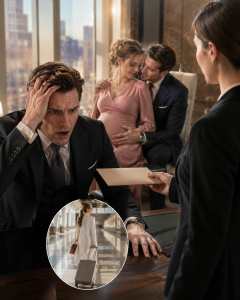
PART 1
“Thatcher, I really can’t eat anymore. The baby’s full,” Belle said, turning her face from the last spoonful of caviar.
He pressed it to her lips anyway, voice gone tender in the way it only ever went for her. “It’s for our son. One more.”
She swallowed it, pouting, then pressed herself into his chest. “You’ve spent three hours with me today. Won’t your wife be mad?”
“Why would she be mad?” His face went dark and satisfied at once. “The house, the cars, the money — I give her everything. Let her say one word and she won’t even have a place to sleep.”
Belle’s mouth twitched — something that wasn’t quite pity, quickly hidden — before she murmured that Saraphina probably had it hard too, alone with little Declan. Thatcher waved it off. “Busy with a kid of unknown origins,” he said. “I still haven’t settled that score.”
He kissed her forehead, told her to rest, and left. The second the door clicked shut, every trace of softness vanished from Belle’s face. She pulled out her phone, texted an unnamed contact — he’s gone — and got back a single word. Good.
Thatcher didn’t notice, on the drive to Greenwich, that his driver Hayes’s hands were trembling faintly on the wheel.
His key turned in the lock. The door didn’t budge. He tried again, cursed, pounded twice. “Saraphina. Open up.” Nothing. “Declan, open the door for daddy.” Silence.
He called her number. The subscriber you are calling is unavailable. He tried Declan’s smartwatch. Also dead. He was still pounding on the door when a neighbor, Mrs. Abernathy, walked by with a grocery bag and a strange look on her face.
“Mr. Sterling — why are you still here? Didn’t your family move? I saw a realtor bringing people through a couple of days ago. Urgent sale, they said. Your wife signed the closing papers herself.” She hesitated, seeing his expression. “Three days ago, I think. She had Declan and two suitcases. Said they were flying south.”
Thatcher stood frozen on the porch as though someone had emptied a bucket of ice water down his spine. He called his assistant, Callahan, who picked up sounding like he’d just been crying.
“Mr. Sterling — I was about to call you. Your wife sold the Greenwich estate three days ago. Thirty-five million. The funds already cleared into her account.”
“That’s impossible. I have the deed.”
“You forgot,” Callahan said quietly. “The estate was registered solely in her name. For the tax structuring.”
“Declan — where’s Declan?”
“Private jet. Palm Beach. Three days ago.”
“Who paid for the flight? Her cards are frozen—”
“She didn’t use your card. She liquidated her shares in that tech company her mother left her. Turned thirty three days ago — the trust released everything on her birthday. She has more liquid cash right now than you do.”
The phone nearly slipped from Thatcher’s hand. He remembered, dimly, sitting with Belle at a 3D ultrasound three days ago while his phone rang seven or eight times — Saraphina’s number, every time — and he’d simply turned it off, annoyed. She’d been at the airport the whole time.
“And my black Amex,” he rasped. “No limit—”
“She used it at a boutique inside the private JFK terminal. Four and a half million on watches. The bank tried calling to confirm and your phone was off, so the charge went through by default. Your checking account currently has less than eighty-five thousand dollars in it.”
Thatcher raised his arm to hurl the phone and stopped — a man was approaching. Mr. Prescott, the HOA manager, holding an envelope and a professionally apologetic smile.
“Mr. Sterling. How fortunate I caught you. The new owner finalized the title this afternoon. You have two hours to clear your things from the garage. The parking spaces are no longer yours to use.”
“What new owner?”
“Your wife, sir. She sold to an LLC she wholly owns. The property has, as of this afternoon, absolutely nothing to do with you.”
Thatcher’s hands shook so badly he could barely open the envelope. Inside was a fresh copy of the deed — Saraphina’s name, clean and unmistakable, listed as legal representative. He stared at the letters and, for the first time in three years, actually saw her — not the woman who’d asked every night if he was hungry, who’d waited by the door with a patience he’d mistaken for weakness, but someone who had apparently been counting, silently, the entire time.
He laughed. It curdled fast into something closer to a sob, and he sank down in front of the door he could no longer open.
His phone chimed. A voice message from Belle — flirtatious, oblivious. Thatcher, tomorrow morning I want croissants from that place in Soho. Bring them on your way?
He stared at the screen. His thumb hovered. He never pressed play again.
Nine hundred miles south, at Palm Beach International, a woman in a beige cashmere coat held a four-year-old’s hand as they stepped out of the private arrivals lounge.
“Mommy, are we never going back?”
She crouched to fix his scarf, smiling. “Going back? Of course we will. As soon as mommy finishes her business, we go back triumphant.”
She checked her phone — the deposit notification for thirty-five million dollars still glowing at the top of the screen — and let herself smile, slow and complete, for the first time in three years.
PART 2
Thatcher sat on the ground in front of the locked door for two full hours before Mr. Prescott came back to remind him the cleaning crew was arriving. He folded the divorce agreement he found in the envelope — dated, he now realized, the exact same day he’d turned his phone off at the ultrasound — and drove to the family estate in the Hudson Valley, because he had nowhere else to go and no idea what else to do.
His mother, Eleanor, was arranging flowers when he walked in. “They’re gone,” he told her. “Saraphina sold the house. She took Declan to Florida. She left me a divorce agreement to sign.”
Eleanor didn’t look surprised. “How many times did I tell you Saraphina wasn’t someone to be toyed with? All these years you belittled her — did you think she didn’t remember every single thing?”
“Did you know she’d leave?”
“I knew she’d leave eventually. I didn’t know she’d take the house with her.” Eleanor studied his face. “Go look in your home office drawer. Everything she left for you is there. I saw it when I stopped by to clean. If you’d looked even once, you wouldn’t be this blindsided.”
Thatcher ran upstairs. In the third drawer on the left, three leather-bound journals sat stacked with military precision. He opened the top one. The first entry was dated the second month of their marriage.
He didn’t come home again tonight. I ate dinner alone. My stomach hurts a little. Maybe it’s from the injection at the clinic yesterday. The doctor said strict bed rest for three days. I didn’t tell him. Even if I did, he wouldn’t care.
He turned the pages, faster, and faster, and the year of their marriage he thought he remembered started collapsing into something else entirely — something he had never once bothered to notice was happening right underneath him.
PART 3
The entries came one after another, each one a small, precise wound. A medical checkup where the doctor asked where her husband was, and she’d said business trip. Five vials of blood drawn, dizziness on the ride home, a hundred-and-fifty-dollar cleaning fee for the Uber she’d thrown up in, which he’d paid without ever asking why. Declan’s first word — dada — sent to him in a video he’d watched, replied okay to, and deleted half an hour later. A hundred-and-two-degree fever, a phone call he’d answered with a woman laughing in the background, told her to call the concierge doctor because he was in a meeting. She’d taken the Tylenol herself and noted, plainly, that by morning the fever had broken but something in her had gone cold along with it.
Page twenty-three: he’d caught her looking at his phone and told her to know her place — he didn’t deprive her of anything, houses, cars, money, don’t cross the line. She’d written, quietly, that she’d wondered what exactly he thought he wasn’t depriving her of. The passenger seat no one ever sat in. The slippers by the door where there was always only one pair out.
Page forty: he’d come home drunk and called her Belle. She’d corrected him. He’d slapped her — not hard, she noted, almost generously — and she hadn’t slept that night, staring instead at the black card he kept under her pillow, buying nothing, just holding it.
The last entry was sloppier, written in a hurry. Their son’s fourth birthday. He’d called, not to wish Declan happy birthday, but to tell her Belle was pregnant and suggest she move out quietly. She’d said uh-huh and agreed, already having decided, two months earlier, exactly what she was going to do on her thirtieth birthday. The house, the cars, the money — she’d take it all herself. He wouldn’t have to kick her out.
Thatcher’s hands shook so badly he nearly dropped the journal. He remembered the slap, dimly, the way you remember something you’ve spent real effort not remembering — and remembered, too, noticing the next morning that her cheek was faintly red, and believing her when she said she’d just slept on it wrong.
Beneath the last entry, in smaller handwriting he almost missed: Thatcher, I waited for you to come to your senses for three whole years. The day you finally look back, I’ll throw these diaries in your face and tell you Declan is not a Sterling at all. Guess whose son he is.
He read it five times. His mind went entirely blank. Not his son. Four years of birthdays, of forced family photos where he’d glanced sideways at Declan’s face and told himself he saw his own features there.
He flipped back further, to entries he’d skimmed too fast the first time, and made himself slow down. Page nine: she’d asked him, gently, if he wanted to help pick a name, and he’d said whatever you want, I have a call. Page twelve: Declan’s first pediatrician appointment, a two-hour wait alone in a lobby full of couples, her handwriting noting, without self-pity, that she’d stopped expecting him to show up around month six and it had, if anything, made the appointments easier to sit through. Page nineteen: a school open house he’d promised to attend and then texted, at the door, that a client dinner had run long — she’d gone in alone, sat in the small plastic chair meant for two parents, and later that night written only, He asked why nobody sat next to me. I told him you were working. It felt like practice for a lie I’d be telling for years.
There was a page, near the middle, where the ink had smudged slightly, as though a drop of water — or something else — had landed on the paper before it dried. She’d written about his father’s stroke, about the six months she’d spent driving to the hospital every evening after work, holding a spoon to Conrad’s mouth while Thatcher texted her from wherever he was that week asking if there was anything urgent. She never told me it was urgent, she’d written. I don’t think she thought I’d come even if she did.
Thatcher pressed the heel of his hand against his eyes and sat with that for a long moment before calling Callahan, voice hollow, and telling him to pull every hospital record that existed to find out who Declan’s real father was.
Callahan was quiet for three seconds. “Mr. Sterling — before she left, your wife told me if you ever asked, I should hand this to you.” A DNA test, dated the seventh day after Declan’s birth. Complete exclusion of paternity.
The phone slipped from Thatcher’s hand and shattered on the marble floor.
*
By morning there was an emergency board meeting he barely made in time for, called by a wife who was, it turned out, dialing in from a bright office in Palm Beach in a gray cashmere sweater looking entirely unlike the woman who’d waited three years by his door. Board member Thorne informed him, with visible discomfort, that Saraphina now controlled 37.5 percent of Sterling Group’s shares — Eleanor’s entire stake, gifted to her three days earlier, fully documented and airtight — making her the majority shareholder with the legal right to demand his removal.
She’d already emailed the board a photo of him embracing Belle in a hotel lobby, timestamped alongside a two-million-dollar corporate reimbursement filed under marketing expenses. Three years of it, all told, over two million dollars in corporate funds funneled toward an affair he’d never once thought to hide carefully, because he’d never imagined anyone was keeping score.
“Did you do all this for revenge?” he demanded.
“I’m not getting revenge on you, Thatcher,” she said, entirely calm. “I’m exercising my rights as majority shareholder. Under your tenure, profit fell forty-two percent. Senior turnover hit sixty percent. You missed seven quarterly meetings. It’s enough for me to simply state the facts.”
Two-thirds of the board had already signed her removal proposal. Thorne looked away. Mercer checked his phone. Vance stood up mid-meeting and walked out for a cigarette, brushing past Thatcher’s shoulder without a word. Nobody in that room, men who’d bowed to him for a decade, said a single thing in his defense.
“When did you start planning this?” he asked the screen.
“Three years ago. When I was carrying Declan and you were celebrating someone else’s birthday. I realized I hadn’t married you to be furniture. Since you never took me seriously, I decided to take what you actually valued. Step by step. Without rushing.” She closed her folder. “I have things to do. Goodbye, gentlemen.”
The call ended. Thorne, still seated, cleared his throat and said, quietly, that the board would need Thatcher’s formal resignation letter by end of day, as a courtesy, so the transition could be announced cleanly to the press. Mercer didn’t look up from his phone at all. Vance came back in from his cigarette break just long enough to collect his tablet and leave again, not meeting Thatcher’s eyes on the way out.
Thatcher picked up the internal line and learned, in pieces, exactly how thoroughly he’d been managed. Callahan had been on Saraphina’s payroll for three months — salary, a Manhattan condo, full cooperation in exchange. Every scrap of intelligence Thatcher had received in the last day had, in fact, come from her, filtered back to him through the one person he trusted least to lie to him and had never once suspected. His SIM had already been ported to a new carrier the night before; the number he’d used for a decade belonged, technically, to someone else’s account now. Two HR staffers arrived with cardboard boxes and an apologetic efficiency that suggested this wasn’t the first executive departure they’d handled that quarter, just the first one that mattered to the tabloids. Security walked him out through the lobby with his belongings fitting into a single box — a fountain pen he’d had engraved with his initials the year he made partner, two business card holders nobody would need again, and a photo of himself with his parents from a decade earlier, back when his father hadn’t yet had his stroke and still stood upright in every frame like a man who expected the world to hold its shape.
No one in the lobby stopped to ask how he was. Several people he’d promoted personally found reasons to be looking at their phones as he passed.
*
He went back to the Hudson Valley because he had nowhere else to go. Eleanor barely reacted to the news. “I’ve lived sixty-three years, son. If that baby in Belle’s belly is yours, I’ll chop off my own head. Do a little research on the dates sometime.” She told him plainly that she’d given Saraphina the shares herself, after watching him run the company into a forty-percent profit decline while his father lay in a hospital bed for six months and Saraphina — not Thatcher — visited every day, changed his bedpan, never once raised her voice.
“Belle’s baby is a theatrical prop she paid for,” Eleanor said. “Callahan sent her to you. Callahan works for Saraphina. She planted that landmine three years ago and waited for you to bury yourself in it.”
Thatcher called Belle directly that afternoon, needing to hear it from her. The flirtatious voice dropped instantly into something cold and amused. She and Callahan had been together five years; they were engaged, marrying next month, funded largely by the bonuses Thatcher had unknowingly wired his own assistant. The baby was fabricated — a prosthetic belly from a theatrical effects artist. She’d never once let him touch her, always deflecting with pregnancy excuses he’d never questioned. Saraphina had paid her handsomely for three years of performance. When Thatcher arrived at her apartment the next day it was already empty, save for an envelope with a bank card returning every gift he’d ever given her — one and a half million dollars, precisely accounted for — and a note telling him to use it to buy himself a coffin.
Within hours, a hidden-camera video of him and Belle went viral, eight million views by morning, every comment a fresh humiliation. He smashed his second phone against the wall of her empty apartment and sat there through the night in the cold.
*
His mother’s lawyer friend Lawson confirmed what Thatcher didn’t want to believe — Saraphina’s evidence was airtight, the share transfer from Eleanor notarized and unbreakable, and the two hundred thousand dollars in household allowance Thatcher had wired over three years had never been spent at all. She’d donated every cent of it to a children’s foundation, in his name.
“There’s no version of this where you win in court,” Lawson told him, not unkindly. “I’ve seen the hotel security footage. I’ve seen the hospital admission records from three years ago, timestamped against your calendar for that week. If this goes to trial, it becomes public record, and it will be considerably worse for you than anything that’s already leaked.”
“I supported her for three years,” Thatcher said. “Every dollar she’s spending was mine first.”
“She never touched a cent of it,” Lawson said. “She built her position separately, on her own instincts, starting from a trust her mother left specifically so she’d never have to depend on you for anything. You just never noticed, because you never once asked.”
He confronted Callahan directly, fists in his collar, and got only a mocking recitation of his own gullibility in return — that Saraphina had understood his character three years ago, understood that his arrogance made him easy to lead exactly where she needed him to go. Callahan didn’t even bother to look afraid, told him plainly to go ahead and hit him if it would help, that it would only add an assault charge to a week that already had more than enough of them. Belle, standing beside her fiancé with a fresh manicure and none of the tearful vulnerability she’d performed for three years, delivered the line that would sit with Thatcher longest: your main problem is that you always think you’re right. If you’d come home for dinner even once. If you’d actually looked at Declan. You wouldn’t be here.
“You could have told me,” Thatcher said, quieter now, some of the fury draining out of him. “Any of you. At any point.”
“Tell you what,” Belle said. “That your wife was smarter than you and knew exactly what you were? Would you have believed it? You didn’t believe it when I told you outright, four different times, that I didn’t want to see you that week. You just thought I was being moody. You never once asked why.”
He spent that night on an overpass, watching taillights blur beneath him, standing in the wind for twenty minutes before climbing back down and taking a cab home instead.
*
The audit came next — a forensic committee, external, independent, combing through three years of expense reports Thatcher had signed without reading, each one now traced directly to Belle’s accounts. Nearly five million dollars he’d have to personally repay, penalties included. His uncle Alistair’s shell companies, which had been quietly skimming Sterling Group contracts for years, were next on the list, forty million dollars deep, and when Alistair showed up screaming that an outsider had no right to touch Sterling business, Eleanor reminded him, evenly, exactly whose steel contracts weren’t legal last year either.
Thatcher, listening to his own family scramble to save themselves rather than defend him, understood finally that none of them had ever respected him — only the chair he’d been sitting in.
He met Saraphina at the airport when she flew back, standing beside a man named Garrison Pierce — her attorney, an old grad-school friend — holding Declan’s hand. Thatcher demanded answers he had no right to anymore. She gave him the truth without flinching: Declan wasn’t his, hadn’t ever been, conceived through a sperm bank the same week Thatcher first stayed the night with Belle, while Saraphina lay in a hospital bed with a hundred-and-two-degree fever signing IVF consent forms alone. She’d decided, in their second month of marriage, that this child would belong to no one but her.
“Why didn’t you tell me?”
“You were obsessed with Belle. You’d have made me get rid of him.”
He knew, hearing it, that she was right, and had no answer for that either.
“You were wrong about three things,” she told him, before walking away. “I was never waiting for you to come to your senses. I was waiting until I had the strength to leave. Declan isn’t your son. And whatever was between us ended the night you first stayed with Belle. I just spent three years arranging a decent funeral for it.”
He asked for forgiveness. She told him it was worthless now, and reminded him, without raising her voice, of the day her water broke and she labored alone for five hours while he celebrated Belle’s birthday with balloons and cake frosting, and the nurse had asked if her husband was coming, and she’d said it was fine, she’d deliver on her own. And she had.
Thatcher went to his knees in the middle of the terminal and stayed there until a janitor tapped his shoulder.
*
Belle released a public confession video days later — paid, she admitted plainly, to fabricate the entire affair, the pregnancy a prosthetic, Thatcher never so much as unfaithful in the way the world assumed. It didn’t rehabilitate him so much as complete the humiliation; the internet’s verdict shifted from cheating scum to gullible fool, which somehow felt worse.
He took a job as a logistics dispatcher, forty thousand dollars a year, after every executive search turned him away for his name alone — one recruiter, more honest than the rest, told him flatly that no board in the tri-state area would touch a Sterling with his particular headlines attached for at least another two years, and that he should consider that a starting point rather than a life sentence. He worked honestly. He learned, for the first time in his adult life, what it felt like to clock in on time because a shift actually depended on it, not because an assistant had built the schedule around his convenience. He had dinner with his mother on weekends and pushed his father’s wheelchair through the garden, and Conrad, who could manage only a handful of clear words most days, once patted his hand and said, slowly, better, which Thatcher chose to take as an assessment of more than just the weather. He signed the divorce settlement without contest, waiving every claim to marital assets, because he had, by then, run out of arguments that held any weight, and because some part of him had started to understand that the version of his life worth salvaging wasn’t going to be found in a courtroom anyway.
Three months later, at Sterling Group’s first public quarterly report under her leadership, Thatcher stood at the edge of the crowd in a plain gray coat, thinner, quieter, when his uncle Alistair lunged onstage with a pocketknife, screaming that Saraphina had destroyed the family. Thatcher was over the barrier and onto the stage before security moved, twisting Alistair’s arm behind his back and taking a shallow slash across his own forearm shielding her.
“Thank you,” she said, breathing hard.
“You’re welcome. First time in my life I’ve taken a hit for you.”
She bandaged the wound herself, told him to see a doctor, and he told her he wasn’t leaving — that he’d left her alone in a hospital once, and he wasn’t doing it again.
*
Weeks later, at the reveal of her first full year as CEO, she found him in the crowd again, handed him an envelope covering the remainder of his audit debt — he could pay her back slowly, she said, she wasn’t in a hurry — and told him Declan had been asking for him. In the green room, the boy ran into his legs the moment he saw him, calling him daddy without hesitation, and Thatcher went down on one knee and held on like the last four years of not truly looking at this child could somehow be undone in a single hug.
“You can come see him weekends,” Saraphina told him. “Don’t think of me as owing you anything for it.”
“Depends on my mood,” she added, when he thanked her, and walked off in her red suit toward the reporters waiting for her, powerful and entirely her own.
Declan handed him a drawing before they left — three stick figures holding hands outside a house, labeled in careful, wobbly letters: Daddy, Mommy, and Declan. Thatcher folded it into his breast pocket like something worth more than the company he’d lost.
Outside, walking Declan to get ice cream, he looked back at the glass tower and saw her silhouette in a top-floor window. He raised a hand. After a moment, she raised hers too.
That Saturday he arrived at nine sharp, in the gray coat he now owned instead of the wardrobe he used to have shipped in seasonally, and Declan barreled into him at the door of Saraphina’s building before Thatcher had even made it past the lobby. Garrison, dropping the boy’s backpack at the curb, gave Thatcher a nod that had settled, over the weeks, into something closer to neutral than hostile — not friendship, but not a threat either. Saraphina watched from the doorway, arms crossed loosely, and told Thatcher to have him back by six, and to actually answer his phone if something happened, this time.
“I will,” Thatcher said, and meant it in a way that used to cost him nothing to promise and now cost him the small, deliberate effort of a man rebuilding a habit from scratch.
They fed ducks in the park that afternoon — the same pond, it turned out, though neither of them said so out loud. Declan pointed out which ducks he’d already named on previous visits with his mother, and Thatcher listened to all of it, memorizing details the way he used to memorize quarterly earnings calls, because it turned out that was the only kind of attention he actually knew how to pay, and he intended to spend all of it on this instead from now on.
Months passed the way they do when a life is being rebuilt in small, unglamorous increments rather than one dramatic gesture. Thatcher kept the dispatcher job even after Saraphina quietly offered, twice, to find him something better; he told her the first time that he needed to know he could hold a job on his own name alone, without the Sterling weight behind it, and she hadn’t argued, only nodded once like she respected the answer more than she’d expected to. He paid down the audit debt in monthly installments that would take years to clear, and never once asked her to forgive the balance.
Declan started kindergarten that fall. Thatcher went to the open house — arrived early, in fact, sat in one of the small plastic chairs meant for two parents, and was still there when Saraphina walked in twenty minutes later, visibly surprised to find the seat beside him already occupied by the person who was supposed to be occupying it. She sat down anyway. Neither of them said much, but when the teacher asked the room whether any parents wanted to share what made their child’s family special, Declan raised his hand immediately and said his family had a mommy and a daddy who both came to see him now, and everybody clapped, and Thatcher had to look hard at his hands for a moment before he trusted his own face.
That night his phone buzzed. A single text. Tomorrow’s the weekend. What time are you coming?
Nine a.m., he wrote back. Best chocolate chip pancakes in the city.
Okay, she answered. Just that.
He put the phone away, took his son’s hand, and walked into a Saturday that no longer required looking back to survive. Whatever came next between him and Saraphina — and he no longer assumed anything, the way he once had, as a matter of course — he understood, finally and completely, that it would have to be earned in exactly this way: one kept promise, one shown-up appointment, one ordinary Saturday at a time, for as long as it took, with no guarantee at the end of it beyond the chance to keep trying.
THE END