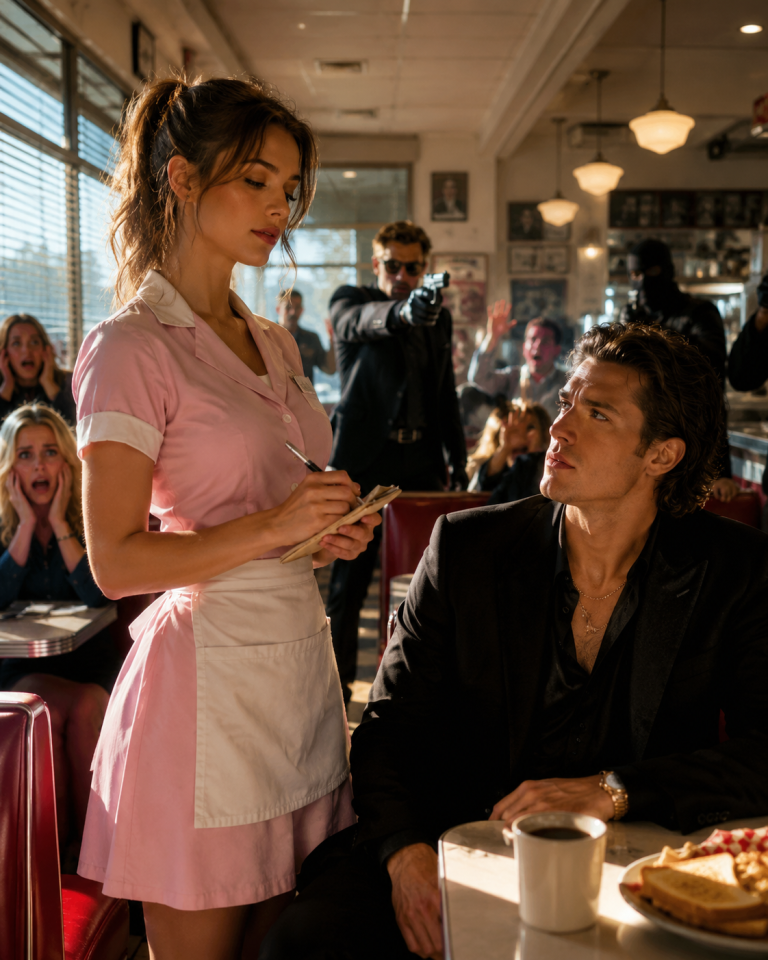
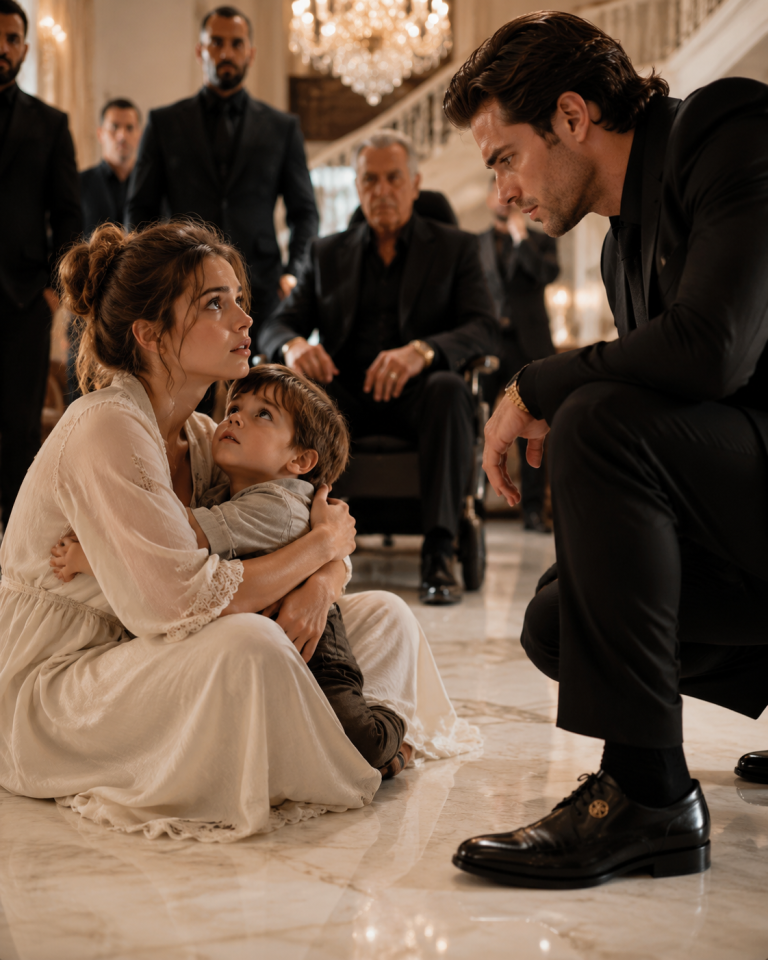
Her Husband Slapped Her at the Restaurant—Then the Mafia Boss Put Down His Fork and Said, “Do That Again. I Dare You”

## PART 1
I had spent eight months learning how to disappear inside my own marriage.
Not the dramatic kind of disappearing — no slammed doors, no tearful confrontations, no moment where I stood in the hallway with a suitcase and finally said *enough.* Just the quiet, daily erosion of a woman who kept reducing herself to fit the dimensions of a man’s patience. Smaller opinions. Softer voice. The dress he chose, not the one she wanted. The restaurant he selected. The table he approved. The version of herself he found acceptable that evening.
The night Marcus hit me in the middle of Elara, I was wearing the wrong color.
That was it. That was the whole reason.
Not the wrong dress — I had worn a dress. Not an inappropriate choice by any reasonable standard. The silk was deep burgundy, my shoulders covered, my jewelry understated. By any measure that existed outside of Marcus Holloway’s specific and shifting architecture of control, I was perfectly presentable.
But he had said the ivory dress.
And I had forgotten.
Or rather — I had remembered and chosen anyway, some small, suicidal act of selfhood I could not even fully explain to myself, some refusal so minor it barely qualified as rebellion. I had stood in front of the mirror in our apartment on the forty-first floor and thought: *burgundy. Just tonight. Just this one thing.*
That was what cost me.
Elara occupied the thirty-sixth floor of the Meridian Tower, all obsidian surfaces and candlelight and the kind of studied silence that expensive restaurants cultivate so that the wealthy can feel they are alone together. The kind of place where even the ice in the water glasses arrived without a sound. I had never felt comfortable there. I had learned to pretend otherwise.
We had been seated for eleven minutes when Marcus noticed the dress.
He did not raise his voice. He never raised his voice in public — that was one of his most sophisticated cruelties, the way he kept his fury at a temperature that read to onlookers as conversation. He leaned across the table. He told me, precisely and quietly, what the dress communicated about my regard for his preferences and his standing.
I started to apologize.
He struck me before I finished.
It was not a dramatic blow. That was the strange thing about it — how insufficient it was as a physical event compared to what it did to the room. His palm connected with the side of my face, sharp and sudden, and my wine glass tipped and bled across the white tablecloth like something hemorrhaging. The sound was not loud. But it was impossible to misinterpret.
The restaurant inhaled.
And held it.
Marcus smoothed the front of his jacket. Around us, thirty people studied their plates with the dedicated intensity of people who had decided, collectively, that they had not seen what they had seen.
My cheek burned. My eyes filled with water, which I refused to release. I pressed my lips together and thought about the geometry of the table, the placement of the salt cellar, anything solid and fixed that had nothing to do with the humiliation climbing up my throat.
Then I felt it.
Not a sound. Not a word.
A shift.
The quality of the air in the room changed, the way it does before weather arrives — that subtle drop in pressure, that alertness in the atmosphere that the body registers before the mind catches up. I looked up without meaning to.
At a table perhaps fifteen feet from ours, a man in a dark suit had stopped eating.
He had not stood. He had not reached for a phone. He had simply gone completely still in the way that large, self-contained things go still when something has caught their attention — a stillness that was its own form of attention, its own declaration.
I did not know his name yet.
I did not know anything about him except what I could observe: that he was alone, that he was not young but not old, that his face was composed in a way that suggested composure was not its natural state so much as its trained one. Dark eyes. The kind of jaw that held decisions in it.
He watched Marcus with an expression I had never seen directed at my husband before.
Not anger. Not outrage. Not the polite discomfort of a bystander wishing he were elsewhere.
Calculation.
The kind that precedes action.
He set his fork down. Touched a linen napkin to his mouth once. Stood.
The movement was so unhurried it was almost insulting to the violence of the moment it was responding to — the deliberate, controlled pace of a man who had learned that urgency signals weakness. He crossed the room in the measured way of someone who had never once needed to hurry to establish that he was the most important presence in a space.
Marcus did not notice him until the shadow fell.
“Touch her again,” the man said.
His voice was low. Conversational. The kind of quiet that requires the room to lean toward it.
Marcus looked up with the expression he reserved for inconveniences. “I’m sorry?”
The man’s eyes moved to my face — briefly, assessing, not unkind — and then returned to Marcus with the unhurried finality of a door closing.
“I said,” he repeated, each word given its full weight, “touch her again.”
Marcus produced the smile he used for subordinates who had forgotten their position. “You’re interrupting a private conversation.”
“That wasn’t a conversation.”
The smile tightened. “My wife and I don’t require input from—”
The man placed one hand on Marcus’s shoulder.
That was all.
One hand. No grip that anyone watching could objectively call aggressive. Just contact, and some specific application of pressure beneath it that drove Marcus back into his chair with a force that whitened his knuckles on the armrests.
Marcus tried to rise.
He could not.
Something moved through his face in sequence — surprise, then anger, then the beginning of something he did not want to name.
“Apologize,” the man said.
Silence.
Absolute.
Even the ambient noise of the kitchen seemed to pause. The sommelier near the window had stopped moving. Two men near the bar who I had not noticed before stood slightly straighter, as if responding to a frequency the rest of the room could not hear.
“She’s my wife,” Marcus said. His voice had lost something.
“Apologize.”
The pressure on his shoulder increased by a degree. Marcus exhaled through his teeth.
“I’m sorry,” he said, the words arriving flat and furious.
The man tilted his head.
“Olivia,” Marcus said. The name in his mouth, in that context, sounded like a door being forced. “I’m sorry.”
The hand lifted.
Marcus rolled his shoulder forward, expression rearranging itself into the specific composition of a man who was going to remember this and respond to it at a time of his choosing.
The man turned to me.
Up close, his eyes were a shade between gray and green that shifted depending on the angle — the kind of color that doesn’t hold still when you try to name it. He looked at my face the way a doctor looks at an injury: without flinching, without drama, but with full attention.
“Are you hurt?” he asked.
Three words. But the way he said them — direct, quiet, as if my answer actually mattered — made my throat tighten in a different way than the shame had.
I shook my head.
He reached into his jacket and withdrew a card. Matte black. No logo. No title. He placed it beside my water glass with the same deliberateness he had applied to everything else.
A name, embossed in silver.
*Niccolo Ferrante.*
He leaned slightly closer, low enough that only I could catch the words beneath the ambient noise of the room finding its breath again.
“If the situation changes,” he said, “use that.”
He straightened. Adjusted his cuff. Returned to his table.
The pianist, who had stopped mid-phrase, resumed playing.
Marcus was on his feet before Niccolo had fully settled back into his seat. “Do you have any idea who that is?” he hissed at me, face close, voice stripped of its public finish.
But I wasn’t listening.
My fingers had already closed around the card.
Its edges were sharp against my palm, and the pressure of it — small and solid and undeniably real — felt like the first honest thing I had touched in eight months.
—
## PART 2
I kept the card for four days.
I told myself it was because I didn’t need it. That I was capable of managing my own circumstances. That reaching out to a stranger I had met in a restaurant because my husband had struck me was not the action of a woman with a plan — it was the action of a woman who had given up on having one.
I was very convincing.
Marcus returned to form immediately. The morning after Elara, he sent two dozen white roses to my office at Hargrove & Blaine, the kind of gesture designed to be witnessed by colleagues, the kind that constructs its own narrative about what kind of husband he was. He kissed my cheek that night as if kissing could retroactively undo a slap, as if tenderness following violence was reconciliation rather than strategy.
But his eyes were different.
More watchful. More precise. He tracked my movements in ways he hadn’t bothered to before, asked questions with the quality of tests rather than curiosity. When I flinched at a cabinet door swinging wider than expected, he smiled very slightly, and the smile was worse than the slap had been.
I moved the card from my purse to my jacket pocket.
Then from my jacket pocket to the inner lining of my work bag, where I had sewn a small flat pocket years ago for no reason I had ever been able to articulate until now.
On the fourth night, Marcus came home later than expected and drunker than he presented. The dinner I had prepared was not warm enough. The specifics of his objection escalated with a logic only available to people who have already decided on a destination and are simply choosing the most available road. By the end of it, my wrist bore four fingerprint-shaped bruises arranged in a pattern that could not be interpreted as accidental by anyone who looked.
I locked the bathroom door.
Sat on the tile floor with my back against the cabinet.
Looked at my own arm for a long time.
Then I called the number on the back of the card, written in handwriting clean enough to have been typeset.
He answered before the second ring.
“I’ve been waiting,” Niccolo said, “for you to decide.”
—
We met the next day at a harbor-side café on the north edge of the financial district, where the water was gray-green and cold and the gulls worked the pylons with the focused indifference of creatures that had stopped being impressed by anything. In daylight, removed from Elara’s amber lighting and controlled atmosphere, Niccolo Ferrante looked different — not less dangerous, but more real. The scar at his temple was visible. The breadth of his shoulders was not an artifact of a good tailor. When he stood as I approached the table, it was not courtesy exactly. It was the acknowledgment of a man who had learned to mark the exact moment another person entered a room.
“I don’t need saving,” I said before I sat down.
The corner of his mouth moved. “I know.”
“Then why did you give me your card?”
He considered this. “Because some situations don’t require saving. They require information.”
I sat. “What kind of information?”
He was quiet for a moment, watching the harbor. Then: “Your husband has been pursuing a relationship with a group called the Trevisi family for approximately seven months. He believes access to their protection network will insulate him from the consequences of certain financial decisions he’s made in the last two years.”
The coffee in front of me went cold while I absorbed this.
“And what does that have to do with me?” I said carefully.
Niccolo’s eyes returned to mine. “He has been offering information about my operations in exchange for entry. Shipping schedules, account structures, personnel.” A pause. “And details about your movements and your access to Hargrove and Blaine’s client portfolios.”
The harbor suddenly felt very exposed.
“He’s using me as currency,” I said.
“He’s using you as leverage,” Niccolo corrected. “He assumes that if he can’t fully control you, he can at least commodify you. It’s a specific kind of thinking that requires viewing people as assets rather than as people.”
I stared at the water. “I didn’t know about any of this.”
“I know.” No judgment in it. Just fact.
“So what do I do?”
He looked at me directly. “You have two options. You can return home and continue managing a situation that will escalate regardless of how well you manage it — and hope that when Marcus’s arrangement with the Trevisi collapses, which it will, the fallout doesn’t include you.” He paused. “Or you leave. Tonight. I have an apartment that can’t be traced to anything connected to your current life. Accounts that are clean. Documents that are current.”
“You’d just — erase me.”
“I’d move you,” he said. “What you build after that is yours.”
I looked at him for a long moment. “And Marcus?”
Niccolo’s jaw shifted slightly. “Marcus has made choices that create consequences independent of anything you do. What’s coming for him comes regardless.”
“You’d go to war over this.”
“He chose the battlefield,” Niccolo said. “I’m simply confirming I intend to show up for it.”
I thought about the roses on my office desk. About the smile after the flinch. About the bruises arranged with a geometric precision that said *I know exactly what I’m doing.*
“I’ll think about it,” I said.
That night, Marcus didn’t give me the chance.
He came home with the specific energy of a man who had already made a decision and arrived only to announce it. The accusations came quickly — where had I been, who had I spoken to, did I think he didn’t have sources, did I think anything I did happened without his awareness. When I didn’t answer the way he required, he moved toward me, and I stepped back, and my shoulder struck the edge of the kitchen island with enough force that something inside me made a quiet sound.
Not my body.
Something else.
The thread Marcus had been pulling for eight months finally reached its end.
I packed one bag. Not carefully — not the way I had rehearsed in private, choosing essential documents and photographing joint accounts and all the careful preparation of a woman with a plan. Just a bag. Clothes. The photograph of my mother. The card.
I walked out while he was still explaining to me why I had no reasonable options.
On the sidewalk in the dark, I dialed.
Niccolo answered on the first ring.
“Where are you?” he said.
I gave him the address.
Twelve minutes later, a black car pulled to the curb. He stepped out himself — not a driver, not a representative, him — and his eyes moved over me with the same clinical attention he had given my face in the restaurant. Cataloging. Assessing.
“Your collarbone,” he said.
“I’m fine.”
“I didn’t ask if you were fine.”
His voice had changed. The composure was still there, but beneath it was something colder and more absolute.
“Get in,” he said. “He will not touch you again.”
As the car pulled away from the curb and the building receded behind us, I understood that two lines had been crossed tonight. Marcus had crossed one. And I, for the first time in eight months, had deliberately stepped across the other.
I did not look back.
—
## PART 3
Marcus moved faster than Niccolo expected, which was the first and only thing that went in his favor.
He had always confused speed with intelligence. He struck two nights after I left, sending six men to Niccolo’s estate on the northern edge of the city in the early hours of the morning with the kind of confidence that belonged to someone who had never personally experienced the gap between planning and execution. He believed that enough aggression delivered quickly enough constituted strategy.
He was wrong.
I woke to the sound of gunfire and sat upright in the dark of the guest room before the alarms had finished cycling. The door opened and Niccolo was there — dressed, armed, expression unchanged from any other version of him I had seen.
“Stay close,” he said.
The basement level of the estate ran like a secured nerve center, calm and operational in the way that genuine preparedness is always calm. Men moved through corridors with the coordination of people who had rehearsed this. No shouting. No improvisation. The contrast to Daniel’s assault — furious, reckless, over-designed — could not have been more complete.
Above us, the attack dissolved in less than twenty minutes.
I heard it end more than witnessed it: the gunfire thinning, silences widening, and then the particular quality of quiet that follows the conclusion of a thing.
When we came back up, Marcus was in the foyer.
He had made it that far himself — through broken security, past men who had been paid to stop him — held together by the last structural element of his personality, which was pride. His collar was bloodied. His gun hand shook with the particular tremor of a man running on adrenaline and the specific stupidity of someone who had spent his entire life mistaking cruelty for power.
He saw me and his face did something complicated.
Not love. Not remorse.
Possession encountering its own limits.
“You think he’s better than me?” he said. His voice was ragged. “He’s a criminal. He’s exactly what you think I am.”
Niccolo said nothing.
“She left because of you,” Marcus said, the gun rising. “She never would have—”
“She left,” Niccolo said, “because of you.”
Marcus’s eyes cut to me, and for one suspended second I saw what I had spent eight months trying not to see — that there had never been love in the way he looked at me, only the specific satisfaction of owning something, and I was watching that satisfaction realize it no longer had an object.
He leveled the gun.
I saw the fallen pistol on the marble floor before Marcus did.
I moved without deliberating. I had no training. I had no preparation beyond eight months of living with a man who had taught me, without meaning to, exactly what the alternative to action looked like. I picked up the weapon. I fired.
The sound was enormous in the enclosed space.
Marcus dropped.
The room went very still.
Niccolo turned to me slowly. He looked at my face with the same attention he had given it in the restaurant — searching, but not for fear. For something else.
My hands were not steady. But my voice was.
“He had made his decision the night of Elara,” I said. “It just took him two more months to finish saying it.”
Niccolo crossed the floor. He took the gun from my hands carefully, his fingers brushing my wrist where the bruises had yellowed to the edges of fading. The touch was brief and deliberate, the kind that asks permission through its own restraint.
“Yes,” he said simply.
Somewhere beyond the estate walls, sirens were already audible — managed, timed, the kind of response that happens when someone has anticipated that it will be needed. As the authorities arrived to categorize what they would later describe, in careful language, as a failed criminal incursion against a private residence, I stood in the ruined foyer and understood something with a clarity I had not earned through logic but through the accumulated weight of everything the last eight months had cost me.
I had not been liberated by a man.
I had been given, by one, the space to liberate myself.
—
Weeks passed.
Niccolo’s estate was large and quiet and full of people who moved through it with purpose, who did not ask unnecessary questions, who treated my presence as unremarkable in a way that was, after everything, one of the most restorative things I had ever experienced. No one managed me. No one corrected my dress or my posture or my opinions. I ate dinner where I wanted, read until two in the morning, took long walks on the grounds in the mornings when the fog came in off the water and erased the city beyond the walls.
My lawyer — my own, not Marcus’s — managed the estate proceedings with an efficiency that suggested she had been waiting a long time for me to ask. Hargrove and Blaine granted me an extended leave, during which I was surprised to discover how many colleagues had seen what I had trained myself not to show.
Niccolo gave me space the way certain people give space — not as an absence but as an active thing, a deliberate clearing of room for someone who needs to remember what their own dimensions are. He did not ask where I was going. He did not comment on my choices. When I startled at sudden sounds — a door, a raised voice from somewhere in the grounds — he noticed and adjusted the environment without drawing attention to the adjustment.
I began to understand the distinction he lived by.
There was violence in his world. He had never pretended otherwise. Men like Niccolo Ferrante did not operate in systems designed by law schools and regulatory bodies. They operated in the spaces between those systems, in the architecture of power that existed before and would exist after any particular legal framework.
But there were rules. Clear ones. Lines that held even when they were inconvenient. And what separated him from Marcus — I came to see, over those weeks of paying close attention — was not the presence or absence of force. It was the question of consent. It was the question of what he considered a legitimate object of that force and what he did not.
He did not consider women who had already been through enough to be legitimate objects of anything.
I found him in his study one evening, deep into a stack of documents with his jacket off and his sleeves pushed back, the lamp making warm light against the hard planes of his face. He looked up when I appeared in the doorway, the way he always looked up — completely, immediately, as if he had allocated his full attention to whoever arrived.
“You’re still awake,” I said.
“Reading,” he replied. “As are you, apparently.”
I crossed the room and stood at the corner of his desk. “I’ve been waiting,” I said, “for this to feel like a transaction.”
Something moved through his expression. “Has it?”
“No.” I looked at him. “Why not?”
He was quiet for long enough that I understood he was actually thinking about the answer rather than producing one.
“Because you’re not here because I required you to be,” he said finally. “And because I’m not — ” he paused, searching, ” — not keeping score of what I’ve done for you against what you owe me.”
“Most people keep score.”
“Most people think generosity is investment.”
I studied him. “What do you think it is?”
“A statement about what kind of person you are,” he said. “Not a bill.”
The simplicity of it caught me off guard. I had expected more — more philosophy, more rhetoric, something to argue with. Instead, he had just said a thing that was true.
“I don’t want to leave,” I said.
Niccolo looked at me steadily. “I know.”
“Is that — ”
“Yes,” he said. “That is what I want also.”
Not I love you. Not I need you. Not you’re mine. Just: *that is what I want also* — the language of a man who had learned to say things clearly because he had seen what happened when people said them obscurely.
I stepped closer. He stood.
When he kissed me it was nothing like the approximations of tenderness Marcus had used as currency — nothing that required me to receive it as debt. It was careful and deliberate, and when I moved toward him instead of away, I felt my own body register the novelty of moving toward something without calculating the cost.
—
Three months after Elara, I went back.
Not because I needed to close something. Not because the restaurant itself held anything I required resolution from. I went back because I was no longer afraid to, and that distinction felt worth marking.
Niccolo had suggested it, actually — or rather, he had said “wherever you want for dinner” with the kind of neutrality that meant *including there, if you want,* which was its own kind of gift.
The maître d’ recognized him the moment we walked in. The room recalibrated in the familiar way, conversations finding new trajectories, spines straightening almost imperceptibly. I had seen it a dozen times by now and had stopped being unsettled by it. This was the texture of the life I was choosing. I had chosen it knowing what it was.
We were seated near the windows.
Not the same table. Different.
But close enough that I could see where we had been, the white linen still white, the candles burning as they always did, the room continuing its practiced indifference to what had happened inside it.
I looked at the space for a long time.
“You’re allowed to feel something about it,” Niccolo said.
“I do feel something,” I said. “That’s the thing. I keep expecting it to feel like more — like I should be angrier, or sadder, or that coming back would break something open.” I paused. “But mostly I just feel like I’m someone who survived something and came back to prove the geography hadn’t won.”
Niccolo lifted his glass. “The geography rarely wins.”
“Says the man who owns buildings.”
The corner of his mouth moved. That quarter-smile I had learned to read as warmth.
“The last time I was here,” I said, “I believed the silence meant everyone had decided not to care.”
“Silence usually means people are deciding who to be afraid of,” he said. “Not who to care about.”
“And that night?”
His eyes found mine across the table. “That night I decided.”
I looked at him in the amber light — this man who had spent his life navigating power and consequence, who had never once tried to convince me that what he was was something else, who had offered me information instead of rescue and a choice instead of a plan — and I thought about the woman who had sat at a table in this room three months ago, pressing her lips together, swallowing copper, saying *I’m sorry* before she had identified the crime.
She was not gone.
She had not been transformed into something unrecognizable by everything that followed.
She had simply been given the room to remember what she was before the eight months had edited her down to something smaller.
“Thank you,” I said.
Niccolo looked almost startled. It was the first time I had seen that particular expression on him.
“For what?”
“For not rescuing me,” I said. “For letting it be a choice.”
He was quiet for a moment.
“You never needed rescuing,” he said.
Outside, the city performed its ordinary spectacle — lights and motion and the indifferent machinery of ten thousand separate lives. In here, the pianist played something low and unhurried. Crystal caught the candlelight. The same room, the same tables, the same floor that had held a different version of this evening.
But the woman sitting at this table had her chair pulled in at the angle she chose. Her glass held what she had ordered. Her dress was the color she had selected that morning with no one standing behind her waiting to approve the choice.
The humiliation of that other night had never belonged to her.
It had belonged to a man who believed that pain was the same thing as power, and who had discovered, too late and finally, that it was not.
Some women learn the difference.
Some women leave.
And some of them come back to the same room, wearing a different dress, and find that the room has nothing left to take from them.
**THE END.**