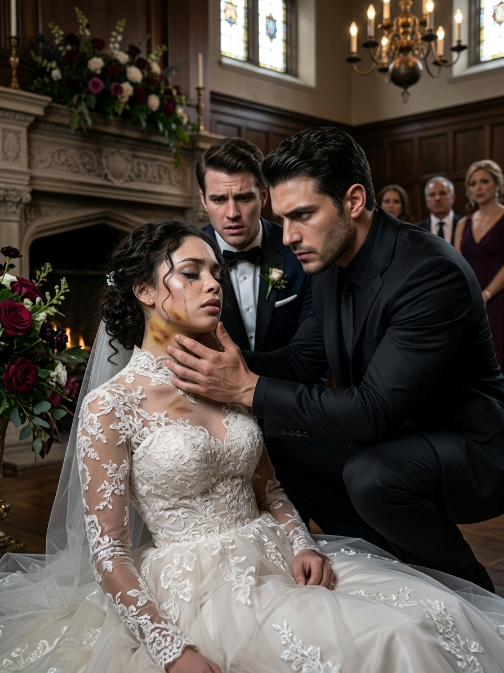
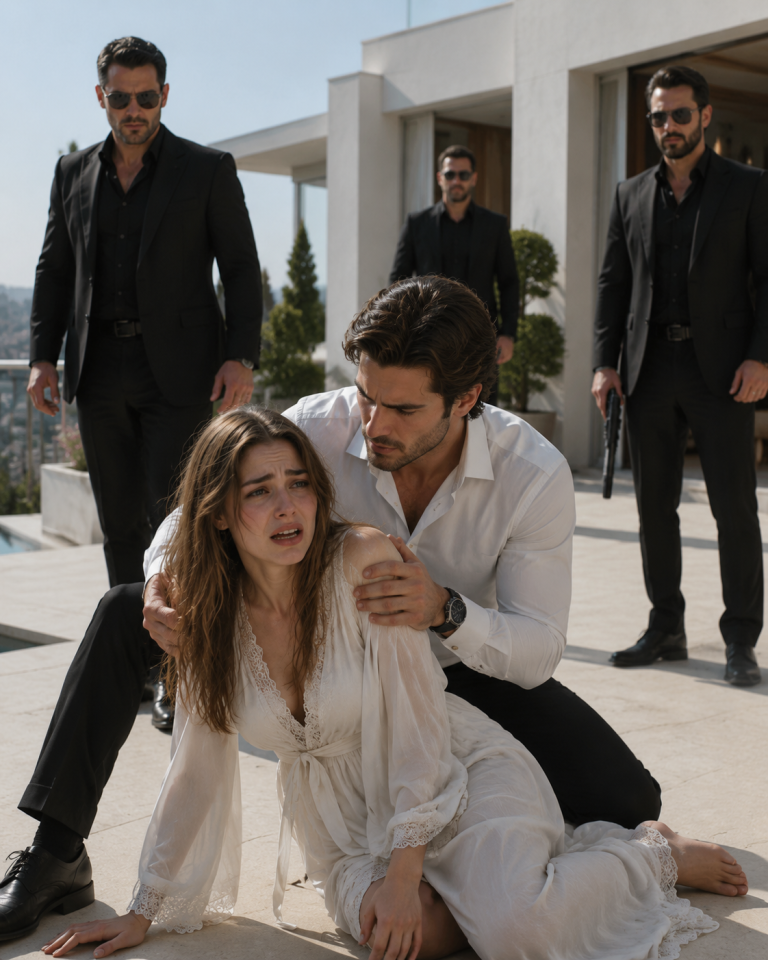
While Everyone Panicked During the Robbery, the Waitress Stayed Calm—The Mafia Boss Then Exposed Her Secret

## PART 1
The gunshot hit the chandelier at 11:47 PM, and Remy Voss counted the exits before the crystal finished falling.
She was already calculating by the time the first scream reached her. Second scream — that was the senator, by the pitch. The crash of overturning chairs was the investment bankers three tables over. She tracked all of it in her peripheral vision without moving her head, because moving your head was what amateurs did when they needed information, and Remy Voss had not been an amateur since she was eleven years old.
The wine bottle in her hand remained at exactly the angle she had been holding it.
She set it down without sound.
Three men. All exits covered except the service corridor behind the east bar. Modified AR-15s, the kind of modification that required sourcing outside standard black-market channels — which meant either a military connection or someone who had been trained to know what they were looking for. Kevlar vests, ski masks, boots with steel insoles that made a particular sound on the marble. She could hear the lead man’s breathing pattern: too fast, too shallow. Not a professional. Someone who had trained for this but never done it.
That distinction mattered.
The Obsidian Club occupied the penthouse level of the Crane Tower in downtown Chicago — the kind of venue where the lighting was calibrated to make everyone look better than they were and the air carried the specific smell of old money and things that had been decided without being said out loud. Remy had been working here for six weeks. She had memorized the floor plan on day three, out of habit and because habit was what kept her alive.
She was watching the man in booth nine when they came in.
Callum Reyes had been occupying that booth every Thursday for three months, always the same seat, back to the wall, sightline to every entrance. He wore the same expensive suit with the same ankle holster on his left leg, favoring his right when he walked, which meant an old injury to the left knee. He tipped exactly one hundred percent. He never spoke to her unless she spoke first, and when he spoke his voice was the kind of quiet that meant he had learned a long time ago that he didn’t need volume to be obeyed.
He was the most dangerous man in Chicago.
She knew that before she took the job, and it was precisely why she had taken the job.
Proximity to someone like Callum Reyes meant that the people hunting her would assume they were hunting a criminal asset, not a ghost. It was the best cover available on short notice after her previous arrangement in Detroit had come apart at the seams.
The lead gunman swept his weapon toward the center of the room.
“Phones and wallets on the floor. Everybody looks at me, they die.”
The panic in the room was extraordinary. Remy had been in rooms with more chaos and more genuine danger, and she had found, over time, that panic was the most contagious thing in any enclosed space — more contagious than gas, more persistent than sound. It traveled at the speed of the first scream and infected everyone who hadn’t been vaccinated against it.
She was vaccinated.
She turned back to the table she was servicing.
A piece of chandelier crystal cut through the air toward her face. She tilted her head two inches to the left, felt the air disturbance pass her ear, heard the shard embed itself in the wall three feet behind her.
She picked up a napkin and placed it over a water glass to prevent contamination from the debris.
One of the gunmen — the younger one, wired, moving wrong — swung his rifle in her direction.
“You. Down. Now.”
Remy looked at him.
She did not look at the weapon. She looked at the specific position of his thumb relative to the safety lever, which was in the wrong position for someone about to fire, which meant he either didn’t know it or was bluffing.
“The safety is on,” she said.
Her voice came out at approximately the same register she used to explain the daily specials.
The man blinked. “What?”
“The lever on the left side. It’s engaged. If you pull that trigger right now, the mechanism doesn’t complete the cycle. You’ll have about three seconds to clear the jam before my manager comes from the kitchen.” She tilted her head toward the back corridor. “He’s a large man and he’s already moving.”
The gunman looked down.
He looked at the safety.
It took him 1.4 seconds.
In that 1.4 seconds, Dario — Callum’s lieutenant — drew his weapon and fired twice. Callum, who had not flinched once, not once, was already moving, drawing from the ankle holster with the smooth economy of someone whose muscle memory was older than his conscious decisions. Three shots. The math of the room changed instantly.
Eleven seconds total.
Remy was checking the wine bottle for cracks when the echo of the last shot finished.
She heard footsteps. Deliberate. Moving toward her.
“You.”
She looked up.
Callum Reyes was standing two feet away, and his ice-blue eyes were doing something she had not seen them do in six weeks of Thursday nights. They were not scanning exits. They were focused entirely on her.
“Mr. Reyes.” She set the bottle on the table. “I’m afraid service is interrupted this evening.”
“You spotted the safety,” he said.
“I made a guess.”
“From twenty feet away. In low light. During a robbery.”
“I watch a lot of crime documentaries.”
He reached out and took her wrist. His grip was controlled, not aggressive, but firm in the way of a man who was used to his grip being sufficient information.
Her pulse was sixty-one beats per minute.
She watched him register that fact.
“Who are you?” he said.
“Your waitress,” she said. “And you’re going to have to let go of my wrist because the police are coming and I need to get the broom.”
She pulled free.
His grip loosened without resistance, which surprised her. She walked toward the service corridor, stepping over the nearest body with the same attention to foot placement she would have given a spill on the floor, and she did not look back.
Behind her, she heard him breathe.
She had spent six weeks being invisible to this man. She had done it well. She had done it by being exactly useful enough to remain employed and exactly unremarkable enough not to be noticed.
She had just used a dead man’s safety lever as a distraction and her cover was not broken, but it was cracked.
She snapped the SIM card from her burner phone as she reached the corridor.
One crack was all it ever took.
—
## PART 2
The police finished with the staff at 1:20 AM. Remy gave her statement in the flat, factual tone of a person who had witnessed a stressful event and was managing it with admirable composure, which was the tone the detective expected and which she provided. She ate a granola bar from her apron pocket because her blood sugar had dropped and she needed her hands to stop being interesting to her own body.
When Callum Reyes appeared at the ambulance where she was sitting, she was not surprised.
“Miss Voss,” he said.
She finished chewing.
“The detective has my statement,” she said. “If you need a witness account, the CPD can—”
“I don’t need a witness account,” Callum said. He leaned against the ambulance door with the ease of a man who was accustomed to leaning against things as a deliberate posture choice. “I need to know where you learned to identify the safety position on a modified AR-15 from twenty feet in dim light.”
“I told you. Crime documentaries.”
“Miss Voss.” His voice dropped a register. “I’ve been running operations in this city for nine years. I know what a trained operative looks like and I know what someone who watches too much television looks like. You are not the second category.”
Remy looked at him.
For a moment — a very brief moment — she allowed herself to be tired in front of him. Not weak. Just tired.
“I’m a broke person trying to pay rent,” she said. “That’s all I am right now.”
“And before now?”
She slid off the ambulance bumper and picked up her tote bag.
“My bus doesn’t run this late,” he said. “I’ll drive you.”
“I’ll walk.”
“Krell’s people may have backed the robbery. If you’re a material witness, they’ll want to know who else was in that room.”
She stopped.
Not because the threat landed the way he intended it to land. Because the name *Krell* connected to something she had been tracking in the background of the last three weeks, and the connection had just moved from ambient concern to active problem.
“I’m not a material witness,” she said. “I poured wine.”
“You disarmed a room with four words,” Callum said. “That makes you memorable. And in my city, memorable has a shelf life.”
She turned.
He was looking at her with the specific patience of a man who had already decided how this conversation was going to end and was willing to wait as long as necessary for the other party to reach the same conclusion.
“If you try to run those fingerprints,” she said quietly, “what you find will not make your life simpler.”
“I know,” he said. “That’s why I want to drive you home instead.”
She looked at him for a moment.
Then she walked to the black armored car.
In the car, crossing the city in the particular silence of two people who are both deciding how much the other person needs to know, she watched the lights blur past and said: “The robbery wasn’t random.”
“No.”
“The timing was wrong for opportunistic. They knew the security rotation. They knew which floor.”
“Yes.”
“Someone gave them the structure.”
“Yes.”
She watched a light turn red.
“Inside source,” she said.
“The question,” Callum said, “is which one.”
She stopped him at the corner of Fifth and Lake, which was not where she lived but which was, in the event of a tail, three blocks from a routing option she had mapped in her second week.
He called her name as she opened the door.
She paused.
“You start tomorrow,” Callum said. “Personal security consultant. Eight AM. My estate.”
“I’m not interested in working for—”
“I know what you are,” he said.
She went still.
“I don’t know the specifics yet,” he continued, his voice even. “But I know the category. And I know that whoever is looking for you will not stop looking. So the question is whether you’d like to be difficult to find inside a fortress or easy to find on a bus route.”
She looked at the street for a moment.
Then she reached into her bag, snapped her current SIM card in half, and dropped it into the grate at the corner.
She did not look back.
She would be at his gate at 7:58 AM.
And she would need to decide, between now and then, how much of the truth she was willing to become.
—
## PART 3
The Reyes estate was designed the way dangerous men designed their homes — not for comfort but for control. The gravel on the drive was noisy by intent. The hedge placement created visual funnels that concentrated approaching movement. The guard rotation had patterns that looked random to someone who wasn’t watching long enough, and gaps that were not actually gaps but tests.
Remy catalogued all of it while walking the driveway at 7:58 AM.
She had been wrong about one thing: the gaps were real. The northwest corner had a forty-second blind window at the shift change between the east and south patrol routes. The security camera on the library entrance had a moisture seal failure — she could tell by the condensation pattern — that would have degraded the night vision capability by thirty to forty percent.
She filed both without showing she had noticed either.
Callum was waiting in the library.
“You’re early,” he said, without looking up.
“You said eight. Early implies I’m early. I’m on time.”
He looked up then, and there was something in his face she had not seen at the lounge — a particular quality of attention that was more personal than professional.
“Coffee?” he said.
“Black.”
She sat across from his desk without being invited. He noticed that too.
The meeting he needed her for was at noon: Salvatore Vega, the head of the Vega family, who had controlled the southern harbor operation for a generation and who was, according to Callum’s brief, resistant to a proposed logistics restructuring that would benefit both organizations.
“What do you need from me?” she asked.
“Eyes,” Callum said. “Vega is old school. He doesn’t trust technology and he doesn’t like lawyers. I need someone in the room who can read what he’s not saying.”
“And his security?”
“Standard for a man of his standing.”
“I’d like to verify that independently.”
Callum looked at her.
“The file,” he said, sliding a folder across the desk. “Everything I have on who’s expected to attend.”
She opened it.
She looked at the personnel details, the photographs, the known associations. Bodyguard assignments, prior incidents.
She stopped at the fourth photograph.
The man in the image was listed as Vega’s lead personal protection. He was in his late thirties, wiry, with the particular flat affect of someone who had been trained to look like he was watching the room rather than a specific target within it.
She knew that affect because she had been trained to produce it.
She knew that face because she had worked with him once, briefly, in a facility she preferred not to think about.
His name was not the one in the file.
She closed the folder.
“Fine,” she said. “I’ll be in the room.”
The sunroom meeting was the kind of negotiation that happened in the margins of legitimate things — the negotiation not about what was being said but about what was being established. Territory. Precedent. Who moved first and what it cost them to do so.
Remy moved through the room as designed — efficient, peripheral, a person whose function was servicing rather than participating. She poured water. She cleared an ashtray. She replaced the espresso carafe with the quiet reliability of a person who understood the event architecture and had no stake in its outcome.
Salvatore Vega was broad, loud in the way of men who had been told their voices were valuable, and genuinely unhappy about the meeting. His three bodyguards were exactly what the file had described: standard protection personnel, large, positioning well but scanning poorly.
The fourth man stood in the back corner near the garden doors.
He was not scanning the room.
He was watching Callum’s throat.
And he was watching it the way someone watched a target, not a person.
Remy continued her circuit. She reached Vega’s side of the table and began to pour water, gauging the geometry of the room.
She tripped.
Not dramatically. A small, controlled stumble that sent three ounces of water onto the table near Vega’s phone and produced the specific kind of social disruption that made everyone in the room look at her and the mess rather than at each other.
Vega swore and stood.
“Get this girl out of—”
“Don’t touch her,” Callum said. His voice went flat in a way that ended conversations.
Remy crouched to collect the glass she had set down, and from that angle she looked directly at Callum. She touched her own throat. Glanced to the corner. Touched her wrist.
*Time. Now.*
Callum read it.
She watched his whole posture shift — not visibly, not to anyone watching, but she was watching at the right resolution. He relaxed. He laughed, a disarming sound that was entirely strategic, and threw up his hands.
“You’re absolutely right, Salvatore. I’ve been pushing too hard. Let’s eat first. My kitchen does a pasta that will make you reconsider every opinion you currently hold.”
The tension broke. Vega sat. The man in the corner settled back onto his heels. The window had closed.
Ten minutes later, in the hallway, Callum pinned her against the wall. Not aggressively. Urgently.
“The corner,” he said.
“Left forearm. He had a ceramic blade, non-metallic, taped inside the sleeve. I saw the outline when he shifted. He was waiting for a trigger point — when Vega got loud enough to justify a move.”
Callum looked at her.
“You just saved my life.”
“I spilled water and pointed at your throat,” she said.
“Remy.”
She looked at him.
His eyes were doing that thing again — focused entirely on her, not on the threat she had described, not on the operational implications. On her.
“Who trained you to read a concealed blade through a jacket sleeve?” he said.
She pushed herself away from the wall.
“I need to go check the cuffs on the guest linens,” she said.
She walked toward the kitchen.
Her heart was doing something she did not have a tactical category for.
She was indispensable now. She had known, the moment she moved to prevent the knife strike, that invisibility was gone. She had crossed from a cover identity into something else — something that required choices she had not yet made about what she was willing to risk.
—
Two weeks.
She reorganized the estate’s security architecture over those two weeks without announcing it. She moved a camera. She filled the northwest blind spot in the patrol rotation with a motion sensor reconfigured from the garden irrigation system. She changed the vehicle routes without explaining why, which Callum accepted without asking for explanation.
He noticed everything she did.
She could tell by the way he didn’t mention it.
She was in the kitchen on a Tuesday when he came in wearing his coat.
“South Loop,” he said. “Construction site. You’re coming.”
“Am I security or a witness?”
“Both,” he said. “Maybe neither. Fourteen days without an incident. I’m starting to believe in superstition.”
She grabbed her own coat.
She had a bad feeling about the day, which was a feeling she trusted because it was not an emotion — it was information. Her body had processed something her conscious mind hadn’t finished articulating.
The route Dario chose was Lower Wacker. She looked at the tunnel mouth as they entered.
“Choke point,” she said.
“Fastest way.”
“Speed and safety aren’t the same variable.”
He looked at her.
She looked at the tunnel.
Ahead, a service truck sat stalled across the center lane.
The feeling sharpened into something specific.
“Stop the car,” she said.
Dario was already moving to navigate around the truck.
“Dario—”
The truck’s side panel blew out.
The lead vehicle lifted into the air and came down against the concrete column in a sound that was both very loud and very wrong, the kind of wrong that was structural, that meant the geometry of everything had changed.
“Reverse,” Callum said.
But the van was already behind them, sideways, and the men coming out of it were moving in coordinated pairs, which meant they had drilled this, which meant—
The tear gas canister came through the weakened windshield before she had finished the thought.
White smoke. Dario firing through the glass, blind. A shot catching his shoulder and his hand going wrong.
Remy held her breath.
She had been trained to hold her breath for sixty seconds in smoke conditions, long enough to move if movement was possible. She could feel the gas on her skin, her eyes, but she was not blind.
The door beside Callum ripped open.
A figure in tactical gear pulled him out.
She was already moving.
She came out of the far door low, came around the rear of the car, and intercepted the figure before the rifle came up. Palm-heel to the chin. Elbow to the throat. She caught the weapon when his grip failed and she rolled over the hood because the next man was already tracking her position and if she stayed on the ground they had the angle.
“Two at six,” she called.
Not to anyone in particular. Out of habit. Out of the part of her that still operated in a team even when there was no team.
She fired twice. She moved again. She used the confusion the smoke created to cover her flanking movement, came in on the third man from his blind side, and the fight was violent and brief and she was aware, during it, that she was not being tactical anymore — she was being fluent, moving through combat the way she moved through language, without translation.
Callum was on the ground.
The fourth man stood over him with the rifle.
She fired once.
Silence.
She lowered the weapon.
She was panting. The smoke was thinning. In the dim tunnel light, she could see Callum on the ground, alive, looking at her.
She looked at the bodies.
Five men. She had accounted for four of them.
The fifth lay near the far wall where Callum had managed to fire during the chaos.
She moved to pull Dario from the front seat, checking the wound — through-and-through, clavicle involvement, dangerous but survivable — and she helped him into the back seat and got behind the wheel and drove out of the tunnel because movement was the only logical next step.
When they reached the street, she pulled into an alley and stopped the engine and sat with her hands on the wheel for a moment.
In the back seat, she heard Callum’s breathing.
She heard him say: “Who are you?”
She had been waiting for that question. She had known it was coming since the moment she tilted her head to avoid the chandelier shard in the Obsidian Club and saw, in her peripheral vision, Callum Reyes noticing.
She turned to look at him.
He had a cut above his eye. His vest was torn. He was bleeding from the temple and he was looking at her with the specific expression of a man who has arrived at the outer edge of his existing model of the world and needs to revise it.
“You need a safe house and Marcus needs a surgeon,” she said. “Drive first. Talk after.”
“Tell me.”
She looked at the tunnel mouth behind them.
“The team in the tunnel,” she said. “They used a split-approach entry with coordinated gas deployment and designated vehicle control. That’s not cartel doctrine. That’s not Russian Bratva methodology.” She paused. “That’s Wraith Protocol doctrine.”
Callum went very still.
“The program is real,” she said. “And they found me. They were probably following you as a vector to locate my position. The tunnel wasn’t aimed at you, Callum. I was the target. You were the justification.”
She started the car.
“Where’s the safe house?”
“Meatpacking district,” he said. “But Remy—”
“I know,” she said. “I’ll tell you everything. But Dario needs that wound packed in the next twenty minutes.”
She drove.
—
At the safe house, after Dario was stabilized — she worked on him with the efficiency of someone who had closed wounds in conditions significantly worse than a converted loft with good lighting — she washed her hands and stood at the kitchen sink and let Callum watch her from the doorway until he asked the question.
“Who are you?” he said. “The real answer.”
She turned the water off.
She turned around.
“Operative Seven,” she said. “Part of a program called Wraith Protocol. Black-budget, off the books. We were taken as children from state systems. No records, no family contact, no identity that predated the program. We were trained for thirteen years and deployed for four. Twelve of us in my cohort. I’m the only one who ran.”
Callum crossed the room and leaned against the counter beside her. Not crowding. Present.
“Two years ago,” she said. “I burned my file. I killed my handler. I ran. I’ve been moving since then, changing names, staying close enough to dangerous people that the program wouldn’t send standard retrieval — they’d have to send something larger and that would draw attention.” She looked at him. “The man in the sunroom today — Vega’s fourth bodyguard. He’s not Vega’s. He’s a program asset. He was there to confirm my location.”
“Which means Vega is either working with them or he’s being used.”
“Either way,” she said, “the meeting with Vega is not your problem right now. Crane is.”
“Crane?”
“My replacement. They sent him after me when I ran. He’s better than any asset I’ve encountered in the field. He doesn’t feel pain in the way that modifies behavior. He doesn’t hesitate. And he knows every technique I know because we were trained by the same people.”
She showed him her shoulder. Pulled the collar aside.
The scar was not clean. It had been a barcode once, surgical, a brand. She had removed most of it herself two years ago with the tools available at the time, which had not been ideal tools, and what remained was ugly and permanent and irreversible.
Callum looked at it.
He didn’t look away. He didn’t produce the expression she had learned to anticipate — the complex mixture of horror and pity and recalibration that people showed when they saw evidence of something they had known theoretically and were now confronting physically. He simply looked at it as information.
Then he reached out and placed his hand flat on her shoulder — not over the scar but beside it, as if establishing a perimeter around something that didn’t need to be touched.
“You’re not a subject,” he said. “And you’re not a weapon anymore.”
“I was both of those things for thirteen years.”
“And then you weren’t. People who run are making a choice.”
She looked at him.
“You’re going to tell me you’ll protect me,” she said. “I need you to understand that whatever you’re planning to do, I’ve been calculating it independently and I’ve arrived at the same answer. Don’t say it like it’s a gift. Say it like it’s a coalition.”
Something shifted in his face — surprise first, and then something that was not quite a smile but contained the same information.
“Coalition,” he said. “What are the terms?”
“You want to know where the Wraith Protocol facility is,” she said.
“Yes.”
“You want to end the threat permanently.”
“Yes.”
“So do I.” She looked at the window. “It’s called the Aviary. Blue Ridge Mountains, Virginia. Underground, three stories, automated defenses, forty personnel on a standard rotation.” She looked back at him. “A direct assault from a single criminal organization fails. They have enough federal cover to call in support within twelve minutes. You’d need something large enough to make calling in support impossible.”
“A coalition,” he said.
“You would need to make the case to every organization that the Wraith Protocol doesn’t just hunt its own escaped assets. It hunts power. Anyone who holds territory significant enough to threaten government interests is a potential future target.”
Callum looked at her.
“Self-preservation,” he said.
“The most reliable motivator available.”
He picked up his phone.
He made calls. She listened to the first three — Russian Bratva, the Wei family in Shanghai, the Calderon cartel — and understood the architecture of what he was building. He was not calling in favors. He was building an argument, and the argument was exactly the one she had constructed, and it worked exactly the way she had calculated it would work, because fear of institutional power was the one thing that unified people who disagreed about everything else.
By morning, he had commitments from seven organizations.
By noon, he had eleven.
By the following week, the army existed.
—
The Blue Ridge Mountains in November were the kind of dark that came from a specific combination of altitude, canopy, and a complete absence of light pollution. The convoy assembled two miles from the Aviary’s outer perimeter at midnight, and Remy stood at the front of it with Callum beside her and understood, for the first time in two years, what it felt like to have enough.
Not safety. She had stopped expecting safety at eleven. But enough.
“You know the layout,” Callum said.
“I lived in it for four years,” she said. “The southeast ventilation access is the only entry point not covered by automated systems. It requires bypassing a biometric lock, which I can do.”
“You’re going inside with me.”
“Yes.”
“Director Vale will be in the central hub.”
“Yes.”
“He’ll try to negotiate.”
“He will,” she said. “He’s very good at negotiating. He’s been doing it with governments for twenty years.”
She looked at the tree line.
“He won’t have anything to offer that makes keeping the program alive worth the cost.”
The assault on the Aviary was not a surgical strike. It was not meant to be. The criminal alliance’s purpose was not to defeat the Aviary’s security — it was to engage it completely, to occupy every automated system, every response protocol, every communications channel for long enough that Remy and Callum could move through the one access point that existed outside the standard defensive architecture.
The convoy moved at 1:00 AM.
The forest exploded.
In the chaos — and it was genuine chaos, the kind generated by the collision of a dozen organizational methodologies that had never operated in the same theater before — Remy moved through it with Callum at her right side, both of them low and fast through the tree line, reaching the eastern ridge while the Aviary’s automated systems were occupied with a thousand simultaneous threat vectors at the main gate.
The ventilation access was exactly where she remembered it.
She bypassed the biometric lock in forty seconds using a contact lens optical spoofing technique that the program had developed and that she had taken the documentation for when she ran.
They dropped into the ductwork.
She moved from memory and muscle memory and the particular knowledge that came from having spent four years in a building — knowing which supports were structural and which were architectural, which maintenance corridors were staffed and which were nominal, which junctions opened into observation positions and which were dead ends.
They came out in the subbasement.
The air was what she remembered: climate-controlled, sterile, with the specific absence of organic smell that meant no natural materials, no wood, no fabric that hadn’t been chemically treated. It smelled like the absence of life that had been made very comfortable.
She had not missed it.
They moved through two security checkpoints using the kind of teamwork that didn’t require communication — she positioned, he covered, they moved together in the rhythm that had developed across the last month without either of them planning it.
The command center doors were sealed.
Callum placed a shaped charge on the lock housing.
The room beyond was full of smoke and running technicians and the specific sound of alarm systems that had been telling people to evacuate for long enough that the people doing the evacuating had become methodical about it.
At the center of the room, behind a partition of polycarbonate that was not bulletproof but was designed to look like it was, Director Aldric Vale sat very still.
He was a thin man, gray-haired, with the complexion of someone who spent most of his time in artificial light. He looked at Remy with the specific expression of a person encountering a problem they had believed was contained.
“Operative Seven,” he said. His voice came through the room’s speakers.
“Remy,” she said. “That’s my name.”
“You’ve done something extraordinary tonight,” Vale said. “You’ve united twelve criminal organizations in an assault on a federal facility. That’s a federal crime in eleven categories. You can’t win this, even if you kill me.”
Callum looked at the partition.
“We’re not here to kill you,” he said.
Vale looked at him.
“We’re here to end the program,” Remy said. “The documentation I’ve carried for two years — the intake records, the training protocols, the operational histories of every asset deployed under Wraith Protocol, including their current status — has been uploaded to twelve separate encrypted servers with time-lock releases. If we don’t input a specific access code in the next eighteen hours, it releases to every major news organization, every relevant congressional oversight committee, and every foreign intelligence service that would find it interesting.”
She crossed to the partition.
“You have two options,” she said. “The first is that you order the program formally terminated, all active assets recalled, all files transferred to oversight for independent review, and you negotiate the terms of that with the organizations currently occupying your front gate who would very much like something in writing about the limits of government interest in their operations.” She paused. “The second option is that none of that happens.”
Vale looked at her.
“What happens under the second option?” he said.
“The files release,” she said. “And I suspect the congressional reaction to the discovery that minors were taken from state custody, stripped of identity, and trained as assassins for black-budget operations will be somewhat more intense than anything your lawyers can manage.”
The room was very quiet except for the continued alarm tone.
Vale looked at her for a long time.
Then he reached for the console.
“Get me the general counsel,” he said to the room. “And contact Director Harmon at the committee. Tell him we need an emergency session.” He looked at Remy. “The active assets. They can’t simply be released into civilian life without—”
“I know,” Remy said. “That’s why the terms include a transition protocol, identity establishment, and a support structure funded by the program’s existing black budget for a minimum of five years.” She had drafted the terms on the drive to Virginia and she had not slept, and it showed. “The assets did not choose their training. They are entitled to a life outside it.”
Vale looked at her.
For the first time in the conversation, she saw something in his face that was not administrative. It was complicated and she chose not to analyze it, because what Vale felt about the people he had created was not her responsibility.
“How long have you been planning this?” he said.
“Two years,” she said. “I started drafting the terms the week I ran.”
He nodded once.
“Get the attorneys,” he said again.
—
The agreement took four days to formalize and twelve weeks to implement fully. Remy attended three sessions in Washington in a building that was not officially connected to any agency, with attorneys on both sides and a federal judge who had been briefed on enough of the situation to understand that the standard framework was insufficient.
She attended them as Remy Voss.
The name she had chosen for herself at twenty-two, on the first morning after she ran, when she was standing in a gas station bathroom in Ohio and had looked at herself in a mirror for the first time in four years and decided that the thing she was looking at needed a name that belonged to it.
Callum came to two of the sessions. He sat at the back of the room as a non-party observer, which was technically the correct status and which technically explained nothing about why he was there.
After the second session, on a Wednesday evening in November with the first snow of the season beginning to come down over the city, they sat in his library with coffee.
Real coffee. Not the coffee she had served at the Obsidian Club, which had been excellent. This was coffee made by a person for another person, in a kitchen, without an audience.
“The northwest corner security gap,” Callum said.
“I know,” she said.
“You noticed it the first morning.”
“Yes.”
“You didn’t say anything.”
“I replaced the gap with a redirected irrigation sensor,” she said. “It was easier than the conversation.”
He looked at his cup.
“The transition assets,” he said. “The program operatives. How many?”
“Fourteen still active.” She set her cup down. “Two declined reintegration. They’ve been in it too long. Nine are pursuing standard civilian documentation. Two are in the first intake for the support program.” She paused. “One is currently employed as a security consultant for a Chicago-based real estate and logistics operation.”
Callum looked at her.
“Security consultant,” he said.
“The title was your idea.”
“Is it accurate?”
She thought about the past three months. The Obsidian Club. The tunnel. The sunroom. The long drive to Virginia with a coalition of the underworld organized behind them.
“It’s one accurate word,” she said.
He put his cup down.
He did not reach for her the way she had seen men reach for things — with the assumption of reception. He shifted slightly, changed the angle of his shoulders, and looked at her with the patience of a man who had learned that waiting was a form of intelligence.
“You’re going to tell me this is complicated,” he said.
“It is complicated.”
“It’s also simple,” he said.
She looked at him.
“You ran because you wanted to be a person,” he said. “I’ve spent years being a name. Names are useful and they’re also lonely in specific ways. I want to know what’s on the other side of that.”
“You don’t know what I am.”
“I know exactly what you are,” he said. “I’ve watched you for three months. I know that you reorganize spaces to eliminate vulnerability because it’s the only way you know how to feel comfortable in them. I know you eat when you remember to rather than when you want to, which means you spent years in an environment where meals were not your decision. I know that when you’re thinking hard you go very still, and when you’ve decided something you move and you don’t second-guess the movement.” He looked at her steadily. “And I know that you drafted a fourteen-point transition protocol for fourteen people you spent years training with, because walking away was not enough for you. They had to come with you.”
She was quiet.
“You wanted to know if you could be a person,” he said. “You’ve been one the whole time.”
She looked at the snow coming down past the library window.
Chicago at this hour had the quality of a held breath — the particular pause before something decided what kind of night it was going to be.
“I told Dario to update the vehicle routing protocols,” she said. “The new patterns are in the security folder. The northwest sensor integration requires a six-week recalibration before it’s reliable in rain.”
“I know,” he said. “You left documentation.”
“I always leave documentation.”
“Remy.”
She looked at him.
He held her gaze in the way of someone who was asking something without saying it, which she appreciated because she had spent enough years in environments where directness was only ever transactional.
She reached out and turned her hand palm-up on the table between them.
He placed his hand over hers.
They sat like that while the snow came down, neither of them speaking, both of them understanding that what had grown between a ghost and a king over three months and one war was not a temporary arrangement.
—
Six months later, the Obsidian Club reopened.
New management. New security protocols, which Remy had reviewed before agreeing to attend.
She came in at eleven on a Thursday night, not in her old uniform, not in a server’s apron, but in a deep gray dress that was elegant rather than conspicuous, which was the version of invisibility she was learning — not the erasure of herself but the choice of which self to present in which room.
Callum was in booth nine.
Back to the wall.
Eyes on the entrance.
He was watching the elevator when she crossed the room, and she saw the moment he saw her — not a dramatic shift in his expression but the specific quality of attention she had learned to read as his version of the feeling she had no vocabulary for yet but was no longer trying to not have.
She sat across from him.
A server appeared.
“The Château Margaux,” she said. “The 2012 if you have it. Not the 1982.”
Callum looked at her.
“You know wine now?” he said.
“I’ve been studying,” she said. “I have more time for it now that I’m not reorganizing your security infrastructure in the middle of the night.”
“You still reorganized three things last week.”
“Two,” she said. “The third one you noticed and fixed yourself.”
He looked at the room the way he always looked at rooms — assessing, cataloguing, the habit of a man who had learned that attention was the difference between survival and its absence.
“Clear?” she said.
“Clear,” he said.
The server brought the wine.
She poured it herself, because she knew how, and because some habits were worth keeping and some were worth replacing with better ones.
She raised her glass.
“To coalitions,” she said.
He raised his.
“To the people who stay,” he said.
She looked at him across the table — the mafia king of Chicago who had called her his wife in a burning safe house before there was any basis for the claim, who had built an army on a two-week timeline because she had asked him if he had access to phones, who had sat in the back of three federal negotiation sessions without being asked and without pretending it was for any reason other than the one it was actually for.
She thought about the girl who had run from a facility in the mountains two years ago with a burned barcode on her shoulder and fourteen points of documentation already drafted in her head and the specific, furious conviction that she was entitled to a life that belonged to her.
She had been right about that.
She was sitting in the proof of it.
“I need to tell you something,” she said.
He waited.
“I’m comfortable,” she said. “That’s unusual for me. I want you to know I’ve identified it.”
He looked at her for a moment.
“Is that good?” he said.
“I think so,” she said. “I’m still gathering data.”
He did not laugh. But the corner of his mouth moved in the way she had catalogued, on the first night, as the expression of a man who found something unexpectedly good in a situation he had not expected to contain it.
Outside, Chicago was doing what Chicago did — moving, loud, indifferent, beautiful in the specific way of things that did not care whether you were present to observe them.
Inside booth nine, a ghost was learning what it felt like to stay.
She thought it felt like this.
She thought this was what it was supposed to feel like.
She raised the glass again, to no one in particular, to the city outside the window and the two years behind her and the fourteen people building lives of their own in cities she was glad to know they were in.
*To the people who stay*, he had said.
She drank to that.
She intended to be one of them.