The Mafia Boss Discovered His Bride’s Hidden Secret—And Lost Control That Night

## PART 1
The memory that came to Celeste Morrow on the morning of her wedding was not of flowers or white silk or the church where three generations of her mother’s family had stood at altars and made expensive promises.
It was of a Tuesday in February when she was nine years old. Her father had come home late, smelling of tobacco and something sharper, and had stood in the kitchen doorway watching her mother arrange dahlias in a crystal vase. Diana hadn’t looked up. She’d just kept cutting stems at precise angles and placing them with the careful deliberateness of a woman who had long ago learned that beautiful arrangements were the safest form of conversation available to her.
Gerald Morrow had watched for a moment, then walked upstairs without speaking. Diana had exhaled almost inaudibly. And Celeste had understood, in the way children understand things before they have language for them, that obedience was not love. It was just the version of survival that came with good posture.
She thought about that moment now, sitting in the bridal suite on the fourteenth floor of the Hargrove Club, her dress already on, her bouquet untouched on the vanity, her hands folded in her lap. Two floors below her, one hundred and sixty guests were filling seats between black-and-white marble columns. Gerald Morrow was down there too, circulating. She could almost feel the particular satisfied energy of a man who had closed a deal and was waiting for the paperwork to clear.
The groom she had met once.
Ronan Callahan. Forty-one. The kind of man whose name changed the temperature of a room when someone said it. Her father’s lawyers had used words like “strategic partnership” and “port consolidation” and “a union that benefits all parties.” Her mother had said he was known to be contained, not cruel. That was Diana’s highest form of endorsement. Not that he was good. That he wouldn’t be excessive about it.
Celeste had signed the acknowledgment page on a Thursday in a wood-paneled office while a man who was technically her attorney but actually her father’s ate a sandwich and watched. She had asked three questions. None of them had been answered truthfully. She knew that now. She had known it then, even. But knowing a trap and having the leverage to refuse it were not the same condition.
She picked up her bouquet.
White roses. Someone had chosen them for her, had decided what she should carry into this marriage, what she should hold while a stranger became her husband.
She pressed her thumb against a thorn until the pressure registered.
The ceremony was twenty-two minutes long.
She did not look at Ronan Callahan directly until the moment she reached the front of the aisle and had nowhere else to look. He was tall. Dark-suited. Watching her with an expression that told her nothing. She had expected something readable in his face — desire, calculation, ownership, at minimum the satisfied look of a man who had concluded a successful acquisition. She found none of it. He was watching her the way she imagined a surgeon watched a patient before making the first incision. Not without attention. Without emotion.
She stood beside him and said the words she was supposed to say.
They were married inside a minute.
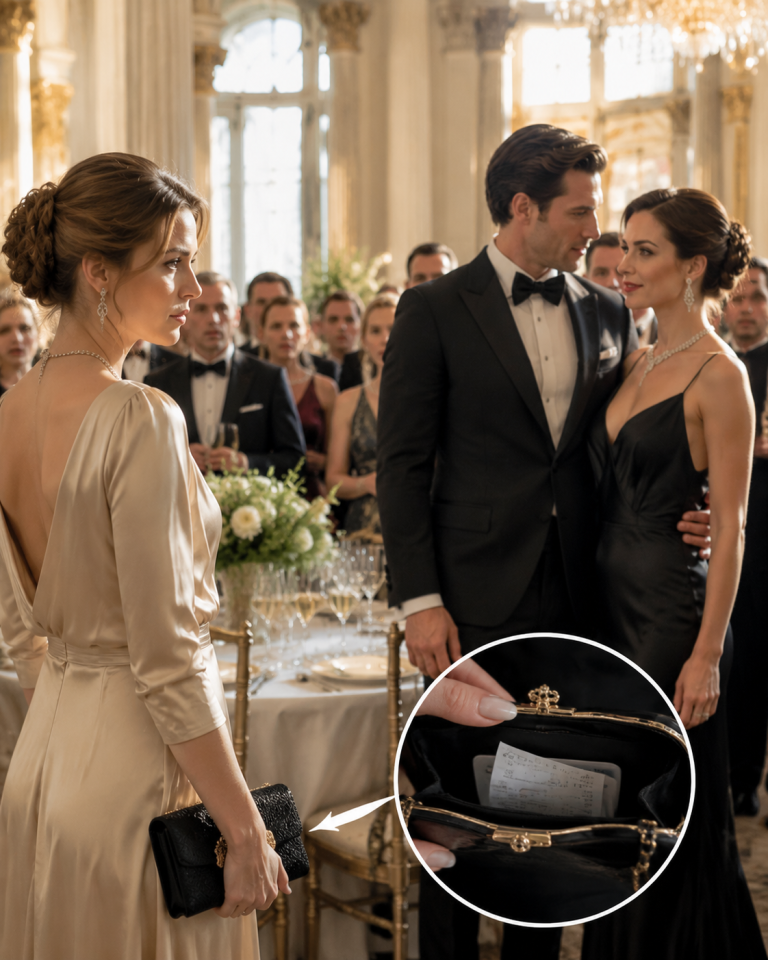
The private reception was worse than the ceremony because it was smaller. Sixty people in a room with nowhere to go and champagne that kept appearing in her hand because movement felt dangerous and stillness felt worse. Diana hovered. Gerald circulated with his chest slightly forward, the particular posture of a man receiving congratulations he believed he deserved. Celeste drank two glasses of champagne and immediately understood she shouldn’t have.
Then Ronan came toward her.
He was not moving quickly. He was not reaching. He simply walked in her direction across the black-and-white marble floor with that same unreadable expression and extended one hand toward her elbow — not gripping, barely touching, just redirecting her away from a waiter who was approaching with a tray.
Her body responded before her mind did.
She recoiled so completely the champagne flute in her hand slipped from her fingers and exploded against the marble.
The sound was catastrophic in the silence that followed it.
The string quartet stopped. Every conversation in the room died. A waiter froze mid-approach. Sixty people looked at Celeste Morrow standing in her wedding dress with a thin line of blood appearing at her knuckle where a thorn had gone deep and her chest heaving in shallow, rapid bursts.
Ronan’s hand hung in the air between them. Not advancing. Not retreating. Just there.
Gerald laughed first, as men like him always did — too loud, too quick, the laugh of a man managing a scene. “Overwhelmed,” he announced to the room. “All that champagne on an empty stomach. You know how it is.”
Nobody answered him.
Diana came forward in heels that didn’t hesitate, took Celeste’s arm with fingers that pressed hard enough to bruise, and whispered, “Smile. Right now.”
Celeste did not smile.
She stared at the glittering wreckage at her feet and felt something split open inside her chest. Not grief exactly. Not despair. Something quieter and worse. The understanding that she had run out of exits.
And then Ronan Callahan said two words that changed the shape of the evening entirely.
“Clear it.”
Not to the waitstaff. Not to the room. To the room.
“Everyone leaves,” he said. “Now. Family only.”
The authority in his voice was not loud. It was simply absolute. Chairs scraped. People moved. Sixty guests filed out with the careful faces of people who understood they had just been shown something private and needed to not have seen it.
Gerald’s laugh vanished.
The room emptied to six people. Ronan crossed the floor and crouched in front of Celeste — actually crouched, so his eyes were level with hers rather than looking down at her — and said, so quietly only she could hear it: “I’m going to ask you one question. Did you choose this?”
Diana inhaled sharply. Gerald stepped forward.
The man Ronan had introduced only as Rourke stepped between Gerald and the room without appearing to move.
Celeste’s throat worked. She glanced at her father. Then back at Ronan. Shame came first, before the words. “I…”
“Celeste,” her mother said.
Ronan did not look away from her. “Did you choose this?”
The silence lasted four seconds.
Then Celeste did something she had not planned and could not explain. She shook her head. Once. Barely visible. A single, terrified no.
What happened after that was not what she expected.
What happened after that was the beginning of something she did not have a name for yet.
—
## PART 2
Gerald erupted the moment the meaning of that small head-shake landed.
“She’s overwhelmed,” he said, voice tightening into the register he used when he wanted to sound commanding and only managed to sound afraid. “Emotional. She doesn’t know what she’s—”
“Take him out,” Ronan said to Rourke.
Two words. No drama. No raised voice. The way people gave instructions they had given a thousand times.
Gerald tried to pull away. Rourke was larger and considerably more practiced. There was no struggle, only the sound of dress shoes dragging once against marble and then the soft click of a door closing.
Diana went too, escorted by Ronan’s associate Dante with the polished inevitability of someone who had run out of objections that anyone was willing to hear.
Celeste was left alone with her husband.
Ronan poured a glass of water from the sideboard and set it on the table beside her. He did not hand it to her. He did not come closer. He appeared, suddenly and deliberately, to be conscious of every inch of distance between them.
“Your mother is in the hall,” he said. “Do you want her?”
“No.” The answer came before she could think about it.
“Then tell me what you were told.”
She told him. All of it. The debts. The threats. Her sisters. The word duty. Her mother’s quiet, devastating instruction about compliance. When she reached the part about the wedding night — what had been implied, what had been assumed, what she had spent the last two weeks preparing herself to endure — she couldn’t finish the sentence.
She didn’t need to.
Ronan’s expression did not change. But something behind it went absolutely still.
He stood.
“No one touches you tonight,” he said. “No one touches you until you understand what you’ve actually agreed to, which is different from what you were told. Dante will take you somewhere safe.”
Celeste stared at him. “Why?”
It was the real question. Not logistics. Not legality. Why. What did a man with that kind of power have to gain from leaving a door open?
Ronan met her eyes, and for the first time that evening, something human moved across his face. Not warmth. Not pity. Something harder and more honest than either.
“Because last night,” he said, “you looked at me like you were counting down to something. And I refuse to be the thing someone counts down to.”
He left before she could answer.
Later, sitting in a borrowed apartment in the West Village wrapped in a stranger’s hoodie while an orange cat regarded her with absolute contempt, Celeste replayed that sentence eleven times.
She was still certain it was strategy.
She was almost certain.
—
## PART 3
The attorney’s name was Sandra Howell, and she had been practicing family and contract law for twenty-three years. She arrived at the West Village apartment the morning after the wedding with a satchel of documents and the brisk, compassionate efficiency of a woman who had untangled worse without blinking.
Celeste sat across from her at the kitchen table and read the contract her father’s lawyers had constructed. Every page. Every clause. Every buried phrase that dressed transaction up as tradition.
Sandra explained what she found without softening it. The consent page, signed under terms that represented Gerald’s interests, not Celeste’s. No independent review. No withdrawal period. Supplemental marital provisions linked to route consolidation in language calibrated to survive scrutiny while still meaning exactly what it meant.
“Your signature is legally present,” Sandra said carefully. “But the question of whether that signature represents genuine informed consent is one that certain clauses here would not survive if tested.”
“Can they be voided?”
“Parts of them, with time. The external alliance structure — the ports, the financial instruments — those hold regardless. But the marital provisions that assume—” She paused, choosing. “That assume conjugal compliance as part of asset transfer? Those are vulnerable.”
Celeste looked down at the stack of pages. “He told me once that men like him don’t tolerate humiliation.”
Sandra did not ask who he was. “Do you believe that’s still true?”
Celeste was quiet.
The truth was she had been building two simultaneous narratives in her head since the wedding, testing each against what she observed. The first: Ronan Callahan had intervened out of strategic intelligence. A frightened wife was an unstable variable. Visible coercion created legal exposure. A merciful facade cost him nothing and bought him goodwill he would eventually spend. This was the narrative her mother’s voice endorsed. Men with power are only kind when they are preparing to demand something later.
The second narrative was harder. It had no structure. It was built entirely from accumulation — from the way he had crouched so as not to tower over her. From the distance he held. From “I refuse to be the thing someone counts down to,” which was not the phrasing of a man managing optics.
Sandra left her with the documents and a direct number.
Ronan arrived an hour later.
He sat in the armchair across the room because she had placed herself at the far end of the couch. The orange cat — whose name, she had been informed by Iris, was Ptolemy, which she privately found inexplicable — arranged himself between them as a furry neutral party.
“What happens to my father?” Celeste asked.
“He loses money. He loses access. He loses the ability to repeat this.”
“And the marriage?”
Ronan’s hands rested on the armchair arms. “That’s what I came to discuss.”
She waited.
“The coercive provisions are suspended,” he said. “What remains, publicly, is a structure. On paper, the alliance holds. Privately, you have time and space and independent counsel and the right to review anything that carries your name.”
“And if I want out entirely?”
“Then we begin that process.”
She studied his face. “You keep giving me exits.”
“Yes.”
“Why?”
That question had a shape now, specific and direct. She wasn’t asking out of gratitude anymore. She was asking with the careful precision of someone taking inventory.
Ronan looked at her for a long moment. “Because fear is not a management strategy I’m willing to build anything real on.”
“That sounds practiced.”
“It is,” he said. “That doesn’t make it false.”
The distinction should not have steadied her as much as it did.
She spent the next three days in the borrowed West Village apartment reading contracts and watching the orange cat ignore her with baroque consistency. Iris dropped food without fanfare. Dante texted logistics. Ronan did not visit again until she asked him to.
When he came, she had a list. Specific conditions. Separate space. Work she owned. Contact with her sisters. Full disclosure. No softened versions.
He agreed to all of it without negotiation.
She watched his face for the seam between performance and intention and found she could not locate it cleanly.
By the end of the first week she was in a townhouse in Brooklyn Heights that smelled of cedar and old books and had a back garden with wet brick and enough distance from both directions to allow a person to hear themselves think. Sandra had confirmed the legal landscape. Ronan had transferred the suspension instruments into her name. Gerald had been escorted from several conversations he’d been trying to have.
Celeste stood in the garden in borrowed socks on the second morning and thought: he keeps doing what he said he would.
She did not know what to do with that yet.
The school came through Iris. A literacy coordinator position at an elementary school in Carroll Gardens — initially just observation, then assisting, then one class per week, then two. Celeste told herself she was going because it was good for her sanity and had nothing to do with any impulse to normalize her life. This was entirely true and also entirely incomplete.
The first child who mattered was a boy named Theodore in second grade who despised sitting still and worshipped marine biology. She put a book about shark migration in front of him on a Wednesday and he read eleven pages aloud just to argue with two of the paragraphs.
She came back to the townhouse that evening and told Ronan about it before she remembered she hadn’t decided whether she wanted to tell him things.
He listened with the particular quality of attention she was beginning to recognize as specific to him: full, un-performed, and so complete it sometimes felt slightly overwhelming. He didn’t offer commentary. He didn’t redirect. He just listened.
“You look different,” he said, when she finished.
She narrowed her eyes. “Different how.”
“Like yourself.”
She didn’t know how to argue with that, so she didn’t.
The photograph arrived on a Tuesday.
Rourke brought it to her in the afternoon — she had insisted on being brought things directly rather than managed at a delay — and she looked at it for a long time. Herself. Leaving the townhouse. Groceries. Hair loose. Shot from across the street at a distance that meant patience rather than opportunism.
She looked at Rourke. “Colombo?”
“Most likely.”
“So I’m leverage.”
“You’ve been leverage since the wedding,” he said, which she appreciated for being true. “Now someone is advertising that they know it.”
She called Ronan herself.
He came within twenty minutes. She noticed he’d been close. She noticed she didn’t mind.
The conversation about security protocols was the first real argument they had. Not because she disagreed with the logic of the protocols. Because she understood, in a way she hadn’t before, that the life she was negotiating her way into was not a stable country. It was a territory under ongoing claim, and the borders moved according to whose attention had landed on it that week.
“I’m not becoming an ornament,” she said.
“I’m not asking you to.”
“You’re asking me to route my movements through you.”
“I’m asking you to route them through Rourke.”
“That’s the same thing in practice and you know it.”
He looked at her for a moment and did not lie. “Yes.”
She held that. “Then I want something in exchange.”
“Name it.”
“I want to see the intelligence. Whatever Rourke knows, I see. I’m not making security decisions from a position of deliberate ignorance.”
He was quiet for a second longer than usual. Then: “Done.”
She had half-expected him to push back. The agreement arrived with such immediacy it almost felt like a trap. She went looking for the trap for several days and couldn’t find it.
What she found instead was that he did it. Rourke began including her in the briefings. Not summaries. The actual materials. Ronan, who she now understood operated on an almost pathological commitment to doing precisely what he said he would do, made no attempt to soften or filter what she received.
Some of it was upsetting.
None of it was worse than what her imagination had constructed.
Gerald’s involvement surfaced in the third week.
Not elegantly. Not through confrontation. Through a set of message logs Rourke’s people had pulled from a contact’s device — screenshots of Gerald, over the previous three months, feeding Gerald-flavored information to a set of intermediaries linked to the Colombo network. Information about Celeste’s schedule. Her location. Her sisters’ school.
Ronan showed her the phone in the back of a car outside a warehouse in Red Hook. He didn’t preface it. He handed it over and let her read.
She read every message.
By the third screenshot her hands were shaking.
Gerald had given them Emma. He had given them Sophie. He had handed his own daughters’ routines to men who sent photographs and called it messaging.
“He was willing to risk them,” she said.
“Yes.”
She didn’t cry. Something colder than tears was happening in her chest. Something architectural. She was re-sorting everything she had ever believed about what her father had been afraid of, and the shape that emerged was not the shape of a frightened man making terrible choices. It was the shape of a man who had never considered anyone else’s body to be quite as real as his own comfort.
“I want him gone,” she said.
Ronan looked at her carefully. Not alarmed. Not eager. Careful. “Say that again.”
“I want him gone,” she said, and this time her voice did not shake. “I want my sisters to grow up in a world where he cannot reach them. I want my mother to have the option of becoming someone else without him in the architecture. I want the version of my life where he is a permanent threat to end.”
The car was quiet except for rain against the windows and Rourke’s breathing in the front seat.
Ronan said, “You understand what you’re asking.”
“I understand exactly what I’m asking.”
“Will you regret it?”
She thought about the dahlias in the crystal vase. The precise angle of the cuts. The exhale that was not quite relief.
“I already regret him,” she said. “This will just be a different form of that.”
Ronan looked out the rain-blurred window for a long moment.
Then he took out his phone.
The call came forty-one minutes later as they were stepping into the penthouse elevator. Gerald’s car. The FDR. Construction barrier. Wet road conditions. Impact fatal.
She read the update on Ronan’s phone without expression.
He watched her.
She handed the phone back and walked to the window and stood there with her arms folded across herself, looking at the river, for a long time.
“I thought I’d feel sicker,” she said.
“You might later.”
“Maybe.”
She turned around. “Does this make me like you?”
He crossed the room and stopped at her side, not touching. “No.”
“That’s a comforting lie.”
“It isn’t. You didn’t build a life around this. You used it once because a man who should have protected you left you no other option that wouldn’t eventually reach your sisters.”
She looked at him. The distance between them was shorter than it had been an hour ago. She wasn’t sure when that had happened. “The distinction sounds like something good people invent to sleep.”
“Then sleep badly,” he said. “But don’t confuse context with character.”
She laughed once, low and exhausted. “That’s annoyingly precise.”
“Occasionally.”
They stood beside each other at the window while the city moved in its indifferent way below them, carrying no knowledge of what had just ended or been begun or been lost in the space of forty-one minutes on a wet highway.
After a while she said, “I need to tell you something.”
He waited.
“Three days ago I came across a document on the secondary drive Rourke gave me access to. A draft contract. My name was still on it.” She watched his face. “I almost stopped trusting you again right there.”
He didn’t blink.
“Then Sandra called,” Celeste continued. “She’d been sent the full version.” She paused. “It wasn’t what I thought.”
“No,” Ronan said. “It wasn’t.”
The document she had found — the contract that had looked, at first glance, like a refinement of her father’s original architecture — was something else entirely. It transferred Gerald’s outstanding debts, his share of the port instruments, and his legal interest in the marital alliance directly into Celeste’s name. Not Ronan’s. Hers. It had given her independent financial standing she hadn’t possessed since her father had removed her from the family accounts at twenty-two.
Gerald had discovered the instrument. That, Sandra believed, was what had accelerated his contact with the Colombo network. Not opportunism. Panic. Gerald had been trying to destabilize the alliance before a document could clear that would leave him with nothing to sell.
Celeste had sat with that information for three days without mentioning it.
“Why didn’t you tell me?” she asked.
Ronan looked at the window. “Because I didn’t want you to stay because of it.”
The simplicity of that answer was almost offensive in how precisely it located the center of everything.
She held his gaze. “That’s why you kept giving me exits.”
“Yes.”
“You were building them in case I needed them.”
“Yes.”
She was quiet for a long time. Rain moved across the glass in slow diagonals. The city lit and unlit itself as clouds passed over it.
Then she said, “I didn’t need them.”
Ronan turned to her.
“I kept not taking them,” she said. “Not because you were trapping me. Because every time you offered me a door, you also stayed in the room. And I kept choosing the room.”
He looked at her with an expression she had never seen on him before — not the contained watchfulness, not the careful precision. Something older and quieter and far more exposed.
“That was probably stupid,” she added.
“Probably.”
“You are genuinely dangerous.”
“Yes.”
“And I still chose the room.”
He reached for her hand slowly enough that she could have moved away.
She didn’t move.
“I love you,” she said, which was not what she had planned to say, but which had apparently been waiting in her chest for long enough that it simply came out. “I don’t know entirely what to do with that given the circumstances.”
Ronan looked down at their joined hands — her knuckles still bearing the faint scar from the thorn on a wedding night that had not gone as planned — and said, with a roughness she now understood was as close as he got to nakedness: “Neither do I.”
She laughed.
Then she kissed him.
Not like the ceremony. Not like obligation. Not like the performance of something already contractually arranged. Just herself, choosing, in the specific way she had never been allowed to.
The months after Gerald’s funeral were neither peaceful nor simple.
They were, however, increasingly honest — which turned out to be its own form of peace once Celeste stopped waiting for it to be taken away.
Diana went to rehab in March. Celeste paid for it without announcement. Not because she had forgiven her mother. Because Emma and Sophie still needed someone capable of becoming something, and Diana at least understood, now, that she had been complicit in the architecture of her family’s cowardice. Whether understanding translated into change remained to be seen. But Celeste was willing to give it the time to find out.
Emma returned to her natural state of being eleven years old and categorically unimpressed by adult authority. She informed Ronan, at a Sunday dinner in the penthouse, that rich people probably had underdeveloped emotional intelligence because no one told them no often enough. Ronan looked at her across the table for a long moment and said, “Who taught you that language?” and Emma said, “Celeste,” without looking up from her food, and Celeste, who had also not looked up, said, “Allegedly.”
Sophie became interested in architecture and developed strong opinions about the difference between buildings that made people feel small and buildings that made people feel held. She asked Ronan once whether his apartment was supposed to be intimidating. He said yes. She said that was interesting and appeared to be filing it away for future use.
Celeste finished her degree in May. Her first classroom was a second-grade room with twenty-two students, one working projector, and a bookshelf so overcrowded that volumes had begun self-organizing horizontally on top of other volumes in what she described to Ronan as “literary desperation.” She came home with marker on her hands and glitter in her hair and the animated restlessness of someone operating fully inside their own competence, and Ronan listened to the stories of her students with a quality of attention she had once found disorienting and now simply accepted as his particular form of caring.
He kept the reading certificates her third graders made him the following year. She discovered them in a folder in his desk. One child had drawn him in a crown with the label “Quiet Principal of Justice” and Ronan refused to discuss this. The folder remained.
The anniversary of the wedding was not celebrated, as such, but marked. Ronan brought home the dissolution documents Sandra had finalized — every marital provision, every inherited clause, every trace of Gerald’s original architecture, ready to be signed and filed.
They were sitting at the kitchen table. Celeste was grading. He set the folder down and she opened it without comment and read.
“You filed for dissolution,” she said.
“I drafted it. I haven’t filed.”
She looked up.
He said, “I can’t give you a real choice before the wedding. But I can give you one now.”
The apartment was warm and quiet around them. A pot of something Ronan had made earlier still on the stove. Emma’s backpack on the bench by the door. Sophie’s drawings on the refrigerator next to the grocery list. The orange cat — Ptolemy, who had migrated from the West Village apartment to the penthouse at some point without anyone formally deciding this — spread across the back of the couch.
Celeste looked at the dissolution papers.
She looked at the apartment.
She looked at the man across from her, who had given her exits and stayed in the room and built instruments with her name on them and said “I love you” as if the words cost something real to produce.
She closed the folder.
“I’m not signing these,” she said.
Something moved in his face that he didn’t entirely control. “All right.”
“That’s it?”
“What else should I say?”
She leaned forward. “Say why you’re not relieved.”
He was quiet for one beat. Two.
“Because if you signed,” he said, “I’d lose you.”
She nodded slowly. “And I’d lose the room I kept choosing.”
Outside, the city was doing what the city always did — moving, unknowing, carrying its ten thousand private reckonings through rain and traffic and ordinary Tuesday evening dark. But in the kitchen the dissolution papers sat unsigned, and Celeste Morrow — who had once stood in a bridal suite pressing her thumb against a thorn to feel something real — was holding the hand of the man she had married under someone else’s terms and rebuilding inside their own.
“I’m staying,” she said. “Not because of money or sisters or fear. Because this is the truest thing I’ve ever had, and I choose it.”
He turned her hand over in his and pressed his mouth to her palm, and the gesture had in it nothing of contracts or alliances or the careful management of consequences.
It was a man learning how to live inside something chosen.
Years later they sat on a bench along the Hudson on an evening in October when the light came off the water at angles that made even asphalt look worth something. Emma was in college studying political theory and sending long, combative emails about systemic power that Celeste read with pride and occasionally sent to Ronan with the note “she gets this from you.” Sophie was finishing her second year of architecture school and had opinions about every building they passed. Diana was sober four years. Rourke had a dog the size of a credenza and loved it with a solemnity nobody remarked on. Dante and Iris still argued at dinner tables like people who had found the single person worth being right against.
Ronan and Celeste sat while the river moved dark and specific beside them.
She leaned into his shoulder. He rested his chin briefly against her hair.
“Do you think about the wedding?” she asked.
“Sometimes.”
“Me too.” She looked out at the water. “I think about the thorn.”
He made a sound of inquiry.
“I was pressing my thumb against a rose thorn in the bridal suite to feel something real,” she said. “Because I was so frightened I’d gone numb and I needed proof I was still inside my own body.” She paused. “And then I got downstairs and dropped the glass and you crouched on the floor in front of me so you wouldn’t be taller than me. And I thought: that’s either very good strategy or something else entirely.”
Ronan looked at her. “And now?”
She smiled. “Now I know it was both.”
He laughed. Quiet, real, the laugh of a man who had found someone honest enough to hold both true at once.
She slid her hand into his.
Below the bench the river was doing what rivers did — moving without opinion past every human arrangement made above it, outlasting the plans and the contracts and the demolished architecture of other people’s bad decisions. But Celeste had stopped measuring her life against permanence. She measured it against truth and against choice, and by both metrics she was, against all reasonable expectation, exactly where she had decided to be.
Not because it was safe.
Not because it was simple.
Because she had looked at a room full of exits and, each time, chosen to stay.