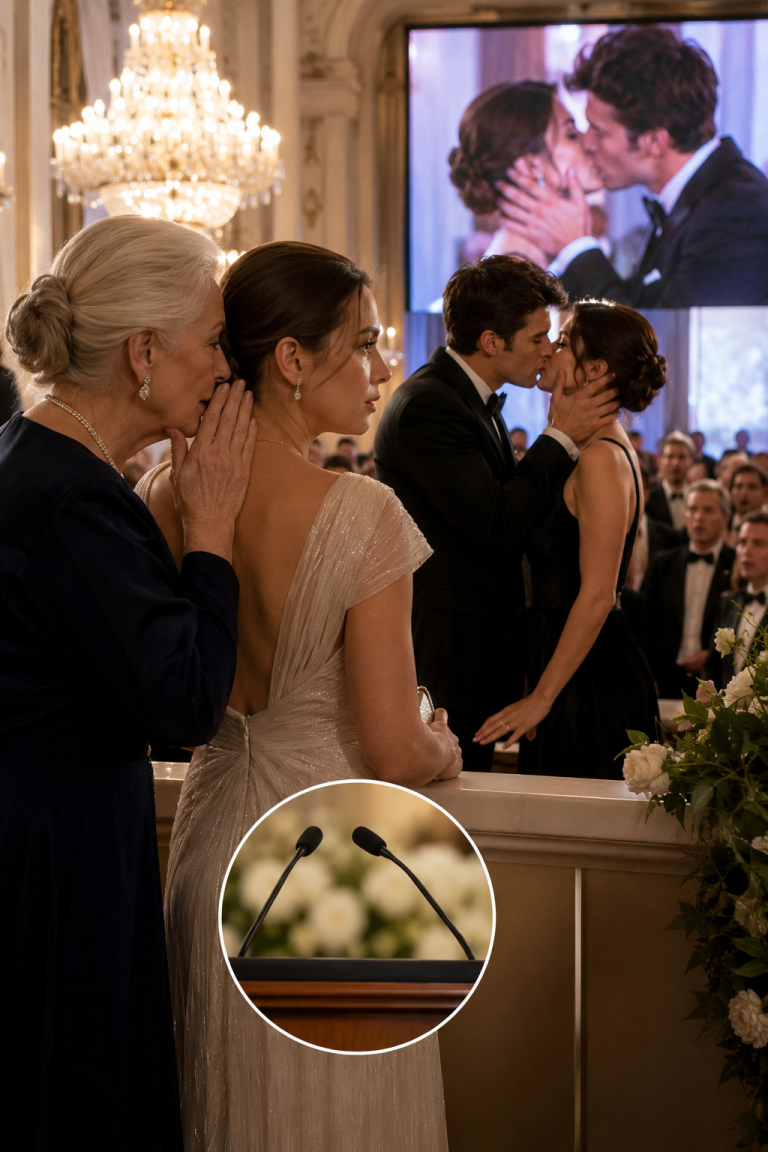
HER HUSBAND SOLD HER FAMILY ESTATE AS THE VENUE FOR HIS MISTRESS’S ENGAGEMENT WEEKEND — HE FORGOT ONE CLAUSE IN A CONTRACT HE NEVER FINISHED PAYING

—
**PART 1**
The place card sat face-up on the confirmation packet at 2:13 in the morning, two words in someone else’s careful calligraphy, and Vivienne Hale read them so many times they finally stopped hurting.
VIVIENNE HALE. FAMILY FRIEND.
Not wife. Not hostess. Not the woman whose grandmother’s silver gleamed across the dining tables in the listing Grant had posted three hours earlier — an aerial shot of four hundred white Vermont acres under fresh snow, black pines, a frozen lake, and the slate-roofed manor her family had held for nearly a century, dressed up in gold lettering as *THE FIRST SNOW ENGAGEMENT WEEKEND AT WINTERMERE*. Private sleigh rides. Candlelit dinners. Champagne beneath the northern stars.
*Hosted by the future Mrs. Mercer.*
Vivienne had been Mrs. Mercer for eleven years. Her mother’s crystal chandeliers glowed in the ballroom photographs. Her childhood bedroom had been rebranded, in tasteful serif font, the Bridal Suite. Thirty-two guests had already put down deposits — board members, investors, three society reporters, a senator’s daughter, and Celeste Arden’s parents, arriving to watch their daughter become mistress of a house that had never once belonged to the man offering it.
She did not call Grant. She did not cry. She downloaded everything — the listing, the guest contracts, the forged venue license, the payment receipts, the private schedule for Celeste’s proposal dinner, and a single photograph of Celeste’s hand wearing a twelve-carat sapphire pulled from an account Grant believed his wife had never found.
Then Vivienne called the one man in America who understood exactly how dangerous her calm could become.
Julian Cross picked up on the first ring. “Vivienne.”
“I need you at Wintermere.”
A pause — not hesitation, calculation. “What did Grant do?”
She looked once more at the gold lettering. “He sold a weekend,” she said. “I’m going to sell the lie.”
The humiliation had started three weeks earlier, beneath a painted Manhattan ceiling of angels bought by families who preferred their sins tax-deductible. Vivienne wore black silk; Grant wore the midnight-blue tuxedo she’d chosen for him in Milan; Celeste wore white, a diamond rivière from the Mercer collection glittering at her throat. Grant took Vivienne’s hand as photographers gathered, and for one foolish second she believed he meant to repair something. Then he lifted his glass. “To new beginnings.” Then, smiling first at his wife for the cameras: “Vivienne and I have decided to end our marriage with grace. We will always remain dear friends.” A ripple of surprise dressed as sympathy moved through the room, and before she could speak he’d already turned toward Celeste, one hand at the small of her back. “In time, I hope you’ll all welcome the woman who taught me that life can begin again.”
The applause came uncertainly, then confidently, because wealthy people so often mistake confidence for truth.
Vivienne recognized the sapphire on Celeste’s hand instantly — her grandmother’s ring, sold off after her grandfather’s death, hunted for years without success. Grant had known she would recognize it.
“I never wanted you to find out this way,” Celeste whispered, loud enough for the nearest reporter.
“What way did you want?” Vivienne asked, and watched the girl’s carefully arranged sorrow tremble, a talented tremble, before Grant’s fingers closed hard around Vivienne’s wrist. *Not here.* She looked down at his hand until he let go, then turned to the cameras herself.
“My husband is right about one thing. Life can begin again.” She lifted her champagne and drank, and the photograph went everywhere by morning — Grant and Celeste glowing in white and blue, Vivienne watching them over the rim of a crystal glass. The headlines called her devastated. Frozen. Abandoned. They had mistaken silence for defeat.
By the time Julian’s Range Rover climbed the private road to Wintermere, Vivienne had been awake thirty-six hours, watching snow move across the estate in long silver sheets, the manor waiting beyond the trees, chimneys breathing smoke into the dawn.
Julian stepped out in a charcoal overcoat, more silver at his temples than she remembered, a handsome face now something closer to severe. Eleven years ago he’d asked her not to marry Grant. A year later, he’d structured the loan that saved Grant’s company from collapse.
“You look tired,” he said.
“You look expensive.”
“I bill by the hour.”
“I own the firm’s largest private account.”
“One of the reasons I came quickly.” It was not the only reason. Neither said so.
Inside the library, a fire cracked beneath the marble mantel while Julian read the contracts in silence for twenty minutes. Then he held up the venue license.
“This signature isn’t yours.”
“No.”
“The notary?”
“Grant’s executive assistant.”
“The witness?”
“Celeste.”
His mouth hardened as he turned to the financial pages. “Deposits were wired to GHM Ventures.”
“Grant Henry Mercer. His personal holding company. Not Mercer & Cole. Not Wintermere Holdings.”
“And he represented himself as owner of the estate.”
“He represented Wintermere as marital property. It isn’t. My mother put it in the Hale Winter Trust before she died. I’m the sole beneficial owner. Grant has no title, no management rights, no authority to rent a single bedroom.”
Julian’s gaze moved to the photograph of the sapphire. “Where did this come from?”
“Northstar Reserve.”
For the first time, real surprise crossed his face. “You found that account?”
“He left the authentication certificate in his dinner jacket pocket.”
“You still check his pockets?”
“I was sending the jacket to the cleaner.”
“That sounds less dramatic.”
“I’m trying to disappoint you.”
“You never have,” Julian said, and the words stayed in the air longer than either intended.
He opened his leather case and drew out a thin black folder — the original loan agreement her family office had made with Grant eleven years earlier, when Mercer & Cole had been one missed payroll from collapse. Eighteen million dollars. She remembered Grant kissing her hands the day the funds cleared, promising he’d spend the rest of his life proving she hadn’t made a mistake.
What she had forgotten was Section Fourteen.
—
**PART 2**
Julian’s finger rested beneath the paragraph. “In the event of fraud, concealment of assets, misuse of Hale intellectual property, or material misrepresentation involving trust-owned property, the outstanding debt converts.”
“Into what?”
“Fifty-one percent voting equity in Mercer & Cole.”
Vivienne stared at him. “Grant told me the loan was repaid.”
“He repaid the principal. He never paid the accrued preference. Four-point-eight million. The security interest remained active the entire time.” Julian closed the folder. “He’s been standing on a trapdoor for six years and never once checked the floor.”
“Can he fight it?”
“He can fight anything. The question is whether he wins.”
“Can he?”
“No.” His answer was so calm her pulse actually steadied. She looked down at the weekend’s printed schedule — Friday cocktails, Saturday’s sleigh ride and private proposal, Sunday’s farewell brunch and press photographs. Grant intended to announce Celeste as his fiancée before the divorce papers were even filed, on her family’s land, in front of her mother’s chandeliers.
“Cancel it,” Julian said.
“No.”
“The contracts are fraudulent. We freeze the deposits, notify the guests, close the estate tonight.”
“That makes me the bitter wife who ruined thirty-two people’s weekend.”
“You’re not required to protect their opinions.”
“I’m not protecting their opinions.” Vivienne tapped the guest list — the board members, the investors, the reporters, everyone Grant had needed in that room to make his new beginning look inevitable. “I’m protecting the audience.”
Something dark and approving moved behind Julian’s eyes. “What do you want?”
“I want every guest to get exactly what Grant promised. The sleighs. The champagne. The dinners. Every perfect detail, right up until the moment he stands up to propose.”
“And in exchange?”
“They watch the truth arrive instead.”
“That isn’t revenge,” Julian said softly. “That’s theater.”
Vivienne looked through the window at the white estate her husband had tried to steal without moving a single stone, at the frozen lake where her mother once skated in a red coat, at the boathouse where her father had proposed to a woman who never once doubted the ground beneath her.
“Theater ends when the curtain falls,” she said. “This ends when the deed does.”
Outside, the snow kept falling, patient and total, the way it always had over Wintermere — burying the road Grant would drive up in three days believing, completely, that he had already won.
—
**PART 3**
**The Cast Assembles**
They worked through the weekend the way surgeons prepare for an operation neither of them intended to lose — methodically, without wasted motion, every document double-checked against the possibility that Grant’s lawyers, once cornered, would look for any loose thread to pull.
Julian filed the fraud notice quietly on Monday, triggering the trust’s security provisions without alerting Grant, and had Wintermere Holdings’ counsel confirm in writing that the Hale Winter Trust — not Grant, not Mercer & Cole — held every right to the property being advertised for sale. He froze nothing yet. Freezing tipped a hand too early, and Vivienne had learned, watching her father run his own negotiations for thirty years, that a man convinced he’d already won made careless decisions no cautious man ever would.
She spent that same week doing something she hadn’t expected — reading, cover to cover, every board resolution Mercer & Cole had filed in the six years since her father’s loan closed, cross-referencing them against Priya’s early findings, until she understood the company almost as intimately as Grant himself did. It surprised her, how naturally the reading came, how quickly the language of quarterly filings and board minutes resolved itself into something almost as familiar as a language she’d simply forgotten she’d once spoken fluently. She had spent a decade being told, gently and repeatedly, that finance bored her, that the company was Grant’s domain, that her role was simply to trust him with it. Sitting alone in the library at midnight with fourteen years of filings spread across her father’s desk, she realized how thoroughly that belief had been installed in her rather than discovered by her.
Marta, the estate’s longtime housekeeper, who had known Vivienne since she was seven and had watched Grant’s assistant walk through the manor with a clipboard three weeks earlier renaming rooms for a wedding brochure, agreed without hesitation to keep every detail of the weekend running exactly as scheduled. “Let the boy have his sleighs,” Marta said, arms crossed, watching snow gather thick and steady on the greenhouse glass. “Just make sure I’m standing close enough to see his face when the sleighs stop being his idea, because I’ve been waiting three weeks for that particular pleasure.”
Julian brought in Priya Anand, a forensic accountant who had traced Northstar Reserve’s fourteen million dollars through six shell entities in under nine hours once she finally had legal authority to look. He brought a court reporter, on retainer, who would be introduced to the other guests simply as a family friend taking photographs for the album. He brought two associates from his firm, dressed for a ski weekend, prepared to serve papers the instant Vivienne gave the word. He had, she realized watching him move through the estate that week with the same unhurried precision he brought to every crisis, quietly assembled an entire small army in under seventy-two hours, without once making her feel like she’d lost control of her own rescue.
And he brought, without being asked, a single sapphire pendant that had belonged to Vivienne’s grandmother before the ring was ever sold — a smaller, matching piece Julian had located and quietly purchased at auction years earlier, the week after her father’s funeral, and had simply never found the right moment to give her.
“I wasn’t going to say anything,” he admitted, setting the small velvet box on the library desk beside the forged venue license. “It felt strange, giving a widow jewelry while she was still married.”
“I’m not a widow,” Vivienne said.
“No,” Julian agreed. “Not yet.”
She did not open the box that night. She set it beside her mother’s photograph on the mantel instead, where she could see it every time she walked past, and found that its presence steadied her more than any legal brief Julian had drafted that week — proof, small and constant, that someone had been paying attention to her for far longer than she’d allowed herself to notice.
**First Snow**
Grant arrived Friday afternoon in a black town car, Celeste beside him in cream cashmere, radiant with the specific confidence of a woman who has been told, repeatedly and by someone she trusts, that every detail of a weekend has already been arranged in her favor.
Vivienne greeted them at the door herself, in pale gray, hair loose the way she used to wear it before Grant told her once, offhand, that it looked more polished pinned back for photographs. She had chosen the dress deliberately — nothing dramatic, nothing that announced itself as armor, simply the version of herself she remembered being before eleven years of small, accumulated corrections had taught her to doubt her own reflection.
Grant’s smile faltered for exactly one second. “Vivienne. I didn’t realize you’d be staying.”
“It’s my house,” she said pleasantly, and watched something flicker behind Celeste’s eyes — the first small crack in a confidence Vivienne intended to widen, slowly, over the next two days, the way ice widens under patient, steady pressure rather than a single blow.
“Your place card says family friend,” Celeste offered, with a smile that wanted to be kind and mostly managed it.
“I noticed,” Vivienne said. “I thought it was very generous of Grant, considering.”
Grant’s assistant, a nervous young man named Dwight who had clearly been given the unenviable task of managing logistics for a weekend built entirely on forged paperwork, hovered near the entrance checking names against a clipboard, and Vivienne found herself feeling something close to sympathy for him — another person who had simply believed what Grant told him to believe, because questioning Grant, she remembered too well from eleven years of her own hard-won experience, had a way of costing you far more than it ever seemed worth at the time.
Dinner that night was flawless — Marta’s staff moved through candlelit rooms with practiced grace, a string quartet played beneath her mother’s chandeliers, and thirty guests toasted the coming weekend with champagne poured from bottles Grant had billed, Priya later confirmed, to Mercer & Cole’s marketing budget under the heading *client relationship development*. Vivienne sat three seats from Grant, in the chair her place card assigned her, and smiled at board members who had once trusted her husband with their retirement funds and would, within forty-eight hours, be asking themselves how thoroughly they had failed to check his math.
She caught Julian’s eye once across the table, during the second course, and neither of them smiled, exactly, but something passed between them that felt like a held breath shared at a distance — two people who understood precisely how much weight the next two days were carrying and had decided, independently and completely, without ever once discussing it aloud, that they trusted each other to carry it.
**Saturday**
The sleigh ride left at eleven, six matched grays pulling polished sleighs across four hundred acres of unbroken snow, guests wrapped in wool blankets stitched with the Mercer monogram — a detail, Vivienne noted, that Grant had commissioned using her mother’s original family crest, simply swapping one surname for another and hoping no one who mattered would recognize the difference. She wondered, watching the guests admire the stitching over mulled wine, how many of Grant’s small thefts had gone entirely unnoticed over the years simply because no one else had known her family’s history well enough to recognize what was being quietly rewritten.
She rode in the final sleigh, alone except for Julian, who had spent the morning finalizing the last of Priya’s documentation and now sat beside her in silence, watching the pines slide past, snow catching in his dark hair before melting almost instantly against the warmth of his collar.
“Are you frightened?” he asked, eventually.
“No,” Vivienne said, and found, saying it aloud, that it was true. “I keep waiting to be. I think I used up all my fear three weeks ago, standing in that ballroom, and there simply isn’t any left for this.”
“What’s left, then?”
She considered the question seriously, the way she considered most things Julian asked her, because he had never once, in eleven years of watching her marriage from a careful professional distance, asked her a question he didn’t actually want answered.
“Clarity,” she said finally. “It feels like clarity.”
“I’ve missed that,” Julian said quietly. “Watching you think out loud like that. Grant used to interrupt you before you finished a sentence. I don’t think you ever noticed him doing it, but I did, every time, for eleven years.”
Vivienne turned to look at him properly, snow settling on both their shoulders, the manor small and gray behind them against the white hills. “I noticed,” she said. “I just didn’t let myself mind it until it was too late to matter.” She paused. “It matters again now.”
Neither of them said anything else for the rest of the ride, but the silence had changed shape entirely, warmer than the one they’d carried up the drive three days earlier, warmer, if she was honest with herself, than any silence she’d shared with anyone in longer than she could easily remember.
The proposal was scheduled for four o’clock, timed to catch the last violet light over the frozen lake, photographers already positioned discreetly among the birches. Vivienne watched from the manor’s upper terrace as Grant led Celeste down to the boathouse — the exact spot where her own father had once proposed to her mother, a detail Grant surely hadn’t chosen by accident, a small cruelty layered so deep beneath the romance that only Vivienne would ever recognize it for what it was.
She let him kneel. She let him open the box holding a ring purchased with money that had never, technically, been his to spend. She let the photographers capture the exact moment Celeste’s hand rose to her mouth, radiant, disbelieving, certain that the next fifty years of her life had just been decided in her favor.
Then Vivienne walked down to the lake herself, Julian a half-step behind her, Priya and the court reporter already moving quietly into position among the guests.
“Congratulations,” Vivienne said, and the whole gathering turned as one.
**The Truth Arrives**
Grant’s face did the same thing it had done in the ballroom three weeks earlier — a half-second of honest fear before the charm reasserted itself. “Vivienne, this isn’t the time.”
“You’re right,” she said. “The time was three weeks ago, in Manhattan, when you announced our divorce to a room full of photographers before you’d told me. But I’ve learned to work with whatever time I’m given.” She turned to the guests, to the board members and investors and reporters who had come expecting a fairy tale and were about to receive something considerably more useful to their portfolios. “I’m sorry to interrupt such a beautiful proposal. But several of you have deposits riding on a venue my husband doesn’t own, financed through a company account he isn’t authorized to use, and I thought you’d want to know before you paid the remaining one-point-four million due Monday.”
The silence that followed had actual weight to it. Somewhere behind her, Vivienne heard one of the investors murmur something to his wife, low and urgent, and understood immediately that he was already doing the same arithmetic every guest in that boathouse would soon be forced to do.
“This is a private matter,” Grant said, low, urgent, the charm fraying at its edges.
“It stopped being private the moment you put it on a website with a payment portal,” Vivienne said. “Julian?”
Julian stepped forward with the calm, unhurried authority of a man who had been waiting his entire career for exactly this moment, and began, methodically, to dismantle everything Grant had spent six years building.
The venue license was fraudulent — forged signature, false notarization, a witness who happened to be standing three feet away in cream cashmere holding a stolen family ring. The deposits had been wired to Grant’s personal holding company rather than the estate’s legitimate owner. And Section Fourteen of an eighteen-million-dollar loan agreement, triggered the moment fraud touched trust-owned property, had converted the outstanding debt into fifty-one percent voting equity in Mercer & Cole — equity that now, as of Julian’s filing that Monday, belonged entirely to Vivienne.
“You don’t run the company that’s hosting this weekend anymore, Grant,” Julian said. “You haven’t, technically, since Monday morning. You’ve simply been the last person to find out.”
Two of the five board members present went visibly pale, doing the same silent arithmetic every guest in that boathouse seemed to be doing simultaneously — recalculating every recent conversation about the health of Mercer & Cole, every assurance Grant had given about the company’s balance sheet, every dollar they’d personally entrusted to a man who had just been exposed, in front of them, forging a notary’s signature to fund his own engagement party.
One of the private-equity investors, a heavyset man named Colton who had flown in from Chicago specifically to celebrate what he’d believed was a rising star’s second act, set down his champagne glass entirely and reached, without a word to anyone, for his phone.
Celeste looked down at the ring on her hand, then at the sapphire pendant now visible at Vivienne’s throat — Julian had fastened it there himself, in the library that morning, without either of them commenting on what it meant that she’d finally chosen to wear it. “That’s my grandmother’s ring,” Vivienne said simply, nodding at Celeste’s hand. “The one my family sold after my grandfather died. I always wondered who’d bought it. I suppose now I know who paid for it a second time.”
“Grant told me it was new,” Celeste said, and her voice, for the first time all weekend, had nothing performed in it at all.
“He tells people a lot of things,” Vivienne said, without cruelty, because she found, standing there in the fading violet light, that she genuinely didn’t need cruelty anymore. The facts were doing every bit of work she required of them. “I’d get that appraised before you decide how you feel about the last six months, if I were you. And I’d call your own lawyer before you sign anything else this weekend.”
Grant looked around the circle of frozen faces — his board, his investors, his mistress, his wife, the reporters he’d invited specifically to witness his triumph now scribbling something considerably less flattering into notebooks they’d brought expecting an entirely different headline — and Vivienne watched, with something that felt almost like pity but wasn’t quite, the exact moment he understood there was no version of the next sentence that improved his position.
“Vivienne,” he said, and it came out smaller than anything she’d heard from him in eleven years. “Please.”
“You said that word to my father once,” Vivienne said. “The day the loan closed. You told him you’d spend the rest of your life proving he hadn’t made a mistake trusting you.” She looked at him for a long moment, the last of the daylight draining slowly out of the violet sky behind them, the frozen lake gone silver-gray in the dusk. “I think we’ve finally found out how that promise turned out.”
**What Was Recovered**
The board voted Grant out of operational control within the month, once Priya’s full forensic trace of Northstar Reserve — fourteen million dollars in diverted consulting fees, licensing revenue, and executive compensation routed through six shell entities over six years — reached the district attorney’s office alongside the forged venue license and the fraudulent wire transfers. He faced charges for fraud and forgery; his plea, when it eventually came, spared him prison in exchange for full restitution and a permanent exit from Mercer & Cole’s board.
Colton, the Chicago investor who had reached for his phone in the boathouse before Julian had even finished his second sentence, became, unexpectedly, one of Vivienne’s most vocal allies in the weeks that followed — furious at having nearly wired additional capital into a fraud, and considerably more furious at himself for having trusted Grant’s charm over his own instincts for as long as he had. “I’ve sat across from a hundred men like him,” he told Vivienne, at a board meeting held in the same library where she and Julian had first read through the forged contracts, the fire still burning in the same grate, the same clock ticking above the same door. “I should have known better. The good ones never need to tell you how much they’ve built. They just show you the numbers, and let the numbers do the talking for them.”
Celeste was never charged. She had signed as a witness on a document she hadn’t understood the weight of, and cooperated fully once she understood exactly what she’d been made a part of. She returned the ring within the week, delivered by courier with a short note that read, in full: *I’m sorry. I didn’t know what I was standing next to.* Vivienne had it reset for her own hand rather than sold, alongside the pendant Julian had given her, two stones from the same family finally back where they belonged.
She heard, secondhand, some months later, that Celeste had left New York entirely, moved to Charleston, and taken up work at a small gallery that had nothing whatsoever to do with the world Grant Mercer had briefly promised her. Vivienne found she was glad of it, in the mild, uncomplicated way a person is glad to hear that someone who once hurt them accidentally has managed to build something smaller and more honest out of the wreckage — proof, she thought, that even the people caught up as instruments in someone else’s fraud could still choose, afterward, to build something entirely their own.
Grant himself sold his apartment within the year to cover his legal fees and the restitution owed to Mercer & Cole’s remaining shareholders, and moved, according to the last update Julian’s office received through routine monitoring, into a rental two states away, working in a role considerably smaller than anything he’d once described at dinner parties as his legacy. Vivienne did not think of him often. When she did, it was rarely with anger anymore, mostly with a kind of distant, almost clinical wonder at how completely a man could convince an entire room, year after year, that his confidence was the same thing as his competence — and how long she herself had been one of the people most willing to believe it, simply because believing it had once felt easier than the alternative.
Mercer & Cole, restructured under Vivienne’s majority control and a board that finally read its own filings, posted its strongest year in company history the following spring — not because Vivienne had any particular gift for shipping logistics, which had always been the company’s actual business beneath Grant’s branding, but because she had spent a lifetime learning exactly how to tell when someone was lying to her about numbers, and had simply, finally, been given the authority to ask. She kept the name Mercer & Cole rather than restoring it to Hale, over Julian’s mild objection, because she found she preferred the quiet, private satisfaction of watching a name Grant had once treated as his own inheritance thrive entirely without him, evidence to anyone who cared to notice that it had never actually needed him to begin with.
Wintermere hosted its true first-snow weekend the following winter — no engagement, no press, no gold-lettered listing, just Vivienne, Julian, Marta’s staff, and a small gathering of people who had actually earned a place at her mother’s table. Priya came, with her husband and two children who spent the entire weekend building a snow fort against the greenhouse wall. Marta’s daughter came, home from college for the holidays. Even Colton flew in for one night, gruffly insisting he’d simply been in the area, and left the next morning having quietly commissioned a portrait of the manor for the company’s new headquarters lobby.
They skated on the lower lake at dusk, and Julian, who had waited eleven years to ask a question he’d finally earned the right to ask, did so beside the same boathouse where her father had once proposed and her husband had once tried to steal the memory of it.
“I’ve been carrying this question around for longer than either of us would probably find flattering,” he said, snow settling on his shoulders exactly as it had the day he first arrived at Wintermere, one year and one lifetime ago. “I’m not asking because the timing is convenient. I’m asking because I don’t think I want to spend one more winter pretending I haven’t already decided, and I don’t think, if I’m honest, that I ever really stopped waiting for you, not once, in eleven years.”
She said yes before he finished the sentence.
Vivienne Hale never went back to being anyone’s family friend again, not for one single day. She became, instead, exactly what the deed had always said she was — sole owner, majority shareholder, and, for the first time in eleven long years, entirely, permanently herself, standing on frozen ground that had never once stopped belonging to her, no matter whose name someone else had tried to print above the door.
**THE END**